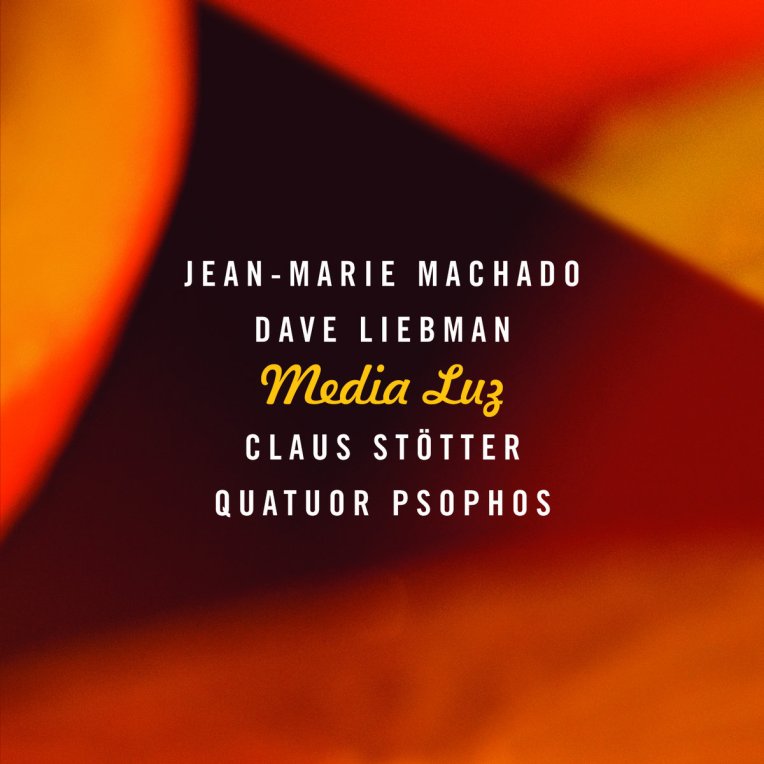
Jean-Marie Machado/Dave Liebman: Media Luz (RJAL 397020)

Cover

Jean-Marie Machado
Dave Liebman
Media Luz

Jean-Marie Machado piano
Dave Liebman saxophone
Claus Stötter flugelhorn, trumpet
Quatuor Psophos
Eric Lacrouts violin
Bleuenn le Maitre violin
Cecile Grassi viola
Guillaume Martigne cello
Recorded live December 7, 2012 at NDR, Hamburg by Michael Plötz and Gérard de Haro
Sound Design by Andreas Paff
Production in Hamburg: Norddeutscher Rundfunk 2012
Executive Producers for NDR: Axel Dürr and Stefan Gerdes
Licensed by Studio Hamburg Distribution & Marketing GmbH
Recorded live January 25, 2014 at Centre des bords de Marne, Le Perreux by Gérard de Haro
Licensed by Cantabile
Mixed in June 2014 by Gérard de Haro at Studios La Buissonne
Mastered by Nicolas Baillard
Release date: November 18, 2014

Pianist Jean-Marie Machado and saxophonist Dave Liebman have been collaborating since 2003. For their third album, recorded live by Gérard de Haro for La Buissone on December 7, 2012, the duo welcomes trumpeter Claus Stötter and the Psophos Quartet for a program of uniquely melodic dreams.

Most of the set list was composed by Machado, and among his writing the title track is an atmospheric gem of sumptuous and cinematographic tendencies. The blending of string quartet with Liebman’s soprano and Stötter’s flugelhorn is magical, while piano comments selectively, engagingly. Machado’s “A noite (fado suite)” and “Snake sonata” are in three parts. Where the former is well-pruned, the latter walks a more overgrown path through emotional territories. A solo piano passage at its center, sweeping and spiraling inward, makes it a highlight. Liebman and Stötter crosstalk amiably in both, while the Psophos Quartet doesn’t just decorate but fleshes out real implications from within. Those same strings widen the camera of “La tarde silenciosa” and in the four-part “Same place different times” lift Liebman’s soprano like a brush on high.

The saxophonist’s own writing is as flexible as his playing. The mosaic of “Breath” is moody, that of “Snow day” more dance-like. “An old friend” closes the gap with a transparent stopper. Liebman’s is a voice to be heard with every fiber, and rewards what isn’t always easy listening with assurance of life.

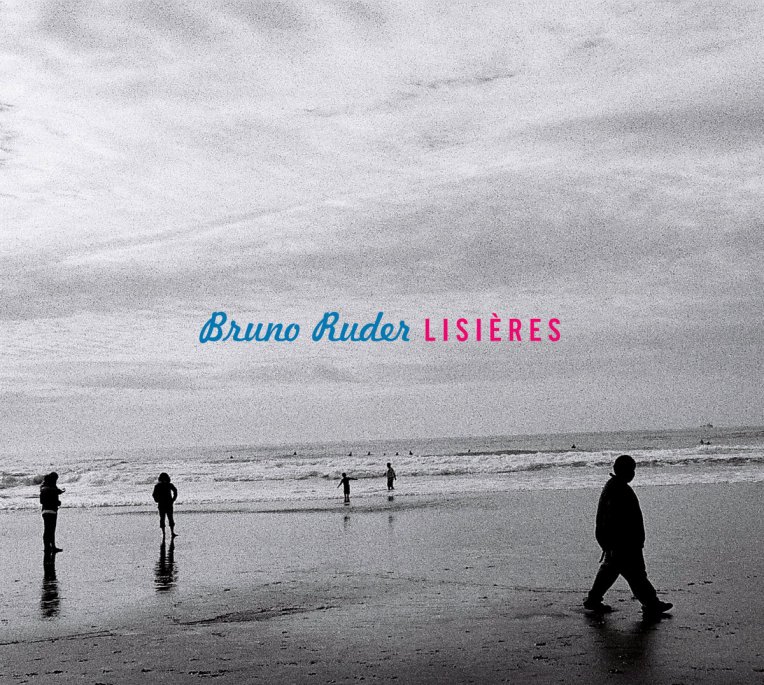
Bruno Ruder: Lisières (RJAL 397019)

Cover

Bruno Ruder
Lisières

Bruno Ruder piano
Recorded May 21, 2013 and mixed February 7, 2014 at Studios La Buissonne by Gérard de Haro
Mastered by Nicolas Baillard at Studios La Buissonne
Piano prepared and tuned by Alain Massonneau
Produced by Stephane Oskéritzian, Gérard de Haro and RJAL for La Buissonne
Release date: June 3, 2014

Lisières (Fringes) is a collection of self-styled short stories for solo piano composed and performed by Bruno Ruder. Ruder’s style lives in the deeper recesses of his instrument. He seems particularly interested in natural resonance, which engineer Gérard de Haro is more than willing to embrace with gentle persuasion. By way of “Ce qu’on appellee,” initial stirrings within are openly drawn. He lets these instincts pour themselves into themselves, like circular pitchers of musical water in another dimension. The more ideas flow into each other, the more convoluted they become. Yet Ruder makes lucid sense of them—enough to draw a comet’s tail to finish.

In “Yojimbo,” if named for the popular 1961 film by Akira Kurosawa, I can detect nothing by way of association except to say that it paints a world long gone. None of that samurai spirit is found here, except perhaps in the tangled dance of cause and effect that besets its final waves of energy. The title of “L’agglutination des pensées” (The agglutination of thoughts) is a far more accurate description of the Ruder mode. It’s a stormy sea of evocation that expands its territory with every block chord. “Des recoins” is in the same vein, albeit tenderer in its insistence on being heard. “Obligation~Évagation” is a conversation between a divided self. Plowing soil both damp and arid, it mixes both until a middle ground takes shape. At last, “Ce qu’on retient” takes all of these orthographies and compacts them into an even grander language. Phenomenal runs in the right hand almost taunt the left for its regularity and achieve a lyrical confluence as they ascend a ladder into self-awareness.

A deeply psychoanalytical listen that requires us to keep our heads on the couch for its duration, letting our ears do the talking.

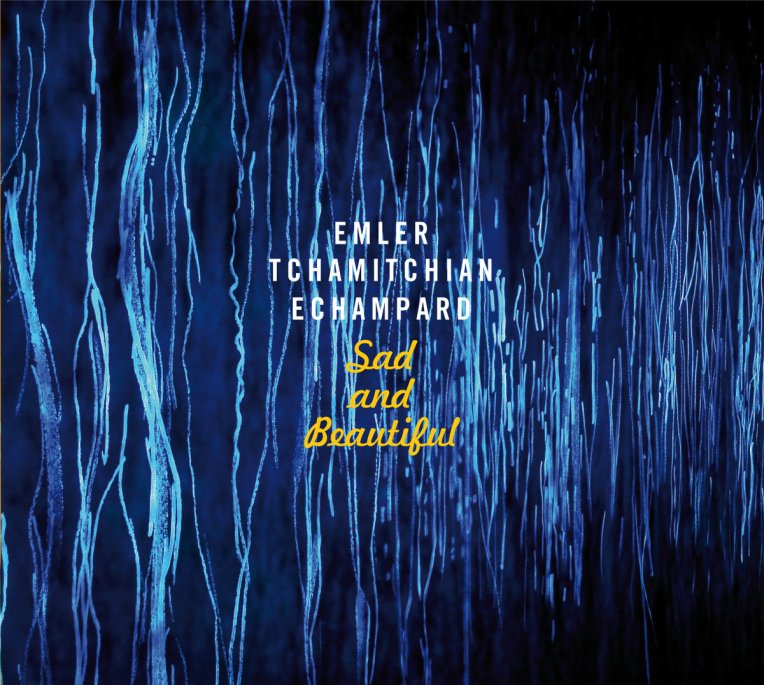
ETE Trio: Sad And Beautiful (RJAL 397018)

Cover

ETE Trio
Sad and Beautiful

Andy Emler piano
Claude Tchamitchian double bass
Eric Echampard drums
Recorded July 1/2 and mixed August 14/15, 2013 at Studios La Buissonne by Gérard de Haro, assisted by Romain Castéra
Mastered by Nicolas Baillard at Studios La Buissonne
Piano prepared and tuned by Alain Massonneau
Produced by Gérard de Haro and RJAL for La Buissonne Label
Release date: January 28, 2014

The ETE Trio—whose acronym stands for pianist Andy Emler, bassist Claude Tchamitchian, and drummer Eric Echampard—spins of its most fragrant fields on record with Sad and Beautiful. “A journey through hope” takes its first steps by gliding rather than walking, speaking through arco bass as if it were an amplifier of the soul. Cycling between ambient stretches out of time and heavy grooves steeped within it, the 11-minute opener actualizes a philosophy built on the permanent spaces between things rather than the ephemeral accomplishments linked to said things themselves.

This balance between the material and immaterial is what distinguishes ETE’s musical acts from their traditional counterparts and is reflected in a tendency to change things up from track to track. Note, for example, the brief and pliant train ride through memories on the verge of fading completely that is “Last chance,” yet which despite those grand implications sits up against “Elegances,” in which a more cellular approach to thematic development lets in the light of spontaneous interaction shine through panes of glass to a trifold interior.

A chain of topographical associations ensues. “Second chance” dips the piano in a dark green lake of bass and rippling cymbals before setting up a campfire near it in “Tee time” and planting a spray of delicate underbrush in “By the way.” Last, we are led into the melodic ellipses of “Try home,” cast into the night like a fishing line from the heart.

While each musician is fantastically talented in his own right, in the present formation I feel like any attempts at separation would do them a disservice. And so, the instinct to shorten their names to a single palindrome makes perfect sense. Such is the nature of their collective spirit.

Dine Doneff and neRED: A New Frontier with an Ancient Heart

Dine Doneff, multi-instrumentalist and composer of Macedonian extraction, is a self-taught musician with an undeniably broad spectrum of signatures at play in his creative persona. Since 2001, he has been a part of Savina Yannatou’s traveling ensemble, Primavera en Salonico, appearing (under his Greek citizenship name, Kostas Theodorou) on three ECM productions: Sumiglia, Songs Of An Other, and Songs of Thessaloniki. After being encouraged by producer Manfred Eicher to start neRED in 2017. Though still in its nascent stages, the label has put out two fascinating yet distinct sonic experiences for the world-weary listener. I recently conducted an email interview Doneff, who graciously offered his time and insights into how this all came to be. I began by asking how he came to be a part of Yannatou’s circle of phenomenal talent:

“I first met Savina purely by accident back in 2000. While visiting a Greek island for a concert, she happened to be there with the band. The bass player, due to a less fortunate type of accident, suddenly couldn’t make it for the next few concerts, so she asked if I would replace him, which I did with pleasure. One year later, I joined Primavera en Salonico permanently as percussionist.”

As for how neRED came to be, Doneff offers the following anecdote:

“Back in 2003, while touring in Germany, I had the chance to meet with Manfred Eicher. Since then, events brought us often together. He always has open ears to listen to what you do, and got to know some of my recorded projects that had never been officially released. Later on he suggested the idea of creating a label under ECM’s auspices. Such advice, not only from a friend but also a master, was not something I could ignore.”

Before getting to neRED proper, however, we cannot gloss over a beautiful little recording called Izvor. Though not originally rendered with neRED in mind, it served as something of a “test” single—a glimpse into worlds to come. Doneff explains its genesis:

“During the 90s, using a portable tape recorder, I often made short recordings with my guitar with the wish—or better, the need—to capture the mood of the day just before I went to bed. Izvor, which means ‘source’ in Macedonian, was recorded back in 1999 and is my way of representing of this sonic diary in miniature.”
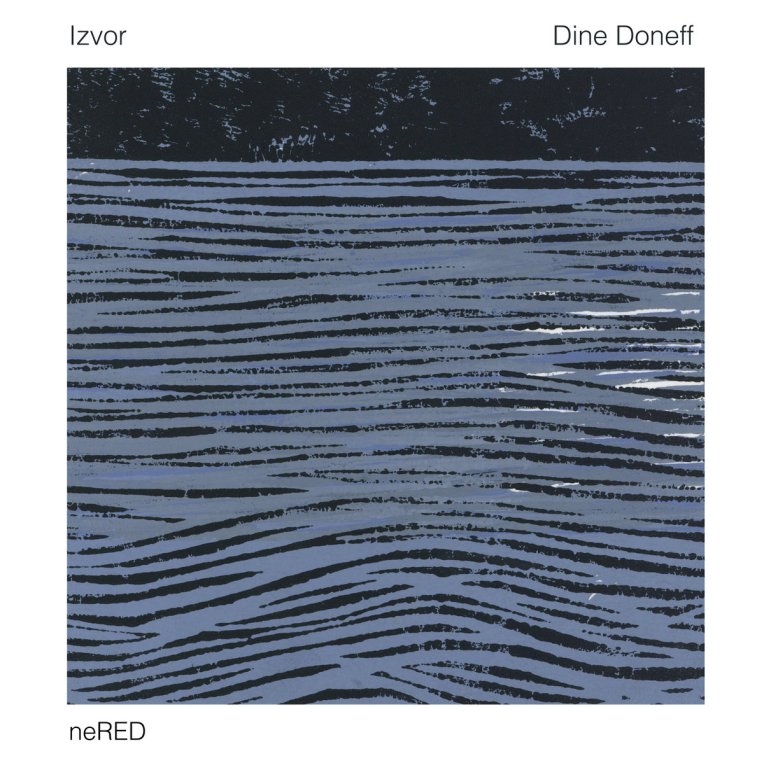
Izvor cover
Izvor

Dine Doneff classical guitar
Recorded November 1999
Release date: January 26, 2017

If labeling music as cinematic hasn’t lost its currency of description, then I must wholeheartedly apply its charge here. This is not to say that Izvor moves like actors on film, but rather that Doneff’s guitar suspends time (and disbelief) in the way a camera facilitates. As memory turns into a reverie of images, words, and sensations, we might just feel the touch of something archaeological, the contact of modern tools resuscitating forgotten relics to their former intimacy, held like an offering to the very air that allows their song to resonate.

From this brief statement (one track of two minutes and forty-five seconds in duration), it is impossible to understand the spectrum of Doneff’s style, much less his inspirations. Of the latter that have come to inform his music over the years, it’s no surprise, given that the bass is among his primary instruments, that he should point to a paragon of creative inspiration:

“I am lucky to have discovered since the late 70s the work of some great musicians. But, if I have to mention one, then I would say that the remarkable personality of Charlie Haden played a big role in my artistic and social development. Especially concerning his projects with the Liberation Music Orchestra.”

While Doneff is very much his own player, perhaps we can draw a connecting thread to Haden’s likeminded ability to evoke grand scenery with minimal gestures. Nowhere truer than in Rousilvo, his first properly cataloged neRED release.
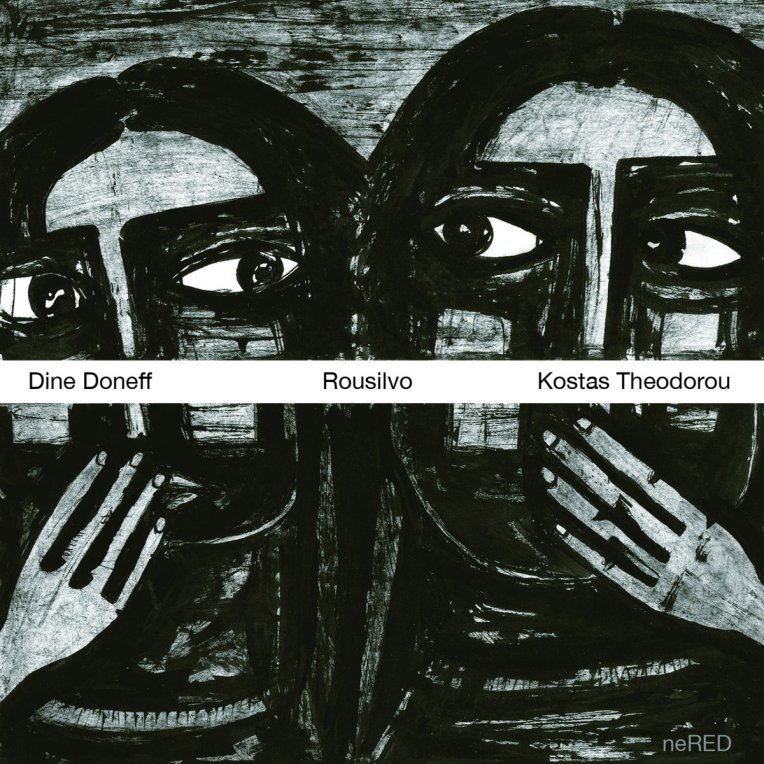
Rousilvo cover
Rousilvo

Takis Farazis piano, accordion
Kyriakos Tapakis oud, mandola
Pantelis Stoikos trumpet
Dimos Dimitriadis alto saxophone, flute
Antonis Andreou trombone
Dine Doneff double bass, guitar, tabla, vocals
Kostas Anastasiadis drums
Slava Pop’va Evdoxia Georgiou voice
Lizeta Kalimeri voice
Martha Mavroidi voice
Lada Kandarjieva soprano
Elena Ginina soprano
Elitsa Dankova mezzo
Irina Gotcheva alto
Recorded April 15-19, 2004 at Agrotikon Studio, Thessaloniki
Additional vocal recordings and editing: Jorgos Pentzikis
Engineered, remixed, and mastered by Christos Megas at Magnanimous Studio, Thessaloniki
Release date: October 27, 2017

This self-styled “Balkan-Jazz Folk Opera” pulls a creative IV from his cultural roots, drawing through that lifeline a flow of minerals, ancestry, and echoes of time. Rousilvo names the village in northwestern Greece once known as Xanthogeia, where Macedonian residents fell victim to persecution and violence at the hands of Greek’s “Hellenization” until it eventually became abandoned. To preserve this marginal community, Doneff combines recordings of the women who survived with an instrumental ensemble and septet of singers. The title of its opening movement, “Narrative,” sets not only a musical but also a conceptual tone. Voice and piano lay down a mournful theme as if standing over a broken landscape and wishing it might all go away. Conversation and birdsong mingle with clear and present melodies, so that those who never got to speak may now be heard.

Doneff further explains the genesis of what he calls his “requiem for a poetry dissolved by political decisions”:

“From a very young age I have experienced social, cultural, and political oppression as a member of the unrecognized Macedonian minority in northern Greece. Even later, as a traveling artist, I came across this issue more times that I would’ve liked. It made me angry but also sad. As I gathered enough strength to talk about it, I built up a kind of operatic structure from those emotions. The libretto includes field recordings and fragments of hidden or ‘forgotten’ songs or stories by members of that same minority.”

Appropriately enough, much of the weight of Rousilvo is carried on the shoulders of its singers. In particular, soloist Slava Pop’va Evdoxia Georgiou’s salt-of-the-earth delivery in “Penelopes of Xanthogeia” moves the heart in a scene teeming with life. Is hers a longed-for past or a hoped-for future? The question remains open, as do we to the Macedonian textures and jazz infusions of “Mirka,” wherein Martha Mavroidi’s voice, wrapped in a cloud of tabla, oud, and drums, cries without border. There is also the unaccompanied singing of Lizeta Kalimeri in “Natsko,” which turns the dawn into a score sheet to be scrawled across by the pen of hardship.

The album is also a vibrant showcase for musicianship. Like theatrical scene changes, each instrumental track is a cleansing of what came before. Highlights include “Apatris” (featuring a gorgeous saxophone solo from Dimos Dimitriadis) and “Song of the unquietness” (a mournful duet between Doneff’s guitar and the trombone of Antonis Andreou). Whether swinging in cathartic improvisation or unraveling a lullaby for the dead, these pieces straddle the line between what cannot be denied and what may never resolve.

Rousilvo, it bears mentioning, is the second part of a trilogy, of which the first part is Nostos (released in 1999 on the independent LYRA label). Doneff speaks of the trilogy itself as “a rite of passage; the long process of the transformation from what we are to what we are coming to be through time.”

We might easily wrap that description around his second neRED release, IN/OUT.
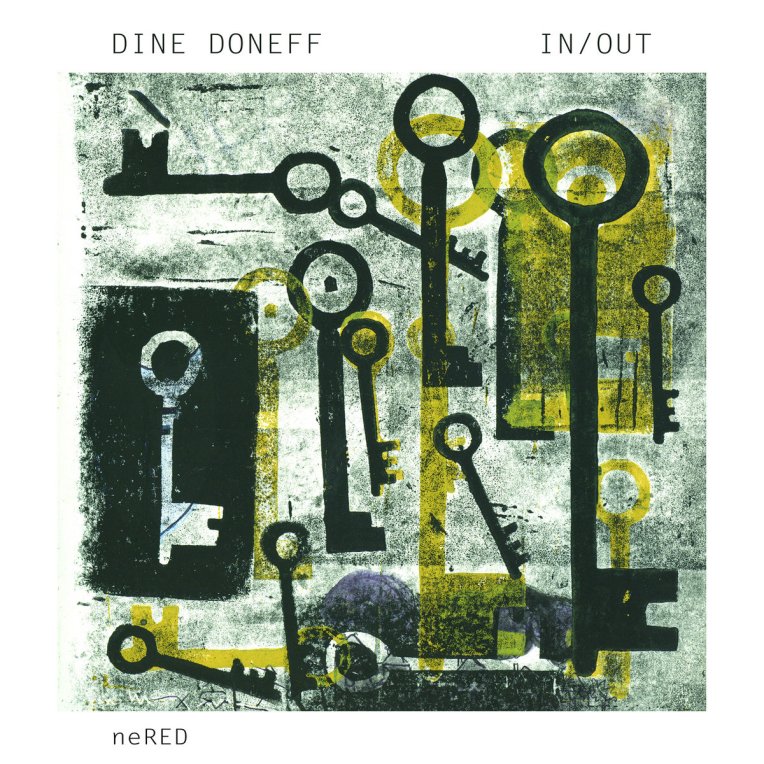
IN:OUT cover
IN/OUT

Dine Doneff piano, Fender bass, electric guitar, drums, waterphone, bendir, bells, flutes, spinetto, keyboards, mouth harmonica, field recordings
Vocal quartet in “Disquiet”:
Lada Kandarjieva soprano
Elena Ginina soprano
Elitsa Dankova mezzo
Irina Gotcheva alto
Composed & performed live by Dine Doneff on July 1, 2016, Domagk Ateliers, Munich as a part of the vernissage for In Search of a Common Ground #2, a group exhibition by eleven contemporary Macedonian artists
Recorded and mixed by Pande Noushin
Mastered by Tome Rapovina
Release date: February 9, 2019

Recorded live on July 1, 2016 as part of the vernissage for In Search of a Common Ground #2, a contemporary Macedonian art exhibition,  this “Soundscape Theater for Double Bass and Tapes” is indeed a search for commonality between the material and immaterial worlds. In light of his maturation as an artist over the decades, it finds him at a point of being able to his fear of going deeper into intimate territories of body and mind.

And what does the album’s title signify to him?

“Mainly balance. Belonging to everything and at the same time to nothing. Both sides, or spaces, are equal in quantity of action and possibilities. In our life experience we are more often in the position of the slash standing between IN and OUT, and it is in our decision to use this ‘symbol of punctuation’ to move from one side to another, however skillfully.”

Over the course of seven parts, the plucked strings of a spinet mingle with bass, the sounds of toys at an open market in Istanbul, an electric guitar, crows in Timisoara, a harmonica, a PA announcement at Zurich Airport, and more. The sensation is that of moving via portals not only through space but also through time. The added magic of field recordings allows us to experience all of this at once. There is a sense that something deeply microscopic is happening here, as if flesh itself were being folded until its inner sanctum is revealed like a diorama at the most genetic level. This method of exploration places the self on a path into the self: the meeting of salt water and fresh water.

Given such subtitles as “Division within,” “Unbelonging,” and “Exile,” it’s difficult to read this as anything but a deeply personal album:

“Indeed. It is a collection of recordings, both composed and out in the field, captured during the past decade while touring in Europe, blended in a storyline, also as a sonic diary. Then, using the recording as theater music, I performed a live monologue on my double bass, interacting with the prerecorded material. A narratively staged debate with soloist as actor/improviser in a one-act play.”

In the context of such attunement, I find myself wondering about a core concept behind it all. Hence, the very name of his label:

“Nered is a southern Slavic word and, in my mother tongue of Macedonian, describes something that has no special order. There is a village in West Macedonia, close to where I come from, that’s called Nered for being chaotic/anarchistic but still beautiful. I felt that neRED applies well to multidimensional artistic projects which have no particular sequence, pattern, or method in relation to one another.”

All of which seeks to inform his art as a space of communication and life experience. Without either, it would just be a flame without a wick. Let his candle burn for decades more.


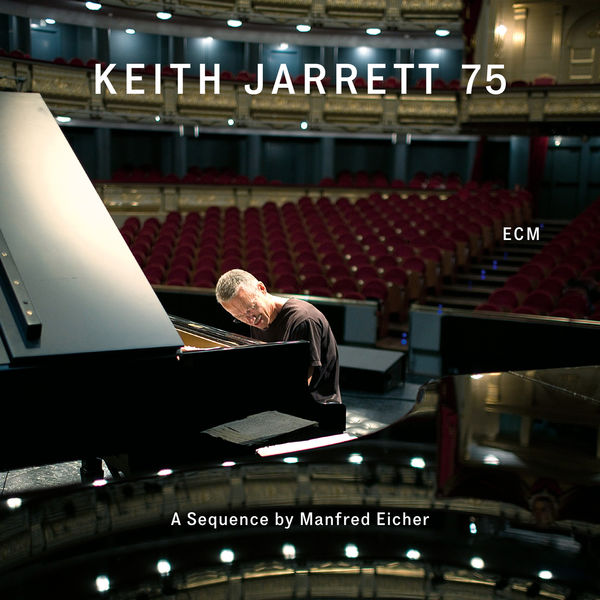
Keith Jarrett @ 75

In celebration of Keith Jarrett’s 75th birthday, ECM has gifted listeners with two very special albums. The first is a teaser encore from the upcoming Live from Budapest album, slated for a Fall 2020 release. In anticipation of what is sure to be a worthy live document, we encounter the beautiful suspensions of “Answer Me,” in which Jarrett molds the piano in loving clay.

front-answer-me-keith-jarrett

Despite being recorded not too long ago (July 3, 2016 to be precise), it sings to us from a distance, held up to the ear like a conch shell in which the past of another has been sheltered from the ravages of time. And yet, the more we listen back on these memories, the more they become folded into our own, as if they had been living inside us all along. This is what Jarrett at his best can achieve: whether spontaneously improvising or digging deep into the tried and true, he makes it all feel so inevitable. The music has always been there, waiting to be drawn out by the right pair of hands. And whose hands could be more effective than his to articulate a melody in the language of sunlight through breeze-shaken leaves.

The second, and more substantial, present is Keith Jarrett 75, a sequence of five tracks curated by producer Manfred Eicher himself. Opening with the churned butter of “Never Let Me Go” (Standards, Vol. 2), it flows in stride with the passage of time. Perennial partners Gary Peacock and Jack DeJohnette are more than a rhythm section, but organs of the same body returning home after a long sojourn. In Jarrett’s vocalizations we hear the ache of it all, pooling like rain in cupped flowers, flung into the air by Peacock’s organic solo. And speaking of solo, we transition into that very territory with Part VII of Creation. In this rolling wave of spirit, sentient waters and thoughtless continents meet to share their silences.

ME Sequence

Another jump in time and mood warps us to Jarrett’s European quartet with saxophonist Jan Garbarek, bassist Palle Danielsson, and drummer Jon Christensen. Together, they unpack the largest cargo from the oceanic vessel that is “Personal Mountains.” A prototypical example of forward motion in music, it sustains inspiration from start to finish, Garbarek gilding the edges of Jarrett’s eyes, themselves closed in surrender. A shuffle of the deck brings us to the landmark duo record Jasmine with bassist Charlie Haden for a gently swinging take on “No Moon At All.” As sweet as it is sincere, it touches the soul with inspiration. Last but not least is “Flying Pt. 1” from Changes. A glorious soar through skies where wingtips catch clouds and leave melodic trails in their wake, it opens Jarrett’s inimitable trio like a book of truisms and waits for us to catch up with the confirmation of experience. The more exciting the music gets, the more we understand the power of harmony at altitudes beyond the audible.

Carla Bley/Paul Haines: Escalator Over The Hill (JCOA 2)

EOTH Cover

Carla Bley
Paul Haines
Escalator Over The Hill

Jack Bruce voice
Linda Ronstadt voice
Viva voice
Jeanne Lee voice
Paul Jones voice
Carla Bley voice
Don Preston voice
Sheila Jordan voice
The Jazz Composer’s Orchestra
Gato Barbieri, Dewey Redman saxophones
Don Cherry, Michael Mantler, Enrico Rava trumpets
Roswell Rudd trombone
Perry Robinson clarinet
John McLaughlin guitar
Leroy Jenkins violin
Charlie Haden double bass
Paul Motian drums
Recorded November 1968 at RCA Recording Studios, New York (engineer: Paul Goodman), November 1970-June 1971 at RCA Recording Studios, New York (engineers: Ray Hill, Jim Crotty, Pat Martin, Dick Baxter, Gus Mossler, and Tom Brown), March 1971 at Empirical Sound, at the Cinematheque, New York (courtesy Jonas Mekas and Richard Foreman; engineer: Dave Jones), and June 1971 at Butterfly Mobile Sound Van, at the Public Theatre, New York (courtesy Joseph Papp and Bernard Gersten; engineers: Karl Sjodahl, Bob Fries, Nelson Weber, and Wes Wickemeyer)
Editing: Carla Bley
Mixing: Carla Bley, Michael Mantler, Karl Sjodahl, and Ray Hall
Production and coordination: Michael Mantler

Escalator Over The Hill is widely considered to be the magnum opus of Carla Bley. And while the pianist, composer, and arranger went on to have a flourishing career in all of those capacities, there’s something to be said for EOTH’s cult status in the annals of jazz (and her own) history. Referred to by Bley, and the increasingly massive crew required to produce it, as an “opera” for shorthand, it is officially billed as a “chronotransduction.” The term comes from the mind of Sheridan (“Sherry”) Speeth, a scientist befriended by EOTH’s librettist, Paul Haines. Given the slipstream nature of what any new listener poised over the PLAY button is ill-prepared to expect, Speeth’s neologism bears the brunt of describing these goings on. More on that below.

Haines, we know from Bley’s own account, sent her a poem in early 1967. At the time, she was working on a piece called “Detective Writer Daughter,” soon to become the seed for the EOTH forest. Shortly thereafter, Haines moved to India, and from his new home sent more texts over the next three years. Even before the piece took shape as such in Bley’s mind, she knew exactly who to train her creative telescope on—namely, the Jazz Composer’s Orchestra and its satellite talents—in search of worthy interpreters. Their orbits were as complementary as the sonic solar system that defined them was organic. What she lacked, however, was an asteroid belt of singers. Notes Bley, as quoted in The Penguin Jazz Guide: “I used every musician I knew for the cast. I even used some people I didn’t know; all they had to do was ask to be in it and I said: “Of course you can.’ At one point I needed some extra chorus voices quickly so I went out on the street in front of the studio and enlisted passers-by.” Her then-husband Michael Mantler recruited Jack Bruce, but it fell upon Bley to seek out the rest. Her search led her early on to actress Viva (one of Andy Warhol’s “superstars”) and later to Steve Ferguson (NRBQ), Paul Jones (Manfred Mann), and Don Preston (Mothers of Invention). Even as forces were gathering, finances were dwindling, as were her relationships with the record company originally slated to back the project, when Sherry and Sue Speeth donated a whopping $15,000 to unclog the drain. This act of generosity (combined with other funding sources) allowed them to move forward with total independence, and even access to RCA Recording Studios. Due to the sizable cast and conflicting schedules, it was nearly impossible to get everyone in the same room, meaning that some had to be recorded separately and fused on the laboratory table of the mixing board. Seventy-five reels of tape later, and after much barrel scraping and knuckle busting (as Bley furiously wrote out every part by hand), she still did not have her Ginger, a politically central figure among EOTH’s dramatis personae. Paul Motian floated the idea of Linda Ronstadt, “who said she had never been confronted with music so difficult,” Bley recalls. Once Ronstadt sent in her tapes by mail to New York from Los Angeles, the final piece of the vocal puzzle fell into place.

With that, let us return to the chronotransduction.

Chrono: Latin root from the Greek khronos, meaning “time.” At once vague and specific. To be sure, everything we encounter along this eclectic train ride—as big band impulses fight for bench space with Kurt Weil dinner theater, Indian classical forms, and progressive rock—has much to do with distortions and questionings of time. Even before a single voice throws a pitch, the windup of Hotel Overture delineates a space where nature and technology engage in melodic congress. The overture itself has a time marking—13 minutes and 11 seconds, to be precise—but the strokes of those numerals feel more like the wrought-iron cars of a prison than the window thrown open by the hands of their inscriber. From this parthenogenetic wellspring echo horns of regression. Just as the gloom is about to turn into doom, Roger Dawson’s conga and Paul Motian’s drums flip on a stage light so that the clarinet of Perry Robinson can rip into the foreground of this carnivalesque nightmare in stark relief. Gato Barbieri’s tenor saxophone likewise unleashes a guttural catharsis for the ages, one that must be heard with every fiber of its being. The preparation of all this is such that when a droning choir of voices overlays our brokenness in This Is Here… we feel it like a swarm of fireflies rent for all humanity.

Cecil Clark’s Old Hotel deepens our impression of time through the matter-of-fact worldview of the Doctor (Don Preston), who has the honor of introducing the album’s title, a metaphor of complicity in the violence of capitalist production. A four-year-old Karen Mantler (daughter of Carla and Michael) utter the comment du jour: “Riding uneasily.” Thus do the men of EOTH’s world proceed to travel, their pulses determining the flow of life until they cease to beat. Barbieri pushes through the pomp and circumstance, calling out to a soul that doesn’t wish to be found. Bley bids everyone to stay awake, as if we might fall prey to a global concussion. The loudspeaker cuts her off, as naysayers often do. But she presses on with dialogic fortitude. Sheila Jordan, singing as the “Used Woman,” further understands the folly of fleshly burdens. In the wake of these disturbances, we are treated to a brief performance by the hotel lobby band in “Song To Anything That Moves.”

The march of the present proceeds to take us Off Premises, as Jack Bruce shouts his corporate angst across the airwaves of his traveling band (John McLaughlin on electric guitar, Bley on organ, Bruce on electric bass, and Motian on drums). Ronstadt lends her crystalline voice to “Why,” which feels like a country tune staged as a farce of climactic achievement. As Ginger, she battles the vagaries of a world that no longer regards itself in the mirror. Beyond the door of Cecil Clark’s, Bruce guides us to the piece that started it all, “Detective Writer Daughter.” This thinly veiled analysis of a broken citizenry looking for leadership while the blood of assassination still stings their eyes sets up “Doctor Why,” in which Bruce’s banter with Ronstadt cracks faces open like diaries better left unread. After the brooding “Slow Dance (Transductory Music),” we get the “Smalltown Agonist,” in which explosions of lies and truth comingle until neither is distinguishable from the other.

Thus have we entered the realm of the transduction. The word describes the process by which energies or messages are converted from one form into another. Whether In The Meadow Or In Hotels, in which Bley sings as the laboratorial Mutant, or in “Over Her Head,” in which she mourns a fallen nationhood, each utterance becomes thought. Amid this unsettling mix of whimsy and self-protection, Charlie Haden’s bass line mocks beneath McLaughlin’s acoustic, as if to express the impossibility of change from what was known before.

In Flux opens with “Oh Say Can You Do,” a duet between Bley on calliope and Bill Leonard as Calliope Bill, sharing the inevitability of misdirection in our lives. This is followed by “Holiday In Risk,” which I can only describe as Meredith Monk doing cabaret. The obligatory nod across the pond comes in the form of “A.I.R. (All India Radio),” which launches Don Cherry’s trumpet over arid terrain, replete with dumbek (played by Souren Baronian) and Motian on glittering percussion. All is but a preview of the nearly 13-minute “Rawalpindi Blues.” McLaughlin’s electric dialogues in the flames of Bruce’s bass, while Motian beats the air into submission, transitioning into Cherry’s desert caravan. Cherry also sings as the Sand Shepherd, carrying us over into “End Of Rawalpindi,” with Jeanne Lee as Ginger II in a passionate helix of description with Bruce. Those same two ensembles blister in a fusion-esque universe that would seem to parallel John Abercrombie’s Timeless.

Because all music must come to an end, Over The Hill reads like an obituary. After the doctor’s final prescription in “End Of Animals,” we encounter the 27-minute masterpiece of “…And It’s Again.” Barring some cryptic lyrics (e.g., “The hectic silhouettes of chins”), the mood is lucid, especially in the horns (among them Michael Mantler on trumpet and Roswell Rudd on trombone), backed by Haden and Motian, before ending on a long hum, made possible by a lock groove in the original vinyl. Of that almighty drone, we get 20 minutes before the curtain closes.

Perhaps it’s the pall of pandemic and social distancing that hangs over me as I write this, but I cannot help hear EOTH as a meta-statement about suffering. Not only for the persecution of those who stand up for their beliefs, but for those who never got the chance. It’s more than a relic of its time. It’s a relic about time and its infinite transductions from concept to physical reality. And Bley has all the scars to prove it.

EOTH Back

The Jazz Composer’s Orchestra: s/t (JCOA 1)

WATT-1801-front

Jazz Composer’s Orchestra

Don Cherry cornet
Gato Barbieri tenor saxophone
Larry Coryell guitar
Roswell Rudd trombone
Pharoah Sanders tenor saxophone
Cecil Taylor piano
The Jazz Composer’s Orchestra
Michael Mantler
conductor
Recorded on 3M 8-track tape recorders in RCA Victor’s Studio B, New York City
Recording engineer: Paul Goodman
Produced by Michael Mantler

It has been 52 years since the Jazz Composer’s Orchestra dropped its weighty stone into the pond of music history. And yet, its ripples are still rocking the boats of listeners today. Count me among them. Despite having first gotten to know Michael Mantler through his intersections with ECM Records (a personal favorite being The School of Understanding), and having been given a taste of this watershed double LP on Review, I was humbled by the intensity herein. The vital link to that latter compilation is “Preview” (recorded May 8, 1968), which compresses the album’s full magnitude into 3-1/2 minutes via a gut-wrenching solo from Pharoah Sanders on tenor. Over a punctuated ensemble, he gives us much to ponder on the altar of our listening, as if it were the living amalgamation of many deaths before it (if not the dying amalgamation of many lives before it). Not out of any grand level of abstraction or concept but only through a sheer embodiment of execution does it succeed to carry a charge.

While soloists tend to dominate the foreground at any given moment throughout this project, the orchestra itself isn’t something to bat a flaccid eyelash at, either. Sheltering such greats as Steve Lacy, Randy Brecker, Carla Bley, Charlie Haden, Andrew Cyrille, Ron Carter, and Eddie Gomez, it blisters to the touch, and perhaps nowhere no more so than on “Communications #8” (recorded January 24, 1968). Hitting us where it counts with a solar flare, it lights the continents of Don Cherry’s cornet and Gato Barbieri’s tenor with killer instinct. Theirs is a power to be reckoned with. Every breath matters. “Communications #9” (recorded May 8, 1968) is an ember by contrast. But Larry Coryell ensures that the air itself is flammable, and that his guitar is the only logical path toward its combustion. Beneath it all, Bley’s piano chops away at the spine to make way for nerve impulses while droning reeds and five bassists level the earth. Coryell twists his strings until they adhere to inner turmoil. “Communications #10” (recorded May 8, 1968) features a rare introduction from Steve Swallow on upright bass, abstract yet flexible, and for that reason alone lends it archival vitality. So begins a morose and strangely unbreakable chain of inward glances. Trombonist Roswell Rudd is the extroverted soloist moving through viscous oceans before reaching a deserted island where, in dialogue with drummer Beaver Harris, he unravels the stuff of fantasy as if it were his only viable companion. The orchestra swoops in until there’s nothing left but smoke to show for their existence.

All of this leads to the massive diptych “Communications #11.” Spanning nearly 34 minutes, it’s another unrelenting communique. Pianist Cecil Taylor solos the you-know-what out of it like someone on fire in frantic in search for water. His interactions with Cyrille’s percussive details is worth the dive in and of itself. If Part 1 is the freefall, then Part 2 illustrates the landing in gruesome detail. Cyrille and Taylor continue their banter, turning starlight knives, each intent on drawing blood. The energy of their flight is sustained so steadfastly as to bring a tear to the eye, only to dry it with a punch in the cheek. This is where insanity goes for respite. Let it keep you sane.

Bley/Sheppard/Swallow: Life Goes On (ECM 2669)

2669 X

Carla Bley piano
Andy Sheppard tenor and soprano saxophones
Steve Swallow bass
Recorded May 2019, Auditorio Stelio Molo RSI, Lugano
Engineer: Stefano Amerio
Produced by Manfred Eicher
Release date: February 14, 2020

For its third ECM outing, pianist Carla Bley’s trio with saxophonist Andy Sheppard and bassist Steve Swallow mixes up an antidote for these times of uncertainty and quarantine. The title suite is the first of three comprising the program. Given that “Life Goes On” came out of a recent brush with illness, it’s fitting that Bley should begin in the dark whimsy of the blues. Her left hand plows fertile soil before leaving Sheppard and Swallow to sow their thematic crop. Years of experience and collaboration funnel into Swallow’s intimate rapport with Bley and into Sheppard’s unforced, spiritual playing. The latter, whether breathing through tenor or soprano, takes two steps forward for every retreat.

A sardonic humor assumes center stage in the three-part “Beautiful Telephones.” The title, quoting a certain leader of the free world, speaks of dire political circumstances, which, like the dial tone of a nation on hold, keeps us hopeful for something that may never come. The central movement reveals some of the deepest conversations and finds Sheppard in an especially soulful mood. The jagged finish is about as astute a commentary as one could pen on the current state of things without words.

The trio saves its most lyrical for last in “Copycat”, which holds a candle to some neglected parts of the human condition. There’s so much beauty in the opening “After You” that only the vessel of the playful title section is big enough to contain it. Setting a tongue in every cheek, it coaxes us with a promise of better times.

Holding it all together is an almost photorealistic approach to life. Like the score pages above Bley’s face on the cover, time feels suspended at just the right moment to reveal a smile of hope beneath it all.

(This review originally appeared in the May 2020 issue of The New York City Jazz Record, a full PDF of which is available here.)

Tim Berne/Nasheet Waits: The Coandă Effect

The Coandă Effect

In this 2019 live set from The Sultan Room in Brooklyn, alto saxophonist Tim Berne and drummer Nasheet Waits connect a 49-minute Möbius strip of improvisational wonder. Composed of two free outpours, “Tensile” and “5see,” the performance is a barrage of ideas, which, despite their thickness of description, leave plenty of room for our imagination as listeners to run wild in tandem. With an immense freedom of spirit and catharsis of expression, the duo breaks down one wall after another until all expectations end up in a free box at the side of our mental road. Without a map, we are left to roam the subtler implications of their interactive cause. The ending of each statement becomes the beginning of another, leaving us with a string of words barred access to orthography. The ebb and flow between clarity and obscurity is as cohesive as the connection between bodily organs.

Berne plays with intense lucidity of communication. He tells stories not for the sake of a reaction but in the interest of filling in blanks the rest of us may be afraid to touch in the Mad Libs of life. His incisiveness fires arrows of indisputable meaning into the air. Waits likewise pulls out the rug from under us not out of a desire to break our equilibrium but to reveal an even more stable surface beneath it. Like Peter Pan, he cuts away his shadow in search of a land without rules, only to realize that connections of a higher order can never be broken. Such is the depth of their rapport as each defers to the other until the geyser of creativity grows too hot to contain. And so while we might end up with more questions than answers, we are all the better for having asked them.

(This review originally appeared in the May 2020 issue of The New York City Jazz Record, a full PDF of which is available here.)