Herbert Joos: The Philosophy of the Fluegelhorn (JAPO 60004)

The Philosophy Of The Fluegelhorn

Herbert Joos
The Philosophy of the Fluegelhorn

Herbert Joos fluegelhorn, bass, bass recorder, bamboo flute, mellophone, trumpet, alto horn, vibes
Recorded July 1973 at Tonstudio Bauer, Ludwigsburg
Engineer Carlos Albrecht
Produced by Herbert Joos

The Philosophy of the Fluegelhorn is Herbert Joos’s first of two albums for ECM’s sister label JAPO, the second being Daybreak. Where the latter was a lyrical, if longwinded, excursion, the former is something of a meta-statement for the German renaissance man—not only because he plays a bevy of overdubbed instruments, but also because its freer detailing gives pause over the sheer depth of realization.

The title track draws us into the outdoors, where field-recorded birds—and, among them, Joos’s horn—populate the trees with temporal awareness. Sibilant breath and popping bamboo flutes share the entanglement: the rhizomatic spread of Joos’s becoming-animal. Following this undulating prelude, “The Warm Body Of My True Love” opens the stage, a halved and hollowed whole. The nature of this soliloquy must be sought out in stirrings of life, excitations of molecules, and less definable physical properties. The horns are trembling, universal. “Skarabäus II” is of similarly finite constitution, navigating passage into darker dreams and adding to those horns a string’s uncalled-for response to the question of existence. Braided offshoots of trumpet fly around one another, each carrying its own flame of obsession. Next is the smooth and sultry “Rainbow.” Tinged by the alcoholic sunset of vibes, it is a hangover not yet shaken for want of the altered perspective. The squealing litter of horns that is “The Joker” segues into “An Evening With The Vampire.” Bathed in the sounds of nine arco basses, it enacts a morose ending to an otherwise luminescent session. Its sul ponticello screams recall George Crumb’s Black Angels and spin the echo-augmented horn like a chromatic Ferris wheel until the breath stops.

If you’ve ever been curious about Joos but didn’t know where to start, then by reading this you’ve already put your hand on the knob. Just turn it.

George Gruntz: Percussion Profiles (JAPO 60025)

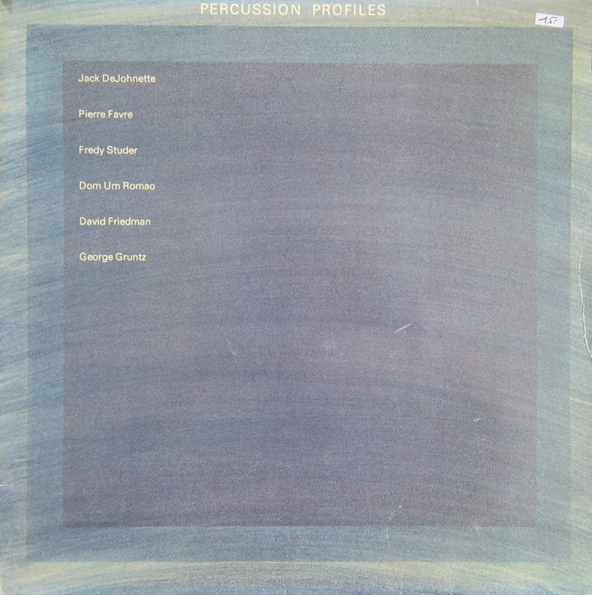
Percussion Profiles Front

George Gruntz
Percussion Profiles

Jack DeJohnette drums, cymbals, gongs
Pierre Favre drums, cymbals, gongs
Fredy Studer drums, cymbals, gongs
Dom Um Romão percussion, gongs
David Friedman flat gongplay, vibes, marimba, crotales
George Gruntz gongs, keyboards, synthesizer, crotales
Recorded September 20, 1977 at Wally Heider Studios, Los Angeles
Engineer: Biff Dawes
Mixing: Georg Scheuermann and Manfred Eicher
Producer: Robert Paiste

Late Swiss composer, multi-instrumentalist, and artistic director George Gruntz (1932-2013) left behind a long and fruitful trail, one that intersected with ECM twice: once for the label proper as Theatre and before that for JAPO in the form of Percussion Profiles. The eminently influential Gruntz assembles here a veritable Who’s Who of the rhythmic circuit at the time of its recording (1977): namely, Jack DeJohnette, Pierre Favre, Fredy Studer, Dom Um Romão, David Friedman, and Gruntz in the architect’s chair on synths and keyboards. The project speaks less to Gruntz’s big band experiments than it does to his classical roots. Dedicated to Paiste brothers Robert (who also produces) and Toomas, the piece is a bona fide percussion concerto that approaches its performers as equal elements in a larger chemistry.

The piece is divided into six Movements, each illuminating a facet of the whole. Movement 1 introduces the pleasant blending of registers—from twinkles to full-throated calls—that defines the album’s broad trajectory. Like the sun on a cloudy day, its light shines variedly: sometimes in floods, sometimes in winks and flashes, but always with a clear conscience. There is a sensitivity of expression here that tells the stories of chamber music in the language of the Serengeti. Movements 2 through 4 bring out a veritable bouquet of fragrances: briny ocean (laced with intimations of birdsong and splashes of electronic marginalia), undercurrents of metal and oil, and resonant drones share a path toward the masterful “Movement 5.” This last opens in a vocal flower, which cups in its petals a sparkling array of notions and potions. The histrionic ways of this piece make it a beguiling standout, akin to Marion Brown’s Afternoon Of A Georgia Faun. Here is where the visuality of his medium is most apparent. If this record is a house, this movement enacts a thorough cleaning of its basement. Rusted tools and unused others share conversations of things past. Stuck between the water-damaged photographs and listless rodents are fortuitous becomings, blips and dots and dashes, sputtering pipes and creaking infrastructure. These are the feelings within, the memories of which “Movement 6” is a snare-inflected shadow, a spacy ride through keyboard textures and xylophoned exeunt.

Those who admire the work of Edgard Varèse will find much to sink their teeth into in Percussion Profiles, which begs repeated, unaccompanied listening, if only for its level of detail. A memorable rung on the JAPO ladder, and worth the climb to get there.

Percussion Profiles Back

Keith Jarrett Trio: Always Let Me Go (ECM 1800/01)

Always Let Me Go

Keith Jarrett Trio
Always Let Me Go

Keith Jarrett piano
Gary Peacock double-bass
Jack DeJohnette drums
Recorded April 2001 at Orchard Hall and Bunka Kaikan, Tokyo
Recording Engineer: Yoshihiro Suzuki
Produced by Manfred Eicher and Keith Jarrett

Keith Jarrett is infinity with two hands. Few have ever molded the keyboard into such prosthesis of expression. Yet while he and his nonpareil cohorts—bassist Gary Peacock and drummer Jack DeJohnette—have repeatedly proven affinity for expanding, sometimes breaking down, the borders of many a jazz standard, relatively miniscule in the trio’s archive is its entirely unscripted output. And while we have gotten tastes of that archive in such albums as Inside Out and Changeless, this double-disc release is formidable for being, from start to finish, purely in the moment. One of the beauties of the album, recorded live in Tokyo over two nights, is that the longer pieces (upwards of 35 minutes) are actually the most concentrated, while the briefer ones (the shortest being under four minutes) are spacious and flossy.

At 32 minutes, “Hearts in Space” is a vivid example of the former. Jarrett opens the pathway with some galactic patterning indeed, which his rhythmatists then re-craft into a drum-infused satellite, its circuits frantic yet pure. The bassist is, in fact, the fulcrum of this opener, although Jarrett and DeJohnette do more than simply lob quasars of activity over him. Together these three strands form a braid stronger than the sum of their parts. Through their art, the surrounding air becomes enigmatically complete, so that even as the mood brightens onto a smoother avenue, where Jarrett has crushed the gravel so finely that the shocks of presumption no longer need bounce, one can still feel the storm in the calm. With Peacock’s intimate scaffolding behind him, Jarrett perseveres through some swing into a spontaneous standard, leaving a tailwind to inhale its absence.

Jarrett exhales “The River” with rearview mirror tilted anew. His glassine block chords and trailing chromatics weave a reverie so holy, tender, and mild that it sings without words. Following naturally from this is “Tributaries,” which paints with DeJohnette’s cymbal droplets, Peacock’s broad ripples, and Jarrett’s fairy-steps an image of mythical cast. The musicians’ trembling glitters like gold at the bottom of the Rhine, describing it not as temptation or curse, but out of a love of ignorance, of travel and movement. DeJohnette’s toms ease us onto the spiritual angles of this scene in arching ritual, tightening even as they loosen in shimmering afterglow. The drummer leads further in “Paradox,” pouring copious amounts of bourbon onto Jarrett’s jagged rocks while Peacock savors every sip with mmms of approval. An inherent free spirit works its way through the fissures here especially, manifesting as audible smiles.

Another pianistic reverie rises and falls throughout “Waves” like the chest of personified time. Peacock creeps into frame, his bass neck a periscope in search of land. This it finds, lured by the sun-glitter of cymbals. Once ashore, the trio hits the sand running, gathering provisions and making shelter in the blink of an eye. The end effect, although illusory, bleeds in tectonic shifts and opens dynamic memories across genres and histories. This summary approach takes deepest root in DeJohnette’s explosive wellsprings and rat-a-tatted closing statements and brightens his torch in the consonant admixture of children’s riddles and adult solutions that is “Facing East.” Its island hopping ways spill over into “Tsunami,” which like its eponym begins with imperceptible bubbles and curling undercurrents. By the time one realizes its proportions, its power cannot be avoided. So it crashes, leaving stillness and piles of grief. In the aftermath is “Relay,” a buoyant circumscription of energy that, by virtue of its dotted boundaries, leaves the trio free to roam inwardly to heart’s content where the external world will not allow.

Always Let Me Go may not be to everyone’s liking, but it was undoubtedly gifted with everyone in mind. In it are the dreams of a gentle giant, together a fraction of some unquantifiable composition. Although the giant may stir, the spell is never broken. It waits for that window of slumber to open and welcome us to the fold of its light.


John Abercrombie: Cat ‘n’ Mouse (ECM 1770)

Cat n Mouse

John Abercrombie
Cat ‘n’ Mouse

John Abercrombie guitar
Mark Feldman violin
Joey Baron drums
Marc Johnson double-bass
Recorded December 2000 at Avatar Studios, New York
Engineer: James Farber
Produced by Manfred Eicher

Cat ‘n’ Mouse introduces a streamlined quartet from the ever-extraordinary John Abercrombie. The guitarist is again joined by violinist Mark Feldman, whose peerless fluidity worked wonders on Open Land. In fact, the Abercrombie-Feldman nexus was what set the current project in motion, manifesting that former album’s title with even greater intuition. Flanked by longtime ally Marc Johnson on bass and drummer Joey Baron, the stage is set for a smooth ride through Abercrombie’s rich compositions and freer realization.

Baron’s brushes wax slickly in the waltzing “A Nice Idea.” A blush of cordial introductions reveals the shifting combinations that color the album as a whole. Abercrombie matches Johnson so well that the two seem like brothers from a different mother, while Feldman brings most light to this play of shadows, floating above Johnson’s protracted bounces. Not all is lilt and whisper, however, for “Convolution” speaks to the session’s driving spirit. Using small motifs as stepping-stones, the quartet deconstructs the many paths ahead. Lapses of unity quickly disperse and shed their skins in favor of rhizomatic denouements. Abercrombie ignites the night air, while Feldman rocks the unison motives with panache. “String Thing” is another emblematic tune, bearing traces of producer Manfred Eicher’s suggestions to play without vibrato—that is, in a more “baroque” mode. The end effect is magical. Feldman and Johnson breathe in alluring simpatico, while Abercrombie’s steel-stringed acoustic brings a warm underglow to the ice. “Soundtrack” evokes moving words rather than moving pictures. Johnson’s pulsing solo and Feldman’s emotional edge say it all: life is romance. “On The Loose” is a diptych, annexing blues with a classic quick draw. The rhythm section here lights a bonfire, Feldman more than up for the swing. Noteworthy is Abercrombie’s pianistic roll in the tune. “Stop and Go” casts a Jerry Hahn vibe into the country and draws influence also from Feldman’s own six-year tenure in Nashville. Its jocular grammar evokes Bill Frisell, even if Abercrombie’s inflections speak their own language. Feldman is all over this one like blue on sky, opening to an explosive monologue at the center and sharing crackling follow-ups with Baron. A real knockout.

Cat ‘n’ Mouse includes two entirely improvised pieces. “Third Stream Samba” harks to the Third Stream music of Gunther Schuller and, despite its title, is as far from Brazil as the sun. Its underlying rhythms are nonetheless engaging, spinning a world of diffusions from razor-thin bowing. Feldman is in his element in these open settings, dancing as much as crawling through the music’s evolving architecture. Neither is Baron afraid to whip up the dust here and there, as in “Show Of Hands.” The album’s closer takes its title from the drummer, who abandons his sticks in the final stretch and goes skin to skin. From the violin’s higher register it stretches a thin atmosphere, sounding like an ancient automaton creaking back to life. As the horizon whips its tail back toward the observer, Abercrombie flicks his lighter into the combustible air until all available oxygen spends itself.

<< Misha Alperin: Night (ECM 1769)
>> Alexei Lubimov: Der Bote – Elegies for Piano (
ECM 1771 NS)

Keith Jarrett Trio: Inside Out (ECM 1780)

Inisde Out

Keith Jarrett Trio
Inside Out

Keith Jarrett piano
Gary Peacock double-bass
Jack DeJohnette drums
Recorded July 26 and 28, 2000 at Royal Festival Hall, London
Engineer: Martin Pearson
Produced by Manfred Eicher

Of his approach to this 2001 album, recorded live the year before in London, pianist Keith Jarrett says, “Don’t ask. Don’t think. Don’t anticipate. Just participate.” Where for so long he and his partners Gary Peacock and Jack DeJohnette had served up piping hot new takes on old recipes, here they decided to do away with all that and, with the exception of their version of the evergreen “When I Fall In Love” that concludes, let the music create itself. What in others’ hands would have been a risky venture turns into a balanced, intuitive record from these most capable sound-smiths.

Jarrett, Peacock, and DeJohnette are undoubtedly masters of their craft, but each album has tended to highlight the skills of one over the others. In this case, DeJohnette is the trio’s North Star. He breaks in the stage like a good pair of shoes, making oil from grit and smoothing the way for Jarrett’s spontaneous fountains at every turn. With a freshness that recalls his Special Edition days, he emboldens the tessellated “From The Body” in such a way that Jarrett’s freestyle analyses can shed fullest sunlight on the unfolding story. Of that story, we get floods of exposition in a sandwich of registers. Peacock muscles his way through with a twangy abandon that characterizes so much of his playing from the period, leaving at the bottom of this crucible a pianism so angelic that it pulls itself skyward until it reaches the beginning of itself.

DeJohnette unpacks further brilliance in the equally jagged title track, which along with the first starts big and works down to the finer core before rebuilding from that core something new and glorious. His powerful brushwork and meditative swing treats every strand as if it were a means to an end and leaves Jarrett to explore their finer implications in a bluesy afterglow. The latter’s right hand has a mind of its own as it skips its way across the keyboard. “341 Free Fade” opens with tantalizing string games from Peacock, bringing back the trio’s tried and true formula of building molecules from atoms. DeJohnette delights yet again, his hi-hat carrying a heavy load into outer space as he tinkers gorgeously around the halo of its kit. And after leading the way through the foot-stomping ritual that is “Riot,” he opens the pathway to genius with his cymbals in “When I Fall In Love.” By means of barest whisper, he stargazes, trusting life’s stresses to Jarrett’s hands and setting them to fly like pieces of paper above a campfire—glowing as they rise, turning into patches of night, indistinguishable from the rest.

Inside Out is unafraid to live up to its title. Although on the surface it seems more abstract than might a typical standards outing, you may just find yourself lulled by its inherent, not to mention accessible, profundity. Were the album a genetic experiment, each track would be a kink in the DNA helix that makes its bearer unique.

<< Heiner Goebbels: Eislermaterial (ECM 1779 NS)
>> Gideon Lewensohn: Odradek (
ECM 1781 NS)

Misha Alperin: Night (ECM 1769)

Night

Misha Alperin
Night

Anja Lechner cello
Hans-Kristian Kjos Sørensen percussion, marimba, voice
Misha Alperin piano, claviola
Recorded April 4, 1998 at Vossa Jazz Festival, Norway
Engineer: Jan Erik Kongshaug
Produced by Manfred Eicher

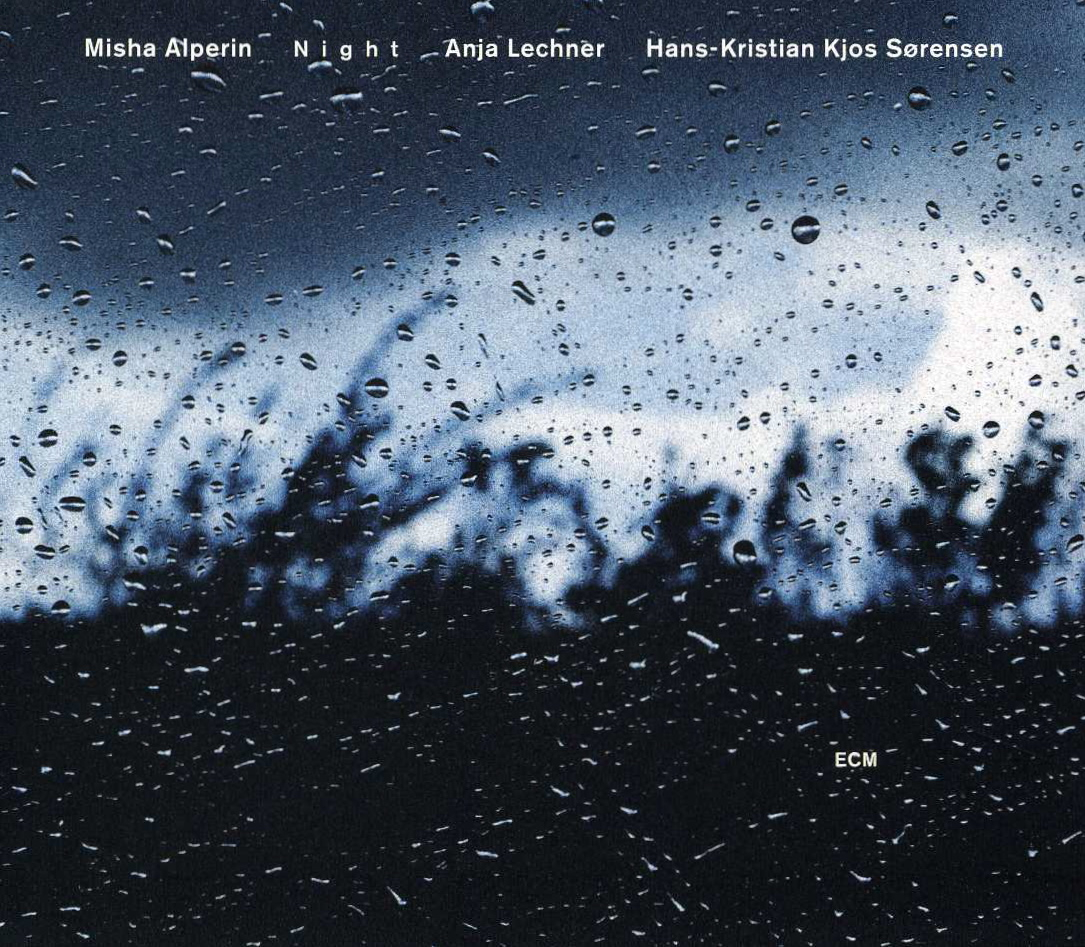
Atmospherically speaking, Misha Alperin has created some of ECM’s most haunting discs. In the wake of one such disc, At Home, the Ukrainian pianist-composer surprises with yet another unexpected turn of events. The event in question is the commissioned performance at the 1998 VossaJazz Festival in Norway documented here. The end result is a new beginning, a flowering of innovation and sensory breadth.

With German cellist Anja Lechner and Norwegian percussionist Hans-Kristian Kjos Sørensen in tow, Alperin’s keys open the curtain with “Tuesday,” and in that Everest shape reveal the touch of two bows: one at Lechner’s strings, the other humming along the edge of Sørensen’s cymbals. As the trio settles into a spiral of sleep, regularities begin to emerge. Thus welcomed into the performance, one can note the figural language that is Alperin’s forte. His body arches, conforms to what is being played. His physicality comes out especially in “Tango,” which fronts his sweet descriptions before delicate snare rolls and legato support from Lechner, the latter switching to pizzicato to buoy every footnote. After a duet between Lechner and Alperin (the tender “Adagio,” which absorbs breath in lieu of exhale), the dotted marimba of “Second Game” counters with some delightful surprises. From the persuasive beauty of its Steve Reichean introduction to jocular turns and thematic quick-changes that recall The Carnival of the Animals of Saint-Saëns, it encompasses a thousand positive memories. These render the quiet spirit of “Dark Drops” all the subtler. The title track is evocation par excellence, weaving cricketing percussion through a loom of moonlight. Timpani and strained vocals make for some unusual effects in “Heavy Hour,” a ritual thesis of howling abandon. The suite concludes with “Far, Far…,” which carries us beyond the implied “away” to a place where lullabies alter the sky as would a luthier achieve a perfect curve of tiger maple.

Night is a topographical palate. From hills to caves, cliffs and open fields, it is a regression to the womb, a reverie of cloud-shift and prenatal lightning. Like etcher’s acid, it renders its images in reverse, righted when printed on the mind.

<< Misha Alperin: At Home (ECM 1768)
>> John Abercrombie: Cat ‘n’ Mouse (
ECM 1770)

Misha Alperin: At Home (ECM 1768)

At Home

Misha Alperin
At Home

Misha Alperin piano
Recorded at home by Misha Alperin, February 1998
Edited and mastered at Rainbow Studio, Oslo
Album produced by Manfred Eicher

Misha Alperin has been something of a shadowy presence in the annals of ECM. His previous albums—namely, Wave Of Sorrow, North Story, and First Impression—marked him as an enigmatic musician of sparse yet effective language, at times of humor and gaiety. But if you want to know how the Ukrainian-born pianist’s heart beats, the forms his dreams take, let At Home be your looking glass. The aching lyricism of the title track, which opens this collection of improvised pieces, is all you need to know what’s going on: a private, reflective session surrounded by Alperin’s most familiar things. Recorded at his home in Norway, where he has lived for the past two decades, the program unfolds in a mosaic portrait of the artist in various stages of emotional awareness.

Remarkable about this album (and true also of Keith Jarrett’s Facing You) are the levels of evocation sustained throughout. It’s as if Alperin were letting himself fall and trusting in the piano strings to catch him in their net. It is inspiring to experience such breaking down of hesitations—to feel, for example, the subterranean forces of “Nightfall” digging so deep it almost hurts to imagine their visceral impact. In “Shadows” Alperin makes use of space as a brush artist would of ink, expressing much with little. Intermittent clusters and arpeggiated phrases share the piano’s natural resonance, stretching phonemes into the speech of “10th of February.” It is the album’s most figural piece, contrasting a circular left hand with a circling right: a night flight of unfathomable scope in under five minutes. Behind the winged structures of “The Wind” thrive unlived pasts, histories beyond the ken of the hermetic performer at the keyboard, lives whose implications are decades yet in knowing.

The album is not without its whimsy. A Norwegian folk dance provides the inspiration for “Halling,” which might have felt out of place in the program were it not for the integrity of its spirit. “Light” and “Game” bring further playfulness to the fore, in the former offsetting potentially ominous chords and in the latter rummaging through a toy chest of childhood relics. With these Alperin creates sparkling vignettes, one after another, until the outtake of “Njet” chambers the parent calling to the child, the husband to the partner, flowing down the hallways into light.

<< Giya Kancheli: In l’istesso tempo (ECM 1767 NS)
>> Misha Alperin: Night (
ECM 1769)

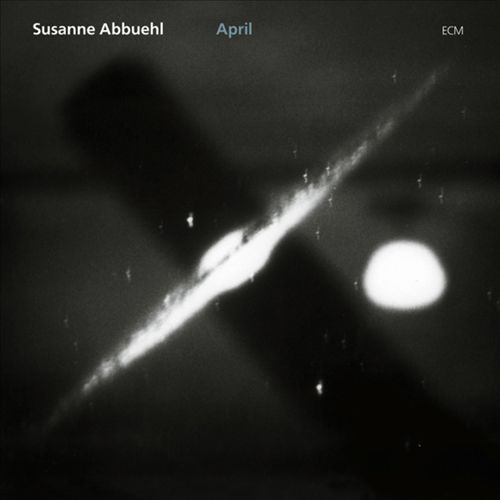
Susanne Abbuehl: April (ECM 1766)

April

Susanne Abbuehl
April

Susanne Abbuehl voice
Wolfert Brederode piano, harmonium, melodica
Christof May clarinet, bass clarinet
Samuel Rohrer drums, percussion
Recorded November 2000 at Rainbow Studio, Oslo
Engineer: Jan Erik Kongshaug
Produced by Manfred Eicher

All night the sound had
come back again,
and again falls
This quiet, persistent rain.
–Robert Creeley (1926-2005)

The ECM debut of Susanne Abbuehl is a verdant introductory résumé for which the Swiss singer-composer presents settings of poems by e. e. cummings and sets her own to the music of Carla Bley. Abbuehl comes from a long line of idiosyncratic chanteuses to have passed through ECM’s hallowed halls—including Sidsel Endresen, Norma Winstone, and Annette Peacock—and has left behind a veritable wing of artwork to admire at length. April carves out perhaps the most distinct of these exhibitions, and with “yes is a pleasant country” introduces us not only to her nesting textu(r)al approach, but also to the poetry of her synergistic band. Pianist Wolfert Brederode (who has since gone on to record leader dates for ECM), drummer Samuel Rohrer (also of Brederode’s quartet), and clarinetist Christof May together grow, needle by needle, the Christmas tree from which Abbuehl hangs her vocal ornaments. The simpatico between singer and sung is further palpable in her braiding with melodica and clarinet in “all i need,” for which its love guides her indigo words far into the heavens. “skies may be blue” and “yes” form a bonded pair. One is a meditation on spring, the other a field of rolling hills painted in wordcraft. Brederode’s composing and playing are exquisite in “maggie and milly and molly and may,” a litany of fleeting memories in which his pianism overshadows with a vocal quality all its own. The final cummings tribute comes in “since feeling is first.” This Abbuehl sings solo, a tribute to the poet’s later disavowals of punctuation.

Bley’s classic “Ida Lupino” gets a lyrical makeover, bringing out just one of countless stories hidden in its pathways: astute, a touch dark, and emotionally forthcoming. Brederode is something of a sage here, navigating the whimsical images therein: a tiger in the snow, a waning eye, a folding of the self into another’s embrace. “Closer” and “A.I.R. (All India Radio)” pitch more cargo onto the S.S. Bley, set adrift on moonlit waters. Beyond Abbuehl’s “together-colored moment,” precious jewels shine in anticipation. The air is as wistful as one’s naming of it, yet promises eternity in the bass clarinet’s deep pocket. The latter tune processes by virtue of Rohrer’s understated timekeeping. Among the more seamless weddings of voice and music the album has to offer, one can easily get lost in its wordless circumscriptions. (It also foreshadows the album’s closer.) Bley gets one last nod in “Seven,” for which Abbuehl places spoken verse—in her words: petal by petal, yet deeper than all roses—upon the heart’s altar.

Yet there is perhaps nothing so beguiling here than her re-imagining of “’Round Midnight.” Accompanied only by Brederode on harmonium, the tune creeps out from the darkness and shivers the very marrow. “Mane na” concludes the session by paying homage to Abbuehl’s Hindustani vocal training with a raga compressed to the scope of a teardrop.

Although barely acknowledged above, Rohrer’s delicate infusions haunt the landscape throughout, reaching, as Abbuehl recites, “somewhere I have never travelled, gladly beyond…” In those rhythms is a heart made of pages, thirsty for the next scratch of pen.

An auspicious label debut.

<< Christoph Poppen/The Hilliard Ensemble: Morimur (ECM 1765 NS)
>> Giya Kancheli: In l’istesso tempo (
ECM 1767 NS)

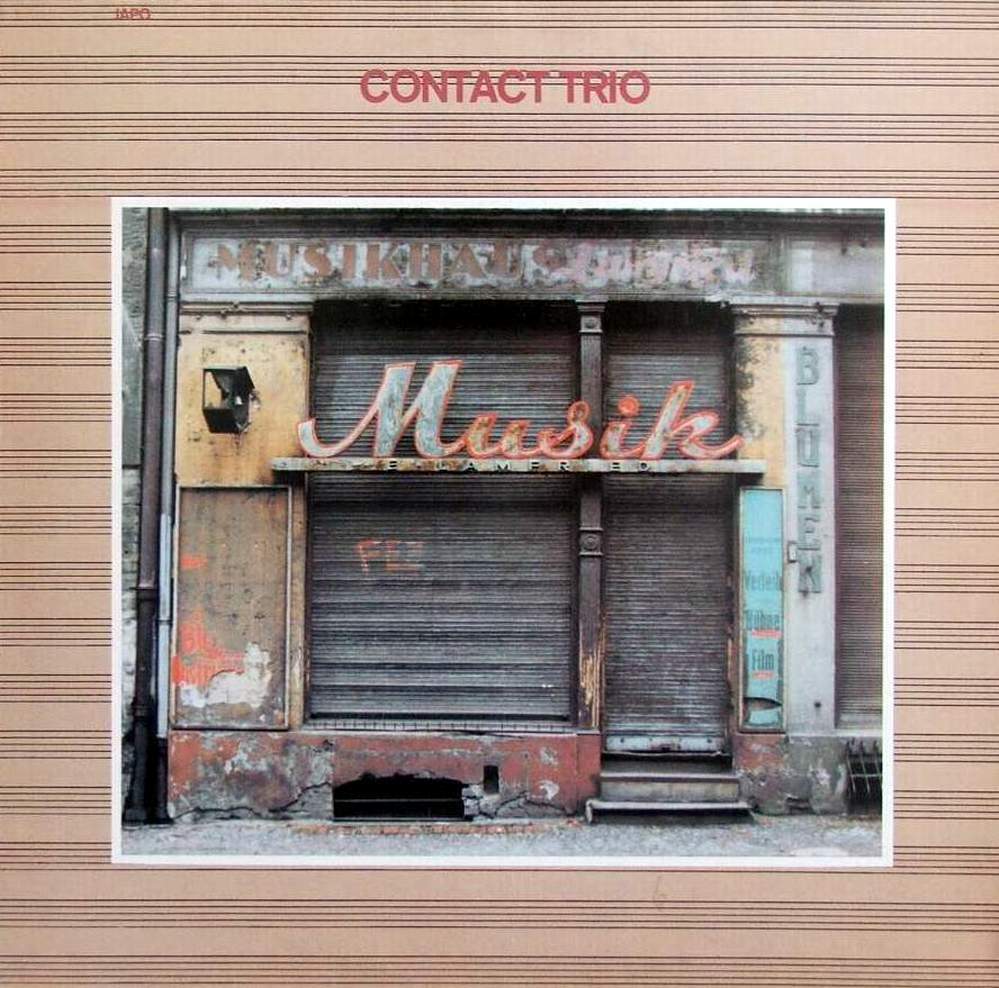
Contact Trio: Musik (JAPO 60036)

Musik

Contact Trio
Musik

Evert Brettschneider electric and acoustic guitars
Aloys Kott electric and acoustic basses
Peter Eisold drums, percussion
Recorded October 1980 at Tonstudio Bauer, Ludwigsburg
Engineer: Martin Wieland
Produced by Thomas Stöwsand

Musik was the second effort by the Contact Trio for ECM’s sister JAPO label. Inspired by the atmospheric developments of Wolfgang Dauner (see, for example, Output) and heavily invested in the softening distinctions between rock and jazz, the trio had by now perfected its rhizomatic sound in what was to be its final record. Here Peter Eisold takes the place of drummer Michael Jüllich, and the result is a truly aerobic experience.

The warm-up
The echoing guitar of “Air Lines” opens the session by straddling extremes of register and sharpness, and starts a snowball rolling down the bass’s equally resonant hill. Strangely, the ball doesn’t pick up speed for some time, but paces itself in a journey of textured reflection, tracing from each icy particle a possible trajectory of flight. Eisold’s unique percussive language is thus apparent. And then: traction as the rhythm section hurls the guitar to tell its story in anticipation of an untimely end.

The stretch
Muscles and tendons glow with flexion in “String Games.” Acoustic in hand, Brettschneider reflects on a past in which the only truth was a broken mirror. There is a feeling of dedication here, a deference to time at large for providing this opportunity to luxuriate in the creation of music. Like the first, this track hooks on to something more propulsive in the final minutes, only now running through the backstreets of a small Spanish town, chasing after a melody.

Lower body
“Daddy Longleg” is an invigorating turn featuring two overdubbed electric guitars and electric basses, each relaying torch light in palpitating dialogue with the other. Eisold again shines with colorful cymbal work that evokes nocturnal footfalls in the walls.

Core
From its title alone, “Simple Symphony” would seem to be an allusion to Britten’s work of the same name. The music provides an entirely different experience. From Brettschneider’s throbbing beats and elastic chording to the groovy trio unity achieved thereafter, it climbs every tree in its way like a squirrel on a mission. The rhythm section positively shines in gorgeous geometries, sliding from one signature to the next with the ease and comfort of a fountain pen.

Back
The spine gets is due attention in “Silence,” which curves in a protracted arch. Stained guitar and arco bass lead into a plunking dream of youthful flexibility, edging a ghost town with its metal detector until it finds two rusted guns from a shootout, long forgotten…

Chest and arms
“Elbow Dance” completes this full-body workout with a slog through cement that finds resolution and strange comfort in the hardening.

At the risk of belaboring all of this analogizing, Musik is an intensely physical record. Not only in the sense that it feels weighted and animate, but also for its permeable compositions. Each is a thoughtful assemblage of lines that no longer has need for points of origin. Together, these lines leave the listener with a lasting meta-statement of harmless transgression.

A gem in ECM’s apocryphal bin.