Michael Formanek: Small Places (ECM 2267)

2267 X

Michael Formanek
Small Places

Tim Berne alto saxophone
Craig Taborn piano
Michael Formanek double-bass
Gerald Cleaver drums, shruti box
Recorded December 2011 at Avatar Studios, NYC
Engineer: Aya Merrill
Produced by Manfred Eicher

After his successful ECM debut, The Rub And Spare Change, bassist-composer Michael Formanek returns with saxophonist Tim Berne, pianist Craig Taborn, and drummer Gerald Cleaver for this set of eight patient, iridescent concoctions. Formanek’s approach is somewhat unusual in modern jazz, blending not only composition and improvisation but also instrumental colors into an even palette that eschews the need for showmanship. The lines are horizontal, reinforcing one another beyond idiomatic reach toward an ego-less whole.

The title track is the group’s calling card. Its rolling topography plants handfuls of thematic roses and coaxes Taborn and Cleaver into quiet cross-pollination. Berne feeds off their pointillism, spitting back valuable loose change as Formanek tills the earth with a rich ostinato. This formula works across the board, lending programmatic intensity to each title, of which the music is an unveiled reflection. “Pong,” for one, deepens the session’s geometric feel, seeming to channel the origami flair of Nik Bärtsch’s Ronin—only here, every fold becomes a splinter. Formanek embodies the ball-bouncing effect, with plenty of ping left in Cleaver’s variegated cymbals. “Rising Tensions And Awesome Light,” for another, is a glittering exercise in mimesis that elicits a moveable feast from Berne, who alongside Taborn traces a chorused shot from motive to motive in “Slightly Off Axis,” thereby encasing the leader’s pilot light in melodic glass. The seemingly resultant “Wobble And Spill” tilts on its axis at Berne’s influence again, dancing and slogging by turns.

Further wonders await in the masterful “Seeds And Birdman” and “Soft Reality.” The former is Taborn at his best. As he draws and redraws stories in mineral rock, he sucks lava from its fissures and exhales its heat through a uniquely geological adlibbing. Berne, meanwhile, pinches flies from the air like a forest of Mr. Miyagis and weaves different shades of night between piano and arco bass, two needles knitting and pearling the horizon even as they unravel it.

Inescapable is the 18-minute “Parting Ways,” which turns its title into an elegiac deepening of the album’s postmodern sentiments. Taborn continues to stir the waters and draws from them sonorous minnows. In so doing, he taps an inner turmoil and externalizes it in poetry. Formanek’s harmonics match this poetry with their own, whispering as if shadow were light. Berne’s noteworthy solo here unearths a bag of gems, corroded but nonetheless precious. The quartet kicks up some homegrown sounds in the latter third, a back yard replete with abandoned tires and herbage galore.

This is inward, hungry playing.

(To hear samples of Small Places, click here.)

Wide Waters: The 1999 Charles Lloyd L.A. Sessions (ECM 1734 & 1784)

In the winter of 1999, tenorist Charles Lloyd drew upon the personnel of his acclaimed Voice In The Night, retaining from that session guitarist John Abercrombie and drummer Billy Higgins, adding to them for the first and only time pianist Brad Mehldau and bassist Larry Grenadier, the latter of Mehldau’s eponymous trio. Recorded in Los Angeles, the tunes were split and released in 2000 and 2001 as The Water Is Wide and Hyperion With Higgins, respectively. And while the latter’s cover art is a negative image of the former’s, they are moved to action by the same invisible heart.

The Water Is Wide

Charles Lloyd
The Water Is Wide

Charles Lloyd tenor saxophone
Brad Mehldau piano
John Abercrombie guitar
Larry Grenadier double-bass
Darek Oles double-bass
Billy Higgins drums
Recorded December 1999, Cello Studios, Los Angeles
Engineer: Michael C. Ross
Produced by Charles Lloyd and Dorothy Darr

Listeners are guaranteed to have Georgia and more on their minds when Hoagy Carmichael’s classic song—made famous by Ray Charles and stripped down here to pure melody—leads off The Water Is Wide with its sweet molasses undercurrents and soulful glow. Lloyd’s signature pop, periodic and delicate, adds punctuation to every phrase in this beautiful trio setting. Half of the album, in fact, pays tribute to songs that have moved Lloyd at one point or another in his long career, as well as to those that have burrowed into his heart. Of the latter is the title track, a Scottish folk tune, which in Lloyd’s arrangement posits Abercrombie inside Higgins’s steam-powered brushwork. Other stops along this migratory journey of things past include a bluesy take on Duke Ellington’s “Black Butterfly,” Billy Strayhorn’s “Lotus Blossom,” a piano-driven “Song Of Her” (Cecil McBee), and the polished bronze of “Heaven” (from Ellington’s Second Sacred Concert). Yet nowhere is the feeling so intimate as in “There Is A Balm In Gilead,” which pairs only the bandleader and Higgins in the cleft of a parting sea. It is the album’s zenith and sign of things to come in Which Way is East.

A variety of Lloyd’s own tunes rounds out the set. “Ballade And Allegro,” written as incidental ballet music, is a veritable supernova regressing to its planetary state and showcases his penchant for emotional directness. Mehldau balances light and dark in perfect proportion, as he does also in “The Monk And The Mermaid,” the album’s other, decidedly aquatic, duet. Together, he and Lloyd mend broken fins and make them swim, iridescent and thirsting for brine. Lloyd re-stretches the canvas in “Lady Day,” a smooth tribute to Billie Holiday, before Abercrombie returns for “Figure In Blue,” swapping constellations with Lloyd in a laid-back vibe. The guitarist joins also in a “Prayer” to Higgins, who had a few years before this recording survived life-threatening health problems. Bassist Darek Oles also guests in this piece of suspension and separation.

<< Annette Peacock: an acrobat’s heart (ECM 1733)
>> Luciano Berio: Voci (
ECM 1735 NS)

Hyperion With Higgins

Charles Lloyd
Hyperion With Higgins

Charles Lloyd tenor saxophone, taragato, maracas
Brad Mehldau piano
John Abercrombie guitar
Larry Grenadier double-bass
Billy Higgins drums
Recorded December 1999, Cello Studios, Los Angeles
Engineer: Michael C. Ross
Produced by Charles Lloyd and Dorothy Darr

“The idea is like with the old Southern preacher,” says Lloyd of Hyperion with Higgins. “You go low and you get high and then you catch fire.” Which is perhaps why his originals comprise the entire program of this second installment—in them is a hearth of coals.

Higgins continues to shine this time around, lifting Lloyd to brighter evocation in the title track and lighting not a few fireworks with his sticks. That unbreakable dialogue continues in “Secret Life Of The Forbidden City,” in which Abercrombie also broadens his wingspan. The guitarist moves with even more pleasure in “Dancing Waters, Big Sur To Bahia” and goes classic in “Miss Jessye,” mixing just enough sugar and spice to keep everything nice. Marvelous also is the geometric pianism. On that note, there’s no mistaking the synergy of Mehldau and Grenadier in “Darkness On The Delta Suite,” a return to roots that works on every level. Their creeping, marshmallow texture, combined with Lloyd’s campfire crisp, clothes the suite with ragged style. Grenadier kicks off a solid groove in “Bharati.” In this one, Lloyd flirts with captivation over Mehldau’s fertile ground, lifting themes like a morning fog, before “The Caravan Moves On” opens the mind in a plains-drifting rite with Higgins. The introduction of guitar and bass adds figures to this desert in slow and steady progress. Abercrombie lobs his characteristic catcalls into an azure sky, Lloyd’s tárogató echoing all the while like a dream held on to just long enough to taste.

Hyperion with Higgins is brimming with warm spirit. Lloyd has honed his lyricism like a blade so fine it cuts hatred until only the shape of love is left. This spirit possesses the melodic inventiveness of his improvisers. Their vocabularies are the fresh to his familiar. Sadly, these sessions further represent one of Higgins’s last recordings before his death in May of 2001. And in that sense, they will forever hold vigil in his name.

<< Thomas Demenga: Hosokawa/Bach/Yun (ECM 1782/83 NS)
>> Robin Williamson: Skirting The River Road (
ECM 1785)

Charles Lloyd: Jumping the Creek (ECM 1911)

Jumping the Creek

Charles Lloyd
Jumping the Creek

Charles Lloyd tenor and alto saxphones, taragato
Geri Allen piano
Robert Hurst double-bass
Eric Harland drums, percussion
Recorded January 2004 at Cello Studios, Los Angeles
Engineer: Talley Sherwood
Produced by Dorothy Darr and Charles Lloyd

Jumping the Creek fronts Charles Lloyd in a marvelous quartet of Geri Allen (retained from the Lift Every Voice sessions) on piano, Robert Hurst on bass, and Eric Harland on drums. The Memphis-born reed man’s 11th album for ECM is filled with magical realism, fleshed out most vividly in Allen’s overtime at the keyboard. He and Hurst often play the part of rhythm section, detailing the stone-skipping exchanges between Lloyd and Harland of “Ken Katta Ma Om,” for which he hollows out a melodic cave for Lloyd to throw his torch into, and the briefer though no less verdant passage of “Angel Oak Revisited.” Whether painting a Jackson Pollock bramble of layers or framing the band in the open geometries of a Sol LeWitt cube, he is a vital presence on this date of hip triangulations.

None of this diminishes Hurst’s own contributions, which bear bushels of sonic fruit throughout. He integrates masterful subtleties into the weave of the title track, bridging Lloyd and Harland’s crosstalk into closure; solos persistently and evocatively in the marvelous “Georgia Bright Suite;” and duets sagely with Lloyd on tárogató in “The Sufi’s Tears.” For each he impacts miles of energy in few footsteps. Duo energies go deeper in the subdued glory of “Canon Perdido” and “Both Veils Must Go,” each an expansion of Lloyd’s improvisatory mission with Harland. There is a sense of belonging here.

Rounding out the set are a veiled take on Duke Ellington’s “Come Sunday” (one of only two not penned by the bandleader) and two epic tracks. “Song of the Inuit” ends with an elemental catalogue, which like the “Georgia Bright Suite” unpacks a fascinating attic of curios. An animated solo from Lloyd pains a night breeze and the leaf that trembles by its touch, with no other dream but to fall. Yet nothing here is so all-encompassing as the leadoff track by Belgian songwriter Jacques Brel. “Ne Me Quitte Pas” reduces Byzantine touches and less intimate cascades in a crucible of undulating development, shoring up the album’s levees with long and song.

Jumping the Creek sails oceans of memory as if they were the future, nakedly and freely. Throughout, Lloyd hangs by a thread that, while thin, tethers his playing to unseen spirit, moving as one might whisper—which is to say, with grace.

Charles Lloyd: Lift Every Voice (ECM 1832/33)

Lift Every Voice

Charles Lloyd
Lift Every Voice

Charles Lloyd tenor saxophone, flute, taragato
Geri Allen piano
John Abercrombie guitar
Marc Johnson double-bass
Larry Grenadier double-bass
Billy Hart drums
Recorded January and February 2002 at Oceanway and Cello Studios, Los Angeles
Engineer: Michael C. Ross
Assistants: Robert Reid and Brian Vibettes
Sound: Joe Harley
Mastering: Bernie Grundman
Produced by Charles Lloyd and Dorothy Darr
Executive producer: Manfred Eicher

“Truth is One, sages call it by various names.”
Rig Veda

On the night of September 11, 2001, Charles Lloyd was scheduled to appear at New York’s Blue Note jazz club. In the wake of that morning’s unforgettable tragedy, he took the concert’s postponement as an opportunity to meditate on a response. Out of this impulse came Lift Every Voice, which in spite of the events that provoked it is more spiritual than political, opting for a message born in words yet conveyed without them.

Lloyd has been shepherding trusting flocks with the crook of his bell for many decades, yet perhaps none so solemn as the one gathered here. Joined by pianist Geri Allen, guitarist John Abercrombie, bassists Marc Johnson and Larry Grenadier, and drummer Billy Hart, he enacts a sonic prayer that only two CDs can contain: one for each hand in supplication. Looking at the final tracks of both discs, we find such balance achieved. Where “Hafez, Shattered Heart” ends the first disc with a profound tárogató solo, opening a dream of desert to reveal another of water, the second concludes on a high note with “Prayer, The Crossing.” The latter’s visceral energy is the key to all that moves between it and the opening “Hymn to the Mother,” another Lloyd original that expands the session’s reach to the stars and back.

Lloyd’s material is the strongest—or, more precisely, is of an altogether different strength than the standards, hymns, and spirituals with which it shares breath—for it is also his most selfless. Whether it’s the bluesy Abercrombie vehicle “East Virginia, West Memphis,” the autumnal colors of “Angel Oak,” or the Allen-focused nostalgia trips “Beyond Darkness” and “Nocturne,” Lloyd finds his voice through the attunement of his band. He finds it further in the darkened fields and pathways left behind by those—named and nameless—who are no longer with us. Marvin Gaye flickers between realms in a distinct arrangement of “What’s Going On,” smooth as a northern light. The intimate repose of “Amazing Grace” (Lloyd plays this as if for the first time) and “You Are So Beautiful” defies all associations, flowering behind closed eyes and open heart. The lyrical cartilage of his support system follows every step as he flutters through the changes, a moth courting the flame.

Noteworthy also are the Duke Ellington tune “I’m Afraid,” a quintessential display of Lloyd’s tonal prowess, and Billy Strayhorn’s “Blood Count,” by far one of the most touching five minutes Lloyd has ever recorded. Two pieces by Cuban protest singer Silvio Rodríguez, “Te Amaré” and “Rabo de Nube,” thicken the pot with some heartfelt craft, both highlights not to be missed. They quiver at slightest contact, cups filled to the brim. All of which infuses eternal flowers like “Go Gown Moses” and the title hymn with constellations galore.

Terror is the soil of togetherness, and in chaotic times the sunflowers are our singers. In their company and by their guidance we open our mouths to the sky. Lloyd is one such singer. Yet he does not lift his voice. Rather, he lets the high notes crack, lest they distract us from the healing taking place beneath them. Thus he gives attention to the impermanence of things. A philosophical move, perhaps, but an inevitable one that reminds us of music’s fragile architecture. He is neither leader nor follower, but a border without countries. He is an artist who stands before us, poised to weep as the world weeps around him.

Manfred Schoof Quintet: Resonance (ECM 2093/94)

Resonance

Manfred Schoof Quintet
Resonance

Manfred Schoof trumpet, flugelhorn
Michel Pilz bass clarinet
Jasper van ‘t Hof piano, electric piano, organ
Rainer Brüninghaus piano, synthesizer
Günter Lenz double-bass
Ralf-R. Hübner drums
Recorded August 1976 (Scales), December 1977 (Light Lines), and November 1979 (Horizons) at Tonstudio Bauer, Ludwigsburg
Engineer: Martin Wieland
Produced by Thomas Stöwsand
Executive producer: Manfred Eicher

Resonance compiles two discs of vital material from the early JAPO releases by German trumpeter Manfred Schoof: Scales, Light Lines, and Horizons. The first two albums are presented in full, while only half of the third is excerpted. As co-member with bass clarinetist Michel Pilz of the Globe Unity Orchestra (another group with a hefty JAPO footprint), Schoof was a hot ticket in the 1970s, when his quintet was all the rage in the European free jazz scene.

Schoof

What distinguished him from the avant-garde demimonde was an insistence on melodic integrity. For Schoof, “the term ‘free’ not only stands for a specific style of jazz that, in its beginnings, opposed with revolutionary gesture everything redolent of the past and reminiscent of tradition but rather the freedom to choose between a multitude of very different means of expression. Tradition, therefore, is viewed as a past experience that merges with and enriches a new style of sound.” His band mates in these recordings include Pilz, pianists Jasper van ‘t Hof and Rainer Brüninghaus, bassist Günter Lenz, and drummer Ralf-R. Hübner, most of whom will be familiar to the more adventurous ECM listeners.

Scales (JAPO 60013)
The title track of Scales opens both album and set with a primal trumpet cry. It is Schoof’s calling card: a rip in the ether from which flows undeniable light. Van ‘t Hof poeticizes this light from a place beyond waking. And indeed, the more instruments are added, the dreamier the music becomes. Over time, Pilz’s gorgeous rasp adds tactility, so that surreal gestures begin to feel familiar. Pilz stands out also in “Ostinato,” which finds him sharing a stepwise ground line with Lenz. We are so fully mired in this swampy unison that when he breaks free from the waves, his voice feels like a shaded benediction in what is easily among the finest tracks in the ECM archive. Van ‘t Hof’s organ drone is also notable here. Over it drums seem to describe abandoned castles, stone by stone, until they loom before us unscathed by time. The keyboardist provides deep color shifts throughout the program, evoking early Steve Kuhn vis–à–vis electric piano in “For Marianne” and spacy atmospheres in “Weep And Cry.” The former’s cloud rolls give Schoof vast chromatic freedom, while the latter evokes sunset before cooling into a twilit canopy, now alive as the darkness reveals its dance through the bass clarinet. The scene closes its eyes with “Flowers All Over” in the album’s most joyous music. Schoof rides a harmonic dolphin, plunging variously into intuitive digs, likewise inspiring Pilz to grand emotional heights.
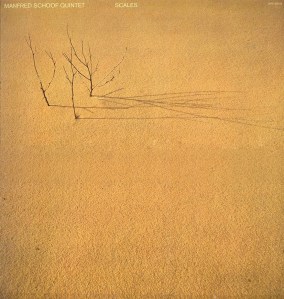
Scales
Original cover

Light Lines (JAPO 60019)
“Source” introduces the second disc with the world of Light Lines. The middle of this JAPO sandwich finds Schoof swimming in an ocean of fire. Overall, the sound is more sparkling by way of Hübner’s clear and present kit work. The album boasts not only its own title track, a splash of sonic goodness in which Schoof’s trumpet is the very image of a bird in flight, but also that of the set as a whole. “Resonance,” for that matter, is more than a catchy word. It is the credo of a musician whose focus unnerves with its precision. Working through the changes like a card shark riffling to his cull, he holds our attention by means of powerful misdirection. “Criterium” and “Lonesome Defender” round things out, on the one hand, the glint of a blade catching sunlight and, on the other, an evocative blend of sweet and savory flavors.

Light Lines
Original cover

Horizons (JAPO 60030)
Brüninghaus steps from the Jan Garbarek/Eberhard Weber mold and into open Horizons, where he adds lilting undercurrents and cascading solos throughout. Pilz’s fierce, uncompromising blues is downright brilliant amid the pianist’s sparkle in the waterlogged title track, in which Schoof emerges like a butterfly from its chrysalis, fluttering to and fro with the determination of a man on fire in search of water. In “Hope,” he sweeps a guiding hand through waves of thematic life, Pilz ever the underwater acrobat. The band rounds up a school of fish hungry for soul in “Old Ballad,” with Brüninghaus and Lenz hauling a fair catch each, while the final “Sunset” fronts the trilogy’s brightest stars, Schoof and Pilz, against a gradual rhythm section, carrying us out toward a forever receding waterline.

Two worthy, if confected, tracks have been elided from Horizons—strange when you consider the collection could have accommodated both. “The Abstract Face Of Beauty,” penned by Hübner, paints a vista of clouds and barren land, every bit the sonic analogue to the album’s cover, and features prime soulful blowing from Pilz. “Sunrise” taps a similarly rubato vein and throws the spotlight on Schoof’s technical prowess. The 14-minute loss isn’t likely to matter to those new to this material, of whom many listeners of Resonance are likely to be. In any event, Schoof himself assembled the included tracks, and one can only imagine his good reason.

Horizons
Original cover

Although he is one diamond in a mine already chock full of them, Manfred Schoof deserves any ECM fan’s close attention. As a composer, he builds a welcoming world. As a player, he turns fantasy inside out and makes it feel possible. Like the solo concerts of Keith Jarrett, if the reader will forgive the otherwise groundless simile, his pieces are distinguished by their ostinatos, which thrum with the invisible energy of ley lines. This is music that looks at itself in the mirror and asks, “Am I the reflection after all?”


Bobo Stenson Trio: Goodbye (ECM 1904)

Goodbye

Bobo Stenson Trio
Goodbye

Bobo Stenson piano
Anders Jormin double-bass
Paul Motian drums
Recorded April 2004 at Avatar Studios, New York
Engineer: James A. Farber
Produced by Manfred Eicher

Bobo Stenson’s trio projects have brought a host of eclectic programs to fruition in ECM’s choicest studios. Like label mate Tomasz Stanko, the Swedish pianist’s repertoire is a balancing act of adventure and return. As with the follow-up, Cantando, the present session draws from classical sources (Henry Purcell’s flavorsome “Music For A While”), protest songs (Vladimir Vyotsky’s “Song About Earth,” here something of a meta-statement), standards (Stephen Sondheim’s “Send In The Clowns” and the title tune by Gordon Jenkins), and Latin American music. All of this and more, including new material by Stenson and bassist Anders Jormin, in addition to some tried and true from drummer Paul Motian. Goodbye is the first recorded meeting of these three greats, who comb the pelt of the cosmos until it glistens.

Whether by stick or by brush, Motian’s touch is meticulously impressionistic, reactive, and aware. His slipperiness is recognizable from the first quiver of the Sondheim classic. He adds so much patina to its well-polished surface, locking rough into smooth like the teeth of a zipper. Those unmistakable brushes continue to beguile in “Alfonsina,” which comes from the pen of Argentine composer Ariel Ramírez. We feel more than hear Motian as he blends into Stenson’s exquisite pianism with all the selflessness of a shadow. Only in the fourth track, “There Comes A Time” (Tony Williams), does he change over to sticks. Hooked on Jormin’s arm, he elicits a certain sweetness, fleeting as mist at sunrise. For his own tunes, “Jack Of Clubs” and “Sudan,” he overturns melodic warmth in spades and dips into resolution as might a painter into crimson. These share in the album’s concluding spate of briefer numbers, along with Stenson’s “Queer Street” and Jormin’s “Triple Play”—both tantalizing.

The bassist enlivens the set with three further tracks, shifting from the stark poetry of “Seli” to the more flexible “Allegretto Rubato” at the flick of a wrist. It is “Rowan,” however, that regards the listener most enigmatically. It lives below the water’s surface, gazing at its own reflection until it can no longer swim. Stenson weeps here with the viscosity of a maple tree. Of that tree, the leaf that is Ornette Coleman’s “Race Face” swings freely, making the jive sound so easy when in truth we can hardly comprehend the paths taken to get here.

Regardless of length, every bit of this moody and often-melancholic set feels complete. This is a jazz of evaporation; not the work of a trio but the feeling of another climate.

Bobo Stenson Trio: Cantando (ECM 2023)

Cantando

Bobo Stenson Trio
Cantando

Bobo Stenson piano
Anders Jormin double-bass
Jon Fält drums
Recorded December 2007 at Auditorium Radio Svizzera Italiana, Lugano
Engineer: Stefano Amerio
Produced by Manfred Eicher

After the epic statement that was Serenity, the Bobo Stenson Trio reshuffled not only its personnel (Jon Fält replaces Jon Christensen, by way of Paul Motian, on drums) but also its sources. Cantando takes these changes in stride, as is clear from the swish and sparkle that unwrap “Olivia.” The opener is by Cuban songwriter Silvio Rodríguez, whose left-leaning politics find traction in the haunting backpedaling toward the end, gelling in wordless spirit like a lake in winter. Astor Piazzolla’s “Chiquilín de Bachín” dips again into Latin American material. This is Fält’s moment, as he brings a painter’s awareness of color and nuance to bear on a groovy ride. Yet Jormin is the head and tail of this Ouroborous, adding much with his amplified amethyst sound. Overall, he is an even more defining presence than usual, ever evolving his navigation of Stenson’s winding turns of phrase. As composer, the bassist offers two tunes. “M” is the more swinging of the two, while “Wooden Church” spins a matrix of liturgical and secular impulses, especially in his solo, which scuttles through the walls like a mouse who knows his way blind. Jormin shines further in the loosened fray of Stenson’s night throughout “Pages,” which culls four of seven pieces freely improvised in the studio. Curious and enchanting, they give rare insight into the art at hand.

Cantando rounds out with a handful of tributes. “Don’s Kora Song” gives props to the late Don Cherry, whose far-reaching sense of mood and timing translate well into Stenson’s world. His mechanical yet intuitive precision in the left-hand ostinato reminds us that all music has a heartbeat. The obscure Ornette Coleman tune “A Fixed Goal” betrays its tongue-in-cheek title in a series of moving targets, of which Jormin’s are the blurriest. Nestled snug against a forward-thinking take on the standard “Love, I’ve Found You” is Alban Berg’s “Liebesode.” A sarangi-like intro evokes stretches of dunescape before the piece’s thick description balances the raw and the cooked in delicious proportion. Last is “Song Of Ruth.” Written by the late Czech composer Petr Eben and recorded here just two months after his passing, it follows wherever gravity may lead. It pulses on forested borders, cut from the cloth of the earth by rivers and footpaths. So veracious is it that it might as well be called “Song Of Truth.” The album contains two versions, a variation of which closes the set, most forthcoming in its philosophies and clothed in the iridescence of its will. Brilliant.

One can always count on Stenson to outdo himself, and this time is no different. He consistently pulls the listener in fresh improvisatory directions, all of which blossom as supply as ever in the spacious engineering, courtesy of Stefano Amerio in Lugano. This trio, in every incarnation, is a book unto itself: over time the binding relaxes but remains intact. All of which gives metaphorical strength to “Pages,” smelling still of the glue that holds them together.

(To hear samples of Cantando, click here.)

Selected Signs, I – An ECM Anthology (ECM 1650)

Selected Signs Ia

Selected Signs, I – An ECM Anthology

The essential, as the cover of ECM’s first true compilation so quietly proclaims, may no longer be visible, but it sure is audible. Unlike the classical New Series Anthology, which took an unexpected dip into ECM proper, here the label’s formative mining of (mostly) European jazz idioms (and idiom-breakers) fills in the clothing it was born to wear. Although one might expect a collection from a catalogue already so vast to span its then-28-year history, amazingly all of its tracks come from albums released in 1997, a critical year for all involved.

The disproportionate amount of material from Tomasz Stanko indicates his importance to the label (the Polish trumpeter has left one of the deepest genetic impacts on ECM’s evolution), if not also the label’s importance to him, for producer Manfred Eicher has extended such loving welcome to his formidable talent. It sparks no wonder, then, that the brooding, sweeping gestures of “Svantetic” (from Litania) should heave their weight from the start. Despite being played by a septet, the feel of it is characteristically hermetic. Like an eyelid weighted with sleep, “Morning Heavy Song” (from his quartet’s Leosia) plunges us into a thick pianistic fog. Another private sketch in charcoal, it places notes where footprints might otherwise have been and lifts us from the shadowy lullaby of “Sleep Safe And Warm” (also from Litania) like the final corner of a jigsaw puzzle destined to be incomplete.

Significantly or not, many of the anthology selections come from early on in their respective albums. As such, they breathe with storytelling power, and nowhere more so than in the bandoneón master Dino Saluzzi’s touching “Gorrión” (from his trio effort Cité de la Musique). This biological excursion was written for Jean-Luc Godard, who has in the past drawn from Saluzzi, among other ECM artists, for his intuitive soundtracks. It is not only air that courses through Saluzzi’s bellows, but also soil, family, and time. Guitarist Ralph Towner, another artist of inward renown, gives the only other solo performance in “Tale Of Saverio” (ANA). It is also cinematic, for like a Bergman film it clicks along at a ghostly pace and finds in its own reflection the arrival of memory, naked and fractured.

Ukraine-born pianist Misha Alperin’s “Morning” (North Story) cages a chamber jazz aesthetic, though its textures become rather dense as the other instruments join him, applied like foundation to give those splashes of color a surface on which to ruminate. In the humid atmosphere he creates, stillness becomes a fairytale. “Hyperborean / Patch Of Light” (Hyperborean) is a classic from Norwegian bassist Arild Andersen’s archive, one of ECM’s strongest. For all its classical associations and wandering lines, it puts a truth to heart. Like a bird with eyes closed, Andersen’s bass knows where it’s going long before wind touches feather. Percussionist and longtime Jan Garbarek collaborator Marilyn Mazur gets a brief nod in “Creature Talk” (Small Labyrinths), a twittering flyby of rainforest that lands us at the feet of the totem carved in “Desolation Sound” (Canto), a deep introduction to American tenorist Charles Lloyd’s moving art. His twilight is strong, his breath dancing from satellite to satellite. “Siegfried And Roy,” by the Michael Cain Trio (from the overlooked Circa), is another fleeting piece of chamber jazz. It is a slow pounce, a leaning of the head, a nocturne that never makes its way into recall.

Next are the keening wonders of the Joe Maneri Quartet in a haunting take on “Motherless Child” (In Full Cry), which turns the familiar spiritual into a DNA helix of healed bones. An illness surrounds these masters, for which Maneri’s reed is the cure. Kenny Wheeler’s drum-less Angel Song project gets due attention with “Past Present.” Threaded by the delicate metronome of bass and strung by hand through guitar, its memorable theme speaks in a language only it can, its breath a sunset turned into wine and poured down the throat of a dream. Jack DeJohnette’s vital contributions take shape in “Free Above Sea” (Oneness). This richly detailed piece showcases the drummer’s melodic brilliance, enhanced here by piano and icy guitar. The anthology concludes (or does it begin?) with the title track from Nothing Ever Was, Anyway, an all-Annette Peacock program featuring pianist Marilyn Crispell, bassist Gary Peacock, and late drummer Paul Motian. This is jazz flung into a wormhole and re-spun as it emerges, a body so unaware of itself that it soars.

Selected Signs creates its own sound story, the story of a label and its heartbeat, of a producer and his vision—a vision that sees as it hears. This being but a cross-section of a single year in ECM’s 40+ history, imagine what the others hold in store…

<< Michael Mantler: The School Of Understanding (ECM 1648/49)
>> Roscoe Mitchell: Nine To Get Ready (ECM 1651
)

Dave Holland Quintet: Prime Directive (ECM 1698)

Prime Directive

Dave Holland Quintet
Prime Directive

Dave Holland double-bass
Robin Eubanks trombone
Chris Potter soprano, alto and tenor saxophones
Steve Nelson vibraphone, marimba
Billy Kilson drums
Recorded December 10-12, 1998 at Avatar Studios, New York
Engineer: James Farber
Produced by Dave Holland

Chris Potter replaces Steve Wilson as reedman in this follow-up to the Dave Holland Quintet’s Grammy-nominated Points of View. The band’s tremendous communication and obvious joy embolden a strong set of nine tracks, five of which come from Holland’s pen, starting with the title. The addictive rhythms are quintessential Holland and usher us into a sound-world that one hardly wants to leave. In this respect, drummer Billy Kilson rules the roost from start to finish. Working seamlessly with Holland as Potter and trombonist Robin Eubanks cast nets over Steve Nelson’s liquid crystal vibes, he engenders a pollinated groove without fail. Kilson further inspires his band mates to step up their rhythmic game, as in “Jugglers Parade,” which boasts a fine example of Holland’s ability to embolden even the most upbeat solos through an inborn lyrical power (not to mention some lovely sopranism from Potter on the recharge), and “Down Time,” the closing trio number with Eubanks in the lead. Potter takes up Kilson’s call most creatively in “Looking Up,” as does Nelson in an epic solo. The smoky rejoinder from Eubanks morphs into a percolating extravaganza and recedes for a quiet yet robust solo from Holland. The leader-bassist seems to deliver a caravan track in every session, and this time around “Make Believe” is it. A sandy and romantic excursion, it spreads the night sky like paper, across which Potter inscribes a love letter to the art of improvisation.

Holland’s coconspirators offer a tune each. Eubanks steals the show with his fireside dance, “A Searching Spirit,” pulling out a bubbling yet punchy solo, while Nelson gallivants through Kilson’s inescapable groove. The alto touches on the downswing foreshadow Potter’s equally upbeat “High Wire.” Nelson sweeps back with his forlorn “Candlelight Vigil,” which feels like an epilogue, a coda, an honest sigh. Kilson bows out here, while Holland picks up his bow for some fluid talk. The drummer returns on his “Wonders Never Cease,” which from a soulful intro by way of Holland looses a stream of inspired beats.

Prime Directive is a listener’s gift, wrapped and tied with a bow, and a viable contender for Holland’s finest ECM session.

<< John Dowland: In Darkness Let Me Dwell (ECM 1697 NS)
>> András Schiff: Schubert C-major Fantasies (ECM 1699 NS
)