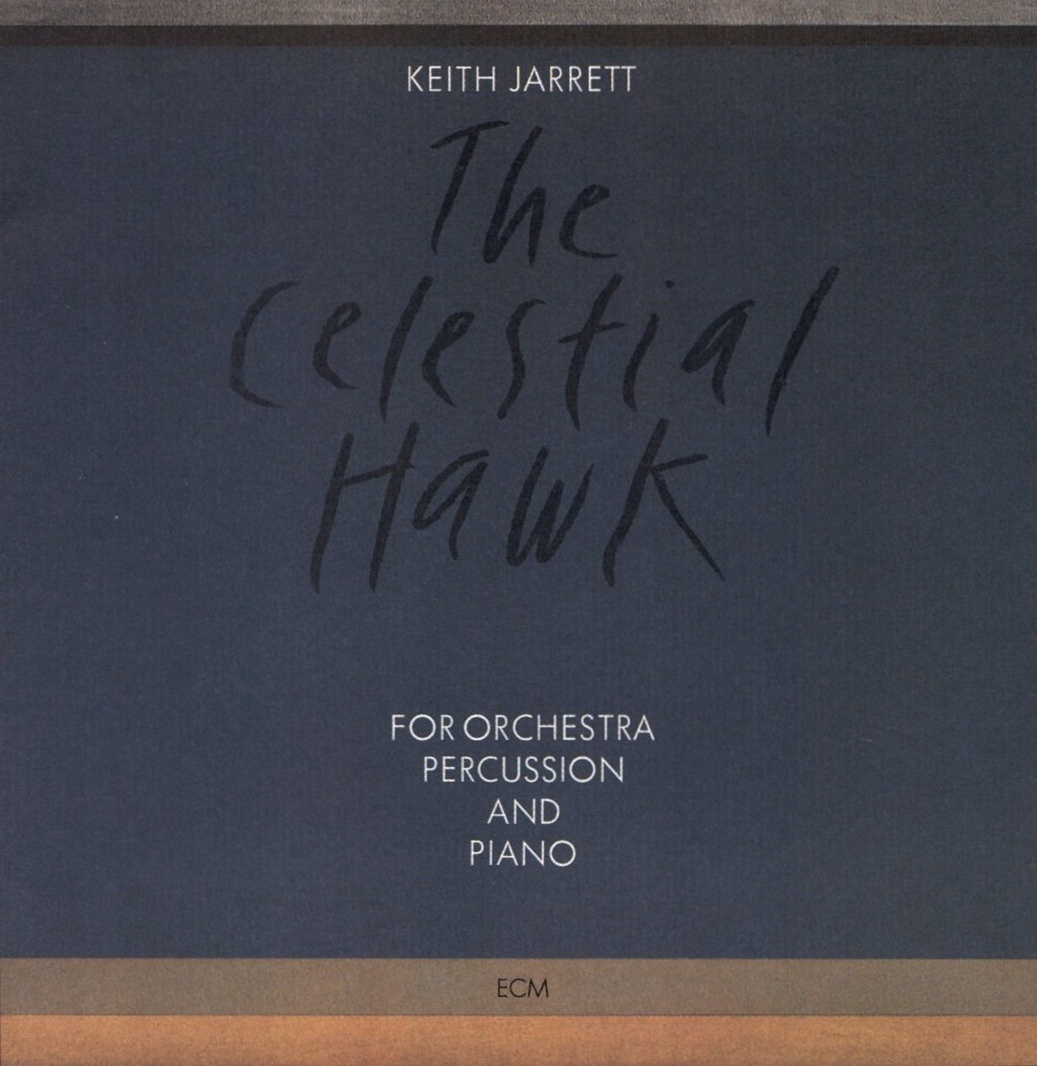
Keith Jarrett: The Celestial Hawk (ECM 1175)

Keith Jarrett
The Celestial Hawk

Keith Jarrett piano
Syracuse Symphony
Christopher Keene conductor
Recorded March 1980, Carnegie Hall, New York
Engineer: Stan Tonkel
Produced by Manfred Eicher and Keith Jarrett

Keith Jarrett’s classical modality often comes across to me as a dark pastoral, a variegated tapestry of intensity and withdrawal. And while The Celestial Hawk may be no different in this regard, it promises some brighter discoveries upon deeper listening. Against a gentle backdrop of percussion that includes timpani, snare, and triangle, Jarrett deploys his tiny fleets of high notes in the First Movement, out of which arises a delicate harp ostinato, doubled by piano and accentuated by woodwinds and strings, as a crystalline glockenspiel slowly clouds into less translucent ores. After a deep surge, Jarrett rows us into calmer waters alone at the piano, where dolphins in the forms of harp and mallet percussion soon join him. The Second Movement offers up the most cinematic passage of this piece. One can feel its images running, skipping, and emoting through lives unseen. We never stay in one thread for too long, for each is picked up by another into which the previous one has looped itself. The martial snare and cavalrous brass of the Third Movement glisten with the patriotism of an undiscovered country, bound to a manifest destiny in which walking is like flight. From behind the uplifted curtain, horns dance for us a message to prosperity. And yet even as the twilight descends, the oboe threads a ray of moonlight through the waters, bringing with it all sense of time for which beauty is but an afterthought to the truer beauties of slumber, where life ends in a crashing gong.

Despite being very programmatic, this music is far more than incidental to the narrative it describes. At times tumbling in billowy romance, at others even jarringly uncomfortable, Jarrett’s piano embraces itself, following the orchestral advice that surrounds it to the letter. It is an honest music, a painful truth, a call for peace in a violent world.

<< Keith Jarrett: Sacred Hymns of G. I. Gurdjieff (ECM 1174)
>> John Clark: Faces (ECM 1176)

Keith Jarrett: Sacred Hymns of G. I. Gurdjieff (ECM 1174)

ECM 1174

Keith Jarrett
Sacred Hymns of G. I. Gurdjieff

Keith Jarrett piano
Recorded March 1980, Tonstudio Bauer, Ludwigsburg
Engineer: Martin Wieland
Produced by Manfred Eicher

The exact date on which George Ivanovich Gurdjieff was born into this world is unknown. This is fitting, for to one who spent his life trying to unravel it, such mundane details would have been unnecessary in the grander scheme of things. Born in Armenia to a Greek father and Armenian mother, Gurdjieff traveled the world in search of fabled monasteries and the secrets they contained. Unlike many before and since, he succeeded. Yet more unlike many before and since, he packed that knowledge into his somatic consciousness until it burst like a supernova. Biographer John Shirley likens the Gurdjieff encounter to a cold shower, “a welcome shock of wakefulness” that leaves its deep, indelible traces in body and soul. Music was the dark matter of his cosmology and operated at the whim of an inarticulable law by which the listener felt compelled to turn oneself inside out, loosing previously bottled emotions into the open stars. Music was vibration, and vibration was life itself. In the hands of an artist like Keith Jarrett, I daresay it becomes something more.

Composed during Gurdjieff’s so-called “second period,” the music on this album arose from a fruitful block of the 1920s, which saw him and Russian composer Thomas de Hartmann together producing a treasure trove of melodies drawn from various folk music traditions and Russian Orthodoxy. The resulting selections are understatedly suited to Jarrett, spun as they seem to be from the kindred methodology behind his own solo improvisations, which construct from the ground down glorious caverns of sound, melody, and spirit. The strains of “Reading Of Sacred Books,” for example, unfold ever so gently, and yet rather than unveiling new territory simply open more and more doors within, each the mirror to a different face of our psyche. Ceremony and despair share the same sky; exaltations and poverty, the same ground. Each of these living moments winds itself like a string around the finger of spiritual forgetting. Jarrett negotiates these stark contrasts, and the connective tissue between them, with unwavering attention. Just listening to the brilliance with which he dialogues the punctuations of “Hymn To The Endless Creator” with the Debussean meditations of “Hymn From A Great Temple” and “The Story Of The Resurrection Of Christ” is wonder in and of itself. “Holy Affirming—Holy Denying—Holy Reconciling” perfectly describes the tripartite process of becoming that Jarrett enacts throughout, leaving us suspended in the final “Meditation.”

From the titles alone, one might think of these pieces as incidental music, when in fact the music is its own ritual, a collection of hymns to itself in a mise-en-abyme of faith. It is a multifaceted jewel of loosely bound energy that finds joy in emptiness. With due assurance and temerity, Jarrett proves it’s not music that is its own religion, but religion that is its own music.

<< Ralph Towner: Solo Concert (ECM 1173)
>> Keith Jarrett: The Celestial Hawk (ECM 1175)

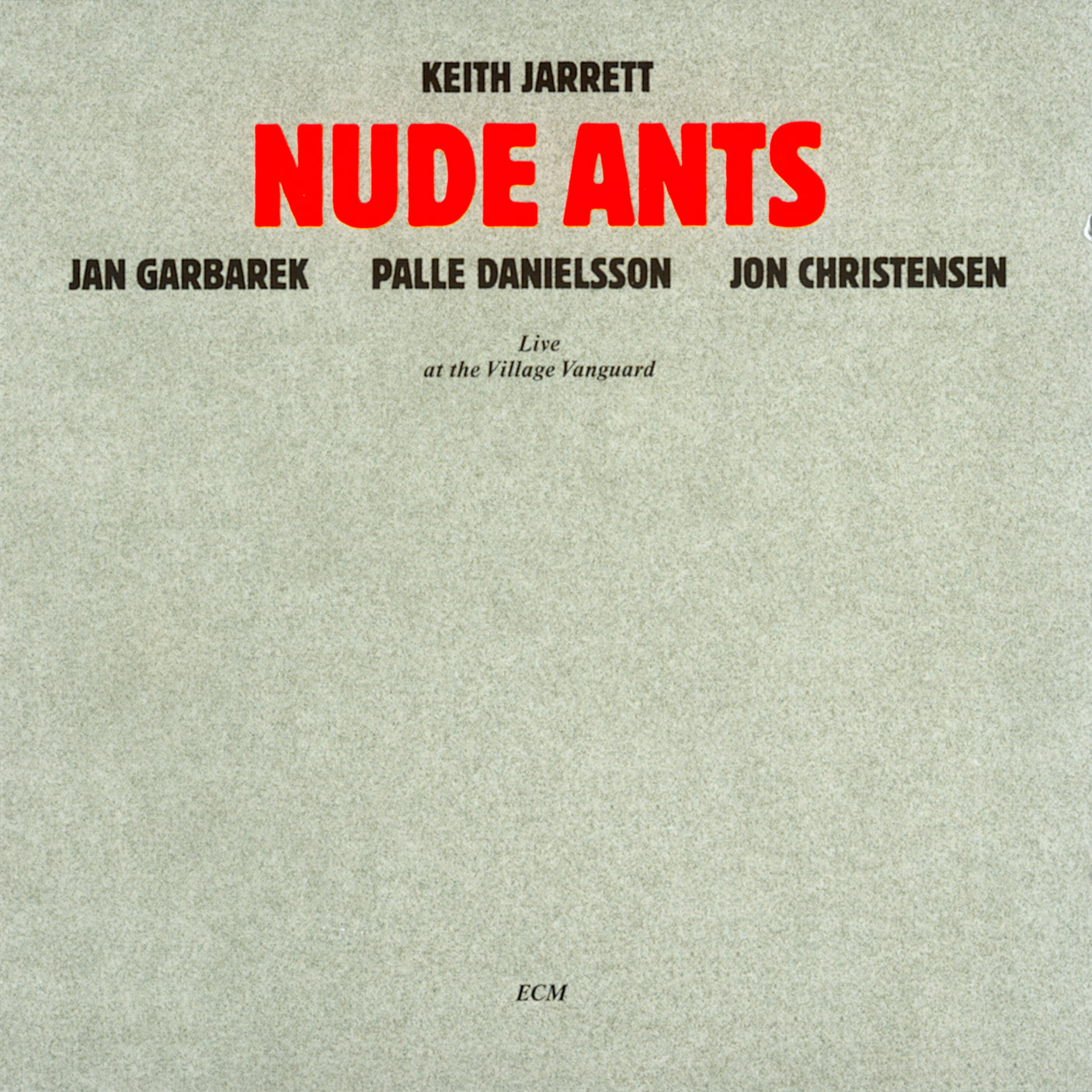
Keith Jarrett: Nude Ants (ECM 1171/72)

ECM 1171_72

Keith Jarrett
Nude Ants

Keith Jarrett piano, timbales, percussion
Jan Garbarek saxophones
Palle Danielsson bass
Jon Christensen drums, percussion
Recorded May 1979 at the Village Vanguard, New York
Engineer: Tom McKenney
Produced by Manfred Eicher

Something about Keith Jarrett’s very presence seems to draw out from even the most highly regarded musicians unexpected levels of performance, commitment, and above all faith in the musical moment. Nude Ants, easily one of his most uplifting live dates (this time at the Village Vanguard) on record and the pinnacle of his quartet activities, exemplifies this to the nth degree.

In its European incarnation, Jarrett’s menagerie of yesteryear opens its gates quietly and smoothly with “Chant Of The Soil.” Jarrett digs in alongside one of the most engaging rhythm sections one could ask for (Palle Danielsson and Jon Christensen). The liveness of the performance comes across early in “Innocence.” Amid clinking glasses and the even more cacophonous spirits of appreciation of those drinking from them, an enthralling intro from keys tosses Jan Garbarek’s exposition like a salad of bright energies. The moonlit “Processional” burrows beyond the trappings of a ballad and into a cavernous subconscious. Jarrett’s singing teases out a vivid pedal point as he punches chords like ecstasy’s time clock before floating off in reverie.

The second half of this heavy loaf slices much like the first: in slabs of wing-beats and half-words. Garbarek shines in “Oasis,” his reed shawm-like and opaque, as he wrenches out some of his most ecstatic high notes on record. Out of this measured catharsis Jarrett waters his colors in a solo tour de force. After the upbeat “New Dance,” the drawl that begins “Sunshine Song” is hardly enough to keep the band from pulling back a slingshot of dynamism and hurtling its contents skyward. Mounting intensities from Christensen underscore a fluttering resolution. And yet, as with everything in this set, it is tempered by an intense feeling of perpetuity that renders every potential end into a pathway of renewal.

In spite—if not because—of the idiosyncratic strengths of its performers, this is ensemble jazz at its freshest. Jarrett’s vocal leaps are nearly as adventurous as his fingers, proving once again that such passion cannot be contained in a vessel so modest as the human lung. Garbarek lets loose in ways seldom heard outside of Sart, while Danielsson and Christensen are so good together that I would be nearly as content listening to just the two of them for the entire set. Everyone here is aflame. Together, they light the world.

An indispensable classic.

<< Haden/Garbarek/Gismonti: Folk Songs (ECM 1170)
>> Ralph Towner: Solo Concert (ECM 1173)

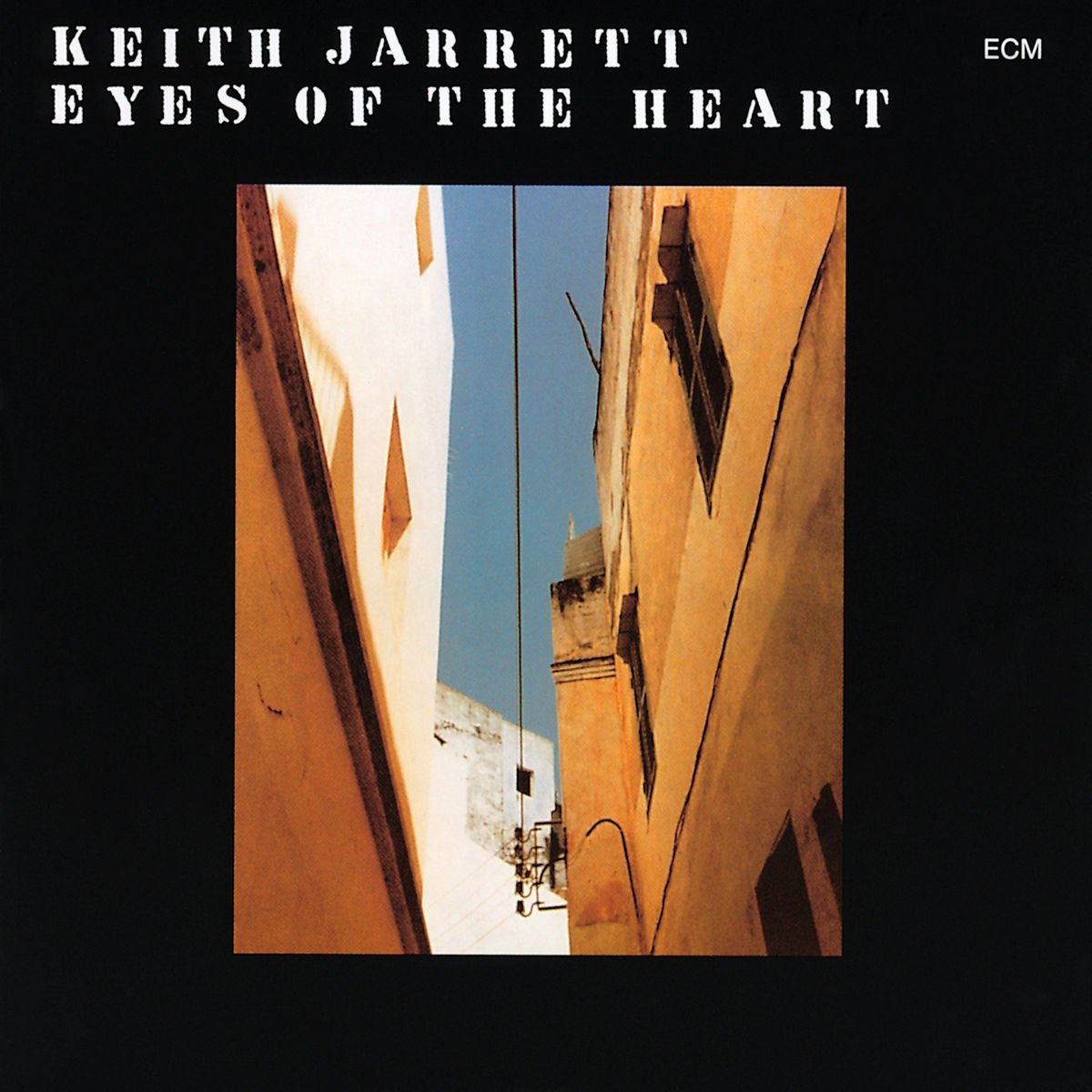
Keith Jarrett: Eyes Of The Heart (ECM 1150)

ECM 1150

Keith Jarrett
Eyes Of The Heart

Keith Jarrett piano, soprano saxophone, osi drums, tambourine
Dewey Redman tenor saxophone, tambourine, maracas
Charlie Haden bass
Paul Motian drums, percussion
Recorded May 1976, Theater am Kornmarkt, Bregenz (Austria)
Engineer: Martin Wieland
Produced by Manfred Eicher

With Eyes Of The Heart, musician’s musician Keith Jarrett landed one of his last American Quartet flights. This live performance, recorded just one month after The Survivors’ Suite, is a journey of different stripes. Jarrett whoops with delight as he opens Part One amid a congregation of drums. The kalimba-like bass of Charlie Haden hops from one foot to another as Jarrett looses a soprano sax into the prevailing winds. Only later does the expected piano shine through his fingertips. Writ somehow large with modest articulations, his right hand brings gradual insistence until the melody and the moment become one, each frame sped into a moving image. Part Two begins with more lovely pianism, this time with grittier chording and the added sheen of Paul Motian’s kit work. An insistent vamp unravels Dewey Redman’s dazzling tenor, and cushions the applause that follow. The tripartite encore is an uplifting, jaunty exposition. Some fantastic drumming and elegant exchanges between soprano and tenor dim themselves silent before the altar of Jarrett’s concluding piano solo.

Just when I think I’ve encountered the extent of Jarrett’s immeasurable talents, he surprises me with an album like this. It’s always a pleasure to hear his peripheral instrumental work, for his talents at the keyboard transfer effortlessly to reed by way of our grateful hearts. Perhaps the title is more than just a metaphor.

<< Barre Phillips: Journal Violone II (ECM 1149)
>> Haden/Garbarek/Gismonti: Magico (ECM 1151)

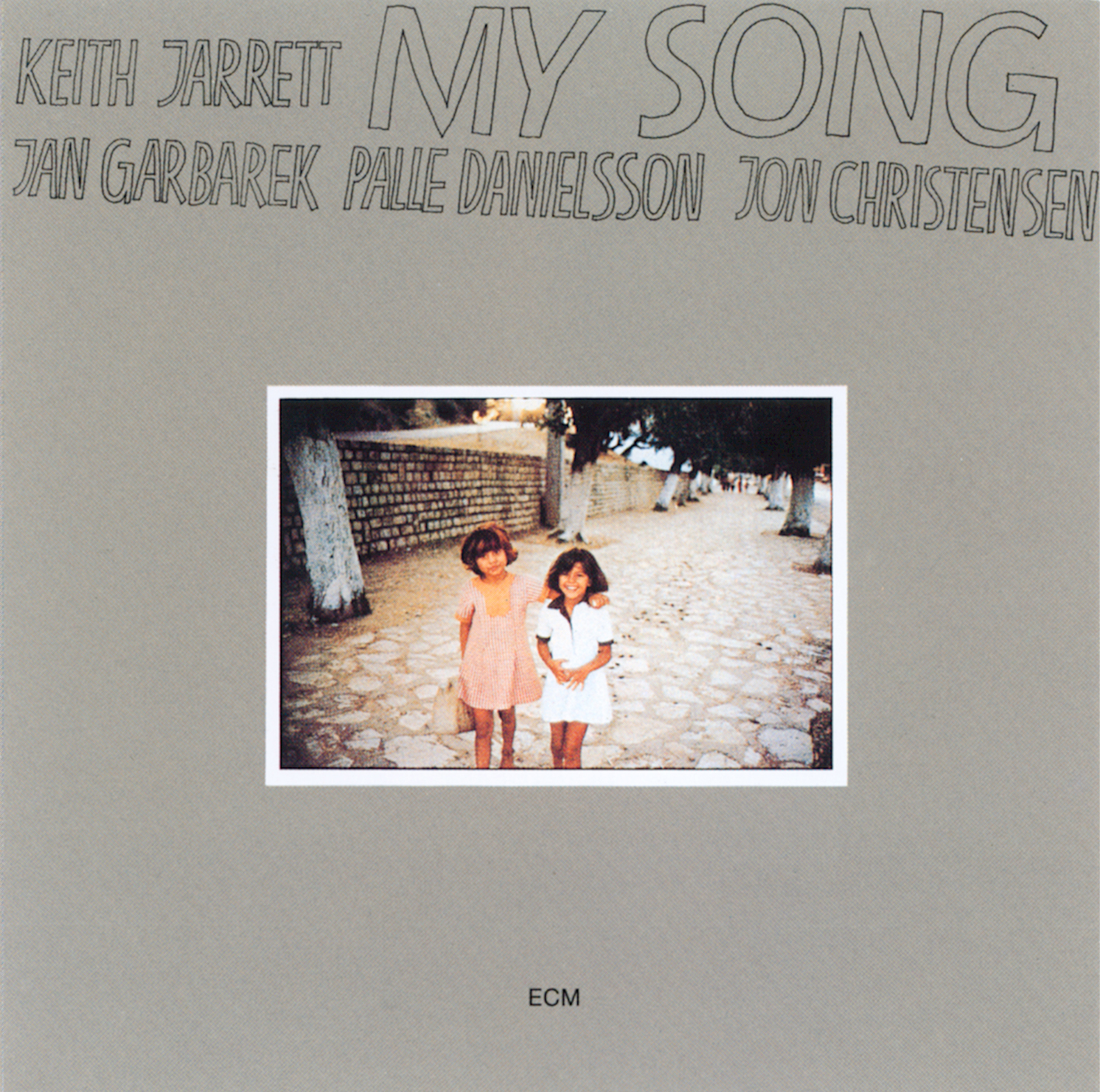
Keith Jarrett: My Song (ECM 1115)

ECM 1115

Keith Jarrett
My Song

Keith Jarrett piano, percussion
Jan Garbarek tenor and soprano saxophones
Palle Danielsson bass
Jon Christensen drums
Recorded November 1977 at Talent Studio, Oslo
Engineer: Jan Erik Kongshaug
Produced by Manfred Eicher
From the moment we step into the transport of Keith Jarrett’s European quartet, we know we are in for a comforting ride filled with lush scenery and temperate climes. “Questar” opens this set of six Jarrett originals by unfolding a melodic altar for the saxophonic offerings of Jan Garbarek, who trades prime invocations with Jarrett in a formula that pervades the rest of the album to great success. The gorgeous title track, in which we encounter a slightly mournful but always majestic invocation, widens the music’s embrace. Garbarek’s pleasing yet incisive tone works wonders and continues to lead the way in “Tabarka,” where nostalgia shares its berth with the dripping shadows of resolution, and which protects the Michael Naura-like buoyancy of “Country” like a dome over Palle Danielsson’s wonderful solo on bass.

Jarrett cultivates the talents of his fellow musicians in a garden rife with unique hybrids. While his left hand is firmly rooted in the soil of his rhythm section, his right seems to frolic in the rain that nourishes it, changing from liquid to gas and back to liquid in a perpetual cycle of self-renewal. He comes across as nothing less than perfection, sharing in this democratic spread of passion. The colorful scatterings of his solo in “Mandala,” for example, are made all the more so for the fantastic rhythm section backing him every step of the way. As Jarrett peaks with intensity, Garbarek arches his back like a sun flare, a whip cracking silently through time-space in slow motion, giving us an aftertaste of the Norwegian reedman at his early best. During another rich bass solo, Jarrett plucks the strings inside his piano as if to defuse the epiphany. After this palpable spurt of energy, “The Journey Home” breathes a sigh of relief and provides the album’s most gorgeous turns from Jarrett. Fluid as his song, his voice basks in the sunshine. Not to be outdone, Garbarek matches this elegiac acuity, at last fading into brushed cymbals.

The music of Keith Jarrett was already highly sustainable long before the concept became an obligatory buzzword. With My Song he brings that personal ecology in fullest force. Garbarek hardly sounds better than he does alongside the discerning piano man, and is here soulful, restrained, consolatory but also insistent, and never afraid to let loose once in a while. These are musicians bound by trust, which they express with every pellucid turn of phrase they utter on an album that represents one of ECM’s most stunning dates of the seventies.

<< Pat Metheny Group: s/t (ECM 1114)
>> Egberto Gismonti: Sol Do Meio Dia (ECM 1116)

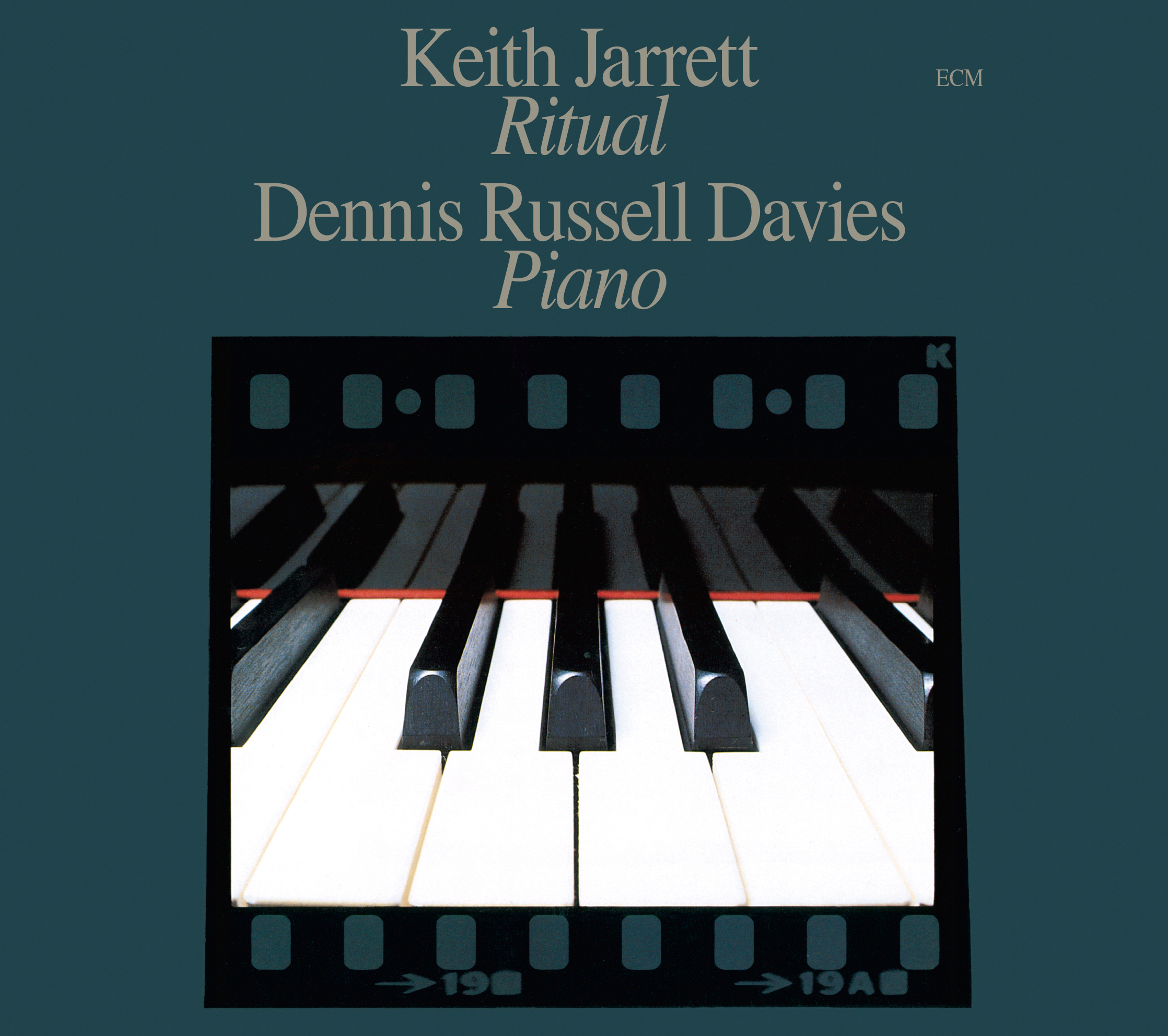
Keith Jarrett: Ritual (ECM 1112)

1112 X

Keith Jarrett
Ritual

Dennis Russell Davies piano
Recorded June 1977 at Tonstudio Bauer, Ludwigsburg
Engineer: Martin Wieland
Produced by Manfred Eicher

Ritual is something of an anomaly in the Keith Jarrett archive. It’s a solo album, as many of his best are, only this time it is pianist, conductor, and frequent collaborator Dennis Russell Davies at the keys playing a work penned entirely by Jarrett. The hallmarks of a Jarrett piano recital are all there—the rolling ostinatos, dense arpeggios, and profound doublings—yet are valenced differently under the rubric of “composition.” In this context, we get a sense of “once removed-ness” that might not present itself under improvisational circumstances. The piece’s modest 32 minutes are divided into two immodest parts. From the opening groundswell we get not only dense pockets of energy, but also nodes of emptiness. Put another way: the music’s glorious peaks share the same space as the shadowy valleys at their feet, thereby encompassing a harmonious middle ground. Like a geyser, its eruptions are predictable yet manage to enthrall every time. Despite its claustrophobic beginnings, Part 1 ends in bright solitude, like a room in which the curtain has been slowly opened to welcome the morning sun. Heavier chording marks Part 2, which resolves in a hopeful melancholy, but not before gelling the emotional plasticity of its precursor. This brings us full circle, ending on a solemn intonation of a single note.

Ritual is far more “regulated” than typical Jarrett fare, spun as it is from the surrogacy of another performer rather than through the alchemy of spontaneous creation (though there is, of course, some of each in the other). The results are captivating in their own way, stoked by every depressed key and lifted pedal. Its shapes are drawn not by what is, but what has been and will be. The present is invisible and lives on only as formless possibility, caught like a blown kiss in the cup of one’s hand.

<< Gary Burton: Times Square (ECM 1111)
>> Tom van der Geld and Children At Play: Patience (ECM 1113)

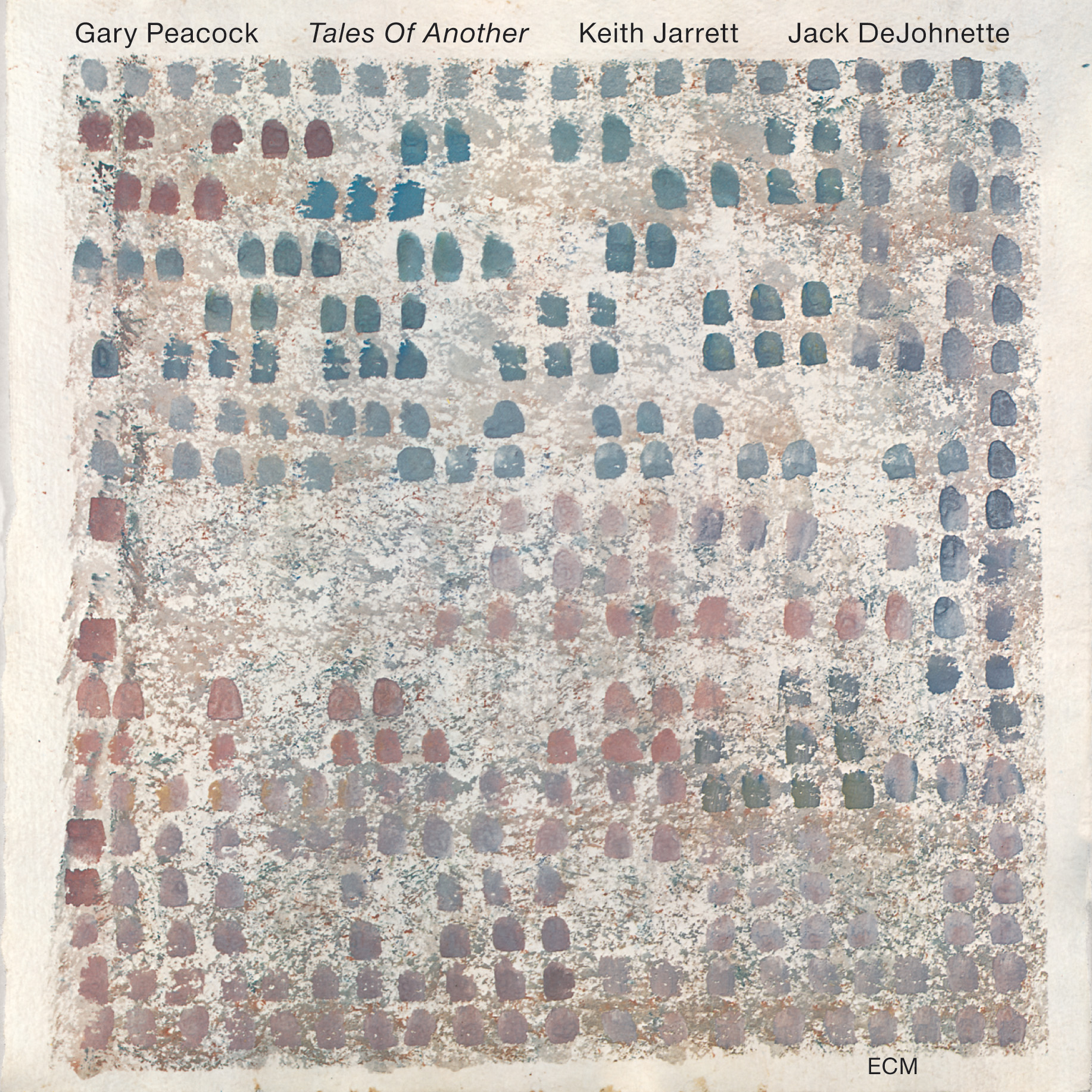
Gary Peacock: Tales Of Another (ECM 1101)

ECM 1101

Gary Peacock
Tales Of Another

Gary Peacock bass
Keith Jarrett piano
Jack DeJohnette drums
Recorded February 1977, Generation Sound Studios, New York
Engineer: Tony May
Produced by Manfred Eicher

The grouping on this album represents a milestone in ECM outfits, persevering to the present day as it has in the form of Keith Jarrett’s mighty standards trio. Though a far cry from the ecstatic overloads honed over years of synergy and touring, there is an almost naïve charm to this effort and the evenhanded musicianship that sustains it. Each of these six “tales” begins in loveliness. Piano and bass bring the most urgency to bear, as in the gorgeous “Vignette,” in which Peacock gets his first lilting solo, and its follow-up, “Tone Field.” Both start off slow and sure, with DeJohnette giving the barest hint of traction and Jarrett biting deeply into fractured themes. “Major Major” gives us the steady beat we crave beneath majestic chording from the piano man, who offers up a prime slab of linear sirloin. Yet the album’s juiciest sediments can be found in the massive “Trilogy” that makes up its second half. DeJohnette skirts the rims with requisite flair while Peacock slathers on a bright veneer. Jarrett grunts ecstatically with every new development, shooting fire from his fingers. Such is the energy one has come to expect from this nonpareil threesome. Jarrett cuts off our air supply before the final stretch, the hair-trigger precision and on-your-toes syncopations of which make this pensive journey more than worth taking.

Peacock’s moody compositions make for a strikingly different experience. His fingers pull with accomplished ease at the strings of his bass. DeJohnette sticks to the margins, but fills them like no one else can. Jarrett, it might be noted, is more vocal here than I’ve ever heard him. For many, this seems to be the album’s only downfall. As far as this listener is concerned, his woops, grunts, and squeals merely underscore a musician who is unafraid to let his heart sing.

<< Keith Jarrett: Sun Bear Concerts (ECM 1100)
>> Kenny Wheeler: Deer Wan (ECM 1102)

Keith Jarrett: Sun Bear Concerts (ECM 1100)

ECM 1100

Keith Jarrett
Sun Bear Concerts

Keith Jarrett piano
Recorded November 1976 in Japan
Engineers: Okihiko Sugano and Shinji Ohtsuka
Produced by Manfred Eicher

Before beginning this review, I imagined writing one line and one line only: Let the music speak for itself. And while such a move does have a certain charm, if not arrogance, I can only hope that the following attempts to transcribe what Keith Jarrett’s Sun Bear Concerts say to this listener might convey even the humblest fraction of the wonders therein. Over the course of two weeks in November of 1976, Jarrett laid his hands to keys in seven major Japanese cities for an historic series of improvised concerts (not all of which are included in this recording). The result was a 10-LP set, now telescoped to six CDs, that must be heard to be believed. Within this modestly typographed grey box beats one of ECM’s profoundest creative hearts. In light of this, a more fitting line might read: Keith Jarrett is music itself. Let it only be the beginning.

Kyoto, November 5, 1976
Part 1 opens in absolute heaven with I daresay the most spellbinding music ever elicited from a piano. Like all such things, it grows all the more affecting as it transforms into something else entirely. Jarrett introduces some jazzier ornaments into these tectonic elegies until he reaches what sounds like a Philip Glass motif broken open, maps drawn from its essence in half-note rolls. Expulsive chording animates this newborn organism with premature self-awareness. This is music to make one weep, for like tears it drips from the eyes and tastes like the sea. With patience, it becomes ecstatically uplifting, scaling a virtual ladder of Steve Reichian phases before plunging into an exhilarating vamp over which Jarrett sings and dances his blissful way. Every rise and fall is vividly etched into our minds as he articulates the grace that so consumes him. He begins to tread water, taking in his aural surroundings like a compass simultaneously pointing in every direction. He dives deep into the notion of depth itself, where sounds are muted as much by the water as by the careful transparency that defines it. With every sweep of a cupped hand, every kick of a calloused foot, we are brought nearer a world where sound takes the place of air. His fingers seem to double their strength in numbers, spreading wide with ecstatic cause, all the while reliving a poignant memory in reverse.

Part 2 brings us into a noticeably more resonant space, and is like multiple radios broadcasting some morbid ragtime catharsis. This music is as good an example as any of how everything that Jarrett does is also done to us. We are flexed, tumbled, turned, and reconfigured at every moment, an endless series of resurrections throughout which one desires no particular body. Jarrett’s tender singing buoys every kinetic gesture. His fingers stretch like wisps of cloud and harden into a giant’s hands. Like Scrabble tablets knocked from their board, the numerical value of every letter becomes meaningless as it slips into a linguistic black hole, in which only the sound of applause echoes like a faceless totem in the audible universe.

Osaka, November 8, 1976
Part 1 is loosely enfolded in time, leaning nostalgically into the forgiving winds of its own recollection—running, tripping, falling, and pulled up every time by strings of hope. It is a persistent hunger that feeds on itself. It pauses to regroup and redeploy, coalescing like a breath into voice. The pianism here breathes organically, shaping itself through a bridge of chemical interaction that connects the physical and cosmological worlds. Jarrett rests in familiar territory while the lead runs off on its own scavenger hunt, bringing back one melodic treasure after another. His creative energy seems inexhaustible in such moments. One begins to appreciate the continuity of his art, for pauses stand out with such weighted clarity that they remind us we’ve been listening to an unbroken stream all along. The music develops into a rolling vamp in which Jarrett foils his own precision with that of chaos. His playing soon plateaus, shaving one hair-thin layer after another from his cartographic imagination as it falls into a Gurdjieff-like trance. From this delicate weave he tears out an image like some consonant idol, only to stagger on dissonant legs into solitude with the resoluteness of a vibrating string coming to rest. Like the vocal articulations that emerge toward the end, this music is guttural and scrapes deep inside a barrel of emotional reserves before ending on a luscious chord, one note suspended from every fingertip like a celestial ornament.

Part 2 begins with a parallel statement from both hands, spreading out ever so slightly like an infant fractal into its implied harmonies. After a cry-inducing peak, Jarrett falls into lilting runs that are variously robust and crumbling. With the quiet revelry of self-discovery, Jarrett crosses boundaries here like identities, each traversal bringing with it a new fear of discovery. It is the fear of the known over the unknown, the lighthouse beyond which one perseveres through adversity, and yet in which is encapsulated all possibilities of being lost. These gorgeous but terse meditations open like an ever-evolving gift before suddenly breaking into an airy enlightenment, bringing with them a hope one never knew existed. The end flutters like the wingtip of a bird loosed from the edge of our half-sleep.

Nagoya, November 12, 1976
In Part 1, not only does Jarrett draw upon his travels, it seems, but also creates new ones as they happen. This music begins in a tighter embrace, coalescing around the piano’s middle range, so that when high notes begin cutting through the fabric of our attention with solid ether, we feel them acutely: a tingle in the spine, a twinge at the back of the brain, a skip in our heartbeats. Jarrett traverses quieter waters, catching the errant melody in his net. The atmosphere is as meditative as that of Osaka and achieves this state through a buildup of energy, the release of which is found in its continual accumulation. With every layer peeled, we come closer to an anthemic center, through which is articulated an oceanic expanse of memories. Some of these are playful, others cumbersome, but all deeply informative of the present moment as a subjective portrait of the music personified. We emerge from this jaunty reverie clad in new aural garments, sewn by a melodic other.

Part 2 reclines with anticipatory passion in an extended introductory ballad. Jarrett is in particularly astute form here, finding in every note the potential for a thousand more. In his simplicity breathes a host of surrounding narratives, each more involved and more historically minded than the last. With this performance, Jarrett shows that even at his most contemplative moments he is all fire. As he seesaws between lower and higher registers, he lapses into transcendental flutters, as if to interrupt our rest with the promise of transmigration. It is a reserved and careful path, but one in which footsteps leave permanent marks of their passage. It is the stories that press them into the earth that are ephemeral, forever lost among the vestiges of diaristic instincts.

Tokyo, November 14, 1976
As if to mimic the geography of his travels throughout Japan, the music finds its own capital in Part 1, fleshing through a long and varied history the deepest heart of the metropole. From gentle beginnings Jarrett tells an inspiring tale of youth gone awry, of love cut short and most unexpectedly reformed, and of the undeniable art these tribulations birth through the performative moment. Over one of his most engaging ostinatos, which he pulls and stretches to its utmost capacity, Jarrett paints a forest of faces opening their mouths without speech. Over time, the trees blend into a more flirtatious musical energy, unfolding in what I can only describe as a passionate aggression into an ecstatic and heartwarming ending.

Part 2 unfolds like a vision and may very well change the way you look at the world, as it describes even the most familiar things with a profound sense of renewal and supreme awareness of the illusory nature of reality. Jarrett’s right hand is like a memory encroaching upon the present of the left, until both become unified in an invisible story. It is a story that can be told only once. Though Jarrett locks himself in a confined space, he flirts with anarchy through anthemic modalities, alternating between heavy arpeggios and even heavier punctuations, and ending in a chaotic resolution toward that last uphill climb.

Sapporo, November 18, 1976
Part 1 begins in flame, glowing like a candle in the window that is so far away it appears as a star. Jarrett locks himself into loops upon loops. These are not periods of indecision, but simply felt as they are felt. At once romantic and mechanical, his sound opens in a captivating sustain-pedaled passage. With equal ardor, it is arrested by a damper just as the intensity gels with magnificent density. It is knocked over like an ink bottle onto the parchment of a somber ballad. The ends of the piano curl in on themselves like a quantum leap through musical space-time as they fall into galactic slumber.

Part 2 paints a funkier sky, brimming with hope and lithe exuberance. Its bittersweet resolution is tempered by a premonition. Such are the moments in which Jarrett is at his most vocal. As the energy diffuses, it unleashes a selfless stream of consciousness. We become privy to a deeper current of animation. We ignore the stumbling blocks at our feet and touch the sky with our hands instead. And as our bodies dissolve into light, we become the sounds that shaped our physicality in the first place. All that’s left of us is a single image of childhood, balanced ever so precariously at a cognitive cusp. From it, we fashion a new one, repeating this process until we are spent.

Appended to these epic journeys are a few possible destinations in the form of three encores. Sapporo is another minimal yet meditative juggernaut. A constantly finger-pedaled C hardwires itself into every exaltation. Tokyo is a heartrending 8-minute experience, throughout which sadness becomes the most harmonious aspiration we can think of. One would be hard pressed to uncover a more magical moment in the Jarrett archive. Nagoya walks a similar path, taking a familiar chord progression and turning it into a ritual object, this time fading in a series of spaced chords, for which there is only stillness as altar.

This set is dearest to my heart, not only for the music it contains but also for having been performed in a country throughout which I have traveled extensively and which has dominated my creative and academic interest for years. I can almost feel the pulse of every city in which he performs (my feet have left their ephemeral prints on all but Sapporo), sharing in the unique atmosphere of each. A bit romantic, maybe, but a reaction I cannot help but nurture every time this music graces my ears. And while location need not necessarily inhere itself into any musical happening, I do feel there is a distinct quality to these Japan performances. One can feel it in the rapt silence with which Jarrett’s audience shows appreciation throughout, in the cathartic applause and appeals for encore.

The Sun Bear Concerts prove that not only is Jarrett an unparalleled improviser but a melodician of the highest order. These pieces are consistent in their striking differences, yet all seem couched in a palpable melancholy that is striated with joy. Despite the sheer volume of music that seems to reside in Jarrett’s entire physiological being, one gets the sense after listening to these six-and-a-half hours of brilliance that they comprise but a single molecule of creation dissected and slowed to discernible speeds. At least we, at this moment in time, can witness these atomic paths, knowing full well that their beauty lies in an allegiance to silence. Not a single note ever feels out of place, because it has no place to begin with, except as the emblem of that which is gone before it arrives.

If you ever buy only one recording of Keith Jarrett, look no further. Then again, why stop here?

<< Taylor/Winstone/Wheeler: Azimuth (ECM 1099)
>> Gary Peacock: Tales Of Another (ECM 1101)

Keith Jarrett: Staircase (ECM 1090/91)

ECM 1090-91

Keith Jarrett
Staircase

Keith Jarrett piano
Recorded May 1976 at Davout Studio, Paris
Engineer: Roger Roche
Produced by Manfred Eicher

Staircase is Keith Jarrett’s fourth solo piano album for ECM, and his first after the previous year’s Köln Concert. In contrast to his earlier studio effort, Facing You, Jarrett elides romantic titles in favor of four singly marked suites in this entirely improvised studio session. Like every carefully chosen word of a William Carlos Williams verse, Jarrett’s equally lyrical insights plough to the heart of the matter like no others.

The title work gives special insight into the pianist’s improvisational process. Atop a foundation of steady syncopation, he constructs a helical tower. Rather than expanding it into a broader sound palette, however, he works his way into every crevice. Ever the master builder, he approaches melodies as if they were bricks to be laid. Upon these he takes careful steps, taking care to rest his fingers upon ivory like toes upon stone. And though he may stumble, there is always a counterbalancing action waiting in the wings, swooping down like an owl from the rafters, pulling a thread in its break to that final microscopic strand.

While Jarrett often works wonders with variations, in the first part of “Hourglass” we also experience the reverse. With great vibrancy, he rolls through its spiritual-infused fields like a child tumbler. Yet this is only a prelude to Part II, in which the ecstasy of elegy blinds us with its 14-minute plenitude. Jarrett’s crisp yet fluid arpeggios run across the keyboard with the fullness of a life that has much to give still. Every note in the left hand is a feather tested by the heavy air of the right. And as every utterance floats ever so gently to the waters below, it traces a zigzag of arcs in the winds of our slumber.

Like the angled shadow of its eponymous timepiece, Part I of “Sundial” appears still when we look at it directly, and only seems to move when we do not. It is at once frozen and highly animate, pulling existence forward with every intangible revolution. Jarrett sings with a genuine croon, holding his breath through the keys. This music is his respiration, and he concludes it on a forgiving sigh.

The three-part “Sand” rises in large handfuls before being thrown into the air. We listen, enthralled, as Jarrett scours the landscape, picking up every last grain. He places them into the hourglass, which he rests on a nearby sundial before ascending the staircase out of sight.

Though difficult to spot in the shadows of other many fine solo outings, there is an essential quality to Staircase that one rarely finds in the confines of a studio. Jarrett accomplishes something much greater than music here, flushing out details like a biological organism developing in reverse, so that by the end we return to the music’s infancy, where the corruptions of a nurturing world fail to wreak havoc on a tender mind. There is a method to his seeming lack thereof, and its name is “now.”

<< Egberto Gismonti: Dança Das Cabeças (ECM 1089)
>> The Gary Burton Quartet with Eberhard Weber: Passengers (ECM 1092)