Kenny Wheeler: Gnu High (ECM 1069)

ECM 1069

Kenny Wheeler
Gnu High

Kenny Wheeler fluegelhorn
Keith Jarrett piano
Dave Holland bass
Jack DeJohnette drums
Recorded June 1975, Generation Sound Studios, New York
Engineer: Tony May
Produced by Manfred Eicher

Kenny Wheeler’s ECM debut cut against the grain of his previously avant-garde stylistics. Dispensing here with his trusty trumpet for fluegelhorn, Wheeler carved out a niche that still leaves room for no other. The heartening tone of “Heyoke” animates our very bodies with 22 minutes of bliss. After Wheeler’s prophetic intro, Jarrett is given free reign at the keyboard, uttering ecstatic cries as he threads through Holland’s solo while also buoying Wheeler’s instinctive pickups. “Smatter” injects this trio of compositions with a hefty dose of kinetic energy that is sustained by Wheeler’s fluid brass and the tireless volleys of Jarrett. Even as the latter takes his lone passage, one feels the energy lingering like a potential leap into flight. “Gnu Suite” begins smoothly before locking into a downtempo trajectory. An unrepeatable magic occurs as Holland’s magnetic solo opens into the wider ethereal territory of his bandmates’ consecutive reappearances. And as the voices realign themselves, we feel the release of arrival, of knowing that we’ve come home.

One could hardly smelt a more fortuitous combination of musical alloys, which in spite of (or perhaps because of) their intense respective powers, manage to cohere into a consistently visionary sound. Jarrett only seems to get better in the presence of others (this was to be his last album as sideman), feeding as he does off their energy and vice versa. Wheeler is another musician who easily stands his own ground, yet imbibes only the most saturated elixirs of mindful interaction. And I need hardly extol the wonders of having Holland and DeJohnette covering one’s back. Gnu High stands out also for the fact that many of its solos occur alone, so that we are able to place an ear to the heartbeat of every musician in turn. Their internal compasses share a magnetic north, pointing to a direction in sound that continues to drive the label some three-and-a-half decades later.

<< Terje Rypdal: Odyssey (ECM 1067/68)
>> Keith Jarrett: Arbour Zena (ECM 1070)

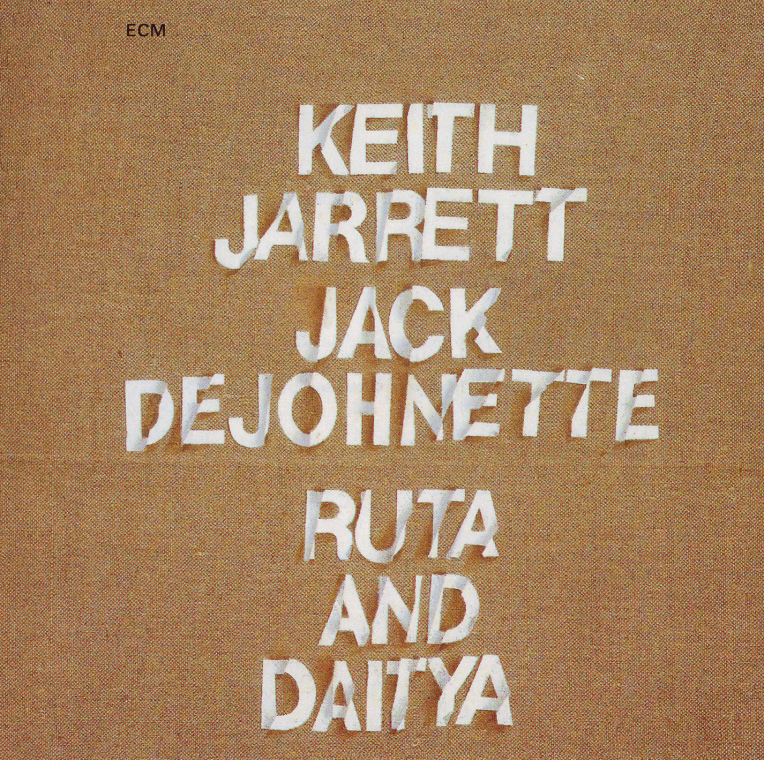
Keith Jarrett/Jack DeJohnette: Ruta and Daitya (ECM 1021)

ECM 1021

Keith Jarrett and Jack DeJohnette
Ruta and Daitya

Keith Jarrett piano, electric piano, organ, flute
Jack DeJohnette drums, percussion
Recorded May 1971 at Sunset Studios, Los Angeles
Engineers: Rapp/Wieland
Produced by Manfred Eicher

Keith Jarrett and Jack DeJohnette, who continue their formidable partnership to this day, join forces for an early and unique collaboration. This being the tail end of Jarrett’s electric period with Miles Davis, Ruta and Daitya marks an archivally important transition into his imminent acoustic pilgrimages. “Overture Communion” captures our attention from the start with a funky, wah-wahed electric piano, warmly guiding us into the album’s exciting, yet somehow always plaintive world. The title track shakes things up with a spate of hand percussion as Jarrett flutes a more abstract improvisation than the one that began the album, though to no less captivating effect. When Jarrett abandons flute for piano, a markedly different shape brands itself into the foreground. In doing so, something gets obscured. It’s not that instruments from such seemingly disparate geographies cannot tread the same path, but simply that they don’t speak to each other as complementarily. Thankfully, Jarrett’s return to flute, this time of bamboo variety, puts us right back into the conversation. DeJohnette takes up a standard drum kit for “All We Got,” a cut that runs around in circles, even as it rouses us with its gospel-infused aesthetic. Jarrett finds himself acoustically redrawn in “Sounds of Peru.” Piano and hand drums work magically this time around as the duo hones further the groove it has been searching for. Jarrett opens up his playing, giving DeJohnette a wider berth in which to lose himself. No longer do the drums skirt the periphery, but frolic in the territory proper. There is even what amounts to a percussion solo as Jarrett coos in the background with delight, thus preparing him for an inspired passage that grinds bass notes in counterpoint to his running right hand. In “Algeria,” Jarrett sings into the flute again, leaving me to wonder why we don’t hear him on the instrument more often, though perhaps its linearity is somewhat limiting to a musician with such expansive hands (hence, his propensity for polyphonic playing). “You Know, You Know” brings us full circle to the electric piano for a more laid-back coolness before we end with “Pastel Morning,” a beautiful meditation on the electric piano. In the absence of punchy distortion, it sounds almost like a vibraphone, its gentler capacities allowed to float of their own accord.

The album’s title is a curious one, and offers at best a rather opaque X-ray of the conceptual skeleton it sheathes. Ruta and Daitya refer to two island-continents, remnants of the second cataclysm to befall the great island of Atlantis. Both were populated by races of titans, known as “Lords of the Dark Face” as a means of indicating their ties to black magic. If we are to believe Madame Blavatsky, who in her second volume of The Secret Doctrine outlines their genealogical significance in her mystical, albeit highly racialized, account of creation, the Egyptians inherited the cosmological legacy of the Ruta Atlanteans, as supposedly evidenced in the similarities of their Zodiacal beliefs. Whatever the origins, there is much to ponder in Ruta and Daitya. The sensitive pianism for which Jarrett is so renowned is in full evidence throughout, though for me his flute playing really sells the album. Jarrett proves himself more than adept and plays with an addictive sense of abandon. DeJohnette, meanwhile, enchants with a melodic approach to his kit, especially in his use of cymbals.

ECM 1021 LP
Original cover

This isn’t an album I would necessarily recommend to those just starting their Jarrett or ECM explorations. For what it is—a meeting of two consummate musical minds—its importance is a given. While perhaps not as consistently inventive as other likeminded projects (see, for example, the phenomenal Charles Lloyd/Billy Higgins effort Which Way Is East), it is certainly more hit than miss, and strikes this listener with the ambitions of its musicians’ reach every time.

<< Chick Corea: Piano Improvisations Vol. 2 (ECM 1020)
>> Chick Corea: Return To Forever (ECM 1022)

Händel: Suites for Keyboard – Jarrett (ECM New Series 1530)

Georg Friedrich Händel
Suites for Keyboard

Keith Jarrett piano
Recorded September 1993, State University of New York, Purchase
Engineer: Peter Laenger
Produced by Manfred Eicher

Georg Friedrich Händel, ever the poster child of the high Baroque, is of course widely known for his large-scale oratorios and chamber music. One sad consequence of such a reputation is the negligence of lesser-known, though no less winsome, works in the composer’s catalogue. As pianist Keith Jarrett notes, “When audiences decide what they think someone is great at, they tend to undervalue other things that same someone does.” Händel actually composed twenty suites for keyboard, though only a handful—known as the “Great Eight”—tend to be grouped together with any regularity. Jarrett chooses four of these, in addition to three outliers, for a single disc filled to the brim with life-affirming music. His unique euphonic sensibilities represent a vivid attempt to rescue these significant works from our ignorance.

This is Jarrett’s finest Baroque recording on ECM. As much as I adore his stately and humbling Bach, one finds a markedly different approach in the Händel. There is a sort of exuberant intimacy that scintillates with Jarret’s every articulation, a solemn poetry that undercuts much of the flowery prose for which Händel is more often appreciated. The opening Allemande of the Suite in G Minor is characteristic of the whole, seeming to leapfrog Bachian counterpoint while maintaining its own melodic robustness. Indeed, the buoyancy of Jarrett’s Allemandes throughout distinguishes him from hunt-and-peck performers who seem content with relatively forced segregations of bonded lines. Each Suite tells its own story, complete with problem, climax, and resolution. The G Minor continues its meditations on the transience of the creative process, made all the clearer by the brief Gigue that closes it. The Suite in D Minor coats this resignation with translucent regret, working through the latter by retreating into one’s fondest memories, only to flee in a cowardly flash. Fortunately, Suite No. 7 in B-flat sings a more joyous song and lifts the spirit with its gorgeous trills and frolicking syncopations. Nestled in the album’s center is the Suite No. 8 in F Minor, where we find ourselves in a more funereal mode, regressing further and further into the childhood of the one we mourn. We recall that prime of life, when innocence and circumstance walked hand-in-hand to a music that was both familiar and beyond present understanding. There is only beauty to be had in Suite No. 2 in F. The recitative-like introduction of its Adagio gives us a glimpse of the vocal Händel in utero before launching into the album’s most compelling Fuga. Suite No. 4 in E Minor opens in a flower of ivory and jubilation, marking a confident path into the finishing Suite No. 1 in A, of which another resplendent Allemande and sprightly Gigue highlight the tropes so firmly embedded in the Suites’ overarching brilliance.

In the presence of Händel, Jarrett is in top form. He pours his telescoped dynamics, fluidity of playing, and impeccable sense of rhythm (shown to greatest effect in the mid-tempo movements) into an attentively ordered program of quiet splendor. One need bring expectations of neither composer nor performer, but simply bask in the music’s ability to work its way into the bloodstream of a stressful day.

<< Krakatau: Matinale (ECM 1529)
>> Jarrett/Peacock/Motian: At The Deer Head Inn (ECM 1531)

Bach: 3 Sonaten für Viola da Gamba und Cembalo – Jarrett/Kashkashian (ECM New Series 1501)

J. S. Bach
3 Sonaten für Viola da Gamba und Cembalo

Kim Kashkashian viola
Keith Jarrett cembalo
Recorded September 1991, Cavelight Studio, New Jersey
Engineer: Peter Laenger

The exact dates of Johann Sebastian Bach’s Sonatas for Viola da Gamba and Harpsichord are contestable. We do know they were composed sometime in the 1740s, making their unity as a set tenuous at best. Still, on their own, they glisten with the genius that bore them. Though more commonly played on the period instruments for which they were written, one may still find the occasional cello filling in. On this recording, we find a unique substitution in the viola, which shares hardly more than a name with its predecessor. This is accomplished by transposing any notes below the viola’s range, making for a relatively buoyant sound. Purists take note: this is, in my humble opinion, the finest interpretation of these much-recorded sonatas. Admittedly, this opinion is as much informed by the fact that it is the first I ever heard of these works as it is by the stellar musicianship that follows Keith Jarrett and Kim Kashkashian wherever they go.

The opening Sonata in G BWV 1027is a warm embrace of Baroque elegance. Jarrett captivates from bar one, his continuo providing bold bass lines as Kashkashian’s deeply sustained tones guide us through foggy waters. The second movement, while airy enough, manages to support its fill of weighty trills and rhythmic spontaneity. The Andante establishes an even tighter bond as Kashkashian dots the i’s and crosses the t’s of Jarrett’s solid arpeggios. A rather bold intimacy is maintained throughout, lending the movement an almost orchestral fullness. It is at such moments—i.e., those where expansive instrumental coverage is implied through rudimentary means—that Bach’s creativity sparkles. This tightly knit synergy carries over into the final movement as the viola harmonizes with Jarrett’s sharply syncopated left hand before doing the same with his right. The harpsichord then takes the lead as the viola provides further diacritical accents to a smooth finish.

The lush Adagio that begins the Sonata in D BWV 1028 glows like a dying fire. It dangles on an unresolved note before diving headlong into the magisterial Allegro that follows. Another beautiful Andante awaits, this time led strongly by the viola, again harmonizing with the left hand, while another confident lead-in to the final Allegro births contrapuntal bliss.

The real tour de force here, however, is the Sonata in G minor BWV 1029 that closes out the trio. The angled playing of the opening Vivace describes an exultant rejuvenation. The viola seems to find purchase in every nook and cranny carved out by the harpsichord in anticipation of the potent repeat; every precisely measured note of the Adagio sends off vibrations of the utmost gorgeousness; and the concluding Allegro is introduced by a fibrous dance which is immediately spun by the viola into an indestructible c(h)ord. The riveting descending motif at the end rings in the heart long after its completion.

The range of sound from Jarrett and Kashkashian impresses as the powerful duo navigates Bach’s intricate contours with active precision and an overarching sense of freedom. Kashkashian’s warm, sandy tone meshes so well with Jarrett’s lively harpsichord that one would seem the symbiote of the other. Upbeat tempos and a gracious resistance to filler material clock the album at a modest 39 minutes. But with such enthralling music to be had, captured at the height of passion, the urge to listen afresh is only intensified. Easily one of ECM’s finest New Series releases, and a resilient exemplar of the label’s fresh take on the tried and true.

<< Jan Garbarek Group: Twelve Moons (ECM 1500)
>> John Abercrombie: November (ECM 1502)

Keith Jarrett: In The Light (ECM 1033/34)

ECM 1033_34

Keith Jarrett
In The Light

Keith Jarrett piano, gong, percussion, conductor
String Section of the Südfunk Symphony Orchestra Stuttgart
Mladen Gutesha conductor
The American Brass Quintet
The Fritz Sonnleitner Quartet
Ralph Towner guitar
Willi Freivogel flute
Recorded 1973
Engineers: K. Rapp, M. Wieland, M. Scheuermann
Produced by Manfred Eicher and Keith Jarrett

One look at my other Keith Jarrett reviews is enough to confirm that I have been guilty of separating his skills as performer and improviser from those of his role as composer. After listening to an album such as In The Light, however, I begin to suspect that for him they are one and the same.

The lush flavors of Metamorphosis for flute and strings are a most substantial appetizer to the many courses that follow in this early foray into larger territories. Soloist Willi Freivogel soars through the orchestra’s empty skies with a free and easy charm, bringing a pastoral sound in which memory is more than recreated; it is relived. Jarrett’s balance of density and linearity speaks with the same sense of total concentration and calculated surrender to the melodic moment as his most admirable improvisations. Moods and techniques take sudden turns, as in a particularly inventive passage during which the members of the orchestra tap their instruments for a pointillist interlude. The album has its fair share of similarly expansive works, including the enchanting Short Piece For Guitar And Strings (with Ralph Towner on nylon), and the anthemic In The Cave, In The Light (pairing Jarrett on piano, gong, and percussion with orchestra). While the latter two never quite scale the heights of Metamorphosis, they are so distinctly realized that one is hard-pressed to make a case for such comparisons. A smattering of chamber works rounds out this ambitious double effort, of which the String Quartet is the most appealing. Its pseudo-neoclassical style is sharp, taut, and uplifting. Unfortunately, Crystal Moment for four celli and two trombones doesn’t work so much for me, and seems to meander from the album’s otherwise steady path. The Brass Quintet, on the other hand, is a wonderful hybrid of timbres and chameleonic styles. Two solo pieces, Fughata for Harpsichord and A Pagan Hymn (both played by Jarrett on piano), provide the sharpest angles in a gospel-Baroque pastiche.

Overall, the idiomatic slipperiness of In The Light keeps us on our toes and ensures that we never outstay our welcome in any given label. Though perhaps a daunting journey to take in one sitting, it is nevertheless a deep insight into one of contemporary music’s most fascinating figures. These orchestral projects are in some ways Jarrett’s most “experimental.” Then again, isn’t experimentation what music is all about?

<< Ralph Towner: Diary (ECM 1032)
>> Keith Jarrett: Solo Concerts Bremen/Lausanne (ECM 1035-37)

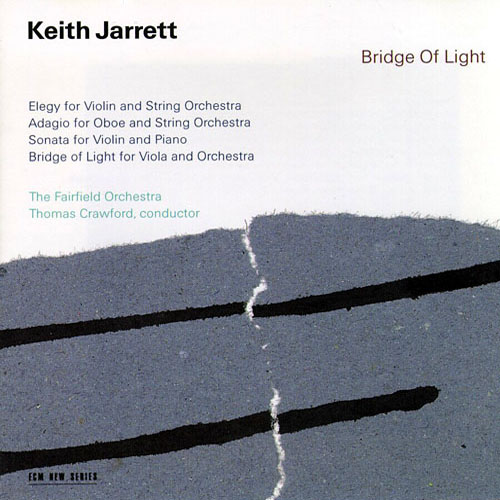
Keith Jarrett: Bridge Of Light (ECM New Series 1450)

Keith Jarrett
Bridge Of Light

The Fairfield Orchestra
Thomas Crawford conductor
Keith Jarrett piano
Michelle Makarski violin
Marcia Butler oboe
Patricia McCarty viola
Recorded March 1993, State University of New York, Purchase
Engineer: Peter Laenger
Produced by Keith Jarrett and Manfred Eicher

Keith Jarrett’s classical compositions tend to feel, not surprisingly, like an expanded piano in which the left and right hands come to be demarcated by greater instrumental forces. I also tend to hear the improvisational origins from which I imagine his music sprouts, as if the orchestra were simply channeling the pianist’s gift for spontaneous creation with due simultaneity. This is by no means a detriment to his efforts in this field, for it cleverly reconfigures the orchestra’s traditional physiognomy. Yet what I hear in the Elegy for Violin and String Orchestra that opens this striking disc is something altogether different from his previous efforts and, dare I say, more fully realized. Here, Jarrett approaches the orchestra on its own terms—cutting a path that is somewhere between the density of a symphony and the detail of a string quartet—in a deft exchange of pensive asides and grander responses. It is a piece about perseverance, reveling in its own structural integrity, and is one of Jarrett’s most painterly compositions.

The Adagio for Oboe and String Orchestra that follows pulls at the same threads, loosening knots that were once ironclad. The structure is therefore freer, amorphously shifting itself into a variety of shapes, while always maintaining the same spirit.

If I were to make any general statement about Jarrett’s classical music, it would be that his lead melodies possess a profound melodic drive. One can hear this most vividly in the beautiful Sonata for Violin and Piano that follows, and particularly in the second movement, “Song.” The Sonata features the composer at the keyboard and glows with a Mozartean charm. The music rolls off the fingers of both musicians with consummate ease and never lets up for a moment, always searching for a new field of expression in which to make itself known. The fourth movement, “Birth,” is, like its name implies, a liminal realm of uncertainty in which dissonance is creation. The third and fifth movements, both titled “Dance,” play with the shadows at the periphery, breathing with a whimsical, almost Bartókian flavor that soothes even as it invigorates.

The title work for viola and orchestra opens with a lush inhalation before the viola expels its rather mournful proclamation. Yet within that yearning a glimmer of hope slowly unfolds. The viola charts a consolatory path, feeling as if it were remembering a journey long past while also sharing those experiences as they happen. Two solo passages act like messengers as the music builds to a glorious ascent, then subsides into its gentle coda, where resolution seems but a natural extension of what came before.

The performers on Bridge Of Light make delicate work of Jarrett’s soundscapes, balancing reservation and overstatement with reverence. Moments of unity abound in which soloists and orchestra share the same breath. It is in these moments that we find glimpses of what makes us human, shaping our internal lives like the ceaseless flow of time.

<< Trevor Watts/Moiré Music Drum Orchestra: A Wider Embrace (ECM 1449)
>> Barre Phillips: Aquarian Rain (ECM 1451)

Bach: The French Suites – Jarrett (ECM New Series 1513/14)

J. S. Bach
The French Suites

Keith Jarrett harpsichord
Recorded September 1991, Cavelight Studio, New Jersey
Engineer: Peter Laenger
Produced by Manfred Eicher

Johann Sebastian Bach composed his so-called French Suites between 1722 and 1725 while still Kappelmeister to Prince Leopold. Although the title was a later addition and has nothing to do with its content (it is, if anything, Italian in form and convention), it does lend the collection a certain categorical charm. The first three suites are in minor keys, while the latter three are in major, leaving an invisible division to be drawn at their center. This does, in effect, create an open circle toward which one may bend an attentive ear at any point and still feel immersed in the suites’ totality.

As with his other Bach recordings for ECM, Keith Jarrett shows himself to be more than comfortable at the harpsichord, threading as he does a distinctive legato pacing into that instrument’s penchant for separation. In Jarrett’s hands, the music generally hovers in mid-tempo. He arpeggiates chords beautifully (note, for example, the Courante of Suite No. 1), approaches the more courtly dances (Allemande of Suite No. 2) with explicit grace, and puts plenty of meat on the bones of his trills (Gigue of Suite No. 1, Menuet of Suite No. 3). He also elicits a strikingly rich tone from the instrument’s middle range (Allemandes of Suite Nos. 2 and 3; Polonaise of Suite No. 6), and in others cultivates a gorgeously voluminous sound (Courante of Suite No. 2). Not surprisingly, Jarrett excels in the faster movements, and nowhere more so than in the Gigues (especially those of Suites Nos. 2, 3, and 4), yet the slower movements also convey a great humility. This isn’t merely because of his astounding virtuosity, but also because of his ability to expand the space in which he operates and because ECM highlights this expansion accordingly through attentive recording. Suite No. 4, with its touching Sarabande and luscious Air, provides some of the most varied atmospheres within any one suite. Suite No. 5 is another rich bouquet, its Allemande perhaps the most exquisite moment of the entire set. The Courante is wonderfully syncopated, while the Gavotte delights with its circuitous melody. The Gigue here is one of the album’s brightest highlights, combining a range of techniques in a spirited display of Shepard scale-like denouement. The Courante of Suite No. 6 flies off Jarrett’s fingers with ease, and the stately Gigue of the same brings everything to a masterfully contrapuntal conclusion.

On the whole, Jarrett performs splendidly. His technique is consistent, impassioned, and stripped to its essentials. These works may abound with courtly flair, but they also break from any of the restrictions that the circumstances of their composition might imply into moments of sheer enchantment. These suites are emotional endeavors through and through, and though they may not always be as consistently enthralling as some of Bach’s “heavier” works for keyboard, they duly remind us that it is never simply the artist’s responsibility to render such music captivating, but also ours as listeners to realize that not all music has to be in order to work its way into our hearts.

<< William Byrd: Motets and Mass for four voices (ECM 1512 NS)
>> Garbarek/Brahem/Hussain: Madar (ECM 1515)

Mozart: Piano Concertos – Jarrett/Davies (ECM New Series 1565/66 & 1624/25)

Wolfgang Amadeus Mozart
Piano Concertos I and II

Keith Jarrett piano
Stuttgarter Kammerorchester
Dennis Russell Davies conductor
Recorded November 1994 and January 1995 (I); May 1996 and March 1998 (II), Mozart-Saal/Liederhalle, Stuttgart
Engineer: Peter Laenger
Produced by Manfred Eicher

Taken as a whole, the music of Wolfgang Amadeus Mozart (1756-1791) remains one of European classical music’s most indestructible pantheons. Among the many symphonies, operas, songs, and chamber pieces in his formidable oeuvre of over 600 works is a handful (at least in Mozartian terms) of twenty-seven piano concertos. Theatrical, eclectic, and epic in scope, the concertos are the epitome of instrumental music written in the eye of an operatic storm. Their dramaturgy is put on full display in these two stunning double-albums from Keith Jarrett and the Stuttgart Chamber Orchestra under the baton of Dennis Russell Davies. The selections therein were approached improvisationally—that is, Davies never knew exactly what Jarrett was going to do, and vice versa. The end result is warm, spontaneous music-making that tickles the ears and invigorates the soul.

1565

The first set, released in 1996, instituted a major breakthrough in Jarrett’s classical career. If no one had taken him seriously with his ECM recording of the Shostakovich 24 Preludes and Fugues, then certainly he was turning a few heads now. From the moment he lays his fingers upon the keys, Jarrett transports us—and himself, I imagine—to a spacious and familiar world of sound, and in the company of such a finely tuned and responsive orchestra his pianism soars to new heights.

Concerto for Piano and Orchestra No. 23 in A Major K.488 (1786)
This concerto moves in sweeping gestures, spreading its arms over grand vistas, secret gardens, and mazes from which one never wishes to escape. The Allegro is sprinkled with moments of colorful synchronicity in which the piano doubles the flutes, further underlining the symbiotic relationship between the soloist and the landscape he inhabits (this doubling is later picked up by strings for an even broader sense of cohesion). The Adagio pulls away its own skin to expose an arduous inner conflict before trusting its resolution to the pianist’s capable hands. An ever-changing ensemble pairs the piano with different combinations of winds, all “strung” together by the orchestral whole of the infectious final movement. The wind writing is superb throughout and provides some of the concerto’s most insightful moments.

Concerto for Piano and Orchestra No. 27 in B-flat Major K.595 (1791)
Mozart’s final piano concerto opens on a playful note, swinging its way confidently through the branches of a singular musical path. The piano solos glow like childhood, which is to say they are entirely without fear. The central Larghetto begins with a light solo before French horns signal the orchestra to follow, weaving a solitary song. Only then do the piano and orchestra find each other after what feels like eons of separation. The Allegro begins again with piano alone, and as the orchestra picks up the theme in a grandiose call-and-response we find ourselves bathed in a scintillating resolve. The many solo moments injected into the final passage make for a provocative finish.

Masonic Funeral Music K.477 (1785) was written for two of the composer’s Masonic brethren, though sources suggest the piece was more indicative of the Society’s ideological spirit than it was of its dedicatees’ service to it. Nevertheless, its minor shifts and mellifluous wind writing make it an elegant experience all the same.

The Concerto for Piano and Orchestra No. 21 in C Major K.467 (1785) is heavier on the strings and is distinguishable by its overtly march-like rhythms. The piano seems to act in the opening movement as a complicated ornament rather than as the focus of attention. The ubiquitously famous Andante sounds fresh and crystal clear as Jarrett carries the orchestra along its pastoral journey with a precise left hand, dropping a trail of breadcrumbs into the encroaching twilight. The virtuosic final movement is nothing short of breathtaking.

The Symphony No. 40 in G Minor K.550 (1788) is one of only two Mozart symphonies in a minor key and is almost as recognizable as Beethoven’s 5th. It comes gloriously alive in this passionate performance, of which the third and fourth movements stand out for their stately precision.

<< Robin Schulkowsky/NPM: Hastening Westward (ECM 1564 NS)
>> Terje Rypdal: Double Concerto (ECM 1567)

… . …

1624

The second set of Jarrett/Davies Mozart collaborations, released in 1999, shows the two interpreters exploring this fine material from an even deeper point of articulation.

The Concerto for Piano and Orchestra No. 20 in D Minor K.466 (1785) is the most somber of either program. Its Allegro builds a structure of monumental darkness. Ironically, the slow movement has far more energy than its predecessor, while the third is one of the masterpieces of collection, bristling with plenty of Mozart’s character-defining trills.

Concerto for Piano and Orchestra No. 17 in G Major K.453 (1784)
This is an epic concerto with another gorgeous Andante and an inspiring Presto that abounds with the liveliness one would come to expect from the younger Mozart.

Concerto for Piano and Orchestra No. 9 in E-flat Major K.271 (“Jeunehomme”) (1777)
The ninth concerto is the earliest piece of either album, written when the composer was just 21. This picturesque concerto is considered exemplary of the classical aesthetic. The opening Allegro is deceptively simple and endlessly colorful; a lush Andantino seems to yearn for an impossible love; and the final movement dutifully carries out its joyful mission, reporting back with most resplendent success.

The piano concertos are so long that, on a 2-CD set, they only leave room for shorter fillers, like the humble Adagio and Fugue in C Minor K.546 (1788), one of his most “filmic” pieces. While the Bach influence is clear, there is a dramatic undertone that is distinctly Mozart’s own and which provides a fitting close to another thoughtful and finely executed album.

Mozart constructed his piano concertos in such a way as to encapsulate all of the space embodied by the strings in the piano’s introductions. In this way he delved microscopically into the larger orchestral organism, revealing hidden biologies with laboratorial precision. Every movement is like a pianistic symphony in and of itself, a fully fleshed musical entity whose relationship to its neighbors is more genetic than it is formal. Davies shows a profound aptitude for the music at hand, as does Jarrett, who breathes clear diction into every phrase. Jarrett also excels in the ornamentations, especially in his many exuberant trills. This is classical music at its “grooviest” and is sure to please. Despite the epic length of the concertos, many surpassing thirty minutes, this could be a demanding listen were it not for Mozart’s continual innovation and unwavering commitment to circumstance. At any rate, the combined forces of Jarrett and Davies make even the heftiest doses easy to swallow.

I find it baffling to see that what little criticism these recordings have garnered focuses solely on Jarrett’s playing, calling it mechanical and lacking in the improvisational flair one would expect from the consummate jazzman. For what it’s worth, I find his performances to be nothing less than inspired and uplifting. I should make the reader aware, however, of the recording itself, which in the first set places the piano curiously distant in relation to the orchestra, as if at the back of the hall or even in a separate room. While this positioning works more fluidly in certain movements over others, ultimately the listener’s discretion will determine whether or not it is a successful arrangement. I find that it takes some getting used to every time I put the album on, but that once I do the effect is quite haunting.

Shostakovich: 24 Preludes and Fugues – Jarrett (ECM New Series 1469/70)

Dmitri Shostakovich
24 Preludes and Fugues

Keith Jarrett piano
Recorded July 1991, Salle de Musique, La Chaux de Fonds
Engineer: Peter Laenger
Produced by Manfred Eicher

“When I first saw these pieces in a music shop, I knew I wanted to play them. I recognized the language. But when I started playing them, they were so close to me that I knew I had to record them.”
–Keith Jarrett

In 1950, during a trip abroad as a cultural ambassador, Shostakovich was treated to a performance of selections from Bach’s The Well-Tempered Clavier by pianist Tatiana Nikolayeva in Leipzig, where the composer had been asked to serve as a judge for the first International Johann Sebastian Bach Competition. Just two years later, Nikolayeva would have Shostakovich’s 24 Preludes and Fugues in hand as their dedicatee for the first public performance in Leningrad. Although one can hardly talk about these pieces without being aware of Bach’s shadow, I think it is precisely Bach’s shadow that Shostakovich is interested in here. In modern parlance one might say these are the “b-sides” of The Well-Tempered Clavier, a record of previously unreleased demos that refused to be lost to time. Like Bach, Shostakovich rallies through a lifetime of moods: from naivety (D major Fugue) to gentility (D major, B major, and F-sharp major Preludes); dawn (E minor Prelude) to destruction (B minor and G-sharp minor Preludes); death (F-sharp minor Fugue) to joy (E major and B major Fugues), resplendence (the standout A major Fugue), and playfulness (A-flat major Prelude and Fugue, B-flat major Prelude). The overall tone, however, is one of exuberance. Whenever this music isn’t dancing, it’s waiting to pick up its feet and resume. The carefully laid out balance of the entire work is clear not only in the distribution of slow and fast movements, but also in Jarrett’s dynamic pianism. He excavates the keyboard like an adult unearthing a time capsule buried as a child—such is the nostalgia folded into every note. From the punctuational bass notes of the E-flat minor Prelude to the poignancy of the F major Prelude and the smooth legato phrasing of the Beethovenian G minor Prelude, Jarrett negotiates a wealth of obstacles with the kind of fluidity that can only exist behind closed eyes. Moments of dissonance creep in only briefly, as if to remind us of perfection in that which is imperfect.

This is incredibly insightful music played by a musician who seems to see more in it than Shostakovich himself. In bearing his heart to us, Jarrett also bears the composer’s. Not only do Shostakovich’s 24 Preludes and Fugues make up one of the most important works of the twentieth century, but Jarrett’s performance and ECM’s flawless production also turn them into one of its most important recordings. Need I say more?

<< Keith Jarrett Trio: Bye Bye Blackbird (ECM 1467)
>> Kancheli/Schnittke: Vom Winde beweint (ECM 1471 NS)