ECM Spectrum Vol. 1

Dating from 1987, ECM Spectrum Vol. 1 appeared during one of the most fertile and experimental periods in the label’s history, as the music and musicians gathered here readily attest. More than a sampler, it functions as a compact atlas of the ECM imagination, moving between invented landscapes, political memory, electronic possibility, and inward forms of solitude.

“The Rapids” brings us into Oregon’s self-titled ECM debut (ECM 1258), carried by Paul McCandless’s soprano saxophone and the intricate percussion of Collin Walcott. Ralph Towner threads their many needles on Prophet-5 synthesizer, rendering the piece in colors that seem to exceed the jurisdiction of sight. Its currents shift beneath a serene surface, producing a music that feels intricately plotted yet free of visible boundaries.

The transition into “Els Segadors,” from Charlie Haden’s The Ballad of the Fallen (ECM 1248), exchanges imaginary terrain for the gravity of history. This song of revolt, rooted in Catalan resistance and associated with the Spanish Civil War, begins with a somber brass elegy before a funereal snare and glockenspiel enter. Fragility and defiance inhabit the same ceremonial space. The arrangement preserves collective memory without embalming it, allowing grief to remain politically alive.

Pat Metheny makes two appearances in this sequence. “Barcarole,” taken from Offramp (ECM 1216), opens with Synclavier-enhanced calls that register as electronic birth cries. Synthesizers and percussion form a broad, fluid continuum while the melody seems to discover its own anatomy in motion. Here, technology does not merely ornament the acoustic world. It rearranges its molecules, placing pastoral lyricism inside a dream of circuitry. “Country Poem,” from New Chautauqua (ECM 1131), closes the compilation in a far more intimate register. Solo acoustic guitar reduces the field to touch, resonance, and the private mathematics of the hand. Its modest scale nevertheless contains a remarkable spaciousness.

“Sunrise,” by Terje Rypdal, Miroslav Vitous, and Jack DeJohnette, points toward the magnetic north of their classic self-titled album (ECM 1125). DeJohnette’s scurrying drums and the suspended glow of Fender Rhodes establish a restless foundation. Vitous’s bass rises through it in deliberate plucks, while Rypdal’s guitar dominates the upper reaches with trembling, abrasive monologues. Overdubs deepen the surrounding space through fallow echoes. His phrases seize the air and shake loose fragments of melody, balancing prophecy with raw nerve.

From that vastness, the program descends into “Paper Nut,” taken from Shankar’s Song for Everyone (ECM 1286). Jan Garbarek’s soprano entwines with Shankar’s restless violin until breath and bow seem to share a single nervous system. The melody turns repeatedly without returning to quite the same place. Shankar supplies flashes of agitation and radiance, while Garbarek draws a clarion line through the thicket.

The two selections from Egberto Gismonti and Naná Vasconcelos deepen the compilation’s sense of music as ritual cartography. Their Duas Vozes (ECM 1279) remains among the most significant ECM albums of the decade. In “Bianca,” handclaps and unusual guitar treatments create a space at once intimate and unbounded. “Tomarapeba” moves further into chant-inflected ceremony, where voice and percussion generate their own sacred conditions. Gismonti and Vasconcelos remain unmistakably themselves, even as they allow something older than authorship to pass through.

Keith Jarrett enters by way of “Never Let Me Go,” from Standards, Vol. 2 (ECM 1289). The performance finds him at his lyrical best, shaping each phrase with tenderness and restraint. His piano tests how much feeling a melody can bear without losing its form. Gary Peacock and Jack DeJohnette surround him with extraordinary attentiveness, preserving a space in which vulnerability retains its dignity.

“Belonging,” drawn from Jarrett’s European quartet album of the same name (ECM 1050), offers a different shade of balladry. Garbarek’s tenor becomes the central consciousness, carrying a solitude that seeks neither cure nor spectacle. Jarrett rearranges the emotional ground beneath him, altering the meaning of each sustained note. The title gradually becomes a philosophical question: perhaps belonging begins when estrangement discovers that it has been heard.

Don Cherry and Ed Blackwell’s El Corazón (ECM 1230) receives a brief, pungent acknowledgment through “Street Dancing.” Martial drums and organ generate a compact procession that seems perpetually to encounter its own shadow. Its brevity sharpens its mystery and prepares the way for John Surman’s “Doxology,” from Withholding Pattern (ECM 1295). Surman multitracks reeds and piano into a solitary ensemble, while his favored sequencer casts a glittering edge around the ashen interior. He cultivates the melodic field with patience, building harmony from divided versions of himself. The result approaches a private theology of sound.

John Abercrombie’s “Clint,” from Current Events (ECM 1311), provides one of the most animated turns. Peter Erskine shines throughout, constantly renewing the rhythmic ground beneath Abercrombie’s guitar. It also comes from an album that deserves far greater recognition, its title now carrying an unintended irony about how swiftly the present becomes neglected history.

Although no Spectrum Vol. 2 followed, ECM itself has always been a spectrum, separating sound into concealed components and revealing further colors within each one. This collection captures a moment when the label’s aesthetic was fully recognizable yet still mutating in ways that defied prediction. Acoustic tradition and electronic possibility coexist without surrendering their native languages.

What binds these recordings is a resistance to the obvious. The compilation ultimately charts the invisible distance between a person and what they have not yet become. Somewhere inside that distance, history stops moving forward and turns inward, carrying its rituals, griefs, and private illuminations toward a point smaller than a note. There, consciousness reveals itself not as music’s witness, but as one more instrument waiting to be played.

Horizons(ecm)

Released in 2000 by Universal Music France in collaboration with ECM Records, Horizons was conceived as a promotional introduction to a catalogue that had long resisted easy classification. Rather than assembling familiar peaks, it traces a quieter borderland where jazz, folk traditions, chamber music, and improvisation exchange passports without surrendering their origins. The collection leans toward ECM’s acoustic and global currents, yet its real subject is passage between cultures and between inner life and the silence that gives every sounded note consequence. The title would later find an echo in the 2007 oral history Horizons Touched, but here the horizon is less a destination than an ethical limit, a line approached through listening and never possessed.

Anouar Brahem’s “Barzakh,” from his 1991 ECM debut of the same name, opens that territory with oud and Béchir Selmi’s violin suspended in deep reverberation. The Arabic title suggests an interval between worlds, and the music inhabits precisely such a threshold. Brahem’s plucked phrases feel carved from darkness, while Selmi answers with a sorrow that never collapses into despair. Its eleven minutes enlarge the listener’s sense of scale until a pause acquires the dimensions of an abandoned city. Zakir Hussain’s “Making Music” then turns creation into a communal mystery. Hariprasad Chaurasia’s flute begins to shape the rhythmic field alongside John McLaughlin’s acoustic guitar, while Jan Garbarek’s soprano saxophone reveals that the pulse already exists within attention before Hussain fully enters. Tabla does not command the piece so much as disclose its hidden skeleton.

That shared act of discovery continues in Codona’s title track from the trio’s 1979 debut. Collin Walcott and Don Cherry meet Nana Vasconcelos in an encounter where wooden flute, tabla, hammered dulcimer, and percussion remain free of conquest. Each instrument retains its ancestry while contributing to a temporary commons. Egberto Gismonti’s “Salvador (Branco),” from Dança Dos Escravos, approaches freedom through play. His guitar writing keeps folding back on itself, changing the terms of its own argument, while his voice rises from within the texture as a private spirit briefly given flesh. Gianluigi Trovesi and Gianni Coscia offer a more theatrical take on “In cerca di cibo,” their clarinet and accordion reworking Fiorenzo Carpi’s music for a 1971 television adaptation of Pinocchio. Beneath its charm runs a darker question: perhaps becoming real begins with hunger, and consciousness is the appetite that can never be satisfied.

Stephan Micus’s “Passing Cloud,” from The Garden Of Mirrors, lets steel drums and sinding gather beneath the shakuhachi, creating a floating architecture whose materials remain earthy despite its vaporous motion. The piece becomes a screen for interior projection, offering faces to one listener and hollows to another. “Syster Glas (Sister Glass),” from Agram, gives that inward gaze a sharper surface. Jonas Knutsson’s soprano saxophone draws liquid lines through Mats Edén’s drone-fiddle, with Ale Möller’s mandola brightening the edges and Palle Danielsson’s bass moving beneath them as muscular memory. The track feels welcoming from a great distance, a voice calling through a transparent wall that cannot be crossed.

David Darling’s “Up Side Down,” from Dark Wood, draws the collection toward its most exposed emotional register. His cello builds a resonant foundation, then sends solitary cries upward through it. Light and shadow mingle until neither can remember its former name. Darling’s virtuosity serves vulnerability, leaving feeling almost undefended. Nils Petter Molvær’s “On Stream,” from Khmer, moves that bodily intimacy into electronic space. Trumpet breath, percussion, bass, and guitar form a slow nocturnal circuitry in which human respiration becomes the ghost lodged inside technology. The groove carries understated charge, yet the real drama lies in the friction between lungs and machinery.

Jan Garbarek’s “Her Wild Ways,” from RITES, answers with greater physical breadth. Marilyn Mazur’s percussion shifts under Eberhard Weber’s bass harmonics, while Rainer Brüninghaus opens long perspectives at the piano. Garbarek’s saxophone cuts through them with unusual directness, turning clarity into its own form of wilderness. Tomasz Stańko’s septet moves inward again on “Sleep Safe and Warm,” Krzysztof Komeda’s melody revisited on Litania. Bernt Rosengren’s tenor deepens its haunted tenderness, and Terje Rypdal’s guitar glows beneath the surface. The lullaby advances without comfort becoming innocent.

Eleni Karaindrou’s two selections from Eternity and a Day elicit a suspended cinema. “By The Sea” pares expression down to a tender piano line, allowing each interval to hold more than melody alone can explain. The variation on “Depart And Eternity Theme” gathers clarinet, mandolin, violin, and strings into a chamber of arrested gestures, where departure has begun but absence has not yet learned its shape. Dino Saluzzi and the Rosamunde Quartett bring the compilation to its final threshold with “Recitativo final” from Kultrum. Saluzzi’s bandoneón opens a grave conversation with the strings, joining private breath to historical weight. The music loosens dreams from their owners and guides them toward a door that remains closed to explanation.

Across Horizons, borders fade without abandoning meaning. These performances travel through inheritance and memory across immense distances while refusing the fantasy that encounter grants ownership. The collection’s deepest argument concerns attention itself. To listen closely is to enter another presence while accepting that some chamber within it must remain inaccessible. Perhaps that inaccessible chamber is where music keeps its conscience. The horizon, then, is not the farthest point the eye can reach, but the place where desire learns to tie its own shoes.

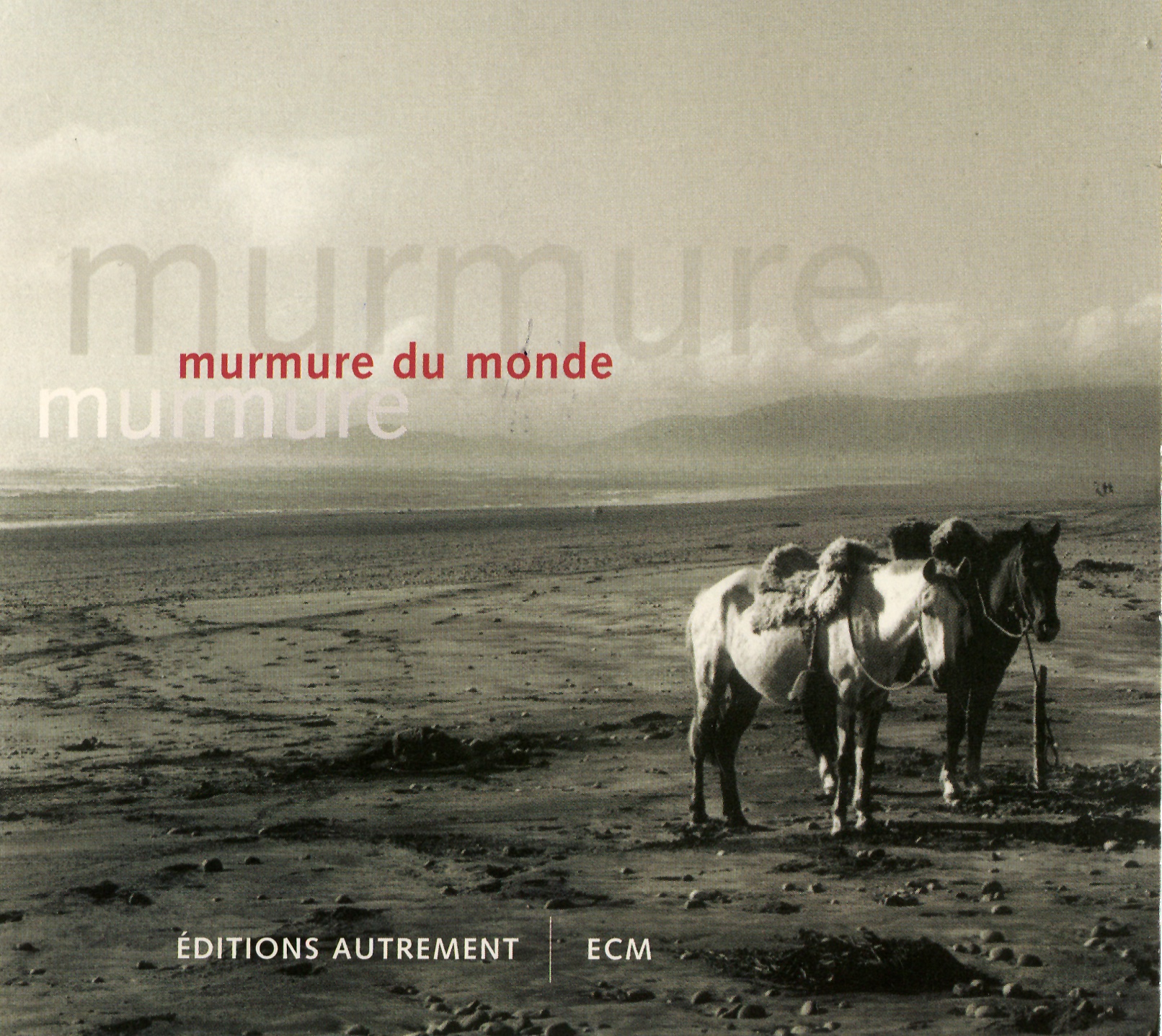
It is worth noting that this edition is the commercial re-release of murmure du monde (1998), originally produced as a strictly promotional, non-commercial CD. Created by PolyGram Projets Spéciaux (PolyGram Special Projects) and marked “Hors Commerce” (“Not for Sale”), it was distributed directly to French radio programmers, journalists, and music-industry professionals to promote ECM’s international jazz and ambient catalogue.

Dinner Jazz With ECM

Dinner Jazz With ECM is a fascinating anomaly in the label’s history. Released in 2011, the compilation did not emerge from a conventional studio project or from Manfred Eicher’s austere curatorial imagination. It was assembled through a partnership between ECM, Universal Music Canada, and the Canadian radio station JAZZ.FM91, where host and music director Brad Barker had cultivated a popular evening program under the same title. Barker selected some of the catalog’s most accessible and contemplative recordings, drawing the album toward melody, acoustic spaciousness, and the gentler end of improvisation. The stated purpose was functional enough: music for dining, relaxing, or withdrawing from the day’s accumulations. Yet the compilation’s finest moments resist such domestication. They refuse to remain tasteful vapor hovering above the table. Each piece alters the room in which it is heard, entering the meal as an invisible guest whose conversation gradually becomes impossible to ignore.

The cover’s aesthetic is quite contrary to ECM’s usual visual grammar. It resembles packaging for a product that has mistaken refinement for soft focus. The music inside, however, has been chosen with genuine care. Pat Metheny’s “Bright Size Life” serves as the opening course, though it arrives with enough sinew to overturn any expectation of polite accompaniment. Metheny’s guitar draws its lucid geometry across the stereo field while Jaco Pastorius’s electric bass moves beneath it with feline intelligence. The performance remains smooth without becoming boneless. Its surfaces gleam, but a muscular current keeps the piece alert, giving the listener something closer to appetite than ambiance.

From there, the compilation performs its first act of culinary mischief. Instead of easing further into softness, it presents Egberto Gismonti’s “Loro,” an umami-rich piano solo from Alma, released on ECM’s CARMO imprint. Gismonti’s hands scatter sparks across the keyboard, then gather them into intricate figures of joy. Chick Corea and Gary Burton continue this recalibration with “What Game Shall We Play Today,” where piano and vibraphone turn the familiar composition into a give and take of refracted light. The tune’s richness makes the designation of dinner music feel almost mischievous. One may eat while listening, certainly, but the music keeps moving the plate.

The album then settles into a sequence governed by the slow deepening of color. Kenny Wheeler’s “3/4 in the Afternoon,” from Deer Wan, relaxes the pulse without surrendering its structural intelligence. Wheeler’s tone opens an immense interior space, while Jan Garbarek’s soprano saxophone threads a bright filament and Ralph Towner’s twelve-string guitar supplies a recollective grain. Wheeler’s playing occasionally approaches the bruised lyricism associated with Enrico Rava, making the appearance of Rava’s “The Man I Love” feel logical. Drawn from TATI, the Gershwin standard arrives steeped in monochromatic nostalgia. Tomasz Stańko’s “So Nice,” taken from Dark Eyes, completes this inward movement with a tenderness that feels almost granular. His trumpet exposes the fragile mineral structure from which such emotions are built.

At this point, the meal abandons any notion of fixed recipes. Familiar songs return altered by the musicians’ attention, their recognizable contours serving as vessels for entirely new substances. The Marcin Wasilewski Trio’s version of Prince’s “Diamonds and Pearls,” from January, rises above the song’s melodic terrain and reveals pathways concealed within the original. Bobo Stenson’s “Send in the Clowns,” from Goodbye, moves in the opposite direction, entering the Sondheim standard at the level of hesitation. Anders Jormin and Paul Motian surround Stenson with a quietude that feels carefully portioned. His lyrical gift lies partly in the ability to place freedom and restraint inside the same gesture, allowing a phrase to wander while preserving the gravity of its destination.

Charles Lloyd’s “What’s Going On,” from Lift Every Voice, expands this act of reinterpretation into something communal. John Abercrombie’s guitar and Geri Allen’s piano create interlocking planes around Lloyd’s saxophone, while Marc Johnson and Billy Hart give the performance a supple internal life. The arrangement becomes a table at which every voice retains its accent, even as the conversation acquires a shared syntax. Lloyd’s tone carries a quiet spiritual charge. He seems to breathe through the melody rather than stand outside it, finding within Marvin Gaye’s song a reservoir of unresolved compassion.

Annette Peacock’s “Circles,” as performed by Paul Bley and Mark Levinson, draws the collection into older, deeper territory. Coming from the early years of ECM, the track reveals how thoroughly the label’s sense of space had already been established. It also interrupts the easy social function implied by the compilation’s title, turning the dining table into a place of interrogation. What have we consumed without noticing? Which voices have passed through the room while our attention remained elsewhere? The track’s placement gives the anthology historical depth, but its greater value lies in the disturbance it introduces, leaving a faint metallic taste behind.

The guitar selections occupy another region of the collection, one shaped by tactile memory. Jacob Young’s “The Promise” represents a newer generation without sounding like it was inserted merely for balance. Bill Frisell’s “Lonesome” offers an acoustic delicacy whose simplicity conceals exquisite calibration. Pat Metheny returns with “Au Lait,” one of the most luminous recordings in the ECM catalog. The title suggests a final cup brought to the table, but the music pours itself into a vessel that cannot contain it.

Manu Katché’s “Pieces of Emotion,” from Playground, draws the album toward a sleek modern pulse without sacrificing compositional substance. The piece understands polish as a form of articulation rather than a method of concealment. Its surfaces are immaculate, yet tiny tensions remain active beneath them, giving the music an alertness that keeps it from dissolving into lifestyle décor. Oregon’s “Beside a Brook,” taken from the group’s 1983 self-titled album, provides a quietly eccentric conclusion to the sequence. Its atmosphere is finely detailed, concerned with the strange density of occupying one particular place at one irretrievable moment.

While, on the surface, Dinner Jazz With ECM would seem to reduce this music to a social utility, placing extraordinary performances beside plates, glasses, and the choreography of casual banter, the compilation gradually reverses that hierarchy. The meal becomes the accompaniment. Eating turns into a secondary rhythm beneath the more consequential act of listening. Across these tracks, nourishment ceases to mean the filling of an absence. It becomes an encounter with forms that cannot be possessed, only received. The musicians offer melody without enclosing it, intimacy without demanding ownership. Even the compilation’s commercial premise begins to acquire philosophical weight. A table, after all, is one of the few human inventions designed around an emptiness at its center. We gather along its perimeter and place what sustains us into that open space, trusting that others will leave enough for us to reach.

Perhaps this is the album’s accidental wisdom. Its most profound invitation has little to do with refinement, relaxation, or the cultivation of atmosphere. It asks whether attention itself might be a form of nourishment, and whether listening can teach us how to share a world without devouring it. The finest performances here preserve an inviolate region within every note, a chamber no interpretation can fully enter. To hear that boundary and honor it is to practice a rare kind of hospitality. The music sets a place for what cannot speak in our language, then waits without impatience for it to arrive.

ECM: Anniversary Waltz – New Releases, Autumn 2009

Although ECM celebrated its monumental 50th anniversary not too long ago, there was a flurry of activity surrounding its 40th as well, including Anniversary Waltz, a promotional sampler where jazz, folk memory, chamber poise, and improvisational risk come together in characteristic fashion. The compilation’s title tune comes from the John Abercrombie Quartet’s Wait Till You See Her (ECM 2102), which also happened to mark bassist Thomas Morgan’s debut for the label. Violinist Mark Feldman brings a robust yet gymnastic tone, while drummer Joey Baron keeps the pulse suspended between delicacy and ignition. “Anniversary Waltz” is a master class in building swing from restraint, finding its deepest momentum in what the players decline to force. Abercrombie’s guitar enters with lyrical tact, almost phosphorescent in its gentleness, while Feldman’s violin draws a darker thread through the fabric, giving the piece its inward flame. Reflection and fire coil around the same center until the band’s signature sound emerges with the clarity of a lamp being lit underwater.

Before that title piece arrives, the sampler establishes its grammar of passage through two superb tracks. The opening gambit belongs to the Tomasz Stanko Quintet, placing the trumpeter alongside pianist Alexi Tuomarila, guitarist Jakob Bro, bassist Anders Christensen, and drummer Olavi Louhivuori. “Terminal 7,” from Dark Eyes (ECM 2115), is already a title of departure, but the music resists ordinary itinerary. Stanko takes the pilot’s chair with that bruised, sovereign tone of his, a sound carrying both command and fracture. Around him, the ensemble smooths disparate instrumental temperaments into a shaded cool so fine-grained it oozes gradation. Bro’s guitar rises from below with slow hypnosis. This quintessential travel song moves without hurry, turning transit into metaphysics.

“Dom de iludir” then carries us into the deeper contemplations of the Stefano Bollani Trio’s Stone In The Water (ECM 2080). Bollani approaches Caetano Veloso’s tune with a thoughtful touch all his own. Bassist Jesper Bodilsen becomes a central figure in this vignette, anchoring the performance with warmth. Morten Lund’s brushes away the dust of recollection until old images resound with startling immediacy. From there, Anouar Brahem’s “Al Birwa,” taken from The Astounding Eyes Of Rita (ECM 2075), widens the sampler’s geography without breaking its spell. Brahem’s oud curves through the piece with devotional precision, supported by Khaled Yassine on goblet drum, Klaus Gesing on bass clarinet, and Björn Meyer on electric bass. The resulting colors are circular and gorgeously diagrammed, a music of arcs, apertures, and quiet revolutions.

The energy rises with “Paper Nut,” drawn from the Jan Garbarek Group’s live album Dresden (ECM 2100/01). With Eberhard Weber unable to perform, Yuri Daniel steps into the bassist’s role, interlocking with pianist Rainer Brüninghaus and drummer Manu Katché in seamless propulsion. First heard on Song for Everyone (ECM 1286), the tune lends its unforgettable melody to the ear as an act of abundance, cutting mineral veins through the bedrock of jazz toward something older than idiom. Garbarek’s sound has always carried the paradox of distance made intimate, and here that quality becomes almost architectural, a bridge built out of breath. A smoother spirit follows in “Song Of Praise,” representing Steve Kuhn’s Mostly Coltrane (ECM 2099). Joined by saxophonist Joe Lovano, bassist David Finck, and Joey Baron, Kuhn swings through homage without becoming trapped by reverence. The piece honors Coltrane by refusing embalmed devotion, choosing motion over monument. Its praise is kinetic, lucid, and alive to the tremor beneath gratitude.

That thread leads naturally into “Hilltop Dancer,” from the John Surman Quartet’s Brewster’s Rooster (ECM 2046). With Abercrombie on guitar, Drew Gress on bass (making an ECM debut of his own), and Jack DeJohnette driving from the drums, the performance has the bite of open air and the density of worked metal. Surman’s baritone is full-bodied and protein-rich, a sound that seems to have roots and antlers. Abercrombie surveys from low altitude, tracing oblique paths across the tune’s robust theme, while the rhythm section gives the whole thing a spring-loaded acuity. “Surfing With Michel” then ushers in the Miroslav Vitous Group’s contribution, a lively duet sourced between the bassist and Michel Portal on bass clarinet sourced from Remembering Weather Report (ECM 2073). Its experimental cast feels playful rather than forbidding, turning dialogue into a kind of lucid mischief. Finally, “London Part XII” from Keith Jarrett’s Paris/London: Testament (ECM 2130-32) brings the anthology to a gospel-inflected radiance.

As a commemorative object, Anniversary Waltz moves as a chain of awakenings during one of its more exciting years of releases. The result is a question gently placed before consciousness, one that can only be answered by listening to it anew.

ECM: New Releases – Autumn 2008

If each year of ECM releases can be said to possess its own internal climate, then 2008 may be remembered as a year of strength, though not strength in the crude sense of volume or muscular display. Here, strength begins in the ability to receive old forms and return them breathing and incandescent. The label’s Autumn 2008 sampler gathers some of its most powerful players insofar as they move with the strange authority of those who understand that tenderness can exert its own pressure.

Gianluigi Trovesi’s Profumo di Violetta offers the most immediate proof. Set within the grand banda tradition of his native Italy, the album places him among wind and percussion forces that seem to rise from a village square and a metaphysical pageant at once. From the sub-suite “Il Mito,” drawn from Monteverdi’s L’Orfeo, we are given five of six movements, re-sequenced into a private mythology in which Renaissance source material becomes less an object of homage than a living root system. Trovesi grafts his own imagination into that ancient trunk with panache so that it sprouts impossible angles. The result moves from delicacy to profanity while preserving a curious sweetness, as though the sacred had been caught wandering through carnival dust with violets hidden in its sleeves.

From this ceremonial blaze, Vassilis Tsabropoulos, at the piano, enters with Anja Lechner’s cello and U.T. Gandhi’s discreet percussion for their rendition of G. I. Gurdjieff’s “Sayyid Dance,” one of two Gurdjieff pieces to appear on the trio’s Melos. The performance is tender, though its tenderness has weight, turning in circles that feel less decorative than devotional. Tsabropoulos sets the music in motion with a lucid, revolving touch, while Lechner draws the cello into a fluid line of inward speech. Gandhi’s brushed drums lay tracks beneath, giving the piece a quiet locomotion toward some center of humility that refuses to name itself. Nothing here pleads for transcendence; the music simply walks toward it, carrying its brilliance as one might carry a bowl filled to the trembling rim.

A different form of inhabitation animates Savina Yannatou’s Songs Of An Other, which was her third ECM outing. Backed by Primavera en Salonico, she navigates “Za lioubih maimo tri momi,” a song of Bulgarian Macedonia, with an intimacy that never collapses into possession. Yannatou’s gift is neither imitation nor mere cosmopolitan elegance. Her voice becomes a hospitable threshold through which folk instincts pass without being stripped of their mystery. She sings across cultures with organic care, and in doing so suggests that universality is not a flattening principle, but a chamber of resonances where difference can remain sovereign. In the context of this sampler, her contribution deepens the discipline of letting another world speak through one’s own breath.

The cultural axis shifts again with Julia Hülsmann’s “The End of a Summer,” the title track from her trio recording with Marc Muellbauer and Heinrich Köbberling. It blossoms from late Romantic stirrings before settling into the nocturnal assurance of a smooth ballad, yet its polish never feels merely decorative. Hülsmann’s touch winds toward the heart by refusing theatrical anguish, intimate enough to bruise without raising its voice. “Yeraz,” the album title track from saxophonist Trygve Seim and accordionist Frode Haltli, intensifies that inwardness from another angle. Their loose treatment of the Armenian traditional opens a field of intimate freedom, with Haltli’s drone providing a deep surface over which Seim stretches his duduk-hued tone.

New York Days places Italian trumpeter Enrico Rava in the company of Mark Turner, Stefano Bollani, Larry Grenadier, and Paul Motian, a group whose authority comes from the way each musician leaves room for the others to become inevitable. On “Lady Orlando,” Rava lays on the nostalgia thick. The rhythm section and piano open with a lush fragrance in the air, after which Rava enters with searching lines that appear to ask questions the city has been avoiding for decades. Turner follows through a corridor of breath, his tenor patient and trustworthy, while Bollani’s lyricism receives an expansive berth. Motian and Grenadier render each turn of phrase in painterly motions that feel at once provisional and final, the sonic equivalent of ink deciding whether to become handwriting or shadow.

The same diurnal undertow carries us into Live At Belleville, where bassist Arild Andersen, saxophonist Tommy Smith, and drummer Paolo Vinaccia take on Duke Ellington’s “Prelude to a Kiss.” The melody surrenders to invisible strings, pulled forward through alleyways of hunger and half-lit recognition. Smith’s saxophone gives the piece its bruised body, while Andersen and Vinaccia create a ground that shifts between pavement and pulse. What emerges is not merely a standard reimagined, but a nocturnal civic document, a map of longing drawn on the inside of a window. Somewhere in its slow advance, a thin screen keeps desolation and consummation in a state of unresolved proximity.

The collection closes with “Song Of Ruth,” a variation of which also serves as the final track on Cantando, one of the most deeply realized statements from the Bobo Stenson Trio. With Anders Jormin on bass and Jon Fält on drums, Stenson turns Czech composer Petr Eben’s melody into a frost-covered meditation on mortality. It has the tenderness of a hand resting on a closed book, aware that its pages may contain both judgment and mercy. Jormin’s bass gives the piece a grave interior, while Fält’s percussion seems to tap at the membrane between existence and disappearance. By this point, the sampler has become more than a seasonal document from a singular label. It serves as a study in how beauty withstands its own weight in a world of mounting conflict.

ECM: First and Other Tracks – Autumn ’99

Across this Autumn ’99 sampler, ECM offers a varied excavation. The label’s familiar spaciousness becomes an instrument of light caught under glass. These tracks are drawn from different points in time and space. Some are lit by candles, some by exit signs, and some by their own bioluminescence. What unites them is a kind of human candor that refuses to be costumed even when it dreams.

“Blame It On My Youth / Meditation,” from The Melody At Night, With You, opens from within. Few entries in the Keith Jarrett treasure trove feel so heart-forward. The music moves with devastating simplicity, cutting through the emotional static of any age and granting the listener a brief respite. Jarrett turns backward with the gravity of someone entering a room where every object still knows his name. His right-hand doublings carry a strange catharsis, burying doubt as a seed before watering it with hope.

The Dave Holland Quintet enters by setting the floor on fire from beneath. On “Prime Directive,” the title track from one of Holland’s late-90s masterstrokes, the bassist convenes a group operating at peak molecular alertness. Robin Eubanks, Chris Potter, Steve Nelson, Billy Kilson, and Holland himself form a kinetic republic in which every voice both governs and revolts. Potter and Eubanks seem especially tuned to each other’s circuitry, their exchanges full of badboy panache and rough-hewn grace, pushing the music toward the edge of combustion without surrendering form. Kilson’s groove moves with ruthless poise, while Holland listens from the center, steering by gravitational intelligence. When Nelson’s vibraphone solo arrives, the track seems to discover another staircase inside itself, climbing toward a finish whose restraint feels almost mischievous, a final ember placed carefully in the listener’s palm.

Speaking of palms, John Abercrombie’s “Gimme Five,” from Open Land, shifts toward a different style of lucid interaction. Building outward from his organ trio with Dan Wall and Adam Nussbaum, Abercrombie welcomes additional voices without crowding the air. Violinist Mark Feldman feels organically summoned, vaulting through the changes through nerve and horsehair. Kenny Wheeler offers later-stage commentary, his trumpet hovering near Abercrombie’s solo with the tact of a ghost who has read the score but refuses to spoil the ending. The tune’s restraint becomes its radiance. Each sound arrives polished by patience, ending on a crystalline high note that epitomizes ECM’s production clarity of this period in its history.

With Tomasz Stanko’s “Argentyna,” courtesy of From The Green Hill, the collection turns toward memory’s borderlands. Joined by Dino Saluzzi, John Surman, Anders Jormin, and Jon Christensen, Stanko shapes a piece saturated with longing. The tune seems to yearn for a time and place preserved only in faded photographs and old cinema dust. Saluzzi and Stanko make a deeply sympathetic pair, each rooted in cultural soil yet open at the borders, their phrases carrying the ache of passports stamped by invisible countries. Surman deepens the atmosphere with a darker grain, adding muscular fragrance to a composition that blends smoke, leather, distance, and the aftertaste of unsent letters.

Frifot’s “Käre Sol/Sjungar Lars-polska” overturns the axis once more, bringing Per Gudmundson, Ale Möller, and Lena Willemark into the fold. Bagpipes, fiddle, shawm, and Willemark’s unmistakable voice gather into a ritual both ancient and newly blooded, charting avian life from shell to fallen wing without unnecessary regret. Willemark appears to loosen old spirits from the rafters, reminding the modern ear that folk music can be neither quaint nor pastoral when handled by artists willing to let its teeth remain visible.

Finally, “The Field,” from Tales of Rohnlief by Joe Maneri, Barre Phillips, and Mat Maneri, closes the sequence by loosening the screws of historical time. Clarinet, bass, and violin meet inside an improvisational tesseract, seeing beyond the polite boundaries of idiom. Meaning is rubbed raw and left glowing under the ribs of the unresolved.

Despite the striking differences among these selections, the sampler carries an underlying continuity of sincerity. None of the music feels forced, even in its most robust passages, and the gentler moments never mistake quietness for absence. ECM’s sequencing gives the listener a gradual initiation into distinct modes of attention. Jarrett teaches tenderness as discipline. Holland reveals fire as structure. Abercrombie suspends grace inside restraint. Stanko follows longing across borders that may never have existed. Frifot returns song to its ritual marrow. The Maneris and Phillips loosen the final knot between sound and speech. The sampler, then, reads as a document of artists refusing to simplify the soul for ease of consumption.

Pat Metheny (POLYDOR MI-4141)

After going through the 10-volume Trio Records ECM Special series, we continue our journey through ECM rarities with another Japan exclusive, a DJ-use-only sampler from 1983. Released in anticipation of a series of Pat Metheny Group concerts held from October 3rd to 10th in Tokyo, Osaka, Shizuoka, and Niigata, it sketches a private map of expectation in melodies already searching for the venues that would receive them. The compilation begins, appropriately, with “Farmer’s Trust” from Travels, whose lyrical introduction opens in the nocturnal hush of bass and piano before brushed drums give the scene a tender pulse. Nana Vasconcelos’s percussion drifts through the edges with uncanny tact, allowing the music to inhabit both soil and apparition. The result is a threshold, not an overture, a place where realism learns to levitate without abandoning the ground.

“Are You Going with Me?” is the first of three tracks drawn from Offramp, each functioning as a pillar in the sequence, though this one feels more concerned with suspension than support. It begins in near-secrecy, wrapped in gentle sway and chordal lushness, before Metheny’s synth guitar pours a warm, liquid radiance across the widening field of sound. The instrument dilates, becoming a luminous nerve stretched across the horizon of the band’s collective imagination. That sensation deepens in “James,” which reaches its highest peaks behind closed eyes, since only the interior can contain its emotional acreage. Steve Rodby’s bass is vital to the group’s robust sound, grounding the ecstatic ascent with a pulse both generous and exact. His presence meshes beautifully with Metheny’s lead lines and Dan Gottlieb’s crystalline drumming, while Lyle Mays, ever the architect of internal skylines, turns his protracted solo into a room whose walls keep moving outward. “Eighteen” introduces a more animated charge, its upbeat undergroove threaded with tasteful synth work from Mays beneath Metheny’s restless brightness.

Two tracks from First Circle also make an appearance, broadening the sampler’s emotional geometry. “Praise” carries an atmosphere of loving affirmation, one so abundant that the tune seems to step beyond optimism into a stranger province, where sincerity becomes almost avant-garde by virtue of its refusal to apologize. Pedro Aznar’s wordless vocals intensify the nostalgic charge with an affection that never curdles into sentimentality. “Yolanda, You Learn” extends this radiance with shinier contours and a buoyant sense of motion, while the title track from American Garage brings a rougher grain to the proceedings, adding swagger and dust. Gottlieb commands the spotlight here, driving the music through its changes with muscular precision. Even at its most exuberant, the band retains its elegance, that rare ability to make propulsion feel hand-carved.

Rounding out the collection is “Phase Dance,” from the Pat Metheny Group’s self-titled debut. With characteristic wit and serious chops, the melody works its way into the head and heart while refusing to settle for either address. There is a longing here for fragile continuities, for vernacular threads stretched across distance and given the dignity of speech. The group rarely sounded more subtly cohesive than it does in this music, where each instrument seems aware of the others through some deeper telepathy of form. Heard in the context of this sampler, “Phase Dance” becomes the earlier inscription beneath the later map, the buried ink that explains why the whole journey was ever begun.

What makes this sampler so compelling is not only its rarity, nor even its usefulness as a promotional artifact from a specific moment in time. Its value lies in how it compresses a band’s evolving language into a single sequence without making that language feel summarized. Metheny’s guitar often appears to lead, yet the music’s true protagonist may be the space between the players, where discipline turns into mercy and virtuosity forgets its own reflection. The strangest thing about this sampler is that it was made for use, but survives as a relic of readiness. It reminds us that some music does not belong to performance or memory alone. It belongs to the instant before arrival, when a destination has not yet become an event, and the map, still folded, already knows the shape of the hand.

ECM Special X: Pat Metheny

For the final volume of the ECM Special series, released in 1980, we are given not merely a selection of standout Pat Metheny tracks, but a small atlas of an artist still discovering that a guitar could become a horizon-making instrument. The set begins with “April Joy,” taken from the Pat Metheny Group’s 1978 debut, where Lyle Mays sits at the piano with a mind attuned to hidden geometries, while Mark Egan and Dan Gottlieb give the music its bright musculature. Even now, the performance seems to arrive from some impossible corridor between pastoral memory and future tense. Metheny’s sound is already fluent in distances, already committed to that strangely American act of turning motion into meditation. He and his crew do not simply occupy a tune; they survey it, stake it out, raise beams inside its silence, then leave enough air between the walls for the listener’s own interior life to wander through. “April Joy” remains quintessential because its open-road feeling never collapses into postcard sentiment. Its chording gleams with patient intelligence, while its lyrical changes suggest a landscape being thought into existence one bend of melody at a time.

The rest of the compilation draws from Bright Size Life and Watercolors, two albums that catch Metheny at an early stage of astonishing self-possession, before his language had hardened into signature and while every phrase still seemed capable of inventing a new law of motion. From Bright Size Life, “Sirabhorn” and “Unquity Road” present the trio of Metheny, Jaco Pastorius, and Bob Moses in a state of luminous unfastening. The former moves with the soft confidence of someone crossing a border that has not yet been drawn, its pulse carrying the mild danger of freedom before freedom receives a name. The latter, by contrast, has more iron in its stride. The tune understands its destination without surrendering mystery, laying out its harmonic wager with the calm audacity of a gambler who knows the deck is life itself. Metheny’s background chords are not decoration, nor are they simple support; they function as a nervous system of resonance, sending bright impulses through the body of the performance. His soloing then rises through that circuitry with a startling grace.

From Watercolors, the compilation offers “River Quay” and “Icefire,” each revealing a different ventricle in Metheny’s imagination. “River Quay” remains one of the most evocative beauties in his ECM years, but its gentleness should not be mistaken for ease. Beneath the tune’s surface drift, there is a subtle discipline at work, a careful arrangement of emotional angles that allows tenderness to appear without theatrical pleading. Returning to it in the context of this rare sampler deepens its spell, since the piece now feels less isolated than reframed, a quiet inlet in the broader cartography of Metheny’s early art. Its charm still rings true because it refuses to announce itself as such; instead, it lets feeling gather in the margins, where melody begins to behave almost botanically, unfurling according to some private rhythm of light. “Icefire” moves inward by stranger means. Alone with his 15-string harpguitar, Metheny draws out pigmental bleed-throughs from the instrument, coaxing tones that seem excavated from a subterranean fresco.

As the last ECM sampler in this series, ECM Special X is modest in form but quietly revelatory in effect. It does not attempt to summarize Pat Metheny so much as illuminate the moment before a personal vocabulary becomes a world. The music gathered here is full of roads, but its deepest concern is not travel. It is the problem of how sound builds a place where thought can stand without becoming still. Metheny’s early work turns lyricism into inquiry and virtuosity into an ethics of attention. What lingers most profoundly is not the guitar’s singing line, nor the glint of ECM space around it, but the sensation that these performances are drawing a map of a country that exists only while being listened to. Yet the unexpected revelation is this: the country was never outside us. It was the listener, briefly made habitable.

ECM Special IX: Ralph Towner

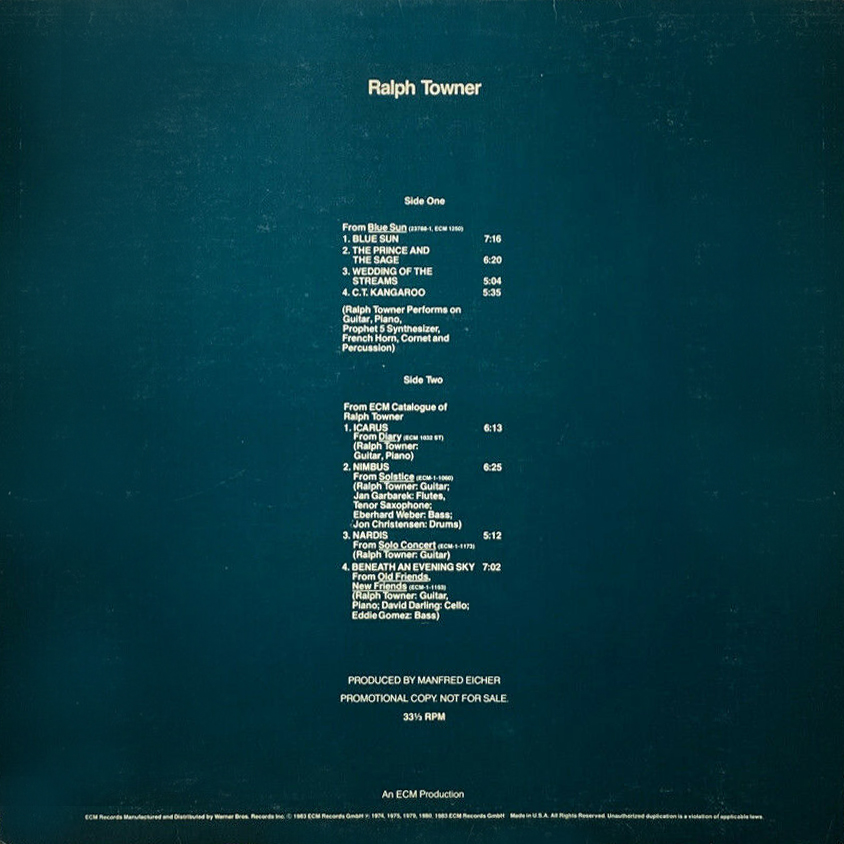
For the ninth installment in its 1970s ECM Special series, Trio Records in Japan presented its second of three artist spotlights, this time devoted to Ralph Towner, whose guitars have long served as measuring instruments for ECM’s most elusive cartographic spaces. The compilation begins where many listeners would instinctively begin, with “Icarus,” his most enduring composition, presented here in the version from Matchbook, his duo album with Gary Burton. Its melodic intelligence never advertises itself as cleverness. The tune gathers its lyric weight by degrees, enlarging its private glow with intimate attention to detail. One may still argue that the more definitive version appeared on Diary, and that album is represented here by “Erg,” a piece in which Towner turns the guitar into a small percussive cosmos. Through fingered attack and body-struck resonance, he draws out a molecular energy.

Among Towner’s early collaborations, Dis with Jan Garbarek remains one of the most luminous. Representing that unforgettable album is “Yr,” where Garbarek’s soprano moves over spiraling guitar lines with an almost disembodied precision, treating unexpected shifts in key and register as the very fabric of reality. The piece seems to fold distance inward, so that melody becomes a corridor and accompaniment becomes a second mind thinking beneath it. More surprising is the inclusion of “Palãcio de Pinturas” from Egberto Gismonti’s Sol Do Meio Dia. It can be easy to forget that these two masters met on this project, yet in the pairing of six- and twelve-string guitars, their affinity sounds immediate, almost inevitable. Their shared sense of color never becomes painterly in any decorative sense. Seemingly simple arpeggios carry more than their apparent weight, while incisive melodies surface as dark fins cutting through a glassy expanse.

The anthology’s pull toward open waters finds its most explicit form in “Staircase,” taken from Sargasso Sea, Towner’s wonderful collaboration with John Abercrombie. The tune is aptly named, but its geometry is stranger than the title suggests. It ascends without promising arrival, arranging angles of sound into a structure that feels both designed and half-dreamed. Abercrombie and Towner draw a shared diagram in the air, then let its lines tremble toward lyric mystery. From there, the compilation closes with “Suite: 3 X 12” from Trios/Solos, a carefully wrought composition in which Towner’s love of harmonics shines through the twelve-string with crystalline force. The work’s final movement presses harder against its rhythmic core, winding its attack with a precision that never forfeits wonder. Even at his most exacting, Towner refuses the tyranny of mere control.

What emerges from this selection is not simply a portrait of a guitarist, but a study in how something as fleeting as touch can serve a permanent architectural purpose. In these performances, virtuosity is never far from  restraint. To strike a string without dominating it, to enter silence without colonizing it, to let the instrument answer in its own difficult grammar: this is the quiet revelation of the set. A guitar, in Towner’s hands, leaves the world unpossessed.