

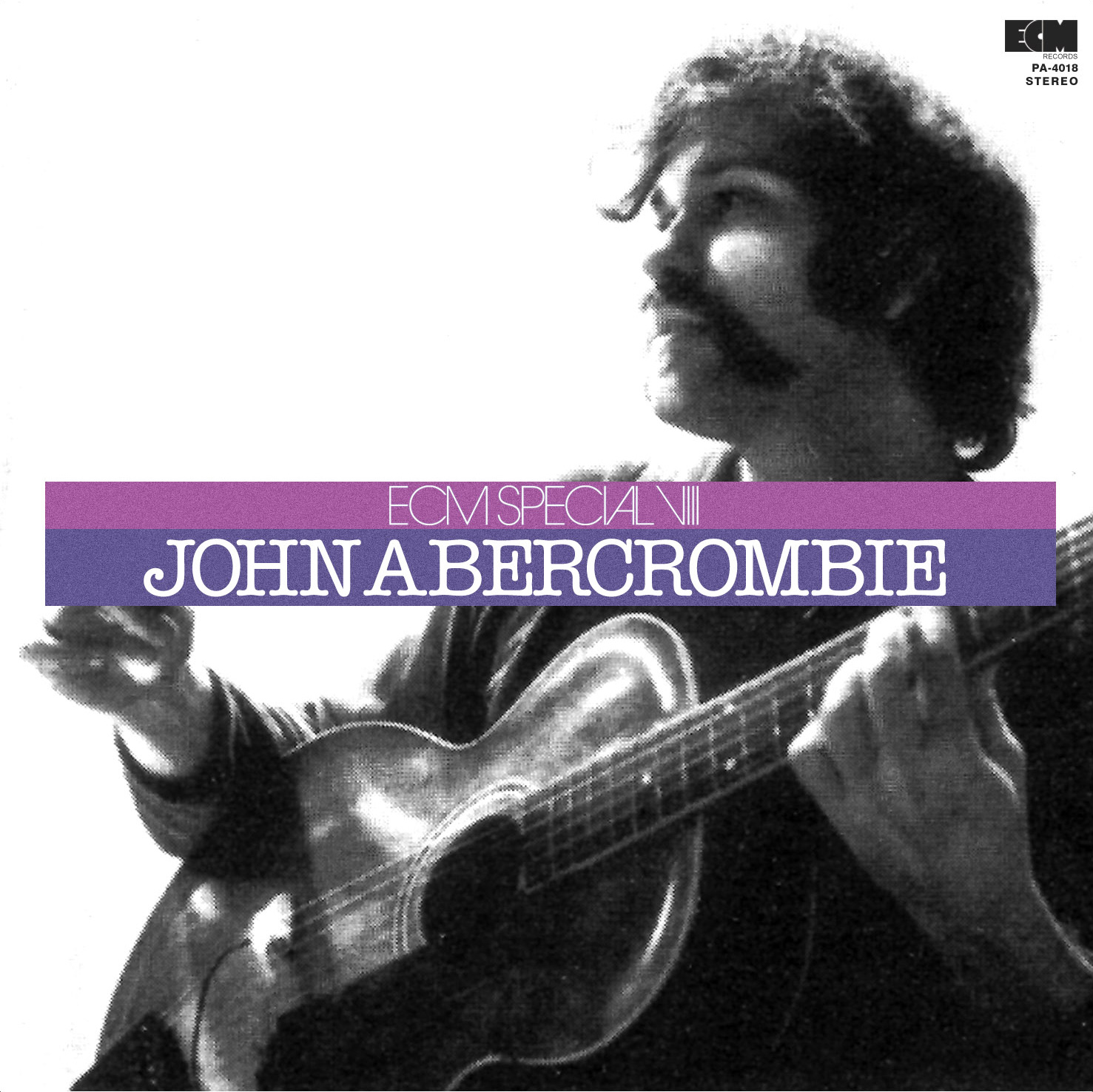
The eighth volume of the Japan-only ECM Special series marked a shift by dedicating itself to a single artist, a model it would follow for the remaining releases. This installment gathers the art of guitarist John Abercrombie under a single lamp, though the music itself keeps slipping beyond the circle of illumination. From the beginning, he was a musician who seemed to enter a piece from the side door of consciousness, carrying with him some private geometry of hesitation and nerve. The program begins, appropriately, with “Picture 3,” a track from Jack DeJohnette’s Pictures that had already appeared on ECM Special V. The duet is full of quicksilver intelligence, with DeJohnette setting traps of momentum that Abercrombie evades by transforming them into passageways. His guitar bends around the shifting terrain beneath it at every turn.
“Ralph’s Piano Waltz,” from Timeless, follows with the confidence of a tune that has polished its own bones until they gleam. It remains one of my favorite tracks from one of my favorite Abercrombie albums in the entire ECM catalogue, and in this company its elegance feels newly alive. The melody carries itself with a sleek inward poise, while DeJohnette once again proves the ideal partner for Abercrombie’s elastic runs. Jan Hammer’s organ burns patiently through the arrangement, a low flame behind stained glass, lending the performance an aura of suspension. The result is music with its collar slightly loosened and its mind fully awake, a waltz that seems to remember the dance floor only as a philosophical rumor.
“Back – Woods Song” is one of two selections from Abercrombie’s Gateway trio with bassist Dave Holland and DeJohnette at the kit. Its rural twang and bluesy touches leave smoky honey on the tongue, but the sweetness is cut by an alertness that keeps the piece from settling into pastoral comfort. Abercrombie’s guitar remains liquid and chameleonic throughout, a substance passing through several states of being. The rhythm section asserts itself with muscular grace, opening pockets of pressure without crowding a single gesture. From Gateway 2 comes the gentler “Sing Song,” which moves with a slower pulse of nocturnal reflection. Abercrombie’s touch here is wondrously soft, each note arriving with the delicacy of something translated from sleep. Anyone who loves this trio may hear these masterstrokes anew in this setting, where sequence itself becomes a kind of argument for the breadth of his imagination.
Characters is an album I rarely hear discussed, but it remains a beautiful object, inwardly lit and strangely self-possessed. Abercrombie’s solo effort offers some of the deepest insight into his gifts as both musician and composer, perhaps nowhere more adroitly than in “Telegram,” portioned here for our delicate enjoyment. A multi-tracked congregation of acoustic and electric guitars, it shifts with the assurance of a message traveling through invisible circuitry toward a destination it has already been altered by seeking. The piece contains that distinctive blend of light and shadow from late-1970s ECM productions, yet its deeper fascination lies in how Abercrombie makes solitude feel populated. The guitars answer one another as if conducting a séance for future selves, and the listener becomes the table at which those presences gather.
“Padma” turns the tide toward Cloud Dance. Featuring Abercrombie’s electric guitar alongside the sitar of Collin Walcott, it opens a more contemplative chamber, where improvisation becomes thinking aloud before language has organized its disguises. The performance feels both intricate and spacious, its beauty unfolding through fine internal pressures rather than surface ornament. Abercrombie listens as intensely as he speaks, and that quality gives the track its particular gravity. Last comes “Over and Gone,” an original tune played with Ralph Towner by way of Sargasso Sea. Between the echoing unity and pliant approach to songcraft, there is much to savor in its caress. The finality here aches because the music has shown that every farewell is also an act of authorship, a decision to leave one version of the self behind before it has finished asking to be understood. Instead of closing the door, Abercrombie’s guitar studies the hinge, hears the molecule of motion inside it, and vanishes through the smallest possible opening.
 Between Sound and Space: ECM Records and Beyond
i wish you had included a track from the Johnson/Erskine band, as well as the wonderful Dan Wall/Adam Nussbaum organ trio
ECM Special VIII was released in 1979, long before the Johnson/Erskine (1989) and Wall/Nussbaum (1993) trio albums came out 🙂