Terje Rypdal: Odyssey – In Studio & In Concert (ECM 2136-38)

Terje Rypdal
Odyssey – In Studio & In Concert

Terje Rypdal electric guitar, synthesizer, soprano saxophone
Torbjørn Sunde trombone
Brynjulf Blix organ
Sveinung Hovensjø bass guitar
Svein Christiansen drums
Swedish Radio Jazz Group
Odyssey (ECM 1067/68)
Recorded August 1975 at Arne Bendiksen Studio, Oslo
Engineer: Jan Erik Kongshaug
Produced by Manfred Eicher

My first encounter with Odyssey came in the late nineties. Still young in my ECM explorations and having just barely crossed over into Jan Garbarek’s Visible World, I wasn’t quite sure what to make of the journey that label stalwart Terje Rypdal (a name as yet unfamiliar) had just taken me on. The CD fell out of rotation quickly, I’m afraid to say, buried under the pile of New Series albums then dominating my attention. Years later, and well into my own listening odyssey, I returned to it, only to find that it had never left me.

Rypdal has, of course, been under the ECM umbrella since almost the very beginning. The release of his self-titled debut in 1971 sparked an intrepid flame that continues to burn through a wide spectrum of colors. As the informative liner notes from John Kelman tell us, the band that was to define Odyssey was the product of circumstance. Drawing on a pool of musicians from previous sessions, including bassist Sveinung Hovensjø from 1973’s What Comes After, he also welcomed unexpected talents into the fold, such as drummer Svein Christiansen and organist Brynjulf Blix, the latter of whom contributed heavily to the album’s well-aged luster. The resulting sound proved a defining one, as inescapable bass lines danced touch-and-go with the guitarist’s unbridled narratives. We hear this most in the solid underpinnings of “Midnite.” Hovensjø lays down the rules for all of its 17 minutes, leaving Rypdal to stretch them to the pathos of his progressive solitude. Those carefully pedaled strings and alluring soprano sax (played by Rypdal himself) careen through its nocturnal billows with humble ferocity as Torbjørn Sunde brings comparable light to the sky with muted trombone. If the plangent cry of “Darkness Falls” that precedes this and opens the album tells us anything, it is that here is a terrain of emotional clarity and immediacy. The magic of this rendering lies in its continual flux, in its refusal to settle into one topographic pattern. The following “Adagio” plunges the album to new depths, even as it raises the bar from which it hangs. Solina strings owe their thickness to the charcoal yet discernible picture into which Rypdal’s guitar spills ether: a shout of autonomy in its coolest disguise. “Better Off Without You” walks in organic circles, occasionally poking its head above the watery depths of Blix’s ostinato haze, keeping an eye trained “Over Birkerot.” In this punchier setting, Rypdal keeps his feet planted amid a chain of horn blasts (think Hans Zimmer’s Inception soundtrack on a smaller scale). His cathartic rock-out midway through is a chance to let hair fly and pulls open the ribbon of “Fare Well.” Along with the final “Ballade,” it finds the musicians in languid suspension, crossing vibraphone-like paths toward elegiac destinations. It may feel blinding, but we can be sure this light comes to us by the force of a distant hope.
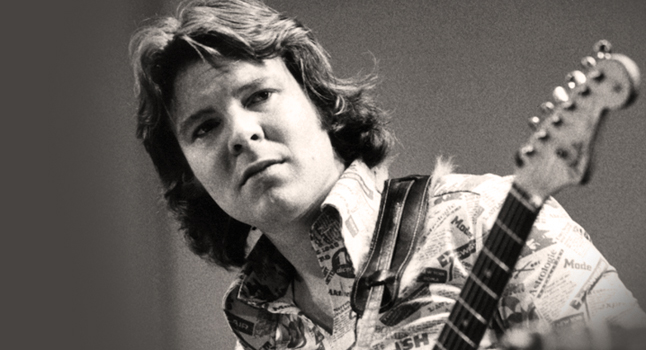
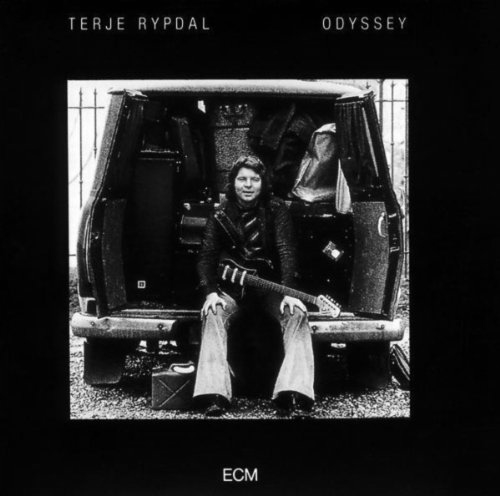
Rypdal has an incisive way of building anticipation, of dropping his solos at the most carefully thought-out points, his guitar an endless book of codas. Like the photo that graces its cover, Odyssey captures the life of a nomadic musician in candid monochrome. And while the album had been reissued on CD prior to this New & Old Masters set, the 24-minute “Rolling Stone” sadly did not survive that first digital makeover. An organ-infused underwater symphony of legendary status, its primal bass line and whammy bar ornaments flow like a meeting between Bill Laswell and Robin Guthrie before bringing on the album’s most rock-oriented developments. It also charts Rypdal in a pivotal moment of self-discovery where his tone began to coalesce into the sound for which he has come to be known. What a treasure to have in restored form.

As if this weren’t already enough to celebrate, ECM has gone above and beyond with another gem from the archives:

Unfinished Highballs
Recorded June 1976 by Swedish Radio, Estrad, Södertälje
Recording producer: Bosse Broberg
Engineer: Ola Kejving

This commissioned radio performance from 1976 features a streamlined Odyssey band (sans Sunde) fronting the 15-piece Swedish Radio Jazz Group. At under four minutes, the title track might blow by like the foreword to a novel were it not for its sheer theatricality. Rypdal’s vision cuts the darkness with a film projector’s eye, and blends into the Matterhorn bass of “The Golden Eye.” Icy synths challenge the thaw of Blix’s electric piano as fiery horns uncurl their tongues from the firmament and lick the snowcapped mountains of an unbridled story. Rypdal lifts this image skyward on waxen wings, which, unlike those of Icarus, are impervious to the light on which they feed. Next on this spacy ride is “Scarlet Mistress.” At once sharpened by muted trumpet and rounded by swinging textures, it gives wide relief to Rypdal’s laser etchings. One feels in its background the kick of eras when music’s enervation thrived in proportion to the harshness of its sociopolitical climate, so that the clubs of the 20s and 30s resurrect themselves and dance their ghostly dance. The soprano returns for a spell, for all a moonbeam peeking out from the clouds into a well of chords that pull us into “Dawn.” Melodies unwind, each a snake wrapped around the wrist of a god who whips it free into the glittering sky. Some enticing bass work dances amid Rypdal’s shimmers of water-harp enchantment, lowering us on a fishhook into the depths of “Dine And Dance To The Music Of The Waves,” in which sitar-like sounds pave a Nazca runway for the soprano’s grand coverage of worldly joy. Christiansen is the contortionist’s backbone of “Talking Back.” Sporting also high-flying reeds from Lennart Åberg and Ulf Andersson, its attunement is downright symbiotic. A real highlight. And speaking of which, where else to end but in “Bright Lights – Big City,” closing out the set on a signature dronescape.

With such a full sense of architecture to explore, it’s no wonder this newly unearthed companion has held its shape. In elevating the big band to a level of orchestral aliveness so rarely achieved, Rypdal has left a mark that is not only indelible, but also inimitable. With a nostalgic sound that distinguishes so much of ECM’s output from the decade, Odyssey – In Studio & In Concert shares the pedestal with Keith Jarrett’s Sleeper as release event of the year.

<< Eberhard Weber: Yellow Fields (ECM 1066)
>> Kenny Wheeler: Gnu High (ECM 1069)


OM: Rautionaha (JAPO 60016)

OM
Rautionaha

Urs Leimgruber soprano and tenor saxophones, bass clarinet, percussion
Christy Doran guitar
Bobby Burri bass
Fredy Studer drums, percussion
Recorded December 1976 at Tonstudio Bauer, Ludwigsburg
Engineer Martin Wieland
Produced by Thomas Stöwsand

The Swiss quartet of OM, which found just the freedom it needed in ECM’s studios for a good decade, flung open the doors with colorful aplomb on Rautionaha, a rare JAPO release. To this early date the group brings a kaleidoscope of shared experience. The sound is appropriately splintered. Guitarist Christy Doran pens the kick-in-the-gut opener, “For Ursi.” Unable to resist the attraction from the get-go, saxophonist Urs Leimgruber colors the twilight with his heady tenor, chaining ladders of virtuosity with attentive form. His gurgling expositions of momentary abandon give Doran just the break he needs to cast a reverberant magic with tails flying. The superb rhythm work from percussionist Fredy Studer and bassist Bobby Burri completes this wall of light. The latter gives us “Stephanie,” his first of two cuts. This meditation of gongs and electronics coalesces into some fine soliloquies from the composer, while the full drumming and six-string picking shimmer like morning sun on the horizon’s lip. The prickly tenor is a bonus. Speaking of which, Leimgruber puts his writing to the test in “Song For My Lady.” Something of a ballad, in it he becomes a crying wayfarer who walks the same circle of self-reflection until there is only music left of the one that produced it. Lifting this ponderous weight off our shoulders is Burri’s title offering, which grows like weed in a groovy embrace. His bass work glows here. Leimgruber opts for soprano, reaching heights of multi-phonic brilliance that no footstool can reach. The effect is nothing short of extraordinary. The quartet ends on a whimsical punctuation mark: a flag without a country, a star without a sky. In the absence of definite shape, we are free to induce our own.

Lennart Åberg: Partial Solar Eclipse (JAPO 60023)

Lennart Åberg
Partial Solar Eclipse

Bertil Lövgren trumpet, fluegelhorn
Ulf Adåker trumpet, fluegelhorn
Jan Kohlin trumpet, fluegelhorn
Håken Nyquist french horn, trombone, fluegelhorn
Stephen Franckevich trumpet (VI)
Lars Olofsson trombone
Sven Larsson bass trombone, tuba
Jörgen Johansson trombone (VI)
Lennart Åberg soprano saxophone, tenor saxophone, alto saxophone
Ulf Andersson alto saxophone, piccolo, flute
Tommy Koverhult soprano flute, tenor flute
Erik Nilsson baritone saxophone, bass clarinet, flute
Bobo Stenson piano, electric piano
Harald Svensson synthesizer (I, IV)
Jan Tolf electric guitar (I, II, III, VI)
Palle Danielsson bass (I-V)
Stefan Brolund Fender bass (I, II, VI)
Jon Christensen drums
Leroy Lowe drums
Okay Temiz percussion (I, II, III)
Recorded September 5-9, 1977 at Metronome Studios, Stockholm
Engineer: Rune Persson, Metronome
Produced by Håken Elmquist

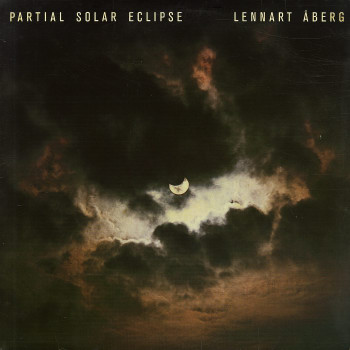
Swedish saxophonist Lennart Åberg assembles a force to be reckoned with for this out-of-print JAPO release. Fronting a 20-piece ensemble that includes early appearances by pianist Bobo Stenson, bassist Palle Danielsson, and drummer Jon Christensen, Partial Solar Eclipse plays out in a six-part suite of epic proportions. The trumpet-led swell of Part I gives way to a groovy bass line amid big band brilliance infused with Brazilian percussion (courtesy of Okay Temiz). A soaring solo from Åberg flirts with the clouds even as it transcends them in fiery sunset. The twinned bass action from Stefan Brolund and Danielsson impels the spirit toward Stenson’s winding finish. Out of these dense beginnings comes a mosaic of hues and textures. From the flanged ground line and backing horns of Part II, which sound like a warped version of “Baby, You’re a Rich Man,” to the oozing finality of Part VI, the album as a whole bursts with a jazz that squeals, “I made it!” Jan Tolf’s guitar work is the conclusive highlight, along with the florid and soulful tenor work of Åberg himself. Between the two we find the Motown edge of Part III, with its radiant flute and oceanic pianism, and the killer baritone work in Part IV of Erik Nilsson, who also unleashes a fabulous bass clarinet solo over the chalky backdrop of Part V.

This is an album that foregrounds itself by foiling the otherworldliness of all that came before. In so doing, it offers the glare of its namesake without the need for glasses. It’s an intense thrill ride, to be sure, but one that offers choice rewards even (if not especially) for those not tall enough to enter.

Mal Waldron: The Call (JAPO 60001)

Mal Waldron
The Call

Mal Waldron electric piano
Jimmy Jackson organ
Eberhard Weber electric bass
Fred Braceful drums
Recorded February 1, 1971 at Tonstudio Bauer, Ludwigsburg

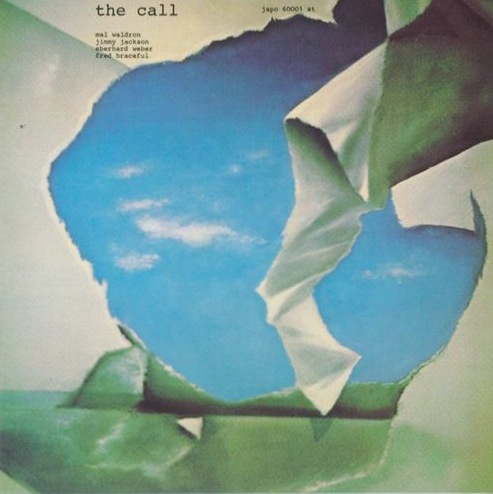
Seeing as Mal Waldron inspired Manfred Eicher to put out his first release, Free at Last, on what was to become the legendary ECM label, it is only fitting that his name should also grace the first release of its relatively short-lived companion imprint, JAPO. Through the magic of digital reissue, many of these once elusive albums can now be experienced for the first time, if not anew. Dipping into the waters of The Call (not to be confused with the Charles Lloyd record of the same name) is like tripping on the past as if it were the Here and Now. Over two long takes, averaging 20 minutes each, he and an all-star team transport us to a warm and inviting sound that is equal parts hard bop jam, psychedelic dream, and free jazz meditation.

The title track brings an energizing sound, slick and classic as can be. Bassist and future ECM mainstay Eberhard Weber, along with drummer Fred Braceful, spurs us through some thickly settled spaces, courtesy of Jimmy Jackson on the organ, all led by Waldron’s interplanetary surf. This joyful epic peaks in a glorious bouquet of heat distortion, smooth as it is sere. Lively solo action from Weber and Braceful pushes the band’s sound into delicate relief, throwing us into a dark groove before restoring us to light.

“Thoughts” is an altogether different spoonful. A diary of aural scribblings, it unfolds private wishes with meticulous patience. After a watery intro, Waldron lays down a chalky little vamp. Subtler denouements and a twist of introspection complete the cocktail. You’ll find no miniature umbrella peeking out above this rim…only the curve of a listening ear. Waldron skips us like a stone into heavier grooves, which in return spiral into whispers. Drums curl inward, and in these quiet crawlspaces between the floorboards of the mind, we take our rest, lost among the dust bunnies whose filaments are string and wire and electric current.

This is music that tastes exactly like what it’s made of.


Alternate cover

Marcin Wasilewski Trio: Faithful (ECM 2208)

Marcin Wasilewski Trio
Faithful

Marcin Wasilewski piano
Slawomir Kurkiewicz double-bass
Michal Miskiewicz drums
Recorded August 2010, Auditorio Radiotelevisione svizzera, Lugano
Engineer: Stefano Amerio
Technical Assistant: Marco Strigl (RSI)
Produced by Manfred Eicher

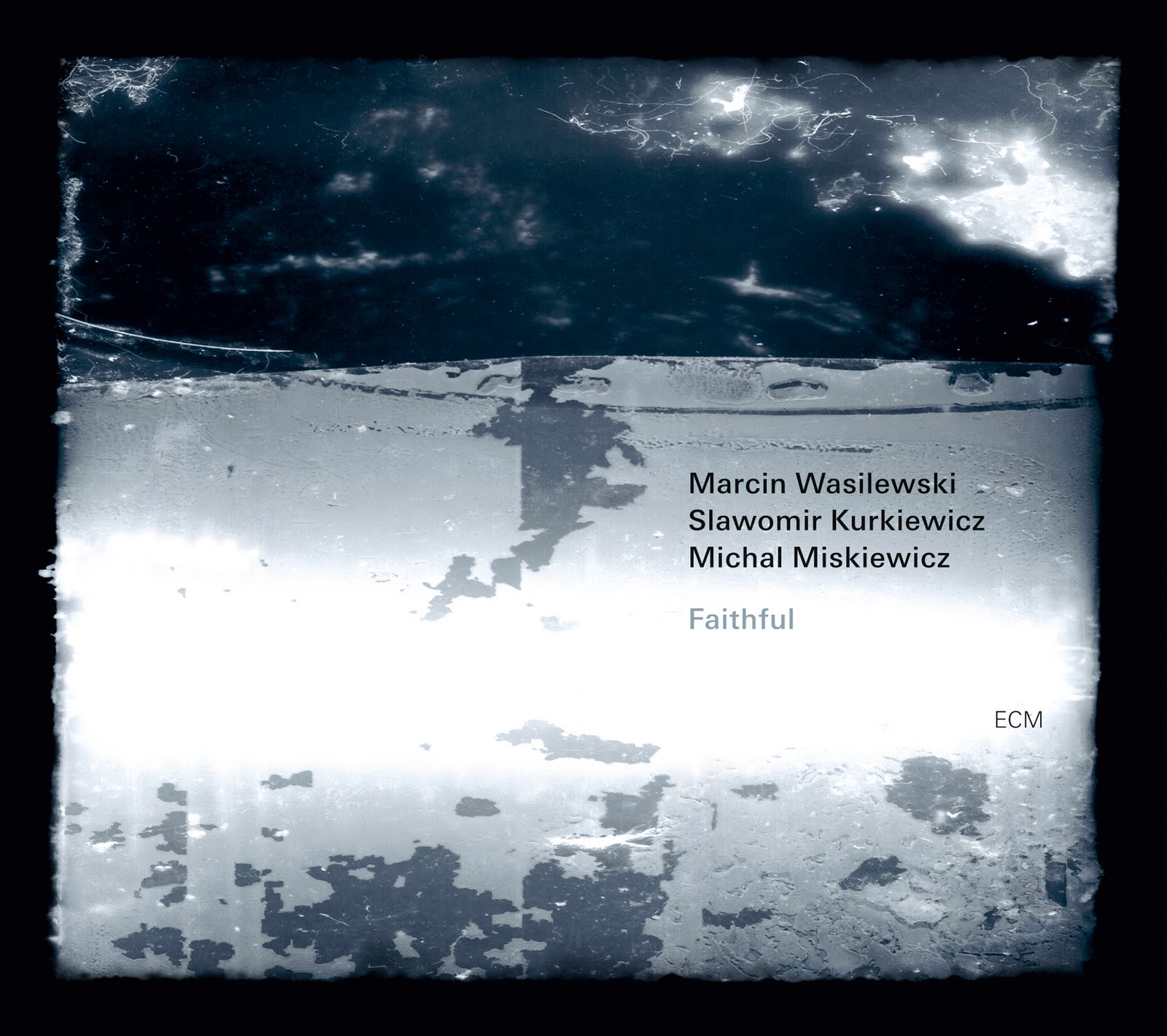
For its third ECM outing, the Marcin Wasilewski Trio expands the precious spaces delineated to such patient effect on TRIO and January. A pianist of uncommon insight, Wasilewski brings out the minimal best in bassist Slawomir Kurkiewicz and drummer Michal Miskiewicz, who in turn inspire reflections on those keys that might not otherwise reveal themselves in solitude. Together, they plant the seed of the album’s ever-expanding flower with a curious opener: “An den kleinen Radioapparat.” This song, by German composer Hanns Eisler (so vivaciously immortalized in Heiner Goebbels’s tribute), is meant to evoke the voices of radio, which haunt the now wordless protagonist in exile. After a 4.5-minute wait at this remote station of smooth and translucent contours, we are welcomed aboard the “Night Train To You.” The first of five Wasilewski tunes, its landscapes bleed watercolor beyond our window. We feel at home somehow, despite being so far from it. Yet with such attentive passengers sharing our car, how could it be otherwise? Their erudition is so fully ingrained into the surroundings that they are free to jump on and off these tracks at will, laying their own along the way. A riffling snare pulls us aside and whispers timetables into our ears, while Kurkiewicz supplies the dimly lit lanterns, the art deco screens, and lavish accoutrements of an Orient Express dining car. If we are the serviettes folded so neatly beside those empty plates, then the lush cut of the title track is the main course that awaits our dabbing. Shingled wave lines on the shore are the language of this Ornette Coleman classic, constantly redrawn to the rhythm of the tide. Which is very much like the flip-flopping of rubato and steady cells in “Mosaic,” also by Wasilewski. The rhythm section’s current polishes our ears to the smoothness of river-rolled stones, culminating in a sparkling waterfall finish. The long exhalation of “Ballad Of The Sad Young Man” follows. Its liberation of youthful fears and more mature reflections make for an utterly captivating experience. Then again, the tenderness of “Oz Guizos” (by Brazilian composer Hermeto Pascoal) makes the last feel like sandpaper in comparison, standing as one of the gentlest and most heart-stilling pieces in the ECM catalogue. Its heartbreak drips like rain from leaves after a quiet storm. The somber piano intro of “Song For Świrek” leads us into the album’s grooviest execution. Written by Wasilewski in memory of Marek Świerkowski, a close friend of the trio, its Ferris wheel pace turns skyward with the breadth of a hang glider. Miskiewicz caresses his kit, appropriately enough, as if it were in need of healing. The pianist’s final offering is “Woke Up In The Desert,” indeed a haze, a dream, a sun pressed into the scrapbook of the sky. Paul Bley’s “Big Foot” finds itself duly revived since its first label appearance on Paul Bley with Gary Peacock. The lively sasquatch of a solo from Kurkiewicz mixes wonderfully with the cameraman’s excitement in the piano. A true delight that reveals also superb detail in the drumming. Wasilewski ends things with his “Lugano Lake,” a protracted gaze through the studio window from one who would rather leave the condensation intact and examine every bead of upturned scenery as it drips into the proportion of something true.

Faithful represents a new direction. It favors protracted treatments and heightened sensitivity. The trio plays as it breathes, knowing just when to pause before moving on. Particularly well recorded, with just the right balance of intimacy and the infinity beyond it, it lives in soft focus. If you wish to know to whom they are being faithful, you need only turn the CD over and look at your reflection.

(To hear samples of Faithful, click here.)

Jörg Widmann: Elegie (ECM New Series 2110)

Jörg Widmann
Elegie

Jörg Widmann clarinet
Deutsche Radio Philharmonie
Christoph Poppen conductor
Messe and Elegie
Recorded June and July 2008, Congresshalle (Messe) and SR Studio 1 (Elegie), Saarbrücken
Engineers: Thomas Raisig and Thomas Becher
Fünf Bruchstücke
Recorded May 2009, Klaus-von-Bismarck-Saal, WDR Funkhaus, Köln
Engineer: Günther Wollersheim
Executive producer: Manfred Eicher

At 39, German composer and clarinetist Jörg Widmann has already established himself as a formidable talent. If his studies under Hans Werner Henze, Heiner Goebbels, and Wolfgang Rihm have left any noticeable influence in his work as composer, it’s the cellular approach at which he is so skillful. His experience as a performer with such ECM regulars as András Schiff, Kim Kashkashian, and Heinz Holliger, not to mention his sister, violinist Carolin Widmann, make him a natural fit for the label in both capacities. Though Widmann has been widely praised for his chamber works, on this survey we get only the Fünf Bruchstücke (1997) for clarinet and piano, and for which he is joined by none other than Mr. Holliger at the keyboard as he explores the extended capabilities of his instrument. His subtle clicks and arcing gestures provide the hum to the piano’s rattle at every turn. We feel these things and more scuttling just beneath the surface, holding on to sounds as idols of whimsy, each blown and deflated like a balloon that refuses to expand and will never know the catharsis of the pop. Among his first published pieces, they give us direct insight into his eclectic flourish…


(Photo by Felix Broede)

…and all the more so for nesting between two leviathan orchestral pieces. Played to astonishing effect by the Deutsche Radio Philharmonie under the baton of Christoph Poppen, his 2006 Messe buries us with immediate and bone-stressing volume, yet somehow retaining, not unlike the Dies irae from Arvo Pärt’s Miserere, the softness of a petal. This is the first of a handful of references, which would seem to include also Górecki’s Third Symphony (note the Contrapunctus I). These allusions are as robust as they are transient, rising as they do from an ocean of great depth and color. Even in the absence of words, the piece abounds with voices. Widmann’s string writing is patient and awakens by a lone violin, as quiet as the opening was loud. Pastoral cries from winds exhale in watery strains. Bows flicker through consciousness like dragonflies. Each step becomes a window of spiritual reflection, a string of dawns, ferocious as lions jumping from the sun. Swollen joints in the Trinitarian body find unconditional love in the crucifixion, sacrifice rendered divine and tipped by fingers of humility and faith. Shadow masquerades as light, and light blinds itself. Reaching the resurrection at last, a promise of life wraps itself in autumn before unfurling a banner of exodus beneath an all-seeing eye, within and without, everywhere and nowhere, in the glitter of the lachrymose.

The 2005 title composition stretches those tearful remainders into lenses of contact. Peering through contorted sighs and unspoken things, reeds, bellows, and high strings dance across a bridge of burning meteorites, each a needle without thread. An operatic current prevails. One can feel characters ambulating about the stage, hiding behind curtains and whispering erratic secrets into the spotlight, which stays lit even after the music ends.

If Widmann’s landscapes seem not so well defined, it is because his intentions (or so I imagine) forego the platitudes of anticipation in favor of an organic, distilled approach. Poppen brings precisely that feel of ebb and flow, drawing out from these performances a viscous and dynamic energy. Holliger’s involvement, too, is fortuitous, for here is a voice that, given time, might very well prove to be his equivalent.

Gianluigi Trovesi and Gianni Coscia: Frère Jacques – Round about Offenbach (ECM 2217)

Frère Jacques – Round about Offenbach

Gianluigi Trovesi piccolo and alto clarinets
Gianni Coscia accordion
Recorded January 21-23 and March 2-4, 2009, Centro Civico Musicale Sant’Anna, Perugia
Engineer: Francesco Ciarfuglia
Produced by Manfred Eicher

In search of Brother Jacques, Mr. Offenbach, the great iconoclast, composer of operettas and wound-bringer to discerning classical minds. Our guides, multi-reedist Gianluigi Trovesi and accordionist Gianni Coscia. The itinerary destroys borders, forges new ones in their wake, and takes every path with more than a grain of salt. The melodies take on an ember glow, gesticulating in the manner of an oil painter’s brush and leaving behind a portrait that is offering and caricature in one. We stumble and marvel at what impedes our feet, knowing that we can only sit this one out and accept the frivolity of its passage. It is the pageant, and we the hapless spectators, ears sharpened to the whim of interpretation.

Scholar Heather Hadlock writes of Offenbach’s Les Contes d’Hoffmann as a “death-utterance,” so concerned is his only (and unfinished) opera with death and its many reflections, to say nothing of its emergence from the pen of a dying man himself. In the course of the work, Offenbach “reviews his own compositional past, drawing its various elements into a musico-dramatic kaleidoscope.” And so, Hadlock concludes, we might better see it as “undead,” for the narrator lives and speaks on even after his symbolic passing. Doubtless, the listener will find in Trovesi and Coscia’s striking reinventions a death-defying vivaciousness on par with their sources. Breath and bellows jump from their digital oven like myriad gingerbread men, running nakedly and wittily through Hoffmann with all the requisite stagecraft such activity would require to convince us of its aliveness. Fitting, too, is the “Epilogue” drawn from the same, which ends the album on a funereal pitch.

Most of what precedes it, however, seats us at a banquet table of delights. The four opéras bouffes—operettas rich in parody and farce named for the Théâtre des Bouffes-Parisiens at which Offenbach premiered them, if not the other way around—sampled here come out of a particularly fruitful tenure, during which time the composer produced some of his most popular work. Of La belle Hélène (1864), La vie parisienne (1866), La Grande-Duchesse de Gérolstein (1867), La Périchole (1868), he quipped most characteristically, “I am certainly the Father, but together they are the Son and the Wholly Spirited.” Trovesi and Coscia are more than happy to toss these ingredients almost cartoonishly in their kitchen. With herbs and stalks a-flying, they include whatever comes to mind in the largest pot they can find, only to ladle the resulting concoction with butler-like care into our bowls. It’s all we can do as their guests to not dip our spoons in unison, and join in the after-dinner dancing into which the sheer joy of these flavors bids us welcome.

To be sure, these provide a rich and complementary tasting experience. The truffle of Trovesi’s alto clarinet blends into Coscia’s creamy leeks, each enhancing the other to infinite effect. La vie parisienne provides some of the album’s maddest brilliance, ambulating like feet on a mission to stir up gossip in the village square. From Mozartian prances to fervent declarations, the remainder flies. Yet it is in the improvisatory hands of our fantastic duo where lie the deepest treasures. Among them are the vivid gems of “Tangoffenbach” and “Dedicated to Hélène and her little birds,” each an aperitif of smoothest finish. These are monologues that sing and move, bringing shadow to can-can, and lipstick to statues.

This is a diarist’s playbook, a sincere exploration of passion and obsession that not only pays tribute to but also transcends its namesake, all the while caging the spark of creativity in action. What’s left is an affirmation…and a smile.

Bjørnstad/Darling/Rypdal/Christensen: The Sea II (ECM 1633)

The Sea II

Ketil Bjørnstad piano
David Darling cello
Terje Rypdal guitars
Jon Christensen drums
Recorded December 1996 at Rainbow Studio, Oslo
Engineer: Jan Erik Kongshaug
Produced by Manfred Eicher

If The Sea was a sweeping journey along the surface of its namesake, then this sequel is a plunge into its darkest depths. With the focus of an underwater camera, Ketil Bjørnstad and his peerless group render visible entire worlds we would otherwise never have known. Unlike its predecessor, The Sea II unfolds its map in 10 titled sections, each a different island strung along a melancholy chain. Cellist David darling joins the pianist for the introductory “Lalia.” In so doing, he carries on the sentiments they so beautifully wove together on The River, the chronological and elemental link between the two seas. A voyage in and of itself, it emotes in all directions until guitarist Terje Rypdal brings forth his blade in “Outward Bound.” Jon Christensen’s orchestral drumming is the only reminder of land to be found as we approach the sandy floor. And while Darling does crest a wave in “Brand,” holding fast to boxes from a forgotten shipwreck, within those boxes lie innumerable others. Rypdal rockets off into the night, where more water awaits him as he jumps into that great river in the sky. Anchorage returns in “The Mother,” its quivering arcs the salve for a wounded heart. “Song For A Planet” takes a solemn look at our own, settling into the album’s most understated cradle. Darling and Bjørnstad are simply transcendent on this duo track, as they are on the forlorn “Agnes” and “December,” the latter an ode to the month in which the album was so sensitively recorded. All three speak to the astonishment of their craft. “Mime” is Rypdal’s time to break into the current, a veritable shaft of sunlight lassoed to a dolphin’s fin, while“South” shuffles to the beat of Christensen’s drum, ever detailed and sincere, as Rypdal plies the ether with inquiries of rain and fertility.

This is music to swim in, to touch and be touched by. Don’t let it leave you dry.

<< Stephan Micus: The Garden Of Mirrors (ECM 1632)
>> Charles Lloyd: Canto (ECM 1635
)

Stephan Micus: The Garden Of Mirrors (ECM 1632)

Stephan Micus
The Garden Of Mirrors

Stephan Micus voice, steeldrums, sinding, shakuhachi, suling, nay, tin whistles, percussion
Recorded 1995-96 at MCM Studios

Just as one look at the many instruments Stephan Micus plays is sure to impress, so too does one experience of what he produces with them dispel arbitrary interest in those means. Music flows from his fingertips in such an organic way that the source catches light in all of us. Nothing feels out of place. It’s worth noting, however, that The Garden Of Mirrors makes especial use of that most intuitive instrument of all: the human voice. Like water in sunset, Micus’s wordless songs collect light-years of travel along the glittering surface of their multiplication. Twenty such voices manifest themselves first in “Earth.” Accompanied by the bolombatto, an African gut-stringed harp, this world traveler speaks to the very marrow of life. A binary star leaves his lips, the being to our nonbeing. These twins become triplets, and so forth, until the galaxy is alive in a choir whose rhythms are the stuff that binds. “Violeta” and “Night Circles” exchange the bolombatto for its hemp-stringed cousin, the sinding, melting into a future where hope may breathe like an autumnal wind through leaves. Dry and crackling fields shape syllables with the ferocity of a linguist. Vocal flocks outline the sky in chalk, coloring it in like the white of a giant eye. Veins become songs. These become the world. “Passing Cloud” bands steel drums, two sinding, and shakuhachi for a sound at once vapor-like and heavy as soil. Those who are content see in it animals, trees, and faces, while others see sighs, depressions, and hardships. For “Flowers In Chaos” we get a coterie of 22 suling (Indonesian bamboo ring flutes), dispelling that very cloud with tales of earthly things. “In The High Valleys” is the album’s most insightful contemplation. In its intimate pairing of sinding and voice, it moves, to reference an album title of the Alial Straa, in a lumbering intransitive dream, and would seem to invoke the origin myth of the jazz bass. “Gates Of Fire” marks its passage with ashen footprints, bringing atonement in circular motions, each a brand on the side of a mountain. “Mad Bird” is a living solo for Irish tin whistle that traverses its own boundaries in search of landing, for life on the wing desires stillness. This singles out the final “Words Of Truth,” where the breath of life courses through six shakuhachi in self-reflective bliss. It is the sailor and his reflection, the storm and its rainbow, caressing the shores of a fading continent, of which we are the only inhabitants left standing.

<< Arild Andersen: Hyperborean (ECM 1631)
>> Bjørnstad/Darling/Rypdal/Christensen: The Sea II (ECM 1633
)