Michael Mantler: The Hapless Child (WATT/4)

The Hapless Child

Michael Mantler
The Hapless Child

Robert Wyatt vocals
Carla Bley piano, clavinet, string synthesizer
Steve Swallow bass guitar
Jack DeJohnette drums, percussion
Terje Rypdal guitar
Alfreda Benge speaker
Albert Caulder, Nick Mason additional speakers
Recorded July 1975 through January 1976 at Grog Kill Studio in Willow, New York with the Manor Mobile at Robert Wyatt’s house and Delfina’s farm in England, and at Britannia Row in London
Engineers: Michael Mantler, Dennis Weinreich, Alan Perkins, and Nick Mason
Mixed January 1976 at Britannia Row by Nick Mason
“The Hapless Child” mixed November 1975 at Scorpio Sound by Dennis Weinreich
Produced by Carla Bley
Release date: June 1, 1978

Our sojourn through the shadowy periphery of WATT-induced slumber presses onward in The Hapless Child. Michael Mantler’s lovingly crafted ode to Edward Gorey (1925-2000) deepens the dream in which we find ourselves, making it seem more real by every sung (and spoken) word. Those who adore Mantler’s soundscapes might already be familiar with Gorey’s words and illustrations. Macabre though his themes often are, there’s also a childlike wonder to his gallery of apparitions, misfortunes, and uncertainties that lends itself beautifully to Mantler’s uniquely sonic stagecraft.

Gorey himself once said, “It’s well we cannot hear the screams we make in other people’s dreams.” And perhaps we are given here a glimpse into that very possibility, as if every scream were re-clothed as a poem that everyone can relate to. Aiding in this psychosomatic translation process is a band that is itself the stuff of fantasy: Carla Bley on piano and keyboards, Steve Swallow on bass guitar, Jack DeJohnette on drums and percussion, and Terje Rypdal on guitar. Standing at the top of this pyramid is vocalist Robert Wyatt, who drinks in all the sunlight and spews out morbid parables for the lost below.

The most convincing turns of this subarachnoid maze are found in three dense scenes. “The Sinking Spell” opens with what sounds like the tail end of an in-studio conversation, reminding us from the start that what we are about to experience has been fashioned as an object of fascination for our voyeuristic ears. Wyatt transitions into the deceptive simplicity of rhyming couplets, telling the story of something “morose, inflexible, aloof” appearing and disappearing. Ever closer but ultimately ephemeral, this unidentified presence looms with a feeling of unsettlement as intense as Wyatt’s matter-of-fact delivery. “The Insect God” conveys the frantic story of a child’s disappearance and the dismay of a family who will never know the ghastly sacrifice for which she has been taken. It is also one of the most disconcerting masterstrokes of prog rock these ears have ever encountered. Then the title song, in which a girl falls into destitution following the death of her parents, only to be fatally run over by her war-wounded father (alive after all), who no longer recognizes a daughter battered beyond recognition by fate.

Rypdal and DeJohnette provide glimpses of gold in these otherwise silver-toned dramas. Bley’s piano and string synthesizer up the quotient of creepiness, while Swallow’s bass is the perpetual mobile of time that stops for no one. Other shards in this bag of broken memories include “The Object-Lesson” (a recitative laid on an extraordinary altar of guitar, bass, and drums), “The Doubtful Guest” (for which Wyatt’s brogue is uncannily suited), and “The Remembered Visit” (about a promise destined never to be fulfilled). Each of these is a path we might very have wandered ourselves, but against which Mantler has constructed a strangely alluring warning sign for us to read in full before heading forth to brighter pastures under opened eyes.

Though The School of Understanding will always be my favorite Mantler piece, The Hapless Child might just as appropriately wear the crown of his highest achievement.
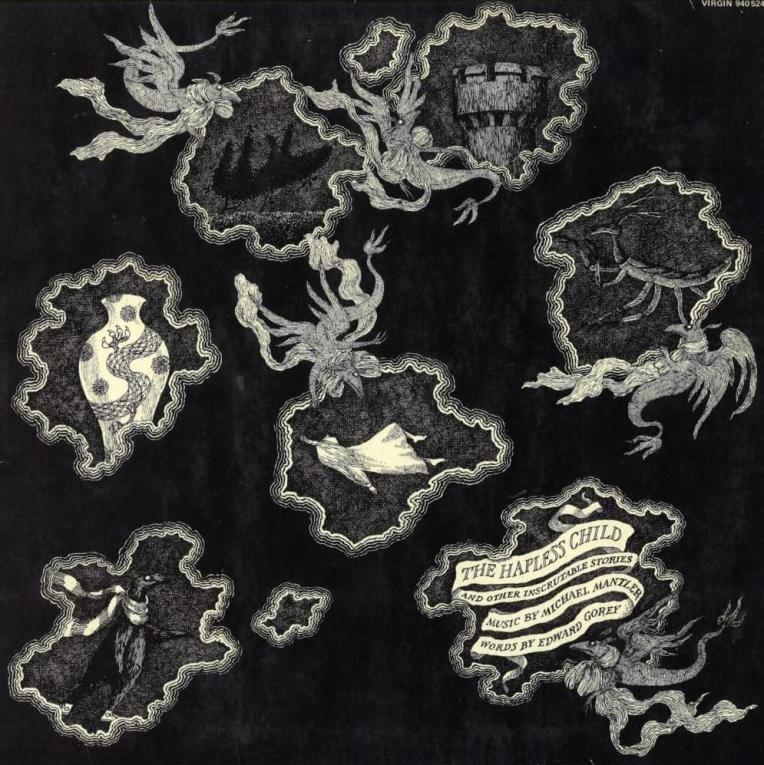
The Hapless Child back

Michael Mantler/Carla Bley: 13 3/4 (WATT/3)

WATT-3-front

Michael Mantler
Carla Bley
13 3/4

Carla Bley piano
The 13 Orchestra
The 3/4 Orchestra
Recorded August 1975
Grog Kill Studio, Willow, New York
Mixed September 1975
Scorpio Sound, London
Engineer: Dennis Weinreich
Assistant: John Hunt
Produced by Carla Bley and Michael Mantler
Release date: February 1, 1978

After sleeping in separate beds, so to speak, in the first two WATT releases, Carla Bley and Michael Mantler share a marquee for the label’s third. The program here is bipartite, sporting one composition by each in a resolutely multi-dimensional form of jazz that pairs Bley’s piano with orchestral forces.

Mantler’s 13 is a morose dive into some light-starved chambers of nature. Sounding like a storm turned into a symphony, it has the climatic features of rain and hail. Bley is a lost and itinerant soul in all of this, one whose mind, despite being over matter, is subject to abuses of the elements. The combinatory dialogue of strings and horns generates internal combustion, reaching textural peaks of brilliance. The piano’s forlorn timbre is emphasized by a slightly detuned and tinny delivery, as if it were an instrument that has known only a life of physical compromise. And so, any glimpses of perfection or woundless-ness feel more traumatic than hopeful. Struggles are indicative not of pain but of an underlying deference to the fate of its infliction. The storm, then, serves to illustrate a way of life, not an interruption to it. We are left with a sea of textures to be felt along the spine and ear canal, building to a cathartic wall of sound à la Glenn Branca.

Bley’s 3/4 is just as distinctly her own, though its breadth of vision may be compared to the classical hybrids of Keith Jarrett (who, incidentally, gave this piece’s premiere). Opening with a cyclical piano that maintains its course throughout, it ties a web of winds and brass, allowing notes to flow through every opening. An overriding drama speaks of the theater, but one in which bodies jump off the stage yet never land. Droll memories share oxygen with coarse futures, yielding a vibrancy that speaks both of its composer and the time during which it came into being. It ends as it began, in a childlike wonder at the immensity of creation. Only now it knows where life will lead because, as we will realize, everything that came before was a prelude to self-destruction.

WATT-3-back

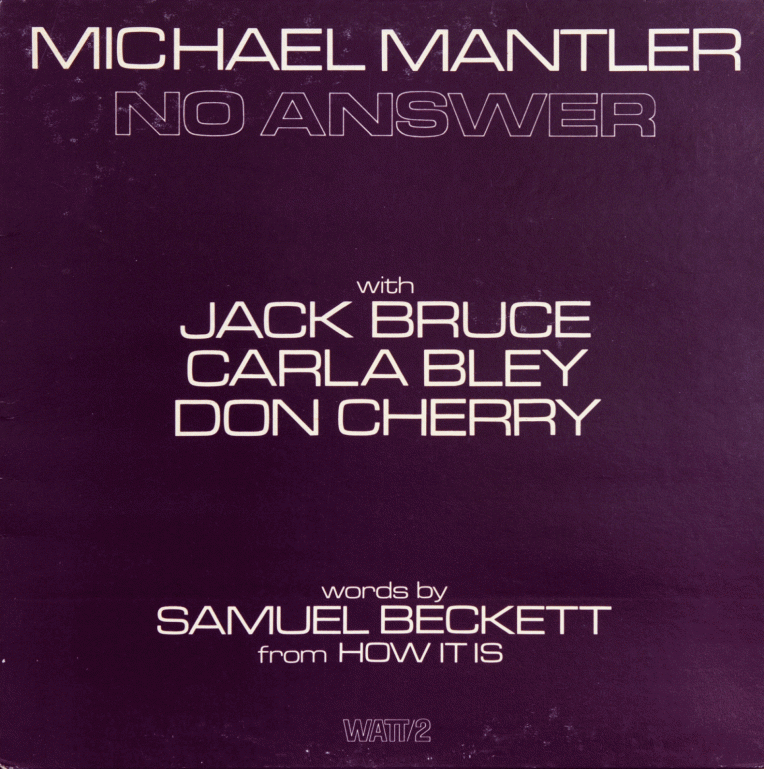
Michael Mantler: No Answer (WATT/2)

No Answer

Michael Mantler
No Answer

Jack Bruce voices, bass
Carla Bley piano, clavinet, organs
Don Cherry trumpet
Recorded February and July 1973
Blue Rock Studio, New York
Jack Bruce recorded November 1973
Island Studios, London
Mixed March 1974
Blue Rock Studio, New York
Produced by Carla Bley and Michael Mantler

when the panting stops yes so that was true yes the panting
yes the murmur yes in the dark yes
in the mud yes to the mud yes

After landing us in the scenery of Carla Bley’s Tropic Appetites, our journey through the land of WATT brings us to its first stopover in the form of Michael Mantler’s No Answer. Here we are exposed not to the snapshots of that first masterful traversal, but rather to the fitful dreams of our displacement following it, wounded by the act of travel in ways that only the unpunctuated prose of Samuel Beckett can articulate. Drawing on the globally talented trio of vocalist Jack Bruce, trumpeter Don Cherry, and Bley herself on piano, clavinet, and organs, Mantler sets passages from 1964’s How It Is (1964) as if each were a life to be shuffled rather than a memory to be pulled from its deck.

Consisting of two sections—NUMBER SIX and NUMBER TWELVE—of four parts each, No Answer is (curiously) an answer to its own question. This philosophical DNA repeats itself endlessly; only we are privy to a sliver of its helix. Bley’s pianism is the damp ground beneath gray-clouded vocal overdubs, yielding beneath every word as if it were a footprint in the making. The quality of Bruce’s singing lends itself organically to Mantler’s stage, as if the two were made for each other. His delivery is sardonic yet sincere, his falsetto particularly haunting in its naked vulnerability. He walks the line of theatrical refraction, rolling up the fourth wall like a backdrop no longer needed. Thus, he represents a lifelong fascination, pulled into an ephemeral mold.

Though the novel itself is a slog through mud and violence, there’s something unclothed about the music that adds an entirely different level to its interpretation. Bley is the curio collector in this regard, at some points rummaging through a closet of memory while at others dancing among the bits of relics she has unearthed. As for Cherry, he is a voice from the past, chanting and bubbling through terrestrial forms of communication.

The second half of the program is introduced via clavinet and Bruce’s congregation of selves. In the context of this vibrant execution, we find ourselves caught in the web of inner meanings over outward appearances. The effect is such that, even when Bruce breaks open a bottle of funk with his bass, there is little to be hopeful for in the bleakness of things. In a reversal of fortune, fire comes before smoke, sinking into the darkness of Bley’s organ in the slow tumble of a drunken tourist.

nothing to emend there no the arms spread yes
like a cross no answer
LIKE A CROSS no answer YES OR NO yes

No Answer back

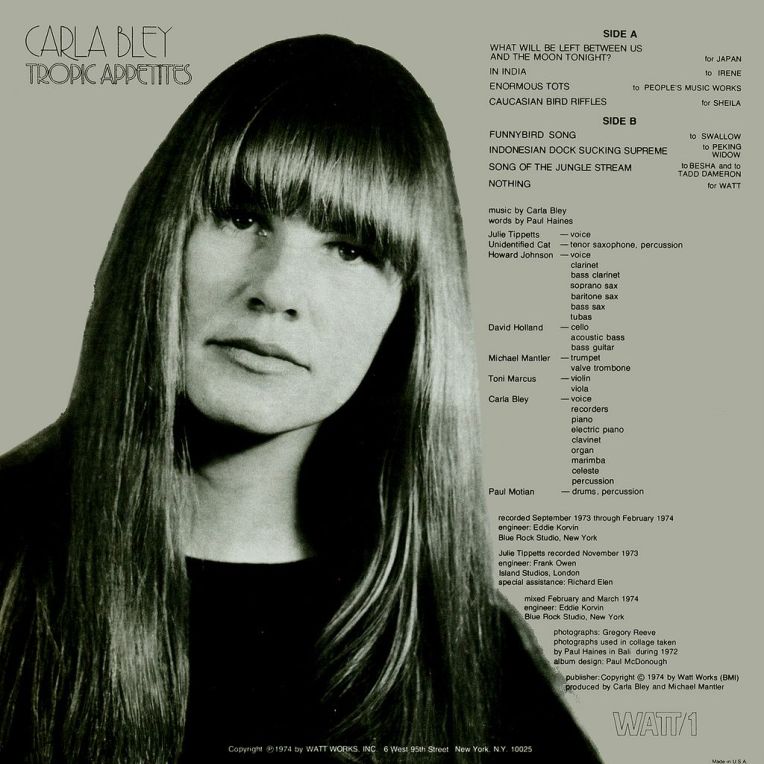
Carla Bley: Tropic Appetites (WATT/1)

Tropic Appetites

Carla Bley
Tropic Appetites

Julie Tippetts voice
Gato Barbieri tenor saxophone, percussion
Howard Johnson voice, clarinet, bass clarinet, soprano, baritone and bass saxophones, tubas
David Holland cello, acoustic bass, bass guitar
Michael Mantler trumpet, valve trombone
Toni Marcus violin, viola
Carla Bley voice, recorders, piano, electric piano, clavinet, organ, marimba, celeste, percussion
Paul Motian drums, percussion
Karen Mantler voice
Recorded September 1973 through February 1974
Engineer: Eddie Korvin
Blue Rock Studio, New York
Julie Tippetts recorded November 1973
Engineer: Frank Owen
Island Studios, London
Special assistance: Richard Elen
Mixed February and March 1974
Engineer: Eddie Korvin
Blue Rock Studio, New York
Produced by Carla Bley and Michael Mantler
Release date: February 1, 1978

Our storybook adventure through the entire catalog of WATT WORKS—the sublabel endorsed by ECM to showcase the work of Carla Bley and Michael Mantler—begins with Bley’s classic prologue, Tropic Appetites. The pianist, composer, and arranger leads a stellar cast of characters in this richly textured slice of jazz theater. Given the fact that Bley’s music has always been so well-traveled, it’s no wonder that her first WATT outing should be so geographically far-flung, setting poems by the late Paul Haines (1933-2003), whose experiences in Southeast Asia inspired the words sung here by Julie Tippetts. Joining them are tenor saxophonist Gato Barbieri, multi-reedist Howard Johnson, Dave (credited as David) Holland, Michael Mantler on trumpet, Paul Motian on drums, and Toni Marcus on violin and viola.

The album’s subtitle (“It’s Rude To Point Your Food At Anyone”) reveals an obvious thrust: the theme of imposing one’s culture on others who might not share it. This sentiment is duly expressed in the opener, “What Will Be Left Between Us And The Moon Tonight?” As Bley’s piano and Motian’s percussion phase across a night sky of bass and tenor, we are taken on a locomotive ride through landscapes of carnal urges and fragrant trees. Holland is superb in this early appearance, lighting our way before the piece pulls steaming into Free-for-All Station.

Much of what follows happens on foot. Whether trekking “In India” or facing “Enormous Tots,” a darkly whimsical worldview guides our way. The latter hands Johnson an evocative passage about snakes and overgrowth, as grungy guitar, bass clarinet, and brass jump from free jazz to carnivalesque at the drop of a hat amid lyrics that explode any vision we might have of childhood, fantasy life, and play. Motian and Holland (on bass guitar) hack their way through with machetes of rhythm. Stripped of artifice, romanticism, and Orientalist trappings, they present us instead with a taste of the earth and of the human condition. “Song Of The Jungle Stream” places us in ancestral territory. Barbieri (the de facto soloist of Bley’s early period) fans catharsis out into a hush of urban cool. Then there’s the unforgettably titled “Indonesian Dock Sucking Supreme,” in which Tippetts and Johnson lob their forces in a context of larger others. Barbieri is once again incendiary. Our tour ends in “Nothing,” a surreal mélange of tango, funk, processional, and a host of other genres.

Along the way we are fortunate to lift off into the air for two spells. First is “Caucasian Bird Riffles,” which reaches through our throats and pulls out something we’ve never seen before: a version of ourselves laid bare for all foreign eyes to see. Thus does travel gut us by removing our egos from the center of things, thus hanging a question mark over the center itself. In this regard, Mantler’s trumpet draws an orbit of self-reckoning. Second is “Funnybird Song.” It’s worth noting that every track on this album bears dedication to a person or collective, and in this case it’s Swallow who gets the nod. (Little did they know this gesture would plant a seed of love—but we’re getting ahead of our story.) A seven-year-old Karen Mantler, Bley’s daughter by Michael, provides guest vocals for this charming little number that, like the album as a whole, polishes exotica until it reflects us critically in its surface.

Tropic Appetites back

Interview: Keith Jarrett conducted by Timothy Hill

KJ front

This ultra-rare promotional CD from 1994 contains an interview with Keith Jarrett conducted by Timothy Hill. Much of the interview is spent discussing the backstory and recording circumstances of At The Deer Head Inn, Jarrett’s phenomenal live album with bassist Gary Peacock and drummer Paul Motian, and Bridge Of Light, a program of classical music composed by Jarrett.

When Jarrett first encountered the Deer Head Inn itself, it was the only place of its kind in Pennsylvania Dutch Country, where jazz wasn’t exactly on the hearts and minds of communities far more concerned with everyday practicalities. Jarrett was living in Allentown, where jazz was limited to generic rooms at best. Deer Head was far enough away that he wasn’t really aware of it until he got his first regular gig there, playing drums for local pianist (and Jarret’s personal friend) Johnny Coates. “I learned a lot about what not to do twice,” he recalls of those early gigging days, long before the piano became his forte. After two summers of grabbing the Deer Head by its antlers, sitting in sometimes on guitar (which, incidentally, earned him an invitation from Stan Getz to play in a Calypso band), he left that part of his history behind to dive headlong into his career as a pianist. By the time the Deer Head gig materialized, he hadn’t played there as pianist for nearly three decades.

Many elements came together for that performance to make it what it was. First, the venue was a “piano room” in the truest sense, a place of intimate construction that practically begged for Jarrett’s song. Second was the fact that drummer Jack DeJohnette, his trio go-to, was unable to make it, leading Motian to fill in at the last minute. Third was the “behavior and concentration” of everyone involved—a rapt attention he attributes at least in part to Motian’s involvement. When things come together like that, following a natural flow without depending on “large things,” as he puts it, magic is born.

Jarrett further bows to a certain magic in the recording itself. He mentions the “crucial little keys” of how a player is feeling, and how technology may struggle to capture those details in such a beautiful way. In this case, however, they shine through with utmost clarity, including the vocal exclamations for which he is (in)famously known. “I should’ve written them a thank you note,” he quips, speaking of Peacock and Motian, who he makes a point of noting added their own whoops of excitement in the heat of the moment. “If I’m going to be the culprit, let it be all three of us.” The conversation turns naturally to the tune “Chandra” (included along with “It’s Easy To Remember” at the end of this CD), which Jarrett praises for Motian’s avoidance of sticks altogether. Where any drummer would start with brushes and switch to the punctuation of sticks, Motian’s continuous brushing spoke directly to Jarrett’s heart: “This is what we’ve got now. This is what it is. And it put me in another place, where the expectations were not the same as they would be every time you play.” Thus did Motian pull everyone into the center of things.

At around the time that Bridge Of Light was coming together, he was already working on a commission from Japan to write the Adagio for oboe and string orchestra featured on the album. When told there would be time left in the program, his thoughts turned to the Elegy he was writing for his Hungarian grandmother. Taking such an active role in directing that recording was, for him, like “being in charge of a country,” whereas Deer Head was like “being not in charge and knowing it would be okay.” Such polar, yet parallel, opposites would seem to define his career. At Deer Head, for example, there wasn’t any music until it was played, whereas in a classical setting, anxieties toward perfection ran high. Classical musicians, he avers, should be less obsessed over playing the same music better than anyone else and more concerned about being themselves enough not to care, allowing the music to “bloom for itself” instead. And if blooming is what it’s all about, then Bridge (from which the Adagio and the “Dance” of Jarrett’s violin sonata are also included here) is a veritable field of life.

“You don’t have to be emphatic when you’re doing something beautiful,” says Jarrett of the creative process. “If you emphasize the beauty of something, you might step on it.” And while one might easily flag this statement for hypocrisy, spoken as it is by someone who can stretch a concert staple like “Autumn Leaves” to well over 20 minutes, there’s a sense that Jarrett is always saying what needs to be said and, accordingly, wasting no notes whenever he’s “on.” As he observes of jazz: “It would be as though you were to write poetry in more than one language at a time…and make it somehow into a coherent language of its own.”

As interesting as the above insights are, at best I would say this rarity has value only as an archival curiosity for the Jarrett completist, though it’s always fascinating to hear him speak of his own work. Either way, the objects of this discussion tell more of their past, present, and future than even he could, and perhaps our journey to find and experience them is the strongest bridge of all.

20004-2-cd

An Hour With Pat Metheny: A Radio Special

ECM PRO-A-810 Side A

In March of 1979, Pat Metheny appeared on the “Oral Tradition” radio program (broadcast out of Venice, California) to talk about the Pat Metheny Group’s self-titled debut and his then freshly released solo follow-up, New Chautauqua. Produced by Martin Perlich, this hour-long special was released on a rare promo LP by ECM and features an in-depth conversation with the guitarist between selections from both of albums.

Metheny gets into the meat and potatoes of his upbringing. Growing up in small-town Missouri among a family of trumpet players, his brother Mike having taught the instrument at Berklee College of Music in Boston from 1976 to 1983, Metheny needed only reach his hand out to grab hold of one. And that he did, joining the school band and doing fairly well for himself until his need for braces put an end to his future in brass. Immersed as he was in Top 40 culture, guitar was an easy choice for a substitute, and so he picked out his first axe and starting swinging. After doing the “garage band thing” for about a year, at age 14 he had a watershed moment when he saw Wes Montgomery and Gary Burton’s group perform a stone’s throw away in Kansas City. Hearing improvisation in earnest for the first time, and in such close quarters, converted him to jazz on the spot. It wasn’t long before he had every album by Burton, Miles Davis, and John Coltrane he could get his hands on. He recalls how naturally the concepts of jazz came to him, whereas in rock music the role of the guitar was ultimately unclear. Sitting in with blues musicians in Kansas City, where he humbly guesses he was being brought onstage as more of a novelty at first than anything else, was his first real classroom. After a year of teaching in Miami, he joined Burton’s band with Steve Swallow, Bob Moses, and Mick Goodrick, all of whom saw something in the young guitarist. Along with their already-heightened abilities came the patience needed to allow someone like Metheny to blossom.

Metheny elaborates on his jump from rock to jazz. Whereas in the former vein he saw a vital sensuality that was of organic appeal to younger listeners, he also yearned for a subtlety that rock just didn’t have. He even gave prog (Deep Purple, Iron Butterfly, etc.) a chance in the hopes there might be something there. But he quickly realized how those guitarists were just “playing blues scales up and down like every rock player always did, [only] a lot longer and twice as boring.” It was in improvisation that he found the wider, more nuanced feeling he was searching for, and the first guitar icon to show him how it was done was Jimi Hendrix. Thinking back on it, he still wonders how Hendrix was as popular as he was. Still, Hendrix was in no way a conscious influence, but a talent to look upon with wonder. In Metheny’s estimation, the guitar was essentially neglected as a frontline instrument until Larry Coryell joined forces with Burton in 1967, paving the way for John McLaughlin and other pioneers. Before then, advances in guitar technology just weren’t developed enough to make it stand out against the harmonic landscape of a saxophone or piano. Coryell was groundbreaking for bringing a hard-edged sound to a jazz context, thereby widening the scope of what the instrument could do as a method of sound production. When Metheny himself came on the scene in 1974, the only viable gigs for jazz guitarists were with Jack DeJohnette, Chico Hamilton, or Burton. Burton was the natural fit.

From Pat Metheny Group we hear “Phase Dance” and “San Lorenzo.” In light these wonders, even Metheny is aware of their commercial appeal the non-jazz listeners (the album hit the Billboard charts, after all) but is adamant about changing nothing to achieve that success. “I just physically couldn’t play something that I didn’t really believe in,” he admits, thus capturing something essential to the steadfastness of his art.

Metheny transitions into reminiscing about touring in Oslo, where he spent three days writing, and two more recording, the music that would become New Chautauqua. Spurred on by fears of typecasting himself, and encouraged by producer Manfred Eicher, transitioning from a quartet to a solo project was the logical next step in his recording journey (though he isn’t without his sense of humor, as when quipping about a “fantasy record” with Lyle Mays and singer Nicolette Larson). Metheny likens the sound of Chautauqua to the open spaces of his childhood—hence the country twang of the album’s title tune (heard here, along with “Sueño Con Mexico” and “Daybreak,” the latter a nod to the Beatles’ “Please Please Me”). He also unpacks the title, which pays homage to the so-called Chautauqua who drove around playing one-nighters all up and down the Midwest (his great-grandfather, in fact, was a leader of one such group).

In addition to these anecdotal details, Metheny reveals a bit of his creative process. “Every time we hit the stage and we play the first notes, it enters a completely different realm for me,” he says of live performance, which is more than his wheelhouse but a way of life. He goes on to describe his style as one of playing “out” and never for himself, and shares an analogy for playing that was passed on to him by Burton: “There’s a whole grammar thing you go through when you’re becoming a musician and an improviser that’s very similar to…when you’re a child and you’re learning…how to speak…. It gets to the point where…you don’t think about verbs and pronouns and stuff…you just say whatever you have to say and it comes out. Sometimes there’s little goofs…but the message comes through if you’ve got something to say. It’s exactly the same when you’re improvising. You have this whole backlog of information, but when it comes time to play, as you become more advanced as a player, you think less and less about the technical things…and you just say what you have to say, and hopefully the audience will respond to what you’re saying if you make the picture clear enough for them.” And how does he respond whenever people come up to him and ask how he plays so well? “I haven’t practiced in four years.” The stage is where it all goes down.

“I don’t see myself as a guitar player that plays melodies in a setting,” he self-observes. “I see the act of playing the guitar and writing the tunes and having the band as a statement about what I want to be like as a guy, you know…. If I were ever not going to do that, I would go sell cars for my father.” Of course, we can be thankful he isn’t selling cars but rather music that was made to flow from their stereos as we drive along open roads to places we’ve yet to know.

ECM PRO-A-810 Side B

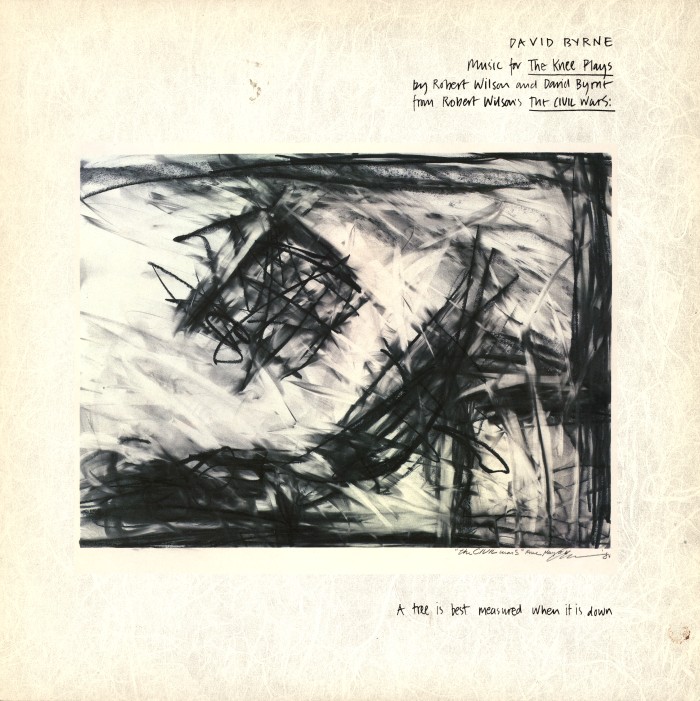
David Byrne: Music for The Knee Plays

25022-front-3

David Byrne
Music from The Knee Plays

Garnett Brown trombone
Ray Brown trumpet
David Byrne vocals
Pete Christlieb saxophone
Rich Cooper trumpet
Ernie Fields baritone saxophone
Chuck Findley trumpet
Bill Green baritone saxophone
Bobbye Hall percussion
Dana Hughes trombone
Paul Humphrey drums
Jackie Keslo saxophone
Harry Kim trumpet
Don Myrick saxophone
Nolan Smith trumpet
David Stout trombone
Phil Teil trombone
Ernie Watts saxophone
Fred Wesley trombone
David Blumberg conductor
Recorded:
One On One Studio, North Hollywood, April 4, 1984
Engineer: Mark Wolfson
Studio Sound Recorders, North Hollywood, April 5 & 6, 1984
Engineer: Joel Moss
Mixed at RPM Studio, December 8-17, 1984
Originally Mastered at Sterling Sound, NY
Produced by David Byrne

A tree is best measured when it is down.

This 1985 release, a rare one for ECM, comes from the fertile mind of Talking Heads frontman David Byrne. Originally intended as incidental music for Robert Wilson’s grand opera The CIVIL warS, to be played while actors and crew prepared set between acts, these brass-heavy arrangements of traditional tunes, folded into a rich batter of original compositions and spoken word, take their inspiration from the Dirty Dozen Brass Band of New Orleans and have since come to constitute a standalone work in their own right.

“Tree (Today Is An Important Occasion)” sets the tone for a journey of horns and voice that is as even-tempered as it is dramatically sincere. This postmodern dirge for the otherwise voiceless intersections of body and materials that govern our lives is perhaps even more relevant now than when it was written. Colors and fashion, each linked to specific emotions and personality traits, roll through the mind like an art gallery disassembled and thrown. As possibilities of self-expression are donned and discarded like replaceable skins, we are left to determine our own subjectivity in the onslaught of objective pretense we call our daily lives. The mélange effect of worlds colliding is dazzling in the moment yet darkly tinged in the remembering.

“The Sound Of Business” is a detailed assessment of our work-obsessed culture. Its uncanny chain of images contrasts the bustle of everyday life with the slow-motion fantasies struggling for air beneath its surface. “Social Studies” pulls away another mask to reveal the colonial scaffolding of well-to-do urbanites. Through deconstruction of knowledge-seeking privilege and the impulse to study that which does not belong to us, it puts our desire to live vicariously under a sonic microscope.

Byrne’s voice is a powerfully understated element. With consistent, even-tempered brilliance, he speaks matter-of-factly about large ideas (and hugely about the mundane), such that the very notion of importance stands on its head until it passes out. Even in his absence, the effect remains. Among the instrumentals he helped arrange, “Theadora Is Dozing” is a particularly enchanting tessellation of brass and percussion, while his own “Admiral Perry” is another standout for its evocative cast, as is the haunting “Winter.”

“In The Future” is quintessential Byrne, and imagines a time when sameness is the norm and norms are all the same. Like an intimate shadow of his timeless “Once in a Lifetime,” this crushing indictment of individualism shows us the horrors of an age when everybody becomes like everybody else. And so, ending in the comforts of the opener’s reprise, we realize that wheels are all there are, and that we, the ephemeral rats running nowhere within them, might one day destroy each other until there’s nothing left.

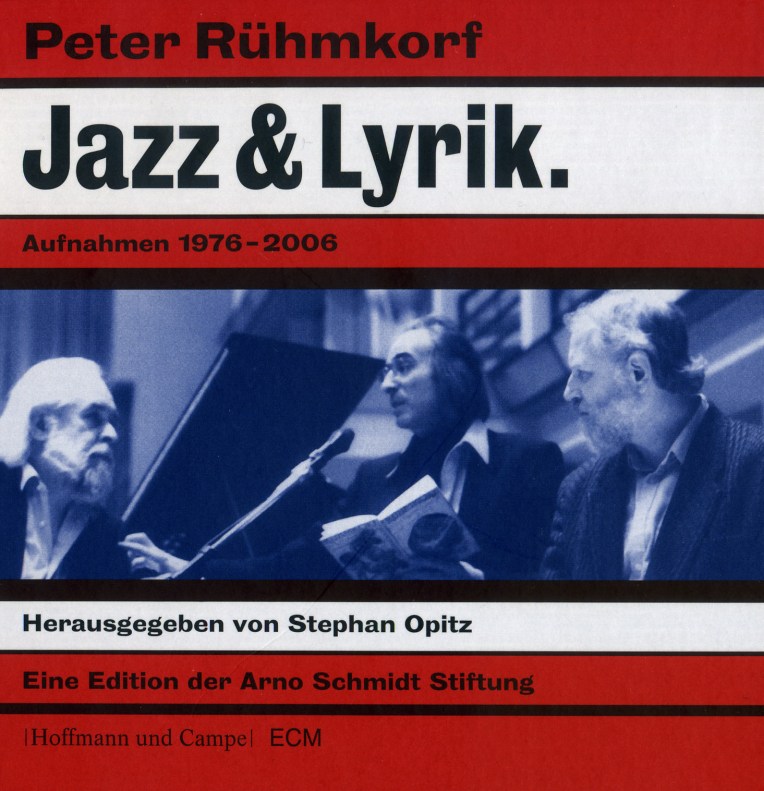
Peter Rühmkorf: Jazz & Lyrik.

JL cover

Peter Rühmkorf
Jazz & Lyrik.

Peter Rühmkorf voice
Michael Naura
piano
Wolfgang Schlüter vibraphone
Klaus Thunemann bassoon
Eberhard Weber bass, violoncello
Christian Willisohn piano
Titus Vollmer guitar
Leszek Zadlo saxophone, flute
Christian Kappe flugelhorn, trumpet
Ansgar Elsner saxophone
Burkhard Jasper piano
Alexander Morsey bass
Klaus Gunnemann drums
Dietmar Bonnen piano
Andreas Schilling bass
Mastering: Eberhard Schnellen and ECM Records
Studio: ES-Dur, Hamburg
Produced by Hoffmann und Campe in collaboration with ECM Records
Release date: November 17, 2009

Jazz & Lyrik names a genre that might never have existed as such without Peter Rühmkorf (1929-2008). Together with pianist Michael Naura, vibraphonist Wolfgang Schlüter, and a host of other talents, the lauded German poet and essayist brought a consistent physical quality to his spoken artistry. It’s a characteristic he quite consciously cultivated: “I’m also a bit like an instrument,” he said in 1985. “My poems are fixed, like the keys on a piano. Only I must strike with the voice. The poem I read is my instrument. I just have to intone it.” While the form of jazz poetry presented in this 3-disc treasure trove, an archive coproduced by Hoffmann und Campe in collaboration with ECM Records and with support from the Arno Schmidt Foundation, reached its peak in the 1960s, the recordings documented here span from 1976 to 2006. The former year was a watershed one, when Rühmkorf recorded Kein Apolloprogramm für Lyrik for ECM. On that album, from which eight tracks are included, he joined forces with Naura, Schlüter, and bassist Eberhard Weber, yielding such phenomenally descriptive morsels as “Tagebuch” and “Zirkus.”

Eight further tracks are also included to represent the 1978 follow-up album, Phönix Voran. Leszek Zadlo (saxophone and flute) replaces Weber, making for a folk-tinged change of scenery and adding delight to such tracks as “Ich butter meinen Toast von beiden Seiten” and “Allein Ist Nicht Genug.”

Yet this album’s most valuable rarities are in its live recordings—delightful not only for their historical value, but also for the insight they provide into Rühmkorf’s effect on an audience. The standout in this regard is “Variation auf »Abendlied« von Matthias Claudius,” from an 18 September 1994 performance. As Rühmkorf riffs on the lyrics of Germany’s most beloved lullaby, he brings an improvisatory quality to the reading, so much so that the applause that follow it feel like those given after a jazz soloist passes the torch. The arrangement by Naura and Schlüter is as heartwarming as it is sincere (it’s also among the more pristinely recorded of the live selections).

This set also traces the afterlife of Phönix Voran as it played out in radio broadcasts from 1987, 2001, and 2005. These unlock secrets in that album’s highlights (especially “Komm raus!”) and others that never made it to the studio (“Einen zweiten Weg ums Gehirn rum”). The addition of guitarist Titus Vollmer in the middle performance is magical, as is the effect of hearing Rühmkorf’s voice recite the title poem on three separate occasions over a period of nearly as many decades.

Other noteworthy selections include the self-styled studio composition “Elbterrassen,” in which Rühmkorf beats over a recording of “C Jam Blues” from the Johnny Griffin album At Onkel Pö’s Carnegie Hall, Hamburg 1975; “Früher, als wir die großen Ströme noch …,” a 2005 performance featuring a rhythm and horn section, along with the less tangible instrument of Rühmkorf’s sly humor; and “Betr. Rundfrage Grundfrage,” a 2006 interpretation of a 1998 poem whose domesticity meshes beautifully with the intimate microscopy of pianist Dietmar Bonnen and bassist Andreas Schilling.

Rühmkorf had a wonderful way of speaking, at once in rhythm with the music (if not the other way around) and wandering its own path freely alongside it. What a significant achievement to have it so lovingly preserved, especially in such a mosaiced fashion. As the title of “Bleib erschütterbar und widersteh” reminds us: stay shattered and resist glory.

Pat Metheny Group: Live In Concert

PRO-030-front

Pat Metheny Group
Live In Concert

Pat Metheny guitars
Lyle Mays keyboards
Mark Egan bass
Dan Gottlieb drums
Recorded August 31, 1977
at the Great American Music Hall, San Francisco
Radio broadcast by KJAZ
Engineer: Bud Spangler
“San Lorenzo” recorded September 4, 1977
at Seattle Opera House
Radio broadcast by KZAM
Engineer: Rick Keefer
Prepared for release by Robert Hurwitz

This rare promo-only LP documents two live radio broadcasts from the summer of 1977 by the Pat Metheny Group. Three of the four tracks are taken from a performance at San Francisco’s Great American Music Hall as heard on KJAZ, while the outlier, “San Lorenzo,” was heard on KZAM from a performance at the Seattle Opera House. That latter tune is a thing of archival beauty. First, we get to hear Metheny introducing to the crowd what has since become a staple of the band’s repertoire as a “brand-new one.” Second, Metheny gives brief insight into its “odd tuning for the electric 12-string” and by extension into his process. This information only heightens our wonder at what transpires for its effortlessness of execution in a nascent stage, while also cluing us in on the historicity of its coalescence. Moreover, Metheny and company play it more slowly and enigmatically than on the seminal album they would record for ECM a year later, thus allowing keyboardist Lyle Mays a horizon’s worth of space in which to dance.

Mays, by any stretch of the imagination, is the highest mountain on that horizon (its peak now glowing more brightly than ever in the light of his recent passing). The greenery he paints in “Watercolors” drips as if after a rainstorm of hope and nostalgia. Amid drummer Dan Gottlieb’s glistening cymbals, he pays deference to an underlying ether. Gottlieb shines also in “Phase Dance,” which opens the album. In this setting, it immediately becomes apparent just how much ECM production brings out from certain configurations. Hearing the Pat Metheny Group in close quarters like this allows individual lines to rise lucidly, leaving us to imagine the depths extracted in a studio setting. Either way, it’s glorious to hear the band’s vibrant turns of phrase. Mark Egan’s electric bass is the backbone, flexing in harmony with every shift of weight. The excitement of the crowd is also palpable, and shows how well-traveled the music was on the road before it landed in the studio a year later. It’s worth noting that the title here is misspelled as “Phase Dancer” on the LP sleeve, as it may just be the most accurate description of Mays’s mode throughout the lesser-heard “Wrong is Right.” Its vivacity, to say little of Metheny’s golden solo, shows what can happen when musicians and listeners share the same oxygen. As KZAM-FM’s then-music director Jon Kertzer writes on the back cover: “Forget about jazz-rock fusion and who played with whom and where. Just sit back and listen to the music—some of the most refreshing and creative sounds that I have heard in a long time.”