Huelgas Ensemble Minguet Quartett Paul Van Nevel director
Recorded February 2014, Augustinus Muziekcentrum, Antwerpen
Engineer: Markus Heiland
Mixed January 2015 in Lugano by Markus Heiland and Manfred Eicher
Produced by Manfred Eicher
U.S. release date: 2 June 2015
ET LUX is an hour-long composition for vocal ensemble and string quartet (2009) by Wolfgang Rihm that situates fragments of the Latin Requiem Mass in cells of sustained chords and spectral wanderlust. Although originally written with the Hilliard Ensemble and Arditti Quartet in mind, the performance here is in more than capable hands. The Minguet Quartett, approved interpreters of the composer’s string quartets, and the Huelgas Ensemble (which doubles the scored voices to eight) illuminate every fiber of this tapestry like sunlight through a castle window.
For a composer so prolific (with over 400 works to his name), it’s only natural that again Rihm should cast once glance backward for every two forward, ending up suspended somewhere between the poles of question and answer, and proving them to be the event horizons of an arbitrary dichotomy. It is music that neither invites nor rejects, but places the listener (and composer) in a space where choices are the only true materiality. Hence the cellular nature of the piece, in which selective phrases serve as requiems unto themselves.
As Paul Griffiths observes in the album’s liner text, “What we have here is not music remembered but music remembering.” Attribution of such sentience to notes on a page is no metaphorical trick. It speaks, on the surface, to the music’s body of antiquity and clothing of modernity, and beyond that to their entanglement among the bramble of performance and the flourishing of listening. In the manner of Alexander Knaifel, the instruments sing as much as the human voices. This, of course, requires a human touch. Still, the inner life of ET LUX is not provided but enhanced by that touch.
The keyword, in both the writing and the playing, is “tactile,” as if both forces were bound by flesh and spirit alike. The quartet breathes, close to silence yet pregnant with words all the same, bringing its own voices to bear upon the passage of time. Each instrument must treat the space as it is treated: as an element of malformed crystal, whose light exists only for as long as it is uttered to be. The effect is such that, even when punctuating the darkness with spikes of pizzicato flash, harmonies merely disperse and regroup, taking on semblance of something newborn.
An astonishing amount of variety pervades a work so slow-moving yet which bypasses pathos toward the development of deep, if sometimes tense, relationships. Moments approaching beauty are inevitably peeled away from expectation, leaving us to reckon with a more true-to-life distortion of textual fantasy. Instead of treating the Mass as a poem or liturgical given, it retraces shards of it until each is self-reckoning. The mystery of faith becomes a reflection of itself.
As the piece goes on, the dynamic between voices and strings becomes mutually divergent, at once developing inward and outward. A prayerful mode gives way to fire, and further to snowy textures. Pulses emerge, morph, and overlap, but disclose little of their intentions. The clearest answer, then, is in the dark, sublime ending; a movement into new beginning, but in which direction is left open to interpretation.
Keller Quartett András Keller violin János Pilz/Zsófia Környei violin Zoltán Gál viola Ottó Kertész/Judit Szabó violoncello Alexei Lubimov piano
Recorded 1995-2012 Casino Zögernitz, Vienna Stadttheater Eichstätt Radiostudio DRS, Zürich Engineer: Peter Laenger Mastered by Christoph Stickel at MSM Studios, München Produced by Manfred Eicher
U.S. release date: 2 June 2015
Cantante e tranquillo grew out of a conversation between producer Manfred Eicher and violinist András Keller, who envisioned an album of slower sections divorced from longer works. In true ECM fashion, this idea developed into a project all its own, framing previous recordings of Knaifel, Schnittke, Ligeti, and Bach by the renowned Keller Quartett with newly recorded selections from Beethoven’s opuses 130 and 135, and between them shorter pieces by Kurtág. The result is not a compilation but a sculpted entity with shape and sentience.
The concept alone is haunting enough; more so in execution, as ghostly appearances begin to sing once the third movement of Ludwig van Beethoven’s F-major quartet (from which the album gets its name) whispers into life. This rustling of the heart, slowed to feverish pathos and drawn as a brush across absorbent paper, embodies a yearning that, over the course of its awakening, resolves into a style of slumber in which the depth of life is surpassed only by that of death. Unlike the Adagio from the quartet in B-flat major, in inhales rather than exhales, holding all it can before expiring.
György Kurtág is known for his ability to pack surprising amounts of information into minute forms, but the Kellers give us examples of pieces that, despite their characteristic brevity, are spacious and expansive. At times parabolic (cf. the Officium breve in memoriam Andreæ Szervánszky), at others misty (Flowers We Are – for Miyako), and at still others pulsing like a geographic lay line (Aus der Ferne V), his music has no need to seek anything because it is starting point and destination all in one. The final movement of György Ligeti’s String Quartet No. 2, by contrast, sprouts in leaf-like structures that tremble to the rhythms of nervous winds. Unlike Narcissus, its reflection is being constantly disturbed, so that the illusion of a second self never clarifies. By yet further contrast, the stillness implied by “An Autumn Evening” (from Alexander Knaifel’s In Air Clear and Unseen), along with the Moderato pastorale of Alfred Schnittke’s Piano Quintet, breathes with lucidity. The latter’s pianism filters an unrequited dance which, like something out of a Tolstoy novel, twists until it bleeds music.
Anchoring all of this are two selections from one of the Keller Quartett’s finest recordings: Die Kunst der Fuge. Johann Sebastian Bach’s final masterwork is alluded to twice in the program, cycling between gradients of lost and found before ultimately falling in love with exile. A variation of Beethoven’s “Cantante” closes the circle with urgent, pregnant emotion, outlining a keyhole that only shadow can unlock to access the light beyond it.
Listening to this album is like watching the moon rise: if you focus on it long enough, you begin to detect its movement through the sky as if it had a mind of its own. Haunting, yes, but then again this music has no ghost to give up. It has one only to acquire.
(To hear samples of Cantante e tranquillo, click here.)
Arvo Pärt
Musica Selecta
A Sequence by Manfred Eicher
Recorded 1983-2011
Mastered May 2015 from the original recordings by Peter Laenger and Manfred Eicher
Produced by Manfred Eicher
U.S. release date: 11 September 2015
Here is a commemoration not only of the professional and personal collaboration of Estonian composer Arvo Pärt and German record producer Manfred Eicher, but also of the creative spirits that guide them both toward shared spatial goals. Beyond that, it is a looking glass of sonic history in which is reflected two souls who’ve welcomed countless listeners on a journey of light. Issued in time for Pärt’s 80th birthday, Musica Selecta divides that light into its spectral gradations, sounding every band in a sequence of hand-selected pieces from his ECM New Series tenure thus far.
In his liner note for the two-disc album, Eicher refers to Pärt’s compositions as “solitary sound-sculptures.” An apt description if ever there was one. Solitary, because they come from the relationship of one man to the divine, but also sculpted because they take in countless aspects of creation into their corporea. What emerges from Eicher’s idiosyncratic sequencing of events here is therefore less the portrait of an artist than a horoscope, as planetary alignments contradict, refract, and inspire one another into a harmony of greater spheres.
Remarkable about the program is not only the way in which it compresses a 30-year history into two hours, but also the gentle reminders and forgotten facets—if not new discoveries—of the composer’s oeuvre it contains. Of the latter, the Hilliard Ensemble’s previously unreleased performance of Most Holy Mother of God is an astonishing example and proof that, more than meaning, it is the very architecture of words which determines their sacredness. Like a modest, timeworn church, these melodic structures stand before us marked by the passage of time. Astonishing, too, are those textures more familiar to us, such as the chant-like Ode VI from the Kanon pokajanen, one of Pärt’s profoundest medi(t)ations of flesh and sacrament. Architectural awareness is again central to understanding the integrity of this music, miring itself as it does in the rafters and other neglected places where godly light is most needed. It also introduces into the album’s narrative flow the Estonian Philharmonic Chamber Choir, whose voices, under the direction of Tõnu Kaljuste, have occupied the central axis of Pärt’s ECM zodiac from almost the beginning. Their harmonies uncover, like a skilled woodcarver’s tools, moments of transcendence as wounding as they are luminescent. Pärt recognizes the scar in every beauty.
This is what we really mean by the phrase “reading between the lines.” Not the extraction of the visible from the invisible, but the knowledge that everything is inherently invisible, except by the illumination of regard. And so, if either of these pieces feels like dreaming, it is only because singing can sometimes be more surreal than anything taking place behind closed eyes. Solitary voices fluctuate like reflections on water, because neither can exist without the other. We might do well to understand Pärt’s compositions in likeminded fashion—that is, to recognize that no simple motif would have grown without the ancestors before it. All the more appropriate, then, that this conspectus should begin with Es sang vor langen Jahren (“From long ago thus singing”) from Arbos. An album that seems to have fallen off the critical radar, but one that is nevertheless a Musica Selecta of its own. It showcases his ability to negotiate a range of atmospheres—from the intimacy of chamber settings (such as this one for alto, violin, and viola) to the inward-looking sweep of his Stabat Mater, which at 24 minutes is the vastest work included here. Its dramas are theatrical in the same way the heart is theatrical.
This collection’s remaining choral pieces are more entangled with non-living, yet somehow sentient, instruments. The Alleluia-Tropus and Beatus Petronius from Adam’s Lament represent organic conversations—one playful, the other somber—between voices and strings. The latter’s addition of winds renders stems for every leaf. Between them is Trisagion (from Litany), performed here by the Lithuanian Chamber Orchestra as if it were so fragile that even playing it might break it. In this universe, the value of silence, such as it is, feels especially alive. Wallfahrtslied / Pilgrims’ Song (Orient & Occident) is scored for men’s choir and string orchestra and moves more celestially in a combinatory realm of mysticism and gravity. It is an expression of the itinerancy of faith and the challenges it faces when crossing borders. Sometimes, however, the borders cross us, as in the two selections from In Principio. Mein Weg, scored for 14 strings and percussion, builds a descending framework to move upward, while antiphonal Da Pacem Domine is a righteous summation, a tipping point into the as-yet-unknown future of his flourishing.
Silouans Song brings us to one of Pärt’s most pivotal and defining releases: Te Deum, which in addition to the stirring title work (not featured here) yields the mighty Magnificat. These works—Silhouans Song for strings and the Magnificat for choir—feel their way along their respective paths, finding that the truest epiphany comes not from moments of grace (however one chooses to frame them) but in their aftermath, during which one trembles from the shock of revelation while putting together the pieces of a shattered soul. As strings cry out, so do voices draw their bows, each the inner to the other’s outer.
In the company of such vocal apparatuses, the mechanism of the piano, in all its earthy resonance, comes to us as if out of time. In his rendering of Für Alina (Alina), Alexander Malter removes enough of his touch that the windows of access he finds in the score glow with a light born of need to see itself seen.
In highlighting the spaces in which Eicher and Pärt have forged their friendship, one necessarily emphasizes the care with which they have chosen musicians to transport listeners outside themselves. And who better than pianist Keith Jarrett and violinist Gidon Kremer to play a duo version of Fratres. It is the most significant work of this collection, being the world’s introduction to Pärt via the seminal Tabula rasa. The album was the first of ECM’s New Series imprint, which since 1984 has sailed a discriminating vessel at the fore of contemporary music. Jarrett and Kremer bring a level of sensitivity rarely heard in subsequent versions of this often-recorded piece, a spirit of newness and adventure that can only have come from their unprecedented reckoning with what was then a relatively obscure voice leaping like the violin from behind the iron curtain of Soviet oppression. The Cantus in Memory of Benjamin Britten is another quintessential selection from Tabula rasa, a vibrant threnody that throbs with passion and memory.
From what is arguably Pärt’s finest release, Miserere, comes Festina Lente. Scored for orchestra and harp, it pairs beautifully with the Cantus, if only for its gradual development and lilting form. It also bears dedication, this time to Eicher himself. The tripartite Lamentate, from the album of the same name, is also included. Pianist Alexei Lubimov and the Stuttgart Radio Symphony Orchestra, at the baton of Andrey Boreyko, strike a most appropriate balance of lucidity and distortion in this fragile tone poem.
Musica Selecta does more than tell a story. It pulls the beginning and ending of that story together to form a circle, which stands before us like a portal, replacing the suffocation of expectations with an eminently breathable oxygen. Pärt, as only he can, spins our comprehension of it all from elements unseen yet—praise creation—audible. So audible, in fact, that this music might just hear more of us than we ever will of it.
Keith Jarrett piano Rundfunk-Sinfonieorchester Saarbrücken Dennis Russell Davies conductor New Japan Philharmonic Orchestra Kazuyoshi Akiyama conductor Samuel Barber
Concert recording, June 3, 1984 at Congresshalle, Saarbrücken
Engineer: Helmut Fackler
Balance engineer: Helmut David Béla Bartók Concert recording, January 30, 1985 at Kan’i Hoken Hall, Tokyo, as part of Tokyo Music Joy Festival
Engineer: unknown Concert promoter: Toshinari Koinuma
Mastered at MSM Studios by Christoph Stickel
Executive producer: Manfred Eicher
It’s tempting to trace overlaps between Keith Jarrett’s roles as a “classical” and “jazz” musician, but in this archival treasure I for once see the importance of their differences. It is precisely because Jarrett is so well versed, and indebted, to both spheres of influence that he seems to recognize the divergent types of rigor involved. In less uncertain terms: to merely conflate one with the other shortchanges both in the process. Hearing these recordings, now three decades old, we can be sure that many things have changed in the pianist’s approach to style and timbre just as we can be sure that whatever indefinable flame sustains him burns as brightly now as it did then.
What we have here are two recordings—one made in Germany in 1984, the other in Japan in 1985—of piano concertos and an additional encore of improvisation. Beyond that, however, we have a statement of almost divine purpose from a musician who listens to everything before he plays.
The Piano Concerto of Samuel Barber (1910-1981) is first on the program and finds Jarrett fronting the Rundfunk-Sinfonienorchester Saarbrücken under the direction of Dennis Russell Davies. Davies is a natural fit, having previously conducted Jarrett on record as composer (see Ritual) and, more than a decade after this recording was reeled, as the featured soloist of Mozart’s own concertos. Written between 1960 and 1962, Barber’s earned him a second Pulitzer Prize and is largely considered to be among his masterworks. The sheer variety of the first movement alone tells us so. The introductory solo might seem spontaneous were it not for the first orchestra hit soon thereafter. Jarrett’s rhythmic acuity is in such fine form that the other instruments almost feel ornamental. The second movement more pastoral, and Jarrett plays it with such flowing intuition that again it sounds like his own creation. Here the very personality of the piano, through Barber’s writing, takes shape, like an infant growing to young adulthood in the span of five minutes. The final movement begins as if through a mysterious screen before stoking its hearth to roaring flame. More pronounced brass and percussion make it a captivating one, even if those faunal winds do creep around the occasional corner with indications of less complicated sojourns. Rousing rhythms from both soloist and orchestra trade places at a moment’s notice, leaving us spellbound.
It’s perhaps no coincidence that Barber’s only piano concerto should be paired with the third of Béla Bartók (1881-1945), as soloist John Browning, who premiered the Barber in 1962, ranked it alongside the very same as a crowning achievement of the genre in the 20th-century. Bartók wrote his in the final year of his life, after having fled to America in the wake of World War II. Jarrett likewise renders it here far from home (in Tokyo, that is) with the New Japan Philharmonic Orchestra under Kazuyoshi Akiyama. The first movement is more soaring than the Barber, filled with minuscule nooks in which to store our fascinations. The denser textures and more overtly “pianistic” writing allow for great variation at the keyboard. Jarrett responds with that trademark touch, building punctuation marks into paragraphs and paragraphs into full narratives. The second movement, though graver, nevertheless achieves crystalline form. Among Bartók’s most profound pieces of writing, its strings emerge like sunrays at dawn. Jarrett coaxes the orchestra, even as it coaxes him, creating a feedback loop of lyrical unfolding. He attends with a patience that is noticeable even in the most percussively inflected portions. An unresolved ending anticipates the finale, a movement of such fitness that it practically leaps away from the musicians of its own accord. Through windswept strings, Hungarian folk dance motifs, and purposeful drama, Jarrett handles that final ascent with finesse.
Following this performance, Jarrett improvised a piece that has since taken the name “Tokyo Encore—Nothing But A Dream.” It’s a balladic jewel that diffuses the energy of the Bartók even while enhancing it, for here is a heart that respects not only the beauty of art, but more importantly the art of beauty, handling both as if they were of the same substance. Anyone else might bungle it, but Jarrett gives it such a genuine connection that we are reminded of his many gifts, not least of all those given to listeners fortunate enough to see their lives overlap with his.
Kate Moore composer Saskia Lankhoorn piano
Recorded April 2013, Auditorio Radiotelevisione svizzera, Lugano
Engineer: Markus Heiland Produced by Manfred Eicher
The music of composer Kate Moore is a hybrid of hybrids. It channels the inner fire of things that must someday turn to ash, and coaxes from this realization one intensely melodic conflagration after another. Born in England but raised in Australia, Moore cites the latter’s open landscapes as having permanently hued her artistic paintbrush. Moore’s longtime interpreter is pianist Saskia Lankhoorn, who debuts both herself and the composer to ECM’s hallowed New Series family.
Even though Moore professes no allegiance to minimalism—and rightly so, for her politics could hardly be more different—fans of the genre’s stalwarts are sure to take distinct pleasure in this program. Furthermore, taking the opening solo piano piece Spin Bird as an example, we find a natural wonderment present in, say, the seminal Philip Glass. Yet where Glass might attend to the overarching philosophical questions of a Koyaanisqatsi or a Satyagraha, Moore is more interested in the under-arching gesture, a cupping of water in all its microscopic glory. In this respect, Stories For Ocean Shells, also for solo piano, is like two hands interlocking: despite being of the same organism, each has characteristics that distinguish it from the other, with whom it only partners occasionally in a world designed to separate them through material engagement. Only through immaterial actions do they come together in a temporarily unbroken circuit of meditation and profound thinking. Every microtonal harmony is a puff of spore, every melodic spiral singing as if sung in the manner of a falling leaf. The result is a music that gazes on its own reflection and sees insight into the self as insight into all selves. And so, what might seem a mere chain of arpeggios in theory is in practice a downright sacred unfolding of time signatures, which can only be notated through the act of speech and bodily interpretation. Lankhoorn is fully adapted to bringing all of this out, and more.
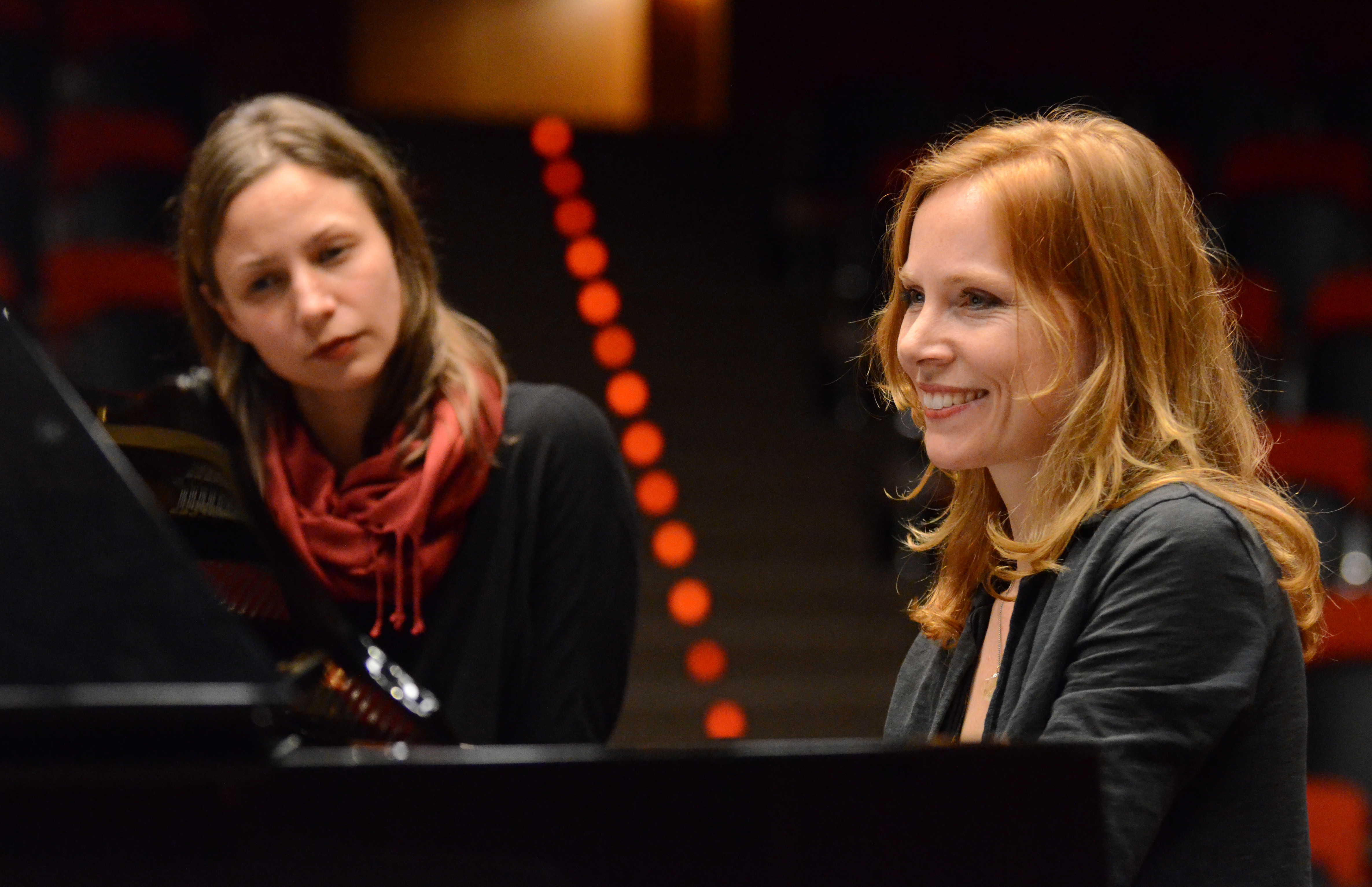
(Photo credit: Dániel Vass)
But if The Body Is An Ear takes its inspiration from the writings of Sufi mystic Hazrat Inayat Khan (as it does), then it also takes inspiration from that which cannot be written (as it should). The rhizomatic pulse of its two pianos is so translucent that the instruments bleed through one another until there is but one between them. The transitions are resolutely beautiful—from smoothness to pointillism, from connectivity to individuality, from river to ocean—but hearing them as we do from the level of the molecule, we recognize that even beauty needs emptiness to survive. In this light, Canon is the intermediary between coalescence and dissolution. Magnified now to four pianos, Moore’s forces begin with a rounded dance of solitude and finish in a thought spiral. As the newest piece of the program, brought to the studio as it was in still-raw form, its gradualness begs a contemplative spirit and rewards the patient listener with presence of mind.
From the above descriptions, it would seem as if Moore’s is an ephemeral realm. This it might very well be, though no more than anything in this world already is. It’s also physical. The spine of Zomer (for solo piano) is glass-boned, its nerves of light sending their messages in occasional, quiet bursts, while Joy (also solo) grows heavier with every iterative cycle of its unfolding. Like the emotion itself, it is sometimes messy, at other times supremely ordered, and prone to exhaustion. The ultimate (for being fundamental) distillation of all this is Sensitive Spot for “multiple pianos,” meaning the musician must play against recordings of herself, trying to match them as closely as possible. Quick and almost nervous, it reinforces itself like a flower becoming lost in its own fragrance.
Landhoorn performs Sensitive Spot:
The closing reprise of Spin Bird, then, feels less like such. Rather, it is a leap farther inward to a place where only you, dear listener, and I may travel, untethered and free to roam.
(To hear samples of Dances and Canons, click here.)
Maria Pia De Vito voice François Couturier piano Anja Lechner violoncello Michele Rabbia percussion, electronics
Recorded December 2012, Auditorio Radiotelevisione svizzera, Lugano
Engineer: Stefano Amerio
Produced by Manfred Eicher
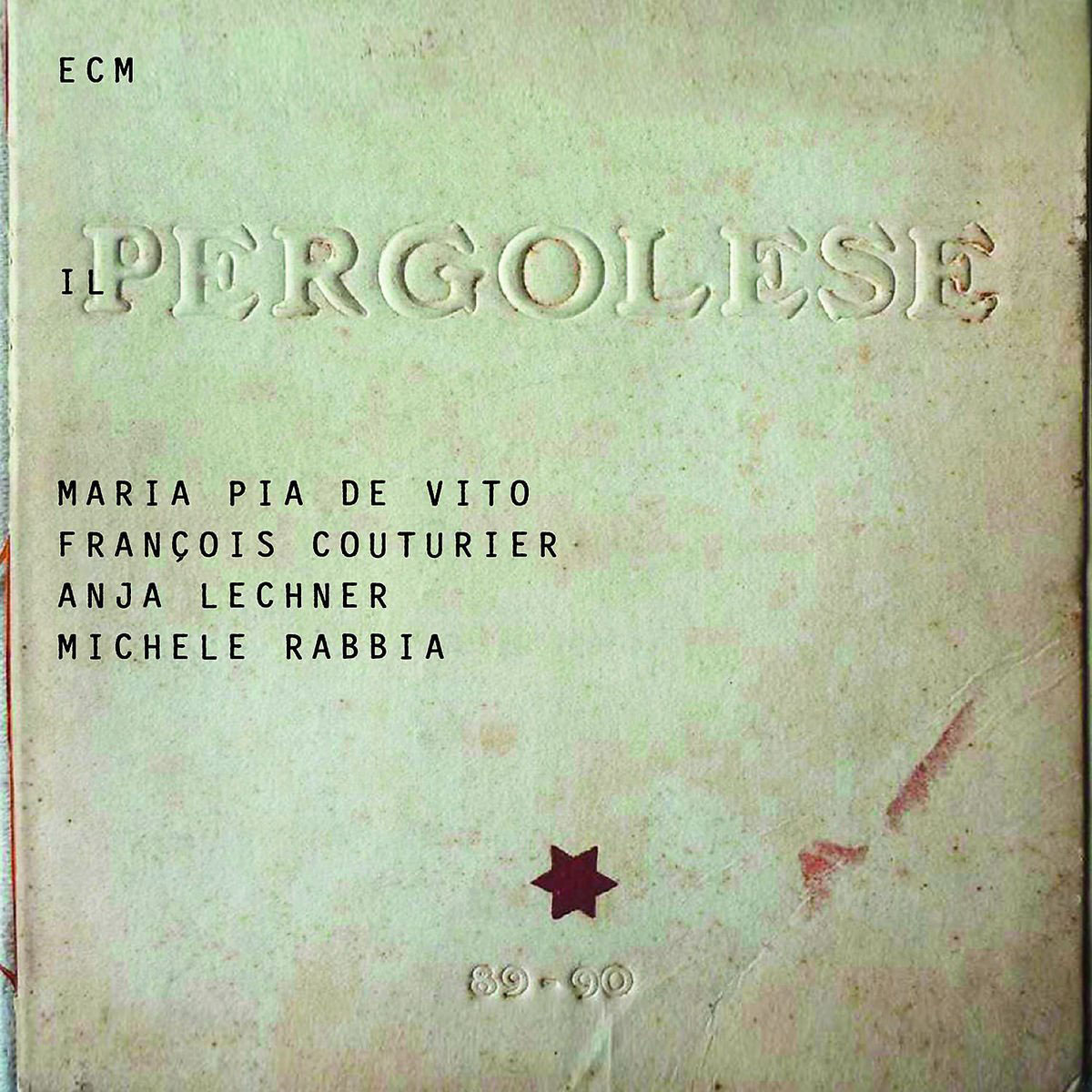
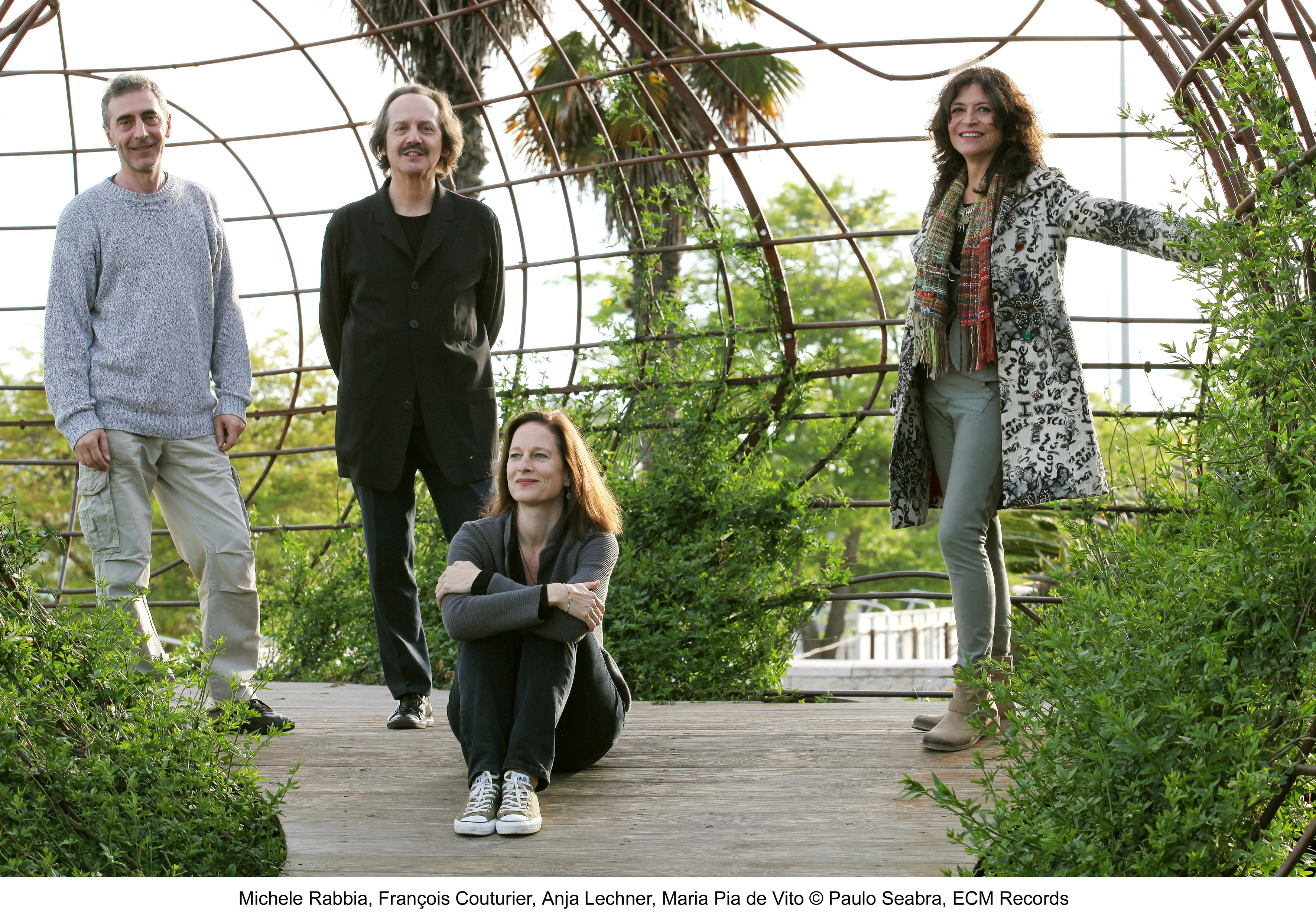
The life of Giovani Battista Pergolesi (1710-1736), cut tragically short at age 26 by tuberculosis, nevertheless made an immeasurable impact on the world of Baroque music and, as evidenced here, beyond. Already a successful opera composer by his mid-20s, Pergolesi would leave behind his final work, the Stabat Mater of 1736, on his deathbed. As Il Pergolese, singer Maria Pia De Vito, pianist François Couturier, cellist Anja Lechner, and percussionist Michele Rabbia have responded to the Italian composer by modernizing him at a crossroads of jazz, folk, and improvisation, De Vito going so far as to translate texts from the Stabat Mater into Neapolitan. The latter move yields pieces by Couturier inspired by that same masterpiece. His “Amen,” like the album as a whole, treats the development process as a precious use of time: only after Rabbia’s airbrushed percussion and additional electronics take hold do the darkly rolling piano and forlorn nightingale of cello share a canvas. The affirmation itself fluoresces under De Vito’s care before carrying over into Couturier’s jazzily inflected chords, by which he sets up Pergolesi’s processional “Fac Ut Portem.” De Vito rides the ocean waves of its drama, craving sunlight but drinking only storm. She then dips back into the Marian text with “Dolente.” Resonant percussion and birdlike vocals give Couturier the space to lull us into the song proper for a lachrymose yet, by virtue of the Neapolitan language’s delectable syllabic flavor, somehow blissful repose.
From Pergolesi’s first comic opera Lo frate ’nnamorato (The Brother in Love) come two arias. The achingly lyrical “Ogne pena cchiù spietata” rests on a bed of piano and cello. Into this gorgeous scene steps De Vito like another Maria—Farantouri, that is—but with a little more maple mixed into her oak. Even after she fades, traces linger on as Lechner and Couturier are joined by Rabbia’s tapped hand drums. “Chi disse ca la femmena,” on the other hand, is a more straightforward melody that turns into folkdance and best explores the band’s rhythmic possibilities. A similar carpet of development unrolls itself down the corridor the “Sinfonia for violoncello,” which holds its own in a landscape of shifting tectonics. With archaeological care and glass tools, Rabbia chips away at Lechner’s caged pizzicati as if they were relics in need of recognition. That they most certainly get in the return of Couturier, who with an empathic analysis tells the backstory of their unearthing. And as Lechner’s bow sings its arco song, it resuscitates a Baroque heart to a calm yet glorious rhythm. “Tre giorni son che Nina,” a wildly popular song of the Italian Baroque attributed to Pergolesi, is another thing of beauty. It opens in raindrops before Lechner puts bow to string and follows a river breached from a dam of mortality.
Some freely improvised tracks round out the program. “Fremente” winds itself around De Vito, whose bubbling lines run wild in the realm of possibility, while “In compagnia d’amore I” and its sequel evoke Luciano Berio’s Visage and a voiceless chasm, respectively. Whatever their guise, the musicians of Il Pergolese pose their emotional statuary in accordance with the moment at hand, turning everything they touch into intimate theater, with De Vito as the heart, and the trio as the soul.
(To hear samples of Il Pergolese, you may watch the EPK above or click here.)
Vilde Sandve Alnæs violin Inage Margrete Aas double bass
Recorded June 2012 at The Norwegian Academy of Music, U1021
Engineer: David Aleksander Sjølie
Mixing and mastering: Guiseppe Ielasi
Produced by Vilde&Inga
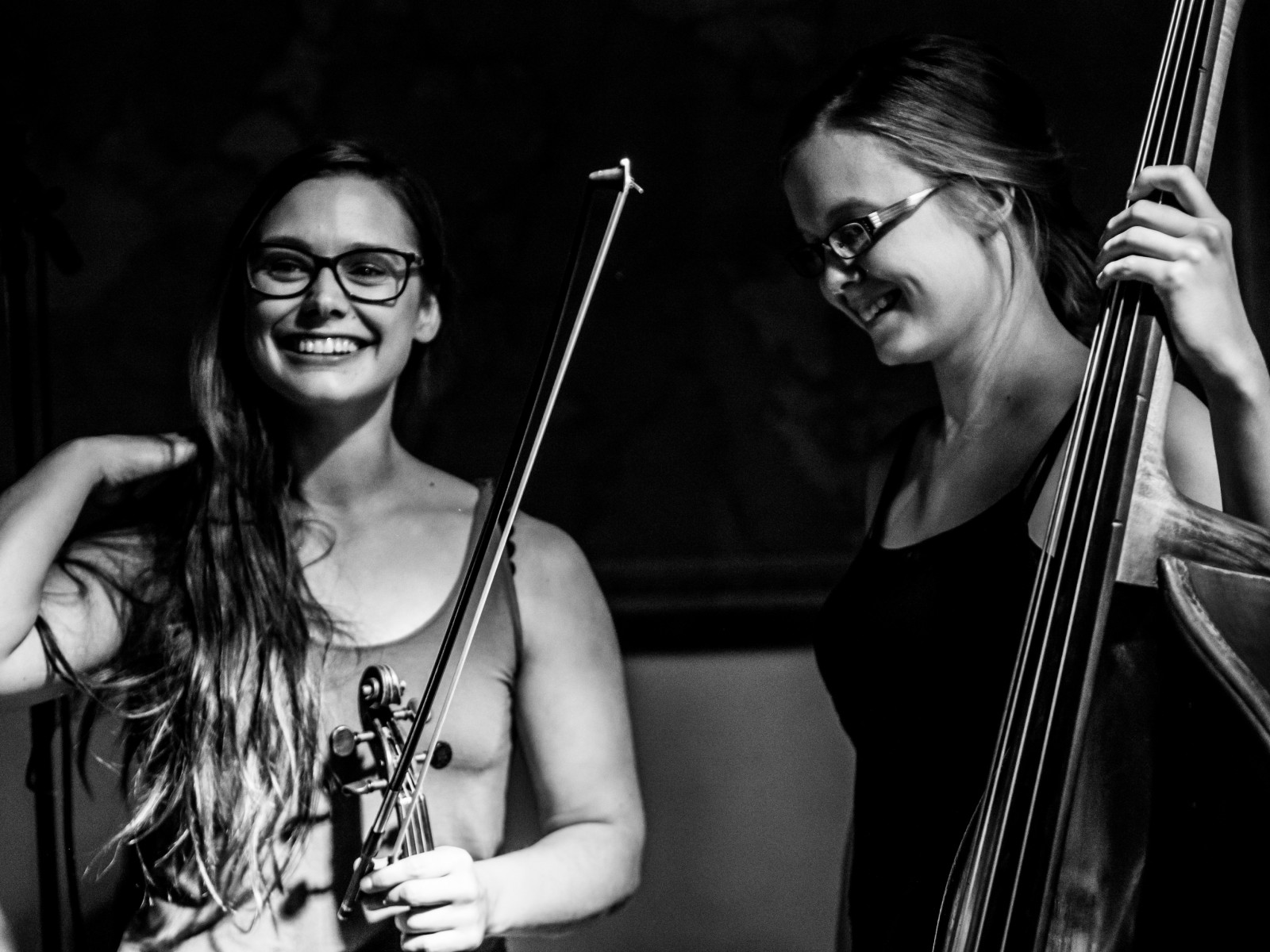
Unlike the stage name Vilde&Inga, the first ECM appearance of violinist Vilde Sandve Alnæs and double bassist Inga Margrete Aas is filled with spaces. Within those spaces exists an ecosystem with something to say for any who will listen. In the album’s booklet, the Norwegian duo thanks label mate Sidsel Endresen, with whom they studied improvisation and who was responsible for bringing this music, recorded at The Norwegian Academy of Music in Oslo, to producer Manfred Eicher’s attention. We can grateful that this acoustically minded granular synthesis should be made so widely available on a label that cares as deeply about its artists as they do about their music.
(Photo credit: Peter Gannushkin)
Whereas some musicians read between the lines, Vilde&Inga read between the veins. It’s as if, rather than training at the academy, they learned their fundamentals in the natural sciences, so anatomically correct is their music. The beauty of that music respires through its very contradiction: one might say it simultaneously begs and vehemently denies the need for specialized nomenclature. However we choose to frame it, there’s something undeniably microscopic about an album called Makrofauna. We feel the creak of every ligament, the thrum of every lumbering step of creatures whose mythology reigns no more but who continue to play servant to the overwhelming architecture of fantasy.
Anchoring us in that fantasy are three tracks labeled “Årringer,” each placed into the soil like a nutrient-rich capsule at a strategic location in the garden. From tendon and timbral extremes to fluttering propeller dream and blustering reset, these brief yet moving stories rewrite themselves into sequel after genetic sequel until the originals are lost in the shuffle. The methods of sound production employed by the musicians—or do the methods employ them?—open their hearts like ecology textbooks, skipping over tables of contents in favor of the indexes. Said methods are not extended techniques in the sense of stretching technologies, but those burrowing deep into the wood of their instruments to reveal voices trapped between the grains. By their unorthodox approach, Vilde&Inga do not stretch limits, but reveal them for what they are.
Vilde&Inga perform in 2014:
Although “Under Bakken” begins the album, it feels more like the closure of a life than the start of one. Harmonics whisper like last testaments, while stiff bones creak at the mere inference of communication. Indeed, friction seems to be the red thread of these spontaneously composed pieces. It is the heart of every action on “Sårand,” in which pizzicato bass harmonics dangle from the violin’s insectile scraping. The squeak of hands rubbed over the bass’s dry skin becomes the uprooting of a tree. The title track further reveals breath itself as friction, marking the scrim between survival and death. A step deeper reveals the sibilance of “Løss,” with barely a note value to be felt, and the mitochondrial respiration of “Røys.” And while elsewhere the meeting of bodies yields discernible pulses (“I Trær”), for the most part we are stuck somewhere between a growl and a purr.
This is not an album of improvisations, but one of spores germinated by touch. The difference is in the details, and what an abundance we can savor on Makrofauna. Taken as a whole, it is but one molecule of infinitely more, an ode to inevitability that emphasizes the sheer amount of concentration required in simply being a physical entity.
Anna Maria Friman voice, Hardanger fiddle, melody chimes Linn Andrea Fuglseth voice, portable organ, melody chimes Berit Opheim voice, melody chimes
Recorded June 2014 at Propstei St. Gerold Engineer: Peter Laenger
Recording supervision: John Potter
An ECM Production
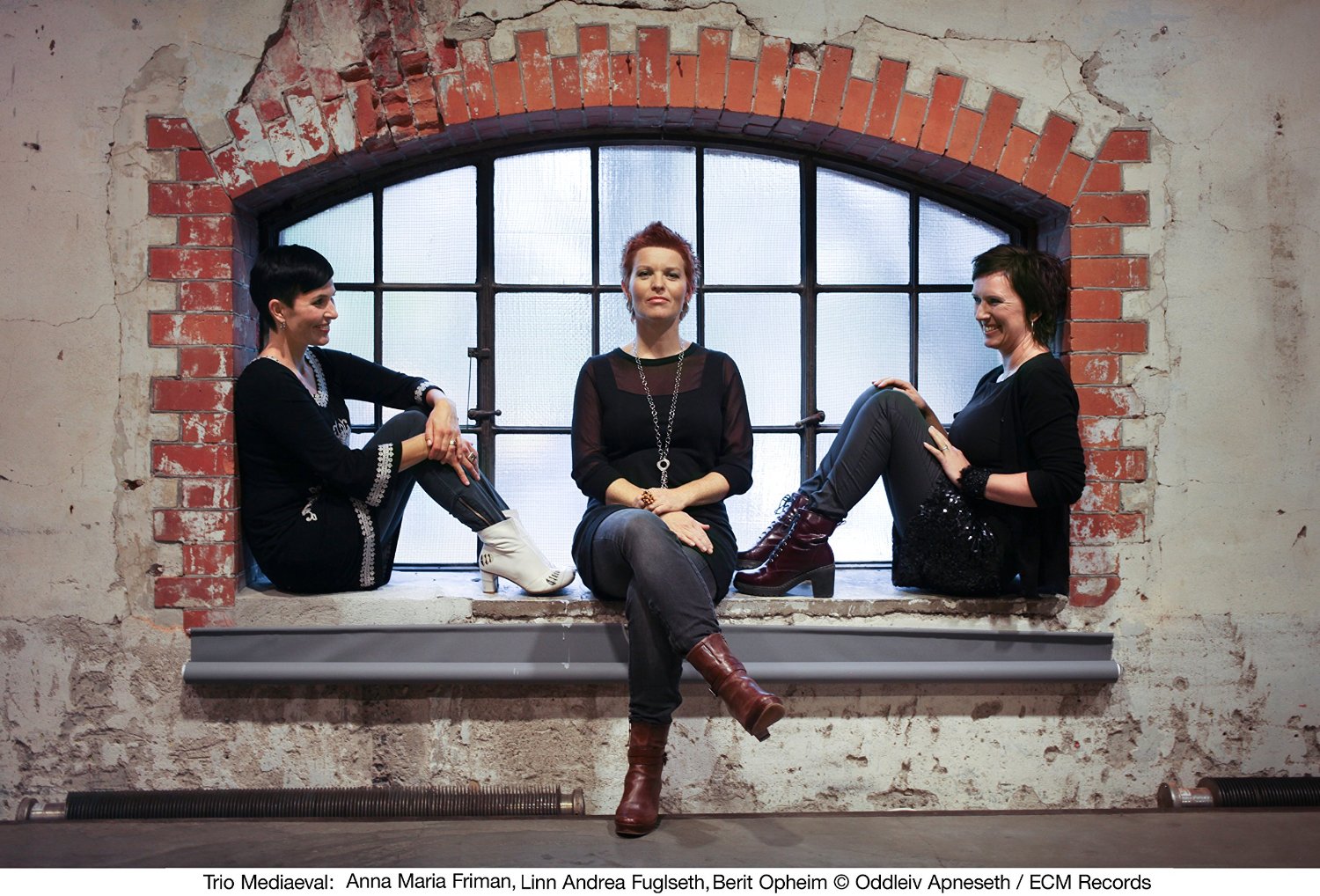
Trio Mediaeval are Anna Maria Friman, Linn Andrea Fuglseth, and, making her ECM debut, Berit Opheim (who in 2014 replaced Torunn Østrem Ossum). In their sixth New Series program, the Scandinavian songstresses bring a characteristically thoughtful cohesion to their selections and the themes under which they live again. The album’s title means “North Wind,” but as recording supervisor John Potter explains in his album note, the metaphor is as much temporal as geographical, emphasizing as it does the Trio’s centuries-long reach.
Furthest from the present are two Italian sacred songs from the 12th century. “Benedicti e llaudati” (Sacred and blessed apostles…) and “Fammi cantar l’amor” (Let me sing of the love…) contrast radiant harmonies spun around a core of chant with monophonic lines of flight. The drone also figures as a natural extension of three Norwegian folk songs, which find the singers accompanying themselves for the first time on instruments (the enriching percussion heard on 2007’s Folk Songs was courtesy of Birger Mistereggen). The Hardanger fiddle, played by Friman, is both heart and lungs of “Ingen vinner frem til den evige ro” (Eternal rest is the reward of…), and its ghost whispers in the air of the vocal solo “Gud unde oss her at leve så” (God gave us grace to live), a string of beauty untying itself in righteousness.
A step closer brings us to 14th-century Iceland and the vespers of the Office of St. Thorlak, beautifully unpacked from their plainchant rudiments into braids of censer smoke. The masterful arrangements enchant with their folkish brogue, sounding at times more like songs of the Irish plains than prayerful nights. Now it’s Fuglseth on the portable organ who gleans a droning undercurrent from the score and copies its DNA until it breathes. Yet another step lands us in the more pronounced polyphony of three 15th-century English carols, of which “Ecce quod natura mutat sua jura” (Behold, nature changes her laws) and “Alleluia: A newë work” are sublime highlights. The latter was the first piece the original Trio ever sung and makes its glowing presence known to a wider audience at last.
In the realm of the living, English composer Andrew Smith contributes three symbiotic pieces to the Trio’s repertoire. Of these, “Ioseph fili David” (Joseph, son of David) is the crowning jewel of the program, while “Ave regina caelorum” (Hail, Queen of heaven) breaks glass with its light. Swedish composer Anders Jormin, better known to ECM fans as a jazz bassist with a classical heart, solely offers “Ama.” Based on a poem by Virgil, it is a miniature of overlaid shapes, transparent and turned askew until they form new harmonies in search of the old. The singers themselves compose three pieces, each a vital organ to the program’s functioning body, planets without satellites whose clouds welcome all suns. And American composer William Brooks yields the somber yet tender “Vale, dulcis amice” (Farewell, sweet friend) on which the program ends.
The combination of self-accompaniment and new music secures the women of Trio Mediaeval as the reigning torchbearers of the now-defunct Hilliard Ensemble, of whom they are superlative protégés. Like their legendary mentors, they are able to move from one coil of existence to the next without slightest loss of form. Here’s hoping they continue to do so for decades to come.
David James countertenor Rogers Covey-Crump tenor Steven Harrold tenor Gordon Jones baritone
Recorded November 2012, Propstei St. Gerold Engineer: Peter Laenger
Executive producer: Manfred Eicher
The illustrious Hilliard Ensemble ends its decades-long tenure with ECM, and with the world of performance, in a program of 15th-century English carols and motets for two, three, and four voices. Since debuting on the label with 1989’s Perotin, countertenor David James, tenors Rogers Covey-Crump and John Potter, and baritone Gordon Jones have enchanted with their peerless blend of timbres, equal interest in contemporary and early music, and scholarly sheen. In 1998 Steven Harrold filled the venerable shoes of Potter, who would go on to strengthen his leadership of the Dowland Project (see, for example, Night Sessions) and pursue alluringly off-the-map endeavors such as Being Dufay. Harrold joined ECM’s venerable ranks in a traversal of motets by Guillaume de Machaut, one of many landmark recordings by the newly minted ensemble.
(Photo credit: Marco Borggreve)
Whereas other vocal groups might have bowed out with a flourish, the Hilliards have chosen a contemplative return to roots, drawing from a repertoire ingrained in their individual beings long before becoming a part of their collective one. Many of the composers whose work is represented herein are anonymous, yet their music, notes David James in his affectionate liner note, is anything but. Included among the sélections sans auteur is some of the Hilliards’ most incisive singing on disc, which illuminates the verily bookended pages of “Clangat tuba” in purest gold and imbues “Lullay, I saw” with baby’s-breath. Also remarkable are the more intimate combinations, especially those pairing James with one or both of the tenors. The Codex Speciálník has long been one of my most beloved Hilliard albums, in large part because of its occasional duets, and Transeamus may just share that position for its own. “There is no rose,” one of the program’s three carols, is one such instance of skeletal beauty.
John Plummer (1410-1483) is one of four known composers represented. His “Anna mater” is an astonishing creation. Through watery sustains, over which the higher voices bend like willow branches, it reveals a consummate approach between image and reflection. The “Stella Caeli” by Walter Lambe (1450/51-a.1499) threads one of the program’s most angelic looms with a continually changing color scheme. “Ave Maria, Mater Dei” by William Cornysh (c.1468-1523) is as lovely as it is luminescent, and is all the more moving for Gordon Jones’s spinal tap. Lastly, Sheryngham’s “Ah, gentle Jesu” secures the Hilliard Ensemble legacy with a piece of such descriptive power that it turns the immaterial into a tangible piece of faithful proportion, if not also proportional faith. Like the windows of Propstei St. Gerold, the Austrian monastery where so much of their brilliance was captured for posterity, these unrivaled singers allow light to shine both ways.
This album’s title may be Latin for “we travel on,” but we the listeners can be sure that just as much of the Hilliards will be left behind in our hearts as they will carry forward in their own.







 Between Sound and Space: ECM Records and Beyond