Zehetmair Quartett: Beethoven/Bruckner/Hartmann/Holliger (ECM New Series 2195/96)

ZQ

Zehetmair Quartett
Beethoven/Bruckner/Hartmann/Holliger

Thomas Zehetmair violin
Kuba Jakowicz violin
Matthias Metzger violin (Hartmann)
Ruth Killius viola
Ursula Smith violoncello
Françoise Groben violoncello (Hartmann)
Beethoven, Bruckner, and Holliger recorded April/May 2010 by Andreas Werner Hartmann recorded April 2002 by Markus Heiland at Radio Studio DRS, Zürich
Produced by Manfred Eicher

Violinist Thomas Zehetmair has become a household name at ECM, and nowhere more passionately than in his world-renowned quartet. While the group has always been adventurous, this album takes that spirit to new heights, and lengths, as it presents a monumental two-disc program of quartets by Ludwig van Beethoven, Anton Bruckner, Karl Amadeus Hartmann, and Heinz Holliger.

ZQ Portrait
(Photo credit: Keith Pattison)

In his brilliant liner notes, Wolfgang Sandner discusses the senescent Beethoven, whose final work, the formidable Opus 135, is the subject of the Zehetmairs’ bar- and hair-raising performance: “Beethoven’s late string quartets share the fate of many works created by great artists in their declining years, works which, as Adorno put it, point to the borderlines of art and almost acquire documentary stature. That is why, he continues, discussions of late Beethoven rarely lack references to his life and destiny.” In other words, the stature of an artist tends to be proportional to one’s biographical investment in that artist, as if the two were bonded matter. But if we were to see this quartet as a rope, we would find that, throughout each movement and between them, the unraveling yields thinner and thinner fibers, each more potent than the last. What distinguishes it as the final work of a master composer is therefore not so much the foreboding admixture of death and reflection that may or may not be intentioned in the music as an underlying spiritedness, held in check until choicest moments of reveal. All of this gives delicate passage into the second movement, which begins in that carefully controlled fragility by which Beethoven was so enamored but sows its field of tension with mounting density. The third movement, marked Assai lento, is cosmic and emotionally naked, a filamented chain into the final movement. Where rhythmic interplay was delightful before, here it surges.

From the end of one’s compositional life to the beginning of it, Bruckner’s String Quartet in c minor, WAB 111, was written in 1862 as a study piece while under the tutelage of German cellist-conductor Otto Kitzler. A smooth mélange of styles, it harbors echoes of Beethoven, and perhaps more explicitly of Dvorák, especially in the opening and closing movements. It is a sumptuous offering, its relief more extroverted in comparison to Beethoven’s inlaid approach, but in the flowing Andante we hear the latter’s game of hide and seek with exuberance before climbing ashore fully intact in the Scherzo, which serves as an amiable and spirited portal into the darker conclusion.

Hartmann’s String Quartet No. 2 is duly special for appearing on this record. First, it was recorded in 2002, eight years before the rest of the program, with a different second violinist (Matthias Metzger) and cellist Françoise Groben (1965-2011), a founding member of the quartet and in whose memory this recording, her last, bears dedication. Second, the music itself represents one of the pinnacles of the 20th-century string quartet. Begun at the tail end of World War II and finished in its immediate wake, it takes a three-movement structure, building on lachrymose foundations a tower of dance. Far from linear, however, it continues the theme of animated expositions out of quiet introductions. By these the music adopts an illusion of self-recognition. Despite its many shadows, the passion and joy with which the quartet plays this piece is fully evident. Groben’s playing is a wonder, bringing out as it does a turgid core. That said, the players do, and must, work together as one unit, for each move pulls the others in empathic response. A pervading heaviness in the central Andantino makes it an especially demanding play, as the performers must engage in deep listening and strictest attention to dynamics. The last movement, a Presto, enables reckoning of those darker predecessors with the light of geometric (if not also geographic) thinking and lends sanctity to the final major chord. Phenomenal.

Last is Holliger’s own String Quartet No. 2. Written by commission from the musicians, this stream-of-consciousness, single-movement work includes aleatory elements and is played scordatura. Like a scientist who pours water from one glass to another yet still finds wonder in the changes, Holliger engages the strings in flowing conversations of elements and transparencies, marking every drop spilled with precision. In this way, he cleverly reverses inner and outer. Like the Hartmann, this piece requires religious attention to dynamic contrast. This is not to say that Holliger is a cryptic composer, but that he composes with solutions rather than questions. One needs not overextend any theoretical impulse to understand the motives of writing that so comfortably favors absorption. This means that the piece’s quieter midsection may seem the very definition of mystery, when in fact it uses the mode of whisper to focus attention on its thread count. Consequently, the more forthright politics of its surroundings glisten with a personal sheen, which finds itself honed by erosion and the shape of human voices, as the musicians are bid to sing in the final scene. With the joining of their throats, these classical constructions of gut and wood become bodies in and of themselves, and render the preceding quartets a limb apiece.

John Holloway: Pavans and Fantasies from the Age of Dowland (ECM New Series 2189)

Pavans and Fantasies

John Holloway
Pavans and Fantasies from the Age of Dowland

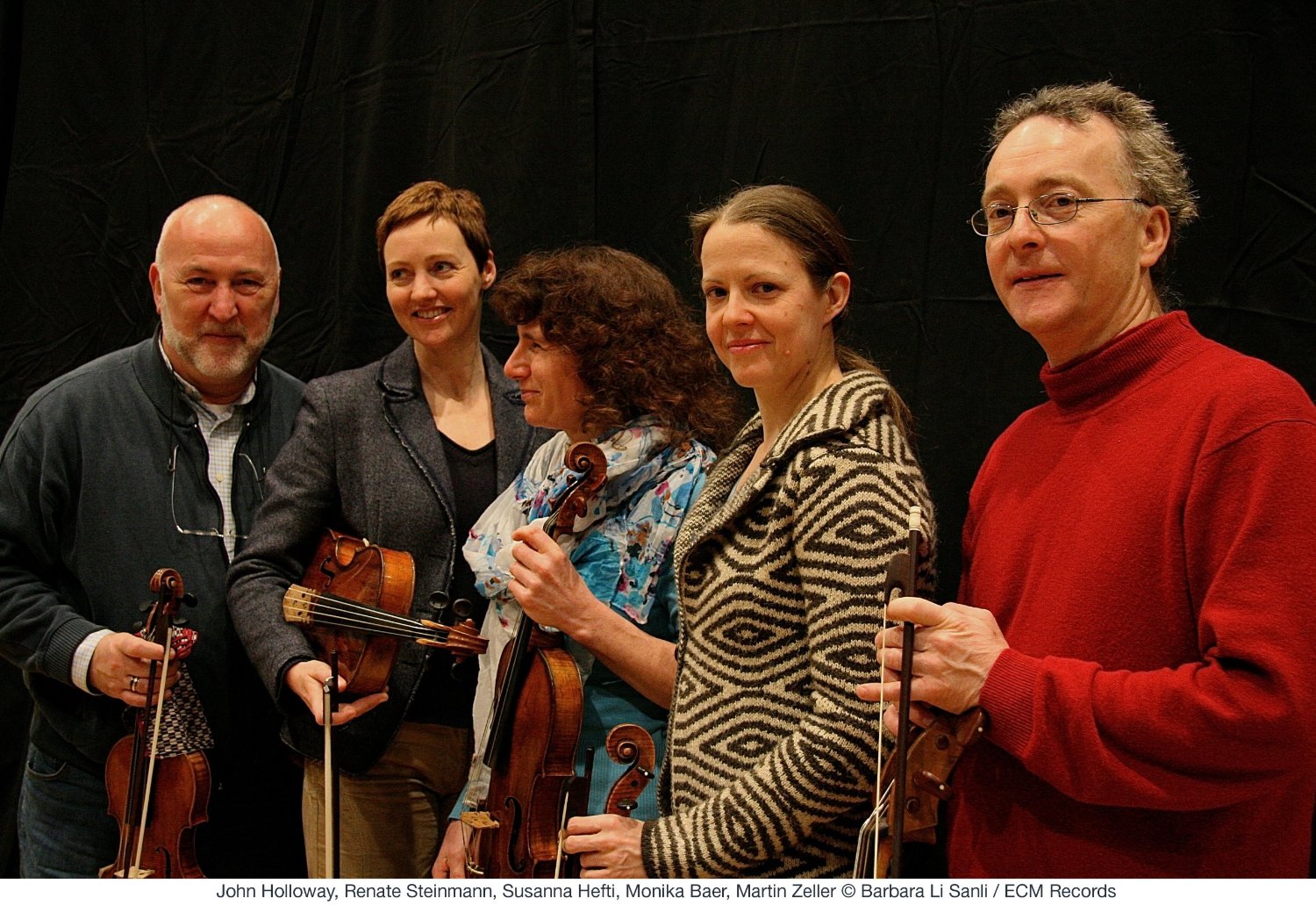
John Holloway violin, viola
Monika Baer violin, viola
Renate Steinmann violin
Susanna Hefti viola
Martin Zeller bass violin
Recorded March 2013, Radio Studio Zürich
Engineer: Andreas Werner
Produced by Manfred Eicher
An ECM / SRF2 Kultur co-production
Executive producer (SRF): Roland Wächter

Violinist John Holloway has carved the deepest Baroque relief into ECM’s surface. With sole exception of Bach’s Sonatas and Partitas for solo violin, he has since 1999 been accompanied by harpsichord and organ or cello continuo in thoughtful and superbly executed programs of music by such composers as Schmelzer, Biber, Veracini, Leclair. For the present disc he joins an all-string ensemble of period specialists in a book of music at once haunting and robustly fleshed. Not only is it renewing to hear Holloway free-floating in a choir of equal voices; his choice of material carries further significance for turning back the dial to one of the great masterworks of the late Renaissance.

Holloway and Friends

The Lachrimae Pavans of John Dowland (1563-1626) take thematic root in composer’s evergreen “Flow My Teares,” a song last recorded for ECM by John Potter on his Dowland Project’s debut. By time the Lachrimae were published in 1604, Dowland had been court hopping for a decade. He composed the collection under the auspices of his then-employer, Denmark’s King Christian IV, whose sister-queen Anne was the subject of its dedication. In addition to being musical landmarks, the Lachrimae represent a watershed historical moment in English music publishing. They came at a time of great frustration for Dowland, who never realized his dream of holding post at the English court. But while melancholy pervades, there are sunlit glades to be discovered among the thickets.

Lachrimae

Indeed, there’s plenty of sunshine to be had in the “Lachrimae Antiquae,” which prepares for its daily works with nightlong ablution. As from so much of what follows, its darkness seeps through like a contrapuntal substance of harmonic order. Dowland’s beauties turn supplication into strength and draw the clouds nearer to earth with every added layer. Both musicians and music move as one sinuous entity—must do so, in fact, to achieve the limpid consistency required of the “Lachrimae Tristes,” which as the program’s exact center is the most deeply hued jewel of this crown. The qualities of subsequent variations are as individual as their titles. “Lachrimae Coactae” is threadbare yet flourishing, “Lachrimae Amantis” more viscous, and the “Lachrimae Verae” a burnished hasp of a conclusion.

Shuffled into the Lachrimae are exemplary selections of English consort music from Dowland’s time. Of these, the Fantasy upon one note by Henry Purcell (1659-1695) is the most forthright, while the Fantasy for 2 Trebles and Bass of Matthew Locke (1621/3-1677) cradles fleeting exuberances in downtempo reflections. The brightest surfaces come from William Lawes (1602-1645), whose autumnal Fantasy in C for 5 is another highpoint of the literature assembled herein. John Jenkins (1592-1678) gets a nod in the form of his Fantasy No. 12 for 2 Trebles and Bass, a fugal ripple of a piece with ballroom denouement. Its contrast of floating highs and supportive brushwork from bass violin give it a most expansive reach. Last but not least is Thomas Morley (1557/58-1602), a key figure in realizing the Lachrimae in print, and whose Lamento for 2 (excerpted from his Canzonets for two voyces) is a slow dance between forest sprites, whose leaf-hidden conjugations harness moonlight in every step.

Although there’s so much to admire the form and content of this album, it’s just the tip of a mountain of contemporaneous sources. Listening to Holloway and friends making such sweet music is akin to skipping a perilous journey and diving straight into the treasure horde at the end of it. But its greatest value might just be the desire it inspires to backtrack and see what fruitful lodgings might have been missed along the way.

(To hear selections from Pavans and Fantasies from the Age of Dowland, click here.)

Michael Mantler: For Two (ECM 2139)

For Two

Michael Mantler
For Two

Bjarne Roupé guitars
Per Salo piano
Per Salo recorded June 2010 at Studios La Buissonne, Pernes-les-Fontaines
Bjarne Roupé’s guitar tracks recorded August 2010 at home, Copenhagen
Mixed and mastered September/October 2010 at Studios La Buissonne by Gérard de Haro and Nicolas Baillard
Produced by Michael Mantler

Following the monumental Review and CONCERTOS, Vienna-born composer Michael Mantler intersects once again with ECM in an especially intimate project. For Two documents 18 duets written for jazz guitarist Bjarne Roupé and classical pianist Per Salo in a chemical reaction of, respectively, free improvisation and through-composed material. The resulting compound lures a microscope over the crucible of a uniquely cellular approach, which by these vignettes boil down Mantler’s equal footing in multiple registers.

Most impressive is the musicians’ rhetorical clarity, which despite a separation in training elicits an enchanting cross-fertilization. You might hear the jagged Duet One and think you have the album’s ensuing architecture pegged. But then Duet Two counters with a denser fusion of chord voicing and pointillism, while Duet Six reaches an almost bluesy union of form and content. Roupé’s fingers on the electric guitar are just as exploratory as Salo’s on the keyboard, so that rare passages of unison, as those in Duets Seven and Fifteen, feel more like departures than returns. Roupé’s hard-won crooning over Salo’s insistent finger pedaling in Duet Eight digs deepest into the fertile soil of Mantler’s umwelt, where perceptions of meter and matter switch places.

The beautiful Duet Ten discloses the responsiveness of composer and interpreters alike. Its brevity only serves to enhance the restless core of it all, that creative spark in which resides the potential to flare. Some may burn more brightly than others, but not one emits a hue it was never meant to emit. The notion of integration behind these pieces, then, is something born of their circumstances. In this case, the studio is not a meeting place but a funnel of ideas, from the end of which emerges unpredictable mixtures. Elements of stealth lurk in the shadows of Duets Fourteen and Sixteen, but always with an exit strategy in hand. Theirs is not a code to be broken. It is a break to be coded, a fracture in the window of time that mends itself in Duet Eighteen by molten notecraft.

Thus, the duet functions as a single organism that divides through the fortune of iteration.

(To hear samples of For Two, click here.)

Zsófia Boros: En otra parte (ECM New Series 2328)

En otra parte

Zsófia Boros
En otra parte

Zsófia Boros classical guitar
Recorded August 2012, Auditorio Radiotelevisione svizzera, Lugano
Engineer: Stefano Amerio
Produced by Manfred Eicher

Hungarian guitarist Zsófia Boros is a revelation. Having found in ECM an ideal venue for her playing, she is able to unfold her wings in quiet strength. Perhaps taking cue from Cuban composer Leo Brouwer, who saw the guitar as a boundless orchestra and whose music is prominently featured in her debut program for the label, Boros plays her instrument as if it were a piano. Each finger is independent of the others, but connected by a network vaster than the sum of its parts.

Boros 1

The shorter pieces of the program are also its deepest, and include the gorgeous faceting of Brouwer’s “An Idea,” the very simplicity of which allows Boros’s expressive gifts to shine. The same holds true for “Ecrovid” by Vienna-born composer Martin Reiter. It’s a jewel of a piece, steeped in an innocence that fades into a chain of unresolved statements. And in “Eclipse” (by Dominic Miller, an English guitarist born in Argentina), Boros bonds every color change to an overarching spectrum of song-like paths.

Furthest afield, geographically speaking, is the tender slice of contrast that is Ralph Towner’s “Green and Golden,” which despite the title is more about texture than color. Its lines curl ever inward, each a strand of physical synaesthesia. Towner’s braids make fine company for the muted spirals of “Te vas milonga” by Argentine composer Abel Fleury and the Brazilian standard “Se ela perguntar” by Dilermando Reis. Freshened in the acoustics of the Lugano studio, each forms, along with the engineering brilliance of Stefano Amerio and Boros’s obvious humility, an artisanal triangulation of effort to liberate an unadulterated spirit.

One can hardly forget in the longer pieces the distinctly shaded lyricism of Spanish composer Francisco Calleja’s “Canción triste.” The beauty thereof lies not only in the tune but also its feeling of history. It’s as if the composer had been waiting with his guitar beneath a storm cloud so that he might catch the music in the sound hole and grow it like a plant. Although the combination of production and performance is fine throughout, here especially one notices an immediate genius as Boros and the Amerio/Eicher team emphasize the warmth of the guitar’s lower end and the clarity of its upper registers in mutual separation. A meditative rubato glow gives this piece a generative character that pours from the fingers. Also pouring from the fingers are the cascades of “Callejón de la luna.” Written by Spanish composer Vicente Amigo, this piece sails the vessel of its flamenco inspirations toward wider waters: a story of lovers circling the earth until they meet again. Flamenco touches echo also in “Cielo abierto” by Argentine composer Quique Sinesi, but in even more refracted form. For while the percussive acuity and variation of technical flourish makes this a standout for its substantive atmospheres and melodic robustness, its brilliance is to be found more so in its balance of sinking and floating.

The album’s heart beats through Brouwer’s “Un dia de noviembre,” which clarifies an uncommon gift for narrative. Brouwer is a master storyteller, and at these fingertips his characters come to life in tangible ways. At one point, Boros leads a rhetorical shift into more rolling motifs with the insistence of a single note. That she does this with such lack of force speaks to the sanctity of her relationship with the guitar. A variation of the same track ends album in somber skies, but beyond them an assurance brought only by dreams that the dawn will bring with it a feeling of return.

(To hear samples of En otra parte, click here.)

Boris Yoffe: Song of Songs (ECM New Series 2174)

Song of Songs

Boris Yoffe
Song of Songs

Rosamunde Quartett
Andreas Reiner violin
Diane Pascal violin
Helmut Nicolai viola
Anja Lechner violoncello
The Hilliard Ensemble
David James countertenor
Rogers Covey-Crump tenor
Steven Harrold tenor
Gordon Jones baritone
Recorded November 2009 at Propstei St. Gerold
Engineer: Peter Laenger
Produced by Manfred Eicher

The limitations of words tend toward failure in expressing the breadth of any creative endeavor. Describing the music of Boris Yoffe is an exceptional case, for here words risk expressing too much. Yoffe himself has lived a life of cutting to the chase. He was born in St. Petersburg in 1968, where he composed and premiered his first works just shy of his 15th birthday. He emigrated to Tel Aviv, completing a degree in composition, and then to Karlsruhe, Germany to study with Wolfgang Rihm. Rihm was struck by Yoffe’s individuality from day one, and includes an affectionate note to that effect in the CD booklet: “His music has great beauty. Can it be misunderstood? Oh yes. But it doesn’t complain. Stays beautiful and giving. Unmisunderstandable. With time also hardened, pointed.”

Yoffe writes one string quartet a day (each just a page long), as if it were scriptural meditation. Of those culled for the present disc, he notes, “For me this recording is a handwritten collection of verse, in which the quartet poems are accompanied by the tenderly coloured miniatures of the sung pieces.” Yoffe’s scores are bereft of dynamics, tempi, and directions, and so the Rosamunde Quartett and Hilliard Ensemble are to be commended for tending to them with so much heart.

I sought him but I found him not introduces the program with ashen strings before the Hilliards’ voices, after a pause, break through the gloom with their palatial moonlight. So does their antiphon continue in meditative interaction with the Rosamundes, whose occasionally sharper gestures merely emphasize a fundamental contemplation. Both registers exist in mutual exclusion, bonded in a reality where contact and surface are one and the same, and the experience of language turns in on itself. My own vineyard I did not keep, by contrast, reflects a less syllogistic approach to text and melody. Brief chains of overlapping voices grow like a vine along brick: filigree to a hardened exterior.

Yoffe allows fragrance to waft through the lattice of his notecraft and opens its interstices to further interpretation. I sleep, but my heart waketh takes this philosophy furthest in a veritable calligraphy of air, born of flesh and thought yet writ large on the wind. Pizzicati in this quartet-only piece feel not plucked but pulled, as if by gravity into a watery hermitage. Death as transfiguration.

My head is filled with dew, my locks with drops of the night is a river run so long that it births a canyon. It is a particularly affecting vehicle for countertenor David James, in whose throat resides angelic hues. This is the most contemplative piece on the album. Its heartbeat folds into strings in My soul went forth when he spoke, for which the body’s connection to a life divine charts an altogether deeper anatomy, one of which veins and arteries are spun from the Word and through which the blood of deliverance dreams like a promise kissed into cognizance.

Yoffe’s elastic sense of proportion confirms the sentiments of Paul Griffiths, who in his liner text characterizes this recording as “a sampling of eternity.” The only possible end result is another beginning.

Lutosławski/Bartók: Musique funèbre (ECM New Series 2169)

Musique funèbre

Witold Lutosławski
Béla Bartók
Musique funèbre

Hungarian Radio Children´s Choir
Stuttgarter Kammerorchester
Dennis Russell Davies conductor
Recorded May 2004 and February 2010, Liederhalle, Stuttgart
Engineer: Peter Laenger
Executive producer: Manfred Eicher

Conductor Dennis Russell Davies leads the Stuttgart Chamber Orchestra in a program of music by, and dedicated to, Béla Bartók. The disc opens in the latter vein with Witold Lutosławski’s Musique funèbre, composed between 1954 and 1958 for the 10th anniversary of Bartók’s death. The title, often erroneously translated as “Funeral music,” is better rendered as “Music of mourning,” and connotes homage to one of Lutosławski’s greatest inspirations, if not the greatest, for he never dedicated a work to another composer. Although the piece’s overarching development resembles Bartók’s Music for Strings, Percussion and Celesta, the opening cellos closely prefigure the robust, overlapping memorial of Henryk Górecki’s Symphony No. 3, even if they do chart a vastly different geography, from collective to individual landing. That initial feeling of density and weight gives way to a dark airiness. Motives bend and sway—at moments pliant, at others sharply angled. Darting violins bring us closer to a sense of inner turmoil and bold reckoning. The Bartókian flavor is clear yet faged, and falls back where it began: in the solemn cellos. Ashes to ashes.

As Wolfgang Sandner observes in this album’s liner notes, for Bartók the music of Hungary’s peasants “was the source of a radical new musical system, not material for reverting to a nostalgic transfiguration of the original sounds.” In light of this, we might reckon his Romanian Folk Dances of 1917 not as an archival storehouse but, more like Estonian composer Veljo Tormis’s choral arrangements, as an experiment made fresh by extant impulses. While for me the reference recording by Midori and Robert McDonald (1992, Sony Classical) gets to the core of the music in ways I’ve not since heard, the Stuttgarters’ soaring performance of this 1937 arrangement for string orchestra by Arthur Willner articulates the orbits of its moons with surprising precision. A delicate piece of nevertheless sweeping proportions, it moves by a hand unseen. The solo violin stands out like a red rose among a field of black, its changes organic, even a touch mournful, in the present setting. As the mosaic evolves, it gives light to the translucent cells of its becoming. The flute-like strings in the enlivening finale give us reason to rejoice in the shadows.

So, too, does the Divertimento. Composed 1939 in dedication to Paul Sacher (who commissioned the work) and the Basler Kammerorchester, it achieves novel balance of spiritedness and restraint under Davies’s direction. Its unmistakable beginning lures with its insistent rhythm but would just as soon fragment into multiple galaxies of melodic thought. There is a smoothness of execution in the tutti passages and a paper-thin delicacy to the solo strings. While one might expect that energy to be sustained, it waxes and wanes in a most natural, thought-out-loud sort of way that lends especial insight into Bartók’s compositional process. The second movement proceeds slowly at first, but then, with the coming of dawn, stretches its gravity. The lower and higher strings forge an implicit harmony, an acknowledgment of the invisible forces connecting them both. The contrast between double basses and violins is one not of tone but of purpose: the lowers an unstable fundament, the uppers a firmament in turmoil. This chaos they share as if it were blood. The final movement returns the promise of that dance with wit. There are, of course, intensely lyrical and slow-moving parts, with the violin carving surface relief, but always returning with that whirlwind of fire.

In the wake of this dynamism, selections from Bartók’s 27 Two- and Three-Part Choruses (1935-41) come as something of a breather. They are not adaptations of folksongs, but were composed in such a style at the behest of Zoltán Kodály. With evocative titles like “Wandering,” “Bread-baking,” and “Jeering,” each is a vignette of imagined life. A snare drum pops its way through the choral textures, by turns martial and lyrical, adding colors of interest throughout. And while these pieces hardly hold a candle to his a capella choruses (the orchestral writing feels at points superfluous), they provide welcome contrast to the veils that precede it with gift of vision.

Kremerata Baltica: Hymns and Prayers (ECM New Series 2161)

Hymns and Prayers

Kremerata Baltica
Hymns and Prayers

Gidon Kremer violin
The Kremerata Baltica
Roman Kofman conductor
Khatia Buniatishvili piano
Andrei Pushkarev vibraphone
Marija Nemanytė violin
Maxim Rysanov viola
Giedrė Dirvanauskaitė violoncello
Sofia Altunashvili voice on tape
Recorded July 2008, Pfarrkirche St. Nikolaus, Lockenhaus
Engineer: Peter Laenger
Produced by Gidon Kremer and Manfred Eicher

A recent album released of solo piano music by Stevan Kovacs Tickmayer bears the title Gaps, Absences, which best describes the music of the composer, pianist, and essayist who, born 1963 in former Yugoslavia, has since 1991 called France his home. His life as an improviser has brought him in collaboration with Fred Frith, Chris Cutler, and many others of the avant garde, while on the classical side he has enjoyed fruitful collaboration with violinist Gidon Kremer and the Kremerata Baltica, having served as composer in residence at the renowned Lockenhaus chamber music festival, where this album was recorded in 2008, and more recently at the Kremerata Baltica’s own festival in Latvia. His Eight Hymns (1986/2004), written in memory of Russian filmmaker Andrei Tarkovsky, begins a tripartite program of monumental works for various ensembles. Scored for violin, strings, vibraphone, and piano, each of Tickmayer’s hymns bears a title of calm strength. His atmospheres are deceptively minimal, at times spectral and at others hovering as mist over a lake at dawn. The instruments interlock in alternating tides and continental shelves. The piano paints evening skies as single notes break off into satellites of a deeper gravitation. The violin is a thin yet utterly present voice, an omniscient myth-keeper whose experiences of assumption, redemption, and remembrance all answer to the same voice. The vibraphone is a pinwheel moved by breath of slumber. Strings move in the draw of a paintbrush from behind a veil of ash and harmonic light. All of this ends in a flower, as fragile as it is trembling, leaving us indeed with gaps and absences of profound resonance.

Such soul-nourishing music finds like spirit by way of Giya Kancheli, who wrote his 2007 Silent Prayer in honor of Mstislav Rostropovich (for his 80th birthday) and Gidon Kremer (for his 60th). The familiar Kancheli themes crystallize in the prerecorded singing of one Sofia Altunashvili. Her pure-toned voice, carried like a feather on exhale, rings authentically for its vulnerability. It’s an unusual voice, an untrained voice, a voice unafraid of a misshapen psalm. As in the Tickmayer pieces, the violin feels thin and unchained, and puts into relief the spaciousness of strings dragging hands across water from methodical vessels. Their occasional interjects feel like proclamations from above, chances to restring the universal lyre. Still, there is a feeling of oppression to this piece, as if the sky had become weighted with death, so that the lively center almost blinds. Even more cinematic in feel than the Tickmayer, Kancheli’s hymnal cast turns wine into water in a single tracking shot.

Equally affecting, if by relatively compressed dynamic force, is César Franck’s Piano Quintet in f minor (1878/79), which occupies program center. A dramatic and chromatically ecstatic work that met with criticism at the time of its premiere, it also makes expert use of its formidable combination of instruments. What appears short and sweet by name becomes epic in performance as Kremer and his colleagues muscle their way through the first movement with heartfelt aplomb, chipping away at the music’s calcified soul as they proceed. Each drift into the major is a barrel over the waterfall of reality. The most genuine passages are the quietest. On that note, the second movement turns an elegiac frame into a window on fertile land. The legato phrasings of the final Allegro, then, are a bittersweet harvest, tempered by the promise of winter’s freeze. In anticipation of that cold, the piano holds a fire in its belly, changing from blue to orange to white as echoes return with nourished grief. For indeed, mourning is the final message of even the brightest day. The tinge of mortality knows no limits of sun.

Garth Knox: Saltarello (ECM New Series 2157)

Saltarello

Garth Knox
Saltarello

Garth Knox fiddle, viola, viola d’amore
Agnès Vesterman violoncello
Sylvain Lemêtre percussion
Recorded December 2009, Auditorio Radiotelevisione svizzera, Lugano
Engineer: Stephan Schellmann
Produced by Manfred Eicher

Garth Knox describes Saltarello, his second nominal disc for ECM’s New Series following 2008’s D’Amore, as “a mobile structure of musical ‘snapshots’ taken from nearly one thousand years of music.” As the former violist of the Arditti Quartet, Knox gained in-depth knowledge of music by living composers, all the while strengthening his relationship to the viola d’amore and folk-grounded fiddling, and compresses that knowledge into a roaming program. Knox has also developed his voice as a composer, as demonstrated by his Fuga libre for viola solo, which juxtaposes fiery arpeggios with moonlit pizzicato diffusions, glissandi, and harmonic overlays. This cellular approach is writ large across the album’s full breadth, which for the most part traverses centuries-old lineages. Joining Knox on his time travels are cellist Agnès Vesterman and percussionist Sylvian Lemêtre.

On the deepest end of the spectrum we encounter works of medieval masters Hildegard von Bingen and Guillaume de Machaut. The former’s lilting poetry, liturgical and solemn to its ashen core, comes out all the more authentically in the intimate setting, while the latter’s Tels rit au ma[t]in qui au soir pleure adds percussion in Sephardic spirit. Three dances from the 14th century speak further to an ancient aesthetic uncluttered by the discontents of modernity, resonating instead through the viola d’amore’s singing body. Here, too, the percussion balances luminescence opposite Knox’s originary tone. A handful of traditionals takes us into less definable territory, where Appalachian folk song and Irish fiddling meet in Black Brittany in limber arrangement with cello, and a trio of Irish tunes under the title of Pipe, harp and fiddle turns temerity into joy through a prism of bells and drums.

A dip into the font of the Baroque gives up the ghosts of Henry Purcell and Antonio Vivaldi. Where one feels steeped in downright cinematic tragedy, the other crucibles a concerto originally written for viola d’amore and orchestra down to its lead and bass lines, so that the striking geometries of each movement, from dancing to slumbering to dancing again, mold a beautiful sculpture of exuberance.

Bolstering all of this is contemporary Finnish composer Kaija Saariaho’s Vent nocturne for viola and electronics, which was written especially for Knox. The first of its two movements bears the title “Sombres miroirs” (Dark Mirrors), the second “Soupirs de l’obscur” (Breaths of the Obscure). The piece includes the composer’s own breathing, as well as the amplified sound of the bow drawn across a string, in a mood that best recalls Sofia Gubaidulina’s String Quartet No. 4. It’s a windblown reverie, opened and not merely enhanced by the technological overlay. It is sometimes restless and draws from a relatively stark palette, even as glass harmonica-like drones bleed into frame as if they were time itself. Splitting the two movements even as it binds them is John Dowland’s Flow My Tears, a song last heard under ECM auspices with words on In Darkness Let Me Dwell. It is, like the album as a unit, a prayer that looks itself in the mirror and neither smiles nor frowns, but takes in the entire face, scars and all, as something greater than the sum of its features.