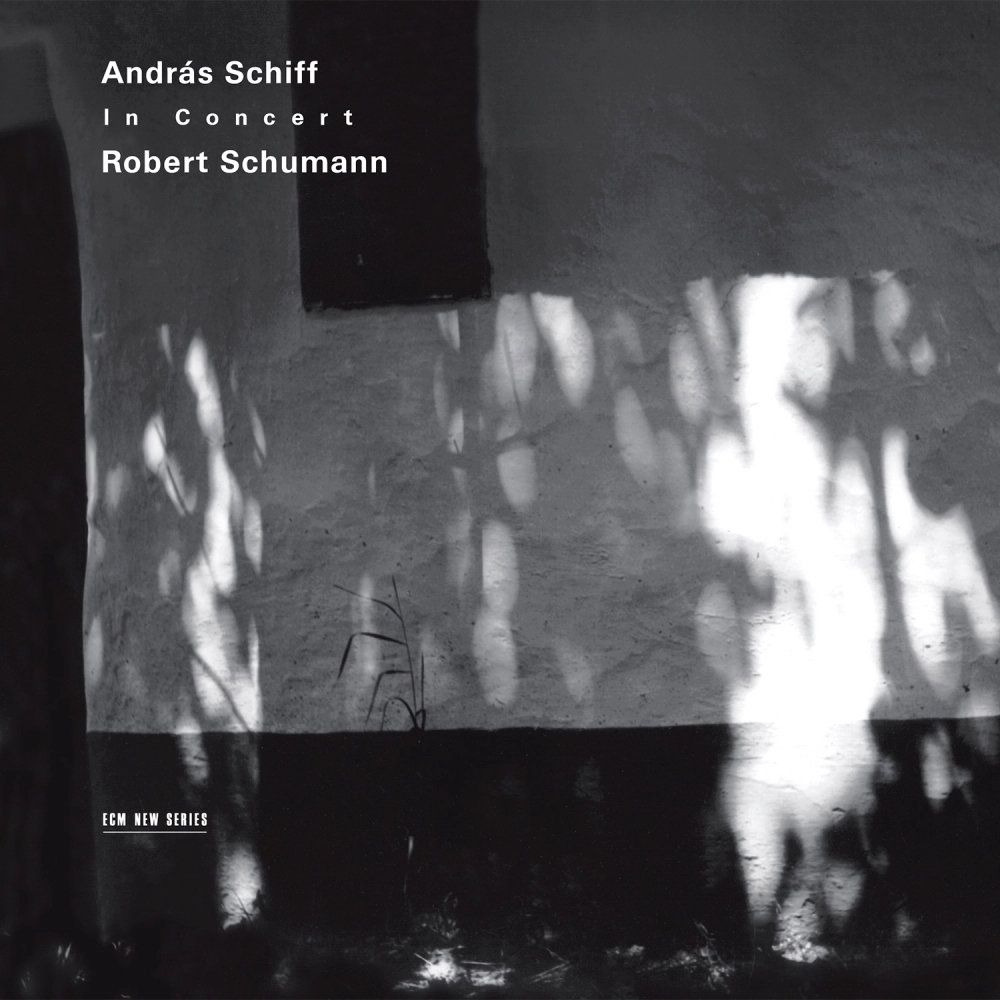
András Schiff: In Concert – Robert Schumann (ECM New Series 1806/07)

András Schiff
In Concert – Robert Schumann

András Schiff piano
Recorded at Tonhalle Zürich, May 30, 1999
Engineer: Stephan Schellmann
Produced by Manfred Eicher

András Schiff returns to ECM with a live all-Schumann recital. Capturing what he sees as the composer’s “burning inventiveness,” the Hungarian pianist allows himself no contrivance in letting the notes speak on their own terms. He jumps right into the deep end with the vibrant Humoreske op. 20 (1838). Written during a time of separation from his future wife, Clara Wieck, in it Schumann incorporates a hidden “inner voice,” which he imagined as Clara’s own. Throughout its invigorating 28 minutes, we are treated to a mosaic of inner passions. Schiff handles its fluid transitions, intermezzi, and stylish moves with requisite grace, allowing plenty of space in the slower passages for the music’s full effect to shine. This is followed by the Novelletten op. 21 of the same year, which comprise the composer’s most extensive piano work. Though distinguished by its exuberant approach, it too embraces Clara’s “voice from a distance” (Stimme aus der Ferne) as a key animating force. Throughout, Schiff captures Schumann’s dynamic range admirably well, teetering between the Apollonian and Dionysian at every virtuosic turn. Yet it is in the “Concerto without Orchestra” that is the Op. 14 Piano Sonata in F minor (1836, rev. 1853) that we encounter the recital’s most luxurious moments. The pianism shines here in a finessed first movement, while making the third (a set of variations on a theme by Clara) sing like love itself. The final Presto rolls off Schiff’s fingers like water. Schumann had originally intended to call an 1839 tribute to his dying brother by the title Leichenphantasie (Corpse-fantasy). Clara convinced him to change the title for publication, thus giving us the Nachtstücke (1839), of which No. 4 constitutes a consolatory, if bittersweet, encore.

This was the first recording of Schumann’s piano music I ever heard, and is one I will always return to for reference. Schiff proves he is just as comfortable with the Romantics as he is with the Baroque masters, and in Schumann has found a most rewarding synergy. The music is, despite its grandiose touches, undeniably intimate, casting one deep look inward for every outward glance. Prosaic though they may be, these performances are anything but analytical. Whatever your familiarity with Schumann, this is an album you will want to hear.

Valentin Silvestrov: leggiero, pesante (ECM New Series 1776)

Valentin Silvestrov
leggiero, pesante

Valentin Silvestrov piano
Anja Lechner cello
Silke Avenhaus piano
Simon Fordham violin
Maacha Deubner soprano
Rosamunde Quartett
Recorded January 2001, Festeburgkirche, Frankfurt am Main
Engineer: Markus Heiland
Produced by Manfred Eicher

With leggiero, pesante ECM devoted its first entire disc to the work of Valentin Silvestrov, inaugurating an ongoing series through which the label has been documenting a quiet musical path that had, until then, led the composer to great acclaim hardly anywhere beyond his native Ukraine. As one who often works in larger forces, Silvestrov was, I think, wisely introduced to listeners through this program of chamber pieces. To be sure, his statements are no less expansive here, but one sees more clearly in the capillary motifs that so fascinate him, and us, with their inner life.

If the opening Sonata for cello and piano (1983) is a mirror, than in it we catch only fleeting glimpses of faces that, through the magic of performance, are slowed like a film reel until their pathos becomes clear. Intense dynamic contrasts ensure that silences are as full as the notes that cradle them. Pianist Silke Avenhaus and cellist Anja Lechner offer a painstaking reading of this rather difficult piece, which challenges with its need for emotional over technical virtuosity.

If the String Quartet No. 1 (1974) is a breath, then each instrument is a sheltering lung. The first violin stretches its capacity, exhaling a jagged agenda against the linear regularity of the trio from which it is birthed. As these become increasingly convinced of its mission, they join the violin in song, only to fall back into the folds of their complacency, leaving the violin to weep for its lost cause. The Rosamunde Quartett’s performance is transparent and honest and ensures that every stage of this mournful journey is illuminated by salvation.

If the Three Postludes (1981/82) are hands, then each grabs the wrist of the other in an unbreakable triangle. Postludium No. 1 is a swan song for Shostakovich and uses the composer’s DSCH cryptogram to satoric effect. Soprano Maacha Deubner reprises the profundity she brought to Kancheli’s Exil, loosing her angelic rain through a gossamer fabric woven of violin and piano. Violinist Simon Fordham makes of Postludium No. 2 an enigmatic complement, while Avenhaus and Silke return for the delicate charm of Postludium No. 3, honing a brightening edge in an otherwise murky recital.

The composer himself takes up the piano for his closing Hymn 2001, dropping highs like spores into the instrument’s freshly tilled lows, where they are silently absorbed to begin the cycle anew.

As the album’s title makes abundantly clear, Silvestrov’s music feels light, but in being so is immeasurably heavy. Just when it seems on the verge of fading like a mist in morning light, it curls back from the binds that loop it firmly around our attentions. It is not that these binds are particularly restrictive, only that the music is so much at peace in their gentle capture that its shoes remain unworn.

<< Sofia Gubaidulina: Seven Words / Ten Preludes / De profundis (ECM 1775 NS)
>> Dave Holland Big Band: What Goes Around (
ECM 1777)

Trio Mediaeval: Words of the Angel (ECM New Series 1753)

Trio Mediaeval
Words of The Angel

Anna Maria Friman soprano
Linn Andrea Fuglseth soprano
Torunn Østrem Ossum soprano
Recorded December 1999, Gönningen
Engineer: Peter Laenger
Produced by John Potter

The fourteenth-century Messe de Tournai is the earliest extant polyphonic mass and provides the skeleton for this debut release by Trio Mediaeval. In his accompanying notes, John Potter (who also produced the album) stresses that the survival of such a manuscript is something of a miracle. Written on the backs of ledgers, the mass could easily have suffered the destructive fate to which most such music succumbed in an age where paper was a precious commodity. That it emerged from a war-torn Europe unscathed is likely “because a conscientious accountant couldn’t bear to throw away old financial records.” An overtly Marian theme pervades this disc, as evidenced by the English-sourced motets and sequences leaved between the Mass, and further in a selection of lauds from thirteenth-century Cortona.

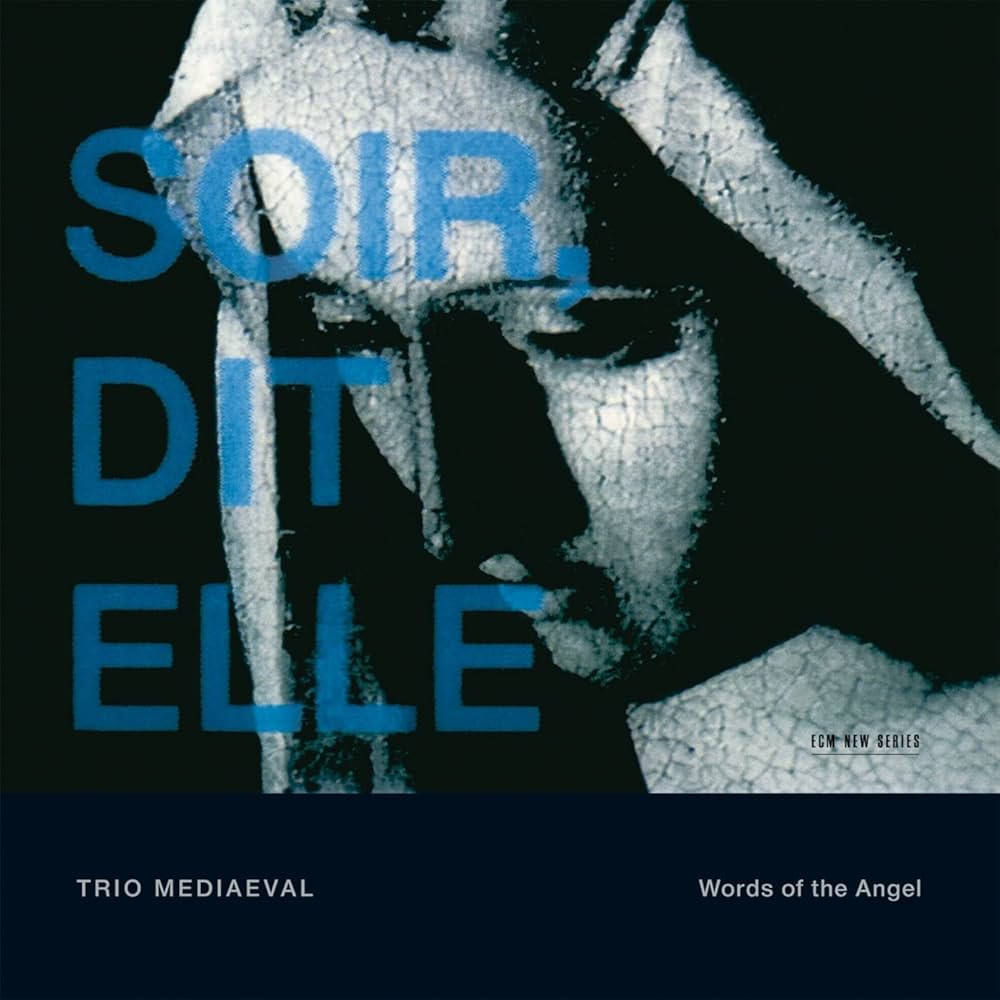
Three solos dot the program, each surrounded by luminescent swaths of divine vibrations. Of the chants, Salve mater misericordie is the brightest, and refracts light like a window into the Trio’s further projects. The words “Stella Maris” clearly stand out here, foreshadowing the title of their third album, while the cover art (a still from Godard’s Histoire(s) du cinéma) cues their second, Soir dit-elle. The Mass itself rests on a delicately consonant edge, ladling our attention between voices and the echoes they project. Nestled like a diamond in an already captivating program is the title piece by Ivan Moody. Dramatic key changes and a snake-like alto core make it one of the most intriguing pieces the Trio has recorded thus far.

Hailing from Norway, Trio Mediaeval honed their craft through focused study with the Hilliard Ensemble, who seem to have passed on not a small amount of adventurous spirit. Often compared with the now defunct Anonymous 4, the Trio walk a striking musical path uniquely their own. Sinuous drones and anchoring lines are gloriously configured, and articulations rendered with vivid care. Words of the angel deserve to be sung by voices of the angel, and here they most certainly are.

<< Andersen w/Tsabropoulos and Marshall: The Triangle (ECM 1752)
>> Kim Kashkashian: Hayren (
ECM 1754 NS)

Herbert Henck: Piano Music (ECM New Series 1726)

Herbert Henck
Piano Music

Herbert Henck piano
Recorded August 1999, Festeburgkirche, Frankfurt am Main
Engineer: Markus Heiland
Produced by Manfred Eicher

George Antheil (1900-1959) caused a stir in October of 1923 not unlike the one provoked by Stravinsky’s Sacre du Printemps after performing a selection of his sonatas. Only when Erik Satie, in attendance for the performance, voiced his unflinching support did Paris accept him as the self-anointed “Bad Boy of Music.” What incited the audience was the sheer ferocity with which Antheil played, so unsettling was it in its precision. In doing so, he flirted with the Uncanny Valley, taking the human dangerously close to the mechanical. And while his American debut was met with less fruitful derision, Antheil remained convinced that he was as important as ever. Whatever we may think of the man, his tireless spirit (he was known to practice for 20 hours at a stretch) lives on in the keen performances of pianist Herbert Henck, who makes a welcome return to ECM, pairing the French maverick’s sonic factories with the more intimate production lines of American composer and political outcast Conlon Nancarrow (1912-1997). The double meaning of the album’s title, Piano Music, gives us clearest insight into its program. Almost instinctively, both composers took to the player piano, treating it as though it were an organism in and of itself. Henck uses the phrase “piano music” as one might speak of “bird song.”

Of Nancorrow there is little to say, as he spent much of his life in hermetic obscurity (in Mexico, no less, after having been denied reentry into America from Spain, where he took up arms against the Franco regime and professed his allegiance to the communist party), quietly amassing a sizable oeuvre of laboriously perforated pianola rolls, which later astonished the musical world with their depth. Although the selections given here were written before Nancorrow began tinkering with the player piano in earnest, their virtuosity is clear in the autonomy of Henck’s elicitations. Such is the electricity that runs the Three 2-part Studies (1940/41), which “roll” off Henck’s fingers with absolute precision, and do the short Prelude and the Blues of 1935.

The Sonatina für Radio (1929), an infectiously jaunty piece with ragtime flair, is a capricious introduction to the music of Antheil, who makes up the rest of this modest 39-minute album. Among a fine selection of miniatures, some as short as thirteen seconds, are his adroit Second Sonata “The Airplane” (1922) and Mechanisms (1922/23). Where the former employs a host of rotary techniques and melodic turbines, all given upward lift by the aerodynamic contours of its fuselage-like core, the latter is a more enigmatic mosaic of unreachable clusters gilded in consonant frames. This is a piece that asks not which mechanisms are being described, but which are being deployed. One possible answer to that question can be found in A Machine (1932/33), a veritable build-up of static shocks that finds its demise in Sonatina (Death of the Machines) (1922). The (Little) Shimmy (1923) that ends the disc is precisely that, scooting the listener ever closer to an indefinable threshold.

This music was meant to be played by only the most skilled of human performers. Henck handles their notorious challenges with a practical ease nowhere to be found when originally composed, showing us in the process that the animate body is still the most creative machine of them all.

<< Keith Jarrett Trio: Whisper Not (ECM 1724/25)
>> Zehetmair Quartett: Karl Amadeus Hartmann/Béla Bartók (
ECM 1727 NS)

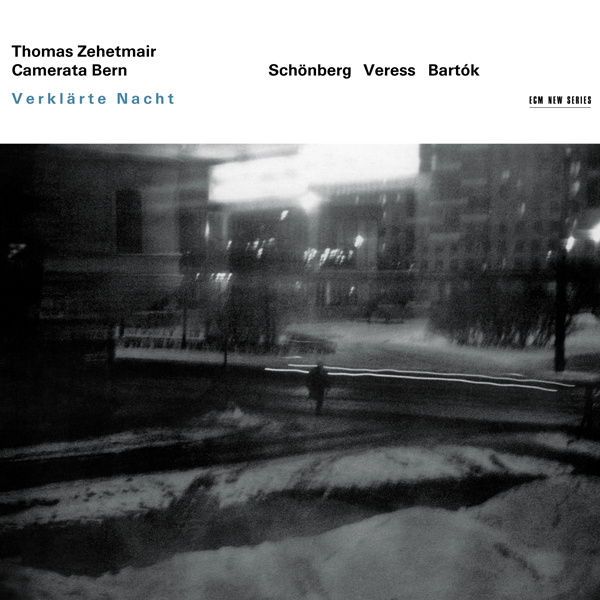
Camerata Bern/Zehetmair: Verklärte Nacht (ECM New Series 1714)

Thomas Zehetmair
Camerata Bern
Verklärte Nacht

Thomas Zehetmair violin and director
Camerata Bern
Recorded 1999 at Radio DRS, Zurich; 1995 at Salle de Musique, LaChaux-de-Fonds
Engineer: Bernd Runge and Eberhard Hinz
Produced by Manfred Eicher

Splendour falls on everything around,
you are voyaging with me on a cold sea,
but there is the glow of an inner warmth
from you in me, from me in you.
–Richard Dehmel, “Transfigured Night” (trans. Mary Whittall)

It’s difficult to believe that the first performance of Arnold Schönberg’s Verklärte Nacht (Transfigured Night) in 1901 incited a riot, prompting one critic to report, “It sounds as if someone had smudged the score of Tristan while it was still wet.” Structured as it is around the eponymous poem by Richard Dehmel, in which two lovers test their resolve while wandering in moonlight, the gossamer threads of night are its makeup. Along with The Book of the Hanging Gardens, it is one of the composer’s most visceral works. Not easy listening, to be sure, but nothing worth coming to blows over, either. Its lyrical chromaticism is lush yet opaque and descriptive to the core. Its contours slowly come into focus like a whale from a dark sea, Zehetmair’s violin waiting along with the seagulls for any morsels to escape from its yawning food trap. The Camerata Bern pays strictest attention to rhythm, caressing every beat with its strings. Though branded as a nocturnal affair, the piece also resounds with light. Certain sections sound like a magnified string quartet, while others breathe with the lung capacity of a full orchestra, but always with characteristic insulation. Like Wagner at his most self-effacing, Schönberg emotes with high narrative volume, as though a ballet and an opera had been stripped of words and collapsed into this one glorious whole.

After a glassy stillness that leaves us transfigured ourselves, the Four Transylvanian Dances of Sándor Veress pull us to our marionetted feet with spirited urgency. The second of these, with its finely wrought pizzicato beads, is notably heartwarming, while the fourth contrasts processional ceremony with outright exuberance. I can hardly imagine a better segue into Béla Bartók’s famed Divertimento (1939), of which the opening is perhaps the Hungarian’s most recognizable motif. Lower strings emerge as a major consonant force against the more adventurous uppers, which dance their way into the Adagio with infectious verve. The musicians’ dynamic control is on full alert here, as quiet restraint carries over into a cyclical swell of emotive power. The third and final movement is played to perfection. Its accentuating fingerboard slaps, solo cello, and open-stringed double stops stand out with scintillating clarity, all wrung through an imitative filter before ending with a pizzicato-friendly “micro-ballet.” The Divertimento, a more precise rendering of which I cannot recall, was the result of a commission by patron Paul Sacher, whose importance one can gauge further in ECM’s kaleidoscopic tribute album.

Verklärte Nacht scores another hit for Zehetmair, whose quartet album pairing Hartmann and Bartók made a concurrent appearance to equal acclaim. There’s no reason why you shouldn’t have both on your shelf.

<< Michael Galasso: High Lines (ECM 1713)
>> Heinz Holliger: Schneewittchen (
ECM 1715/16 NS)

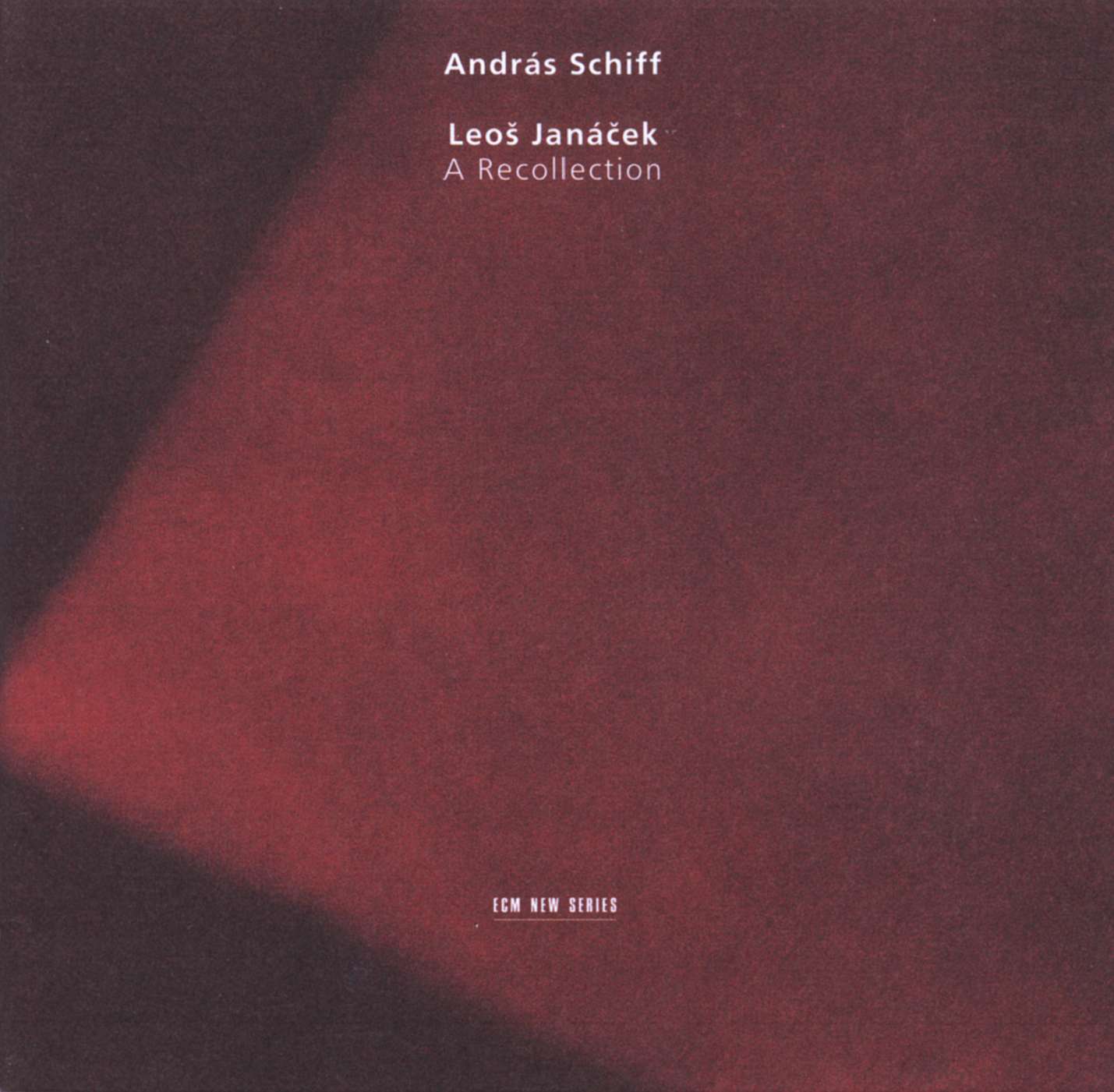
Leos Janáček: A Recollection (ECM New Series 1736)

Leoš Janáček
A Recollection

András Schiff piano
Recorded January 2000, Schloss Mondsee, Austria
Engineer: Stephan Schellmann
Produced by Manfred Eicher

“And it floated along on the water that day, like white swans.”
–Leoš Janáček, on tossing his score for the 1905 Sonata into the Vltava River

Intimacy and the piano make for an inseparable pair. At its best, the instrument paints an image of a composer in solitude, forging from its complex array of mallets, strings, and keys a music of one’s own. This is especially apparent in András Schiff’s peerless recital of Leoš Janáček (1854-1928), at last given the ECM makeover it deserves. Drawing from Moravian folk melodies and less discernible influences, Janáček’s pianism, by way of Schiff, is all about heart.

The Andante of In the Mists (V mlhách), composed in 1912, plays like a guitar, strings pressed rather than plucked, given renewed life in surroundings of waning visibility. One immediately notices the delicacy of the Schiff touch, and beneath it the supremely robust evocation of the melodic line that balances its way throughout the program’s remainder. He continues pulling at hidden energies in the Adagio that follows, working magic in small bursts. Each emotion falls with the insistence of late summer rain toward the transfixing Presto. One finds here the incredulity of the melodic gesture played out against itself in a roiling sea, where darkness lives only in our dreams.

The Sonata 1.X.1905 (From the street) is an incomplete work written, we are told, in memory of Frantisek Pavlik, a young Czech carpenter bayoneted during a Brno demonstration on 1 October 1905 in the name of higher learning. Dissatisfied with the result, Janáček burned the third movement, a funeral march, and cast the first two into the Vltava. It might have been lost forever had not Ludmila Tučková, who gave its premier in January of 1906, announced that she still had a copy in her possession. Each of its survivors is a mirror of the other, a long and soulful stream that leaves us lost and without company at their conclusion.

The miniatures of On an overgrown path (Po zarostlém chodníčku) form a pinnacle of the composer’s chamber output. Book I of 1908 is the more programmatic of the two. With such titles as “Our evenings” (Naše večery) and “A blown-away leaf” (Lístek odvanutý) at the outset, we are never in doubt as to what is being described. Yet even without these, we can feel our toes spreading in wild grasses, hear the music of autumn drifting across the dawn. The lovely reverberations of “The Madonna of Frydek” (Frýdecká panna Maria) and “Good night!” (Dobrou noc!) linger throughout later vignettes, such as “In tears” (V pláči) and in the call and response of “The barn owl has not flown away!” (Sýček neodletěl!). These last paint an emotional portrait of a composer bereaving the premature death of his daughter, Olga. Such diaristic approaches to musical experience are furthered in Book II (1911), where an Orphic, undulating Andante sits beside a bipolar Allegretto. The concluding three sections fall under the subtitle “Paralipomena” (or supplements), of which the Allegro leaves the most indelible mark.

A recollection (1928) plays us out with the grace of a sunflower bending to the wind.

Although the music of Schiff’s third ECM album evokes so much in the way of sight and sound, it rests firmly on silence insofar as it worships the internal impression, which is ultimately inarticulable. Try as they might, these lips produce nothing worth hearing in light of the music at hand, and so I type instead, hoping that my arbitrary dance of fingers on a keyboard of a rather different sort have done even a modicum of justice to what can more easily be known from buying this superb album and experiencing it for yourself.

<< Luciano Berio: Voci (ECM 1735 NS)
>> Vassilis Tsabropoulos: Akroasis (
ECM 1737)

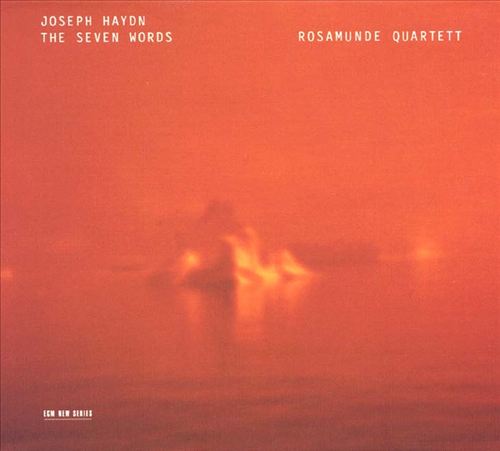
Haydn: The Seven Words (ECM New Series 1756)

Joseph Haydn
The Seven Words

Rosamunde Quartett
Andreas Reiner violin
Simon Fordham violin
Helmut Nicolai viola
Anja Lechner cello
Recorded May 2000, Festeburgkirche, Frankfurt am Main
Engineer: Markus Heiland
Produced by Manfred Eicher

What a paradox it is that the trappings of language should bring us so much spiritual power whereby our actions speak not only louder than words, but in place of them. Speech can only be a stepping-stone, replacing our imagination with temporary idols. Rather, the breath of life inside language is itself the awe we seek. Franz Joseph Haydn (1732-1809) offers another possibility: that the divine word is pure sound. The Seven Last Words of Our Savior on the Cross is his crowning achievement in this regard, and transcends all possible semantic constraints. Prefaced by an introduction and ending with an earthquake, at its center beat seven hearts in sonata form:

Sonata I
“Pater, dimitte illis, quia nesciunt, quid faciunt”
(“Father, forgive them, they know not what they do”), B flat, Largo

Sonata II
“Hodie mecum eris in Paradiso”
(“This day thou shalt be with me in Paradise”), C minor, Grave e cantabile, ending in C major

Sonata III
“Mulier, ecce filius tuus”
(“Woman, behold thy son”), E major, Grave

Sonata IV
“Deus meus, Deus meus, utquid dereliquisti me”
(“My God, My God, why hast thou forsaken me?”), F minor, Largo

Sonata V
“Sitio”
(“I thirst”), A major, Adagio

Sonata VI
“Consummatum est”
(“It is finished”), G minor, Lento, ending in G major

Sonata VII
“In manus tuas, Domine, commendo spiritum meum”
(“Into thine hands, O Lord, I commend my spirit”), E flat, Largo

Though originally written for orchestra, and in a state of religious fervor, the string quartet redaction performed here (it also exists as an oratorio and in a version for solo clavier), though questionably sanctioned by the composer, brings forth the music’s intention all the more vividly. Most scores will have the Latin texts directly beneath the first violin line, lest their efficacy fade in the absence of human voices, which makes the Rosamunde Quartett’s performance all the more astonishing for its enunciative clarity, an inward sense of tempo and nuance that seems to breathe through every instrument.

The opening proclamation is a wakeup call. While not especially dense, it nevertheless pulls us like a hooked fish. Its tight harmonies reveal a more porous foundation by which the benefits of language are weighed against its sins. We are swept past our conjectures with intense forward motion into a world of sound where Classical charm and Baroque pensiveness walk hand in hand. The violin strings the others like beads on a rosary. Through an almost serpentine motif and multivalent gentility, it exposes the folly of human ways by the light of retribution. We pause on the occasional neutral resolution before soaring into more rhythmically staggered interiors. In the Third Word, we encounter imbalanced key changes, thereby establishing the corpus of the piece as though a cocoon were unwinding itself into a path to the more urgent Fifth. By the time we take our final footsteps, treading carefully over muted strings, we lose ourselves in the trembling earth.

<< Keller Quartett: Lento (ECM 1755 NS)
>> Stephan Micus: Desert Poems (
ECM 1757)

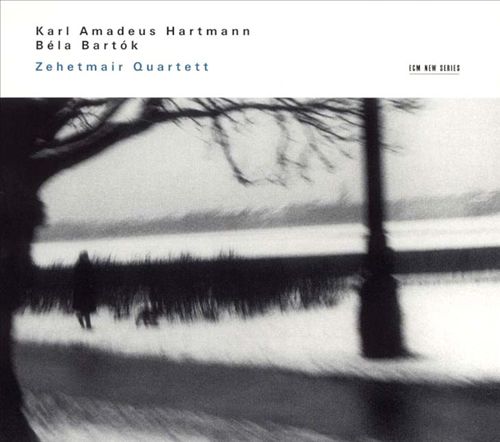
Zehetmair Quartett: Hartmann/Bartók (ECM New Series 1727)

Zehetmair Quartett
Karl Amadeus Hartmann/Béla Bartók

Zehetmair Quartett
Thomas Zehetmair violin
Ulf Schneider violin
Ruth Killius viola
Françoise Groben cello
Recorded November 1999, Radio DRS, Zürich
Engineer: Markus Heiland
Produced by Manfred Eicher

Violinist Thomas Zehetmair made headlines when he debuted his quartet in what stands to be a reference recording for years to come. The two pieces featured on this disc, one from Karl Amadeus Hartmann (1905-1963) and the other from Béla Bartók (1881-1945), date from the interwar years, during which time ravages of a bloody past and intimations of an even more tragic future sat side by side. In this respect, the string quartet represents what Hermann Conon in his liner essay describes as a “microsocial sphere in which human beings can learn to coexist harmoniously.” Hartmann was inspired by Bartók’s Fourth String Quartet (1928) when writing his first (1933). The two are linked here in temporal spirit to form a tightly knit program from one of the genre’s most talented configurations.

Hartmann draws into his neglected masterpiece with a mournful viola, which is then lifted ever so slightly by cello. These pass through a cluster of harmonics, as if traversing a portal, into a world of structural contrasts that foreshadow those of Górecki’s works for the medium some six decades later. The Zehetmair Quartet carefully measures every tension and release, as in the avian calls of the second movement, marked con sordino (that is, played with mutes). The nervous energy of the final is funneled into robust violins as they scale beyond Bartók into their own airspace. This is a quartet that demands not only to be heard, but also to be seen.

The Bartók itself plays out like a game of leapfrog, such that each instrument is always engaged with another. Through a spidery forest of glissandi, pizzicati, dynamic contrasts, and tinny bowings, we find ourselves in a likeminded atmospheric haven at its center. The famous Allegretto pizzicato introduces us to a Bartókian staple, given all the room it needs to soar. The frenetic dance at the close works off a tight rhythm section in the lower strings into dense fortissimo thickets of dissonant bliss.

This recording warrants nothing but highest praise on all counts and furthers ECM’s commitment to the very best in string quartet performance and composition. What a journey it continues to be.

<< Herbert Henck: Piano Music (ECM 1726 NS)
>> Tsabropoulos/Andersen/Marshall: Achirana (
ECM 1728)

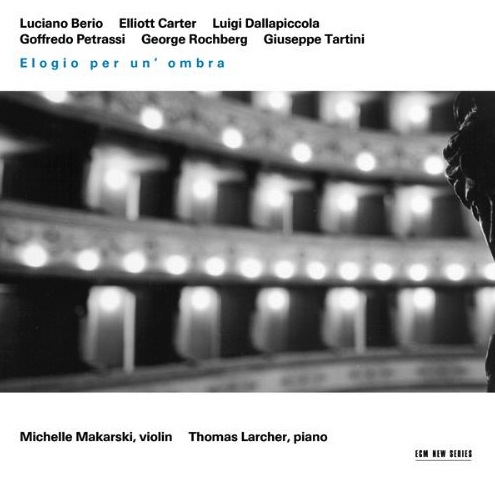
Michelle Makarski: Elogio per un’ombra (ECM New Series 1712)

Michelle Makarski
Elogio per un’ombra

Michelle Makarski violin
Thomas Larcher piano
Recorded May 1999, Radio DRS, Zürich
Engineer: Stephan Schellmann
Produced by Manfred Eicher

For her second ECM recital, Michigan native Michelle Makarski has assembled an equally disparate yet harmonious program. The endlessly fascinating Caprice Variations (1971) of George Rochberg (1918-2005) continue where they left off on the violinist’s label debut, Caoine, twirling into a sonic thread between the two. Makarski is a particularly sublime interpreter of Giuseppe Tartini (1692-1770), whose music is the window into all that borders it. His Sonata VII in A minor is spread throughout in large bites, each gnawing on the succulent Sarabanda at their core. Its lilting cadences and finely executed trills capture our melodic eye from note one to none. The Due Studi (1947) of Luigi Dallapiccola (1904-1975), an early Italian devotee of the Second Viennese School, share Tartini’s affinity for deconstruction. Here, Makarski is joined by Thomas Larcher on piano for added color. The album’s title piece, written in 1971 by Goffredo Petrassi (1904-2003), carries us through a gentle introduction and softly piercing high notes into a conduit of agitations and protracted statements. Though delicate in its tension, it nonetheless requires lucid virtuosity. Elliott Carter balances this out with a Riconoscenza (1984) for the same composer. Larcher returns for the Due Pezzi (1951) of Luciano Berio (1925-2003). These are more playful, if naïve, pieces with enough neo-classical flint from which to strike an adequate fire. Makarski then graces us with the anonymous Lamento di Tristano of 14th-century Italy, played sul ponticello for a rather metallic slide into finality.

<< Kim Kashkashian: Bartók/Eötvös/Kurtág (ECM 1711 NS)
>> Michael Galasso: High Lines (
ECM 1713)