Roscoe Mitchell: Bells for the South Side (ECM 2494/95)

2494|95 X

Roscoe Mitchell
Bells for the South Side

Roscoe Mitchell sopranino, soprano, alto and bass saxophones, flute, piccolo, bass recorder, percussion
James Fei sopranino and alto saxophones, contra-alto clarinet, electronics
Hugh Ragin trumpet, piccolo trumpet
Tyshawn Sorey trombone, piano, drums, percussion
Craig Taborn piano, organ, electronics
Jaribu Shahid double bass, bass guitar, percussion
William Winant percussion, tubular bells, glockenspiel, vibraphone, marimba, roto toms, cymbals, bass drum, woodblocks, timpani
Kikanju Baku drums, percussion
Tani Tabbal drums, percussion
Recorded September 2015 at Museum of Contemporary Art Chicago by David Zuchowski
Mixed May 2016 at Studios La Buissonne, Pernes-les-Fontaines by Gérard de Haro with Steve Lake
Mastered by Nicolas Baillard
Produced by Steve Lake
Release date: June 16, 2017

To celebrate the 50th anniversary of the Association for the Advancement of Creative Musicians (AACM), Roscoe Mitchell presented a cornucopia of trios at the Museum of Contemporary Art Chicago in conjunction with the exhibition The Freedom Principle: Experiments in Art and Music, 1965 to Now. Said exhibition included percussion set-ups favored by Art Ensemble of Chicago legends Don Moye, Malachi Favors, Lester Bowie, Don Moye, and the reed-favoring multi-instrumentalist himself, all incorporated into the present double-disc recording.

Mitchell is the alpha and omega of this project, spearheading a series of designated trios to explore different organs of his immense compositional body. With Hugh Ragin (trumpet) and Tyshawn Sorey (here on trombone), he offers “Prelude to a Rose,” a somewhat funereal dirge that pops a cathartic blister about midway through.

With Jaribu Shahid (double bass) and Tani Tabbal (drums), Mitchell presents an unabashedly soulful sermon in “Prelude to the Card Game, Cards for Drums, and the Final Hand.” By force of his muscular alto, he punches holes in the time cards printed and cut by Shahid’s thick bowing before Tabbal turns the very concept of time inside out in an extended soliloquy, leaving a brief trio to throw some light at the end of the tunnel. Mitchell continues down that same introspective avenue in “Six Gongs and Two Woodblocks.” For this he’s joined by James Fei (reeds, electronics) and William Winant (percussion) for what may just be the album’s most brilliant turn of events. Its balance of outer and inner is at the very core of what Mitchell does best as a composer.

Even with pen laid aside, as in “Dancing in the Canyon,” a group improvisation with Craig Taborn (piano, organ, electronics) and Kikanju Baku (drums, percussion), he’s still the catalyst for an otherwise impossible chemical reaction. His sopranino dances as if it’s on fire and the only way to keep itself from turning to ashes is to sing until its throat runs dry. The sheer musicality of this unscripted dive inward is lucid to the extreme.

The album’s remainder is as shuffled as its musicians, for throughout it Mitchell recasts his trio actors in new roles and configurations. From the picturesque latticework of “Spatial Aspects of the Sound” to the nearly 26-minute blend of ambience and explosions that is “Red Moon in the Sky,” the latter segueing into the AEC’s calling card, “Odwalla,” played by the entire nonet, sound is substance. Connective tissue along the way spans a world of apparent influences, from Pierre Boulez and Iannis Xenakis to Anthony Braxton and Edgard Varèse. Taborn (electronics) and Shahid (bass guitar) unearth haunting ore in “EP 7849,” while in the title track Ragin slings precise arrows of piccolo trumpet over the “percussion cage” Mitchell created for the AEC and which is resurrected here to wonderous effect by Sorey. But even at its most explosive, as in the drums- and piano-heavy “The Last Chord,” there’s more Genesis than Revelation at play. Let there be music.

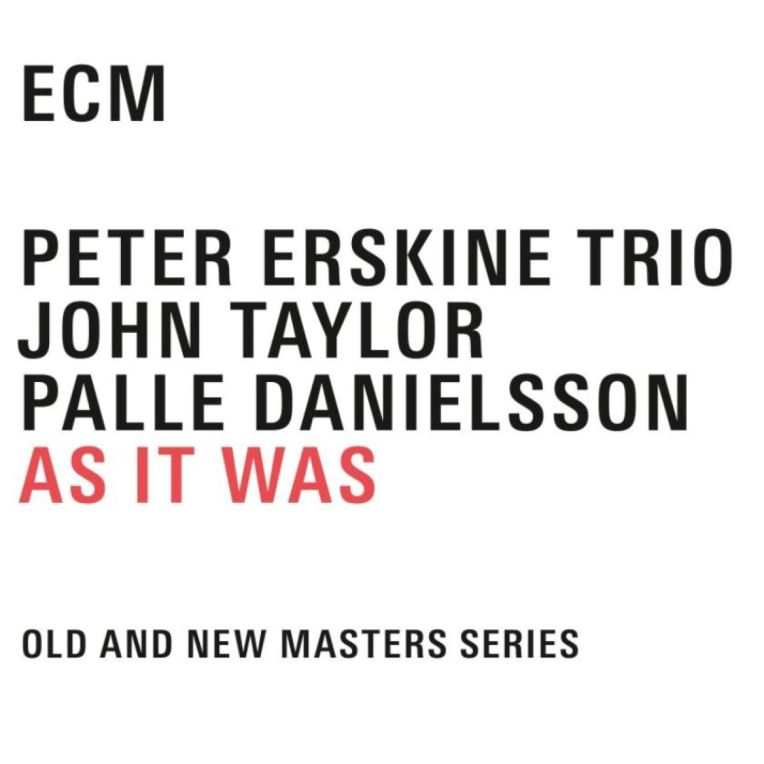
Peter Erskine Trio: As It Was (ECM 2490-93)

As It Was.jpg

Peter Erskine Trio
As It Was

Release date: July 1, 2016

On paper, drummer Peter Erskine might have seemed like an unusual leader for a piano trio, but once the sounds of his collaboration with pianist John Taylor and bassist Palle Danielsson made their acquaintance with uninitiated ear canals, there was no denying their efficacy as a unit. Erskine followed a trajectory all his own to enter the ranks of ECM, having already established his reputation with the Stan Kenton Orchestra, Maynard Ferguson, and Weather Report before breaching ECM waters in sessions with John Abercrombie, Jan Garbarek, and Kenny Wheeler. The latter association brought him into fateful contact with Taylor and Danielsson, and their interactions as a touring band paved the way for the four albums featured on this Old & New Masters set. And so, when it came time to craft his first ECM leader date—1992’s You Never Know—the choice of sidemen was obvious. “Side” being the operative word here, for John Kelman aptly describes the band in his superb liner notes as an “equilateral musical triangle.” By then Danielsson and Taylor were both ECM veterans: the former via landmark recordings with saxophonist Jan Garbarek and pianist Bobo Stenson, the latter via another unorthodox trio with singer Norma Winstone and trumpeter Kenny Wheeler known as Azimuth. Says Erskine in those same liner notes of the band documented here: “The trio seems, by its mathematical and geometric natures, to offer the most possibilities where interaction meets form, and openness meets density.”
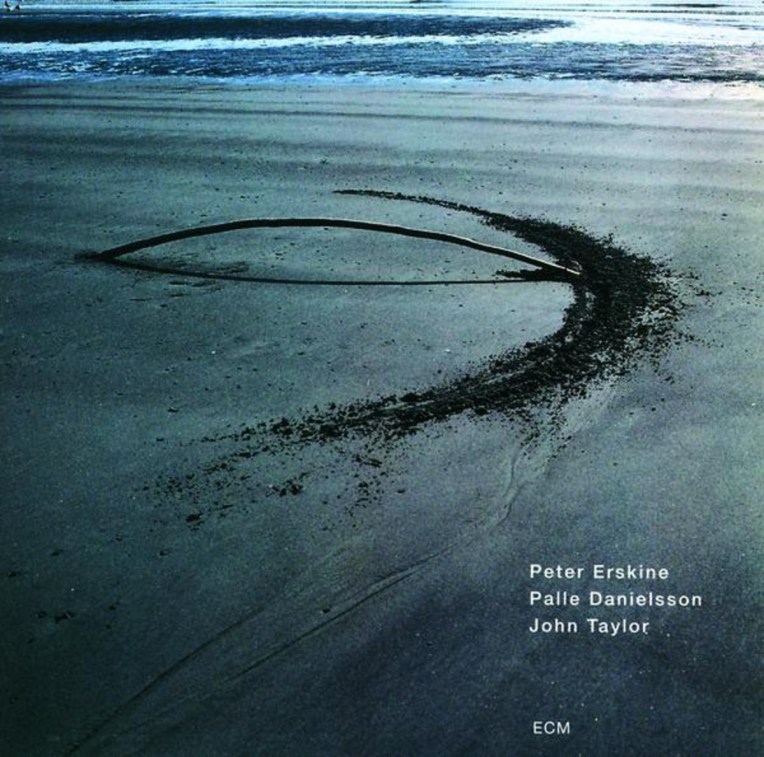
You Never Know

You Never Know (ECM 1497)

John Taylor piano
Palle Danielsson double bass
Peter Erskine drums
Recorded July 1992 at Rainbow Studio, Oslo
Engineer: Jan Erik Kongshaug
Produced by Manfred Eicher

With this first recording in the company of his European trio, Erskine made a lasting, if subdued, statement of intent. Its contours feel familiar, its moods even more so, and its overall feeling is one of peace and quiet passion. Considering the talent girding every corner of this triangle, it might seem unfair to single out one musician above the rest, but Taylor’s richly harmonic style is difficult to leave unpraised. Not only that, but his compositional contributions make up the bulk of a set awash in tuneful elegance. Take, for instance, the nine-and-a-half-minute opener, “New Old Age,” which seems to tell the story of a life in full circle. Taylor’s motive is the album’s heartbeat. Danielsson expands its EKG line and paves the way for Erskine’s airy considerations. This pattern repeats a cycle of experience, spinning the wheel of time and landing on “Clapperclowe.” This lively tune, softened by a montuno twang, features massage-like patter from Erskine. Another Taylor notable is “Evans Above,” a soulful Bill Evans tribute that sets the pianist dancing on clouds as he glides across landscapes past and present. Danielsson’s exquisite solo, flexible as a gymnast, is a glowing centerpiece. “Pure & Simple” might as well be called “Pure & Cymbal” for Erskine’s astute punctuations, each chiseling away at Taylor’s meteoroid on its path of sonorous fire.

Erskine himself contributes one tune: the sublime “On The Lake.” Its still and reflective sheen obscures a bass that moves like an evolutionary mystery beneath Loch Ness, even as home movies of children swimming, lovers canoeing, and friends gathering at the water’s edge flicker to the rhythm of the composer’s brushes. Three ballads by Vince Mendoza (whose tunes were heard to such great effect on John Abercrombie’s Animato) brings out the trio’s tenderest side, as in the 360-degree support of “Amber Waves.” And how can the empathic “Heart Game” not move us? It tugs and never lets go. If synergy is your bag, look no further than the trio’s closing rendition of “Everything I Love.” This Cole Porter joint is a window through smoke and time and practically bursts with effervescence at Taylor’s touch.

You Never Know would seem to have ushered in a new era for ECM, setting standards yet again for quality of recording, performance, and audience consideration. A dulcet and memorable date that lingers like the notes of a home cooked meal.

<< Aparis: Despite the fire-fighters’ efforts… (ECM 1496)
>> Hal Russell/NRG Ensemble: The Hal Russell Story (ECM 1498)

… . …
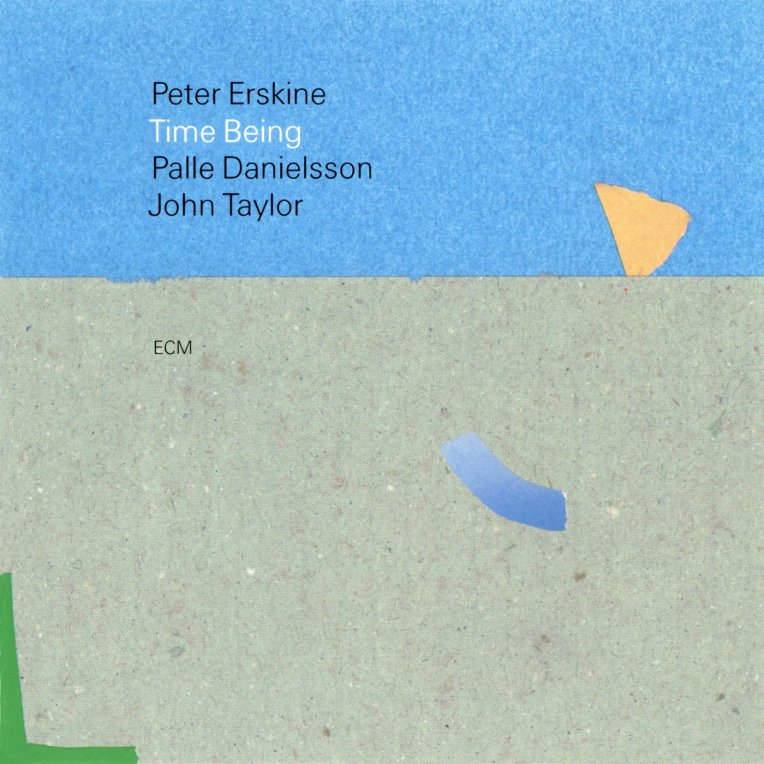
Time Being

Time Being (ECM 1532)

John Taylor piano
Palle Danielsson double bass
Peter Erskine drums
Recorded November 1993 at Rainbow Studio, Oslo
Engineer: Jan Erik Kongshaug
Produced by Manfred Eicher

Once the lyricism of “Terraces” eases its way into our hearts, we know we’re in for a sublime experience on Time Being. Erskine’s sensitivity behind Danielsson’s equally considered solo, peeking above the horizon like the edge of a flock in silhouette, reveals sensuous technique through the cymbals and butterfly snare of “For The Time Being,” the responsive brushwork of “Phrase One,” and the dance-like movements of “Palle’s Headache” and “Evansong.” Yet it is Taylor, playing the piano as a blind man might touch a face, who makes this date the melodic gem that it is. We hear it in “If Only I Had Known,” sparkling blurrily in a visual language all its own. Taylor continues to take in every movement of leaf and shade in “Page 172,” which feels like a dream an old windup clock might have, a child’s automaton stretching its hands toward darkness. For “Bulgaria” he takes some thematic cues from folk music of the same. The Bobo Stenson feel on this track pays lovely tribute to the milieu from which he has grown. Danielsson paints a complementary impressionism, putting full heart into every brushstroke of “Liten Visa Till Karin” and in the fluid rustle of “Pieds-en-l’air,” ending a cordially realized set.

These images speak to us in indications, each a fragment of a mosaic beyond even the musicians’ comprehension. It is that same font into which all great improvisers dip, a limitless well that proceeds and recedes simultaneously, churning sentiment at the edge of a pond where inhibition ends and light begins. This is jazz of delectable subtlety that will embrace you, and another masterpiece from a trio that grew in leaps and bounds with every release.

<< Jarrett/Peacock/Motian: At The Deer Head Inn (ECM 1531)
>> Gavin Bryars: Vita Nova (ECM 1533 NS)

… . …
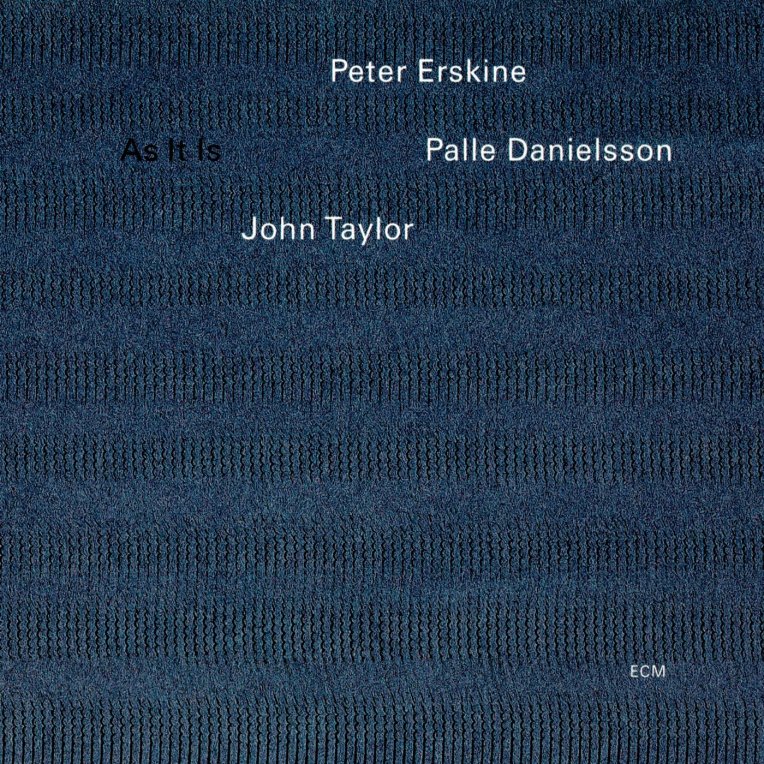
As It Is.jpg

As It Is (ECM 1594)

John Taylor piano
Palle Danielsson double bass
Peter Erskine drums
Recorded September 1995 at Rainbow Studio, Oslo
Engineer: Jan Erik Kongshaug
Produced by Manfred Eicher

In this follow-up date to 1994’s Time Being, Erskine, Danielsson, and Taylor hone their salute to the Bill Evans and Paul Bley schools in their most transcendent short story collection yet. Each of these three narrators lends nuance to the arc. Taylor embodies a sense of perpetual motion quite different from that of Erskine, who in “The Lady In The Lake” evokes with his brushes a quiet train ride. Where the pianism is impressionistic and rounded, the drums are precise and crisp. So, too, in “Esperança,” which through shifting seasons reveals a brocade of sentimental journeys. Danielsson is more than the tuneful support of “Glebe Ascending,” though even in this album opener we get intimations of the interactivity to follow. His engaging filament runs through tunes like “Woodcocks” and “Touch Her Soft Lips And Part,” leaving a trail of footsteps alternating in charcoal and pastel. And what of Erskine? Look to “Episode” for your answer. This urgent piece hits the ground running and stumbles through city streets, whispering of metal and wind and skin. I submit to the defense also “Romeo & Juliet,” which like the classic play begins in innocence before culminating in Erskine’s tragic catharsis of a solo.

As It Is eschews the formulaic, instead kneading instruments and gestures into uniform dough. Just when Taylor seems to launch into an extended monologue, Danielsson rises from the deep to overtake it even as Erskine throws a commentative thread through every loophole. The resulting tumble is fluid and soft. Despite the breadth of its sweep, the music operates at a microscopic level. This is top-flight jazz, recorded, composed, and packaged with artisanal endearment.

<< Ketil Bjørnstad/David Darling: The River (ECM 1593)
>> Franz Schubert: Trio in Es-Dur/Notturno (ECM 1595 NS)

… . …
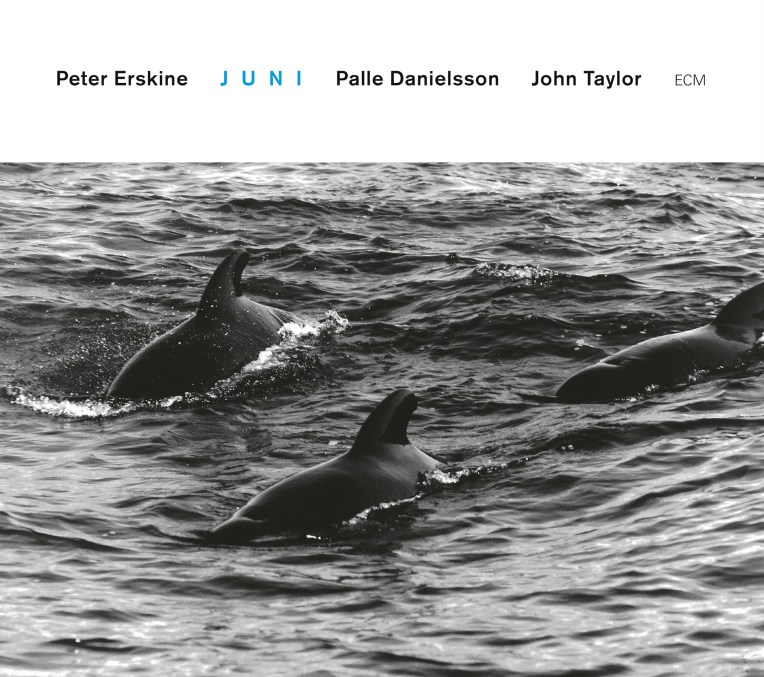
1657 X

JUNI (ECM 1657)

John Taylor piano
Palle Danielsson double bass
Peter Erskine drums
Recorded July 1997 at Rainbow Studio, Oslo
Engineer: Jan Erik Kongshaug
Produced by Manfred Eicher

ECM’s fourth and final album by the Peter Erskine Trio, JUNI best realizes the balance between fullness and sparseness the three had been seeking since their debut. An underlying Bill Evans influence—lifeblood of everything this trio plays—is even more nakedly portrayed. “The forming of this trio was partly a reaction to a lot of stuff that’s out there,” notes Erskine. “There’s so much music that’s just thrown at you, and it’s loud and it has no real dynamic range and all the spaces in the music are filled up. I wanted to oppose that trend.” To that end, if not beginning, Erskine and company enable a delicate asymmetry in which transformation is a necessary condition of life. Whereas before they created epic swaths of watery goodness, this time they concentrate on a subtler array of themes and moods.

Taylor again contributes the most tunes and opens with his wavering “Prelude Nr 2.” Raindrops seem to fall from his fingers in an abstract introduction, dark though chambering a shining heart. “Windfall,” previously heard on Journey’s End by the Miroslav Vitous Group, plots a smoother, Brazilian-flavored journey. Supple flowers grow wherever Danielsson treads, and his rounded solo foils Taylor’s dialogue with Erskine to remarkable effect. “Fable” rounds out the Taylor compositions with a ray of golden light and feathered shadow evoked by him and Danielsson respectively, and strung by the restless air currents of Erskine’s brushes. The latter add paternal love to the plush emotional exchanges of Danielsson’s “Siri,” in which Taylor is the true standout.

Erskine himself counters with a twofer of his own, including the fragmentary and whimsical “The Ant & The Elk” (notable for his subdued yet popping aside) and “Twelve,” from which the album gets its title (jūni means “twelve” in Japanese) and which evokes the barest whispers of swing, maintaining purposeful ambiance even at its most straightforward. “For Jan”—by Kenny Wheeler, for a relative of the same name—reflects Erskine’s work with Taylor in Wheeler-led ensembles. From a skittering drum intro it unfolds into a sparkling anthem with gorgeous slides from Danielsson, who polishes the edges of Taylor’s keys.

Like the second hand of a schoolroom analog clock, “Namasti” (Diana Taylor) passes smoothly through the minutes with precision. Its face may be secular, but its implications are spiritual and take things for the illusions that they are.

JUNI thus brands a perfect yin yang onto Erskine’s résumé. He holds the world on a wire, eliciting a most sonorous gravitation. He is the sun of these sessions. May his light touch your heart.

Arild Andersen: In-House Science (ECM 2594)

In-House Science

Arild Andersen
In-House Science

Arild Andersen double bass
Paolo Vinaccia drums
Tommy Smith tenor saxophone
Concert recording by ORF, September 29, 2016
at PKS Villa Bad Ischl, Austria
Recording producer: Michael Radanovics
Engineer: Alios Hummer (Radio Österreich 1)
Mixing/mastering: Jan Erik Kongshaug and Arild Andersen
An ECM Production
Release date: March 23, 2018

The swirling, majestic world of bassist Arild Andersen’s trio with drummer Paolo Vinaccia and saxophonist Tommy Smith is difficult to contain, which is probably why it’s best captured in a live recording. On In-House Science, we’re treated a 2016 performance from Austria. Over the course of six Andersen originals, sensations ranging from reflection to full-blown transformation are handled with equal commitment.

What begins as a soft awakening in “Mira,” courtesy of Andersen’s sunlit tone, turns into a blinding sunrise as Smith unleashes a fiery sermon. Toward the end of the tune, a hint of uplift dies as quickly as it’s born: a signal, perhaps, to remind us that getting inside the heads of listeners is far more vital than making them nod in agreement. That being said, there’s something about the way in which these three powerful characters merge so democratically from the fog of egotistical possibilities. They follow as much as lead, take in as much as elicit, and fall into loose interpretation as much as strict. That they’re able to triangulate them so selflessly all is not only remarkable; it’s downright laboratorial. Hence the album’s title, which is split between two tracks that, together, encapsulate Andersen’s powerful ethos while also expanding its parameters. In “Science,” he and Vinaccia connect to form a Möbius strip of sonic fuse, while Smith traces its endless spark more thrillingly than the possibility of any explosion. The passionate degaussing that follows from Andersen is an album highlight, as much the exhalation to Vinaccia’s inhalation as the other way around. And while “In-House” builds on similar principles, its fluency is deepened by Smith’s growling ruptures of translation. Again, bassist and drummer turn the spotlight inside out, making sure that every particle is given a voice. This is art that fulfills the promise in compromise.

Between those two mountainous zones we get the temperate valleys of “Venice,” “North Of The North Wind,” and “Blussy.” The first is a prize fight between antiquity and modernity, Vinaccia mapping every punch and parry with his kit. The second is an ambient turn inward, its electronically sequenced bass telling a love story between land and water, and the ever-changing border of their contact. The last is a modern classic of Andersenian muscle, and gives Smith more than enough fuel to fly his rocket through the stratosphere without ever losing contact with home base.

I was brought to this album by the yesterday’s sad news of Vinaccia’s passing, for which today has been a time of solemn remembrance yet vibrant listening. May he continue to be heard.

Wolfgang Muthspiel: Rising Grace (ECM 2515)

Rising Grace

Wolfgang Muthspiel
Rising Grace

Wolfgang Muthspiel guitar
Ambrose Akinmusire trumpet
Brad Mehldau piano
Larry Grenadier double bass
Brian Blade drums
Recorded January 2016, Studios La Buissonne, Pernes-les-Fontaines
Engineers: Gérard de Haro and Nicolas Baillard
Produced by Manfred Eicher
Release date: October 28, 2016

Nearly three years after making his ECM leader debut with Driftwood, Austrian guitarist Wolfgang Muthspiel returns to the studio, expanding that trio into a quintet. Carrying over bassist Larry Grenadier and drummer Brian Blade, he adds the potent variables of pianist Brad Mehldau and trumpeter Ambrose Akinmusire. The result is exponential.

Muthspiel is that rare artist who makes arpeggios sound like melodic leads rather than backbones. Cases in point are the title track and “Triad Song.” In both, the band attracts character traits that are to define the album’s master narrative. Muthspiel and Grenadier move in lockstep, while Akinmusire keens, Mehldau sings, and Blade shines like gold in the morning sun. Their flowing sound, studded with occasional peaks, catches the glow of a humbly creative lighthouse.

As composer, Muthspiel focuses on the little things, and in so doing makes them feel all-encompassing. Such highlights include “Intensive Care” for Muthspiel’s nylon-stringed questions and Mehldau’s lyrical answers, “Supernonny” for Akinmusire’s robust exposition, and “Boogaloo” for its riskier details.

The set is fleshed out by dedicatory masterstrokes. “Father And Sun” examines a relationship that is earthly, spiritual, and uncontainable. Its atmospheric integrity, domestically inclined, finds heartfelt analogue in “Den Wheeler, Den Kenny.” This loving tribute to trumpeter Kenny Wheeler especially references 1976’s Gnu High, a longtime inspiration for Muthspiel. Here, the soaring of that classic album is met with an elegiac crawl across a barren landscape. “Wolfgang’s Waltz,” a tune written by Mehldau specifically for this album, finds its own father soloing with a storyteller’s grace between the binding of an adhesive groove. All of which makes Rising Grace a gracious (indeed) experience filled with love, hope, and extended kinship.

Jakob Bro: Streams (ECM 2499)

2499 X

Jakob Bro
Streams

Jakob Bro guitar
Thomas Morgan double bass
Joey Baron drums
Recorded November 2015, Studios La Buissonne, Pernes-les-Fontaines
Engineers: Gérard de Haro and Nicolas Baillard
Produced by Manfred Eicher
Release date: September 23, 2016

The title of Streams, guitarist Jakob Bro’s second leader date for ECM, could hardly be more appropriate to describe music that flows with the quiet charm of a forest creek, bubbling all the way from childhood to whatever here and now you happen to inhabit when encountering it.

“Opal” touchingly opens the album’s inner sanctum: a sacred gift for profane times. As the first of seven layers, it peels back just enough of life’s opacity to sense a shared humanity deeper within. Bro zooms in on filaments of memory, each a wire drawn from one biographical telephone pole to another. Bassist Thomas Morgan is so attuned to these electrical impulses that the possibility of a power outage seems a distant fantasy. Drummer Joey Baron marks their trail with care, ending with raindrops on a silo.

“Heroines” is one of Bro’s most patient confections. Morgan shuttles through the composer’s loom, soloing with restraint and focus, while the guitar folds itself in layers of cosmic radiation until the night itself begins to glow. This tune is further recast in a solo guitar version later in the set. Like a plant regressing to seed, it has all the world in its mouth before it opens to sing.

“PM Dream” is a free improvisation dedicated to Paul Motian. As in the music of its namesake, its heart beats somewhere between veiled ambience and solid ground. Morgan and Baron dot its continent with runes of memory, as they do in “Full Moon Europa,” which through its quiet substructure yields achingly dramatic elicitations from Bro. “Shell Pink” is another stunner, tracing its nautilus spiral into origins. Morgan is wonderous and sincere, enhancing that locomotive quality, inherent to all of Bro’s finest, along a parabola of ice to fire to ice.

Nowhere is geologic force so thoroughly studied as in “Sisimiut.” Where normally Bro is more interested in following a burning fuse than chronicling the explosion it foreshadows, this time he allows a little of that fire to spill over. But because destruction would be antithetical to the loving atmosphere he has so painstakingly created, we never encounter a bang, going out instead with a hush.

Parks/Street/Hart: Find The Way (ECM 2489)

Find The Way

Find The Way

Aaron Parks piano
Ben Street double bass
Billy Hart drums
Recorded October 2015, Studios La Buissonne, Pernes-les-Fontaines
Engineers: Gérard de Haro and Nicolas Baillard
Produced by Manfred Eicher
Release date: April 21, 2017

The first time that Melquíades’ tribe arrived, selling glass balls for headaches, everyone was surprised that they had been able to find that village lost in the drowsiness of the swamp, and the gypsies confessed that they had found their way by the song of the birds.
–Gabriel García Márquez, One Hundred Years of Solitude

After making his lauded ECM debut with Arborescence, Aaron Parks returns with his first album for the label as bandleader. Featuring an enviable dyad of bassist Ben Street and drummer Billy Hart, Parks’s outfit is melodious enough on paper before PLAY is even pressed. I caught up with the pianist and composer via phone to ask about his experiences making Find The Way with producer Manfred Eicher:

“By the time Manfred and I began discussions, I had been working with this trio for a number of years already, and mentioned it to him as a band of special energy. Later on, as it turned out, we had a six-day tour in the UK. I had it in mind to capture the band in the studio right after the tour, and he was into the idea.”

Special energy comes across as an understatement when the different generations represented in each player align as if by genetic suggestion. Track 5, “The Storyteller,” is an emblematic summation in this regard, for like an oral storyteller Parks focuses on the integrity of plot arc without privileging any word over another. This dynamic is as conscious as it is inevitable, given the simpatico atmosphere in which the trio operates:

“At our best, we felt like one organism. You can hear that especially later in the album’s sequence. Being in that environment, hearing it back in the studio, makes you play differently, as does having Manfred there listening. I went into that session with the idea of radical surrender. With the trio in general, I’ve got my compositions, but Ben and Billy create a context for me to let go of them and explore together.”

Although “Adrift” was recorded second, upon hearing it Eicher immediately knew it would be the first track of the record. So it goes when a trusted pair of ears notices things of which sometimes not even creators themselves are aware…

“We were really sequencing it on the fly as we went along. There’s an interesting architecture, intended or not, in the sequence. The tunes at the end are solidified, while “Adrift” feels tumultuous to me, as if we might not make it out alive. We’re all coming from different angles at once, circling the beat by virtue of a common gravitational pull. And in general, there’s a feeling throughout the record of gradually achieving solid form.”

Parks Trio
(Photo credit: Bart Babinski)

As it stands, the set’s opener lands us softly into its seascape, folding wings made not of feathers but vinyl, beating hard against the sun in defiance of Icarus’s folly. Across the spectrum of “Song For Sashou” (a bossa nova for a dear friend), “Unravel” (a connective introspection), and “First Glance,” we encounter laid-back yet fully rendered images in which Parks gets every last molecule of pigment out of his sonic paintbrush. Gentle on the ears yet even gentler on the heart, his solos read like love letters, balancing prosody and poetry while avoiding the temptation to self-edit as he writes. He lets everything go, giving more than taking, his chords swept like a pond’s surface beneath willow branches.

The title of “Hold Music” is something of a misnomer. Sounding nothing like the vapid pedantry one usually encounters in a maze populated by customer representatives, it delineates an emotional pause for reflection that keeps us steady while the world rushes by on its own path to self-destruction. Hart’s depth-soundings here reveal the piece’s original conception as a “miniature drum concerto.” Park goes on:

“I used the same 15-chord sequence in an old tune called ‘Chronos,’ which appears on James Farm [Nonesuch, 2011]. Something about those chords takes me to outer space every time, so I decided to revisit them here. I think of the title in terms of creating a space to hold this music. Also, in this song you’re waiting for something that never really happens.”

Throughout Find The Way, transitions are never oversold. “Alice,” taking inspiration from the selfsame Coltrane, is a syncopated wonder, marking differences not only within its borders but also between them and surrounding territories. Over shifting tectonic plates, it works its way into a bluesy froth, spreading across shoreline like butter over toast until it melts: a memory to be savored. The equally evocative “Melquíades,” named for a character in Gabriel García Márquez’s masterwork, reads fantasy into every note. The album finishes with the title track, the only not by Parks. Written instead by Ian Bernard and first sung by Rosemary Clooney on 1963’s Love, it closes the door in bliss.

“The tune has always stood out to me for its beauty and oddness: asymmetrical form, 7-bar A sections, playing with minor and major tonalities in unexpected ways. And the lyrics are so sad and strange. I’d known I wanted to cover it for a long time. And it felt so natural with this band. Billy’s performance on this one is just astonishing to me.”

But so should it all astonish, for the album’s banner of coexistence is something we can all uphold. In its shadow, we enter a natural order of things, where everything is a balance of safety and unpredictability. And because ECM has always thrived in such soil, there could be no better home for this music to have taken root.

Trygve Seim: Helsinki Songs (ECM 2607)

2607 X

Trygve Seim
Helsinki Songs

Trygve Seim tenor and soprano saxophones
Kristjan Randalu piano
Mats Eilertsen double bass
Markku Ounaskari drums
Recorded January 2018 at Rainbow Studio, Oslo
Engineer: Peer Espen Ursfjord
Produced by Manfred Eicher
Release date: August 31, 2018

Every new release by Trygve Seim is cause for celebration. In this case, a quiet celebration, as the Norwegian saxophonist offers a brilliantly understated program in Helsinki Songs. Despite lacking a single lyric, the keyword here is “songs,” for every track tells a story in its own right, rendered through feeling rather than exposition. Thus, whether laying down a theme or straying freely from it, Seim is as much a singer as a reed player. All of which yields a dedicatoryalbum replete with friendship, love, and communication: the very hallmarks of an artist unafraid to clip his heart on his bell where most would settle for a microphone.

Of especial note are two tracks written for his children. Both “Sol’s Song” (for his daughter) and “Ciaccona per Embrik” (for his son) evoke budding minds whose blossoming is limited only by the amount of sunshine they’re willing to take in. Either melody is an exercise in honest reflection, balancing the anxiety of parenthood with the affirmations of its inarticulable joys. In each, bassist Mats Eilertsen and drummer Markku Ounaskari fill in the cracks of Randalu’s soulful bedrock, so that the way forward remains as smooth as this band traveling across it. “Birthday Song” likewise pays tribute to Eilertsen, whose pivoting therein from drunken haze to self-awareness is its own rejoicing. Other nods include Igor Stravinsky, whose relationship with his first wife is examined in the bittersweet “Katya’s Dream,” Jimmy Webb in the fiercely poetic “Morning Song,” and even a city in “Helsinki Song,” which matches its namesake’s blend of stark originality and hospitality. Another highlight is “Randalusian Folk Song,” which finds the selfsame pianist in a sublime mode, and Seim closest in spirit to one of his deepest influences: Jan Garbarek.

Other connections reveal themselves more in the playing than in the naming. “New Beginning” and “Sorrow March” speak of the emotional depths acquired in Seim’s studies with Armenian duduk virtuoso Djivan Gasparyan. These haunting tunes allow his backing trio to unravel filaments that might be missed as the bandleader cries out, as if from an arid mountain, knowing only the earth might be listening. That same rich soprano chases the setting sun of “Nocturne” and the Ornette Coleman-esque tail of “Yes Please Both.” The last, with its free charm, embraces questions without answers in a space of total clarity. As Seim himself notes, “I’m surrounded in this quartet by players who enable me to really be myself.” And boy, does it show.

Michael Mantler: Comment C’est (ECM 2537)

Comment C'est

Michael Mantler
Comment C’est

Himiko Paganotti voice
Michael Mantler trumpet
Max Brand Ensemble
Christoph Cechconductor
Recorded April 2016 at Porgy & Bess Studio, Vienna
Additional recording, mix, and mastering June/July 2016 at Studios La Buissonne, Pernes-les-Fontaines
Engineers: Gérard de Haro and Nicolas Baillard
Produced by Manfred Eicher
Release date: November 3, 2017

Few composers face their zeitgeist quite so head-on as like Michael Mantler. In this timely song cycle, written in French and performed by Himiko Paganotti (voice), Mantler himself (trumpet), and the Max Brand Ensemble under the direction of Christoph Cech, Comment C’est is a gut punch of agitprop exasperation, reactionary finesse, and thick description. It’s also in many ways the closing of a circle begun on his first ECM project, Folly Seeing All This. As on that 1993 album, we begin here by beholding the news (“Aujourd’hui”) in all its violent denouement. The instruments, now as then, embody a concerned citizenry, while Paganotti wraps her vocal cashmere around every word as if it were in danger of never being heard.

not much
if anything
not much at all
we’ve learned from history

Mantler’s trumpet, for its own part, acts as mediator between linguistically articulated horrors and victims whose capacity for speech has been torn apart. Through perennial indiscretions of xenophobia (“Intolérance”), killing (“Guerre”), and capitalism (“Commerce”), Mantler leaves a trail of mirrors in the hopes that false idols of supply and demand might catch a glimpse of themselves and turn to salt at the mere sight of their own reflections.

At the core of it all is a harsh winter (“Hiver”), whose nakedness is its only defense against itself. Paganotti’s dramaturgical commitment, shivering at the molecular level, awakens the dead to mourn for those still alive.

of course I know
when this one ends
another war
will start some other place

This triangle of interpretive forces—lungs, brass, and ensemble—folds in on itself until one side can no longer be distinguished from the other (“Sans fin”). The winds take on progressively darker shades of meaning, as if the very shadows of war were reaching out their hands in the hopes of taking down as many with them as possible before the light of the next bomb extinguishes that possibility.

no more place to live
not even in a space already gray
cataclysmic
and again, again
they resume

Terrorism reigns (“Folie”), wonderment bleeds (“Pourquoi”), and despair grows into an all-consuming forest (“Après”). Mantler tries to prune every offending branch, but finds even himself overwhelmed by the sheer immensity of our own inhumanity. The poignancy of this music, its reason for existing in the first place, is an endless cycle of which we’ve been offered these ten exegeses. But while they might seem crisp now, we know that one day they will be shuffled into a deck perpetually stacked against us. As the final question (“Que dire de plus”) bids us adieu, we must ask ourselves another: When will it end?

Wolfgang Muthspiel: Where The River Goes (ECM 2610)

2610 X

Wolfgang Muthspiel
Where The River Goes

Wolfgang Muthspiel guitar
Ambrose Akinmusire trumpet
Brad Mehldau piano
Larry Grenadier double bass
Eric Harland drums
Recorded February 2018, Studios La Buissonne, Pernes-les-Fontaines
Engineers: Gérard de Haro and Nicolas Baillard
Produced by Manfred Eicher
Release date: October 5, 2018

Where The River Goes doesn’t so much pick up where Rising Grace, guitarist Wolfgang Muthspiel’s second leader date for ECM, left off as add sub-chapters and interludes to its story. Drummer Brian Blade is replaced here by Eric Harland, while core band members Ambrose Akinsmusire (trumpet), Brad Mehldau (piano), and Larry Grenadier (bass) are carried over in the creative equation. While each musician has leveled his own combination of power and grace in respective projects, in this configuration a certain ease of expression prevails, allowing them to luxuriate in the resonance of an exclusive spirit.

The title track introduces the strengths of each player in turn. Muthspiel’s ability to establish a framework of quiet integrity is demonstrated in his unaccompanied intro. Mehldau’s unparalleled lyricism eases into frame with the tenderness of a child awakening in Saturday-morning sunlight. Grenadier likewise transitions from whisper to declaration, lubricating every joint for want of a healthy body. Harland treats cymbals like drums and drums like cymbals, lending warmth to a frost-kissed scene. Akinmusire, for his part, is like a daytime moon: almost surreal yet an undeniable reminder of celestial forces at work beyond the firmament. The more hauntingly rendered “Clearing,” a group improvisation, is another example whereby layers of space and time are delicately upended in favor of a democratic relativity.

Harmonically speaking, this album’s core spins by the magnetic give and take of Muthspiel and Mehldau, whose dialogic interactions in “For Django,” “Descendants,” and “One Day My Prince Was Gone” evoke fantasy and reality in equal measure. Mehldau’s lone compositional offering, “Blueshead,” triangulates that relationship with Grenadier’s muscular refereeing, and gives Akinmusire air through which to soar. Indeed, the trumpeter’s voice soars highest in the present milieu, although there are passages, such as “Panorama,” in which the bandleader duets with Harland, and the nostalgia-brimming “Buenos Aires,” which holds the guitar alone, thus reminding us that no organism can function without a neural network to archive its experiences, ready for recall at a moment’s notice, when communication matters above all.