Michael Mantler: Cerco Un Paese Innocente (ECM 1556)

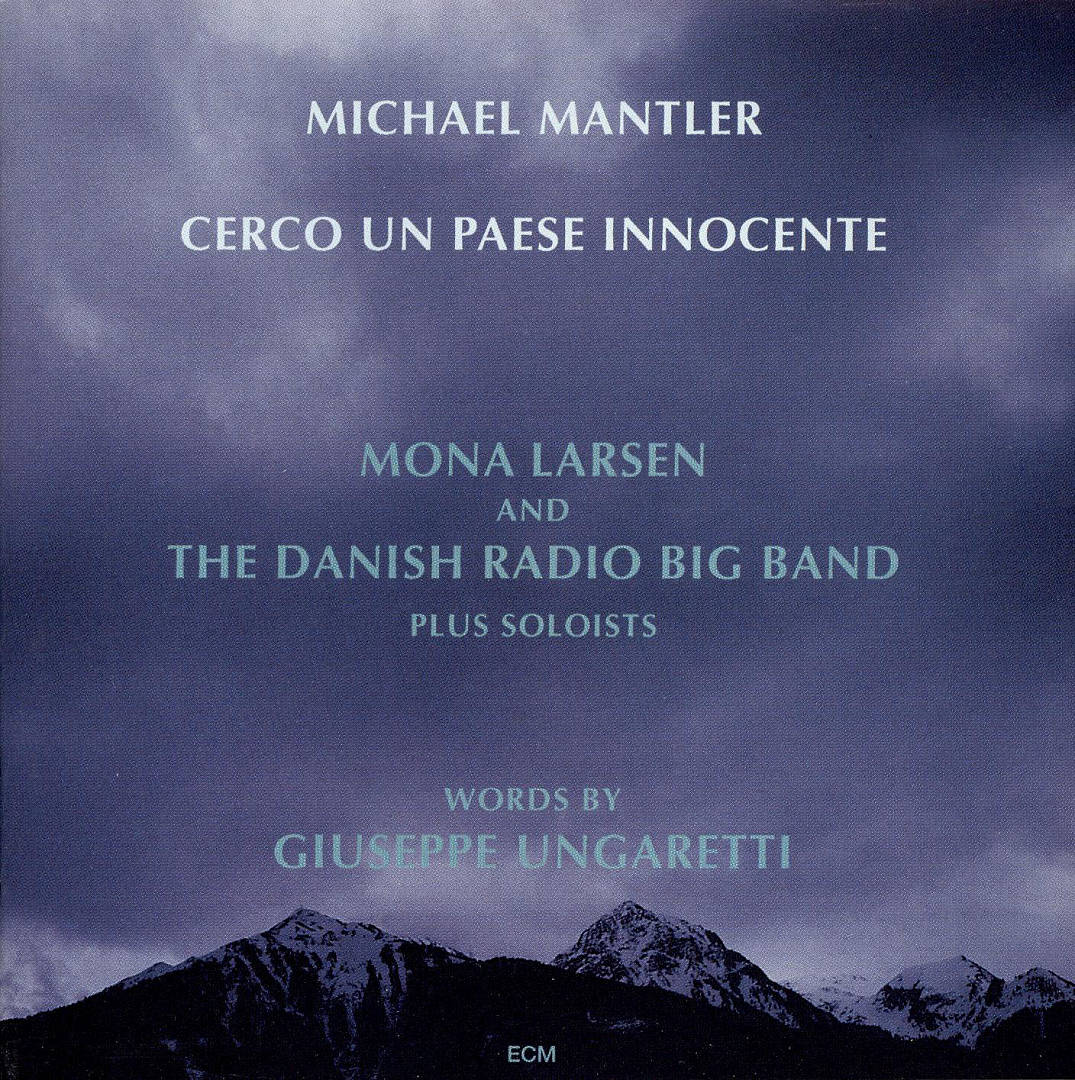
Michael Mantler
Cerco Un Paese Innocente

Mona Larsen voice
Michael Mantler trumpet
Bjarne Roupé guitar
Marianne Sørensen violin
Mette Winther viola
Gunnar Lychou viola
Helle Sørensen cello
Kim Kristensen piano
The Danish Radio Big Band
Ole Kock Hansen conductor
Recorded January 1994 at the Danish Radio, Studio 3, Copenhagen
Recording and mixing engineer: Lars Palsig
Produced by Michael Mantler

Beginning has us singing
and we sing to make an ending

Michael Mantler’s Cerco Un Paese Innocente (I search for an innocent land) pays tribute to the father of modern Italian poetry, Giuseppe Ungaretti. Subtitled “A Suite of Songs and Interludes for Voice, Untypical Big Band and Soloists,” this seamless construction feels anything but untypical in the comforting plush of its instrumentation and attention to soundscape. The present recording is also significant for bringing Copenhagen-born vocalist Mona Larsen back together with the Danish Radio Big Band, who debuted her as soloist in the seventies to wide renown. Larsen’s diction, in combination with her already broad palette, imparts life to dead limbs and electrical impulses to still hearts. Through it we know the touch of many landscapes, their peoples, their flora and fauna, reaching through our bodies toward the setting sun at our backs. This same sun warms the field’s worth of fragrance that wafts through the swell of orchestral goodness in the piece’s introduction. Yet the voice of “Girovago” (Vagrant) does not feel that touch, is forced to wander, forever a stranger, from land to land. A clarinet plays, stringing a trail of possible futures, all of which disappear into the first of five intermezzi, each an anointing of melodic oil that smacks of the perpetual. Curtains part to reveal the starlight of “Stasera” (This evening) and Larsen’s Francesca Gagnon-esque acrobatics. “Perché?” (Why?) ties an operatic ribbon around the index finger of Part 2. It is the tale of a dark heart lost in its desire to erase the scars of travel. “Sempre Notte” (Everlasting night) turns the dial further inward and walks through cascading gardens, from which hang sad and sorry tales of yesteryear like so much totora reed left to dry. The depths of “Lontano” (Distantly) evoke the poet’s blindness in a landscape of fiery hands. The music here seems to explore those sparkling pockets of air in which our dreams still breathe. Breathing, however, comes at a cost in Part 3, where the soaring orchestration of “Se Una Tua Mano” (With one hand) euphemizes the harm of curiosity trembling beneath its veneer. “Is surviving death living?” Larsen sings, prompting mental implosion through Ungaretti’s unwavering mortal concerns. The halting rhythms of “Vanità” (Vanity) further paint a world of startlement and shadows, its rubble soldered back together by the warmth of Mantler’s trumpet into “Quando Un Giorno” (When a day) and the invigorating “Le Ansie” (Fear). In these we encounter life as smoke, at once agonizing and brimming with potential. Gloom lives in these soils and nourishes the churning dramaturgy of Part 4, of which “È Senza Fiato” (Motionless) darkens like an arc of twilight, led by a shooting star of electric guitar into “Non Gridate Più” (Outcry no more). This sweeping transition rakes its fingers through silent grasses and hushes the mouths of the dead, in whom only the resolutions of “Tutto Ho Perduto” (I have lost all) continue to resound, their childhoods laid to rest by a final word.

One of your hands resists your fate,
but the other, you see, at once assures you
that you can only grasp
tatters of memory

<< Sándor Veress: Passacaglia Concertante, etc. (ECM 1555 NS)
>> Charles Lloyd: All My Relations (ECM 1557)

Jan Garbarek Group: Twelve Moons (ECM 1500)

Jan Garbarek Group
Twelve Moons

Jan Garbarek soprano and tenor saxophones, keyboards
Rainer Brüninghaus keyboards
Eberhard Weber bass
Manu Katché drums
Marilyn Mazur percussion
Agnes Buen Garnås vocal
Mari Boine vocal
Recorded September 1992 at Rainbow Studio, Oslo
Engineer: Jan Erik Kongshaug
Produced by Manfred Eicher

Twelve Moons may be the fifth Jan Garbarek Group album by name, but its smoothness and level of musicianship mark it as a great leap into the group’s signature sound. Between the sparkling ocean of the two-part title track and a gloriously realized “Witchi-Tai-To” (making its first reappearance since the selfsame album of 1974), Garbarek and his mind-melded band mates have created a record of great scope and mood. Earthen motives mesh with synth textures, breath with lively percussion, folk tunes with modern lilts. By means of his cinematic sweep Garbarek turns aside the bane of an indifferent world in favor of visceral emotional connections. Just when we think those connections have receded, they come back at fuller force, pulling away the darkness like a curtain to reveal the light which has offset it all along. Agnes Buen Garnås (who had previously collaborated with Garbarek on Rosensfole) and Mari Boine lend their mineral-rich voices to “Psalm” and “Darvánan,” respectively, moving from vast droning landscape to haunting duet as might a rainbow split into two. Garbarek’s tenor makes only a few appearances (most effectively in the arcing storyline of “Brother Wind March”). Its voice in “The Tall Tear Trees,” for one, implores the firmament with the conviction of a returning wayfarer who has just spotted home on the horizon. Yet this session is mostly about a soprano whose sky-bound warbling in “There Were Swallows…” (notable also for Eberhard Weber’s whale-like bass) and lullaby strains in “Arietta” seem to take great comfort in the cushiony surroundings. “Gautes-Margjit” is an especially attractive groove that rests itself easily in the cradle of our wonder, bristling with an aliveness of pianism such as only Rainer Brüninghaus can elicit. Garbarek’s soaring tone bleeds pink like tropical clouds afflicted with heat lightning. And let us not forget Manu Katché’s gripping provocations in “Huhai.”

A flawless classic, Twelve Moons offers a rich bouquet for the ears with melodies and rhythms that go straight to the heart of anyone who loves to listen.

<< Red Sun/SamulNori: Then Comes The White Tiger (ECM 1499)
>> Bach: 3 Sonaten für Viola da Gamba und Cembalo (ECM 1501 NS)

David Darling: Cello (ECM 1464)

1464 X

David Darling
Cello

David Darling acoustic cello, 8-string electric cello
Recorded November 1991 and January 1992 at Rainbow Studio, Oslo
Engineer: Jan Erik Kongshaug
Produced by Manfred Eicher

David Darling’s Cello is one of the most stunning albums ever to be released on ECM in any genre. Its fluid paths feel like home. Darling plows the improvisatory depths of his soul, given free rein in the studio to paint the negative spaces in between those clouds on the album’s cover, ever deeper, ever truer to the core of something alive. Most journeys might take you across some distance to get you to where you’re going, yet few will actually unpack where you are standing with such complex, unabashed glory that one need not take a single step to travel to the end of the universe and back. Cello is one such journey.

The opening “Darkwood I” carries us into a state of bliss unlike any other, finding its interest in the empty spaces of time that define our action and thought alike. “No Place Nowhere” swells with the blessing of life, finding in every shift of light a new window through which Darling casts the details of his destiny through shadow. One finds here a long and winding road into horizon, forever receding, that is the vanishing point in sound, the blessing and the curse of beauty, the sweeping gesture of aesthetic pleasure rolled humbly into a never-ending circle. The bird calls of “Fables” dance in the sky like time-lapsed aurora borealis, twisting our sense of time to the tune of something divine. “Dark-wood II” is a wilting flower, a lakeside flower dropping spores. “Lament” lowers us in swaddling into the slow-motion cradle of the wind, the mountain veil as a crook in a mother’s arm, singing our souls softly to sleep. “Two Or Three Things” evokes Jean-Luc Godard with its softly flowing landscape of water and wind, grass and foam, where swim the vagaries of our modern life against the tide of regression that is our calling into death. This breathtaking journey guides us into a place that is so deeply inside us that we must disappear to find it. “Indiana Indian,” forever my favorite track on the album, begins in a harmonic swirl before loosing a pizzicato chain of finely honed memories. A jazzy half-note swing brings us into the enthralling drama of “Totem.” Here, an ocean of double stops, a tidal wave of lilting lines, leaving an imprint of “Psalm” in the sands. Its protracted antiphony sheds its clothing to reveal “Choral.” This Möbius drop into solitude, where harmony offers the illusory promise of companionship in a world without bodies, whispers at the interstices of our alienation. “The Bell” has the makings of an Arvo Pärt choral work with its microtonal harmonies and tintinnabulations. “In November” rounds a cinematic edge, rolling over into a low and calming thunder and ending with the yellowing strains of “Darkwood III.”

On paper, these might seem little more than chromatic exercises, but in the vastness of Darling’s playing, combined with Eicher’s attention to space, they achieve a meditative state in which the simplest musical utterances become the most profound. Eicher’s touch can be ever felt in the sound and in the melodic elements he has provided, showing us that he is not only a fine producer, but also has a supremely sensitive ear for melody and, above all, time. For this improvised session, Eicher told Darling to go as deep as he could go, thus expressing the spirit of the label at heart, not to mention the spirit of what a musician can achieve when open to infinity.

<< John Surman: Adventure Playground (ECM 1463)
>> Charles Lloyd: Notes From Big Sur (ECM 1465)

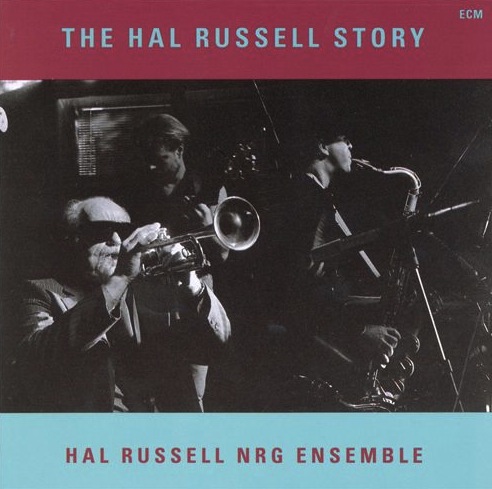
Hal Russell/NRG Ensemble: The Hal Russell Story (ECM 1498)

Hal Russell
NRG Ensemble
The Hal Russell Story

Hal Russell tenor and soprano saxophones, trumpet, drums, xylophone, percussion, gong, narration, vocals
Mars Williams tenor, alto and bass saxophones, toy horns, wood flute, didgeridoo, bells, sounds, narration
Brian Sandstrom acoustic bass, electric guitar, trumpet, toy horns, percussion
Kent Kessler acoustic bass, trombone
Steve Hunt drums, vibraphone, tympani, percussion
Recorded July 1992 at Hardstudios, Winterthur
Engineer: Martin Wieland
Produced by Steve Lake

What do you do when you know too much? 

Improvise!!!

The late and great Hal Russell passed away not five weeks after recording, prophetically enough, The Hal Russell Story, a whirlwind of a tour through the autobiography of one of jazz’s undisputed champions. From the intro, we get Russell’s taste of yore with megaphone amid an engagingly frenetic cyclone of sound, followed by a toy parade in the spirit of the Art Ensemble of Chicago: a romp through childhood’s darkest corners, ending in a trumpet free-for-all and the sketch of a nascent musician caught in the radio waves of life. So begins the 18-part title suite, a pan bursting with golden nuggets of abandon. A bed of drumming supports with mounting intensity a lithe dance of vibes. A swinging sax rises from the depths of a torturously sonorous past. A breezy sort of high-octane energy works its saxophonic magic at every turn with delectable aplomb. Squawks and dark raptures trade verses for curses against some hard-hitting reed work all around. The rhythm section sees Russell eye to eye at every level. Incredible screeches from tenor work over an invisible crowd with utterly attenuated vocal energy. That wonderful rhythm section kicks in at key moments, making headway against the soprano’s ululating tide. Smokier flavors sit side-by-side with empty flutters from bass. From match-lit tributes to late masters to quiet reflections, every nuance speaks as if born again, unsure of the death that gave it life. A growling guitar swept up in unsheathed brass is blown to bits by squealing tenor, letting us down easy into the night, where Miles still wanders, dragging the weighty trailer of his craft. Flowering little suspension bridges of influence and affect bleed into slices of swank. Dramatic pops and scuttling opportunities run rampant. The band’s resolve contracts and expands through haunts and explosions. Freedom principles and fast rules tune themselves to the drama of “Lady In The Lake,” a pensive and strangely declamatory track that nudges us into a distinctive rendition of Fleetwood Mac’s “Oh Well.”

Steve Lake has produced some of ECM’s most exciting recordings, and The Hal Russell Story stands as a crowning achievement. A brilliant album that weaves its personal threads over and under for an honest patchwork. With all of this clear from one studio effort, I can only imagine what the live NRG experience must have been as musicians switched instruments at the drop of a hat in a controlled chaos.

Vaudeville, yes vaudeville (can’t seem to shake the influence).

<< Peter Erskine Trio: You Never Know (ECM 1497)
>> Red Sun/SamulNori: Then Comes The White Tiger (ECM 1499)

Andersen/Towner/Vasconcelos: If You Look Far Enough (ECM 1493)

If You Look Far Enough

Arild Andersen bass
Ralph Towner guitars
Nana Vasconcelos percussion
Audun Kleive snare drum
Recorded Spring 1988, July 1991, and February 1992 at Rainbow Studio, Oslo
Engineer: Jan Erik Kongshaug
Produced by Arild Andersen

Manfred Eicher strikes gold with yet another inspired melding of musical minds. The microphones at ECM’s Rainbow Studio this time are privileged to witness an emotionally powerful session from bassist Arild Andersen, guitarist Ralph Towner, and percussionist Nana Vasconcelos. The session begins with something of a title track in “If You Look.” From this swell of drones and metallic whispers comes “Svev,” a scintillating piece that finds Andersen in a buoyant mood. “For All We Know” is a stunningly gorgeous duet between him and Towner—a match made in heaven. Andersen’s tender spaces are the perfect sky for Towner to spread his careful, classical wings. “Backé” continues this intimate reflection, only now with Vasconcelos’s auguries providing a more focused berth for Towner’s spindly ruminations. Vasconcelos adds a vocal swoon for effect. These two tracks are the heart of the album and could continue for its full length if they wished. “The Voice” begins with Andersen’s sustained calls, drawn out like cloud wisps on the horizon and providing a long-forgotten plain for the rhythm and tackle of Vasconcelos’s well-traveled feet. Andersen dips into some electronic augmentations, sounding like an infant foghorn with melodic growing pains. “The Woman” is a beautiful little duet for percussion and bass that works its tender embrace one muscle of sentiment at a time. Andersen’s deft monologue of serpents and harmonics carries the conversation over into “The Place” at a more urgent pace, working sidelong into an inspiring spiral. “The Drink” is another transportive duet, swaying like a caravan transport in the unforgiving sun. Next is “Main Man,” which jumps back into the rhythmic deep end with some funkier vibes, while “A Song I Used To Play” is a slow and tender build to Towner’s 12-string ebullience. “Far Enough” is another haunting drone of spectral footsteps that brings us into “Jonah,” a bass solo that smiles with all the wonder of new life.

This album is something of a sleeper ECM hit and worth seeking out for fans of any and all of these musicians. Don’t pass it up.

<< Meredith Monk: Atlas (ECM 1491/92 NS)
>> Messiaen: Méditations Sur Le Mystère De La Sainte Trinité (ECM 1494 NS)

Gary Peacock/Ralph Towner: Oracle (ECM 1490)

Gary Peacock
Ralph Towner
Oracle

Gary Peacock double-bass
Ralph Towner 12-string and classical guitars
Recorded May 1993 at Rainbow Studio, Oslo
Engineer: Jan Erik Kongshaug
Produced by Manfred Eicher

With so much virtuosity living inside bassist Gary Peacock and guitarist Ralph Towner, one might expect from this duo a showcase of lively showmanship. And while this it most certainly is at heart, on the whole we are given an understated album recorded out of deepest respect for its listeners. The improv is robust yet tender and marked by a distinct patina around the edges. Above all, however, I find the playing to be forward thinking and worldly. Peacock and Towner bring a cartographer’s care to tracks like “Gaya” and “Inside Inside.” Programmatic energies abound in “Flutter Step” and “Burly Hello,” each speaking as if behind cupped hands into the ears of a secret joy, while the turns of “Empty Carrousel” resolve into a hazy picture that blurs even as it develops. “Hat And Cane” gives us a happy-go-lucky reprieve, its effervescent licks crossing the postcard of “St. Helens” into the title track. What begins as a quiet breathing exercise turns full somersaults for the album’s most intense unions. Finishing with “Tramonto,” we find the duo at its emotive best.

Oracle is like the ocean: we know its overall shape but the movement of every wave is at the whim of something unseen that flows through all of us.

<< John Abercrombie Trio: While We’re Young (ECM 1489)
>> Meredith Monk: Atlas (ECM 1491/92 NS)

John Abercrombie Trio: While We’re Young (ECM 1489)

John Abercrombie Trio
While We’re Young

John Abercrombie guitars
Dan Wall Hammond organ
Adam Nussbaum drums
Recorded June 1992 at Power Station, New York
Engineer: James A. Farber
Produced by Manfred Eicher

John Abercrombie fronts the first of his trio recordings with Dan Wall on Hammond organ and Adam Nussbaum on drums. This sumptuous combination of instruments, cradled in ECM’s enabling acoustics no less, is candy for the ears. Dividing the record into two halves, one finds the first bubbling with excitement. One might not know it from the all-consuming gaze of “Rain Forest,” in which Wall takes center stage. Bathed in a rough and dimly lit spotlight, he listens to his own stories as if someone else was telling them, but gives way to the swell of “Stormz.” Abercrombie takes slow but steady shape, ringing like the edge of a coin blown and held to the edge of an ear, now tumbling, now sprinting, with an eye ever-trained to some distant point that holds his attention by a thread of perspective from pick to horizon. In “Dear Rain,” Nussbaum’s drumming indeed evokes the patter of precipitation as Wall’s tender strains waft through the humid air. All of this seems but fuel to “Mirrors,” which turns up the flames on this gas stove to a deep and lively blue. Fantastic playing abounds on this one, but particularly from Nussbaum, who keeps us on our toes.

“Carol’s Carol” links a chain of memories toward the album’s darker side. Erskine’s cymbals form the peak of some mountainous drumming, sending us over into the neighboring valley of “Scomotion.” This down-tempo tribute to John Scofield tones the remainder down to a quiet smolder. Abercrombie finds sentimental breadth in “A Matter Of Time,” kindling to Wall’s probing sparks, while “Dolorosa” ends on a tearful note, made all the more so by the guitar’s lovely sound, setting us down from a beautiful and reflective effort before going on its silent way.

<< Bley/Peacock/Oxley/Surman: In The Evenings Out There (ECM 1488)
>> Gary Peacock/Ralph Towner: Oracle (ECM 1490)

Bley/Peacock/Oxley/Surman: In The Evenings Out There (ECM 1488)


In The Evenings Out There

Paul Bley piano
Gary Peacock bass
Tony Oxley drums
John Surman baritone saxophone, bass clarinet
Recorded September 1991 at Rainbow Studio, Oslo
Engineer: Jan Erik Kongshaug
Produced by Manfred Eicher

This wondrous date finds pianist Paul Bley, reedman John Surman, bassist Gary Peacock, and drummer Tony Oxley in a blissful state of affairs. Not since the deeply felt Fragments had a quartet so honestly captured the spirit of free jazz at its most humbling. The music on In The Evenings Out There, punning on the Carla Bley tune “In The Mornings Out There,” is a canyon in ECM’s vast improvisatory continent. “Afterthoughts” sets the tone with a voice that whispers like memory yet speaks of the here and now. It moves from somber tears to insistent runs, from horizontal planes to sharp and rugged inclines, in the space of a heartbeat. With “Portrait Of A Silence,” we find that the album is more about space than time, for each facet of this misted jewel is made of various combos. This, the first of two solos from Peacock, reveals a player who knows his instrument like his own body. He explores architectural details of jazz that others too often neglect and grinds them down into handfuls of prayers.

Some of the titles seem arbitrary. “Soft Touch,” for one, brings out some of the album’s sharpest points. Yet one doesn’t listen to such music for track listings. One surrenders instead to the lovely geometric exercise of “Speak Easy” or the full quartet musings of “Interface.” Surman’s timeworn baritone seeks nourishment in the latter’s shadows, bringing us into “Alignment,” which recalls his self-referential solo work elsewhere. His bass clarinet in “Article Four” speaks that same nocturnal language, tracing its own demise like a shooting star. “Fair Share” is a buoyant duet between Bley and Peacock that breathes by the edge of understanding and drops us into a bog of sentiment. Bley offers the album’s final words. The solo “Married Alive” crosses over into explorations with Oxley in “Spe-cu-lay-ting” before ending with “Note Police,” breaking through the clouds at last with unfettered light.

This is an intuitive sort of music-making, brimming with lessons of hardship. Utterly remarkable.

<< Paul Giger: Schattenwelt (ECM 1487 NS)
>> John Abercrombie Trio: While We’re Young (ECM 1489)

Stephan Micus: To The Evening Child (ECM 1486)

Stephan Micus
To The Evening Child

Stephan Micus steel drums, voice, dilruba, suling, kortholt, ney, sinding
Recorded January and Feburary 1992 at MCM Studios
Digital mastering: Tonstudio Mahne, Dießen

Stephan Micus’s fifth album for ECM is a lullaby. I know nothing of its origins, but I would be surprised if he hadn’t just become a father before recording it, so freshly paternal are its meditations. This time, Micus turns the kaleidoscope of his endless talent to reveal steel drums as the sound color of the moment. These provide a resonant, gamelan-like undercurrent throughout and become more biologically attuned as they sing beneath his mallets. Yet it is his actual voice that awakens the heart in “Nomad Song,” scooping earth in such a way that all life falls through its fingers unharmed, leaving only a heap of unconditional love. The newness of creation abounds in “Yuko’s Eyes,” in which Micus sings now through a bowed dilruba, turning infancy inside out to reveal a future of hope and dreams fulfilled. “Young Moon” pairs that constant steel drum with suling (an Indonesian bamboo flute) and kortholt (a capped reed instrument popular during the Renaissance) for a softly glittering wave of light, given corporeal shape through open-throated calls. The title track welcomes ney, through it gilding the album’s aquatic themes with moonlight. It grows a feather for every breath that falls, as if reaching out to any and all children who slumber in fear and security alike. From these Micus spins a wealth of comfort, trembling to the tune of his heartbeat. There is perpetuity in this dream, from which one is born and to which one returns when circadian rhythms have become a thread of silence. “Morgenstern” stretches a sky bridge from cloud to cloud with steel-drummed steps, while “Equinox” lives in penumbral shadow, crowning a procession of closed-mouthed reverence. Each pair of hands offers a flower to “Desert Poem.” Eyes shielded by sleep, Micus dips his toes in the Milky Way’s waters and dries himself against a tree that grows alone, save for the fallen seed who awaits for the light of dawn to bless it with the kiss of tomorrow.

This music sounds in those hushed spaces where the universe inhales, the sound that keeps all celestial bodies spinning. Like the language in which Micus sings, its words convey meaning to a part of us deep and out of grasp. But for the duration of an album, at least, we can feel it as presently as the rain on our faces.

<< Michael Mantler: Folly Seeing All This (ECM 1485)
>> Paul Giger: Schattenwelt (ECM 1487 NS)