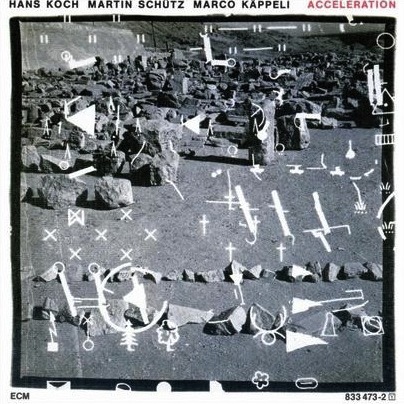
Koch/Schütz/Käppeli: Accélération (ECM 1357)

Hans Koch
Martin Schütz
Marco Käppeli
Accélération

Hans Koch clarinet, bass clarinet, tenor and soprano saxophones
Martin Schütz bass, cello
Marco Käppeli drums
Recorded June 1987 at Tonstudio Bauer, Ludwigsburg
Engineer: Martin Wieland
Produced by Manfred Eicher

The debut recording of classically trained Swiss clarinetist Hans Koch’s jazz trio with bassist/cellist Martin Schütz and drummer Marco Käppeli, Accélération is not a shy blip in the fascinating potpourri of ECM’s 80s period, by which time Koch’s formidable outfit had left its footprints in standard territories before branching out here with a set of nine originals. Into this, the shivering cello and pointillist rims of “Shy Csárdás” provide a fitting point of entry. Like an opera overture these sounds recede as quickly as they rise, making way for the clarineted protagonist whose introductory aria secures a tether of human folly to the romantic sentiments that follow. Koch’s forte sings as it moves and moves as it sings, finding an ecstatic dance “Im Delirium,” which gives us also the album’s first and last tenor line over a waltzing bass. “Midori” is a synaesthetic exercise, rustling through leaves and time with the obsession of hunger and divulging some fine moments from Schütz against a spate of frenetic drumming. That clarinet waves like the last thread to something familiar as it snaps into an ecstatic death throe. “Loisaida” casts a dreamy spotlight thereon and unspools a whirligig of a denouement in “Glas(s)no(s)t.” Of this, the engaging stichomythia between cello and soprano is but an appetizer to the screeching “Tatzelwurm,” itself a preamble to the bouquet of trio action that begins with “Nitrams Rock” and ends in the playful piece of swank that is “GG-U-GG-U-RR-U-GG.”

A personal favorite among ECM’s lesser-knowns.

<< Pepl/Joos/Christensen: Cracked Mirrors (ECM 1356)
>> Stephan Micus: Twilight Fields (ECM 1358)

Dave Holland Quintet: The Razor’s Edge (ECM 1353)

Dave Holland Quintet
The Razor’s Edge

Dave Holland bass
Steve Coleman alto saxophone
Kenny Wheeler fluegelhorn, trumpet, cornet
Robin Eubanks trombone
Marvin “Smitty” Smith drums
Recorded February 1987 at Tonstudio Bauer, Ludwigsburg
Engineer: Martin Wieland
Produced by Manfred Eicher

Still reeling after seeing Dave Holland in a recent intimate performance with Jason Moran, I find myself going back to the fresh directions he explored on ECM with one of his finest outfits: the Quintet. As its third album for the label, The Razor’s Edge is all the more important for being reedman Steve Coleman’s last run with the group before his travels took him elsewhere on the path to musical geomancy. He joins Holland with the usual suspects: trumpeter Kenny Wheeler, trombonist Robin Eubanks, and drummer Marvin “Smitty” Smith (of, among countless other projects, Jay Leno Tonight Show Band fame).

The Quintet is as dynamic as ever in this seminal outing, which finds Eubanks and Coleman in particularly fine form. The trombonist gives us some early traction against Holland’s skittering delights in “Brother Ty,” while that unmistakable alto trades places with soulful insights in the more pensive “Vedana.” Next is, if the reader will indulge me, the title cut, which opens with Wheeler against a delicate rhythm section before releasing a tremulous solo from Eubanks. Coleman flies off a half-pike of big band sound, a raging flare of virtuosic wonder at the mouthpiece. Holland pauses for reflection in “Blues For C.M.,” only to drop the anchor with a gorgeous and unassuming theme. Coleman dominates again, bringing a slower heat this time around as he fills each available nook and cranny with his golden tone. An all-too-brief response from Eubanks brings us down into “Vortex.” Holland proves the early bird, opening to the full band with Coleman at the helm of yet another engaging vessel. And out of sparkling breath comes a muted Wheeler, hurling a pitch to Coleman at bat. Tracks like this are hard to beat, each a hefty dose of wonder and logic rolled into a ball of fun. After a couple of slow swings, Smith kicks us off into “Figit Time,” in which Coleman excels right out the gate. He is, like the album as a whole, a house aflame, threading every hot potato of a needle passed his way. The invigorating drum work in this masterpiece makes it alone worth the price of admission. This is life on jazz.

<< Gary Peacock: Guamba (ECM 1352)
>> Oregon: Ecotopia (ECM 1354)

Marc Johnson’s Bass Desires: Second Sight (ECM 1351)


Marc Johnson
Second Sight

Marc Johnson bass
Bill Frisell guitar
John Scofield guitar
Peter Erskine drums
Recorded March 1987 at Rainbow Studio, Oslo
Engineer: Jan Erik Kongshaug
Produced by Manfred Eicher

This sophomore effort from Marc Johnson’s Bass Desires comes nowhere near the octane levels of the project’s wild self-titled debut. This doesn’t mean, however, that Second Sight is no less enthralling. Its strength lies in its personnel. Guitarists Bill Frisell and John Scofield seem so well made for each other that, were they not split between the left and right channels, respectively, they might as well be thought of as some bizarre 12-stringed chunk of genius. How can we, for instance, not be moved by the sentiment of “Small Hands” and the resonant eddies of “Sweet Soul”? The latter, with its touch of Pat Metheny brightness, is especially moving. And let us not bypass the unassuming opener, “Crossing The Corpus Callosum.” Here the guitars dance on edge over the rolling hills of Peter Erskine’s drums and Johnson’s bass. The wealth of extended textures opens vista upon vista of possibility. Frisell is downright glowing in “1951,” which might as well have been an outtake from Naked City’s Radio. A dreamy slice of nostalgia pie if there ever was one, it comes served piping hot with a dollop of electric ice cream to boot. The solos are three-dimensional.

Lest we think this is all too ponderous, Scofield livens the proceedings with an invigorating twofer. The Richard Thompon-esque rhythm guitar in “Twister” is the set’s most spirited. Frisell and Scofield add to each other’s fire as they unabashedly scale the diminished seventh ladder (think Beatles), splitting off into the groovier weave of “Thrill Seekers.” Scofield rules with his solo here, while Frisell winds some of his most insectile threads in the background before slingshotting stardust back through the atmosphere. The band recedes for a fragile solo from Johnson before playing out on the vamp. The jauntiness of this number is superbly contrasted by “Prayer Beads,” a monologue from Johnson, who closes the door with “Hymn For Her.” This last is a dream within a dream. It feels like watching life through a veil of trickling water and finding that hope is already beside you, that its forgiving melodies flow both into and from the heart.

A note on the cover: the helicopter is a foil. Without it, the beach is just a beach. With it, the beach begs to be appreciated.

<< The Bill Frisell Band: Lookout For Hope (ECM 1350)
>> Gary Peacock: Guamba (ECM 1352)

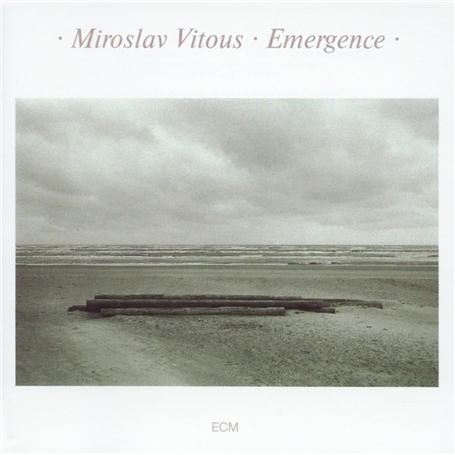
Miroslav Vitous: Emergence (ECM 1312)


Miroslav Vitous
Emergence

Miroslav Vitous bass
Recorded September 1985 at Tonstudio Bauer, Ludwigsburg
Engineer: Martin Wieland
Produced by Manfred Eicher

Although Miroslav Ladislav Vitouš has had varying levels of success in the post-Weather Report years as bandleader, we can hardly help but marvel at this gem of a solo recording. With nary an overdub in sight and more than enough heart to spare, the Czech bassist plots an orchestral sweep through his precisely (at)tuned skills. Like the caron that disappeared from the end of his name before going international, it is a valley of possibility, and he our shepherd through its gallery of songs and tales. All the more appropriate, then, that we begin with “Epilogue,” for it is a lasting look back at what is to follow. There is much to experience in this piece: a deep memory, intimations of a dance, the infused colors of a dream. Vitous carves from this chunk of maple the balsa-like delicacies of “Transformation.” There is indeed a metamorphosis in its lovely arco lines: from the internal to the external, from the thought to the spoken. Yet all of this is but a prelude to the four-part Atlantis Suite, of which the third movement (“The Choice”) is one of the most beautiful on the album. It flexes like a hand wafting smoke into our interpretive memories, and holds a flock of harmonics in its nets. From this, rays of light open into further transformations I can only liken to the shift from a voiceless to voiced consonant. Here, the mythical continent has not been torn asunder by inexplicable cataclysm. Rather, Vitous unravels its legacy in reverse, back to its golden age. “Wheel Of Fortune” similarly turns the passage of time into a visage of understanding, running through a field of prismatic colors into the abstract whirlwind-cum-groove that is “Regards To Gershwin’s Honeyman.” Vitous shows his sense of humor in the spirited “Alice In Wonderland,” which has something of the elusive rabbit’s mockery, then turns to subtler invigorations in “Morning Lake For Ever.” This is a fantasy in sound, a cleansing of the palate before a nod to Sketches of Spain ends the set in the rainbow of dramatic statements.

The skill of commanding attention with only a bass lies in the ability to treat the instrument as both a self-contained unit and as a seed for unheard things. Vitous accomplishes just such a dynamic. Never once does he sound like a backup instrument in want of a band. Whenever his fingers way to bow, there is nothing but openness in every action. As Vitous says in his dedication, this is “music with no boundaries.”

Emergence delights in the ways it blends registers, drawing upon a wealth of joys with just the right touches of melancholy and cerebral edginess. Such a well thought-out session cannot help but earn a rightful place alongside Dave Holland’s Emerald Tears as a classic in its field. The album is also superbly recorded, enhancing the instrument’s natural resonance by placing us in its very ribcage, as it were. It feels like walking through a dream, for in its confines perspectives change with such fluidity that one hardly notices them as the whims of a human touch. And perhaps they are the most natural of all, guiding us into a world of perception where evaluations such as this are but feathers on a dying bird.

<< John Abercrombie: Current Events (ECM 1311)
>> Werner Pirchner: EU (ECM 1314/15 NS)

Eberhard Weber: Orchestra (ECM 1374)


Eberhard Weber
Orchestra

Eberhard Weber bass, percussion, keyboards
Herbert Joos fluegelhorn
Anton Jillich fluegelhorn
Rudolf Diebetsberger French horn
Thomas Hauschild French horn
Wolfgang Czelustra trombone
Andreas Richter trombone
Winfried Rapp bass trombone
Franz Stagl tuba
Recorded May/August 1988 at Tonstudio Bauer, Ludwigsburg
Engineer: Carlos Albrecht
Produced by Manfred Eicher

Despite an overt lack of the very instruments implied by the title of this mysterious effort from bassist Eberhard Weber, it is far from misleading, for the orchestra is in our minds, and in Weber’s heart as he emotes with the fullness of his instrument. The album divides itself between two distinct halves. The first of these hones emphasis on the solo. Weber is the foreground, flexing like the backbone of a creature whose anatomy is otherwise invisible. After the fluttering opening statement of “Seven Movements,” the palette warms into a lush ostinato, which only seems to accompany itself as it coils its golden threads into a brass-gilded frame. Some percussive death throes provide rare drama. “Broken Silence” features a delicate arco bass soaring low above its droning shadow toward the horizons of “Before Dawn.” This, a gorgeous spell working its lilting magic like a funhouse mirror, except that here we find not laughter or distortion, but an expansion of our sonic worldview. Weber jazzes things up for “Just A Moment,” riding a slingshot into “Air,” itself but a pliant reed in a pond, a cattail waiting to cast its children into the wind.

“Two Early To Leave” blends a congregation of brass into tremulous strings, thereby evoking the sweeps of Weber’s earlier work and inaugurating us into the breathtaking second half. We continue with “One Summer’s Evening,” floating sinuous lines along a current of synthesizer. The tender solo of “Daydream” winds its embrace against a sunny drone, while the darker emotional urgency of “Trio” drops itself into a deep sleep, where it dreams of the “Epilogue,” a forlorn path tread by pizzicato footsteps until it is flattened and no longer kicks up dust.

Orchestra is Weber at his purest. A lovely exposition of his talents, technical and melodic alike. Certainly not the one you’ll want to start with, but by no means a shabby place to spend the night before continuing on your journey.

<< Dave Holland Trio: Triplicate (ECM 1373)
>> Dino Saluzzi: Andina (ECM 1375)

John Surman: Private City (ECM 1366)

John Surman
Private City

John Surman bass clarinet, recorders, soprano and baritone saxophones, synthesizer
Recorded December 1987 at Rainbow Studio, Oslo
Engineer: Jan Erik Kongshaug
Produced by Manfred Eicher and John Surman

If the title of Private City comes about as close as one can get to describing the sound-world of John Surman, then that of its first piece, “Portrait Of A Romantic,” does the same for the man behind it. Its quivering recorder blankets us in warmth, fully realized by an electric piano and bubbling as the waters in a forgotten loch. A bass clarinet swims, a creature of myth remembering a time when its kind were plentiful. Thus begins this widely regarded album of incidental ballet music that remains one of Surman’s most personal. The recorder returns, an elusive and mythic voice, “On Hubbard’s Hill,” calling forth steady electronics from the depths of its own dreaming, leaving us to look out on all we’ve done. The familiar sequencer shows its face in “Not Love Perhaps,” climbing itself like a self-generating ladder and carrying with it a sacred form of déjà vu, in which time is but a loop within the heart of learning. Surman’s soprano moves with the grace of a traditional melody that has only now come to the surface of our audible history. “Levitation” is exactly what he accomplishes with an unwieldy instrument like the bass clarinet. As it splinters into myriad offerings beneath a pregnant moon, an “Undernote” bobs on a current of its own regret. “The Wanderer” is another watery piece, that beautiful soprano melting over a wavering ground of synth lines and bass clarinet, and ending on a distant fanfare. The swaying “Roundelay” exemplifies Surman’s limitless talents, as well as the purity of his notecraft. Led by a fairy-like soprano, it feels like ice-skating along an infinity sign set to music. Last is “The Wizard’s Song,” the album’s crowning jewel, showing us again the inimitable delicacy with which its composer approaches the lower, neglected reeds. Like the ending credits to a movie that lives on even after it is done, the effects keep scrolling in our heads, wandering the darkness until they have reached the private cities inside all of us.

<< The Paul Bley Quartet: s/t (ECM 1365)
>> Masqualero: Aero (ECM 1367)

The Paul Bley Quartet: s/t (ECM 1365)

The Paul Bley Quartet

Paul Bley piano
John Surman soprano saxophone, bass clarinet
Bill Frisell guitar
Paul Motian drums
Recorded November 1987, Rainbow Studio, Oslo
Engineer: Jan Erik Kongshaug
Produced by Manfred Eicher

John Surman, Bill Frisell, and Paul Motian again join Paul Bley for a follow-up to the quartet’s stunning debut, Fragments. This self-titled record is another awe-inspiring session and chronicles some of ECM’s most beautiful tales. The slow, 20-minute first chapter, “Interplay,” frees each musician to make careful melodic choices. Motian’s sibilant cymbals are immediately recognizable, grounding Bley’s punctilious chording as Surman paints the night sky with his soprano. Bill Frisell’s rubbery playing proves complimentary in this yielding nexus. Then something happens: the effervescence curls in on itself and Frisell’s ghosted lines blossom from the stem of a bass clarinet before Bley flies away in a pollinated liberation. Configurations shift. Motian shares a masterful exchange with Bley, the former’s brushes skittering over the latter’s pianistic landscape like a field mouse without a predator in sight, for even the graceful hawk of Surman’s soprano cares not for hunting but rather knows it is already the prey of something sonorous, invisible. Frisell undulates like a dark veil between us and Bley’s stars, each lit by a nebulous match. Surman trembles, seeming to chase after his own echoes, as if losing them might spell certain death. And so, he takes solace again in the bass clarinet, making these switches so effortless that one hardly notices them until they peek above the horizon. His soprano treads more cautiously in “Heat,” which continues the chemical reaction. Bley provides the keystone, Frisell the mountain to be split by the unity of their harmonic registers, running like a crack in a windshield that wanders when you aren’t looking. “After Dark” is where the real flames start burning. Surman scampers through a host of constellations, looking for “One In Four,” finding in it a delicate rush of cascading pianism. This superbly erratic flight dips into the final vestiges of “Triste,” a powdery and effervescent solo from Bley that pulls the heart into a self-defeating smile, where the only comfort is the assurance that within music there is validation of our solemnity.

Like an eclipsed sun yawning into the brightness after its respite, the light of this enigma speaks to us quietly, having traveled unfathomable distances to warm our weary minds. It may be a challenge for some, but for those willing to fall without a safety net, it promises flight, flowering and nocturnal.

<< Tamia/Pierre Favre: de la nuit … le jour (ECM 1364 NS)
>> John Surman: Private City (ECM 1366)

Michael Mantler: The School of Understanding (ECM 1648/49)

Michael Mantler
The School of Understanding

Jack Bruce observer
Per Jørgensen teacher
Mona Larsen refugee
Susi Hyldgaard journalist
Karen Mantler student
John Greaves businessman
Don Preston doctor
Don Preston synth drums
Robert Wyatt guest observer
Michael Mantler trumpet, conductor
Roger Jannotta clarinet, bass clarinet, flute, oboe
Bjarne Roupé guitar
Marianne Sørensen violin
Mette Brandt violin
Mette Winther violin
Helle Sørensen cello
Tineke Noordhoek vibraphone, marimba
Kim Kristensen piano, synthesizers
Giordano Bellincampi conductor
Recorded and mixed by Largs Palsig
Danmarks Radio Studios, Copenhagen
August-December 1996
Occasional assistance by Henriette M. Frandsen
Orchestral strings recorded by Bo Kristiansson
Robert Wyatt recorded by Ewan Davies
Chapel Studios, Lincolnshire, England
Produced by Michael Mantler

“don’t mind me
I am just watching
and observing
asking questions
trying to understand”

Thus do we look into the heart of Michael Mantler’s magnum opus, The School of Understanding. Originally called The School Of Languages, the piece’s central theme came out in its final title, for which the composer did not, for once, work with Heiner Müller and wrote his first libretto instead. Mantler calls this “sort-of-an-opera” not just as a humble gesture, but also because it is an expression of the music’s unwillingness to mask itself in romantic decorations. Rather, it emotes through a powerful cast that includes Per Jørgensen, Jack Bruce, Mona Larsen, Susi Hyldgaard, Karen Mantler, John Greaves, and Don Preston. Whether familiar or not, these names fade into the roles they now adopt. As Teacher and Observer, Refugee and Journalist, Student, Businessman, and Doctor, they bring essential theatrical elements to the offering table.

But like an opera, we begin where voices can have no foothold: in the breathtaking “Prelude.” This tremulous coming into being cracks like the skin of time, filling in every new border with musical information. Against the program’s soft palate, the harder strings bounce like a rubber ball into stasis, leaving behind a trail of dots and lines. This moves us into “Introductions,” during which Teacher brings a raw professorship to bear on the lives of his students, who open like college-ruled notebooks before him. Though bound in primary colors, their stories intersect in all manner of hues and combinations, while Teacher’s haggard monochrome reflects those starry-eyed gazes, those hopeful dreams, those tortured pasts, like unpolished silver. Occupations, aspirations, and inspirations fall to the linoleum floor—itself an incomplete jigsaw puzzle, the pieces of which will never all be found.

The voices are as distinct as their characters, blending histories as they drip like turpentine from an unwashed easel. Still, there is one who holds back until all ears are on him. One who speaks through the act of witnessing. One whose drama is sonorous, heart-stopping. “First Lesson” is a call to mental action, an acknowledgment of tools both given and made. There is only one book and an ever-present television screen, both conduits of words and concepts to the outside world, which itself lies in ruins. And on that screen, we encounter the “News,” a catalogue of inhuman affairs, a string of adjectives, and a slow-motion punch to the winded gut of relevance. The hypnotic pulse of reiteration throws us into the quicksand of information. The orchestral colors that began the piece now merge into a tracking marimba and Mantler’s trumpet. The latter is the occasional placating force, adding brief but potent addendums to narratives of oppression.

There is also a satellite drama. We follow it from “Love Begins” to “Love Ends,” for it can never rise above fallacy in a world whose political architecture is brick-and-mortared with enmity. A clarinet takes off its shadowy muzzle to reveal a voice of reason and bleeds into a formative conversation, a date—as in dinner and a movie—that thrives on a hint of obligratory romance, yet which dies in the inevitable dismay of human connection.

“War,” in both length and content, is the heart of this composition, a tearful sermon on the iniquities of weapons and flesh which makes clear to us that this is a school not only of understanding but also of conversation, a school where education is nothing if not extracurricular. It is a church whose only preacher is whoever appears on a tendered note, and where terrorism is a font in which anyone may be baptized. The cry of an electric guitar bounces across faded frescoes. The students are shocked to realize that war is a reality one may live. The real learning begins in the knowledge that placing their minds in the hands of conflict is one thing, but that likewise placing their bodies is another entirely. An acoustic guitar is another veil of tears through which only the Refugee may see clearly to the memories beyond. She tells her story as might a mother to her child, as might a child to her mother. This street where once she ran is now a place of careful footsteps and homes reduced to ashes and dust.

We “Pause” for reflection and release, swimming through the confusions and contusions of “Understanding,” and awaken in the deeply rooted tremors of “Health And Poverty.” True sickness, we are told, ignores the corporeal and makes its nest in denial and vanity. Once the mirror is broken, we at last see ourselves for who we are, sucking life like parasites from those who need it most, those who’ve never known what it could be, to whom possibility is a passing ideology. Once suffering has clarified its cause, the rest of us latch on to the effect, as if it might give us answers. To the awakened mind, the truth is too much to bear, so that statistics become like words, speaking all too clearly. And while the banality of human interaction (“Platitudes”) is offset by alluring music, we check off our litany of exasperations in “Intolerance,” working our way toward silence, where only one question remains: “What Is The Word.” The Teacher’s voice grows distant as we fall from the source of all songs, sliding down the double-edged blade of knowledge, which both brought everyone here and glints with the promise of hard-won salvation. It cuts the playing field into same-sized pieces, repeating itself, repeating itself…

If you were ever unsure of Mantler’s genius before, then I can only hope this will convince you. The School Of Understanding is not the soundtrack to a film, but the film to a soundtrack. It scoops the idea of education like a dead fly out of stagnant water and resuscitates it to full buzzing flight. It is the pinnacle of Mantler’s craft. This definitive recording belongs on any “Best of ECM” list.

<< Dominique Pifarély/François Couturier: Poros (ECM 1647)
>> Selected Signs, I: An ECM Anthology (ECM 1650
)

Stephan Micus: Bold As Light (ECM 2173)


Stephan Micus
Bold As Light

Stephan Micus raj nplaim, bass zither, chord zither, bavarian zither, nohkan, sho, voice, kalimba, shakuhachi, sinding
Recorded 2007-10 at MCM Studios

All these ideas, striving towards one goal, thronged whirling through his head, blinding him with their light.
–Leo Tolstoy

Here it is, the dead of winter, and I am listening to Bold As Light, the nineteenth ECM release from renaissance man Stephan Micus. After a few days of heavy snow, the temperatures have risen and let slip a warmer precipitation. Ice melts in the downpour, and I find solace in this music, which works in similar intra-seasonal contrasts. Two transverse bamboo instruments form the audible crux of the sanctuaries therein: the Laotian raj naplaim and the Japanese nohkan. When multiplied, the former coalesces into a proto-harmonium of twirling skies, while the latter skates its wingtips along the clouds.

Like much of Micus’s later work, titles to individual pieces have again crept from the creative woodwork. Yet the music is so rich that one might just as well forego these sentimental tags and experience what they have to offer firsthand. And so, while the opening “Rain” might be a harbinger for the “Spring Dance” that follows, it is only through Micus’s profound playing that our spirits come into focus. “Flying Swans,” for instance, has not a feather in sight. Rather, Micus sings a different style of flight, the forest looming as high around us as the lake is deep, shielding a copse where voices gather to pay their respects to the wind. “Wide River” is barely distinguishable from what has come before, flutes winding themselves around a droning core like fibers to a tether that attaches every listener to a star. The clearest shadows come in the form of “Autumn Dance,” a beautiful and lilting shakuhachi solo falling like a leaf from the “Golden Ginkgo Tree” that follows. Dedicated to master teacher and maker Kono Gyokusui (1930-2008), that latter is easily one of the most enchanting improvisations Micus has ever recorded, and all the more so for being accompanied by the percussive rattle of a sinding (African harp).

Wood and flesh come together in “The Shrine.” Animated by a solemn congregation, it is a prayer unto itself. “Winter Dance” highlights the negative spaces in every snowflake, gaping like a mouth in a plant of infinite soliloquies, of which this is but one leaf. “The Child” would seem to be the recipient of every preceding color shift. Another awe-inspiring track, this one comes across as especially personal. We end in a bed of “Seven Roses,” blooming as if in the forgotten summer, and rocking on a seesaw of meditation and soaring dreams.

You can read more about the fascinating background to and instrumentation of Bold As Light here, but ultimately such explanations are, like the words you’ve just been reading, empty in the face of a music so full of life.