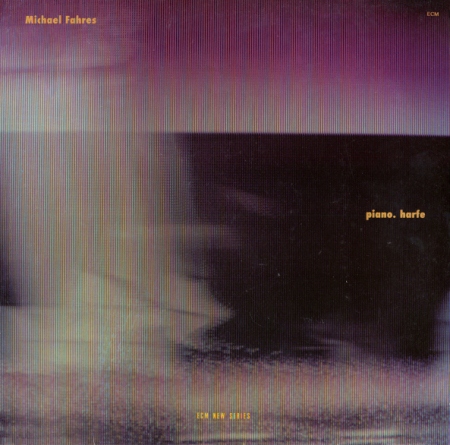
Michael Fahres: piano. harfe (ECM New Series 1281)

Michael Fahres
piano. harfe

Polo de Haas piano
Gyde Knebusch harp
Paul Godschalk live electronics
Hans Stibbe live electronics
Digital Recording, August 1982, Tonstudio Bauer, Ludwigsburg
Engineer: Martin Wieland
Produced by Manfred Eicher

German-born, Netherlands-based composer and sound installation artist Michael Fahres flirted with ECM for the duration of this single album only. Simply titled after its two central instruments, this vinyl-only rarity gives healthy intimations of the electro-acoustic depth for which he is now so highly regarded.

We find in both of these early pieces a sense of self-directed wonder, as if one’s reflection has come to life and danced a version of the future. The low note that spawns a taped echo in piano sets just such a tone. A crack in the window of our desires spiders its way to the edges, falling into the garden when it has nowhere else to go. Every shard sprouts legs and trips through the underbrush. Foxes and moles—each a clouded memory returning with soft vengeance—nip at their ankles like herding dogs. The live piano stares into a digital mirror. Thus confronted with its mortality, it grows still, like a foot poised above a landscape of eggshells. Behind closed eyes, it falls into looped miracles. The jangle at the periphery, never clear before, is now crystalline. Voices tremble, a flock of rubber bands falling one at a time into a synthetic gallop. Veins resonate, each the tube of a televised existence. Your hand passes through childhood like the illusion it is, a canopy of little legs kicking above its Alvin Lucier-like current. They crawl over one another as high as they can, growing more distorted with every promise, until there is only shadow to hold you.

But then, in harfe, strings are touched by flesh, each unfolding a city map. Streets hum like birth. (The atmosphere reminds me of a Zeena Parkins performance I once attended as a teenager: an undercurrent of restless comfort bedding naked scrawls.) Between watery ascents and muddy stumbles, someone speaks: “The voice of reason is the one that achieves distance.” There is a beating of the string, subtle and barely noticeable. A knock at the door of a museum where only the debris of earthquakes is shown. A meditation without eyes, a prickling of hairs, an imploding temple. There is something sacred implied here. Its transcendence melts into a single piece of candy, placed on a serpent’s tongue. The trees buckle their knees in guttural pathos, every torn root a string plucked by green hands. The sky awakens, pouring its flood into a restorative nightmare. Finis.

In spite of my unsettling impressions, I would never characterize this album as such. There is something hopeful about its inventiveness. In exploring the contours of ruin, it holds itself aloft, away from those whose only desire is to crush music into a dark key. The lock to that key is nowhere but here, floundering like a fish cradled back into a sea of twilight.

<< Jack DeJohnette’s Special Edition: Album Album (ECM 1280)
>> Chick Corea: Voyage (ECM 1282)
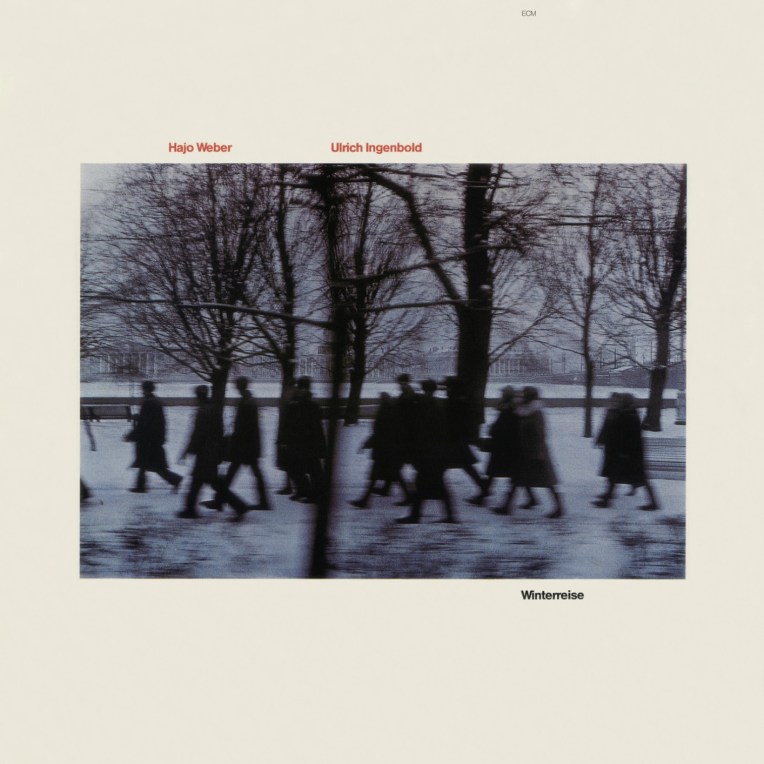
Hajo Weber/Ulrich Ingenbold: Winterreise (ECM 1235)

ECM 1235

Hajo Weber
Ulrich Ingenbold
Winterreise

Hajo Weber guitar
Ulrich Ingenbold guitars, flutes
Recorded March 1982 at Tonstudio Bauer, Ludwigsburg
Engineer: Martin Wieland
Produced by Manfred Eicher

I came as a stranger; as a stranger now I leave.

I know nothing of Hajo Weber and Ulrich Ingenbold beyond the incandescent duets these two guitarists buried in the snowy recesses of Winterreise (Winter Journey), one of ECM’s greatest forgotten treasures. The title, of course, evokes Schubert, and the comparison may not be so arbitrary, for like the famous song cycle it speaks with hushed clairvoyance. Weber and Ingenbold bring distinct flavor to this session, dividing themselves at four compositions apiece.

Weber’s are meandering. Filled with pauses and reflections, they measure the passage of time in breaths. Ingenbold gilds the wood-grained lily of “Der wundersame Weg” (The Miraculous Way) with a trembling flute. Gentle footsteps trade places with an unfamiliar cry, meditating on a horizon which, once distant, is now close enough to pluck and make music out of. “Zweifel” (Doubt) plays like its shadow, dancing through dreams as if this were the only possible means of expressing itself. The tides shift with “Drehung in der Luft” (Rotation in the Air), a floating reverie insulated from the cold, while the flamenco kiss of “Filmmusik” washes up on Aegean shores. The air is moist, glowing in the moon’s lantern light.

Ingenbold’s sound-world is more continuous, treating Weber’s backdrops as canvases for a virtuosic appliqué. His “Karussell” is the session’s masterstroke, and puts me in mind of the early cinematographs, spun into impossible animation through a gallery of slits, each the promise of an ephemeral life. The title cut teeters on a whisper. Amid a rustling of wings and tail feathers, the blade of uncertainty falls from the throat of time behind a shining veil of recollection. A child dances where children cannot be seen, but is safe beneath the snow, where spring hides from all. “Sommerregen” (Summer Rain) fulfills the promise made at the album’s outset. It is the Golden Fleece without curse, the light of better days without the pain of absence. We feel the wind on the rims of our ears, hoping for sunlight, but instead experience something far more invigorating: the song of melting ice. Ingenbold dons a flute’s clothing again in “Son’s Song.” A lullaby wrapped in dawn’s brittle skin, it wishes away evil even as Weber chases away the nightmares with his light. The music becomes flesh, the flesh becomes music, and the music becomes love.

Winterreise is a poetic diary that deserves only poetry in return, and ranks alongside Bill Connors’s Theme To The Gaurdian and Ralph Towner’s Solo Concert as one of ECM’s most evocative guitar dates. As long as a reissue seems unlikely, make this your first vinyl rediscovery.

<< Everyman Band: s/t (ECM 1234)
>> Arild Andersen: Molde Concert (ECM 1236)

Gary Burton Quintet: Whiz Kids (ECM 1329)


Gary Burton Quintet
Whiz Kids

Gary Burton vibraphone, marimba
Makoto Ozone piano
Tommy Smith saxophone
Steve Swallow bass
Martin Richards drums
Recorded June 1986, Tonstudio Bauer, Ludwigsburg
Engineer: Martin Wieland
Produced by Manfred Eicher

This aptly titled date from the Gary Burton Quintet showcases two wunderkinds: saxophonist Tommy Smith and pianist Makoto Ozone. It was Chick Corea who recommended the up-and-coming Smith, just 18 at the time, as a Burton sideman. One year later, Smith was thrust into the ECM spotlight, bringing his robust tenor voicing to one of the finest outfits in the business. And speaking of Corea, one would be hard-pressed to find a more kindred spirit than Ozone, who at 25 was already a longtime phenom in his native Japan, and whose tutelage at Berklee led him to work with Burton.

These talents are showcased not only technically, but also compositionally. Smith leads the way with “The Last Clown.” This warm, nocturnal cityscape is the perfect appetizer for what’s in store. The space afforded to every musician is a testament to the group’s democratic flair. Those unmistakable vibes glisten like rain-slicked streets, Burton taking his sweet time to let every note sing, while Ozone deepens the proceedings with every key he touches. Yet the pianist shines brightest in his own two upbeat contributions. Of these, “La Divetta” shows the group at its finest and is honed to a formidable edge by Smith’s aerial attack and the breakneck pacing of drummer Martin Richards. The balance of Ozone’s “Yellow Fever” is invigorating to say the least. Burton shows off his mindboggling precision, as do Smith and Ozone, one cream to the other’s coffee. Both of these pay homage to Corea, whose tune “The Loop” caps off a diamond-solid set. A couple of rarities complete the picture. “Soulful Bill” is a lovely ballad that features an even lovelier bass line from Steve Swallow, who dances with his own quiet magic through a gallery of fine solos. And the mid-tempo “Cool Train” brings on the love tenfold, especially in its sweeping pianism, which here recalls Bruce Hornsby.

The themes on Whiz Kids are ripe, the playing even more so, and the recording pristine. This is a quintessential example of ECM’s tender side, perfect for those lazy afternoons during which dreaming is the best kind of travel. Sadly, this smooth-as-silk recording would mark the end of Burton’s 14-year run on ECM. All the more appropriate, then, that his selfless respect for new generations of talent should take center stage.

<< Jon Hassell: Power Spot (ECM 1327)
>> Paul Hindemith: Viola Sonatas (ECM 1330-32 NS)

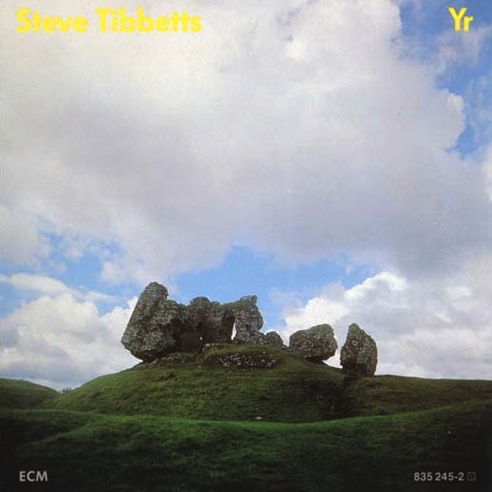
Steve Tibbetts: Yr (ECM 1355)


Steve Tibbetts
Yr

Steve Tibbetts guitars, kalimba, synthesizer
Marc Anderson congas, drums, percussion
Bob Hughes bass
Steve Cochrane tabla
Marcus Wise tabla
Tim Weinhold bongos, vase, bells
Recorded ca. 1980 at Atma-Sphere and Oxit Roxon, St. Paul
Engineer: Steve Tibbetts
Produced by Steve Tibbetts

Yr is yet another fascinating peek into the Steve Tibbetts sound-verse. The feeling of open plains that so characterized his previous efforts remains, only now the production is more immediate, such that the 12-string intimations unlocking the doors of “Ur” set us adrift in our own mysteries. Percussionist Marc Anderson soars, seeming to grow out of Tibbetts’s hollow-bodied heart before the heavy thrum of the latter’s electric curls itself into a ball and rolls down a hill of unrelenting melody. After an explosion of beats and guitars settles us into the soothing reverie of “Sphexes,” we find our expectations blotted by an interlude of kalimbas before Tibbetts spreads his buttery axe over this acoustic toast with sweetness in “Ten Years.” Fantastic. “One Day,” much like the opener, rises from the ashes of a campfire, but not without leaving an aftertaste of the prairie. “Three Primates” is a pocket of sunshine that shifts masterfully between tones and timbres. Now darkened by shadow, now blinded by noon, it dives headfirst to a tabla-infused conclusion. “You And It” is another shimmering slice of life. Backed by strings and icy sleigh bells, it breathes life into a new day. This opens the doors even wider, letting in the dawn’s early electric and unleashing a torrent of dreams made real. “The Alien Lounge” traipses through tall grasses, weaving past abandoned foxholes and memories of warm nights toward the starlight of “Ten Yr Dance,” spun like a home movie rewound to one’s first days on earth.

This is by far Tibbetts’s most uplifting date and one sure to win you over with its no-frills charm, emoting as it does with an artistry at which we can only shake our heads in wonder. It also shows just how deftly and appropriately he takes advantage of the studio, flipping prerecorded bits on end and adding just the right touch of electronics for depth. The spaces therein are constantly morphing, content to move on once they have achieved a certain kind of beauty while always looking forward to the next.

Timeless, as all Tibbetts releases are.

<< Oregon: Ecotopia (ECM 1354)
>> Pepl/Joos/Christensen: Cracked Mirrors (ECM 1356)

Lester Bowie’s Brass Fantasy: Avant Pop (ECM 1326)

Lester Bowie´s Brass Fantasy
Avant Pop

Lester Bowie trumpet
Stanton Davis trumpet
Malachi Thompson trumpet
Rasul Siddik trumpet
Steve Turre trombone
Frank Lacy trombone
Vincent Chancey French horn
Bob Stewart tuba
Phillip Wilson drums
Recorded March 1986, Tonstudio Bauer, Ludwigsburg
Engineer: Martin Wieland
Produced by Manfred Eicher

Lester Bowie’s Brass Fantasy is all about joy. The joy of making music, the joy of turning the popular inside out, revealing the beating heart of that which makes sound accessible. In this respect, the title of Avant Pop might as well mark the genre that this most talented trumpeter forged. And the sound? Aromatic, clean as a whistle, and affirmative. What with the heaping portions of brass sandwiched between Bob Stewart’s gorgeous tuba bass lines and Phillip Wilson’s otherworldly percussive colors, something’s bound to move you, sparking a dormant memory into animation.

Bowie pulls out all the stops on this album, blatting with ease through the opening waves of “The Emperor” and on into a lyrical rendition of “Saving All My Love For You.” The latter’s big band sound hits you right in the gut of your denial. Like a swing you never want to jump out of, it builds to a swooning climax. The vocal colors of “B Funk” add another spice to the stew and leave us spinning on “Blueberry Hill.” Stewart digs deep here and follows Bowie wherever he leads. Things get a little swanky in “Crazy,” while homage is the name of the game in “Macho (Dedicated To Machito),” which spins from a prayerful bell an infectious montuno vamp that would have made the Afro-Cuban jazz master proud. This is followed by “No Shit,” which besides having the honor of boasting the only curse word in the ECM lexicon (?) also gives us the album’s catchiest motif—a cross between “Pride and Joy” and a distorted C jam blues. “Oh What A Night” provides an irresistible and punchy conclusion.

Never has Bowie sounded so tonally corpulent, a feat only underlined by the superb engineering. And while he may blow shooting stars across a universe of familiar tunes, in this context we cannot help but hear them anew. The album is indeed a fantasy, not only in its backward glance but also in its very revival of popular song, which speaks to the sometimes-magical escapism of the form. Rather than enhance it, Bowie seems intent on bringing it down to earth in a crash landing of goodness. The breadth of idioms represented on Avant Pop is inspiring and barely scratches the surface of his legacy of wit and good cheer.

As epic as it is intimate, this is a sonic child that could only have been nurtured by a mind like his.

<< Arvo Pärt: Arbos (ECM 1325 NS)
>> Jon Hassell: Power Spot (ECM 1327)

Chick Corea: Septet (ECM 1297)

SEPTET

Chick Corea
Septet

Chick Corea piano
Ida Kavafian violin
Theodore Arm violin
Steven Tenenbom viola
Fred Sherry cello
Steve Kujala flute
Peter Gordon French horn
Recorded October 1984 at Mad Hatter Studios, Los Angeles
Engineer: Bernie Kirsh
Produced by Chick Corea

Chick Corea is a musician who plays with X-ray vision, which is to say he’s highly adept at animating skeletons through his improvisatory prowess. And yet, whenever those bones are fleshed out into full-grown compositional organisms, one tends to lose sight of their anatomy. With the exception of Children’s Songs, Corea excels where there is at least a combination of the prescribed and the free. On Septet he is joined by a string quartet, flutist Steve Kujala, and Peter Gordon on French horn. Already in the First Movement, we are confronted with the quartet’s somewhat pedantic role, which is at pains to blend with the otherwise lovely sound forged by Corea and Kujala (not suprising, given that they’d just cut the effervescent Voyage not three months before). That being said, there is a wistful vitality to be had in those occasional moments that said forces do sync, as in the Second Movement. Some gorgeous, abstract pianism distinguishes the opening waves of the Third, which, despite exploring the album’s more fascinating ideas, are quickly curtained by the horn. Things fare far better in the Fourth, with its Bartókian sense of rhythmic acuity, and in the richly varied Fifth. At 10 minutes in length, the latter is also the most fully formed. Tacked on to this picturesque finale is portrait of “The Temple of Isfahan” that could easily soundtrack a documentary about the temple in question, a sacred site to the Zoroastrians who saw its attributive fire as a purifying agent. Like a well-edited film, this piece builds itself through vignettes, which despite never quite connecting as organically as they might have had they been left to speak among themselves, form a larger chain of ideas that must be taken in deep breaths before they can be exhaled as one.

It’s hard to know what to make of this album. What it lacks at the start, it certainly makes up for by the end, but it doesn’t necessarily beg for repeated listening. The musicianship is also top flight, especially the lovely playing of Gordon, who wrenches a gutsy and artful sound from his horn, and in the peerless virtuosity of Kujala. A lovely jewel for the completest, to be sure, but its absence would make Corea’s crown no less bright.

<< Lester Bowie’s Brass Fantasy: I Only Have Eyes For You (ECM 1296)
>> Azimuth: Azimuth ’85 (ECM 1298)

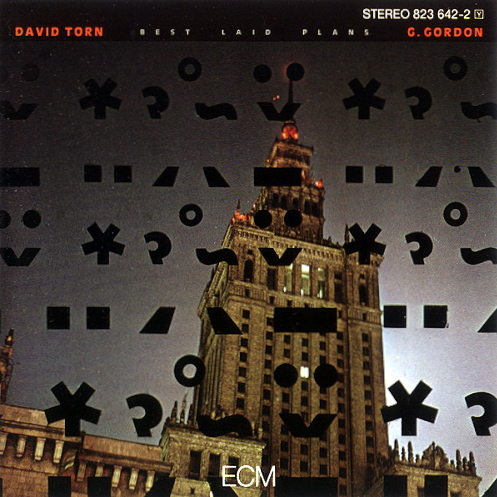
David Torn: Best Laid Plans (ECM 1284)

David Torn
Best Laid Plans

David Torn guitars
Geoffrey Gordon percussion
Recorded July 1984 at Rainbow Studio, Oslo
Engineer: Jan Erik Kongshaug
Produced by Manfred Eicher

David Torn is one of the more indefinable guitarists on planet Earth and has left an alluring hatching of marks on ECM’s wall. Vivid among them is this unusual session with percussionist Geoffrey Gordon. Their pastiche navigates a territory that lies somewhere between Elliott Sharp, Steve Tibbetts, Terje Rypdal, and Bill Frisell. Torn’s electric is a storm of spirals and tails, surges and dissolves. The smooth arpeggios and inevitable disruptions of “Before The Bitter Wind” and the title track project a life lived through dreams and nightmares alike. The glow of “The Hum Of Its Parts” unfolds through Torn’s itching and pliant core, dramatized by Gordon’s highly connected tabla. One highlight, if in name only, is “Removable Tongue,” a guitar solo that twists its way around a relatively melodic caduceus and seems to have a good influence on “In The Fifth Direction,” which is perhaps the most unified blend of rhythm and texture on the album. After the sweltering heat rash of “Two Face Flash,” Torn rattles the firmament with “Angle of Incidents,” every grating cry a search for lost questions to extant answers.

Torn’s playing is a unique beast. It is oblique in such a way that, even when fully formed, it remains somehow distant, calling to us as if from the future and gone by the time we catch up. The best we can do is to stand where we are and wait for its evocative disintegration.

<< Paul Motian Trio: it should’ve happened a long time ago (ECM 1283)
>> Bruno Ganz: Hölderlin – Gedichte gelesen von Bruno Ganz (ECM 1285 NS)

Chick Corea: Voyage (ECM 1282)

Chick Corea
Voyage

Chick Corea piano
Steve Kujala flute
Recorded July 1984 at Tonstudio Bauer, Ludwigsburg
Engineer: Martin Wieland
Produced by Manfred Eicher

Steve Kujala is a flutist of exceptional ability known for his “bending” and other extended techniques, which immediately distinguish his sound from anyone else’s. After touring with Chick Corea in the early eighties, the two of them stepped into the studio to record Voyage, a shuffled yet modest deck of three Corea originals and two freely improvised interludes. Though a suitable companion to Red Lanta, this duo session could hardly be more different. As musicians both well versed in the avant-garde, Kujala and Corea forge an undeniably cerebral brand of magic. The lushness of “Mallorca,” for example might easily blind us to the microscopic approach of “Star Island,” for where the former dances like some ethereal Flamenco reflection, threaded by birdsong and fast-forwarded tongue fluttering, the latter is a piano solo that indeed takes form like a dollop of land in an oceanic expanse. It is also the deeply beating heart of the album, a stunning piece of wizardry that could easily run its entire course without ever growing fatigued. Corea continues this subdued brilliance in his intro to “Free Fall” before Kujala makes his theatrical entrance, singing to us of days and years gone by. This is much in contrast to “Diversions,” a far more abstract intertwining of airy improvisations which, even after their rousing finish, leave us scrambling for narrative traction. “Hong Kong” is also very abstract, but by way of its title at least gives us a place to hold on to. Like that city’s bustling streets, connections come and go as they please, sometimes utterly unaware of one another in the constant blur of lights, faces, and smells.

This is a highlight in the Corea discography on any label and an ideal opportunity to discover, as I did, a flutist of outstanding innovation along the way.

<< Michael Fahres: piano. harfe (ECM 1281 NS)
>> Paul Motian Trio: it should’ve happened a long time ago (ECM 1283)

Pierre Favre Ensemble: Singing Drums (ECM 1274)

ECM 1274

Pierre Favre Ensemble
Singing Drums

Pierre Favre drums, gongs, crotales, cymbals
Paul Motian drums, gongs, crotales, calebasses, rodbrushes
Fredy Studer drums, gongs, cymbals
Nana Vasconcelos berimbau, voice, tympani, conga, water pot, shakers, bells
Recorded May 27 and 28, 1984, Mohren, Willisau
Engineer: Martin Wieland
Produced by Manfred Eicher

Singing Drums brings together some of ECM’s most formidable percussionists in this one-off incarnation of the Pierre Favre Ensemble. For this date, Favre welcomes Paul Motian, Fredy Studer, and Nana Vasconcelos into his fold. The results are, while brilliant, likely to be overlooked due to the special interest of its instrumental makeup. Let this not deter anyone, however, from experiencing its wonders. What I love most about this session is that each player’s style is so instantly recognizable. Between the twangy call of Vasconcelos’s berimbau, the crotales of Favre, the delicate cymbals of Studer, and Motian’s earthly patter, we can easily tease out every thread of conversation being woven before us.

One finds in these atmospheres broad intimations of times and places, a blurring of geographic and cultural signatures into a mosaic of worldly mindedness, a space where human and animal blur into one another, such that the hands of the player become the keen pounce of a lion in the bush and the leap of the gazelle who thwarts it. Drones and footsteps exchange glances amid the branches of the opening “Rain Forest,” while other tracks like “Metal Birds” work in more clipped gestures. Vasconcelos’s chanting is a vital thread here, and seeks only to enhance the pitch-bent drums and other sinuous energies around him.

This is a profound album of subtle creativity that gets only deeper with every listen. Anyone who knows these performers will not expect an all-out frenzy, but the careful and porous readings of “Edge Of The Wing” and “Prism,” not to mention the whispered accents of “Frog Song.” Theirs is a journey both of anthropology and dislocation, a masterful text written “Beyond The Blue,” which leaves us to ponder the cries of our ancestors, as countless as the stars above our heads.

<< Art Ensemble of Chicago: The Third Decade (ECM 1273)
>> Arvo Pärt: Tabula rasa (ECM 1275 NS)