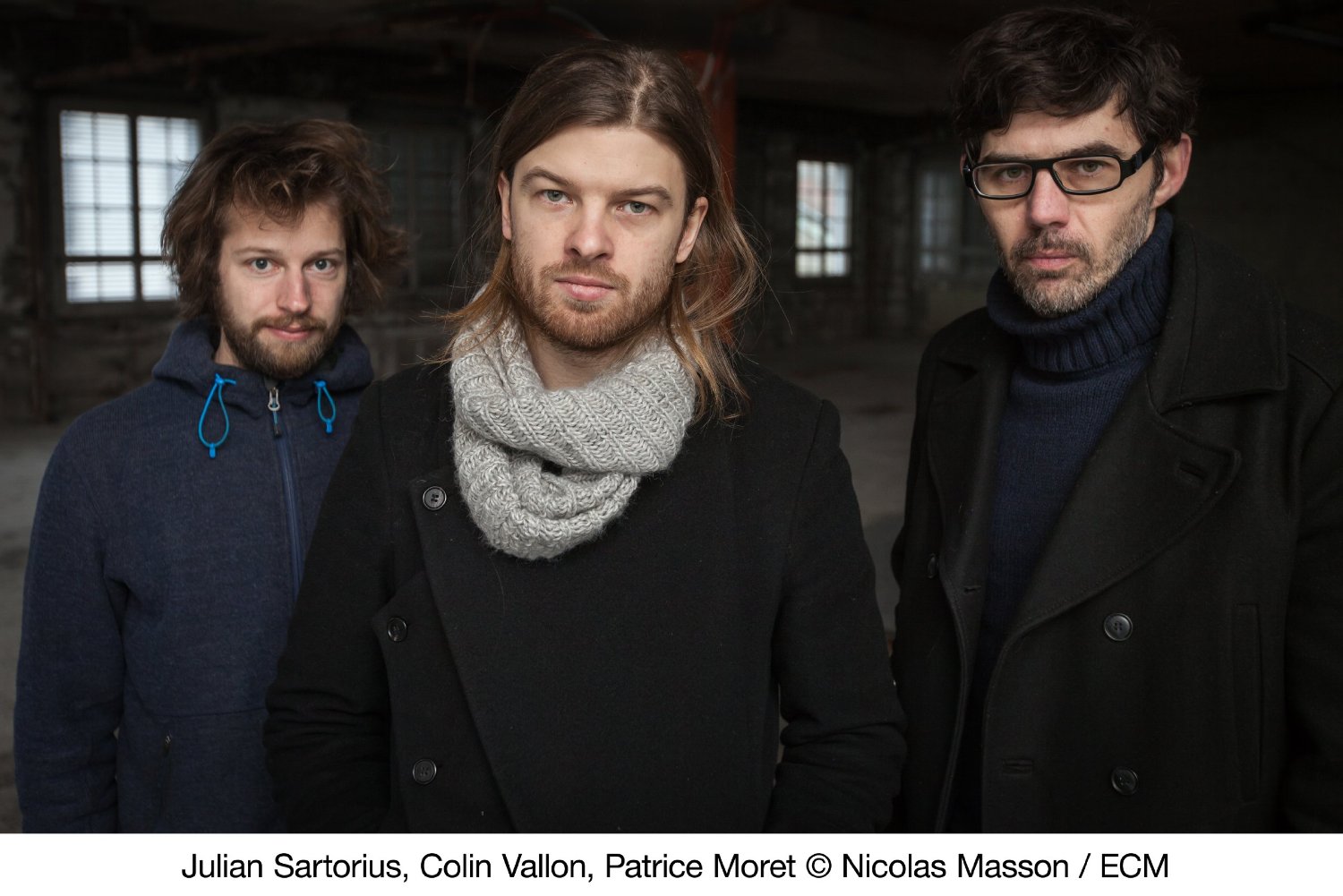
Colin Vallon Trio: Le Vent (ECM 2347)

Le Vent

Colin Vallon Trio
Le Vent

Colin Vallon piano
Patrice Moret double bass
Julian Sartorius drums
Recorded April 2013 at Rainbow Studio, Oslo
Engineer: Jan Erik Kongshaug
Produced by Manfred Eicher

Rruga marked the ECM debut of a peerless piano trio, and with that release opened new doors for the format. Pianist Colin Vallon again joins bassist Patrice Moret, and together with new drummer Julian Sartorius they unhinge those doors in absence of need. With an even more refined geometry, one that borders on white magic, these three young men quietly draft an unforgettable statement for the 21st century. Aside from being a master class in texture and atmosphere, Le Vent mines the element of surprise as if it were ore in rock. As the trio builds its quarry, it reveals itself as a creature of ritual. If Tord Gustavsen’s trio is the x axis (marking time) and Bobo Stenson’s is the y (marking distance), then Vallon’s selfless band is the z, by which we might gauge jazz’s inter-dimensional potential.
Vallon Trio

Moret’s sole compositional offering is also the album’s most significant. “Juuichi” opens the set with pulsing, unified chords. The title is an intriguing one, being Japanese for the number 11, and could refer to many things (I’m inclined to think of it as related to the stumbling time signature that shadows its every move). Growing in brightness and presence, it builds toward quiet reflection, spawning a tide of minnows. One immediately notices the care with which the trio builds its sonic worlds, each an ode to the value of patience. These musicians prove that, while indeed the best things come to those who wait, one must make music of the waiting for art to be born.

Skipping to the album’s end lands us in two freely improvised tracks: “Styx” and “Coriolis.” Both highlight Sartorius’s delicacy with brush and wand as he un-knots planks of wood until the album’s vessel resigns itself to a beautiful sinking. In these final statements are whispers of many others to come.

Between these two shores churns an ocean of Vallon originals, of which the title track further emphasizes Sartorius’s climatic tendencies. Here the melody from the composer’s fingers crystallizes like an icicle, but not before it traces a heart on a fogged train window. Though closed, that window allows a breath of current to make its briny notes known, a scent fecund with origins. Yet each time the trio switches tracks, it sets the tundra aflame with poetry.

Moret is a thrumming force, here and throughout, providing anchorage in “Immobile” and tactility to the soft-hued flames of “Cendre.” Elsewhere, he gives validity to every state, be it the protracted undulation of “Fade,” the bittersweet “Goodbye,” or even a clouded hint of “Rouge.” He also sets off evocative interactions between piano and cymbals, which in “Pixels” are light and glass.

Like grief, Vallon and his bandmates do not deny the immovable wedge of melancholy but grow larger to contain it. They are young in body but possess old souls, each with a space for the others in the name of living.
The Hilliard Ensemble: Il Cor Tristo (ECM New Series 2346)

2346 X

The Hilliard Ensemble
Il Cor Tristo

David James countertenor
Rogers Covey-Crump tenor
Steven Harrold tenor
Gordon Jones baritone
Recorded November 2012, Propstei St. Gerold
Engineer: Peter Laenger
Produced by Manfred Eicher

Throughout a four decades-long career, the Hilliard Ensemble has astonished with a vocal style so fluid yet so clearly textured that sometimes the inhales tell as much of the story as the exhales. There is, in no uncertain terms, something topographic about the Hilliards’ singing, which arcs and swivels like the mapmaker’s oldest instruments. Tenors Rogers Covey-Crump and Steven Harrold are particularly noteworthy as a core thread of the present recording, although it is baritone Gordon Jones who anchors Roger Marsh’s settings of Cantos 32 and 33 from Dante Alighieri’s Inferno with the added weight of guttural, chant-like singing. Written for the ensemble in 2008, Marsh’s title work (meaning “Misery of the heart”) is a masterful addition to the repertoire. Although it shares certain affinities with the rest of the program, one may ignore any marketing attempts to characterize its juxtaposition with the Renaissance works featured herein works as “seamless.” It is, rather fascinatingly, distinct for its organic irregularities. With a more stream-of-consciousness, recitational style, Marsh calls upon the voices to dig into Dante as if he were the very soil, until the Florentine poet’s underworld widens before us, where heads of betrayers lodged a frozen lake become tripping stones to his narrative other. Marsh’s remarkably astute writing and the Hilliards’ embodied diction make for a dramatic experience. In an explanatory liner note, the composer bids the listener to listen to these Cantos not merely for their harmony, but also for their poetry. Consequently, this release begs ownership of a physical copy. How else, then, might one appreciate Dante’s disturbing conversation of the disembodied, or the delicacy with which he and those tuneful tenors have “passed onward” into the next circle?

Francesco Petrarca, otherwise known as Petrarch, is the textual subject of interest for Bernardo Pisano (1490-1548) and Jacques Arcadelt (c. 1507-1568). The poems now focus on a rather different misery of the heart, calling on the powers that be more often to extinguish its yearnings than to chase them away by fire. Pisano’s settings are headlong excursions. Between the swift resolutions of Or vedi, Amor (Now you see, Love) and the ponderous circularities of Che debb’io far? (What must I do?), the Hilliards lead a deluge of probing sentiments. The freshness of their performance enhances Pisano’s sly arranging, which runs the gamut from lively and swinging to flowing and evenhanded. And the singers’ dynamic mastery is nowhere so beautifully tested than in Ne la stagion (At the moment), a trio of self-deprecating stanzas on the art of solitude.

Solitude further reigns over Arcadelt’s own settings, which yield some of the album’s fairest skies. The robustness of Solo e pensoso (Alone and thoughtful) sits self-interestedly on the shore of L’aere gravato (The heavy air). The latter is an ideal vehicle for David James, whose voice brings tidings of pulchritude wherever it may tread. Tutto ’l dí piango (All day I weep) likewise spotlights the countertenor and boasts some of the most pristine ensemble singing of the Hillards’ ECM tenure. And like Petrarch, who in that last verse is grieved by the failings of others more than his own, they seem to embrace the listener as an extension of their giving selves, trading fortune for a candle doused by the breath of a turning face.

(To hear samples of Il Cor Tristo, click here.)

Momo Kodama: La vallée des cloches (ECM New Series 2343)

La valée des cloches

Momo Kodama
La vallée des cloches

Momo Kodama piano
Recorded September 2012, Historischer Reitstadel, Neumarkt
Engineer: Stephan Schellmann
Produced by Manfred Eicher

As of late, ECM’s New Series imprint seems to be on a mission to prove that impressionism in classical music is, if anything, an exercise in clarity. This has been the message behind such releases as Tre Voci and Alexei Lubimov’s account of the Debussy Préludes. Joining these debunkers is distinguished pianist Momo Kodama, whose first solo recital for the label is sublime as crystal.

The title (which translates to “The valley of the bells”) of her characteristic program comes from Maurice Ravel’s Miroirs. This five-part gallery of expressionist vignettes wants for nothing in environmental fidelity. Each is an embodiment of its image, and then some. The first two pieces, “Noctuelles” (Night moths) and “Oiseaux tristes” (Sorrowful birds), are together a study in contrasts, juxtaposing the former’s dreamlike wing-beats, which by slightest touch of pond’s surface scatter minnows in sunbursts of activity, and the latter’s methodical gravidity, which transgresses memory like a cigarette through silk. Already obvious at this point is Kodama’s meticulous pressure, her balancing of strength and fragility. She adds leagues to “Une barque sur l’océan” (A boat on the ocean). Like a ballerina dissolving one cell at a time, it pirouettes into a dream of wind and sail, as if one were the inverse of the other. “Alborada del gracioso” (Mornign song of the jester), on the other hand, has a Spanish flavor, made all the more vibrant for its dissonances and reflective detours, while the final bells make for some strangely provocative reflections.

Momo Kodama

At the other end of the album’s spectrum is Olivier Messiaen, a composer close to Kodama’s heart and whose La fauvette des jardins is a wonder. Something of an extension of the Catalogue d’oiseaux, a recording of which Kodama released to great acclaim on the Triton label in 2011, it presents formidable challenges to the musician by way of its affective variety. An ashen foundation in the piano’s lower register contrasts and diffuses the upward motions that follow, lighting the way with the breath of a thousand torches. Its paroxysms are decidedly spiritual. Through them salvation sings with the notecraft of insects. A restlessness of servitude pervades. It speaks through contact of flesh and bone, not tongue and breath. The piece’s negotiation of the progressive and the regressive is ideally suited to Kodama, who transforms its turbulence into an opportunity for reflection, such that its consonances feel exhausting in their orthodoxy.

Considering that Tōru Takemitsu was such a great admirer of both Debussy and Messiaen, his Rain Tree Sketch makes for effortless company. Occupying as it does the center of the program, one might feel tempted to read it as filler or segue from one French master to the other. In Kodama’s practice, however, it holds its own as a robust work of art. Takemitsu was, of course, a prolific film composer in his native Japan, and his experiences in that capacity seems to have carried over into his later works, of which this is but one evocative example. The illustrative strengths explored in the work introduce another relationship of balance into Kodama’s toolkit—this between circular and linear forms—and does so with meditative attention paid to the underlying touch of things. Like the musician herself, Takemitsu’s idea of a sketch is full enough to be called consummate.

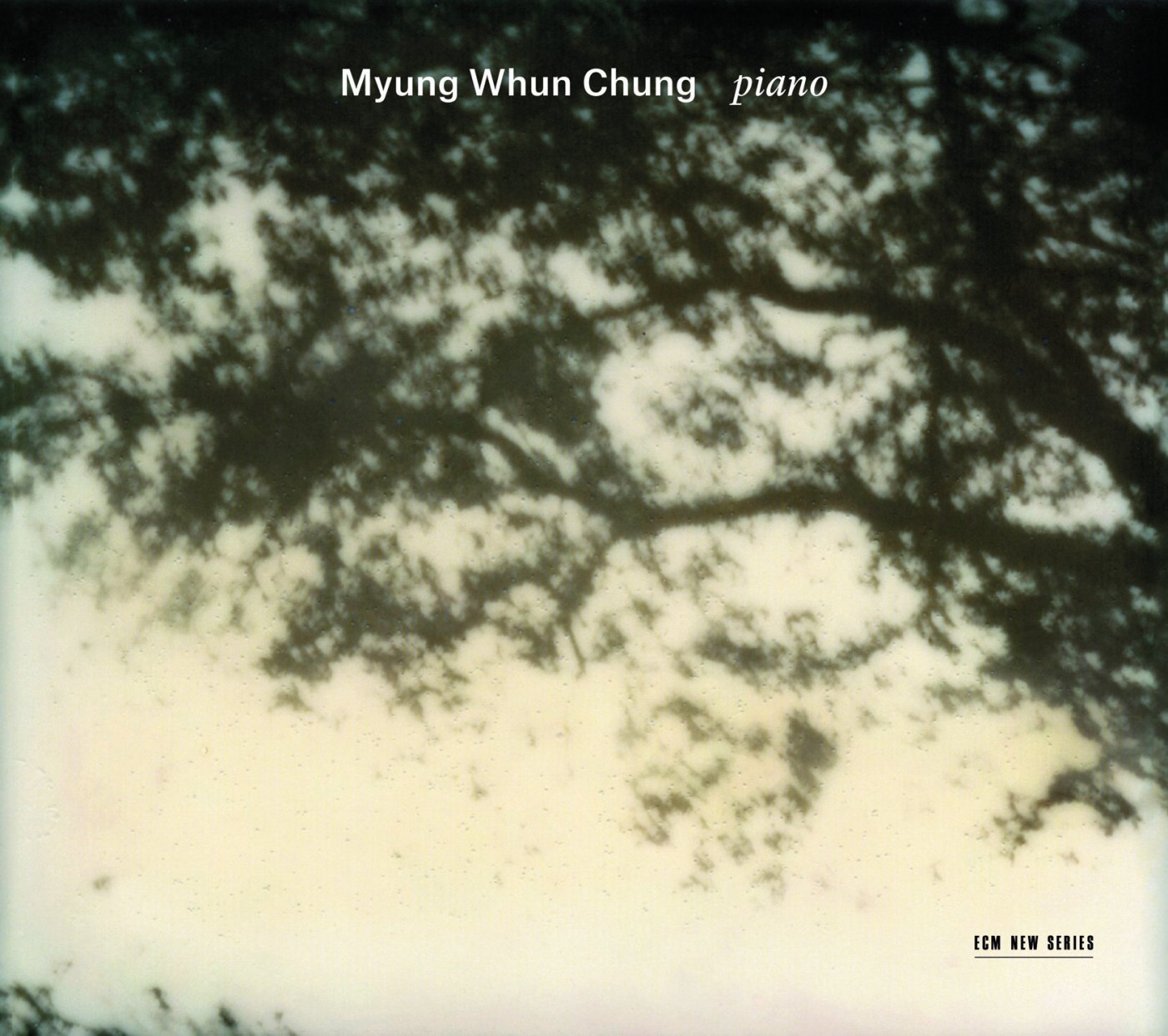
Myung Whun Chung: piano (ECM New Series 2342)

piano

Myung Whun Chung
piano

Myung Whun Chung piano
Recorded July 2013, Teatro La Fenice, Venice
Engineer: Rainer Maillard
Produced by Manfred Eicher

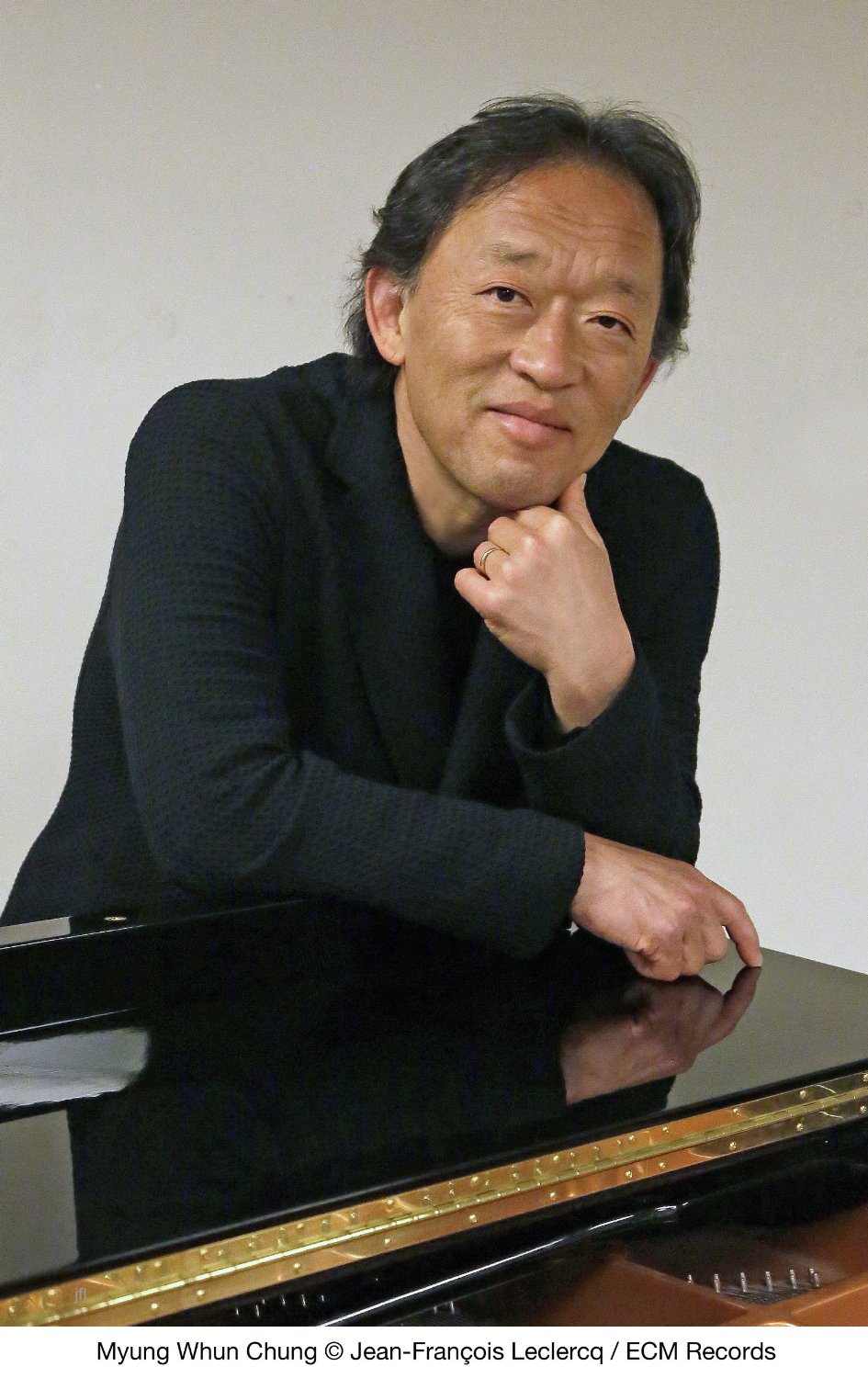
“I believe that musicians are only responsible for half of the real musical experience—the other half must be done by the listener. How one listens and receives the music is perhaps the most important gesture.” So writes Myung Whun Chung in a gracious liner note accompanying his ECM debut. One could receive no more fitting an invitation to a program for which the renowned conductor puts down his baton and takes to the piano, sharing his thoughtful inscriptions across some of the most immovable palimpsests of the classical canon.

In keeping with the spirit of listening, his barely titled piano is more a gift than a recital. It is also a brilliant instance of presentation, and of music’s personal necessity. The melodies we will know—some by name, others by association, each so ingrained in our subconscious that they would seem to exist of their own impulse.

Myung Whun Chung

Chung’s forte is his commitment to texture. True to reputation as a conductor, his interpretations are remarkable for their studied pacing and dynamic appropriateness. The giants of the set list are also its greatest ambassadors for intimacy. Among them, Debussy’s Clair de Lune is paramount. Yet where this much-copied painting, excised from the composer’s Suite bergamasque, so often drifts through our outstretched hands, in Chung’s it has palpable elasticity, made material by a heartfelt triangulation of playing, instrument, and engineering. His Für Elise is likewise weighed, Beethoven’s castaway gem taking on a driven quality through a balance of whimsy and despair.

Intimacy also reigns over Chopin’s Nocturnes in D-flat Major, op. 27/2 and in c-sharp minor, op. posth. Chung draws out the fidelity of their singing and underlying dance, walking that ephemeral path between slumber and waking. Even Mozart’s twelve Variations on “Ah! Vous dirais-je, maman” (better known to many as “Twinkle, Twinkle, Little Star”) don a patina of solitude. Despite their jovial development, they retain a cerebral edge that looks back to Bach even as it looks ahead to Beethoven, and conjures up imagery of self-enclosed genius.

Even with all the evening hymns, two Schubert Impromptus—these in E-flat Major, D899/2 and G-flat Major, D899/3—render the album’s darkest shades. Lovely in their own way, not least of all by their performer’s evocative makeover, they clutch within their sparkling ribcages hearts of unresolved tensions. So too do Schumann’s melancholy Träumerei and whimsical Arabeske, each an ode to closed eyes. Yet nowhere do Chung’s intentions take such unforced flight as in Tchaikovsky’s Autumn Song, in which he gives proper attention to the open spaces of the score, allowing them to breathe so that we may share in that breath.

I can assure you that none of the above is mere reviewer’s hyperbole. To dismiss it as such is to misrecognize the music’s inherency and the selflessness with which it is presented. You will, of course, hear these pieces again, just as you have heard them many times before, but it is unlikely that you will find them so lovingly unpacked. This is music that recognizes us before we recognize it.

(To hear samples of piano, you may watch the video above or click here.)

Erkki-Sven Tüür: Seventh Symphony/Piano Concerto (ECM New Series 2341)

Seventh Symphony

Erkki-Sven Tüür
Seventh Symphony/Piano Concerto

Laura Mikkola piano
Frankfurt Radio Symphony Orchestra
Paavo Järvi conductor
NDR Choir
Werner Has Hage choirmaster
Recorded June 2009 at Alte Oper, Frankfurt and June 2010 at hr-Sendesaal, Frankfurt
Recording producers: Eckhard Glauche (Piano Concerto) and Hans Bernhard Bätzing (Symphony No. 7)
Recording engineer: Thomas Eschler
Executive producer (hr): Andrea Zietzschmann
An ECM/Hessischer Rundfunk (hr) co-production

We are what we think.
All that we are arises with our thoughts.
With our thoughts, we make our world.
–Siddhartha Gautama

ECM’s sixth New Series album dedicated to Erkki-Sven Tüür spins the Estonian composer’s pen like the hand of a great karmic clock until it lands on some of his most ambitious writing to date. Tüür has come a long way since being introduced to ECM listeners on Crystallisatio, changing his compositional method not only nominally but also materially as he branches further into the cosmos by means of more orthodox assemblages. No longer do we get the standalone tone poems, the vocal juggernauts, or architectonic fragmentations—or, it might be more accurate to say, we get all of these together, now compounded into a fresher biological code, the dots and dashes of which find kindred souls on the pages of two massive scores in the proverbial formats of symphony and concerto.

The Piano Concerto of 2006 resounds with consciousness. Laura Mikkola is the soloist, nestled in the silvery tones of the Frankfurt Radio Symphony Orchestra, under Paavo Järvi’s erudite direction. Although the concerto assumes a tripartite structure, each movement dovetails into the next by means of an inexhaustible life force. The low piano hit and high bell that open the piece are pure Tüür: compactly dynamic and self-aware. Like the outer rim of an eclipse, it exposes arcs of fire normally obscured by the sun’s extroverted shine. This change of light allows us to see that everything is quilted. Due to its fragmentary grammar, the piano allows us to perceive only the asteroids it gifts to the atmosphere. Mikkola takes on no small task in finger-pedaling fault lines along the orchestra’s landscape. Fans will note the flutes from Crystallisatio making a distant cameo, but find them short-lived and intermittent in the grander scheme at hand. And while the piano, as a compositional tool, is this music’s genesis, in performance it feels rather like a membrane of intellectual freedom.

If the first movement is interactive, the second is retroactive. The beauties of the latter’s solo piano introduction cannot be emphasized enough. It’s wonderful to hear Tüür’s piano writing in unaccompanied snippets, for these reveal a composer who gathers his sweep with nothing wasted. The string writing in this instance is overtly narrative in style, cutting the scene with razor-thin sheets of rain and giving more pronounced voice to percussion and brass. A jazz piano trio signals the final movement, which morphs into a deep-space drone of starlight and comet-tail blues. Whether one sees such idiomatic choices as tried or true, they nevertheless tease out a playful heart beneath all overlap.

EST

The Symphony No. 7, subtitled “Pietas” (Devotion), is something of a spiritual hodgepodge. Dedicated to Tenzin Gyatso (the Dalai Lama) and his lifelong endeavors, it pairs the same orchestra with the NDR Choir, singing words attributed to the historical Buddha (from the collection known as the Dhammapada), as well as a lyrical potpourri from such diverse sources as Jimi Hendrix, Saint Augustine, Mother Teresa, and Deepak Chopra. Any opinions about its interfaith message are easily quelled by the symphony’s command of scope, which becomes more microscopic the larger it grows. Like the minnow to the frog, it speaks in origins.

So vast is Tüür’s vision that one can hardly be surprised at the entrance of the chorus, because the singers seem built of the same primordial stuff. The relationship between elements—strings, percussion, winds, and voices—is one of neither construction nor deconstruction, for they swim in parallel. The second movement hurtles its satellites farther into space, catching them in galactic nets with athletic precision. The third begins in helical spirals of brass and timpani but becomes more jagged with polyglot idioms. This leaves the 20-minute final movement, which is a symphony unto itself. There is a thick undercurrent to the singing, as if barely hanging on for all its gravidity, which is then atomized by the orchestra’s gradual materialization. Heavenly geometries unfold overhead, even as shadows crystallize below. Strings take on increasingly vocal qualities in the “thrown-ness” of their utterances, uniting with choir into a closing benediction of vibraphone.

Tüür seems always to have abided by his own string theory and awareness of the interconnectedness of things. In a marketplace where fellow Estonian Arvo Pärt has dominated contemporary classical music’s outreach even to those professing little interest in the genre, I can only hope that Tüür will continue to gain wider recognition for his comparable mastery and that others will realize there’s a little bit of all of us in the genetic evolution of his compositional voice.

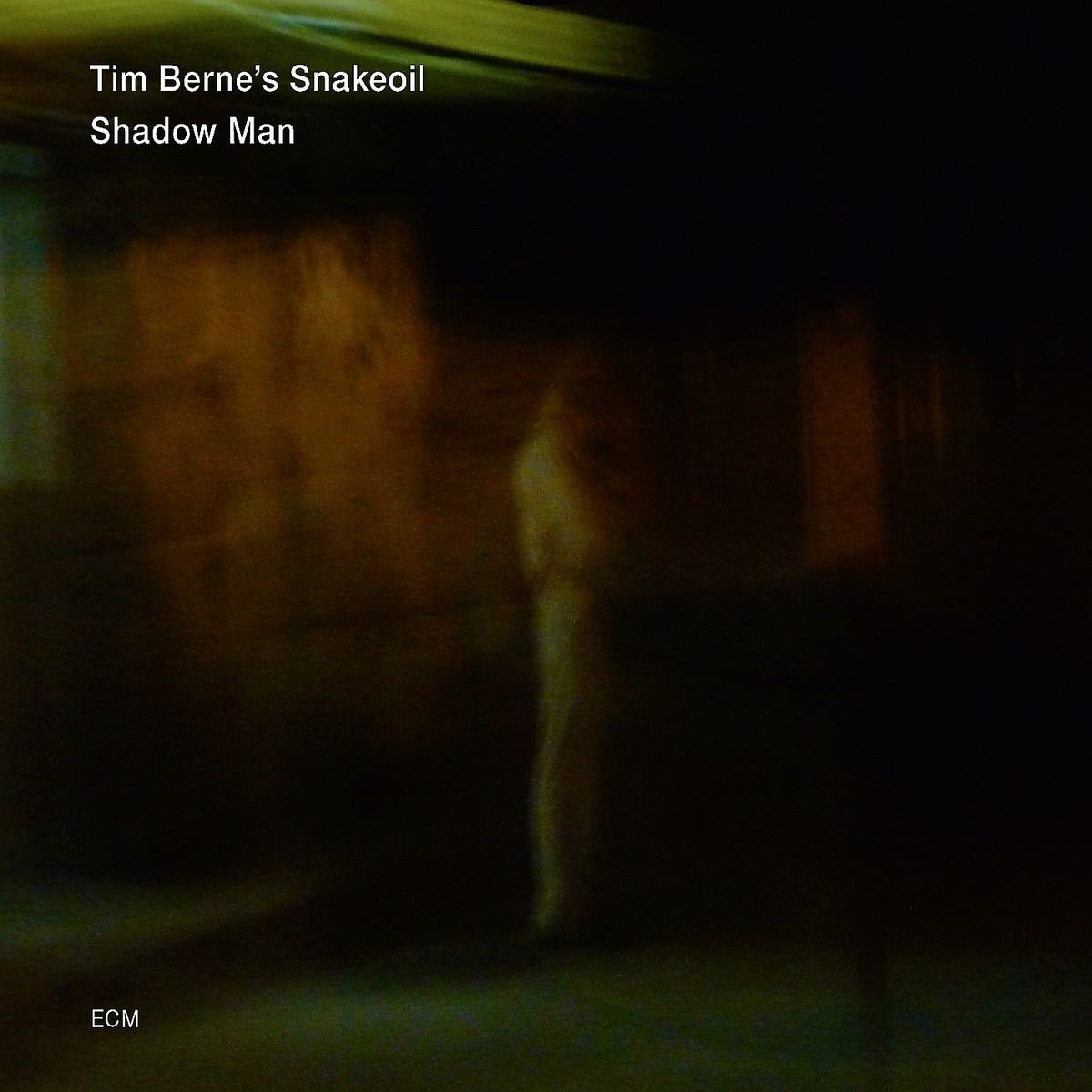
Tim Berne’s Snakeoil: Shadow Man (ECM 2339)

Shadow Man

Time Berne’s Snakeoil
Shadow Man

Tim Berne alto saxophone
Oscar Noriega clarinet, bass clarinet
Matt Mitchell piano
Ches Smith drums, vibraphone, percussion
Recorded January 2013 at Clubhouse, New York
Engineer: Joe Branciforte
Assistant: Bella Blasko
Mixed by David Torn at Cell Labs
Produced by David Torn and Tim Berne

In the world of Tim Berne’s Snakeoil, openness is the new closure. Having boomed into the ECM airspace with its self-titled debut, this band of powerhouse New Yorkers was ripe for a second coming. And in the throes of Shadow Man, it’s impossible to witness the musicians’ leaps of evolution and intuition and not be moved. We might easily throw around words like “cerebral” or “complex” to describe what’s going on here, but at the end of the way what really matters is its emotional impact, and this it possesses in spades. This is music that does more than speak to the listener; it embodies the listener.

With an average length of 12 minutes, and one track clocking in at just shy of 23, the album’s six tunes are more than that. They are living, breathing entities. The one outlier—or should I say inlier?—of the set is Paul Motian’s “Psalm,” which receives a heartfelt duo treatment from Berne and pianist Matt Mitchell. With such breadth of expression spilling from his alto (at points, one might swear it was a tenor), Berne is an ideal interpreter for this classic melody. The rest of the album is from his pen, thereby leaving us with far more dimensional puzzles to put together. Opening the occasion is “Son Of Not So Sure,” which begins in mid-utterance. The array of sounds elicited by drummer-percussionist Ches Smith is nothing to balk at. He is the creaking gate in the back yard, the window left open and the flies seeking refuge from the heat through it, the latch long untended and hanging by one last thread of the screw. Mitchell meanwhile sifts through the keys like memories and replaces them with fresh experiences. Only then does the bass clarinet of Oscar Noriega reveal its profile as Smith switches to vibraphone, calling forth some enchanting distortions. Through this, Berne and Mitchell join melodic hands in a collective reach toward the cooling stars. The stage is set.

Smith grabs more spotlight in the knottier “Static.” The mood is, of course, anything but. Noriega’s early solo on the lower reed founds Berne’s altoism, which in turn gets folded into Mitchell’s well-kneaded filo. Like some nocturne turned fierce, the tune moves with all the illusion of a Jacob’s Ladder toy—which is to say, in pursuit of the next idea with yet another already in mind—toward a strong-armed finish. Yet despite these moments of shine, the band is a well-oiled machine of which no cog is dispensable. Nowhere does this assertion hold more water than in the juggernaut “OC/DC.” A masterpiece for its length as much as for its strength, in swims through Berne’s meticulous tangle in a protracted degaussing of the proverbial screen. From the rubble of information before us, he builds a new icon, cell by cell, by which to double-click our acceptance. That the quartet dives into full-on, ecstatic control means less than it seems to say. Chaos is its mantra, because chaos fills in the gaps we are afraid to acknowledge. Mitchell on drums punches the spike, as it were, as Berne spits the sonic equivalent of an urban legend: so beguiling that it just might be true. Even when Noriega’s clarinet goes off by its lonesome for a bird’s eye view of what’s been left behind, it does this with a yearning to fall. This tune is so sharp, it can’t even handle itself without bleeding.

The 19-minute “Socket” is another evolutionary wonder. At any given moment of its passage, Berne speaks in two linear tongues, switching between them at will, while bass clarinet adds a third, internal register. Mitchell’s punctuations are liberal but on point, just as the others walk fault lines into coda. “Cornered (Duck)” tears off three minutes from the former’s duration like a chunk of taffy stretched between the two reedmen. With even greater attention to detail, the band plots its course here one angle at a time until sparkle becomes strangle.

It’s worth remarking on the album’s production, which puts Berne and David Torn at the mixing board—an unsurprising meeting of minds, given that the two appeared together on the legendary guitarist’s Prezens back in 2007. Here they have achieved the feeling of a live performance with all the lucidity of the studio. This was, in fact, Berne’s goal all along, and having seen Snakeoil perform some of these tunes live in Munich, I can attest to the validity of their capture.

There’s no such thing as the future of jazz. It’s already here.

(To hear samples of Shadow Man, click here.)

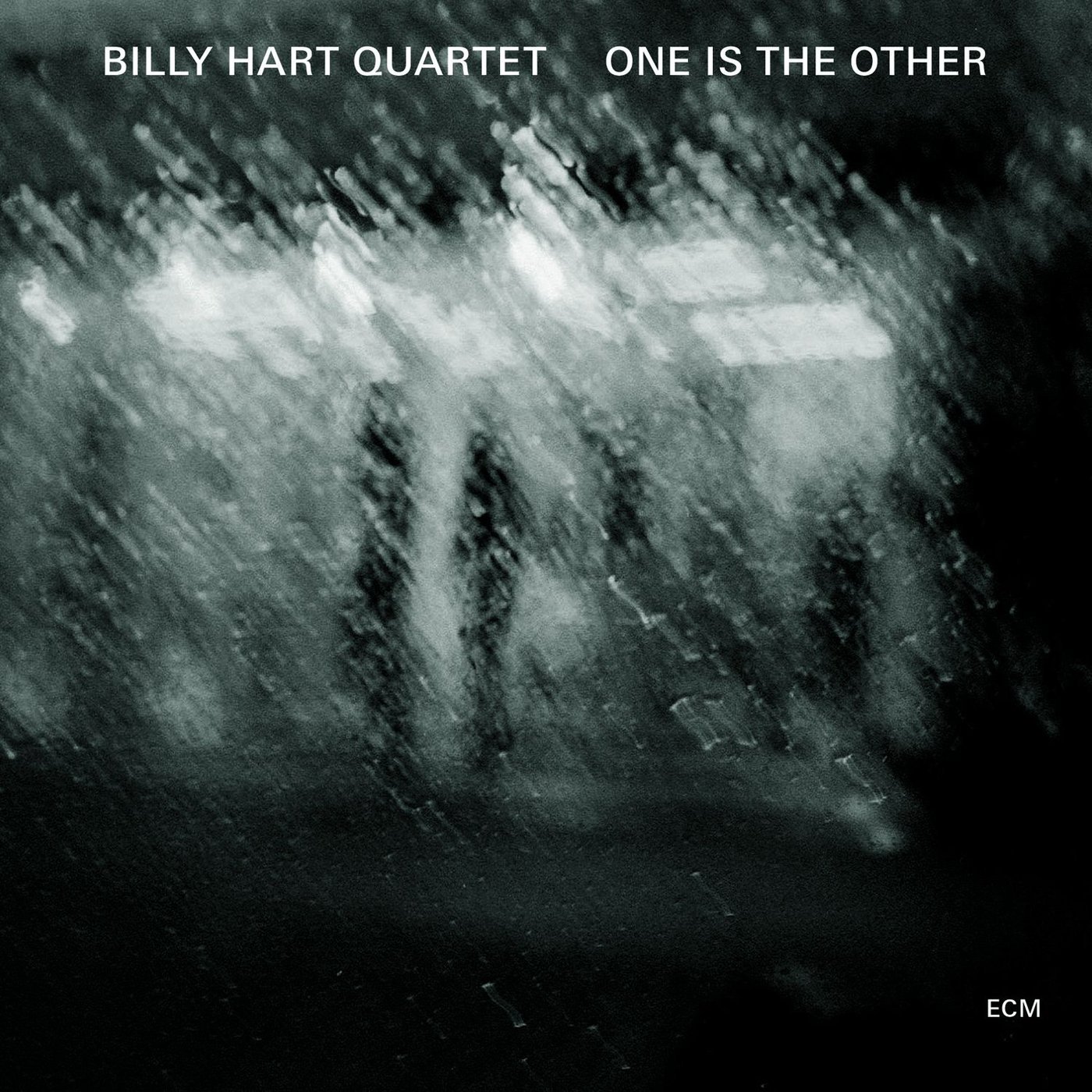
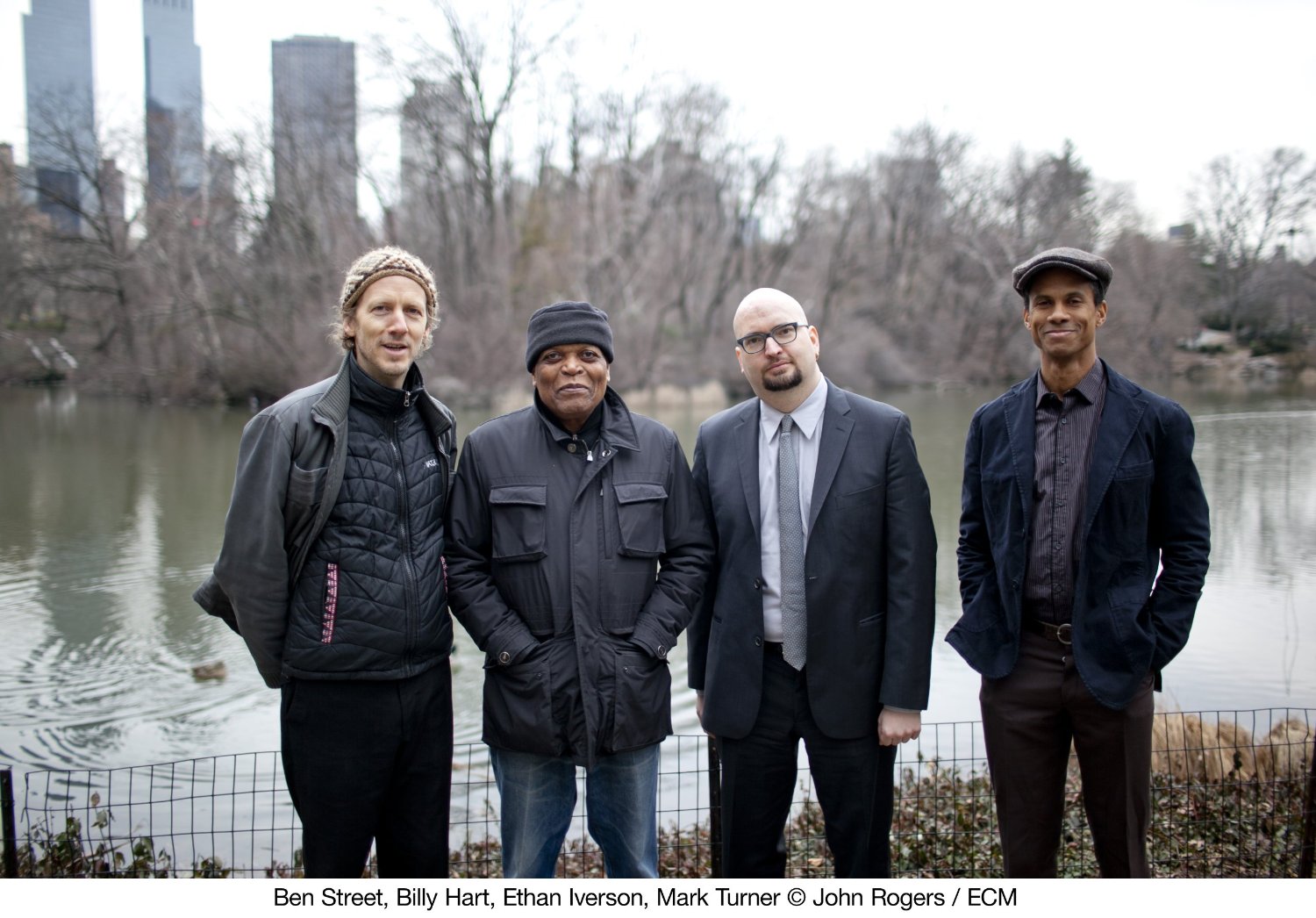
Billy Hart Quartet: One Is The Other (ECM 2335)

One Is The Other

Mark Turner tenor saxophone
Ethan Iverson piano
Ben Street double bass
Billy Hart drums
Recorded April/May 2013 at Avatar Studios, New York
Engineer: James A. Farber
Assistant: Bob Mallory
Produced by Manfred Eicher

It is like jigsaw pieces on a mission that tenorist Mark Turner, pianist Ethan Iverson, and bassist Ben Street have fallen into place around master drummer Billy Hart, with whom they return for a second ECM round. One Is The Other is therefore a manifold title for the achievements of this unique quartet. Not only does it imply something shared among the musicians, but also emphasizes the ways in which their individual voices interlock. With freshness of voices and depth of spirits, they ply an ancient trade of intergenerational communication. Teaching and learning occur in both directions. This sense of equality pervades every exchange.

BHQ

Turner contributes two tunes, including the flowering opener, “Lennie Groove,” in which so much of what happens is indicative of what follows. A geometric intro from Iverson gives way to the rhythm section’s smooth entrance and the composer’s own tenor arcing into focus. Solos are tasteful, keenly attentive to Hart’s timing and, above all, sincere—not a shade of pretension within earshot. The gorgeous “Sonnet for Stevie,” which reappears on Turner’s leader date, Lathe of Heaven, is even more intimate here than it is there. Anchored by soft two-part harmonies from Street and Hart’s glittering cymbals, pianist and reedman stay a course that cares little for arbitrary destinations. Iverson counters with a deuce of his own, of which “Big Trees” ends the album in style. The textural brilliance of Hart’s intro betrays little of the slippery groove that unfurls in its wake. Especially noteworthy are Turner and Iverson’s solo, which despite being their most abstract of the set are also their most grounded. Hart also blushes us into “Maraschino,” an endearing track made all the more so for its vulnerability. One can hear every process at work. This is no small feat.

Hart offers up a triangle of originals. Beginning with “Teule’s Redemption,” a groovier affair with turn-on-a-dime interaction between him and Turner, pushing on through the cymbal-splashed energies of “Amethyst,” and ending in the urban vibe of “Yard,” these tunes comprise a mini album in and of themselves and highlight the consummate skills of everyone involved. Top it all off with the cherry of “Some Enchanted Evening” (from the Rodgers and Hammerstein musical South Pacific), and you’ve got yourself quite the confection to savor.

People often talk of artists being in their “prime.” Hart, however, proves that it’s as much a matter of revealing as knowing yourself. Indeed, here is a peacock with plumage fully fanned and ready to play.

(To hear samples of One Is The Other, click here.)

Winstone/Gesing/Venier: Dance Without Answer (ECM 2333)

Dance Without Answer

Dance Without Answer

Norma Winstone voice
Klaus Gesing bass clarinet, soprano saxophone
Glauco Venier piano
Recorded December 2012, Auditorio Radiotelevisione svizzera, Lugano
Engineer: Stefano Amerio
Produced by Manfred Eicher

When a night black as coal
Placed a cloud in her soul.
Still she found the wings to fly
To the higher places…

When people compare something to a fine wine, they mean to say that its flavor deepens with age. But what of the color? It, too, changes, taking on new hues as light strikes the residuals of its enjoyment. This is more like what Winstone’s voice can do to her listener, who is but the glass to her vintage and through the prism of her words takes on something of their atmosphere. Indeed, here is an album that begs a fireplace, an upturned book, and shelter from a snowstorm.

Winstone has rarely sounded better than in the company of reedist Klaus Gesing and pianist Glauco Venier. On Dance Without Answer, she joins them for a third time on ECM. There has always been something therapeutic about Winstone’s music. It always seems to deal with coping, whether with joy or sadness, as expressed in the opening title track. The figure of Venier’s piano casts a long-drawn shadow like the body of Gesing’s clarinet. Their instrumental foundation bleeds through transitions from day to night, where truths and lies of love coexist as reminders of what might never be.

In spite of a thematic consistency, the moods of this trio are as varied as the linguistic colors of the titles. Winstone and her bandmates take the listener through the stark histrionics of “Cucurrucucu Paloma” (a portrait of abandonment) and the folkish “Gust Da Essi Viva” (filigreed by Gesing’s soprano) to the earthier “A Tor A Tor” (centered by a didgeridoo-like bass clarinet) and the evocative “Slow Fox” without lapsing into a single unnecessary detour. Yet Winstone shines brightest in the darkest places. In a wordless, raga-like style, she brings hope to “High Places” and follows what would seem to be the same female protagonist through the experiential dramas of “A Breath Away,” a remarkable lullaby that sets Winstone’s lyrics to a tune by Ralph Towner. And yet, while the poignant “It Might Be You” may seem to confirm its elusive presence—love in this album is an asymptote, so that even here she encounters the realization but not consummation of it.

Rounding out the set is a bouquet plucked from the popular canon. In Nick Drake’s “Time Of No Reply” Winstone mediates between realms of light and loneliness, while from Joe Raposo’s timeworn “Bein’ Green” she teases out visceral tenderness. Regardless of the words, she puts her all into each color change. But before Fred Neil’s “Everybody’s Talkin’” closes the album with a final survey of the palette, we also reckon with Madonna in the panoramic “Live To Tell” and Tom Waits in the bluesier “San Diego Serenade,” of which one line says it all: Never heard the melody ’til I needed the song. Prophetic words for those who never needed these songs until they heard the melodies, and a clue to the album’s name: the dance does have an answer, and it is the music itself.

(To hear samples of Dance Without Answer, click here.)

Tigran Mansurian: Quasi parlando (ECM New Series 2323)

2323 X

Tigran Mansurian
Quasi parlando

Patricia Kopatchinskaja violin
Anja Lechner violoncello
Amsterdam Sinfonietta
Candida Thompson concertmaster
Recorded October 2012, Muziekgebouw aan ’t IJ, Amsterdam
Engineers: Peter Laenger and Stephan Schellmann
Produced by Manfred Eicher

ECM’s ongoing relationship with Tigran Mansurian yields what is perhaps the Armenian composer’s most integral archive yet. In a program of works spanning nearly three and a half decades, Quasi parlando brings together a roster of committed interpreters—musicians who live and breathe in order to allow the music of underrepresented composers that same privilege on an international stage. Yet if the image of a stage seems too formal for music that emerges as a butterfly from its chrysalis, it’s because Mansurian does not write music to be validated by the fleeting sanctity of the concert hall. Rather, he builds it as a craftsman would a piece of furniture, so that every joint fits without need for the glue of representation. In this respect, analogies fall short of his mastery even as they feel necessary to make sense of the darkness therein.

Patricia Kopatchinskaja and Anja Lechner are the respective soloists of the Double Concerto for violin, violoncello and string orchestra. Composed in 1978, it is the earliest work on the program and consists of two Largo movements. The first, marked “concentrando” (indicating an intensification of tone over time), is a concentric maze from opposite sides of which the lone cello and barely dancing violin seek an interactive center. Even when distanced by walls and dead ends, they share a certain elasticity of purpose that inhales even as it exhales. Only when the internal geometries of their capture begin to waver in the emerging chaos do open double stops cry through barriers toward their asymptotic meeting. Each instrument occupies its space at intervals of unaccompanied reset, inspiring the orchestra to unravel itself, one vine at a time. Yet where the effect here is exponential in the manner of a Fibonacci sequence, the second movement follows its designation of “sostenuto” (sustained) by means of a rhythmic core. From this extend tendrils of memory, guiding a single droplet of experience from mountaintop to river. A resolute tenderness ensues, creating suspension in a dream of lucid impulse.

The two pieces that follow are the disc’s most recent. Romance (2011) for violin and string orchestra once again features Kopatchinskaja, to whom it is also dedicated. In characteristic fashion, Mansurian constantly shifts the role of soloist and orchestra, as if between cause and effect, or among tiles in a sliding puzzle. Each aspect of its ungraspable emotions has the constitution of an after-effect. Kopatchinskaja emphasizes this and so much more, treating her bow as kindling to a growing fire that looses controlled tongues in every unaccompanied breath. The 2012 title composition for violoncello and string orchestra also bears dedication to its soloist. Lechner’s role, however, is more integrated, very much a part of the ecosystem in which it finds itself. Though possessed of a kindred robustness in its unaccompanied passages, the writing for cello abides by an even more self-directed faith in its own surroundings. There are quiet triumphs in this piece, intersections of light and cloud that stay locked in place through the simple act of acknowledging them, left to drift only by the final pizzicato strum.

Mansurian’s Second Violin Concerto carries the subtitle Four Serious Songs” (2006), a translucent bridge perhaps to Johannes Brahms’s scriptural settings of the same name. Compared to the music that came before, these movements come across with consistency. Denser and of more mournful quality, they morph from teeth to ribbons toward a final, subterranean resolve, following the magma to its womb.

If Mansurian’s corpus is a truth, then we are its clothing of mystery. It hides nothing of itself, but is hidden by our knowing of it. Let this be a lesson, then, unto the hit-and-run listener: you will leave a scar unless you tend to the wound of your interruption.

(To hear samples of Quasi parlance, click here.)