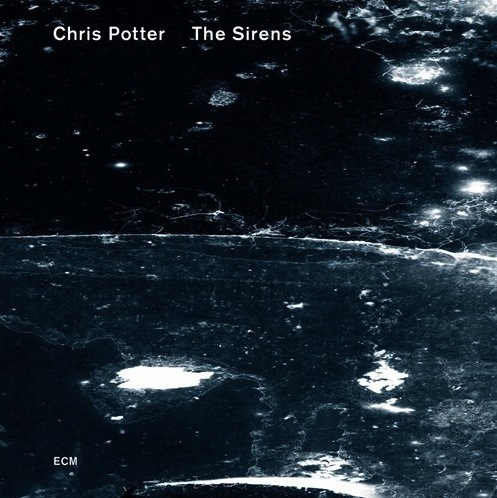
Chris Potter: The Sirens (ECM 2258)

The Sirens

Chris Potter
The Sirens

Chris Potter tenor and soprano saxophones, bass clarinet
Craig Taborn piano
David Virelles prepared piano, celeste, harmonium
Larry Grenadier double bass
Eric Harland drums
Recorded September 13-15, 2011 at Avatar Studios, New York
Engineer: James A. Farber
Assistant: Charlie Kramsky
Produced by Manfred Eicher

Saxophonist Chris Potter does Homer’s The Odyssey jazzily in his first leader date for ECM. Joined by pianists Craig Taborn and David Virelles, bassist Larry Grenadier, and drummer Eric Harland, he dips into a sea of changes and emerges with a row of gold coins in his mouth. It is one thing to read into his allusions and programmatic suggestions for what follows, quite another to take the music on its own terms in the heat of moment after delectable moment. Not only has he taken a concept and made it his own, but he has further let the concept have a life of its own. He’s unafraid to round the corners, darken the edges, and age the surface, so that each tune is fully weathered before it reaches us, despite its nominally spontaneous creation and oxidization. In such a context, his extroversion speaks a thousand tongues.

Sirens

From the start, “Wine Dark Sea” proves an apt descriptor of Potter’s tannined blowing and sets a tone for this smooth, eminently drinkable leader date (his first for ECM). The cinematic writing (all but the final track were penned by Potter) and rolling pianism get us into the textuality of things with a single reed as interpreter. Potter also opens the door for a far-reaching solo from Taborn, whose recognizable tickling brings a hip, modern edge to an otherwise classic sound. Matching this fine work is Virelles, whose prepared piano adds patina to “Wayfinder.” This ebullient track dashes more than a hint of its flavor from Pat Metheny and contrasts with the opener as a way of expressing Potter’s depth of execution.

On to “Dawn (With Her Rosy Fingers),” perhaps the only Homeric ballad in modern jazz. If we are tempted to read the urban sprawl into its matrix it’s only because Potter is so adept at rendering the ancient as if it were cotemporal with our awareness of it. Grenadier’s solo captures all of this and more, flipping rocks and mushroom caps like children in search of miniscule dreams. The progressive solo from Potter is a music lover’s dream come true: fresh, welcoming, sincere. He expands his versatility in the title track, for which he cracks open a vintage bottle of bass clarinet and lets its notes air. The attention to detail is sublime, even if the music is more than that. One might expect the call of the eponymous sirens to be ethereal, floating, and divine. Yet while the bass clarinet certainly possesses these qualities in its forested way, it is perhaps not the first instrument we might choose to evoke such iconic allure. What we experience, then, is not the call per se but the wrenching thrill of that call at the cellular level, of the biological fists that clench in response to it. We feel this especially in the arco bass solo, which threads its own curse, as if on the verge of blackout. And even when the calls themselves are realized by way of tenor, the steadiness of Potter’s breath enacts a decidedly secular enchantment. That same tenor flows through the veins of the penultimate “Stranger At The Gate” (a more complexly singing track that fits Taborn’s pointillism into a lovely trio progression) and gives the disjointed “Kalypso” an epic cast. The latter’s boppish ending throws us like a stone into moonlit water.

Potter dons the sopranist’s hat in “Penelope” and “Nausikaa,” both of which give us aerial views of the album’s topography and narrative arc. Potter’s squint-worthy changes and chromatic playing flower intently, towering but never domineering. Virelles evokes the princess’s footsteps via celeste, running with piano down the slopes—only in this valley of the wind there is only music. He and Taborn settle the tab with “The Shades,” a shimmering sunset of celeste and piano only.

The Sirens showcases Potter’s most mature writing yet. His tone is robust yet crisp, weighted yet dancing. He bears his improvisatory toolkit most admirably, going from legato chains to piercing wails at the flip of a tunic. His panache is never hackneyed. This the seasoned Potter fan will already know. What separates his saxophonism on this album apart is its commitment to story arc. How appropriate he should pick a tale that survived for so long through oral preservation alone. In meshing these two “texts”—the spoken and the written, the improvised and the composed—he continues that tradition, cutting into it a rift of personal experience into which we are welcome to pour our own. And indeed, Potter structures these pieces as any good storyteller would: with introductions that hook us in and with characters that come and go as they would in real life. This is the magic of The Sirens: in mining a classic of world literature, Poptter frees its personages and places from the bondage we might expect of them. Led by motives as gnarled as the oldest roots, they wander, never lost as long as they are heard.

Writing as I am in Ithaca (New York, that is), I cannot help but feel self-indulgent in loving this scintillatingly recorded disc. Its spacious, verdant music-making has as many tales to tell as there are people to hear them. Wherever ECM might take you, be sure to spend the night here at least once in your odyssey. Destined to be a classic.

(To hear samples of The Sirens, click here.)

Roscoe Mitchell: Nine To Get Ready (ECM 1651)

Nine To Get Ready

Roscoe Mitchell
Nine To Get Ready

Roscoe Mitchell saxophones, flute, vocal
Hugh Ragin trumpet
George Lewis trombone
Matthew Shipp piano
Craig Taborn pianos
Jaribu Shahid basses, vocal
William Parker double-bass
Tanni Tabbal drums, percussion, vocal
Gerald Cleaver drums
Recorded May 1997 at Avatar Studios, New York
Engineer: James Farber
Produced by Manfred Eicher

Nine To Get Ready realizes a leap of intuition for saxophonist Roscoe Mitchell and his Note Factory ensemble. The influential Art Ensemble of Chicago veteran observes structure in even the freest settings and activates that structure with convulsive possibility. Taking his previous collaborations with Evan Parker as litmus, we find in Mitchell’s approach to composition a like-spirited feeling of bridled spontaneity. Yet if those two unforgettable sessions represented the breaking of new ground, this one enacts a finer sifting of its upturn.

The mysterious “Leola” opens in goopy meditation and perhaps shifts expectations to another plane entirely. From a slow draw it liquefies the pips on playing cards and scrambles them until a royal flush of reflective art takes form. From this Mitchell deals as potent a hand as one could imagine, introducing us to the post-AEC developments he has so meticulously sustained. Here is a scene where sunlight peaks out from overcast Byzantine sky with all the weight of a dictionary compressed into a single utterance. Like the mouth rounded in preparation, its textures work in a symphony of muscle and air. As the atmosphere builds up the depth of its green, trills add fresh movement to an implied and fragrant biosphere. Here is the power of imagination, kneaded until the grammar of brass is personified even as it is depoliticized.

If the Parker comparison feels arbitrary, then through “Dream And Response” it finds purchase in Mitchell’s remarkable sopranism, which lends mysticism also to the silver chain of “Hop Hip Bip Bir Rip.” At once sibilant and razor-edged, it carves as it sings. The beauty of the former piece—and by extension of Mitchell’s sound-world on the whole—is that dream and response are one and the same. Like a nighttime vision it implies a vast and impenetrable backdrop, a sphere of myriad voices. The late Lester Bowie gets prime dedication in “For Lester B.” This gorgeous, slow swing through galactic travels is all the more poignant for trumpeter Hugh Ragin’s soulful approach. Couched in a loving cluster, he casts a bronze of stark quality. A shaded bass solo reaches a hand heavenward and pulls down a projection screen, across which flits a gallery of memories.

To offset the bitter sweetness of it all, Mitchell reveals a clear and golden tone in “Jamaican Farewell.” In the presence of his buttery textures and delectable intonation, the entrance of piano resounds with oceanic current and stuffs plenty of beauty into the naysayer’s pipe. The title track is another soprano feat, circular and intense. Here is also where the doubled backing trio reveals its many-chambered heart. Drummers Tanni Tabbal and Gerald Cleaver, bassists Jaribu Shahid, and pianists Matthew Shipp and Craig Taborn match the speed and tone of every phoneme in a Jacob’s Ladder of overzealous diphthongs. They are both the underlying soil and the fresh pavement atop it. Highlights abound further in “Bessie Harris.” This more straightforward morsel whirls until it spends itself in pure goodness. Phenomenal playing from Mitchell moves the spirit in Ragin’s thin-lipped solo, and bids both drummers to speak. After the insightful experiment in reanimation that is “Fallen Heroes” (featuring Mitchell on flute), the ensemble ends with two shorter tracks, “Move Toward The Light” and “Big Red Peaches,” the latter spinning a Tom Waits-like coda.

We can speak of this music all we like, but by the end it has spoken of us.

<< Selected Signs, I: An ECM Anthology (ECM 1650)
>> Bach: Die Kunst der Fuge – Keller Quartett (ECM 1652 NS
)

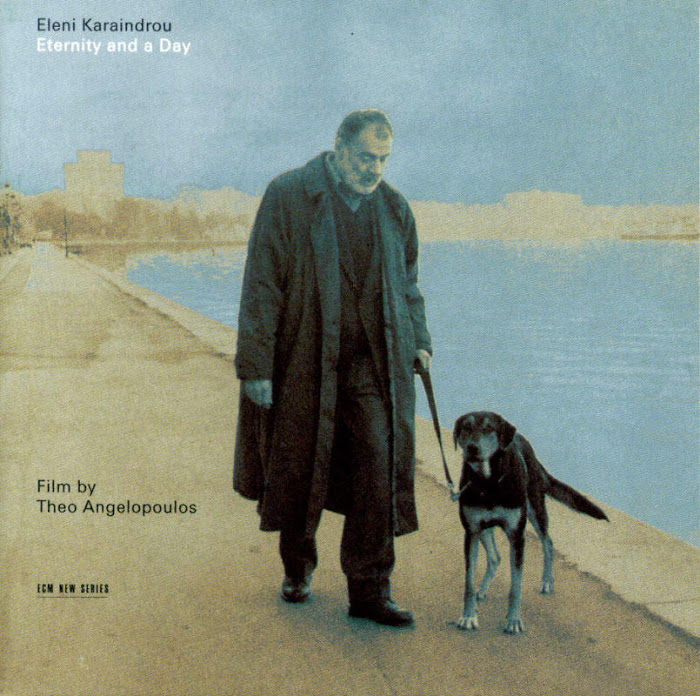
Eleni Karaindrou: Eternity and a Day (ECM New Series 1692)

“Open always, always watching, the eyes of my soul.”
–Dyonisios Solomos

The Film
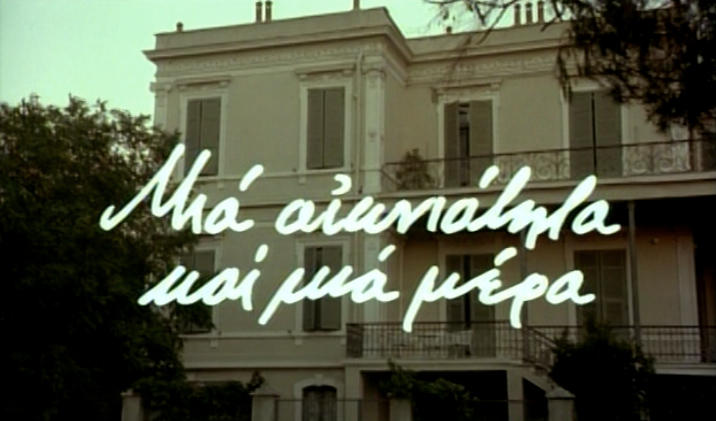
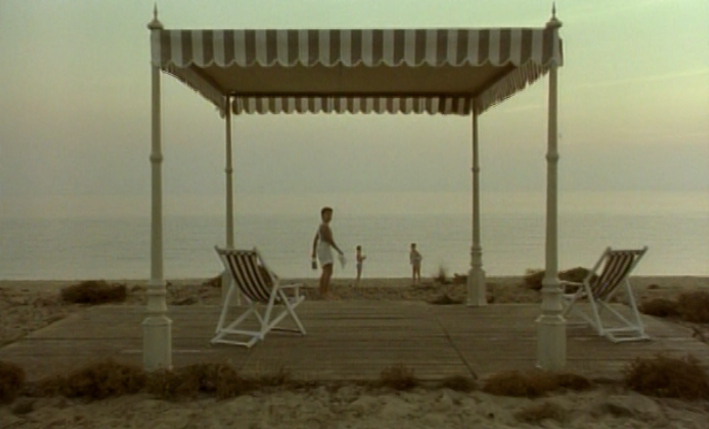
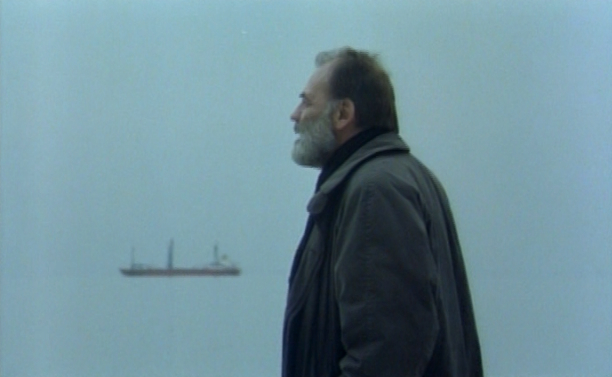
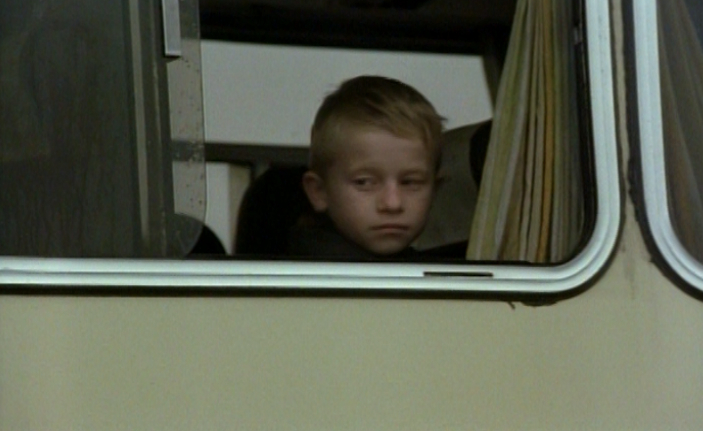
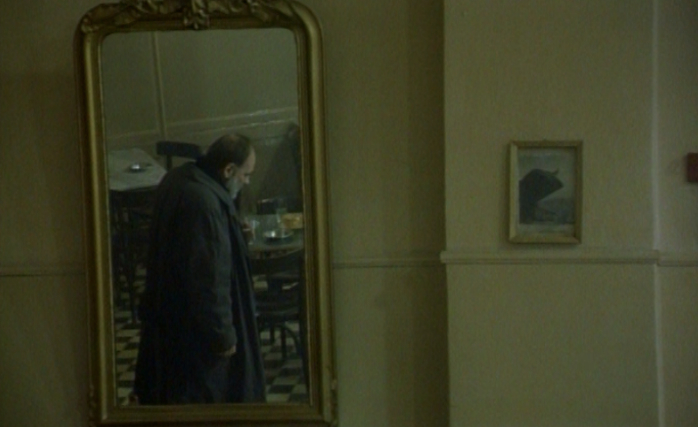
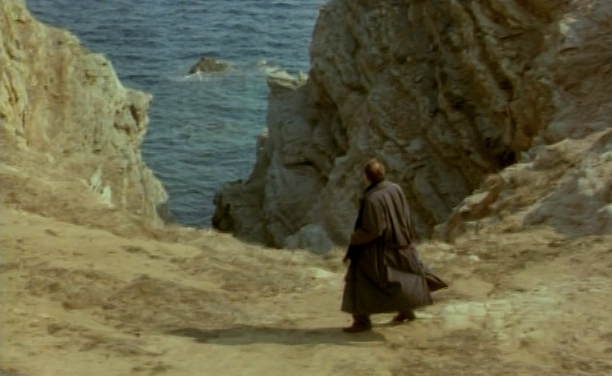
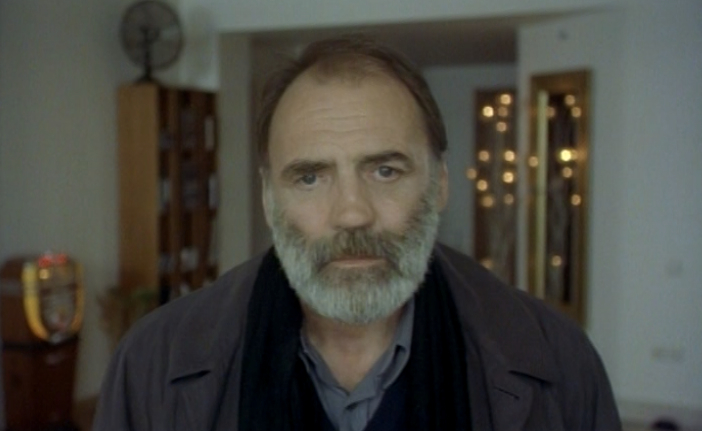
An ancient city, lost beneath the ocean. The stuff of history. Time, a young voice tells us, is “a child playing jacks on the beach.” A piano wafts through the image like a breeze carrying scents and sounds of retrospection—the film’s leitmotif. Here the past functions not as a repository for memory but as a palimpsest for a mind still practicing. It is the mind of Alexander (Bruno Ganz), an aging poet whose dark trench coat cuts a crow’s wing against director Theo Angelopoulos’s wintry palette. A slow approach to a window guides us to the film’s title by way of Alexander’s boyhood. The camera follows him as if through a ghost’s eyes.

2013-04-11_0005

When we first encounter Alexander as he is now, he holds a taste of the sea in his mouth…

2013-04-11_0009

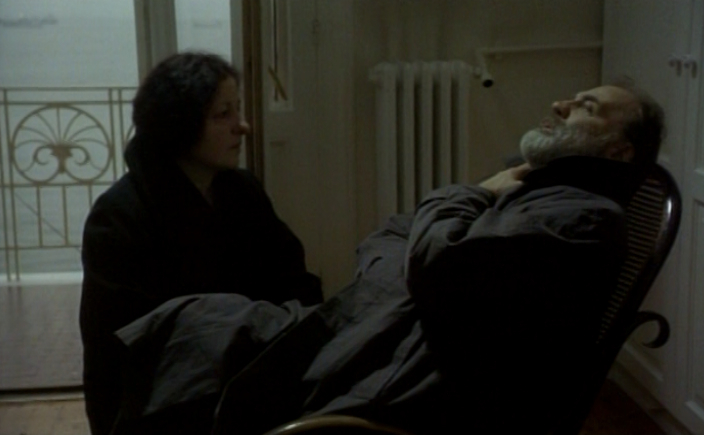
…and clutches his throat as if breathing were a labor. This momentary inability to get words out is both curse and blessing: an obvious malady for a man of letters, but also a release from the world’s imploration to dress its dreariness in pretty semantics.

2013-04-11_0011

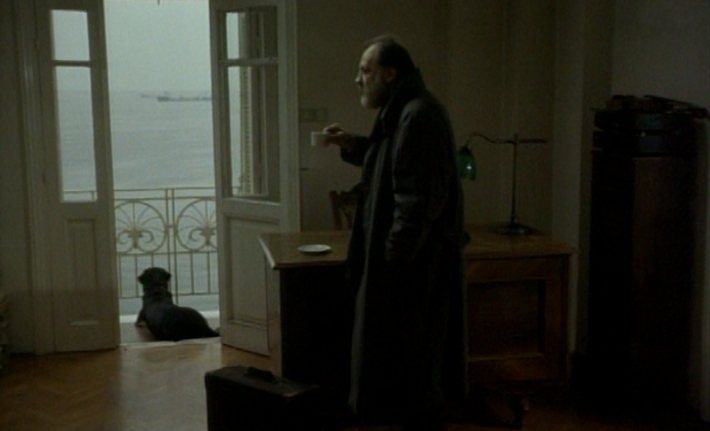
The sea follows Alexander. It is the tail of the dying comet that is his life. His dog looks toward that same sea, a place where music and memory are engaged in dance. A terminal diagnosis looms over him (his constant pill-popping brings rhythm to the narrative), mist over a landscape of uneven hills. He feels silence encroaching and fills it with regrets of unfinished work, of “words scattered here and there.”

2013-04-11_0014

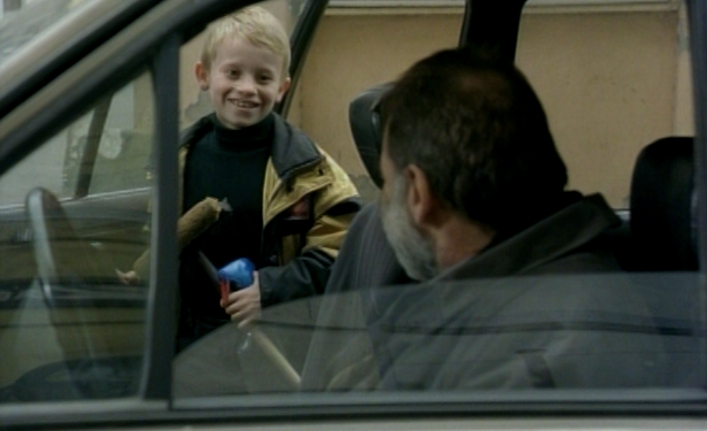
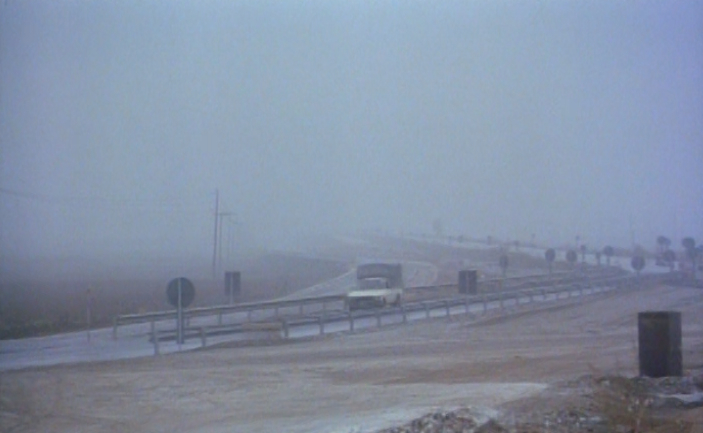
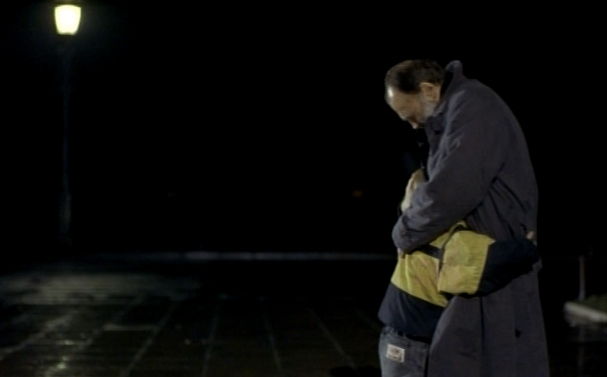
Alexander welcomes a boy (Achileas Skevis)—an Albanian vagrant washing windows at stoplights for petty cash—into his car. His whim begins a final poem, a magnum opus borne of action and sacrifice that can never manifest as ink and paper but rather unspools across light and film. Yet while this charity saves the boy from capture by police and gives us the film’s first smile, it comes at the cost of ignoring the other boys into whose meager routine of survival he had fallen.

2013-04-11_0022

Alexander knows the ripple effect of his actions. He feels the churning waters of time as a swallowing force. Its life-giving properties are so far removed from the here and now that it is all he can do to plunge his feet into the mud of recollection. After spending a lifetime waiting for progress, he will spend another waiting for regress. Angelopoulos’s title does not compare eternity and a day, but equates them.

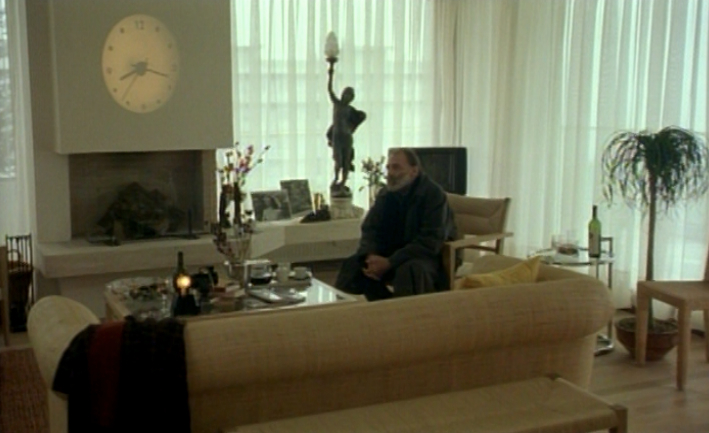
As Alexander prepares to leave his everyday existence and spend his remaining days in convalescence, he brings the dog to his daughter, Katerina (Iris Chatziantoniou). The contrast between her upscale apartment and her utter yearning for a transparent ancestry are but surface to the inner sanctum of her father’s raw linguistic materials. She displays her anxieties among the art objects of her living room, where a wall catches the circumference of a projected clock. As the film’s symbol par excellence, it hovers like a dedication page torn from its binding and pasted where a window might be. In this manner Katerina turns her glitches into quantifiable space.

2013-04-11_0025

During this visit we learn that Alexander is completing an unfinished 19th-century epic by Dyonisios Solomos. “The Free Beseiged,” as it is known, is mired in the Greek War of Independence, from which it draws blood to fill its pen. Alexander has been working on the project since the death of his wife, Anna (Isabelle Renauld), who comes to us in flashbacks. And while Katerina may not understand why her father would ever wish to graft his words onto another’s, she flows through him like the returning sea when he gives her letters written in her mother’s hand. Through her reading, Alexander is read anew, revitalized as if by the boy whose fate he has influenced.

2013-04-12_2252

2013-04-12_2254

The sea is a trance, pillow of scent-filled houses. Sleep and silence cohabit its ever-changing shoreline. Through her daughter’s voice, a resurrected Anna links newfound maternity with love, safety, and breath. The vulnerability of her body engenders absolute trust in, and safety for, her blossoming child. For Katerina is indeed a flower, the center of a family gathering in the sunlit prime of a warmer era. Even in life, Anna was constantly on the verge of dissolving, a wanderer in love. Alexander is moved beyond comfort, for he knows that his dissolution will bring him closer.

2013-04-12_2250

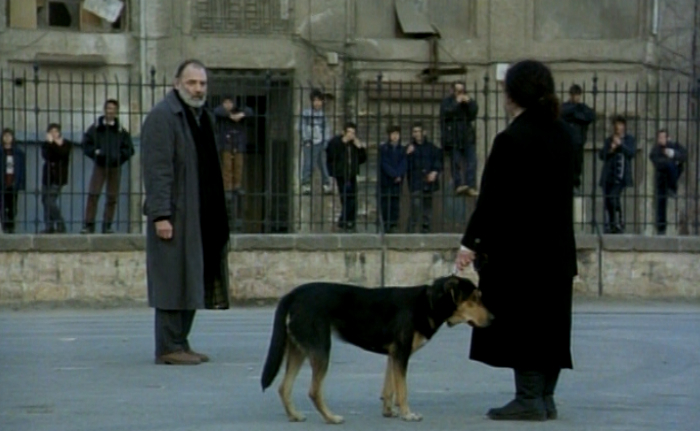
Like all reveries, this one is all the more poignant for its brevity and it is Katerina’s husband who breaks its spell. Put off by the presence of what in his eyes can be nothing more than a haggard vagabond, he tells Alexander he has sold the old house by the sea—the very house where Katerina tumbled into maturity—and that it will be demolished. He also takes unkindly to animals and questions any obligation to welcome the dog into his home.

The streets, paved in articulate indifference, keep Alexander in check. They are the insignia of a publisher far grander than anything he can contemplate with his ties to speech. In opening himself to a stranger, Alexander realizes he has found in the boy a beacon—not of hope, but of evenness. This balance is upset when he witnesses the boy being thrown into the back of a cargo truck.

2013-04-11_0042

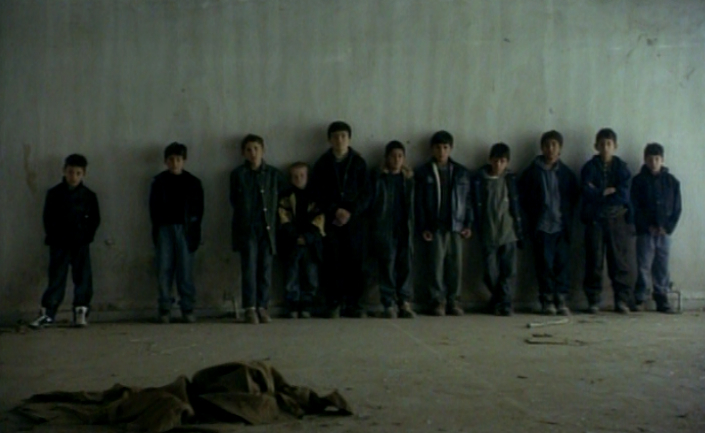
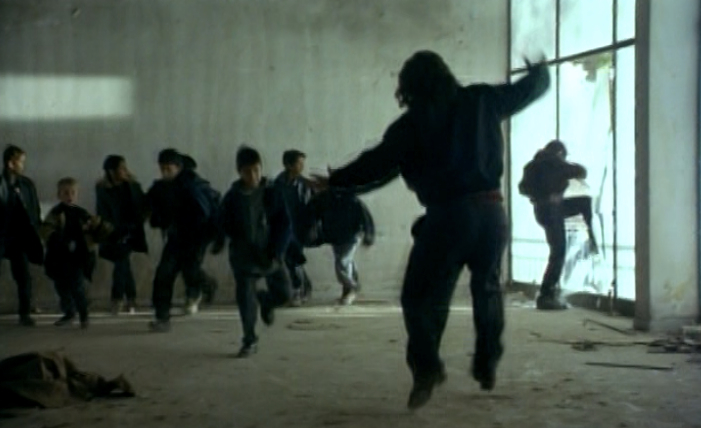
He follows the vehicle to a shady warehouse where other urchins have been plucked from their rocks and are being sold into an invisible market. The boys, however, are wise to this and make a run for it in a ballet of quick thinking and broken glass.

2013-04-11_0048

2013-04-11_0049

In the ensuing chaos, Alexander saves the boy of his interest, giving all the money on his person in exchange. He puts the boy on a bus going toward the Albanian border, both in the hopes of losing him before he loses himself and in the hopes that there might be a home to return to.

2013-04-11_0059

2013-04-11_0103

The boy comes back to Alexander, having found a home in presence of the bearded stranger. He sings a children’s song from his homeland, tells Alexander of crossing the border, thereby revealing a likeminded fixation on language. Alexander takes him to the border, but they run when the boy tells him he has no one.

2013-04-11_0107

2013-04-11_0121

2013-04-11_0122

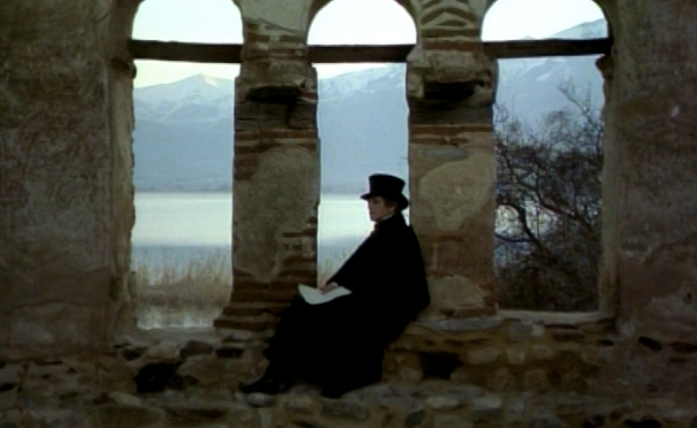
Alexander tells him the story of the poet Solomos (Fabrizio Bentivoglio), Greek but raised in Italy, who returned to his homeland when he heard the Greeks were rising against the Ottomans. He does not speak the language, and so he buys words from the locals. Across a night “sown with magic” he travels, reaching deep into his reservoir of sentiments to produce the “Hymn to Liberty.” It remains a significant verse for Alexander, a bid for freedom from language, through language.

2013-04-11_0129

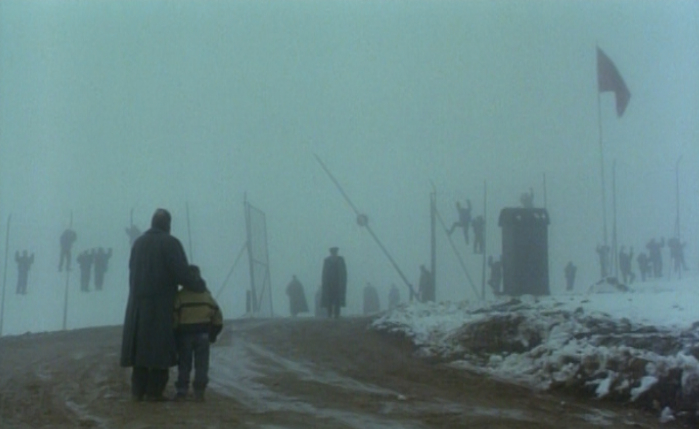
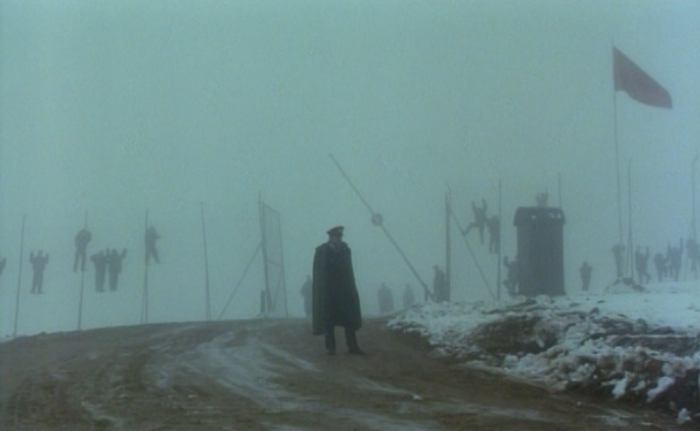
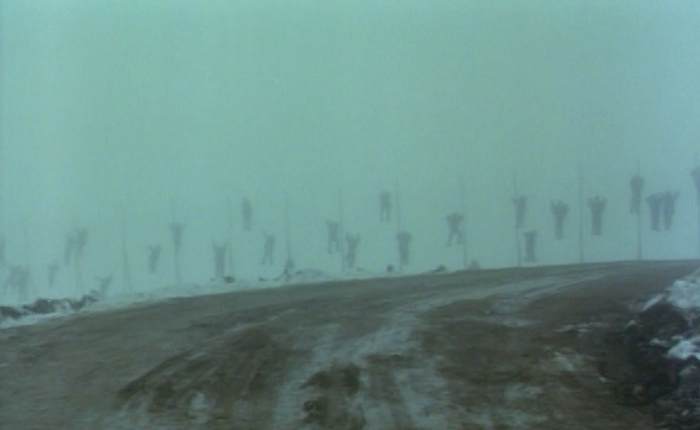
In the end, he entrusts the dog to his housekeeper, Urania (Helene Gerasimidou), interrupting her son’s wedding to do so. Spectators hanging from the gates mirror those at the border, each a living puppet frozen in the wake of a changing tide.

2013-04-11_0138

2013-04-11_0119

This leaves the boy, Alexander’s only link, his only mirror. “You’re smiling, but I know you’re sad,” the boy tells him. Such contradictions—in the end, not really contradictions at all—are essential to Angelopoulos’s cinematic world, a world where light and dark are so permeable as to be unquestionable. For while Alexander’s cape is the shadow of his deteriorating self, of a body blurring into lifelessness, it is also a flag whose communication harnesses wind like a sail.

2013-04-12_2300

He is a man devoid of contact, yet who is touched by humanity; a man in self-imposed exile, yet who knows the landscape as if it were his own; a man known for words, yet who pays for them with emotional currency. The boy wants to say goodbye, but Alexander convinces him to stay, will not accept that his hand may bring about another end.

2013-04-12_2319

Thus the camera looks beyond the curtain into the reflecting pool of the human condition.

2013-04-12_2311

2013-04-12_2322

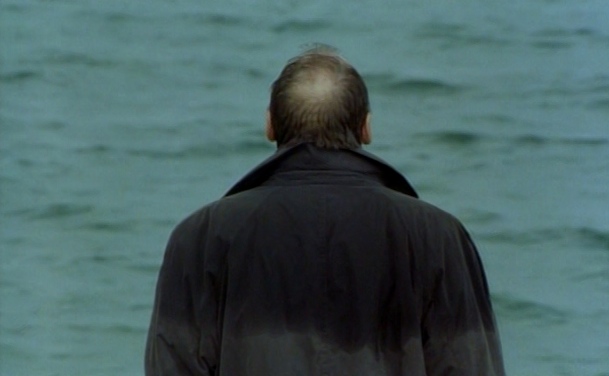
His films are unfinished, stitched yet tattered. In allowing their seams the privilege of coming undone, he delivers messages devoid of hyperbole. The zoom, for example, sheds its derivative qualities in such a context, seeking not to focus our attention so much as to remind us of limitations. As in the films of Andrei Tarkovsky, the occasional close-up shocks with its candor, reaches into the pit of our complacency and stirs up the love we have forgotten. When Alexander turns his back on us, he turns his back on the world.

2013-04-11_0037

2013-04-12_2323

The Soundtrack
Composer Eleni Karaindrou has her finger so firmly on the pulse of Angelopoulos’s ethos that her flesh has melded with his images. Yet there is something more than the combination of sight and sound going on in Eternity and a Day, for this more than any other film she has soundtracked is an ode also to time.

Eternity and a Day

Eleni Karaindrou
Eternity and a Day

Vangelis Christopoulos oboe
Nikos Guinos clarinet
Manthos Halkias clarinet
Spyros Kazianis bassoon
Vangelis Skouras french horn
Aris Dimitriadis mandolin
Iraklis Vavatsikas accordion
Eleni Karaindrou piano
String Orchestra La Camerata Athens
Loukas Krytinos director
Recorded March and April 1998, Athens Concert Hall
Engineer: Andreas Mantopoulos and Christos Hadjistamou
Produced by Manfred Eicher

The title of the first piece, “Hearing the Time,” would seem to say as much: just as Angelopoulos puts an eye to lens, so too Karaindrou puts an ear to history. She draws thick yet airy wool over our eyes, that we might view the world through the blur of fibrous experience. Over an expanse of archival strings we hear a distant relay between violin and accordion. These punctuations are not ruptures but voices from below. The composer at the keyboard elicits “By the Sea,” a humid snapshot that segues us into the mandolin accents and silken oboe line of the “Eternity Theme.” As Beethovenian cellos churn, we think back to its corresponding scene in the film, in which we find Alexander listening to this very music on the radio. He shuts off his mechanical translator and looks out across to the other apartment complex, where the same music flows from another window. “Lately” he muses, “my only contact with the world is this stranger opposite who answers me with the same music.” Perhaps true to character, he decides against pursuing this fascination: “It’s better not to know…and imagine.”

And imagine is all we can do when taking this soundtrack on its own terms. The theme echoes throughout its architecture, inflected differently by each soloist. A bassoon evokes tears colored by fate, while clarinets drip from the great beyond with tastes of once-forgotten joy. A traditional wedding dance fills the air with bright steps, contrasting almost painfully with the solitude of “Bus,” and lends relative sanctity to Ganz’s recitation in “The Poet.” Yet it is in a little piece called “Borders” that the fluidity of his embodiment is clearest. Through it we realize that harmony needs change.

Like the film itself, the score of Eternity and a Day creates a somewhere far removed from its content yet which is equally cinematic. It is a looking glass unto itself, a kaleidoscope named “then.”

<< Kenny Wheeler: A Long Time Ago (ECM 1691)
>> Evan Parker Electro-Acoustic Ensemble: Drawn Inward (ECM 1693
)

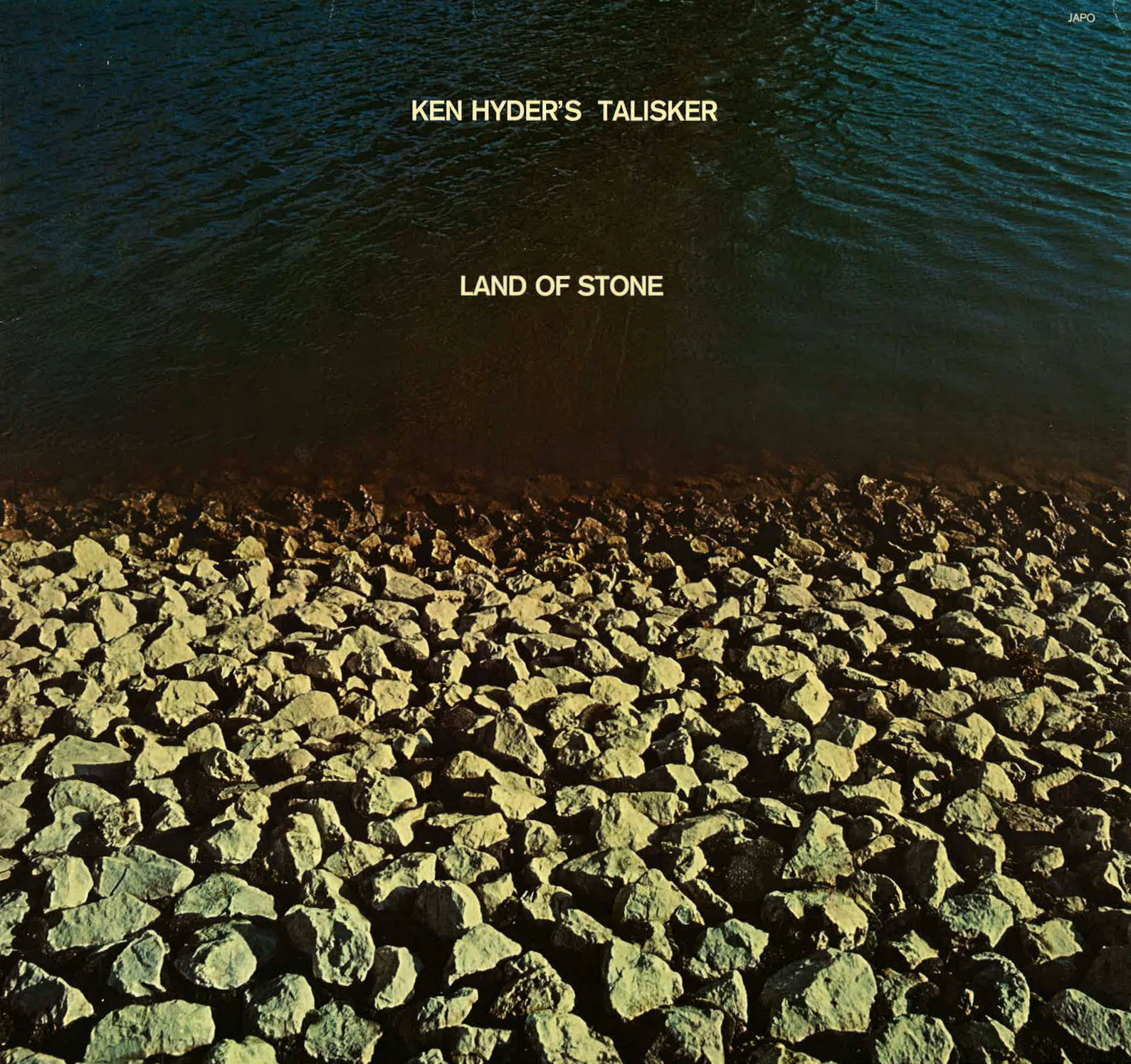
Ken Hyder’s Talisker: Land Of Stone (JAPO 60018)

Land Of Stone

Ken Hyder’s Talisker
Land Of Stone

Ken Hyder drums
John Lawrence bass
Marcio Mattos bass
Davie Webster alto saxophone
John Rangecroft tenor saxophone, clarinet
Ricardo Mattos soprano and tenor saxophones, flute
Brian Eley vocals
Frankie Armstrong vocals
Phil Minton vocals
Maggie Nichols vocals
Recorded April 1977 in London
Engineer Martin Wieland
Produced by Thomas Stöwsand

Over a career spanning more than four decades, Scottish percussionist and vocalist Ken Hyder has developed a strong body of work, though perhaps none so robust as his Talisker outfit. Combining Celtic and jazz influences, Talisker debuted in 1975 with Dreaming Of Glenisla on Virgin Records. Yet as Hyder’s musical interests began to expand to traditional Irish music and further to Asian monasticism, his sound opened itself to a world of possibilities. Enter album the second, Land Of Stone, which found a home on the JAPO label two years later.

“The Strathspey King,” a strangely swinging ode to Scottish master fiddler James Scott Skinner (1843-1927), sets a homegrown tone. Clarinetist John Rangecroft proves to be a vital presence in this increasingly enigmatic session, adding swagger aplenty. Like a young hopeful decked out in fresh threads and money in the pocket, he tricks the heart into thinking that harm is a while away. Hyder’s militaristic drum solo intercepts street-side, as if offering free samples of reality before a chorus of bidders drops into view with its haunting brand of Hebridean choral music in “The Men Of Barra Know How To Drink, But The Women Know How To Sing.” A boisterous and colorful chain, its syllables become actions, teetering like drunken instruments into “Close The Window And Keep It Down.” This likeminded island song is an onomatopoetic excursion into the inner lives of house wares and propriety. The latter quickly disintegrates as bonds loosen their friction and slide from grasp in screeching ululations, courtesy of ECM margin-bearer Maggie Nichols. The color wheel darkens further in “See You At The Mission, Eh, If It’s No’ Full,” in which a brood of instruments strains unison phrasings through an upturned colander. Bass and drums form a knot of support, eyes in a flowing wood grain. In the wake of these dirt-caked fingernails, “Derek Was Only A Bairn” rides into the dawn, a smooth caravan lead by Ricardo Mattos on flute and horse’s trot.

Hyder insists that improvisation was a vital component of Scottish bagpipe playing, and in a tripartite pibroch he explores the crossover from the Highlands to the fringes of American free jazz, dedicating parts respectively to the MacCrimmons (a notable family of pipers), John Coltrane, and Albert Ayler. After a microscopic dialogue between bassists John Lawrence and Marcio Mattos, soprano saxophone masquerades as bagpipe in piercing shepherd’s call. Hints of a jig rise and fall from deeper drones, a sky behind mountain silhouettes. Over the click of cymbal, dense voices weave in and out of earshot, taking solid presence in the loam of memory, to slumber and to molt. The banshees return with gentle persuasions, their ashen hair and earthward grins blistered by the rub of their limbo. Yet with the coming of rhythm they achieve communication somewhere on the other side of fear, ecstatic totems each passing through sea and grain until the wind puts fingers to lips and blows.

Cleaning off the dust of age, Talisker shakes out tunes old and new, and with the chaff pieces together charcoal fields as would a cobbler hammer a sole. Or is it soul? There’s plenty to be had in this land of stone.

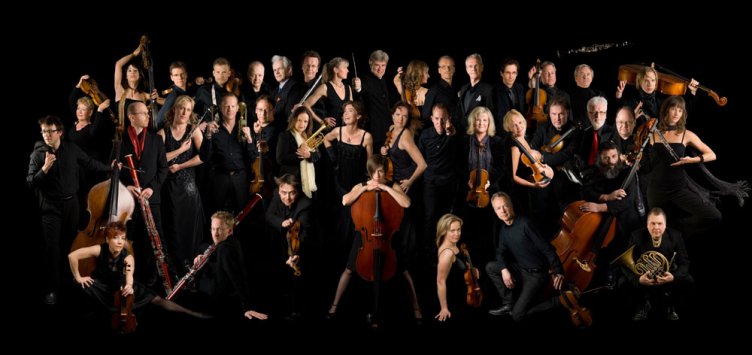
A Dance of Strings: Sweden’s Premier Chamber Orchestra Takes on Beethoven and Mozart

Swedish Chamber Orchestra
Garrick Ohlsson piano
Thomas Dausgaard conductor
Bailey Hall, Cornell University
April 26, 2013
8:00 pm

SCO

There is nothing like a heaping helping of Beethoven to cap off a prodigious concert season. That was just what we got on Friday night when the Swedish Chamber Orchestra, under the baton of Thomas Dausgaard, took to the Bailey Hall stage. Between the sweet concentrate of the Coriolan Overture and the unprecedented volume of the Third Symphony, there was much to savor. Like the spring weather that has finally waved its magic wand over the fertile Ithacan landscape, it was a veritable flowering of activity.

The overture revealed an orchestra blessed with just the panache and dynamic control required of any Beethoven interpreter. The piece contains two themes, one in C minor (representing the tenacity of its eponymous protagonist, an ancient Roman leader) and the other in E-flat major (representing the forlorn mother who shuns his bloodlust). The latter theme set the tone for the night, not only in spirit but also because the remaining works on the program followed the same key. The smoothness of execution was top-flight, achieving heartrending contrast between tense string arpeggios and recurring cinematic sweeps of battle.

In addition to superb control of dynamics and tempi, the players of the SCO found delightful traction in Dausgaard’s programming. In this regard, closing with the unwieldy “Eroica” symphony was a reflective choice. Not only did it embolden the exploits of Coriolanus with its martial overtones (the piece originally bore dedication to Napoleon Bonaparte), but it also transcended its political wrapping into the variegated gifts within. Long even for its time, Eroica feels even heftier in this age of quick sound bytes.

Notable are the three French horns, whose golden blasts resolve a brooding funeral march in the second movement and whose hunting calls add punch to an already agile scherzo in the third. Yet it was the first and closing movements that honed the orchestra’s deeper talents. Following intermission, Dausgaard (who conducted the symphony without a score) was barely on the podium before a swing of his arms threw us headlong into a storm of intense, restrained energy. Moving between the ethereal and the worldly at the flick of a bow, the strings never strayed into melodrama, and the wind section maintained admirable footing throughout.

Ohlsson

Yet the concert found its brightest star in Garrick Ohlsson, whose appearance spiced the meat of this classical sandwich at program center. A student of the late Claudio Arrau, the White Plains, New York native has since grown into one of our generation’s most elegant pianists. His poise and range at the keyboard were immediately apparent as he engaged the SCO in the exchange that opens Mozart’s Piano Concerto No. 9. Written when the composer was just 21 years old, it bears the subtitle “Jenamy,” so named for the daughter of a dancer whom Mozart befriended in 1773. Sure enough, dance was just what Ohlsson’s did as they navigated the tireless runs and trills (a highlight of his playing) so profuse throughout the opening Allegro. The contrast between his gritty left hand and airy right in the cadenzas was nothing short of remarkable. After the almost funereal sublimations of the Andantino, the concluding Rondo made for a flourish to remember. That Albert Einstein once referred to this piece as “Mozart’s Eroica” was no coincidence. Its scope and focus were comparably arranged. Both made for exciting performances.

“These days we like everything to be local,” said Ohlsson, who addressed the audience by way of pouring a sonic aperitif to the hefty concerto. He lamented not knowing anything by an Ithacan composer, but settled on The White Peacock by Charles Griffes (1884-1920) from nearby Elmira. Perhaps his most well known piece, its Gershwin-like swirls and touches of French impressionism made for a competent and programmatic detour. As if to carry over the feeling of dancing, the SCO closed the concert properly with “Wenn so lind dein Auge mir” from Brahms’s beloved Liebeslieder Waltzes. And with that, we were taken.

(See this article as it originally appeared in the Cornell Daily Sun.)

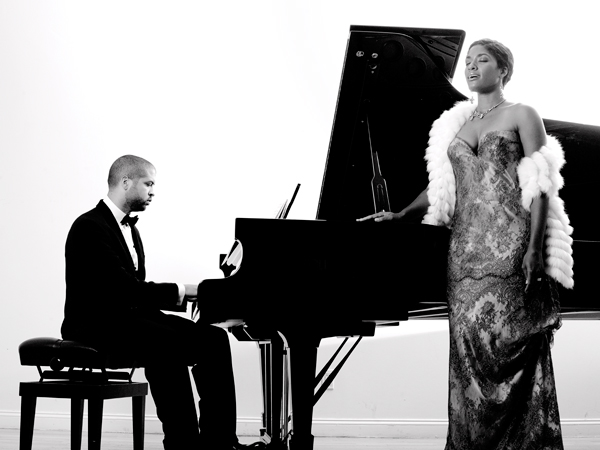
A Little Bit Wiser: Jason and Alicia Hall Moran

Jason Moran piano
Alicia Hall Moran voice
Barnes Hall, Cornell University
April 11, 2013
8:00 pm

JAHM

In January of 2012, pianist Jason Moran and his wife, mezzo-soprano Alicia Hall Moran, were slated to perform on Cornell University’s intimate Barnes Hall stage. A Broadway gig prevented Alicia from being able to appear and bassist Dave Holland was kind enough to substitute. The result was an unforgettable evening of music. Yet I always wondered what spells the original billing might have cast. At last, some 15 months later, that magic was realized. There was something about the way that Jason opened with his solo rendition of Fats Waller’s “Honeysuckle Rose” that assured us we were in for something special. His flourishes were straight from the heart, not the least bit rhetorical. He took those classic threads and re-spun them: same colors, different weave. It was the first of a handful of solo pieces, which also included John Scofield’s “Fat Lip” (a jauntier affair, coated in silver and wine) and some original music written for Alonzo King. The latter revealed the gentler side of an artist whose panache lays it all on the table: diamonds, clubs, hearts, and spades. Or maybe it was the way in which Lucille Clifton’s “blessing the boats” tumbled from Alicia’s lips. A poetess in her own right, she took to the platform fully prepared for the power of love in a world riddled with hindrances. Her resonance filled the room, sharing the rafters with spiders’ webs and history. Like Clifton’s timeless words, she manifested a fully embodied style, her pulse audible during sustained notes.

may the tide that is entering even now the lip of our understanding carry you out beyond the face of fear

Alicia used these interludes as doorways to personal reflection. Not only because she wrote the melodies, but also because in her was a storyteller whose loom was strung with moonbeams. By the end of the night we knew how she and Jason had met and fallen into oneness, how music had called to them as equals and set their phasers to shine. Their autobiographical transparency cut the fourth wall like butter.

may you kiss the wind then turn from it certain that it will love your back

A soulful rendition of a Stevie Wonder classic, endearingly altered as “I Was Made to Love Him,” set off a string of standards. Of these, “My Funny Valentine” stood out for its rasp, traversing a bridge of good fortune into a swinging “Summertime.” Leonard Bernstein’s “Big Stuff” was the icing on an already optimistic cake, boxed and tied with a bow.

may you open your eyes to water water waving forever

Two pieces by Jason from a commissioned suite based on hymns of the quilters at Gee’s Bend, Alabama were the reigning portion of the set. “Here Am I” was downright transcendent, melding supplications into sustained, train-like chords from the keys. “People are more important than things,” Alicia sang, and we could feel that theory made real in practice. This was followed by “You Ain’t Got but One Life to Live, You Better take Your Time,” the notes of which rubbed up against one another as Alicia looked us all in the eye and straight into our hearts. She walked offstage, her voice still carrying before boomeranging back to encore with Duke Ellington’s “I Like the Sunrise.” A glint of light at the end of this long winter, it glowed until we were warmed.

and may you in your innocence sail through this to that

By this point, we had experienced something more than a show. It was a life lesson. Thus spoken and sung for, we carried snatches of post-concert conversation in our pockets out into a maze of streetlights, strung to the gills with joy. Carry on, butterflies, carry on.

Lena Willemark album review

Click on over to RootsWorld magazine to read my review of a new album by Lena Willemark on the Swedish label, Country & Eastern. Readers will be familiar with her handful of ECM projects, including the popular Agram. Here she is joined by saxophonist Jonas Knutsson (also featured on Agram) and keyboardist Mats Öberg in a gorgeous folk-inspired program. I further encourage ECM fans to check out Country & Eastern. It is the brainchild of Bengt Berger, whose Bitter Funeral Beer album is among the best of ECM’s outliers.

ADS

All 4 One: The Anonymous 4 Sparkle at Sage Chapel

Anonymous 4
Sage Chapel, Cornell University
April 5, 2013
8:00 pm

Anonymous 4

Although the Anonymous 4 have been singing for over 25 years, to hear them is to experience what feels like centuries more. The current lineup of this all-female vocal quartet (two of its original members have moved on to other projects) consists of Ruth Cunningham, Marsha Genensky, Susan Hellauer, and Jacqueline Horner-Kwiatek, who together presented “Marie-Marion: Motets & Songs from 13th-century France” to a packed Sage Chapel audience last Friday night. Motets formed the bulk of the program, each built around Old French and occasionally Latin texts. The latter were mostly dedicated to Marie (the Virgin Mary), who along with an earthly counterpart, Marion, was the main protagonist of the evening’s dedications. The presence of both Marie and Marion made for a creative pastiche of the divine and amorous. The singers augmented this with a selection of plainchant standards and solo renditions of the trouvère (troubadour) love songs to which the grander settings often alluded.

Fans of the Anonymous 4 will be familiar with their classic Love’s Illusion. While in that program the focus was on courtly love, here a deft mash-up of sacred and secular themes formed the backbone of a dramatic and sometimes-prurient corpus. The motets were complex in their own right, with two or three voices singing from entirely separate texts over a wordless “tenor” line. The selections came from the Montpellier Codex, compiled in the south of France circa 1300. Paring its 315 motets down to an hour-long “best of” was certainly no easy task, but the end result was nonetheless intuitive and sure.

The flowing nature of the program was such that parsing of individual pieces seemed as unnecessary then as it does now. Moods ranged from forlorn to joyful, but were always flavorsome. If any distinction can be made, it is that the most secular passages were often also the most restless. Staggered rhythms and the occasional unexpected change in pitch attested to the singers’ sparkle of execution amid a landscape of maidens, shepherds, and holy visions.

The concert culminated in a final juxtaposition of the two “Marys,” who came to represent the fullness of consciousness, the depth and shallowness of human concern in the forest of life. For indeed, the Anonymous 4 achieved a verdant sound. Their blends, at moments uncanny, allowed single voices to rise and fall with the tide, so that the ringing qualities of each could shine through. Of those qualities we heard plenty in the solo chansons: Cunningham’s roundedness; Hellauer’s sweeter, raspier blush; Genensky’s sharper, earthy tone; and Horner-Kwiatek’s fair, supple lilt. In each was the flutter of a genuine medieval heart.

We might compare these ancient settings to contemporary popular songs, for in them were brief, simple introductions, engaging riffs and satisfying conclusions. That being said, we must remember that the motets especially were considered avant-garde for the time(s) in which they were composed. Either way, it is refreshing to know that one can still be privy to such splendor in concert, navigating its mazes as if they were our own, held only to the standard of our adoration, unadorned. Keeping true to their name, the talented songstresses of Anonymous 4 presented melodies without discernible authors, a dynamic that might seem as distant from us in this age of intellectual property as the Old French in which much of this music was sung. Whatever the language, we could not help but be fascinated.

(See this article as it originally appeared in The Cornell Daily Sun.)