Through the Fog: A Contact Live Report from Birdland

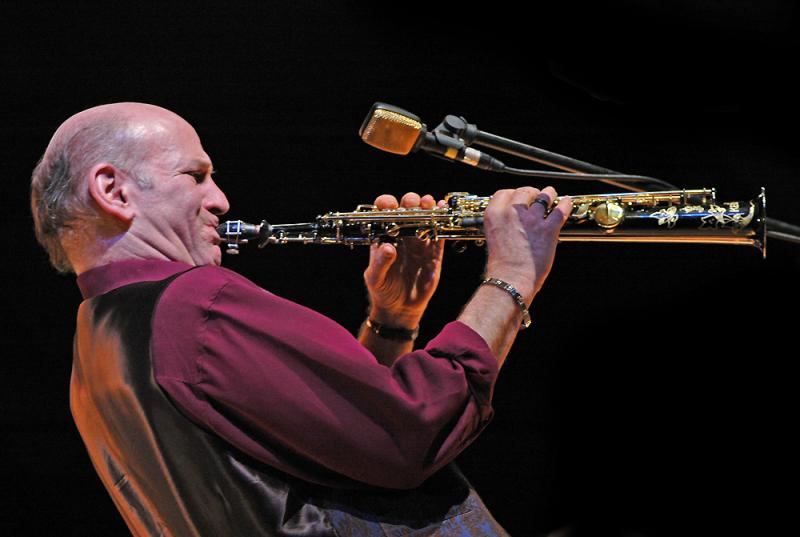
Dave Liebman soprano and tenor saxophones
John Abercrombie guitar
Marc Copland piano
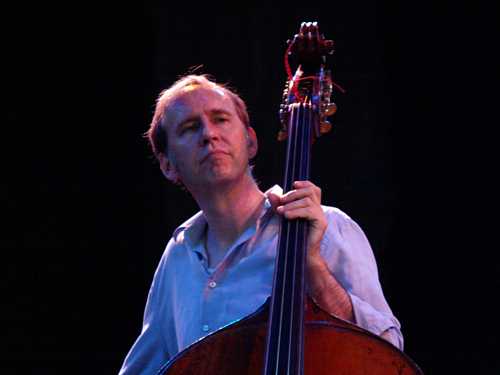
Drew Gress bass
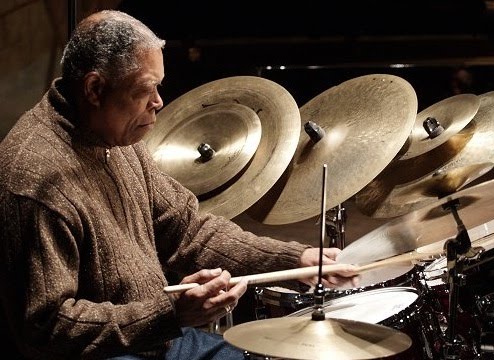
Billy Hart drums

Birdland, New York City
February 10, 2012
11:00 pm

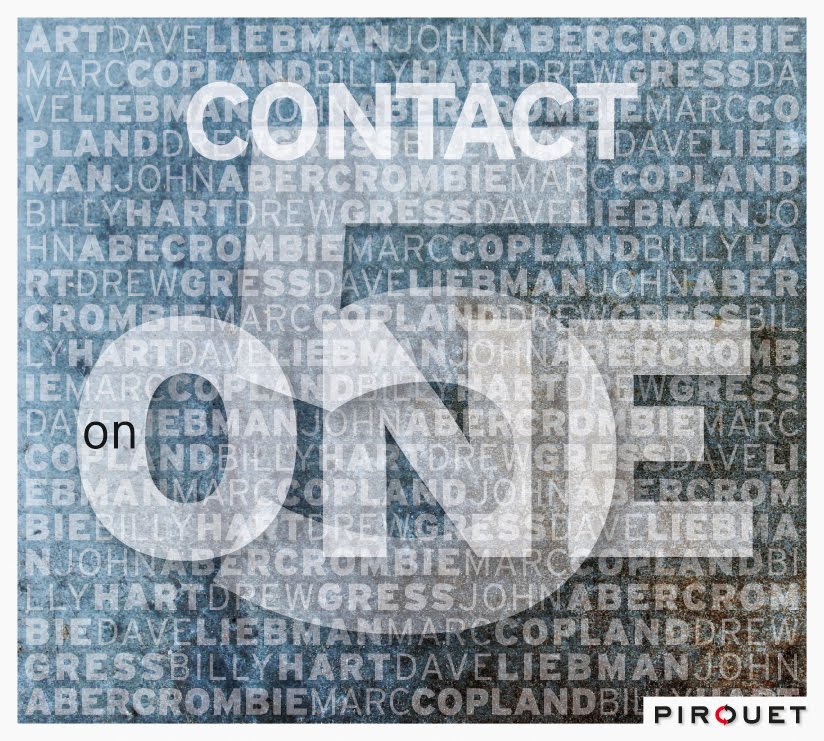
Contact is as appropriate a name as one might come up with for saxophonist Dave Liebman’s newish outfit. This star-filled quintet—in which he joins forces with guitarist John Abercrombie, pianist Marc Copland, bassist Drew Gress, and drummer Billy Hart—practices what it preaches, bringing a surprisingly permeable sound to bear upon equitably spread writing and performing. Once the group took to the stage at Birdland last Friday night, Abercrombie quipped on the name, assuring us it had nothing to do with the Jodie Foster film of the same name. Then again, he added, such a connection might prove valid as they develop their interactions over time. If this show was any indication, I am inclined to agree, for most intriguing were the dramatic developments it underwent over the course of its four long tunes.

Liebman’s soprano, at once flute- and trumpet-like, was the first to catch our ears as it danced through a tentative midrange guitar in “Soundup” (Abercrombie), also the opener of the group’s 2010 Pirouet album, Five On One. Hart set a precedent of color for the night with his glottal cymbals, while Gress’s well-tuned fingers brought an omnipresent depth. Abercrombie’s first solo was buoyant, if conservative, and seemed to end just as it was flapping its wings. Copland was almost inaudible at first, preferring, it seemed, to linger like a trembling breath. Liebman’s bubbling gestures, on the other hand, sprouted a wealth of chromatic foliage. Every note had its own tone, shaped by a rare breadth of embouchure. Once he and Abercrombie receded, Copland at last came to the fore. Spearheading some lovely trio action, he brought out the classic core that moves the heart of all of these musicians. Notable was the way in which he unraveled the number’s tightly woven themes, making the rejoinder all the more comforting.

“Footprints” (Shorter) arose out of a quiet eddy in which Liebman swam limberly on tenor, fading in and out, as he did throughout the set, like an ear selectively attuned to stillness. Abercrombie was visibly more comfortable in his solo this time around. He moved with a hum of wincing energy, seeming to first define a branch then trail from it like a spider from a thread of web. Copland kept his hands quite close for his turn, as if tied by one of those very threads to some hope through foggier days. Hart was the real star here, dialoguing on the light fantastic with the rest of the band in vast, metallic exchanges.

If the winds of improvisation had only begun to blow before, in “Childmoon Smile” (Copland) they now whistled through the trees of the audience with the insistence of a dream. The tune’s composer regaled us with a lush solo, gilded by Hart’s bronze, before Liebman dovetailed his soprano to the emerging carving. Gress evoked Gary Peacock in his solo, while Copland sparkled like a watery surface in soft focus. Hart’s brushes were at once ice and sand, brought to life with a kiss of warmth. After leaving the quiet vessel of Abercrombie’s solo, Liebman saw fit to ply more cosmic territories. Copland added his characteristic impressionism to the cubist splendor of Liebman, who enchanted with the most innovative solo of the night before Copland wrung out another verdant splash to close.

Abercrombie led us down an abstract path to “Blues Connotation” (Coleman), which kicked off the set’s final cerebral groove. Liebman was superb on tenor here, moving in clusters and high-flying loop-de-loops, echoed by Abercrombie at every catch. Both scaled and slid through this melodic plane like an uninterrupted game of Snakes and Ladders. Gress flickered like a candle in fast forward before Copland crept in from the periphery. Then, it was just he and Gress taking us into blissfully unexpected territories, uniting in moments that elicited gasps of admiration from the audience. Hart reprised his locomotive charm and unmasked a solo like an origami figure unfolding and refolding itself by fire alone. The final stretch went down like a swig of Jameson.

Liebman plays at the speed of thought. He allows for space, vital and alive, drifting in and out of the ear like an idea does the mind. His playing is something beyond melody, yet entirely devoted to it. Copland’s inventiveness is limitless, and in such a rich setting he had more enough to work with. Abercrombie was fluid as ever, though it seemed to take him a while to warm up to the feeling of the moment, and it a great pleasure to finally see Gress and Hart in concert, for the two of them provided a penetrating elasticity that was subtly surprising. Here is a band that really listens, and we can only give the same in return.

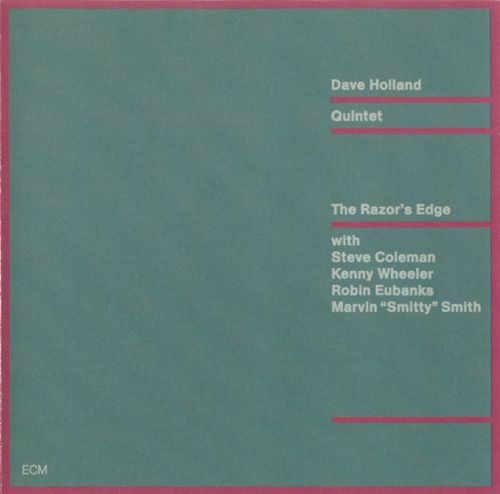
Dave Holland Quintet: The Razor’s Edge (ECM 1353)

Dave Holland Quintet
The Razor’s Edge

Dave Holland bass
Steve Coleman alto saxophone
Kenny Wheeler fluegelhorn, trumpet, cornet
Robin Eubanks trombone
Marvin “Smitty” Smith drums
Recorded February 1987 at Tonstudio Bauer, Ludwigsburg
Engineer: Martin Wieland
Produced by Manfred Eicher

Still reeling after seeing Dave Holland in a recent intimate performance with Jason Moran, I find myself going back to the fresh directions he explored on ECM with one of his finest outfits: the Quintet. As its third album for the label, The Razor’s Edge is all the more important for being reedman Steve Coleman’s last run with the group before his travels took him elsewhere on the path to musical geomancy. He joins Holland with the usual suspects: trumpeter Kenny Wheeler, trombonist Robin Eubanks, and drummer Marvin “Smitty” Smith (of, among countless other projects, Jay Leno Tonight Show Band fame).

The Quintet is as dynamic as ever in this seminal outing, which finds Eubanks and Coleman in particularly fine form. The trombonist gives us some early traction against Holland’s skittering delights in “Brother Ty,” while that unmistakable alto trades places with soulful insights in the more pensive “Vedana.” Next is, if the reader will indulge me, the title cut, which opens with Wheeler against a delicate rhythm section before releasing a tremulous solo from Eubanks. Coleman flies off a half-pike of big band sound, a raging flare of virtuosic wonder at the mouthpiece. Holland pauses for reflection in “Blues For C.M.,” only to drop the anchor with a gorgeous and unassuming theme. Coleman dominates again, bringing a slower heat this time around as he fills each available nook and cranny with his golden tone. An all-too-brief response from Eubanks brings us down into “Vortex.” Holland proves the early bird, opening to the full band with Coleman at the helm of yet another engaging vessel. And out of sparkling breath comes a muted Wheeler, hurling a pitch to Coleman at bat. Tracks like this are hard to beat, each a hefty dose of wonder and logic rolled into a ball of fun. After a couple of slow swings, Smith kicks us off into “Figit Time,” in which Coleman excels right out the gate. He is, like the album as a whole, a house aflame, threading every hot potato of a needle passed his way. The invigorating drum work in this masterpiece makes it alone worth the price of admission. This is life on jazz.

<< Gary Peacock: Guamba (ECM 1352)
>> Oregon: Ecotopia (ECM 1354)

Marc Johnson’s Bass Desires: Second Sight (ECM 1351)


Marc Johnson
Second Sight

Marc Johnson bass
Bill Frisell guitar
John Scofield guitar
Peter Erskine drums
Recorded March 1987 at Rainbow Studio, Oslo
Engineer: Jan Erik Kongshaug
Produced by Manfred Eicher

This sophomore effort from Marc Johnson’s Bass Desires comes nowhere near the octane levels of the project’s wild self-titled debut. This doesn’t mean, however, that Second Sight is no less enthralling. Its strength lies in its personnel. Guitarists Bill Frisell and John Scofield seem so well made for each other that, were they not split between the left and right channels, respectively, they might as well be thought of as some bizarre 12-stringed chunk of genius. How can we, for instance, not be moved by the sentiment of “Small Hands” and the resonant eddies of “Sweet Soul”? The latter, with its touch of Pat Metheny brightness, is especially moving. And let us not bypass the unassuming opener, “Crossing The Corpus Callosum.” Here the guitars dance on edge over the rolling hills of Peter Erskine’s drums and Johnson’s bass. The wealth of extended textures opens vista upon vista of possibility. Frisell is downright glowing in “1951,” which might as well have been an outtake from Naked City’s Radio. A dreamy slice of nostalgia pie if there ever was one, it comes served piping hot with a dollop of electric ice cream to boot. The solos are three-dimensional.

Lest we think this is all too ponderous, Scofield livens the proceedings with an invigorating twofer. The Richard Thompon-esque rhythm guitar in “Twister” is the set’s most spirited. Frisell and Scofield add to each other’s fire as they unabashedly scale the diminished seventh ladder (think Beatles), splitting off into the groovier weave of “Thrill Seekers.” Scofield rules with his solo here, while Frisell winds some of his most insectile threads in the background before slingshotting stardust back through the atmosphere. The band recedes for a fragile solo from Johnson before playing out on the vamp. The jauntiness of this number is superbly contrasted by “Prayer Beads,” a monologue from Johnson, who closes the door with “Hymn For Her.” This last is a dream within a dream. It feels like watching life through a veil of trickling water and finding that hope is already beside you, that its forgiving melodies flow both into and from the heart.

A note on the cover: the helicopter is a foil. Without it, the beach is just a beach. With it, the beach begs to be appreciated.

<< The Bill Frisell Band: Lookout For Hope (ECM 1350)
>> Gary Peacock: Guamba (ECM 1352)

Listening to the Wind: Moran/Holland Duo Live Report

Jason Moran / Dave Holland Duo
Barnes Hall, Cornell University
January 28, 2012
8:00 pm

Sometimes a performance can change your life. Equally rare is the performance that brings life to change. To those fortunate enough to be in the intimate confines of Barnes Hall last night, the latter is in tall order. The performers need no introduction (for the curious, my pre-concert report is here), and perhaps they prefer it that way, for when they take to the stage they deflect attention from themselves by first paying deference to one another. Yet even before our rapt attention and respectfully placed woops fill the room, the stage itself has told us all we need to know. Between towers of speakers and amplifying equipment, two instruments: a freshly tuned Steinway and a prone bass. Moran’s chair, which he brings wherever he can, sports clean, modern lines, while Holland’s trim yet deep instrument seems to hold countless histories in its burnished surface. Already there is a conversation happening, as if to confess the music before the artists actualize it.

And actualize it they most certainly do. Rather than kick off the concert with bang, however, they start with a touching homage to the great Sam Rivers, with whom both Moran and Holland had the opportunity to work and whose recent passing was felt deeply by all who knew him. To feel his spirit living on like this is a joy to witness. With the gentle cascade of a frozen waterfall in spring thaw—appropriate for this unseasonably warm winter—the gentle strains of “Beatrice” go straight to the heart, from the heart. Between Moran’s crisp pointillism and Holland’s smooth hibernations, one finds hard-won balance. Each note leaves an aftertaste of affection.

Holland and Moran follow up with an offering apiece. Holland’s paints some of the broadest sonic vistas of the set, twisting his virtuosity into a solved Rubik’s cube. Alongside this powerful chunk of expressiveness, Moran’s “Gummy Moon” reads like a bedtime story (and by no coincidence, for the title reflects his children’s mispronunciation of the classic Goodnight Moon). Beneath Holland’s monotone, the piano man unpacks terse chording into a majestic tale of starlit travel. A breath and a pause, and we’re off to a whole new gig as Duke Ellington’s neglected “Wig Wise” ushers us into the center portion of the show. The duo share a smile and a nod, welcoming us into something as timeless as the thematic material at their fingertips. Moran is a whirlwind of ideas, though both musicians’ flair for ecstatic performance is in full evidence here.

After a ballad so smooth one would swear the house lights dimmed out of sympathy, the unmistakable zigzag of Holland’s classic “Four Winds” further strengthens the Rivers connection. Moran explores some of the more turgid recesses of this well-aged tune, even as Holland stomps his way through a storm of brilliance. As with all the music they play, they take this number not only to new heights, but also to new depths.

Next, Holland provides one of the concert’s highlights in his “Hooveling.” Meant to evoke one’s navigation through a New York City crowd, it twists and turns with a deftness so hip it almost hurts. Moran listens right there with us, enjoying the talents of one who commands at the solo bass like no other, before turning an eye to something bygone, a tender farewell that only presages the second tribute of the night in Paul Motian’s “Once Around the Park.” As Holland lovingly explains before they play, Motian frequented the jogging path around the reservoir at Central Park. It was during one such running session that the tune came to him. And indeed, we can feel the chill city winds passing from the piano through the bass’s arboreal footwork. A fitting tribute to a human being of profound melodic insight.

Before the duo close with improvisations on a familiar Thelonious Monk theme, they lay the nostalgia on thick with “Twelve,” a tune once taught to Moran by his teacher Jaki Byard. The result is a veritable train ride through a landscape of nodding heads.

With these two, jazz isn’t just an art form. It’s a warm hearth in the cold. Moran is a hopeful player, always looking ahead to whatever light may be on the horizon. His right hand is a water strider of expression that widens its purview at every turn. Now a chromatic jester, now a paternal force, it engages the left with insistence and verve. Holland, too, strikes a happy medium between wildness and diction. In spite of his ever-wandering fingers, he is nothing if not selective. He chooses his lows carefully, as does Moran his highs, and each of his harmonics feels like a drop of innocence in a conflicted world. He can bring that wincing twang to bear with the best of them, but more often wants to talk with us rather than at us. Both Moran and Holland make every repetition novel and exciting. Like souls lost in the beauty of a memory that threatens to fade in a harsher present, they seek to record everything they see—not for posterity, but for the invaluable ardor of the moment.

If you were unable to get a ticket, or simply found out about this special performance too late, fear not, for you needn’t have been there to feel its effects. Those energies are still out there, running rampant like a Rivers soprano line, if not slinking stealthily like a Motian brushstroke, into the most hidden recesses of our consciousness. Just listen, and you might hear them in the wind.

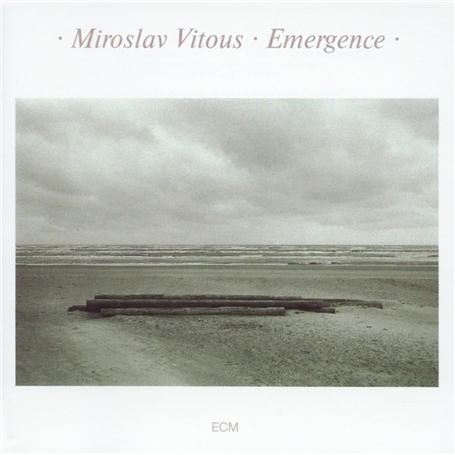
Miroslav Vitous: Emergence (ECM 1312)


Miroslav Vitous
Emergence

Miroslav Vitous bass
Recorded September 1985 at Tonstudio Bauer, Ludwigsburg
Engineer: Martin Wieland
Produced by Manfred Eicher

Although Miroslav Ladislav Vitouš has had varying levels of success in the post-Weather Report years as bandleader, we can hardly help but marvel at this gem of a solo recording. With nary an overdub in sight and more than enough heart to spare, the Czech bassist plots an orchestral sweep through his precisely (at)tuned skills. Like the caron that disappeared from the end of his name before going international, it is a valley of possibility, and he our shepherd through its gallery of songs and tales. All the more appropriate, then, that we begin with “Epilogue,” for it is a lasting look back at what is to follow. There is much to experience in this piece: a deep memory, intimations of a dance, the infused colors of a dream. Vitous carves from this chunk of maple the balsa-like delicacies of “Transformation.” There is indeed a metamorphosis in its lovely arco lines: from the internal to the external, from the thought to the spoken. Yet all of this is but a prelude to the four-part Atlantis Suite, of which the third movement (“The Choice”) is one of the most beautiful on the album. It flexes like a hand wafting smoke into our interpretive memories, and holds a flock of harmonics in its nets. From this, rays of light open into further transformations I can only liken to the shift from a voiceless to voiced consonant. Here, the mythical continent has not been torn asunder by inexplicable cataclysm. Rather, Vitous unravels its legacy in reverse, back to its golden age. “Wheel Of Fortune” similarly turns the passage of time into a visage of understanding, running through a field of prismatic colors into the abstract whirlwind-cum-groove that is “Regards To Gershwin’s Honeyman.” Vitous shows his sense of humor in the spirited “Alice In Wonderland,” which has something of the elusive rabbit’s mockery, then turns to subtler invigorations in “Morning Lake For Ever.” This is a fantasy in sound, a cleansing of the palate before a nod to Sketches of Spain ends the set in the rainbow of dramatic statements.

The skill of commanding attention with only a bass lies in the ability to treat the instrument as both a self-contained unit and as a seed for unheard things. Vitous accomplishes just such a dynamic. Never once does he sound like a backup instrument in want of a band. Whenever his fingers way to bow, there is nothing but openness in every action. As Vitous says in his dedication, this is “music with no boundaries.”

Emergence delights in the ways it blends registers, drawing upon a wealth of joys with just the right touches of melancholy and cerebral edginess. Such a well thought-out session cannot help but earn a rightful place alongside Dave Holland’s Emerald Tears as a classic in its field. The album is also superbly recorded, enhancing the instrument’s natural resonance by placing us in its very ribcage, as it were. It feels like walking through a dream, for in its confines perspectives change with such fluidity that one hardly notices them as the whims of a human touch. And perhaps they are the most natural of all, guiding us into a world of perception where evaluations such as this are but feathers on a dying bird.

<< John Abercrombie: Current Events (ECM 1311)
>> Werner Pirchner: EU (ECM 1314/15 NS)

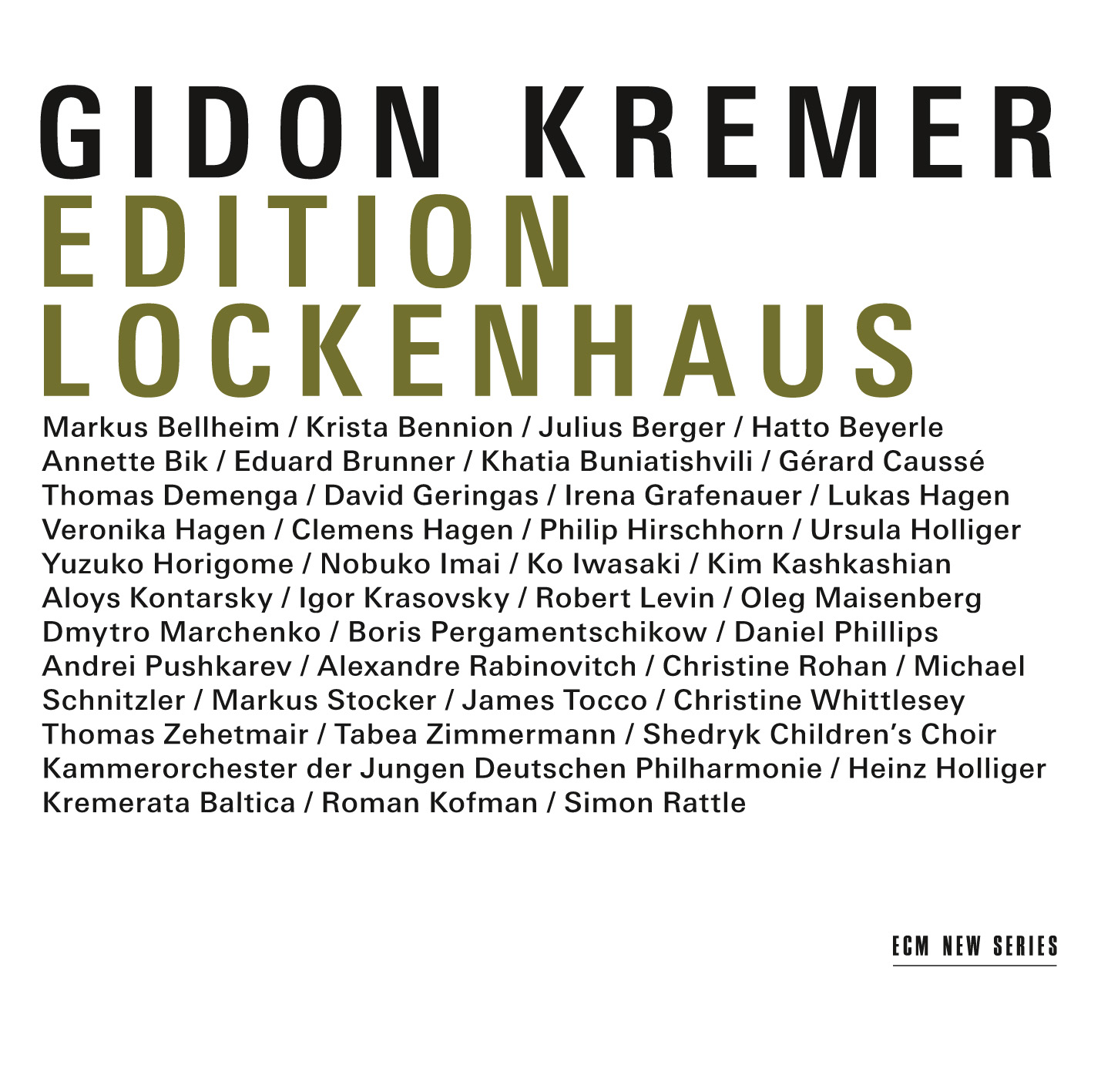
Gidon Kremer: Edition Lockenhaus (ECM New Series 2190-94)

Gidon Kremer
Edition Lockenhaus

The Lockenhaus Chamber Music Festival is the brainchild of violinist Gidon Kremer. Once called an “anti-festival,” it is more a gathering of friends bound by a love of all things chamber and a certain haphazard brilliance: its constant cancellations, rescheduling, and daunting thematic choices somehow coalesce into a coherent yearly event. And an event, it most certainly is. As Peter Cossé writes in his liner notes: “In Lockenhaus, awareness, the casualness of a holiday atmosphere, a creative commitment bordering on musical revolution, and even instrumental mishaps that result from nightly round-the-clock socializing induce a shimmering acoustic ‘painting’ that the totally immersed chamber music fan views in alternating states of torpor and enlightenment.” This potent energy and the communal spirit that animates it abound in every note. For this five-disc Lockenhaus Edition, Kremer and coproducer Manfred Eicher have chosen from out of literally hundreds of recordings these highlights from the festival’s 30-year history.

Disc 1

Shedryk Children’s Choir, Kiev
Markus Bellheim 
piano
Christine Rohan 
ondes Martenot
Khatia Buniatishvili 
celesta
Andrei Pushkarev 
vibraphone
Dmytro Marchenko
Igor Krasovsky 
percussion
Kremerata Baltica
Simon Rattle 
conductor
Roman Kofman 
conductor
Recorded 2001 and 2008 at Lockenhaus Festival
Engineer: Peter Laenger

The Metamorphosen of Richard Strauss (1864-1949) makes for a formidable opener. This study in strings was dedicated to the great Paul Sacher and penned as the doors of the Second World War were closing. In light of its circumstances, one can hardly resist reading an almost Wagnerian shade of grey into its opening gestures, tinged as they are with a certain disillusionment with reality. The music is constantly finding itself through a blurring of conflict and resolution. It is a hall of mirrors where self-awareness is an understatement, in which every vague pizzicato turns the mirrors to new angles. The solo instruments don’t so much arise out of this swirling mass as glint off them. The double bass lines are especially overwhelming, while the violin becomes a looping sentiment curled ever so gently around the throat of trauma. It is as if a single molten thread were running through it, our vision of it but one of countless beads strung along its path. It finds its peace in little dissonances, casting a critical eye on platitudes, and in that way one finds perhaps only in Schubert recedes into the foreground. It is the flow not of water, but of the algae that visualizes the current’s direction. Lovingly played by the Kremerata Baltica and conducted by Simon Rattle, this performance shows Rattle’s eclectic talents in the raw, turning over as he does the sweltering underbelly of this piece. He is an ideal choice, for he knows how to make the lush feel like a drop in the bucket. He sees what the music nests itself in and works his baton around and through every twig. One of ECM’s finest live recordings.

Although Olivier Messiaen (1909-1992) composed his Trois petites Liturgies de la Présence Divine not long before Strauss’s Metamorphosen, its register could hardly be more different. Where the latter is a meditation on memorial, Messiaen’s aural triptych is an unfolding flower of light. The synaesthetic Frenchman has brought a profound imagination into palpable dimensions here. A wistful combination of piano, strings, and women’s voices opens the first liturgy, each the side to a nebulous triangle of forces. The agitations at the keyboard are like a broken crystal, drawing its light from vocal lamentations. The violin seems to rise with a spindly charm that is as alluring as it is self-destructive. We get the internal musings of an ondes Martenot, as well as various percussive accents falling like stardust in the religious imagination. In the second liturgy, jubilation quickly turns into a discomforting beauty, the piano jumping from a subterranean crawl to unmarked flight in but a fluttering of the keys. The third unravels a chant into its constituent lines, each an iridescent tether to sentiments performed rather than spoken. Passages of transcendence sit somehow comfortably alongside dips into magma, ending in a brushstroke of heavenly choirs.

ECM 1304_05

Discs 2/3 (originally Vols 1 & 2, ECM New Series 1304/05)

Gidon Kremer violin
Eduard Brunner clarinet
Oleg Maisenberg piano
Irena Grafenauer harp
Christine Whittlesey soprano
Ursula Holliger harp
Hagen Quartett
Kammerorchester der Jungen Deutschen Philharmonie
Heinz Holliger conductor
Recorded 1984, 1981, and 1982 by Austrian Broadcasting Corporation (ORF)
Engineers: Roland Pulzer and Martin Frobeen
Remix and editing: Martin Wieland

If the first disc was an introduction, then the Quintet in f minor for piano and strings by César Franck (1822-1890) is a rich first chapter. From the opening violin proclamation we are plunged headfirst into the depths of Romanticism proper: the piano as heartbeat, the strings as lifeblood. It is a plaintive world, at once cloudy and broken by light, unnamable except through sound. The piano vies for constant resolution, knowingly situated at the center of an unsolvable debate, sometimes leaping and sometimes falling back into the despair that first gave it meaning. As we tread softly into the distance of the second movement, the young Lukas Hagen displays profound versatility with his clarity of tone and burrowing vibrato. As the central melody emerges into arid light, our ears come into focus as might a pair of eyes. The piano’s high note phrases are like droplets laddering down leaves on a solitary tree. The third movement lays down an almost Philip Glassean ostinato in the strings develops with fractured intensity. The piano promises hope, but settles altruistically into shadow, where pizzicati lurk like a guitar in Death’s hands.

So begins a lush pairing of French and Slavonic works, which offers dramaturgical insight into the festival’s vibrant mentality. The former side of things continues with a curious piece by André Caplet (1878-1925), a composer whose orchestrations of the works of Claude Debussy outshone his own musical visibility. Based on Poe’s “The Masque of the Red Death,” Conte phantastique sounds like Maurice Ravel’s Trois poèmes de Stéphane Mallarmé turned into an opera, stripped of voices, and condensed into a string quartet. Add to this the aquatic brilliance of Ursula Holliger on harp, and you get a truly distinct experience. Holliger plays pianistically and extracts a profound power from her instrument. The music vacillates between the programmatic and the omniscient. Strings jumble together as the masquerade intensifies, the harp descending like Prospero in gracious intervention. A knock interrupts the action, prompting glassine whispers from the violins. Agitation mounts, only to flutter its eyelids for the last time.

Two songs from “Fiançailles pour rire” make for a fine entry from Francis Poulenc (1899-1963). These somber settings grab our attention with their potency. With empathetic effect, soprano Christine Whittlesey shapes every note with locative color. Her dynamics fall like ripe fruit from a tree of implication, caught in the capable hands of pianist Robert Levin. Every last shred of hope is laced with painterly melancholy, leaving only scars to show for its passing.

Leoš Janáček (1854-1928) was an intensely confessional composer, and nowhere more so than in his string quartets, of which we get his first. From the urgent suggestions and biting interjections of the opening movement to the enigmatic veil of the fourth, we are pulled through a diorama of illusory scenery. Clemens Hagen is especially brilliant here, his cello lighting the way through a fog of folk tales, while second violinist Annette Bik provides moments of rhythmic brilliance. The Quartet No. 1 is a blind spot in the Janáček oeuvre. We accept its disorienting illusions without fear of what lies behind them. We hear carriages drawn by spooked horses, the cries of a forlorn father, the hunting calls of an aristocracy in decline. Thus populated by our imaginations, the music brings us closer to our own internal dramas.

After such inescapable opacities, the neoclassical clarity of Igor Stravinsky (1882-1971) comes as a pleasant surprise. Scored for violin, clarinet and piano, these three dances from L’Histoire de Soldat show the composer at an evocative peak. Kremer brings characteristic fire to every nuance. His sonorous gypsy acrobatics are a joy to behold. Clarinetist Eduard Brunner peeks in for the opening Tango, offering constructive support. The beautifully syncopated Waltz holds to its core with enthusiasm, Aloys Kontarsky’s occasional high notes adding confectionary flavor. The final Ragtime brings a mounting complexity to these brief but vivacious utterances.

An enthralling performance of Stravinsky’s Concerto in D follows. Under the passionate direction of Heinz Holliger, the Kammerorchester der Jungen Deutschen Philharmonie springs to life with the opening pizzicato. Noticeable idiosyncrasies abound, such as a strikingly textured moment when the inside of piano is plucked for added effect during the Vivace. The flexibility of the second movement is intensified in hands of such bright young musicians, dancing lithely between pathos and fleeting awareness. Plunked double bass accents punctuate every moment of this graceful interlude. The final movement displays an astute sense of division, especially in the solo cello and its immediate refraction. These musicians bring an almost manic sense of multiplicity to music that is already beyond alive.

Who better to end this portion with than Dmitri Shostakovich (1906-1975)? A far cry from the monochromatic intensities of his quartets, the wonderfully Mozartean waltzes for flute, clarinet, and piano glisten with salon-like ebullience. The interplay between Brunner and flutist Irena Grafenauer makes for a clever listening experience. The second waltz is especially alluring in its ascending harmonies, its last flutters eliciting audible smiles from the audience.

The Two pieces for String Octet op. 11 comprise a more complicated diptych. After a dense opening statement in the Prelude, the lower strings spread out as violins dissolve like mist in the dawn. We get a hint of later Shostakovich in the Più mosso. Its mature balance of aggression and delicacy betrays a forward-looking mind. The final passages writhe in agitated beauty. A solo cello draws a long energetic line, accompanied by pizzicati and distant calls. More dissonant pairings and threats of a fall that never materializes draw us into a tensely mystical finish.

<< Terje Rypdal: Chaser (ECM 1303)
>> Ralph Towner/Gary Burton: Slide Show (ECM 1306)

… . …

Edition Lockenhaus Vol. 3 is excluded from this set (you can see my full review of it here).

… . …

ECM 1347_48

Discs 4/5 (originally Vols. 4 & 5, ECM New Series 1347/48)

Gidon Kremer violin
Thomas Zehetmair violin
Yuzuko Horigome violin
Philip Hirschhorn violin
Kim Kashkashian viola
Nobuko Imai viola
Veronika Hagen viola
Boris Pergamentschikow violoncello
David Geringas violoncello
Julius Berger violoncello
Thomas Demenga violoncello
James Tocco piano
Recorded Lockenhaus Festival 1985 and 1986
Engineers: Peter Laenger, Andreas Neubronner, and Stephan Schellmann

Although one is wont to paint a morose picture of Shostakovich, continues our melodic bridge into the final portion of the set, I think we can hear in these late string quartets especially that within him beat a vibrant heart of passion. Music cannot have been for him so much of an escape as it was simply a voice. We need only cast a careful ear toward the String Quartet No. 14 op. 142 to hear its vibrancy. The distorted jig that works out of the opening crawl is something of an achievement on paper and at the bow. David Geringas at the cello proves to be the ever-present anchor, guiding the quartet as a whole through a variety of registers—from gentle to ecstatic and back again. In the Adagio, his strings throb like ventricles. The more we listen to its words, the less we know of their origins. It is as if they have reached us only light years later, like a star long dead yet still visible. The cello cuts these shadows into a string of glassy shards in the final Allegretto, of which the violins are ecstatic reflections. This movement is more porous and waves its gossamer threads as might a plant to attract insects. Its intimate yet vast cross-pollination achieves something close to transcendence before taking its unnoticed leap into fantasies.

The String Quartet No. 13 op. 138, on the other hand, is a single-movement opus in twenty-two and a half minutes. Its gorgeous beginning unrolls a flat landscape along which a violin comes hopping, not unlike a creature from Vivaldi’s The Four Seasons. Others take up the call in a widening circle of light, launching into a spiral of percussive attacks (which in this performance never come across as declamatory but as clarity incarnate). The congregation disperses as quickly as it came together, leaving solitary voices, though distant, to unknowingly harmonize. And the landscape of mourning through which we have slogged opens itself to a beam of light in the violins,  reminding us that sometimes music matters only where it ends.

The Two Movements for String Quartet add yet another hue. These are more majestic and deftly spun through a slow-motion slalom course of light and dark. The higher and lower strings achieve delicate mutuality, seesawing on a fulcrum of potent stillness.

Czech composer Erwin Schulhoff (1894-1942), a forgotten ideologue-in-arms of Shostokovich, was an intensely dynamic composer. His music lies somewhere between the Russian and Górecki, and provides a fitting cap to an altogether fascinating Lockenhaus portrait. After an exultant introduction, his opus 45 Sextet wanders varicose paths with trembling caution. The violins shimmer like the surface of a moonlit pond in the second movement, under which glide the cello and viola, each an electric eel that lights up the night. In the chambers of this heart, the only blood is a silence that hangs from the trees, gripped like a branch beneath an owl’s talons. Some stellar pizzicato passages in the third movement add hope to our dreams, puncturing the backdrop until it resembles an artificial sky. The final movement is a fractured look back on the first three, a heavy and romantic flower whose weight barely bends the stem, its desires never spoken louder than a whisper.

A high energy and passionate execution make the Duo for Violin and Cello a true highlight of the entire set. Philip Hirschhorn, along with Geringas, navigates a landscape of varying tensions, moving from the snaking opening lines to crunchier motives for a broad, almost orchestral palette. The piece is always flowing in spite of its sometimes-abrupt movements, and is a testament to Schulhoff’s effervescent spirit. Yet it is in the slower passages where we most hear Shostakovich, lingering like a spirit overcoming limitations of time and space.

Pianist James Tocco turns out another star performance the Cinq Études de Jazz op. 58. These inventive pieces draw more upon the rhythmic than melodic colors of the genre. The result is an exposition that is not only delightful fun, but also one that provides foiled insight (especially in the second etude) into composers like Satie and Poulenc who were keyed into popular music idioms. The third etude has the majesty of a Gershwin yet the bleeding colors of the French impressionists, while the fourth is a romp and a cascade rolled into one, leaving the fifth to return full circle with the verve of the first, drawing a lively signature on which to end.

In an interview, Kremer remarks on the difficulties that inevitably arise in putting together such a festival. Quintessential are the tense circumstances surrounding the Franck Quintet, which apparently failed to come together to the musicians’ satisfaction during rehearsals. In spite of this, they managed to pull off one of the most lauded performances of that year (1984). Such is the spontaneity that Lockenhaus creates, encourages, and promotes. This is an exciting limited edition for reasons too numerous to list in full. Not least among them is the fact that the original recordings marked the debut of New Series stars Eduard Brunner, Thomas Zehetmair, Heinz Holliger, and Robert Levin. It is a stream-of-consciousness narrative linked in the fluidity of real-time recollection, the immediacy of which is only heightened by the superb musicianship and live recording. This treasure trove belongs on your shelf.

<< Terje Rypdal & The Chasers: Blue (ECM 1346)
>> Zakir Hussain: Making Music (ECM 1349)

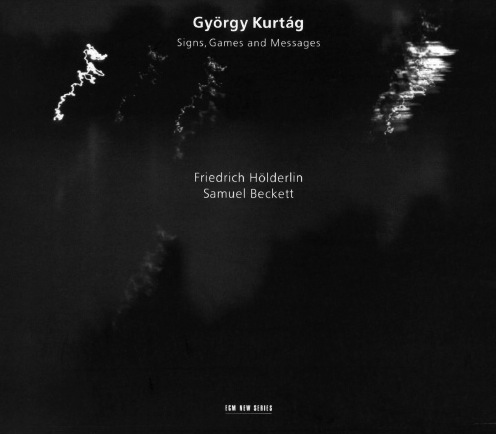
György Kurtág: Signs, Games and Messages (ECM New Series 1730)

György Kurtág
Signs, Games and Messages

Kurt Widmer baritone
Orlando Trio
Hiromi Kikuchi violin
Ken Hakii viola
Stefan Metz cello
Mircea Ardeleanu percussion
Heinrich Huber trombone
David LeClair tuba
Recorded February/March 2002 at Radio DRS, Zurich
Engineer: Markus Heiland
Produced by Manfred Eicher

When the heavenly procession proceeds higher
Then the joyful Son of the Highest
Is called like the sun by the strong,

As a watchword, like a staff of song
That points downwards,
For nothing is ordinary.

–Friedrich Hölderlin, “Patmos” (trans. James Mitchell)

In literary criticism, we throw around our fair share of arbitrary terms. Yet one I stand by, and of which I am especially fond, is “intertextuality,” which refers to the borrowing, shaping, and influence of texts on other texts. Similarly, one can say many things about Hungarian composer György Kurtág. He is a “master of the miniature,” a microscopic craftsman. His language implodes with a hermetic (im)precision. His wit is boundless, unassuming, and unabashedly lyrical. And so forth. But in the end, his sound-world is nothing if not intertextual. For one, we might feel tempted to read the Hölderlin-Gesänge for baritone as an exercise in a less tenable buzzword: deconstruction. Kurt Widmer’s superbly controlled breath wanders from its cradle in search of feet on which to stand, but instead finds a carefully broken ground. Its wavering entrances drop from a cloudless sky. The unexpected appearance of trombone and tuba beget a coarser exposition, proving that Kurtág’s fractures are never twice the same (compare, for instance, to the Kafka-Fragmente). Where sometimes he externalizes the hidden, here he shows us just how fragile the hands of our psyches must be when holding language. These are pieces not with but about words. Therefore, I must respectfully disagree with Thomas Bosche, who in his liner notes says “there is a secret here that is difficult to decode.” Rather, everything about this music is naked.

If anything, it is the ever-evolving opus that is Signs, Games and Messages which presents us with a more enigmatic grammar to parse. These fleeting vignettes for string trio—no less descriptive than their vocal predecessors—shift from playful (“The Carenza Jig”) to plaintive (“Ligatura Y”) in the blink of a galactic eye. The title starts us on the path to understanding: signs are the essence of communication, games the fields in which signs are manipulated. Yet messages trapise somewhere in between. Signs work differently than games, creating a freer vocabulary which, though it may be bound by rules, is not necessarily restricted by them in outcome. One of the most masterful pieces in this respect is “Eine Blume für Dénes Zsigmondy,” which unfolds silently not unlike a flower (an image plain to hear even before one looks at the title—a testament to Kurtág’s flair for the descriptive) while also wilting. In this instance, however, secrets don’t extend beyond the personal, so that every idiosyncrasy of “Perpetuum Mobile” A and B becomes a diacritical mark, leaving only the orthography for us to deduce. Even pieces like the “Hommage à John Cage” crumble before the pantheon of inspiration, as if aware that the only way to bring about their finer implications is to grind them into dust. Yet perhaps all this secrecy simply boils down to subtlety, for even in the stealthy clicks of “Schatten” we may see ourselves reflected.

…pas à pas – nulle part… brings together these same instrumental forces (baritone and string trio) and adds percussion to settings of poems by Samuel Becket, with a sprinkling of aphorisms from the misanthropic French writer Nicolas Chamfort (1741-1794) for good measure. Over the course of—count them—34 parts, this collection draws strings between a fragile politic. From falsetto to whispers, the fantasy-like vocal aesthetic only seeks to enhance the “barely there” instrumentation. Against some intensely emphatic moments, the cello mocks with its self-harmonization, as if to simultaneously beautify and underscore an entire classical tradition. Lively stuff.

This is music that lingers, both within its own shadows and in the recesses of our memory. Unlike some contemporary music, it never feels like a challenge. It is, rather, a mellifluous gesture of hope born from fragments of hatred.

<< András Keller/János Pilz: Béla Bartók – 44 Duos for Two Violins (ECM 1729 NS)
>> Alexander Knaifel: Amicta Sole (
ECM 1731 NS)

between sound and…photography?

To my constant readers, new and old alike. You may have noticed the header images on between sound and space, and wondered where they come from. Now you can go right to the source at In a landscape, my online photography gallery. I hope you see something you like, and feel free to leave a comment or two if you dare.

Giya Kancheli: In l’istesso tempo (ECM New Series 1767)

Giya Kancheli
In l’istesso tempo

Gidon Kremer violin
Oleg Maisenberg piano
The Kremerata Baltica
The Bridge Ensemble
Recorded December 2000, Festeburgekirche, Frankfurt; July 2003, Pfarrkirche St. Nikolaus, Lockenhaus; June 1999, Festeburgkirche, Frankfurt
Engineers: Stephan Schellmann, Peter Laenger, Markus Heiland
Produced by Manfred Eicher

“I hope that listeners will be touched by my compositions and not confuse my deliberate simplicity with what I consider the most dangerous thing—the feeling of indifference.”

These words from Giya Kancheli—a composer-in-exile who is not “in between,” but rather who inhabits his “outsiderness”—speak for something beyond music, for it is the simplicity of life itself that glows at the heart of his works. Each inhabits the same vast country, as mythical as it is real. Together they are a landscape torn asunder and rebuilt through a passion that only strings, hammers, bows, and the occasional tongue can articulate. In such a country, Time…and again is not only a 1997 composition for violin and piano, but also the sign of a mind steeped in the tea of remembrance. It writes itself into existence with unified declarations, any given sentiment deeper than the last. Violinist Gidon Kremer draws breath from Oleg Maisenberg’s low rumbles at the keyboard, the latter of a storm on an uncertain path. Themes are incidental, their background as present as a thought. Shades of dislocation reveal themselves, sometimes secretly (the allusion to Arvo Pärt’s Spiegel im Spiegel at 4:41 provides a clue). Outbursts forgo catharsis in favor of renewed self-awareness. Flashes of dances and folk melodies paint familial pictures, if only to remind us that we have traveled far.

Yet the singing in V & V (1994) for violin, taped voice, and strings seems to bridge that distance, flowering directly from within us. As orchestra and soloist unravel the deeper implications of that voice, we are ever on the verge of fading with it into the surrounding dust. Persuasion is rare, dynamic contrasts wide, and callings deep. And it is in their vale that the title piece for piano quartet travels in caravan. Maisenberg traces a steadying presence, setting the tone from which the strings may work their way into soft glides and terse spirals. The strings, in fact, seem to inhabit a parallel dimension where the implications of an incomplete statement are the norm (Another allusion to Pärt at 21:57 pulls the threads lost therein through an enigmatic loophole, thereby binding us to a circular breath).

These are ponderous works, never concerned with virtuosity, shying away from injury, stretching out even the densest element into translucence. A challenging program for some, to be sure, but one that can never be faulted for following its own path with the gentle reassurance of a mortal gaze.

<< Susanne Abbuehl: April (ECM 1766)
>> Misha Alperin: At Home (
ECM 1768)