Pat Metheny Group: Live In Concert

PRO-030-front

Pat Metheny Group
Live In Concert

Pat Metheny guitars
Lyle Mays keyboards
Mark Egan bass
Dan Gottlieb drums
Recorded August 31, 1977
at the Great American Music Hall, San Francisco
Radio broadcast by KJAZ
Engineer: Bud Spangler
“San Lorenzo” recorded September 4, 1977
at Seattle Opera House
Radio broadcast by KZAM
Engineer: Rick Keefer
Prepared for release by Robert Hurwitz

This rare promo-only LP documents two live radio broadcasts from the summer of 1977 by the Pat Metheny Group. Three of the four tracks are taken from a performance at San Francisco’s Great American Music Hall as heard on KJAZ, while the outlier, “San Lorenzo,” was heard on KZAM from a performance at the Seattle Opera House. That latter tune is a thing of archival beauty. First, we get to hear Metheny introducing to the crowd what has since become a staple of the band’s repertoire as a “brand-new one.” Second, Metheny gives brief insight into its “odd tuning for the electric 12-string” and by extension into his process. This information only heightens our wonder at what transpires for its effortlessness of execution in a nascent stage, while also cluing us in on the historicity of its coalescence. Moreover, Metheny and company play it more slowly and enigmatically than on the seminal album they would record for ECM a year later, thus allowing keyboardist Lyle Mays a horizon’s worth of space in which to dance.

Mays, by any stretch of the imagination, is the highest mountain on that horizon (its peak now glowing more brightly than ever in the light of his recent passing). The greenery he paints in “Watercolors” drips as if after a rainstorm of hope and nostalgia. Amid drummer Dan Gottlieb’s glistening cymbals, he pays deference to an underlying ether. Gottlieb shines also in “Phase Dance,” which opens the album. In this setting, it immediately becomes apparent just how much ECM production brings out from certain configurations. Hearing the Pat Metheny Group in close quarters like this allows individual lines to rise lucidly, leaving us to imagine the depths extracted in a studio setting. Either way, it’s glorious to hear the band’s vibrant turns of phrase. Mark Egan’s electric bass is the backbone, flexing in harmony with every shift of weight. The excitement of the crowd is also palpable, and shows how well-traveled the music was on the road before it landed in the studio a year later. It’s worth noting that the title here is misspelled as “Phase Dancer” on the LP sleeve, as it may just be the most accurate description of Mays’s mode throughout the lesser-heard “Wrong is Right.” Its vivacity, to say little of Metheny’s golden solo, shows what can happen when musicians and listeners share the same oxygen. As KZAM-FM’s then-music director Jon Kertzer writes on the back cover: “Forget about jazz-rock fusion and who played with whom and where. Just sit back and listen to the music—some of the most refreshing and creative sounds that I have heard in a long time.”

William Naboré: Franz Schubert – Piano Sonatas

ECM TRIO PAC-205-front

William Naboré
Franz Schubert – Piano Sonatas

William Naboré piano
Recorded May 1976 at Tonstudio Bauer, Ludwigsburg
Engineer: Martin Wieland
Produced by Manfred Eicher

When ECM recorded Valery Afanassiev performing at the 1985 Lockenhaus Festival, it would be label’s first intersection with Schubert after its classical-leaning New Series imprint went into effect. Sadly, that recording didn’t see daylight until 1998. Still, it set a benchmark for future New Series way stations in the ongoing Schubertian journey that has since unfolded. But ECM and Schubert have an even deeper relationship going back to 1976, when Virginia-born pianist William Naboré made this rare recording (distributed in Japan on Trio Records) at Ludwigsburg’s Tonstudio Bauer under the direction of producer Manfred Eicher and engineer Martin Wieland. In a way, Afanassiev picked up where Naboré left off, taking on Schubert’s posthumous opus DV 960 in B-flat Major, while this album begins with DV 959 in A Major. Naboré’s reading of the latter is as distinguished as anyone familiar with his playing will expect. It’s also chock-full of selectively applied exuberance, especially in the righthanded tone clusters of the Andantino. Before that, however, a faintly Mozartian take on the opening Allegro lends insight into a player who reinforces the architecture of what came before so that he might have the most artful support possible for his sometimes-acrobatic bursts of whimsy. In that precise vein, his rendering of the third movement—a delicate Scherzo—is exquisitely detailed. The final Rondo-into-Allegretto speaks of a composer who, at the end of his short life, had already perfected the sonata form as he understood it to the point of breathing it out onto the page, despite his rapidly waning health, and of a performer who, only a few years older than Schubert himself when he wrote it, understands this music as if it were his own.

By the time of this recording, as Naboré himself observes in an album note, apocryphal impulses had crept their way into the hands of many a Schubert interpreter. “The Schubert sonatas,” he writes, “are addressed to the imagination and need no such props to validate their existence.” True to his assessment, Naboré uses steadfast restraint as a source of illumination from within rather than elaboration from without, as is especially the case in this program’s second half. The C Major Sonata, DV 840, was composed in 1825 and bears the title “Reliquie” (referring to its unfinished state, as only two full movements survive). Nevertheless, the initiatory Moderato is in no way diminished by its power of execution in this most fundamental of tonalities. There’s a geometrical quality to be experienced that holds its breath throughout the Andante that follows. Though no less dramatic than its predecessor, the mood is subtler in its urging. Thus, the intimacy of this recording (and of the instrument it captures) only enhances the grandeur of Schubert’s spirit (and Naboré’s ability to extract it).

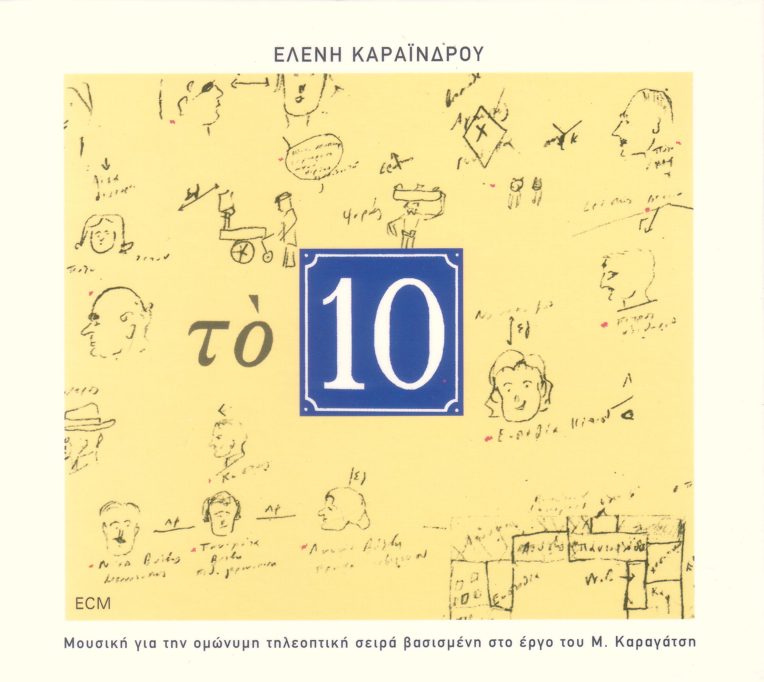
Eleni Karaindrou: τό 10

MA15231-11-front-box

Eleni Karaindrou
τό 10

Music for the TV series based on the homonymous novel by M. Karagatsi
Directed by Pigi Dimitrakopoulou

Spiros Goumas bouzouki, baglamas, mandolin
Kyriakos Gouventas violin
Dinos Hadjiiordanou accordion
Thomas Konstantinou guitar, mandolin
Mimis Doutsoulis contrabass
Vangelis Christopoulos oboe
Nikos Ginos clarinet
Stella Gadedi flute
Maria Bildea harp
Sergiou Nastaza violin
Eleni Karaindrou piano, keyboards
Recorded September 2007 at Studio Sierra
Engineer: Giorgos Kariotis
Mastering: Petros Siakavellas
Produced by Eleni Karaindrou

This soundtrack by Greek composer Eleni Karaindrou was released in 2008 on the Mikri Arktos label in cooperation with ECM. Containing music from the television series The 10, itself based on the last (unfinished) novel of M. Karagatsis, it is something every admirer of Karaindrou’s music will want to track down. Set in the 1950s, the show centers around a block of apartments and the many exploits of its wealthy landlord, whose nephew has designs to inherit it all. In a satirical and soap-ish fashion, its many colorful characters come out of the woodwork, each with their own dramas to add to the mix.

This collection of quintessential melodies scintillates with the contributions of some of Greece’s finest musicians, including oboist Vangelis Christopoulos (Karaindrou’s go-to interpreter), accordionist Dinos Hadjiiordanou (last heard by ECM followers on Tous des oiseaux), harpist Maria Bildea (see Dust of Time and The Weeping Meadow, among others), violinist Kyriakos Gouventas (who appears regularly alongside Savina Yannatou as part of Primavera en Salonico), and the composer herself on piano and electronic keyboards. Other leading voices to be found among the ensemble are the bouzouki of Spiros Goumas and the guitar of Thomas Konstantinou. Karaindrou’s arrangements brim with the personalities that made the series (available on YouTube here, if you want a sense of context) such a colorful success. With an effortless combination of beauty and whimsy that is her bread and butter, she weaves a full biographical tapestry for her subjects.

Each piece embodies a life. Moods range from the understated to the exuberant. As in so many of her soundtracks, a fantastical approach to history clothes a dreamlike core, adorned with moments of unabashed reality, at once uplifting and heartbreaking. In this case, it’s all about contrast. Whether baiting shadows with light or vice versa, every motif has its opposite. Tunes sport many variations, as if showing us just how chameleonic people can be as they interact, divide, and everything in between. Even the opening tango, alluring as it is, has its mournful reiterations (the fourth of which, for harp and accordion, is the most haunting). All of which suits the voyeuristic nature of the show, affording us glimpses through one window after another at the lives of those just trying to find their place in an increasingly cosmopolitan world.

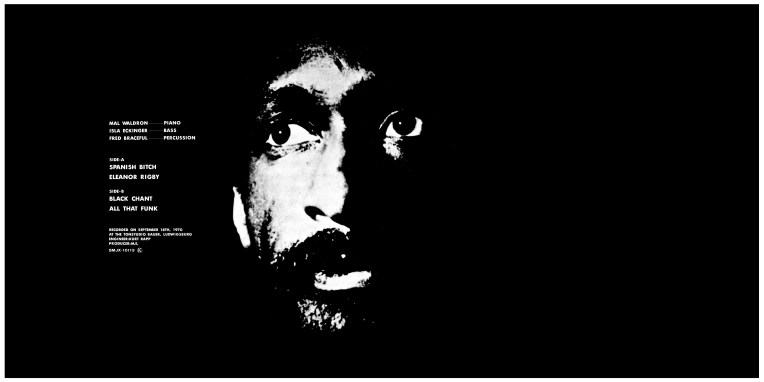
Mal Waldron: Spanish Bitch

SMJX 10113-LP-front

Mal Waldron
Spanish Bitch

Mal Waldron piano
Isla Eckinger bass
Fred Braceful percussion
Recorded September 18, 1970 at Tonstudio Bauer, Ludwigsburg
Engineer: Kurt Rapp
Produced by Manfred Eicher

Post-bop master Mal Waldron may just be the most important musician in ECM history, if only because his Free At Last was the label’s first bona fide release, opening a doorway to a paramount catalog of music. And while that seminal album, recorded in 1969, has recaptured the spotlight in a recent vinyl reissue, listeners may not be aware that Waldron stepped into the studio a year later to lay down a sequel of sorts. Recorded at Tonstudio Bauer, with Kurt Rapp engineering and Manfred Eicher producing, the curiously titled Spanish Bitch never made it to ECM proper and was released instead in Japan on the Globe label. Like its predecessor, Spanish finds the pianist in a trio setting, once again with go-to bassist Isla Eckinger but now, in place of Clarence Becton, welcoming Fred Braceful on drums.

SMJX 10113-LP-inside

SIDE A opens with the eponymous tune, and through its modal affiliations nods in the direction of Miles Davis and John Coltrane, who also appropriated Spanish scales for effect. In his hands, however, such motifs take on an almost ritualistic quality as scaffolding for an idiosyncratic reverie. From a web of bass and plucked piano strings emerges a vibrant block of chords. Waldron sets aside the theme almost as soon as he develops it, using it as a springboard for his laser-focused energy. Eckinger’s unusual solo sets up Waldron’s phenomenal own, building to steadfast density and playing off Braceful with glorious aplomb. This is followed by Waldron’s audacious take on “Eleanor Rigby.” A somewhat warped version of this evergreen, it boasts a robustness of architecture such as only Waldron could blueprint. He owns the song from start to finish, turning it into something of a macabre lullaby.

SIDE B pulls us back into original territory with the laddering effect of “Black Chant.” Initial restraint waters a muscular flower of high tone clusters over a plowing left hand. Though the aesthetic is Waldron’s own, it incorporates the voices, movements, and hardships of many who came before him. But don’t mistake this for catharsis. It is, rather, a link in a humble chain. Another original, “All That Funk,” saves the strongest for last. Here Waldron swings hard like a ton of rocks, leaving plenty of room for Eckinger’s forthright exposition before punctuating a groovy dialogue with Braceful. Here most of all, Waldron’s playing comports itself as a force to reckon with in three dimensions. Thus, his willingness to go deep into the darkest parts of his musical soul yields blinding light.

SMJX 10113-LP-back

As a service to completists, below I have translated the original Japanese liner notes by jazz critic and producer Masahiko Yuh (悠雅彦):

The first thing to catch my eye is this album’s title, Spanish Bitch. It brings me back to one late May evening, when Mal was listening to Miles’s widely lauded Bitches Brew in an apartment not too far from the center of Munich. Mal just sat there without a word, casting his gaze in my direction from time to time to show me how much he admired the extraordinary beauty of Miles’s music. I can still see that gentle smile.

“Anyone would be captivated by this music on the surface. But the real beauty of Miles is on the inside. It’s amazing, don’t you think?”

I’ll never forget the way Mal’s eyes sparkled as he said this. There’s no reason to think he would be married to his choice of album title here. This music, painted as it was on his canvas, clearly differs from the world of sorcery and black magic that so enamored Miles (Bitch = Witch), who had incorporated a representative mode of Spanish folk music for little more than exotic effect. That said, remembering Mal’s expressions of enthusiasm, I like to think that perhaps in using the word “Bitch” he had Bitches Brew somewhere in mind. And as the light percussion of Ina’s knife from the dimly lit kitchen mingled pleasantly with Miles’s trumpet, it may be that the concept behind Spanish Bitch was already starting to take shape. As I made to leave, Mal handed me a copy of the ECM label’s first release, his own Free At Last (Japanese catalog number SMJX-10098). About four months later, on September 18, 1970, Mal would head into Tonstudio Bauer in the city of Ludwigsburg with bassist Isla Eckinger and drummer Fred Braceful to record his second album for ECM, Spanish Bitch.

… . … . … . …

Mal Waldron vanished from the American jazz scene in 1965, when he moved across the pond to Europe. It would be fair to say, however, that he had already been primed to do so since ’62, when his singular career as a jazz pianist came to a halt. In ’63, a long bout with illness left him virtually unable to perform. Moreover, life in America had hijacked his creative ambition. And so, as had happened over the past few years when playing with Mingus and Dolphy, among others, there was no longer anything to ignite his passion.

In ’64, Mal wrote his first film score for Cool World. “Not even that lit a fire under me to perform,” he recalls. At the time, Mal was shut in with his parents, who lived in Jamaica, Queens. But then, another composing gig: this for a French film called Three Rooms in Manhattan. Gleefully, he flew to France and, after a month of taking in the freer air of Paris, completed his score.

A brief return home found him hurriedly putting the finishing touches on scoring and recording for the film Sweet Love, Bitter, by then already intent on putting America behind him. This was how Mal, once separated from performing in earnest, ended his film composing career as quickly as it began. He also knew that a host of new creative endeavors awaited him in Europe.

And that was how, in the fall of 1965, he settled down in Paris at last. That same year and the next, Mal took part in the Bologna Jazz Festival. It was during that time that he recorded his well-known tune “All Alone” and moved to Germany by way of Italy at the end of ’66.

He landed in Munich in ’67 and never left, and since then has become a fixture of this city.

Munich was love at first sight. Here he discovered Swiss bassist Isla Eckinger and American-born drummer Clarence Becton, the talented jazzmen with whom he would play on Free At Last. He was able to take short trips to European capitals and make a living by performing jazz. It’s easy to imagine how much contentment it brought him. Above all, however, it was the superlative atmosphere of the Domicile jazz club, where he enjoyed performing every night, and where the ancient and the modern comingled in perfect accord, that kept him there. The atmosphere in Munich was the freshest and most alive in all of Germany.

Nearly every jazz fan and musician who set foot inside the country paid a visit to Munich, where they were sure to drop by Domicile. Dusko Goykovich led his big band there, bringing verve to a packed house amid uproarious applause. Recently, bassist Jimmy Woode sat in with Mal’s trio, and, much in contrast to Mal’s deadpan demeanor, coaxed smiles from the crowd like a circus clown. Pony Poindexter, stopping over on his way to Belgium, was also welcomed onstage. With alto in hand, he gave a laid-back performance. One night it would be Benny Bailey, the next it might be the Clarke-Boland Big Band delighting audiences to overflowing. Such was the energy Domicile was known for. Only when Mal sat down at the piano did an apparently miraculous silence take over the room. His profound reverberations and faint tone colors coiled about the feet of everyone squatting next to all those great black musicians whose portraits hung on every wall. It was most unbefitting of this city’s nondescript lights and the hammering of Olympic construction outside. I dare say, his own hammering thundered more eternally. Still, Mal’s acute sensibilities already had a whiff of German folklore to them, combining with his ancestral blood to produce an even deeper, heavier reverberation. We both remember that time, when he recorded “All Alone” during his brief Italian sojourn, a tune replete with the sun of the south country in all its warped beauty, laden with transparent pathos…. I don’t know anyone who so intuitively grasps the plight of ethnic peoples and who struggles so earnestly with his own music as Mal.

Keith Jarrett: Salle Pleyel Paris 1992

KJ INEDITS

Recorded at Salle Pleyel in Paris on October 25, 1992 and produced by Manfred Eicher, this was a limited promotional item offered by the French retail chain Fnac to customers who purchased two qualifying ECM or ECM New Series CDs. Consisting of two exclusive tracks, it’s a poignant snapshot of Jarrett atop a mountain no one else is likely ever to scale.

His perennial encore, “Over The Rainbow,” glistens with lyrical suppleness. Looking back as we can through the lens of retrospection, we find in it the story of an entire career, if not also the life it defines: from the initial stirrings of talent that surely twitched in the young pianist’s fingers, through the chronic fatigue syndrome that would all but hijack his gifts four years later (incidentally, when this disc was offered), and beyond a recovery whose afterglow continues to illuminate ears in the darkest hours. No matter how sweeping, dramatic, and turbulent the experiences that came before, we can hold vigil in these fleeting moments of intimacy before they turn away from us to seek the hand of an ether we have yet to touch.

In the wake of this inward glance, the exuberance of Jarrett’s own “C The Blues” feels like a splash of water on the face. Romping through memories as if they were a muddy riverbank along which the dead and the living dance in celebration of kinship, Jarrett gives every mouth a voice. The colorful ornaments of his right hand are the nurture to his left’s nature, each note a word spoken, a relationship formed, a spirit harnessed, only to fade as quickly as it forms. Like the fog of a window about to be defrosted, it resolves into a clarity of vision such as only he can provide.

These same two tracks also appeared on a CD included with issue No. 672 of the French magazine Jazz in May of 2015:

Jazz Magazine

Jazz Magazine CD

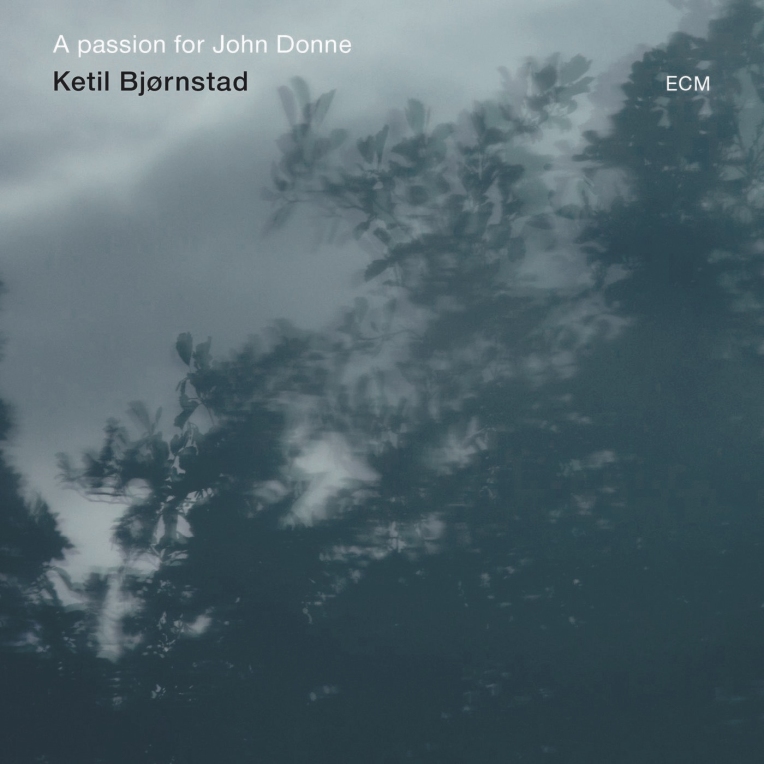
Ketil Bjørnstad: A passion for John Donne (ECM 2394)

2394-front

Ketil Bjørnstad
A passion for John Donne

Håkon Kornstad tenor saxophone, flute, voice
Ketil Bjørnstad piano
Birger Mistereggen percussion
Oslo Chamber Choir
Håkon Daniel Nystedt
conductor
Recorded live March 2012, Sofienberg Kirke, Oslo
at the Oslo International Church Music Festival
Engineer: Jan Erik Kongshaug
An ECM Production
Release date: October 24, 2014

Batter my heart, three-personed God; for, you
As yet but knock, breathe, shine, and seek to men;
That I may rise, and stand, o’erthrow me, and bend
Your force to break, blow, burn, and make me new.

Pianist and composer Ketil Bjørnstad has sailed some of ECM’s purest waters. Yet while many of those journeys have been instrumental, he has with increasing frequency turned to the human voice as a candle from which to exude a melodic glow. True to metaphor, much of 2008’s The Light represented a major engagement with English poet John Donne (1572-1631), whose verses are the backbone of the present recording. Written for the Oslo International Church Festival and given its premiere in March of 2012 (the very performance heard here), Bjørnstad’s A passion for John Donne features Håkon Kornstad (tenor saxophone, flute, voice) in his ECM debut alongside percussionist Birger Mistereggen, the Oslo Chamber Choir under the direction of Håkon Daniel Nystedt, and the composer himself at the keyboard.

An Introitus gradates this hymnal piece into existence with a gong before piano and choir pull back the curtain of night to reveal a dawn-lit choral arrangement of “Thou hast made me.” As Kornstad’s tenor weaves through the undergrowth of these self-reflective intonations, unfolding one wordless implications after another, a silent heart of reverence is illuminated. Kornstad also sings, lending sanctity to “A fever” and “Farewell to love” as Bjørnstad shelters him like a church would a believer.

The writing for choir is sweeping yet intimate, most notably in “Death, be not proud” and “A nocturnal upon St. Lucy’s Day, being the shortest day,” the latter an atmospherically rich tapestry of waning moons and withdrawn souls. “A valediction, forbidden mourning” is another memorable passage, its use of marimba laying a supple path for Kornstad’s reed and voice to wander.

Each poem enacts a laser-focused concentration of mortality, distilling years of life into single words and phrases. This scriptural quality lends itself well to the piece’s concept as a “passion,” which by virtue of its promises of everlasting life through the doorways of death and love gives rise to a grander meaning in the texts. Like the benediction for incorruptible blood with which it ends, its prayerful mold feels more ripe than ever to be filled with our submissive will.

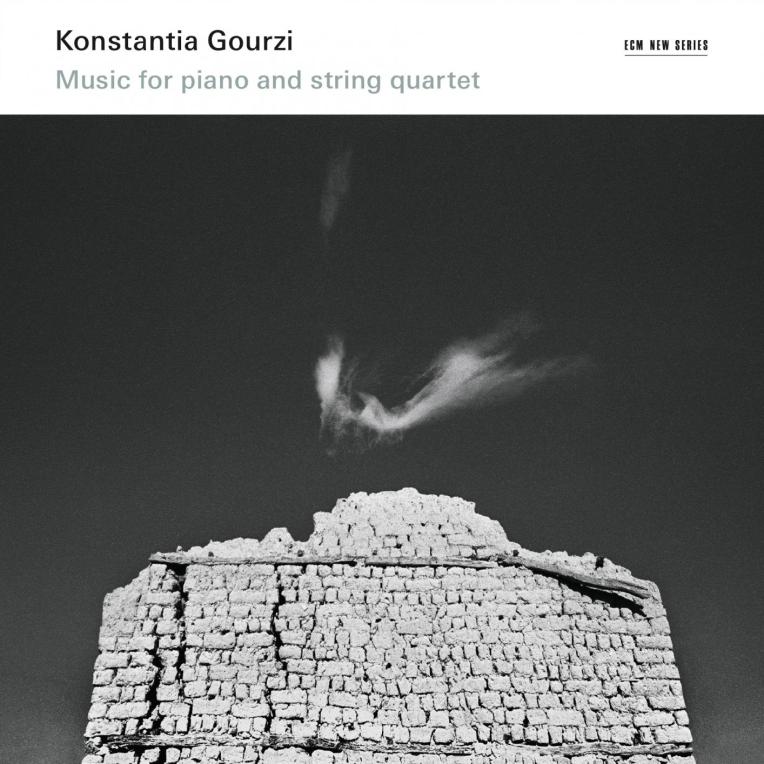
Konstantia Gourzi: Music for piano and string quartet (ECM New Series 2309)

Gourzi

Konstantia Gourzi
Music for piano and string quartet

Lorenda Ramou piano
Ensemble Coriolis
Heather Cottrell
violin
Susanne Pietsch violin
Klaus-Peter Werani viola
Hanno Simons violoncello
Recorded July 2012, Himmelfahrtskirche, Munich
Engineer: Stephan Schellmann
Produced by Manfred Eicher
Release date: October 10, 2014

Greek composer Konstantia Gourzi’s approach to time plus ECM’s approach to space equals the most whole of sonic numbers. Said whole consists of intimate minutiae, each the corner of a photograph otherwise hidden by the downturned palm of history. The transubstantiation of Eine kleine Geschichte, op. 25 (2005) for solo piano epitomizes this feeling of obscurity. Notes fall neither like rain nor like teardrops, but more like a maple copter in slow motion, yearning for the touch of soil. After such a liminal experience, the opening proclamation of the String Quartet No. 2, op. 33/2 (2007) indeed feels like a bear hug of gravity. Titled P-ILION, neun fragmente einer ewigkeit (the latter meaning “nine fragments of eternity”), it is a fitting description of the molecules that inform Gourzi’s atmospheres. A powerful river in which to drop one’s ears like stones, its currents teem with reminiscences and fantasies alike. Whether groveling in a heavenly day or dancing in a pagan night, the sheer breadth of evocation herein is staggering. As the cloth of familiarity frays at the shards of stories yet to be told, this piece elicits a lyricism so deep that it can only end where it began. Moods are darker in the String Quartet No. 1, op. 19 (2004). Bearing the title Israel, it begins with the mortal urgency of Henryk Górecki and the playfulness of Claude Debussy before morphing into a lone voice, orphaned but for its spiritual genealogies traceable back to Abraham’s near-sacrifice.

The program gives us a cross-section of Gourzi’s writing for piano. From the seven miniatures that make up „noch fürcht’ ich”, op. 8 (1993), an early opus that is her first for the instrument alone, to the similarly aphoristic Klavierstücke I-V, op.24 (2004) and the eclectic Aiolos Wind, op. 41 (2010), we encounter jazz, folklore, and hypermodern cartographies. The moment we find something to hold on to, it slips away and offers a substitute made of an entirely different material. When piano and string quartet combine in Vibrato 1, op. 38 (2009/10) and Vibrato 2, op. 38 (2010), Gourzi creates the soundtrack to a tracking shot, one footstep at a time.

I cannot fathom how this album slipped past my radar for so long. Though of only recent discovery, it has already earned a top spot among my favorite New Series discs. And while these compositions may sit comfortably beside those of György Kurtág and Helmut Lachenmann, there’s something distinct about Gourzi that is to be found not in her last name but in her first. Konstantia, which means “steadfastness,” is precisely the quality of which her music is possessed, moving ever forward as a way of polishing us like mirrors held up to the past.

Jøkleba: Outland (ECM 2413)

Outland

Jøkleba
Outland

Per Jørgensen trumpet, vocals, kalimba, flute
Jon Balke electronics, piano
Audun Kleive electronics, drums, percussion
Recorded May 2014 at Madstun, Fall and Rainbow Studio, Oslo
Engineers: Audun Kleive and Jan Erik Kongshaug
Mixed by Audun Kleive
Mastered by Bob Katz
Produced by Jøkleba
Release date: October 24, 2014

Is it the sea you hear in me,
Its dissatisfactions?
Or the voice of nothing, that was your madness?
–Sylvia Plath, “Elm”

Although Per Jørgensen (trumpet, vocals, kalimba, flute), Jon Balke (electronics, piano), and Audun Kleive (electronics, drums, percussion) had already made four albums as Jøkleba before debuting on ECM under that same name, each musician had been involved in numerous other productions for the label. That said, this set of literarily themed improvisations leaves its own set of fingerprints, the whorls of which are spectral in range. By the second track, “Bell Jar,” itself a saline flush of digital impulses and organic trumpeting, the listener will know whether leaving or staying feels like the right thing to do.

To be sure, there’s much to admire here. From the visceral mountain calls in “Blind Owl” and “Horla” to the moonlit twinges of “The Nightwood” and “Below The Vulcano,” this trio knows how to craft a mood from scratch with cinematic lucidity. And while each musician contributes a personal energy throughout, for me it’s Jørgensen as vocalist who links the most creative chains. He plays the trumpet as if it were his own voice and sings as if his throat were honed in brass. The album’s most intriguing passages are his to carry. “Brighton,” for example, unfolds with the cadence of a Butoh dance, rich with meaning in the subtlest of movements.

Amid these abstractions, the appearance of piano and drums in “Rodion” feels like an oasis in the desert. “One Flew Over” gives further traction to the keyboard, and by that deference hints at something more pre than post. By the end, we’re left with a slipstream narrative that neither fulfills a promise nor answers a question. And perhaps that’s the way they prefer it.

Avishai Cohen: Big Vicious (ECM 2680)

2680 X

Avishai Cohen
Big Vicious

Avishai Cohen trumpet, effects, synthesizer
Uzi Ramirez guitar
Jonathan Albalak guitar, bass
Aviv Cohen drums
Ziv Ravitz drums, live sampling
Recorded August 2019, Studios La Buissonne, Pernes-les-Fontaines
Engineers: Gérard de Haro and Romain Castéra
Mastering: Nicolas Baillard
Produced by Manfred Eicher
Release date: March 27, 2020

Big Vicious marks the studio debut of trumpeter Avishai Cohen’s eponymous band. Already six years old, this assembly with Uzi Ramirez (guitar), Jonathan Albalak (guitar, bass), Aviv Cohen (drums), and Ziv Ravitz (drums, live sampling) embodies the canyon-wide leap of evolution Cohen has taken across ECM’s terrain since Into The Silence in 2016. This album is distinguished by its digital sheen, which through a web of guitars and live sampling shines the light of a distant future on the darker here and now. It’s a sensation amplified by the project’s silent partner, Tel Aviv musician-producer Yuvi Havkin (a.k.a. Rejoicer), who served as Cohen’s cowriter (another new direction for the frontman) on such tracks as “Honey Fountain” and “Teno Neno.” Where the former lifts the spirit by chains of echoing sentiment, even as it redraws boundaries of the flesh from which it stretches a hand toward hope, the latter tune speaks of moonlight in the language of a star.

From start to finish, Cohen fulfills the role of a storyteller gathering characters, dialogue, and settings, and in his combinations of those elements forges history. Throughout “Hidden Chamber,” his trumpet is a warrior of light, a reminder that politics forces us into places where tongues of strife lose their sense of taste. Cohen’s composing paves us a viable detour. From the propulsive bassing of “King Kutner” to the regressive groove of “This Time It’s Different,” every melody oils our skin through the thorny bramble of adversity.

The brightest heavenly bodies are the band’s arrangements. Beethoven’s “Moonlight Sonata,” for one, is reborn. Shedding every possible shade of cliché, it lives in a space only ECM can provide. Massive Attack’s “Teardrop” gets an equally postlapsarian treatment and harks to the earliest days of Big Vicious, when Cohen and friends mainly played 90s covers. The original lyrics of this song are appropriate in describing the present sound:

Water is my eye
Most faithful mirror
Fearless on my breath
Teardrop on the fire
Of a confession

Likewise, messages ooze from the ground as if during a spring thaw. Each is artfully crafted, traveling upward in a vortex of self-regard.

Of especial note is the album’s cover, a painting by David Polonsky, perhaps best known for Waltz with Bashir. Like the image itself, this is music that eschews photorealism in favor of something touched by hands, materials, and movement. It is also the visual equivalent of the album’s closer, “Intent,” which is so smooth that you might just find yourself blending in with your surroundings, wherever you happen to be.