Arvo Pärt: The Deer’s Cry (ECM New Series 2466)

2466 X

Vox Clamantis
Jaan-Eik Tulve artistic director and conductor
Mari Poll violin
Johanna Vahermägi viola
Heikko Remmel double bass
Taavo Remmel double bass
Robert Staak lute
Toomas Vavilov clarinet
Susanne Doll organ
Recorded September 2013 and 2014 at Tallinn Transfiguration Church
Veni Creator recorded June 2007 at Dome Church of St. Nicholas of Haapsalu
Engineer: Igor Kirkwood, Margo Kõlar (Veni Creator)
Recording supervision: Helena Tulve
Mastering: Manfred Eicher and Christoph Stickel at MSM Studios München
Executive producer: Manfred Eicher
Release date: September 9, 2016

For now we see through a glass, darkly; but then face to face: now I know in part; but then shall I know even as also I am known.
–1 Corinthians 13:12

While in Capernaum, Jesus is invited into the house of Simon the Pharisee. There, a woman, identified in the Scriptures only as “a sinner,” approaches Jesus with an alabaster box of ointment. Much to the astonishment of the house, she washes his feet with her tears, wipes them with her hair, and anoints them. When confronted by Simon about his acceptance of this act, Jesus replies by pointing out the fact that Simon offered no water for his feet or ointment for his head: “Her sins,” he says of the woman, “which are many, are forgiven; for she loved much: but to whom little is forgiven, the same loveth little.” This episode, recorded in the Gospel of Luke 7:36-50 and arranged for choir by Arvo Pärt as And One of the Pharisees (1992), is the spiritual center of a new program dedicated to the Estonian composer. Not only for its illustration of salvation through faith, but also because it serves as a loose metaphor for sacred music today. Like that sinner, Pärt washes our ears against the verbal abrasions of pharisaic intellect, his offerings thus denounced by “wisdom” of the popular yet confirmed by the Holy Spirit. In the present setting, countertenor Mikk Dede provides a vulnerable personification of Simon, while baritone Taniel Kirikal balances the equation as our humbling Savior.

Although Pharisees comes later in the sequence, its seeds are already being watered in the opening title work, The Deer’s Cry (2007). Drawing on the words of St. Patrick, it is a meditation on God’s omnipresence. Here, as in the other a cappella prayers that follow, including the Alleluia-Tropus (2008/10) and Habitare fratres in unum (2012), compact structures embody quiet resolution. Each is a link in a chain of infinite being, a harmonization of flesh and spirit through the Word, touched by graces of which we are unworthy.

Longtime Pärt listeners will notice echoes of the familiar, such as Virgencita(2012), which is eerily reminiscent of Psalom (1985/91), and a version of Summafor four voices, wherein the circle of this seminal 1977 piece is squared. Gebet nach dem Kanon (1997), from the Kanon Pokajanen, is a child wandering in search of purity, only to find himself crying in a world of corruption, his voice ignored by all except the Father whose hand shields him from brimstone. Da pacem Domine (2004/06), too, reads differently from previous ECM appearances. Where the latter felt like a telescope, now it is a microscope.

Rounding out this journey are three works for voices and chamber instruments. In Von Angesicht zu Angesicht (2005), scored for soprano, male choir, clarinet, viola and double bass, said instruments evoke the trembling fear that is the beginning of all wisdom. Pärt takes a lived understanding of that precept by following the rhythms of Biblical recitation. Veni Creator (2006), for mixed choir and organ, hovers on the brink of transfiguration and is one of his most haunting compositions. Sei gelobt, du Baum (2007), for male choir, violin, lute and double bass, is another textual wonder. Its words, by Viivi Luik, praise the tree for its wood, by which violins and organs might be built for His glory, each note released therefrom a spore returning to its creator.

Despite, if not also because, Pärt’s marked shift over the years from inner to outer, there’s an ethic of sharing in these shorter pieces. Now that his music is known worldwide, one tastes in it something grander left for listeners to decide, a piece of a mosaic that can only be completed when all us take the time to see it being made up of us all. That such profundity comes across so directly is testament to Vox Clamantis and director Jaan-Eik Tulve’s willingness to let everything speak for itself.
Alexander Knaifel: Lukomoriye (ECM New Series 2436)

Lukomoriye

Alexander Knaifel
Lukomoriye

Oleg Malov piano
Tatiana Melentieva soprano
Piotr Migunov bass
Lege Artis Choir
Boris Abalian conductor
Recorded February 2002 at The Smolny Cathedral, St. Petersburg
Engineer: Victor Dinov (St. Petersburg Recording Studio)
Recording supervision: Alexander Knaifel
Mastering: Boris Alexeev (engineer)
An ECM Production
Release date: April 20, 2018

As the fourth ECM New Series album dedicated to the music of Alexander Knaifel, Lukomoriye is both continuation and departure from previous discs. In the former sense, it pulls us deeper into the recesses of his faith; in the latter, it engages with more secular—though no less inspired—material. The program’s pillars rise from prayers to the Holy Spirit. Both O Comforter (1995) and O Heavenly King (1994) are written for choir, the second adding to that foundational grammar the punctuation of vibraphone and piano. Like Jeremiah in the pit, they look upward for grace. Their bead-like structure welcomes a thread of spiritual seeking, marking the passage of voices from firmament to soil as if to show us that the opposite trajectory is possible.

This Child (1997), played by pianist Oleg Malov, follows the Gospel of St. Luke. It opens with a single chord, played as if at a far corner of the room, before proximate notes finish the sentence. This sets up the Godly call and prophetic response, articulating questions that can only be answered by salvation. O Lord of all my life (2006), sung by bass Piotr Migunov to Malov’s electronically processed accompaniment, bonds itself with stillness. Through its 16 minutes of rewarding intimacy, Migunov sings with a vulnerability that recalls Sergey Yakovenko in Valentin Silvestrov’s Silent Songs. A prayer of St. Ephraim the Syrian, wherein humility is preached, and a poem from Pushkin, wherein idealism is crushed into a sinner’s prayer, render the sonic equivalent of a two-way mirror.

From the Word to the World, we are invited to A mad tea-party (2007), in which a heavily reverbed piano breaks its own suspension by the delicate play of a more immediate instrument, evoking both the frustrations and excitations of this pivotal scene in Lewis Carroll’s Alice’s Adventures in Wonderland. Such contrasts might be counted as child-like impulses were it not for the conscious use of silence, touches of percussion, and whispers. Kindred details abound in Bliss (1997), wherein the composer’s wife, soprano Tatiana Melentieva, revives Pushkin. Her voice masterfully captures every shade of mythological revelry at hand with barest support from Malov at the piano.As in the title composition (written in 2002 and revised in 2009), even fully formed sentences flit through trees like birds in search of a new dawn, taking on the magic of their surroundings as they travel ever inward.

The ghost of Pushkin lingers in Confession (2003/04). Here Malov intones the words inaudibly, exploring love, carnality, and desire through the keyboard instead, every note as delicate as the balance of flesh and glory that every composer faces, yet few of which channel with such humility.

Gavin Bryars: The Fifth Century (ECM New Series 2405)

The Fifth Century

Gavin Bryars
The Fifth Century

PRISM Quartet
Timothy McAllister soprano saxophone
Robert Young alto saxophone
Matthew Levy tenor saxophone
Taimur Sullivan baritone saxophone
The Crossing
Donald Nally conductor
John Grecia piano
The Fifth Century was recorded July 2014 at Gould Hall, Curtis Institute of Music, Philadelphia
Two Love Songs was recorded June 2015 at Saint Paul’s Episcopal Church, Philadelphia
Engineers: Andreas K. Meyer and Paul Vazquez (Digital Mission Audio Services)
An ECM Production
Release date: November 18, 2016

A shepherd, soldier, and divine,
A judge, a courtier, and a king,
Priest, angel, prophet, oracle, did shine
At once when he did sing.
Philosopher and poet too
Did in his melody appear;
All these in him did please the view
Of those that did his heavenly music hear:
And every drop that from his flowing quill
Came down, did all the world with nectar fill.
–Thomas Traherne

Before this 2016 release, the last ECM New Series album dedicated solely to composer Gavin Bryars was the 1994 masterpiece Vita Nova. What both discs lack in temporal proximity, however, they make up for in philosophical overlap.

Thomas Traherne’s Centuries of Meditations, written in the 17th century, yields the 2014 title composition. Scored for choir and saxophone quartet, this setting of a long-unknown English theologian distills what he calls the “essence of God” from glorious creation. The fifth and final century of Traherne’s mystical treatise examines relationships between finite bodies and infinite space, knowledge and ignorance, intimacy and grandeur: dichotomies Bryars has explored in And So Ended Kant’s Traveling In This World (1997) and Glorious Hill (1988), among others. The combination of reeds and voices is as seamless as it is variegated, leaving behind a trail so distinct as to feel antique. That said, the saxophone quartet is subdued in its presence and function, serving as guide rather than commentator, and reaching peak integration in the fifth of seven sections. Performed by the PRISM Quartet and The Crossing, under the direction of Donald Nally, these motifs carry enough weight to exist on their own yet cohere like a sacred text in which is wasted not a single word. While the poetry is rich throughout, the first lines of section III epitomizes the spirit of the piece: “Infinity of space is like a painter’s table, prepared for the ground and field of those colours that are to be laid thereon.” This echoes a theme laid out in the opening of Centuries proper: “An empty book is like an Infant’s Soul, in which anything may  be written. It is capable of all things, but containeth nothing.” Bryars evokes this very sense of purity corrupted by flesh in his harmonies, which remind us that dissonance can be beautiful when interpretation is treated as an act of humility rather than pride. And in that humility Bryars, like Traherne, finds joy.

Alongside this cathedral stand the smaller Two Love Songs. These 2010 settings for female choir of sonnets by Petrarch, a personal favorite of the composer, draw a dotted line between the Italian madrigal tradition and the melodic vibrancy of the language itself, which shimmers in the second song, “Solo et pensoso.” Here soloists Kelly Ann Bixby, Karen Blanchard, and Rebecca Siler arise like relics from a receding ocean in a world run dry with passion for want of transfiguration.

Kim Kashkashian: Arcanum (ECM New Series 2375)

2375 X

Kim Kashkashian
Arcanum

Kim Kashkashian viola
Lera Auerbach piano
Recorded October 2013, Radio Studio DRS, Zürich
Engineer: Peter Laenger
Produced by Manfred Eicher
Release date: September 30, 2016

The 24 Preludes, Op. 34, of Dmitri Shostakovich (1906-1975), not to be confused with his 24 Preludes and Fugues, Op. 87, comprise the first half of this fascinating diptych. Transcribed for viola and piano in 2010 by Russian composer Lera Auerbach (b. 1973), and rendered by Auerbach at the keyboard with Kim Kashkashian on the viola, the resulting forest of sound is one into which the listener is immediately dropped via chromatic parachute. The tone is familiar, comforting, and wise, dreaming in its C major cradle like the foundation of the world. Although there are certainly jagged choreographies to be savored (e.g., Nos. 5 in D major, 9 in E major, and 18 in F minor) such as only Shostakovich could have devised, a deeply felt sense of humor balances the spectrum in Nos. 6 (B minor), 9 (E major), and 15 (D-flat major). Kashkashian’s uncanny connection to her instrument is resolutely expressed in the lyrical turns of No. 7 (A major) and 17 (A-flat major). Yet whether marching through the thicker settlements of Nos. 13 (F-sharp major) and 14 (E-flat minor) or dancing joyfully in 24 (D minor), she keeps her ears as open as possible to opportunities of freedom.

Drawing out lines of articulation from within the piano’s own vocabulary and grafting them onto the viola is no small task, given their divergence of material articulation, and Auerbach has accomplished something subtle and wonderful with respect to her source. Highlights in this regard include the Prelude No. 21 in B-flat major, which holds its ground in the cross-current of interpretation, and 23 in F major, wherein Kashkashian’s pliant tone and color blossom remarkably well.

Our forward-leaning duo follows with the Auerbach composition from which this album gets its name. Written in 2013 and dedicated to Kashkashian, it shows an intimate understanding of the viola’s internal vocabulary. In an interview with NHK Television in Tokyo, excerpts of which are included in the CD booklet, Kashkashian describes the title as referring to “some knowledge that we have, which we may not necessarily verbalize or rationalize. This knowledge allows us to see the truth, to be guided, to seek answers.” Thus, Auerbach walks between knowing and unknowing, favoring pregnant questions over barren answers. Like the viola itself, it exists comfortably in a liminal space. Above all, it is a transfiguration of thoughts into notecraft. The first movement, marked “Advenio”(meaning “to arrive at”), defines itself in real time, content in the narrative potential of every moment. Its pauses speak volumes while its utterances waste no breath of meaning. The second movement, “Cinis” (“ashes”), treats darkness as tenderness, lifting tears from the face they cling to like decals in search of order. Its implications, almost fully formed, hang from the viola’s guttural dips and falsetto highs. “Postremo” (“at last”) embodies a thematic impatience as if trying to become the very object of its own desire. Through a linguistic approach to tempi, it unfurls a mosaic of neural pathways, as does the fourth and final movement, “Adempte” (“to rescue”), which indeed brings salvific understandings to bear upon karmic falsehoods. Like a pyramid carved in negative space, it embraces geometry as a way of life—a sensibility perhaps informed by Auerbach’s experience as a sculptor. Either way, she understands music’s physical consequences.

Open Land: Meeting John Abercrombie (ECM 5053)

Open Land

Open Land: Meeting John Abercrombie

A film by Arno Oehri & Oliver Primus
A Music Heritage Production
Release date: June 15, 2018

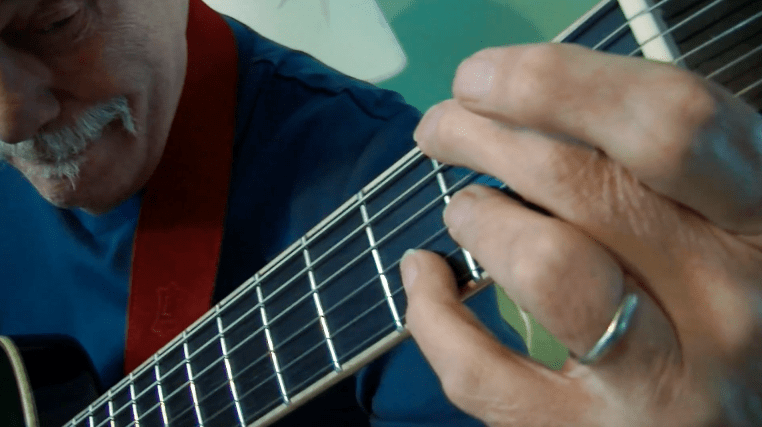
Open Land: Meeting John Abercrombie is a curious film. On the one hand, it’s the only documentary on the late guitarist, and for that reason alone has value. On the other, it’s such a cursory treatment of an immense talent that I would hesitate to recommend it except to the most die-hard fans.

As the delicate strains of “Sad Song” waft through a nocturnal New York City montage, we’re promised an intimate look at an intimate artist—one whose discography on ECM and beyond reads like a film unto itself. And in this regard the directors tick the usual boxes when it comes to a standard biographical portrait. We learn of Abercrombie’s earliest inspirations, listening as a boy to the likes of Chuck Berry, Fats Domino, and Little Richard and feeling a fuse ignited within by the electric guitar. After convincing his parents to buy him one, he finds himself smitten by its possibilities. “This was my salvation,” he says of the instrument as a divining rod for discovering his path.

03

He tells us of his parents, who, despite their hesitations, let him study at Berklee College of Music—a rather unusual gesture for the times, as jazz was still an “underground” music. He lived in Boston for eight years, studying for half of them, started gigging, and began attending jazz concerts on a regular basis. His growing reputation earned him walk-in rights to The Jazz Workshop, a prestigious club where all the greats played just feet in front of him. “I thought the mothership had just landed from space,” he says of hearing John Coltrane live for the first time. He still had a lot to learn.

02

No such documentary would be complete without contributions from those who knew him best. We meet his wife Lisa, who speaks of her husband’s unerring love, as expressed in a willingness to put his music on hold while she finished her schooling in California, and in his acceptance of people as they were. “The deepest part of him is music,” she says, yet in the same breath acknowledges his ability to make everyone feel just as vital to living.

04

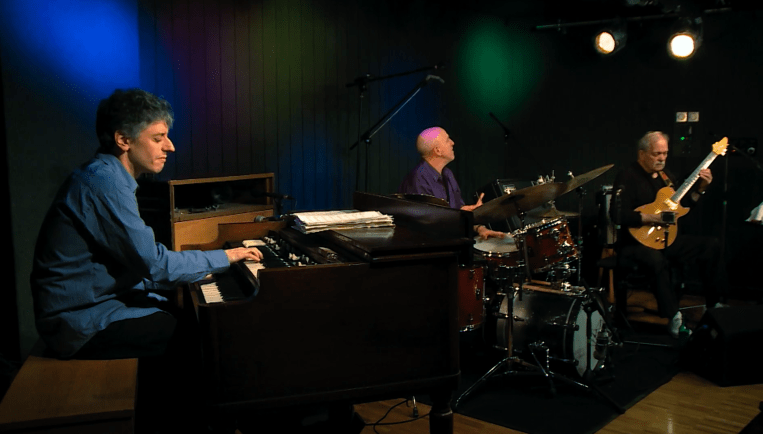
Drummer Adam Nussbaum and keyboardist Gary Versace share their own fond memories of going on the road with Abercrombie. They remember his humor, his practical nature, and the trust he placed in his fellow musicians. Thus, we come to something of a double meaning in the film’s title: his openness was not only musical but also interpersonal. As if to prove that statement, we encounter some wondrous footage of Abercrombie, Nussbaum, and Versace playing “Another Ralph’s” at Jazztage 2014 in Eschen, Liechtenstein. Through 12 minutes of delicate fire, the trio works its magic with ease.

05

All of which points to the film’s greatest weakness, which should have been its strength: namely, the music itself. Throughout we hear selections from Wait Till You See Her (2009), Within A Song (2012), The Third Quartet (2007), 39 Steps (2013), Class Trip (2004), Current Events (1986), and Timeless (1975). The first thing to notice is that, among this latter-day selection, we don’t hear any music from a 20th-century recording until an hour into the film. Anyone being introduced to Abercrombie’s music through this documentary alone might therefore mistake him for a laid-back picker, as there’s no attempt whatsoever to flesh out his variety, as expressed in such albums as Night (1984), Getting There (1988), and Animato (1989), to say little of the dynamism of Timeless itself. Neither is there discussion of his non-ECM recordings, including his groundbreaking work with Stark Reality and Billy Cobham, in the early 1970s.

06

Many of these musical selections share a feeling of melancholy, a characterization that fittingly describes his most personal writing and a quality that brought him and ECM producer Manfred Eicher together in the first place. But this is half of his personality at best, by no means the only lens through which to scrutinize his art. A related misstep, for example, concerns his first studio appearance on Barry Miles’s Scatbird (1972), which Abercrombie talks about at some length twice in the documentary. And yet, we don’t hear a lick of it.

07

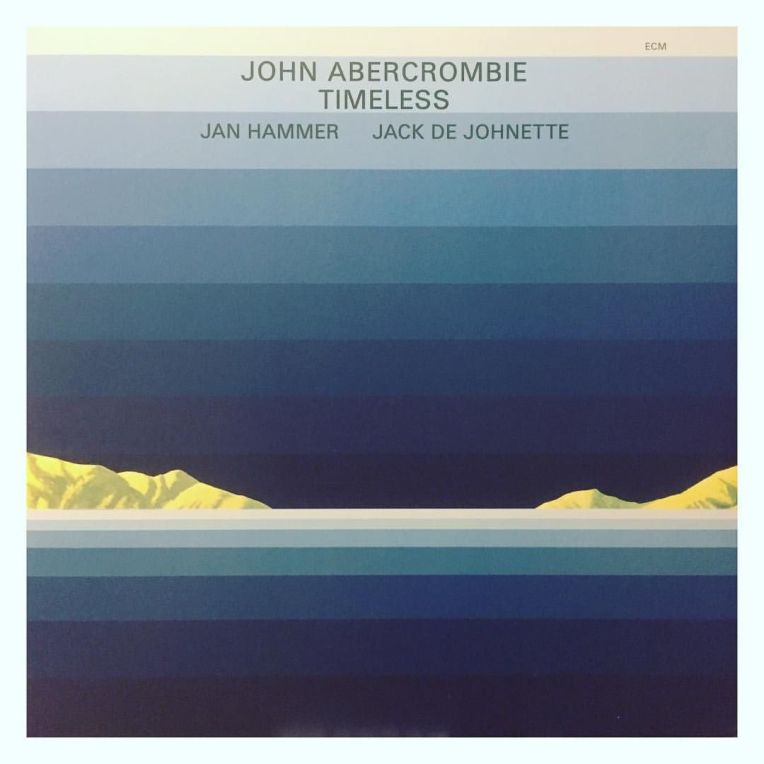
We are, however, treated to Abercrombie’s recollections of making Timeless, a record that came about through Eicher’s persistence alone. Under the influence of Indian fusion (by way of John McLaughlin) in vogue at the time, he created a melody over an E-major drone, showed it to keyboardist Jan Hammer and drummer Jack DeJohnette, and the rest was history. We learn, too, that Manfred Eicher turned off all the lights in the control room while listening back to “Timeless,” which until then had no title. Abercrombie cites this as the moment his identity as a leader, composer, and performer gelled. Fascinating, to say the least.

Timeless

While the film has other issues—notably its hesitant editing and filler visuals that take up valuable real estate in time—these are tolerable in light of the fact that so little music is offered. Witnessing Abercrombie at home on the piano, for example, is unabashedly beautiful, but gone too soon.

01

Open Land is ultimately one of those situations where our love for the subject outweighs our criticism of presentation. But as someone who simply plays what he likes, working with two parts intuition for every part intention, Abercrombie isn’t all that dynamic when it comes to describing his music or process. All of which makes for a lovely piece of apocrypha, to be sure, but far from the best introduction to the man’s life, art, and musical significance. For that, look no further than The First Quartet and its in-depth liner notes by John Kelman, whose laser-focused passion for and knowledge of this music speak to the worth of experience not only for artists but also those who admire their creations.

John Abercrombie: The First Quartet (ECM 2478-80)

The First Quartet

John Abercrombie
The First Quartet

Release date: November 6, 2015

The three albums reissued for this Old & New Masters set were the missing pieces in John Abercrombie’s discographic puzzle for ECM. Released less than two years before his death in 2017, the present collection comprises a vital document not with regard to its bandleader but also the label he would call his primary home after the release of Timeless in 1975. As Abercrombie recalls in John Kelman’s superb liner notes, “[T]hat was my first real break; it helped me find my own way, because I was basically a John McLaughlin rip-off at the time.” Whether we agree with the latter self-assessment, the album was a watershed moment of jazz history in which Abercrombie and producer Manfred Eicher collaborated on a lasting statement.

Abercrombie, Kelman goes on, fell in with bassist George Mraz and drummer Peter Donald while studying at the Berklee College of Music in Boston (where he was roommates with Mraz and keyboardist Jan Hammer). After moving to New York, he squared the circle upon meeting pianist Richie Beirach. While building his profile as both musician and composer, Eicher gifted him with a Revox reel-to-reel tape recorder, which along with the piano would become his primary compositional tool for years to come. It was around that time that the quartet featured here came together in the studio under Eicher’s watch. As Kelman notes of their first session, “Arcade doesn’t sound like a nascent group still finding its way.” Indeed, what we have here is music that comes to us as if midstream, matured and ready to be experienced without any other filter than the decades it took to reach us in digital form.

Arcade

Arcade (ECM 1133)

John Abercrombie guitar, electric mandolin
Richard Beirach piano
George Mraz bass
Peter Donald drums
Recorded December 1978 at Talent Studio, Oslo
Engineer: Jan Erik Kongshaug
Produced by Manfred Eicher
Original release date: March 1, 1979

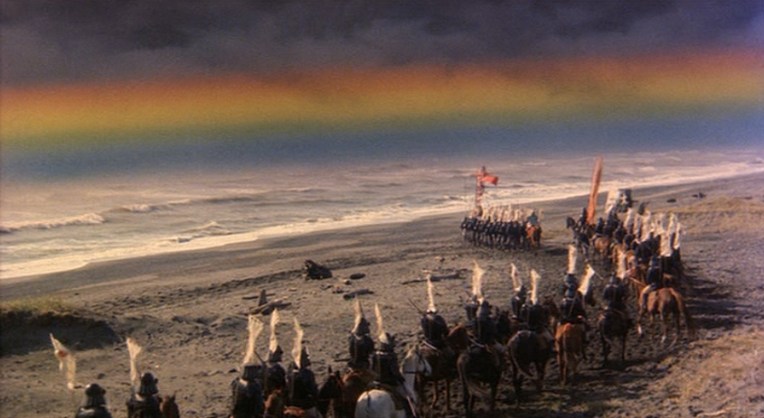
Toward the end of Akira Kurosawa’s Kagemusha, a rainbow spreads its band across the ocean to warn General Katsuyori not to proceed into the Battle of Nagashino that lies ahead, lest he meet with certain doom. Tragically, he ignores it and rushes himself and his men into an all-out massacre. Such omens are rare outside of the cinematic imagination. And yet, here we find a similar image gracing the cover of Arcade, signaling to us a music that doesheed that omen and luxuriates in the sonic benefits of its deference to a higher power.

Kagemusha
Film still from Kagemusha (1980)

The title track, with its buoyant bass line courtesy of George Mraz (onetime member of the Oscar Peterson Quartet) and an effervescent Richard Beirach (rightful heir to the Tatum/Evans legacy) on piano, frames John Abercrombie’s adventurous fingers like gloves, making shadow puppets against the taut screen of Peter Donald’s drumming. This formula works from the get-go and provides plenty of magic from which the quartet spins one glorious melody after another. A splash of rain brings us to the “Nightlake” with downcast eyes as Abercrombie lays his rubato soloing over a liquid rhythm section. The results showcase the quartet at its best. “Paramour” is another stunner, working over the listener in waves. Mraz digs deep into his emotional reserves for this one. Meanwhile, things are a bit more cosmic on “Neptune,” where arco bass cuts a swath of moonlight in nebular darkness. Abercrombie launches tiny rockets into the stars with his electric mandolin, tracing new constellations on the way to becoming one himself. In closing, the group shows us what “Alchemy” is all about. From its lead filings arises a golden phoenix. Every appendage is an instrument animating the harmonious whole, tickled by Beirach’s ivory and gilded in a layer of cymbals. As its heart contracts, the guitar lets out a plaintive cry, running ever so delicately into the shadows of resolution.

Abercrombie’s pinpoint precision abounds, his mid-heavy picking amplified to buttery sweetness, and shares notable interplay with Beirach. Over a yielding backing, these sustained reverberations occasionally coalesce in bright tutti passages. The resulting sound is enchantment.

<< Walcott/Cherry/Vasconcelos: CODONA (ECM 1132)
>> Tom van der Geld: Path (ECM 1134)

… . …

Abercrombie Quartet

Abercrombie Quartet (ECM 1164)

John Abercrombie guitar, mandolin guitar
Richard Beirach piano
George Mraz bass
Peter Donald drums
Recorded November 1979 at Talent Studio
Engineer: Jan Erik Kongshaug
Produced by Manfred Eicher
Original release date: 1980

One year after debuting with Arcade, the John Abercrombie Quartet cut out the auditory paper doll that is this curiously overlooked successor. What set the quartet apart from its contemporaries was not only the fluid playing of its frontman and the ways in which it intertwines with that of musicians who are beyond intuitive, but also the sense of development in the structuring and ordering of tunes. Beginning with the pianistic groove of “Blue Wolf” and ending on the acoustically minded “Foolish Dog,” this self-titled peregrination winds itself into a tour de force of solemn virtuosity. From Beirach’s overwhelming cascades to Mraz’s contortions, we encounter a virtual entity of unity whose heartbeat counts off to Donald’s drumming and whose eyes glow with Abercrombie’s characteristic pale fire. This body unfolds into a misty landscape, where the gusts of “Dear Rain” spread melodies into harmonic pastures. Looser gestures like “Stray” (here, both verb and noun) share appendages with the resignation of “Madagascar,” which falls like a sheet from a clothesline in an oncoming storm. As the quartet grows in, Abercrombie’s gentle remonstrations graze the bellies of clouds with the barest touch of curled fingers, allowing “Riddles” to build their conversational nests in the branches of an undisclosed longing.

No matter how “into it” these musicians get, they always display an admirable sense of control, so committed are they to the thematic altar around which they cast their spells. There is a sound that lingers on the palate, one that finds in its cessation the birth of something new.

<< Azimuth: Départ (ECM 1163)
>> Gary Peacock: Shift In The Wind (ECM 1165)

… . …

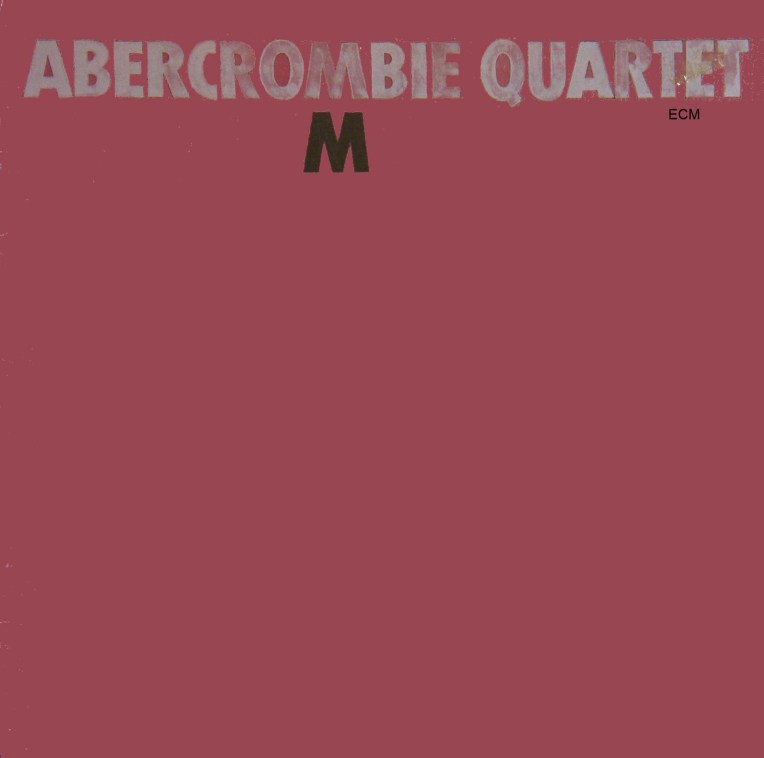
M

(ECM 1191)

John Abercrombie electric and acoustic guitars
Richard Beirach piano
George Mraz bass
Peter Donald drums
Recorded November 1980 at Tonstudio Bauer, Ludwigsburg
Engineer: Martin Wieland
Produced by Manfred Eicher
Original release date: 1981

For its third ECM outing, the John Abercrombie Quartet produced this viscous and mysterious entity known simply as M. This seven-part exercise in burnished reflection plows its foggiest waters in “Boat Song.” Abercrombie’s guitar weeps like bells over a harbor, skimmed for flotsam by Beirach’s somber piano. At nearly ten minutes, this is the longest track of the album, and its darkness haunts all that proceeds from it. We encounter this also in “To Be” (a rubato wave notable for Mraz’s effortless bassing), and the harmonic inversions of “Veils.” Here, Abercrombie’s sinewy melodic lines stretch farthest, slowly immersing hands into the “Pebbles” in which we find closure. Donald’s drumming is particularly fine here and shines like sunrays from cloud-break.

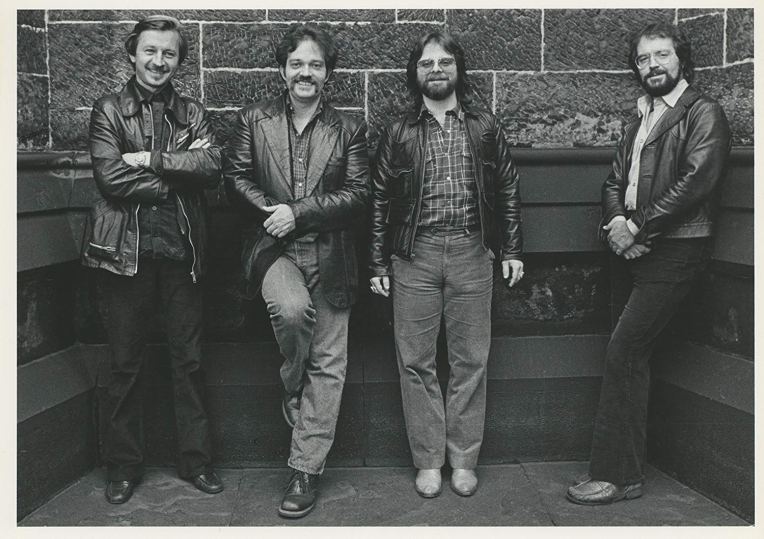
JAQ
(Photo credit: Rick Laird)

Despite Abercrombie’s often-piercing swan dives and a pirouetting rhythm section, even the liveliest moments in “What Are The Rules” (a rhetorical move proving there need be none) or “Flashback” never lift their feet too high off the ground. The latter’s circular conversations draw around us a perimeter that we are free to overstep. Yet after being bathed in such sonic finery, we feel reluctant to do so. The result is one of Abercrombie’s lushest albums, with a somewhat obscure and tinny production style that writes a different story every time.

Taken as a trilogy, these albums are a time capsule of creative evolution into which the listener may step in, reading each tune like a cross-section of its own becoming in service of a whole that will only continue to grow as it ages now—remastered, revitalized, and released for all to share.

<< Pat Metheny & Lyle Mays: As Falls Wichita, So Falls Wichita Falls (ECM 1190)
>> Rypdal/Vitous/DeJohnette: To Be Continued (ECM 1192)

Abdullah Ibrahim: African Piano (JAPO 60002)

African Piano

Abdullah Ibrahim
African Piano

Abdullah Ibrahim piano
Recorded live on October 22, 1969 at Jazzhus Montmartre, Copenhagen

South African pianist-composer Abdullah Ibrahim (born Adolph Johannes Brand), still performing at the time of this 1969 live album under the moniker “Dollar” Brand, unleashed a mastery so enticing on African Piano, it’s a wonder that any of the folks at the club where it was recorded had the resolve to treat it as background to their dining. By the same token, reinforcement of that fact by constant ambient noises renders Ibrahim’s performance all the more sacred by contrast.

Amid a sea of chatter, cleared throats, and sudden intakes of breath, he breaks the surf with the gentle yet hip ostinato of “Bra Joe From Kilimanjaro,” working meditative tendrils into the bar light. Over this his right hand brings about an explosive sort of thinking that spins webs in a flash and connects them to larger others. With clarion fortitude, he drops bluesy accents along the way: a trail of crumbs leading to “Selby That The Eternal Spirit Is The Only Reality.” Ironically (or not), this is the most solemn blip on the album’s radar and blends into the ivory tickling of “The Moon.” Here Ibrahim’s heartfelt, dedicatory spirit comes to the fore, proving that, while technically proficient, he possesses a descriptive virtuosity that indeed evokes a pockmarked surface lit in various phases, harnessing sunlight as if it were skin in dense, vibrating harvest. The kinesis of this tune is diffused in the tailwind of “Xaba,” which then flows into “Sunset In Blue.” Ibrahim’s ancestral awareness is clearest here. The level of respect evoked for both the dead and the living lends a ritualistic quality by virtue of tight structuring, which despite hooks at the margins flies freely in its magic circle. “Kippy” is a smoother reverie with flickers of flame. A beautiful amalgam of measures and means, it slips an opiate of reflection into its own drink. After this, the intense two minutes of gospel and downward spirals that is “Jabulani—Easter Joy” takes us into “Tintinyana,” thereby crystallizing the album’s flowing energies. Tracks bleed into one another: they runneth from the same cup, their spiritual resonance deep and true.

African Piano is a gorgeous, thickly settled album, but one that is always transparent when it comes to origins. Such is the tenderness of Ibrahim’s craft, which speaks with a respect that transcends the sinews, muscles, and eardrums required to bring it to life. It finds joy in history, connecting to it like an Avatar’s tail to steed.

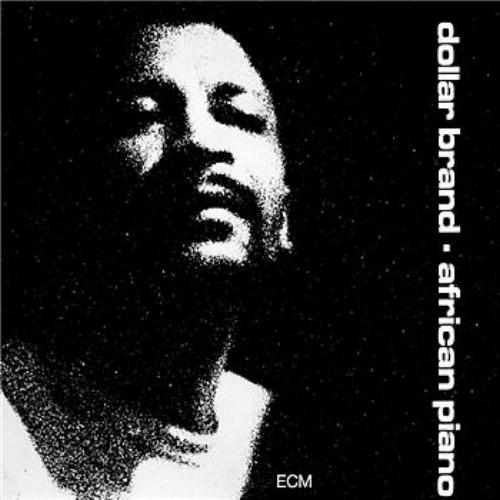
African Piano
Original cover

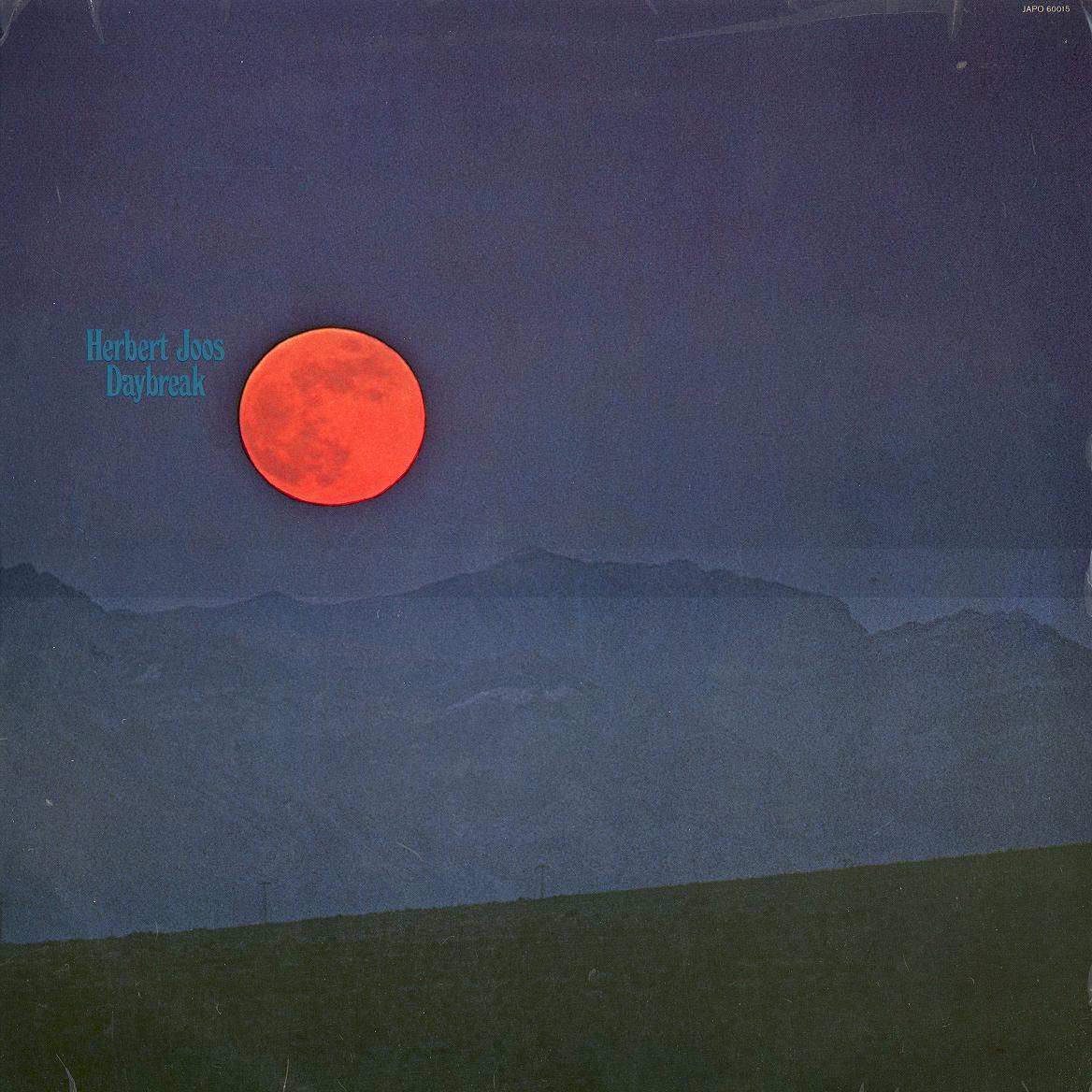
Herbert Joos: Daybreak – The Dark Side Of Twilight (JAPO 60015/ECM 3615)

Daybreak Dark

Herbert Joos
Daybreak -­ The Dark Side Of Twilight

Herbert Joos fluegelhorn, trumpet, cornet
Thomas Schwarz oboe
Wolfgang Czelustra bass, trombone
Strings of Radio Symphony Orchestra Stuttgart
Recorded October 1976 and July 1988 at Tonstudio Bauer, Ludwigsburg
Engineer: Carlos Albrecht
Produced by Herbert Joos and Thomas Stöwsand

German trumpeter and fluegelhornist Herbert Joos’s flirtations with ECM have been few, contributing to the big brass sound of Eberhard Weber’s Orchestra and notably to Cracked Mirrors, a marvelous and, it would seem, overlooked date with guitarist Harry Pepl and drummer Jon Christensen. Yet it was with Daybreak, recorded in the fall of 1976 for sister label JAPO, that the knot of Joos first audibly untied itself alongside Thomas Schwarz (oboe), Wolfgang Czelustra (bass and trombone), and the strings of the Radio Symphony Orchestra Stuttgart.

The emphasis on classical textures will feel familiar to admirers of Keith Jarrett’s likeminded forays, especially In The Light and Bridge Of Light. That being said, the overall effect is shadowy, overhung, though equally honest. “Why?,” for example, answers its own question up front in the very asking. Although an obvious reference to Charles Ives’s The Unanswered Question, its progression spins closure from an interrogative oboe. The normally pastoral associations of the instrument are shed along with lingering symphonic details, such that when Joos’s breath cuts the air with its golden knife, the strings drip like lifeblood from its plane. None of which is meant to suggest that the music is in any way macabre. For what can there be but hope in the cyclical motif that churns during fadeout? “When Were You Born?” asks another question answered by its own sounding. The delicacies of Joos’s high-register playing render far more expansive maps in this instance, touching proboscis to firmament and sampling sunlight until nightfall. “Leicester Court 1440” features Joos in muted soliloquy. Riding a horse of compressed time, he enacts an agitated recession into the title piece. Joos has only his own echo for company before the inward journey is externalized by the dark arrival of strings. Hence, the “Black Trees” looming not far away. Yet despite the title, they actually let down the brightest of the album’s seeds with an approach that gives voice to nature and seeks universal truth in a bird’s nest. Joos’s lines bespeak haughty quest in “Fasten Your Seatbelt.” This playful frolic through arco fabric balances laughter and fearless arpeggios, while scuttling crabs and landlocked others communicate without need for sound. And when the seatbelt fails us, we are thrown into a life of slower motion, lit by “The Dark Side Of Twilight.” The latter appears only on the 1990 CD re-issue (ECM 3615) and, at 15 minutes, is the album’s most brooding texture. Relaying brass-synth and string chorale settings, it walks a broken circle with its head hung in thought, an outlier among the album’s modest population.

The music of Daybreak speaks to children in the language of adults. It photographs the illusion of age and melts it into a sea of numbers. Not every detail will be preserved in that translation, but in the process we come to understand that history and music are sometimes like water and oil. In this chamber of the past, futures hide in corners the light struggles to reach.

Daybreak
Original cover