Abercrombie/Johnson/Erskine: s/t (ECM 1390)


John Abercrombie
Marc Johnson
Peter Erskine
s/t

John Abercrombie guitar, guitar synthesizer
Marc Johnson bass
Peter Erskine drums
Recorded April 21, 1988 live at the Nightstage, Boston
Engineer: Tony Romano
Produced by Manfred Eicher

After the resounding success of their two studio albums, Current Events and Getting There (with Michael Brecker), guitarist John Abercrombie teamed up with bassist Marc Johnson and drummer Peter Erskine for this wondrous live 1988 recording from the Nightstage in Boston. It’s crystal clear from the groove laid down by Johnson and Erskine in the opener, “Furs On Ice” (think Getting There), that each of these men travels the edges of a constantly shifting yet with-it triangle. Abercrombie spins some Frisell-like chording before emerging with a soaring synclavier line in this, one of two Johnson-penned tunes, the other being a trimmed-down version of his “Samurai Hee-Haw” (see Bass Desires). Replacing Bill Frisell and John Scofield is no small order, yet Abercrombie fills these shoes with plenty of funk to spare. That unmistakable bass line, in fact, courts some of the most electrifying improv heard in a while from Abercrombie, who brings a Hammond organist’s sensibility to the proceedings via his fiery macramé. Erskine is also fantastic here. Abercrombie turns up the heat even more on his own two contributions. “Light Beam” is a particularly well-suited vehicle for synth guitar, and indeed seems focused like a laser splashed through the prism of his rhythm section. This is followed by a drum solo from Erskine, who shows us a nifty thing or two from his skill set, particularly in his dialoguing between bass drum and toms, before Abercrombie’s classic “Four On One” (from his seminal 1984 joint, Night) plies its musings and rounded edges with the record’s crunchiest playing. The three continue to converse beautifully in their group improv piece, “Innerplay.” Notable for Johnson’s delightful string games, it is a lasting testament to the powers of spontaneity.

The rest of the set is filled to bursting with a hefty portion of standards. Between Erskine’s delicate rat-a-tat timekeeping in “Stella By Starlight” and the delicacies of “Alice In Wonderland” (into which the rhythm section eases so carefully one feels more than hears it), there is much to stimulate repeated listening. Yet it is in “Beautiful Love” that we find the pot of gold at the end of this rainbow. From the gentlest guitar solo Abercrombie spins a song even as he unravels it into a water-skating journey so gorgeous it almost weeps. The trio’s finest moment and easily one of Abercrombie’s most inspired (and inspiring) improvisatory passages on record. The final “Haunted Heart” almost reaches those same depths, smoothing out an extended guitar intro into a velvety soft ballad that stirs us into a pool of melting chocolate and lets us steep.

A sublime recording from musicians at the top of their game, for a game this most certainly is, played by those who know the rules as well as anyone.

<< Terje Rypdal: Undisonus (ECM 1389)
>> Thomas Demenga: Bach/Carter (ECM 1391 NS)
John Abercrombie: Getting There (ECM 1321)


John Abercrombie
Getting There

John Abercrombie electric and acoustic guitars, guitar synthesizer
Marc Johnson bass
Peter Erskine drums
Michael Brecker tenor saxophone
Recorded April 1987 at Power Station, New York
Engineer: James Farber
Produced by Lee Townsend

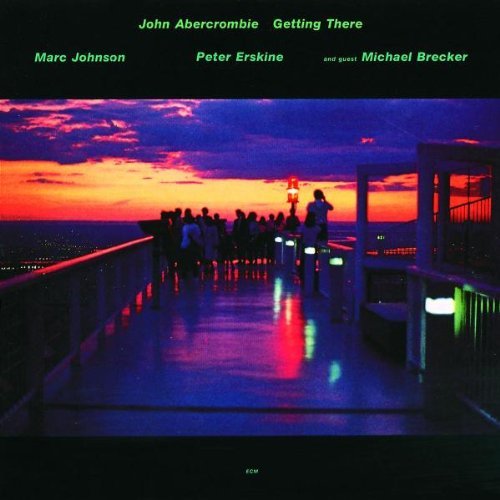
This trio—consisting of John Abercrombie on guitars (still favoring synth treatments at this point), Marc Johnson on bass, and Peter Erskine on drums—was one to be reckoned with in the 80s. Getting There seems, like many of ECM’s dates from the decade, to have been overlooked by many, but its rewards are plentiful. All the more so for the presence of saxophonist Mike Brecker, whose buttery tenor graces a smattering of its tracks. First and foremost among these is “Sidekicks.” This fishhook of a tune reels us into the album’s sweep, sped along by Erskine’s anthemic drumming and Johnson’s springy lines before ending on a classic fadeout as Brecker careens into outer space. “Remember Hymn” is another Brecker-heavy capsule of nocturnal medicine. With wondrous lyricism, the group constantly reforms itself here in one of the frontman’s finest. Marc Johnson spikes the compositional punch with “Furs On Ice”—one of only two non-Abercrombie tunes on this set (the other being Vince Mendoza’s “Thalia,” which finds Abercrombie in a Metheny mode)—lays down a smooth groove for Hammond organ-like chording and Brecker’s smooth emotive pinwheels. Abercrombie glows in his solo, drawing his electric sound like a dull razor across the stubble of time. Speaking of which, “Upon A Time” gives us plenty, taking the trio form down memory lane as Abercrombie’s fingers squeak along the fret board like birds.

This album is also marked by thoughtful choices in distortion and amplification, as exemplified in the title track, in which Abercrombie lets fly his laser-honed melodies, burning like a welding torch in a silent film. Erskine is epic on this cut. “Chance” brings a more delicate body language to that same immortal circle, while “Labour Day” gives Johnson a turn at the helm over Erskine’s precise brushes before Abercrombie returns for his most spirited solo yet.

Abercrombie has a tendency to catapult his notes, sending listeners on clean, high lobs. These are some of his brightest, not least because of Lee Townsend’s sparkling production. And in the company of such comparably strong wings, this flock can do no wrong. This is captivating music-making that welcomes us into the joy of musicians at the peak of their expressive powers.

<< Paul Bley: Fragments (ECM 1320)
>> David Torn: cloud about mercury (ECM 1322)

John Abercrombie: Current Events (ECM 1311)

John Abercrombie
Current Events

John Abercrombie guitar, guitar synthesizer
Marc Johnson bass
Peter Erskine drums
Recorded September 1985 at Rainbow Studio, Oslo
Engineer: Jan Erik Kongshaug
Produced by Manfred Eicher

Current Events marks an incubatory period of sorts for John Abercrombie. The evolving guitarist found willing collaborators in drummer Peter Erskine and bassist Marc Johnson, both of whom decorated his synth-heavy experiments with bold care. Erskine excels in the more upbeat numbers, bringing sparkle to “Clint” and to an all-acoustic version of “Ralph’s Piano Waltz” (see Timeless and Towner’s Solo Concert for reference). The ghostly intro of “Alice In Wonderland” wings into a free-flowing liquid of a tune that will tug at your childhood. Each touch of cymbal is a splash and the bass a slinking amphibian making its way to the present with a jewel of remembrance in its mouth. The loving acoustic solo “Lisa” segues into “Hippityville,” which somersaults along Abercrombie’s electronic ladder. “Killing Time” (exactly what this album doesn’t do) modestly titles a shimmering veil of slumber, carried into wistful awakening by declarations from the trio in full. Last is “Still,” a carpet for Johnson’s lumbering gait and the shimmering cellular network of Abercrombie’s acoustic. Sharp and gorgeous.

This is for the most part a subtle album, though it does possess its fair share of catharses, and promises new returns every time. Like the last track, it slides into your soul before you know it, making it one of Abercrombie’s most enjoyable dates.

<< Chick Corea: Trio Music, Live In Europe (ECM 1310)
>> Miroslav Vitous: Emergence (ECM 1312)

John Abercrombie: Night (ECM 1272)

John Abercrombie
Night

John Abercrombie guitar
Jan Hammer keyboards
Jack DeJohnette drums
Michael Brecker tenor saxophone
Recorded April 1984 at Power Station, New York
Engineer: Jan Erik Kongshaug
Produced by Manfred Eicher

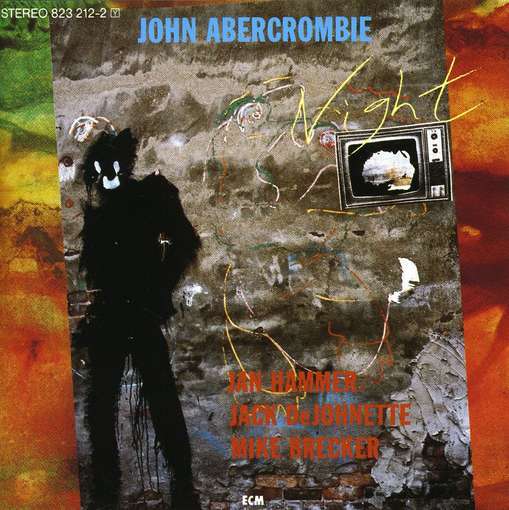
As its cover indicates, Night gives us a colorful, collage-like portrait of John Abercrombie, who jumps here into the urban deep end with smoky club atmospheres and tight jams. It’s a joy to see the guitarist working with Jan Hammer again, and the inclusion of Mike Brecker on tenor and Jack DeJohnette on drums make for a winning formula. Hammer adds a particular spike to this sonic punch, competently filling the session’s lack of bass while also fleshing out the production with an evocative sweep. Between the idiomatic blend of “Ethereggae” and the Timeless heat distortion of “3 East,” his billowing keys give Brecker more than enough room to show off his chops (he has hardly sounded better). This date isn’t all fun and games, however, for the rain-slicked streets of “Look Around” give us pause for reflection. Hammer reignites things in “Believe You Me,” which despite being the most straightforward track compositionally sports Brecker’s most uninhibited solo yet. The band saves the best for last with “Four On One,” which draws another ring of fire in an enthralling closer. DeJohnette gets his moment in the sun here as well.

Though something of an blip in the Abercrombie back catalogue, Night is far from benign. Aside from the effusive music, what really distinguishes this album is its sound. Another slam-dunk for engineer Jan Erik Kongshaug.

<< Pat Metheny: Rejoicing (ECM 1271)
>> Art Ensemble of Chicago: The Third Decade (ECM 1273)

Ralph Towner/John Abercrombie: Five Years Later (ECM 1207)

1207 X

Ralph Towner
John Abercrombie
Five Years Later

Ralph Towner classical and 12-string guitars
John Abercrombie acoustic guitar, 12-string electric guitar, mandolin
Recorded March 1981 at Talent Studio, Oslo
Engineer: Jan Erik Kongshaug
Produced by Manfred Eicher

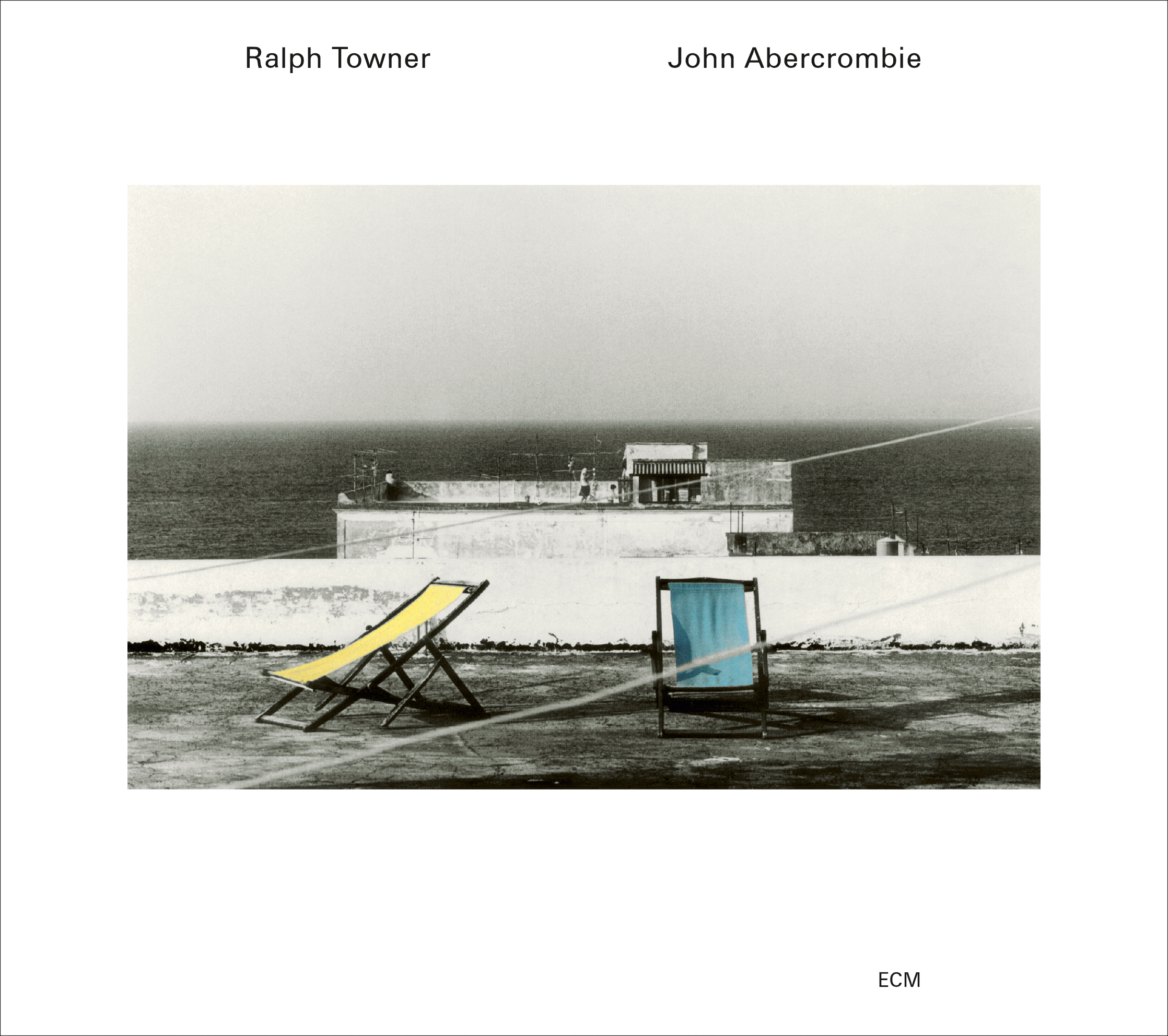
John Abercrombie is unique among guitarists in that whenever he becomes enraptured his sound becomes neither louder nor more pronounced but becomes somehow mysterious, liberated. Ralph Towner, on the other hand, revels in the crackling ruptures that so characterize his playing. Yet these roles seem reversed in this follow-up to the duo’s Sargasso Sea. A far more fragile carnation than its predecessor, it seems to forego the usual bag of tricks in favor of something more, as the album’s title would imply, reflective. This is especially apparent in the three improvisations with which the set list is dotted, and nowhere more so than in “Late Night Passenger,” where Abercrombie’s laddered filaments provide stunning berth for the other’s muted, jangling starlight.

As for composed pieces, Towner offers three, Abercrombie two. Among the former’s, the all-acoustic “Half Past Two” is a vibrating rib cage of biographical energies, and the most comely track on the album. The attraction continues with “Caminata” and on through the whimsy of “The Juggler’s Etude.” Abercrombie’s “Child’s Play” pairs electric and classical for a complementary sound, Towner’s shallower accents the caps on Abercrombie’s resonant stalks. Child’s play it may be in name, but in execution it is anything but. Yet it is in “Isla” that the reverie reaches new depths, the musicians’ negotiation of lead and backing effortlessly egalitarian. Such reciprocity is the keystone that keeps this arch from crumbling.

<< Gallery: s/t (ECM 1206)
>> Lande/Samuels/McCandless: Skylight (ECM 1208)

Gateway 2 (ECM 1105)

ECM 1105

Gateway 2

John Abercrombie guitar, electric mandolin
Dave Holland bass
Jack DeJohnette drums, piano
Recorded July 1977 at Talent Studio, Oslo
Engineer: Jan Erik Kongshaug
Produced by Manfred Eicher

In this era of tawdry sequels, it’s almost difficult to believe that John Abercrombie, Dave Holland, and Jack DeJohnette could have surpassed the profundity of 1975’s seminal Gateway. I say “almost” only because each member of this dream trio has yet to let this committed listener down and always comes to the studio bearing a basket overflowing with fresh ideas. Not only do the results of this 1978 follow-up not disappoint, they ascend into their own category.

At first we aren’t sure what to think in the carefully executed half-sleep of the 16-minute “Opening.” Amid tinkling icicles Abercrombie’s guitar wavers above the bass as it gradually forms intelligible words out of the scattered letters with which we are confronted. The process is so intensely organic that we find ourselves being lulled into its speech-like rhythms. As the snare becomes more forthcoming with its intentions, Holland fleshes out its implications with a tantalizing loop, through which Abercrombie hooks his song with a sound that is wiry yet ethereal. Just as engaging in his supportive statements, he provides ornamentation for Holland as DeJohnette rides with fierce precision into a fine solo of his own. The steam of malleted cymbals condenses into the following “Reminiscence.” Holland and Abercrombie blend into a larger instrument in this pensive track that sounds like the acoustic shadow of Pat Metheny’s “Midwestern Night Dream” (see Bright Size Life). “Sing Song” is another dose of milk-and-honey goodness. Wonderfully nuanced drumming here from DeJohnette uplifts even as it placates. Meanwhile, Abercrombie leans back into an ergonomic continuity that soon plateaus into an engaging turn from Holland, whose quintessential bass line in “Nexus” opens the band to a limber display of virtuosity. Abercrombie is again transcendent in this tower of syncopation, from which trails the Rapunzel-like strands of a limitless creative cache. DeJohnette’s piano turns “Blue” into an ending that is as bitter as it is sweet.

For those who haven’t heard this unit’s first album, I recommend doing so before settling into this one. Not because either is “better” than the other, but only because the development between the two is more readily appreciated when experienced chronologically. In any case, Gateway 2 is its own animal that thrives best in the habitat of our appreciation.

<< Richard Beirach: Hubris (ECM 1104)
>> Art Lande and Rubisa Patrol: Desert Marauders (ECM 1106)

John Abercrombie: Characters (ECM 1117)

ECM 1117

John Abercrombie
Characters

John Abercrombie guitars, electric mandolin
Recorded November 1977 at Talent Studio, Oslo
Engineer: Jan Erik Kongshaug
Produced by Manfred Eicher

Just four months after the historic Gateway 2 session, John Abercrombie stepped into Oslo’s Talent Studio to record Characters, his first and only solo album for ECM. While the guitarist’s trademark electric lurks here and there, a modified mandolin takes the strongest lead. The album also features about as much acoustic as one is likely to hear from Abercrombie in one sitting. All of this makes for sonic perfection.

At nearly 11 minutes, “Parable” is the longest cut on the album. A plaintive mandolin seems to stretch its strings as Abercrombie adds almost sitar-like cadences until, about halfway through, we realize this is but the stem of an overarching flower, which reveals its full bloom in an acoustic umbrella. With peerless thematic acuity, Abercrombie reconfigures his melodic matrix in “Memoir,” a nostalgic acoustic duet, each channel part of a spontaneous conversation. It is the most fleeting track on the album, but also the most intuitive. Next, Abercrombie transmits a “Telegram” straight into our souls. Like the message of its title, it is formless during transmission, but arrives in tangible form through the advent of technology, of which performance is Abercrombie’s medium of choice. His involuntary humming harmonizes with itself in a subconscious overdubbed chamber choir. “Backward Glance” recalls the title of Steve Kuhn’s classic tune. Dense acoustic chording spins powerful thermals upon which Abercrombie spreads his electric wings, drawing a feathered curtain over our eyes in the final strum. The spindly diversions of “Ghost Dance” percolate like anesthesia through the bloodstream before “Paramour” makes its debut as another acoustic duet (Abercrombie would soon resurrect it at the heart of his first quartet album, Arcade). More of the same awaits us in “After Thoughts,” where every pause feels like a deep breath that is at last exhaled in a luxurious chord. Lastly, through the liquid sheen of “Evensong” we catch visions of ourselves at different ages. After a silence, an acoustic hand opens its fingers wide as one electric swells in accompaniment and the other glides like a stingray for a sublime finish.

The album’s title is a prescient one. In addition to glyphs on a writing surface, “characters” are people, animals, or any other living creature whose desires animate a story. They might also be the traits of those creatures, or even the morals that define their personalities. Here, we encounter all of these and more, threaded ever so genuinely by one musician’s unique sense of space-time. For anyone wishing to peer into the soul behind the sound, let this be your window.

<< Egberto Gismonti: Sol Do Meio Dia (ECM 1116)
>> Jan Garbarek: Places (ECM 1118)

Enrico Rava: The Pilgrim And The Stars (1063)

ECM 1063

Enrico Rava
The Pilgrim And The Stars

Enrico Rava trumpet
John Abercrombie guitar
Palle Danielsson bass
Jon Christensen drums
Recorded June 1975 at Tonstudio Bauer, Ludwigsburg
Engineer: Martin Wieland
Produced by Manfred Eicher

In today’s wealth of commercially visible jazz trumpeters, one pines for vintage brass at the lips of musicians for whom “creativity” is more than just a brand. And while I’m the first to admit to having a soft spot for the likes of Chris Botti, there’s nothing like an Enrico Rava experience to wipe your slate of appreciation clean and start you on a fresh path. From the striking cover to the synergistic musicianship, Rava’s ECM debut is an album to return to time and again. Joined by a dream team of John Abercrombie on guitar, Palle Danielsson on bass, and Jon Christensen on drums, Rava reaches for the sky with this one, and succeeds.

The title track brings the album to life in raspy exhalation. This whisper turns into full-blown speech as Abercrombie takes the rhythmic wheel. He steers us into “Parks,” in which we find Rava at his most incisive. In a lively duet with acoustic guitar, he lays down a smooth melody filled with a nostalgia you never knew you had. This is a fantastic track, and one of Rava’s brightest moments. Next is “Bella,” which lays down a gentle groove before Rava flexes his lungs like wings, setting every note to flight. Christensen brings on the frenzy, to which Rava adds his own, yet with a delicacy that never leaves him. An intense guitar solo of soaring and piercing clarity follows. A rare whoop from Christensen knocks things up a rung or two, and a very present Danielsson cuts to the quick before ending on a glorious reinstatement of the theme from Rava. The lead melody of “Pesce Naufrago” coalesces out of the slow-motion big bangs that birth much of the band’s gravity. “Surprise Hotel” is a wilder affair, with energetic runs all around in a confined space. “By The Sea” offers wonderful reinforcement in the bass as Abercrombie circles overhead with distant cries. We end with “Blancasnow,” in which Rava floats his trumpet in the murky waters of his rhythm section. After a free and easy introduction, he pulls us toward even greater melodic destinations.

What’s amazing about these musicians in that they conduct so much creative electricity from such quiet musical circuits. Rava is, as per usual, variously a raging fire and a delicate flicker, straying as far from the wick as possible while remaining tethered by the thinnest of flames. The band is miked in a nice full spread, drums and trumpet at center, bass in the mid-right channel, and guitar anchored hard left. This leaves plenty of room for us to walk among them and enjoy the sounds as if they were our own.

<< Collin Walcott: Cloud Dance (ECM 1062)
>> Keith Jarrett: The Köln Concert (ECM 1064/65)

John Abercrombie/Ralph Towner: Sargasso Sea (ECM 1080)

ECM 1080

John Abercrombie
Ralph Towner
Sargasso Sea

John Abercrombie electric and acoustic guitars
Ralph Towner 12-string and classical guitars, piano
Recorded May, 1976 at Talent Studio, Oslo
Engineer: Jan Erik Kongshaug
Produced by Manfred Eicher

It was often raining when I woke during the night, a light capricious shower, dancing playful rain, or hushed muted, growing louder, more persistent, more powerful, an inexorable sound. But always music, a music I had never heard before.
–Jean Rhys, Wide Sargasso Sea

Given the contrasting but strikingly compatible talents of John Abercrombie and Ralph Towner, this album was bound to happen sooner or later. The aptly titled “Fable” best describes what these two musicians achieve together, for theirs is a tale that sounds as if it were written long ago, coalescing out of life’s improvisations into a memorable narrative. Its pairing of Towner’s 12-string with Abercrombie’s electric represents the duo in its most melodically satisfying comfort zone. We get more of the same in the title track, an uncertain travail with hints of soliloquies caressing our ears from either side, and in the relatively explosive moments of “Elbow Room.” Abercrombie opts for an echo effect here, the pulse of which dictates the piece’s rhythmic trajectory. And while I do think the effect weakens the track as its pathos becomes clearer, Towner compensates its contrivance with some flamenco-like body taps. “Staircase” features classical guitar and Abercrombie’s more directly amplified electric in the album’s most carefully realized blend of sound and circumstance. Towner then leaps to his 12-string amid Abercrombie’s own ascendant doodling. A few all-acoustic tracks enliven the mix, of which “Romantic Descension” is the loveliest. The final track, “Parasol,” is a triangular affair between 12-string, electric guitar, and Towner’s overdubbed piano.

Sargasso Sea is an enchanting reverie that has stood the test of time, and with an attractive patina to show for it. Like a kiss in deepening twilight, it loses its physical shape and becomes pure sensation, lost in the placation of a distant slumber.

<< Jack DeJohnette: Pictures (ECM 1079)
>> Art Lande: Rubisa Patrol (ECM 1081)