Jan Garbarek Group: Wayfarer (ECM 1259)

Jan Garbarek Group
Wayfarer

Jan Garbarek tenor and soprano saxophones
Bill Frisell guitar
Eberhard Weber bass
Michael DiPasqua drums, percussion
Recorded March 1983 at Talent Studio, Oslo
Engineer: Jan Erik Kongshaug
Produced by Manfred Eicher

The Jan Garbarek Group has ever been among ECM’s more formidable. Its winning inclusion of bassist Eberhard Weber ensured a fluid foil to Garbarek’s scalpeled lines. The brief tenure of guitarist Bill Frisell made that balance even more promising. That being said, Wayfarer tends to meander as much as its eponymous protagonist, although who’s to say this wasn’t the intention. Gone is the full-on dreaminess of Paths, Prints. In its place: a session that walks in a half-sleep through picturesque territories without ever really looking at them, never quite knowing which reality it is committed to. Drummer Michael DiPasqua gives us hope in the inaugural “Gesture,” carrying over the cymbal rides one misses in Jon Christensen’s absence, but his surroundings only seem to wander in circles. “Gentle” is another case in point, though Weber manages to enliven this piece into something beautiful. At ten and a half minutes, “Pendulum” is the album’s central epic and gives Frisell plenty of room to stretch. But the ponderousness wears thin, and one loses sight of the destination. Likewise, “Spor” seems more like a studio warm-up to something that never made the final cut. The album’s reigning exception is the title track, which from a brooding crawl through dimly lit catacombs bursts with DiPasqua’s incredible frenzy as Frisell sharpens his axe along the periphery. It also gives us a taste of the old Garbarek.

Despite occasional flashes of brilliance and fine musicianship all around, the themes on Wayfarer are relatively weak and don’t seem to add up. In my journey through ECM’s back catalogue thus far, this is the only Jan Garbarek Group album I would hesitate to recommend. This may be one, however, to grow with time.

<< Oregon: s/t (ECM 1258)
>> Chick Corea/Gary Burton: Lyric Suite For Sextet (ECM 1260)

Chick Corea: Trio Music, Live In Europe (ECM 1310)

Chick Corea
Trio Music, Live In Europe

Chick Corea piano
Miroslav Vitous bass
Roy Haynes drums
Recorded September 1984 in Willisau and Reutlingen
Engineer: Martin Wieland
Produced by Manfred Eicher

In 1983 the Keith Jarrett trio was just getting on its feet. That shadow would prove to be a difficult one to step out of in the coming decades. But if anyone could have thrown a light onto it, it was Chick Corea, who, along with bassist Miroslav Vitous and drummer Roy Haynes, emoted a live recording for the ages. Corea seems to have done much soul searching in the 70s, and on this set one hears his chrysalis crackle with uncontainable vivaciousness. After his warm intro, “The Loop” kicks off the band’s deep combinatory powers with fortitude. Vitous is a joy to experience, his rich, oblong sound surrounding us like a wooded glade, brought to the life by the rustlings of Haynes’s snare and the trickling sunlight of Corea’s keys. “I Hear A Rhapsody” cocks its ear toward rapture. Lost along the winding staircase of its motive, it is a while before we realize these musicians have been keeping us in sight all along. We are reminded of this with every shift, and in the way Corea draws Haynes into whimsical conversation. “Summer Night / Night And Day” gives us the album’s first double-header, Vitous fluttering his wings in ways few others can. From this upbeat wonder, the trio transitions seamlessly into its inverse, seeming to fill every gap in the former’s carving with glorious relief. The second double-header tears a page from the Scriabin playbook with “Prelude No. 2,” making for one of Corea’s most beautiful stretches of internal life ever committed to disc. This bleeds into the staggered breathing of “Mock Up.” Vitous solos us through “Transformation,” while “Hittin’ It” pours the light on Haynes. Eicher has done us a service in including these, for, as so often happens in jazz recordings, long solos are either cut or curtailed. Yet here they are fully fledged elements in the album’s molecular pathways. We end on “Mirovisions,” which writes an arco bass across soaring pianism before diving hawk-like into the Valley of the Groove. A colorful unraveling follows, marked by flashes of buoyancy against a thoughtful backdrop.

A perfect album from Alpha to Omega, this is one of ECM’s finest and a delightful new addition to my Top 10. Invigorating to the last.

<< Dino Saluzzi: Once upon a time – Far away in the south (ECM 1309)
>> John Abercrombie: Current Events (ECM 1311)

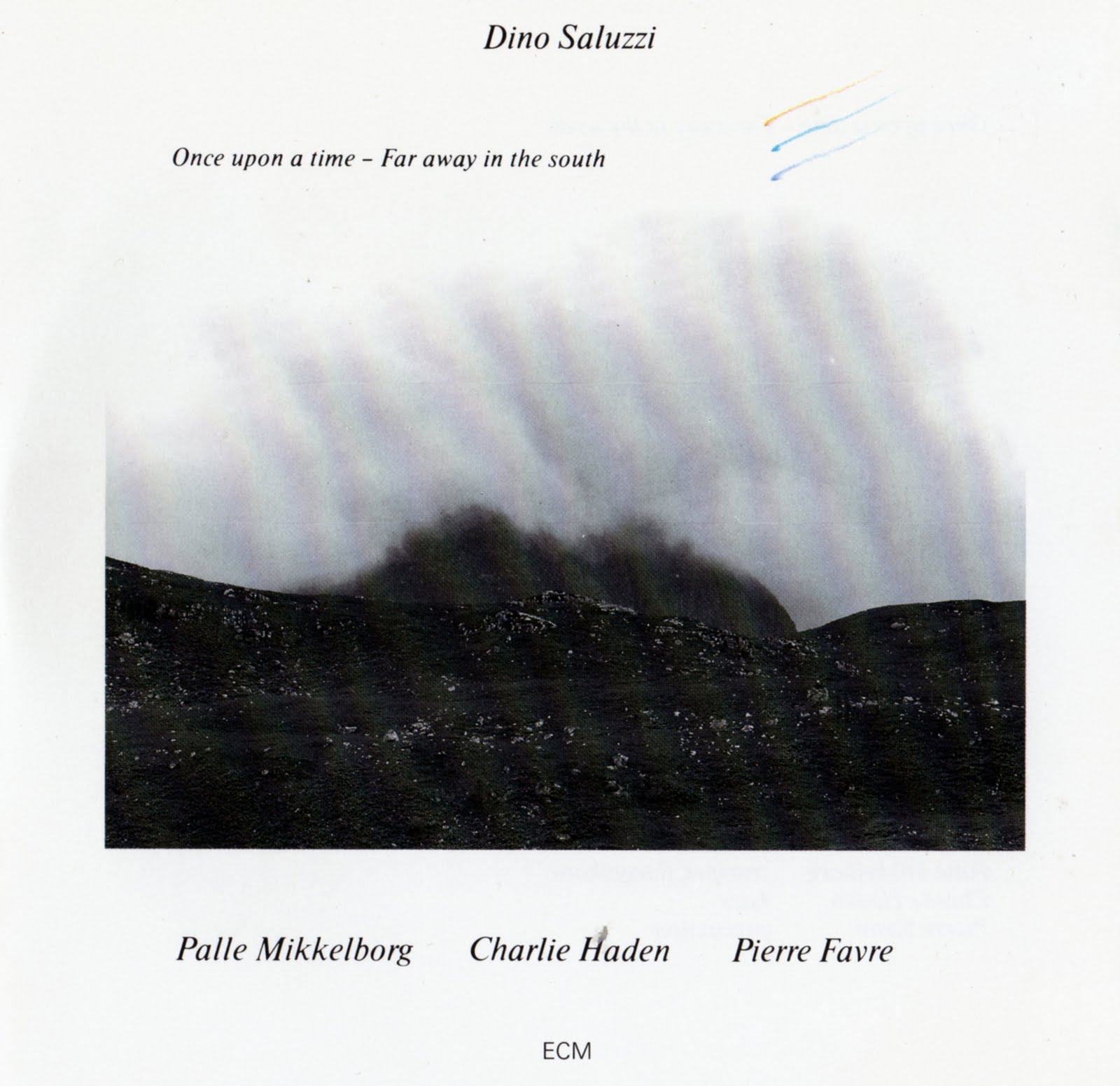
Dino Saluzzi: Once upon a time – Far away in the south (ECM 1309)

Dino Saluzzi
Once upon a time – Far away in the south

Dino Saluzzi bandoneón
Palle Mikkelborg trumpet, fluegelhorn
Charlie Haden bass
Pierre Favre percussion
Recorded July 1985 at Tonstudio Bauer, Ludwigsburg
Engineer: Martin Wieland
Produced by Manfred Eicher

There is an effusive quality to bandoneón virtuoso Dino Saluzzi’s art, one that speaks of the past, which through slogs of time becomes recoverable through the hope of performance. Listen to the sonic photograph that develops in “José, Valeria And Matias” this becomes clear. Every face is a memory incarnate, speaking with the voices of a hundred. Bassist Charlie Haden and trumpeter Palle Mikkelborg round out the album’s histories, along with percussionist Pierre Favre, whose rustlings shake a metallic tree of its own. Mikkelborg proves himself more than adaptable to these uncharacteristic circumstances, and Haden, as ever, is no mere accent but a living, breathing songster, ever open to the resonance of harmony. The titles of each track tell stories in and of themselves while also telling a larger narrative together. “And The Father Said… (Intermediate)” strings a contemplative (and what about this album isn’t?) duet between Saluzzi and Haden (who broadens the reflections that so deepened “José…”) before Favre’s earthly drums draw us upright into “The Revelation (Ritual).” Over a swelling gong and skipping snare, Mikkelborg and Saluzzi spin a frantic spell. “Silence” is a heartening solo from Saluzzi that ebbs like the tide and saunters into the verdant landscapes of “…And He Loved His Brother, Till The End.” Mikkelborg’s sensitivity swings in slow motion here from Haden’s tether. Favre returns in “Far Away In The South…,” painting the empty spaces with his embracing nature. In this 16-minute saga of intimate proportions, we get the album’s most dynamic changes, a mosaic of improvisatory energy, a sometimes-playful excursion into recollection. The quartet finishes with “We Are The Children.” The sun of this anthem burns away the rain, bringing together each signature in a field recording of children at play.

Once upon a time… is a language unto itself, a study in movement and matter. This recording is also a testament to ECM’s meticulous production values. Guaranteed to wash your soul clean.

<< Shankar/Caroline: The Epidemics (ECM 1308)
>> Chick Corea: Trio Music, Live In Europe (ECM 1310)

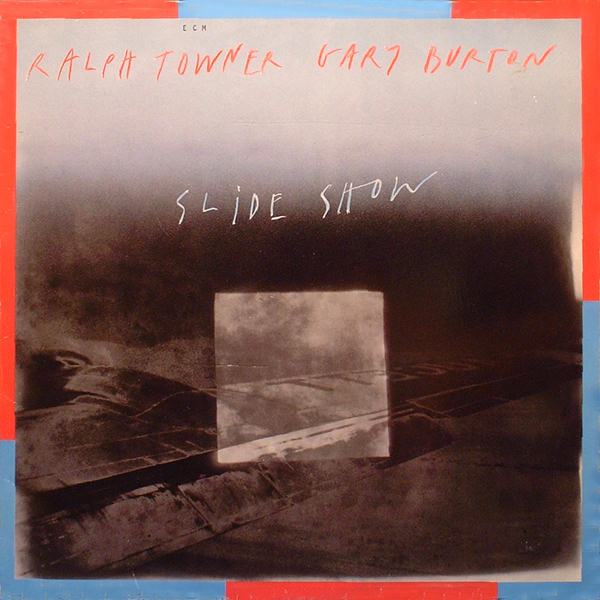
Ralph Towner/Gary Burton: Slide Show (ECM 1306)

Slide Show

Ralph Towner classical and 12-string guitars
Gary Burton vibraphone, marimba
Recorded May 1985 at Tonstudio Bauer, Ludwigsburg
Engineer: Martin Wieland
Produced by Manfred Eicher

When one thinks of pairing vibraphonist Gary Burton with another soloist, Chick Corea comes foremost to mind. Burton’s work with guitarist Ralph Towner could hardly be more different, for where the former configuration funnels into a colorful storm of activity, in the latter we find far more intimate gestures articulated in monochrome. Case in point: “Maelstrom,” which starts us on the inside, spinning on its edge like a coin teetering at the promise of rest. Towner is as delicate as ever, fitting his harmonic staircases into Burton’s Escherian architecture with ease. This piece also highlights Towner’s compositional talents, which make up eight of the album’s nine tracks (the only exception being the slice of sonic apple pie that is “Blue In Green”). Towner and Burton frequently swap roles (“Vessel” being one notable example) and do so with seamless charm. Between the waking dawn of “Innocenti,” which features a rare turn from Burton on marimba, and the flurried “Around The Bend,” there is plenty of range to delight and calm the senses in turn. In the latter vein, we have “Beneath An Evening Sky,” a canvas of hues as muted as its title would suggest. The combination of Towner’s twinkling 12-string and Burton’s “vibrant” aurora lures us into a life of fantasy, where “The Donkey Jamboree,” a jocular ditty comprised of slack guitar and marimba, gives us a taste of sand and sunlight. “Continental Breakfast” (compliments of the Hotel Hello?) keeps the energy going in a travelogue of morning train rides, while “Charlotte’s Tangle” loosens the seams of the sky above.

This follow-up to the duo’s 1975 Matchbook is every bit as lovely as its predecessor, only this time around the atmospheres are deeper, richer with detail. Worthy.

<< Gidon Kremer: Edition Lockenhaus Vols. 1 & 2 (ECM 1304/05 NS)
>> First House: Eréndira (ECM 1307)

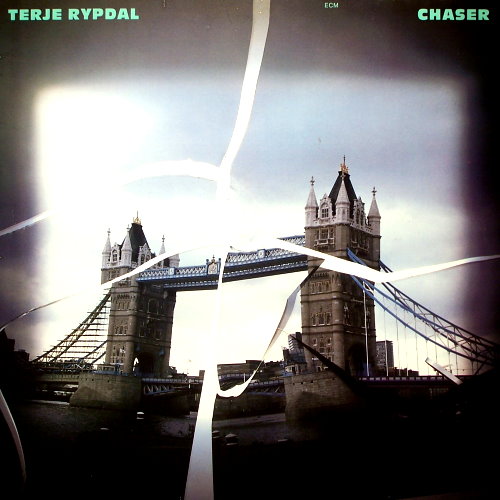
Terje Rypdal: Chaser (ECM 1303)

Terje Rypdal
Chaser

Terje Rypdal guitar
Audun Kleive drums, percussion
Bjørn Kjellemyr basses
Recorded May 1985 at Rainbow Studio, Oslo
Engineer: Jan Erik Kongshaug
Produced by Manfred Eicher

1985’s Chaser finds Norwegian guitarist Terje Rypdal in cahoots with drummer Audun Kleive and bassist Bjørn Kjellemyr. From what I can gather, even some die-hard Rypdal fans are turned off by this one. I can only scratch my head at such reactions, because for me the results are powerful and memorable. Rypdal’s strong-armed phrasing makes the nine-minute opener, “Ambiguity,” a bitter piece of chocolate indeed, but Kjellemyr’s caramel center gives us just the sweetness we need to balance it out. It takes a few minutes to accustom oneself to the sound, but once the rock grabs hold it is difficult to deny. The trio shifts gears with “Once Upon A Time,” which sounds like a film noir that never materializes, if only because there is no one around to populate it. It is the slow blaze of a metal barrel fire pit, a cityscape obscured by sewer steam. For “Geysir,” Rypdal hooks his fluid anchor through a snaking Eberhard Weber-like bass, finding light, cold and subterranean, in every echo. The nighttime feel of “A Closer Look” ports us into “Ørnen,” a deep spiral of hard-won energy—the badlands compressed into 6.5 minutes of emotive genius. Also masterful is the title track. This tender ode to art rock evokes youth and electricity, charging us for the keening embrace of “Transition” and on through “Imagi (Theme),” this last a flexing muscle through which the band separates strength into chains of non-strengths, looking past the façade of power to the surrender that begets it.

Rypdal has singlehandedly honed his axe into an exacting, if serrated, edge. Forged in fire and ice, his sound sings as it lives: nakedly and brightly. This is without a shadow one of Rypdal’s best and belongs alongside such classics as Descendre and his self-titled debut on the throne of his craft. Due to its wide range, to which one finds touchpoints in the work of guitarists as diverse and Buckethead and Bill Frisell, this is as broad a portrait as one can expect to find of a consummate artist who has, in ECM, found a loving home.

<< Marc Johnson: Bass Desires (ECM 1299)
>> Gidon Kremer: Edition Lockenhaus Vols. 1 & 2 (ECM 1304/05 NS)