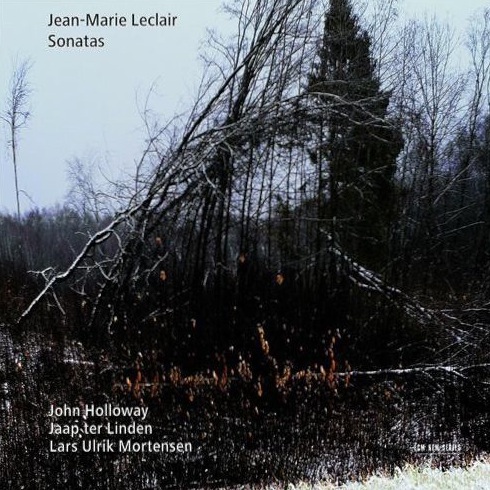
John Holloway violin Jaap ter Linden violoncello Lars Ulrik Mortensen harpsichord
Recorded November 2006 at Propstei St. Gerold
Engineer: Stephan Schellmann
Executive producer: Manfred Eicher
The biographies of composers can sometimes outweigh the notoriety of their music. Jean-Marie Leclair (1697-1764) is one such case. Born 1697 in Lyon, he left the city in his mid-twenties for Turin, where he sharpened his eye (and ear) for theatre and ballet and returned to Paris in 1723 to make a name for himself as a composer. Within a decade he was one of the most exciting violinists of his time, a pioneer in the French school of his instrument. By 1758 he had fallen on hard times. After leaving his wife, Leclair rejected the offers of his patron, the Duke de Gramont, to instead take lodgings unbefitting of his station in an unreputable part of the city. Six years later, a gardener would discover the composer stabbed to death in his vestibule. The gardener himself and Leclair’s nephew emerged as primary suspects, but no conclusive evidence was ever brought upon either (the most recent scholarship fingers the latter). One might think, in the wake of this tragedy, that the fruits of his endeavors would have bounded of their own accord into the public eye. This was not to be, and it is only with the advent of recording that his chamber works have grown into the recognition they deserve beyond musicological interest.
In a conversation included in the CD booklet, John Holloway is quick to place Leclair alongside the great violinist-composers under the bow of his acclaimed earlier ECM recordings: Biber, Muffat, Schmelzer, and Veracini. With cellist Jaap ter Linden and harpsichordist Lars Ulrik Mortensen, the British violinist takes on five selections from the opus 5 of 1734. Among the composer’s finest, the set yields a surplus of charm and virtuosity. While Holloway’s Leclair reads more conservatively than the fiery licks of his Biber, these sonatas are more about consistency than drama. To achieve this is no small feat, and requires fluid concentration of the musicians. That being said, the uniformity of dynamic patterning and phrasing will tire some listeners, who may feel it better suited as a light soundtrack to their activity. All the more reason to give it a deep listen the first time around.
Leclair’s time in Italy clearly rubbed off—not only because he follows the four-movement model of his predecessor, Arcangelo Corelli (in Turin, Leclair studied with Giovanni Battista Somis, himself a pupil of Corelli), but also because his deft blend of the Rococo and the Baroque sets him apart from the Parisian pack and speaks of a continental (known then as the gouts réunis, or “mixed taste”) perrsonality. The sonatas chosen here boast some of his subtlest inflections, and nowhere more so than the whimsical opening of the Sonata VIII in D major. This gives way to spirited color changes as the harpsichord continuo drops out for the tender Aria, only to make its triumphant return in the stately Andante before bristling with sprightly atmospherics in the dancing Allegro. Those wanting stronger excitements need look no further. This theatrical edge continues in the Sonata VII in a minor, in which a straightforward beginning yields two winged Allegros. Captivating harmonies between violin and harpsichord add to the airborne feel and give extra shine to Holloway’s trills.
One hears Italian pigments seeping through the opening Adagio of the Sonata I in A Major, the Aria of which weaves the more sensitive writing on this disc, as do the Largo and Aria of the Sonata III in e minor. The Sonata IV in B-flat Major carries this tender mission further in its Adagio, which sparks a fuse of complex proportions in an exhilarating Chaconna, a sonata unto itself.
This may not be as thrilling as Holloway’s previous recordings for ECM, and not one the newcomer may wish to start with, but Leclair’s music lives by its own rules of contrast. The intuitiveness of his harmonization and counterpoint, Holloway notes, begs for that same attentiveness in the performing. This becomes more obvious with each new listen, enfolding us in the depths of a music that breathes as it sings.
Veljo Tormis Estonian Philharmonic Chamber Choir Tõnu Kaljuste conductor
Recorded August 1998, Estonian Concert Hall, Tallinn
Engineer: Teije van Geest
Produced by Manfred Eicher
“I do not use folk song. It is folk music that uses me.”
–Veljo Tormis
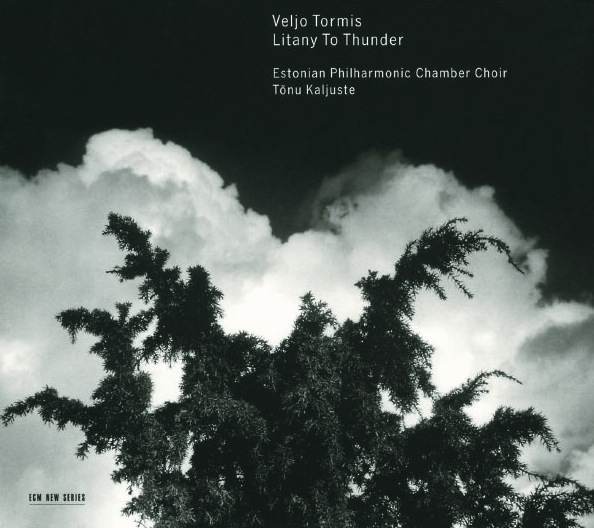
Since the 1992 release of Forgotten Peoples, the first major survey of Veljo Tormis to be released outside of Russia, ECM has paved an international appreciation of the Estonian composer, whose choral output exceeds 500 pieces. More than number, it is the melodic and textual content of those pieces that asks of the listener attention to source, meaning, and atmosphere. Although so much of Tormis’s work is drawn from Baltic folk traditions, his project is more one of expression than of preservation. He paints a distinct amalgam of texts and motifs, so that what we are left with is a sonic trajectory that moves ever forward. There is no group more qualified to follow that trajectory than the Estonian Philharmonic Chamber Choir. Under the direction of Tõnu Kaljuste, these intensely talented singers breathe the music on Litany To Thunder as if it were their own.
dear girls dear maidens where shall we go before the night sets in
How Can I Recognize My Home begins the program with a runo-song. This form finds its charge in the pre-Christian beliefs of the Baltic Finnic region, linking stanzas in a two-part round. On the surface a paean to nostalgia, it is more deeply a cartography of origins in which the voice becomes the thread that grows thinner with life and snaps only in death. Between the fatigue of travel and the cold springs that gurgle in wait of parched throats, the moon shines through it all like a maternal eye.
When the boys sang on the ship, the girls thought it was an organ playing. They could not imagine that the boys of their village could sing so well.
Singing Aboard Ship (1983) is an Ingrian-Finnish folk song that features a call-and-response framework welded tight by the contralto of Karin Salumäe. The EPCC’s restraint is in full flower here, lapping at vessel’s edge with the reverence of lips pursed to a holy relic. It is an important setting, for it proves the power of song to be a guiding light through adversity. That the Finnic peoples exiled by the Soviet regime in the wake of World War II managed to preserve this tale is testament to that very fact.
You are earth-born, I am earth-born, we are both black boil.
The Kalevala-inspired Curse Upon Iron (1972) showcases Tormis’s uncanny ability to soak us in a feeling. With its shamanic drum and tense use of silence, it peers into the heart of elemental forces and further into the human condition, which too often seeks to render those forces into tools of harm. The words reduce iron to its blood, to the evil that is its parasite. They even draw a line of affiliation to modern warfare, to the bane of technology. The furnace becomes a symbol of hatred fueled by temptation. Tenor Mati Turi and bass Allan Vurma bellow its fires, sustaining themselves through (if not on) sirens and shrieks of indignation.
And I, the child, then learned and learned, I, little one, picked up the words.
In the wake of this aural forge, The Singer’s Childhood (1966) emerges as one of the most ethereal choral compositions to ever grace the ear. It is not only that its relative beauties are gentle enough to break apart from a sigh, but also because its appeal to nature as a source of art pulls our eyes from the upward swing of industrial and social progress and returns them to the wealth of activity and inspiration we have yet to regard on the ground.
The sea has fed us, the sea has watered us, the sea has taken away many men from us.
Songs Of The Ancient Sea (1979) is overtly programmatic. Its technical admixture of whistling winds, cackling seagulls, and calling of shipmates lure the imagination from land. This piece is akin to performance storytelling, whereby the listener is not only engaged but also implicated in the action. A particularly moving section comes halfway through, when the tenor soloist laments a brother’s loss to the waves.
A hundred swordless men, a thousand sworded men, all the men from under a hill, from the black earth.
The Bishop And The Pagan (1992/95) tells of Bishop Henry, whose death by the hands of a Finnish pagan farmer in 1158 is told from both sides. On the one hand is the memorial feast in Henry’s honor; on the other, an alliance with the victor. History changes places like shuffled cards, each obeisance a faltering shadow of reconciliation. In its careful balance of monastic solemnity and outright vilification, the vocal weave grows more resilient the more it is pulled.
Pour, Thunder, pour
The 1974 title composition for male choir shares similar touch points of battle, turning them into emblems of sacrifice. The meadows, overrun with chaos, funnel like sand through an hourglass, leaving a perfectly formed mountain of time.
I stepped into the house a chair was brought to me made of the bones of my geese
The Lost Geese is the forlorn tale of a maiden who must look after the geese on her family’s farm. The task proves more difficult than she imagined, however, when her geese are chased by demons into a spooky manor, where she is offered a meal of her charge. She throws their blood to the earth, where grows a tree populated with wildlife. This and How Can I Recognize My Home comprise the Two Estonian Runo-Songs, composed between 1973 and 1974. Sung as purely as the words are crystalline by sopranos Eve Härma and Kadri Ratt to the unobtrusive commentary of Marrit Gerretz-Traksmann at the piano, they wander without pause.
Tormis’s vitality and aesthetic properties connect the peoples of this music as the shore connects land and sea, establishing a fluid relationship between fields of geography and tradition. Images transcend linguistic barriers. In so being heard, they live anew.
José Luis Montón guitar
Recorded April 2011, Auditorio Radiotelevisione svizzera, Lugano
Engineer: Stefano Amerio
Produced by Manfred Eicher
“In this music I have tried to translate all the sincerity and love of art that I appreciate so much when I encounter it.”
After hearing José Luis Montón play so dazzlingly in Amina Alaoui’s Arco Iris, one of ECM’s finest records of this or any year, producer Manfred Eicher invited the Barcelona-born guitarist back twelve moons later for a solo session. The result: Solo Guitarra. Paying homage to the flamenco music that continues to challenge and inspire him, Montón took this opportunity, as he did with Alaoui, not to build on or recreate some monolithic tradition but rather to use his instrument as the starting point for independent compositions through which a mythic past flows unimpeded.
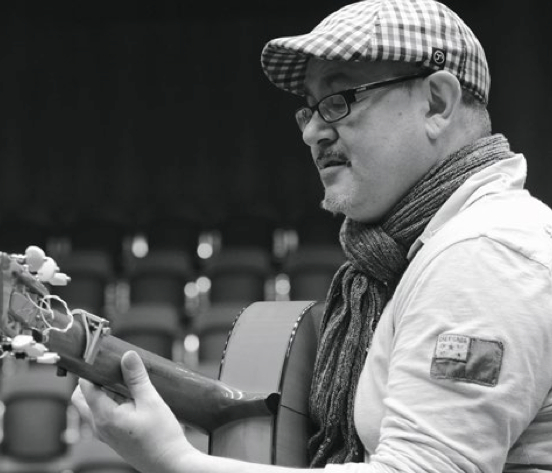
(Photo by Dániel Vass)
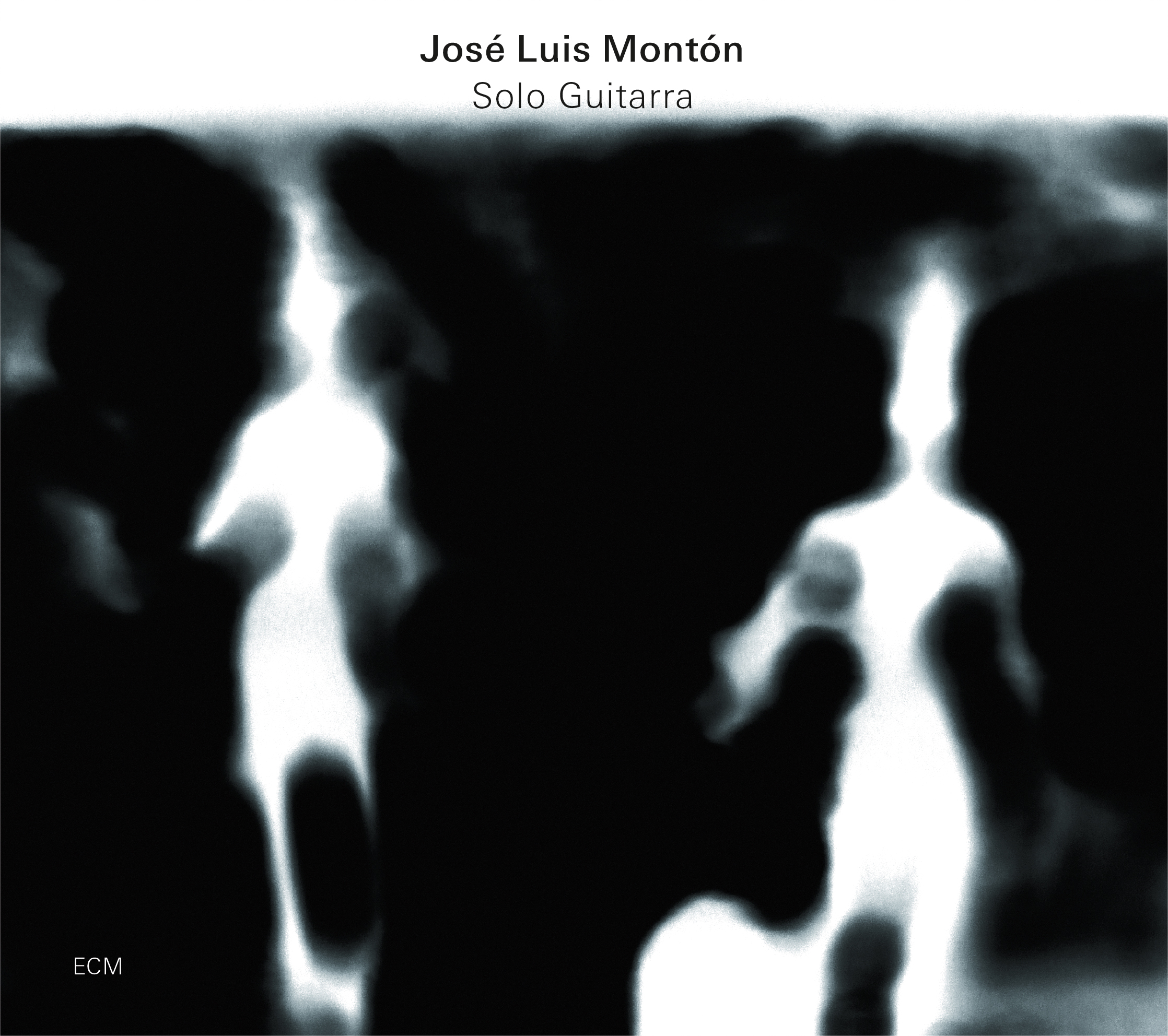
As with the implied figures of the Max Franosch cover photo, there is nothing “solo” about this guitarra, for the architecture of its player’s technical and idiomatic acuity has many chambers. The farruca, a (possibly) Galician strand similar to Portuguese fado, is referenced in the two opening pieces. This light and airy style is most evident in the understated virtuosity of “Rota,” but also shows a darker side in “Española.” Already we have witnessed the depths of Montón’s abilities, turning six strings into a choir just yearning to proclaim and meditate in turn. The acrobatics of the bulería come out through “Son & Kete,” a spiraling and almost tense flurry of activity. “Altolaguirre” and “Hontanar” give us the chameleonic tango. On the surface fragile as rose petals yet thorny as the supporting stem, it lives as it sings: without the need for words, and in service of that one moment when all is cast away. Next is an enraptured tarantella. “Con permiso” turns said folk dance into a diary of consummated love. There is the unsure touch, the cheek quivering at first caress, the pile of shed inhibitions cushioning every pinpoint of oneness. The relatively unornamented shapes of the Andalusian cantiñas and soleá roll like children down a hill through “Al oído” and “Conclusión,” respectively. Theatrical use of slaps and rasgueado (those distinct hummingbird strums) speaks to Montón’s experience as a composer of incidental music. The seguirilla, one of flamenco’s most expressive and formidable variations, shows him at his spirited best in “Detallitos.” The inventiveness of his mid-range melodies is second only to his intuitiveness of rhythmic control. “Tarareando” is without citation. As a result, its wide steps bolster the innocent joy of “Piel suave,” a rustic Cuban guajira that turns like a Rubik’s Cube, the solution of which glows flush in an endearing rendition of “Te he de querer mientras viva.” Nestled in the heart of all this is the Bach-inspired “Air,” which gives respect to the famous movement of the Orchestral Suite No. 3. It is an enlightening reminder of the many paths we travel to find the sound that best expresses us, only to discover that those paths all lead to a shared origin.
Latvian Radio Choir Sinfonietta Riga Vox Clamantis Estonian Philharmonic Chamber Choir Tallinn Chamber Orchestra Tõnu Kaljuste conductor
Recorded November 2011 at Niguliste Church in Tallinn by Peter Laenger and Stephan Schellmann, except for Estonian Lullby and Christmas Lullaby, recorded May 2007 by Margo Kõlar
Mixed at Rainbow Studio in Oslo by Arvo Pärt and Manfred Eicher with Jan Erik Kongshaug (engineer)
Produced by Manfred Eicher
“The text is independent of us; it awaits us. Everyone needs his own time to come to it. The encounter occurs when the text is no longer treated as literature or artwork, but as reference point or model.”
If the above is any indication, Arvo Pärt is one who understands text for what it is: a stepping-stone. With an attention equaled perhaps only by Alexander Knaifel, he holds words like votive candles, giving them flame by the touch of his gift for sound. Whatever we bring along the way is welcomed as it is, broken and hungry for a voice to lift its spirits. To this end, the writings of Saint Silouan (1866-1938) again form the touchstone for a program shaped as much by lips and tongue as by the Holy Spirit that guides them. If we never forget Silouans Song, the strains of which bled through the Estonian composer’s groundbreaking Te Deum recording of 1993 with especial scintillation, it is because its source had already been surpassed by the first draw of a bow. On Adam’s Lament, texts come to us as travelers with distant knowledge in their satchels. For ECM’s thirteenth program devoted to his art, Pärt builds on the tintinnabulation that shrouded his work of the eighties and nineties. He looks even more internally, seeking not only the echo’s path but also its unknowable spark.
(Photo by Kaupo Kikkas)
Paradise as Adam knew it may be lost, but in the eponymous piece we find our own. Though it is an illusion made possible by reverberation and microphones, its power rings beyond the circumscription of its capture. Here, Pärt works from the inside out, finding in every contour of its ecclesial Slavic text a vision of flesh and nature. Holding these together is the touch of one whose own humility exceeds him. And is not humility the greatest mystery to be enhanced through the act of putting pen to staves? It is, says Pärt, an enigma to the stained mind: “like marble, its beauty radiates from its depths.” The locus of that beauty takes form through the body’s destruction. Even then, its reality is partial. To be sure, the gaze of science goes far in this regard but stops at the threshold of something invisible. In the absence of eyes to see, the Lord’s grace gives us receptacles to hear.
Pärt’s microscopic approach sees us as something more than the sum of our parts. Shouldering the vagaries of time, we drag our feet toward a light on the horizon. Its name is stillness, and we are its destroyers. Strings and voices do not so much blend as talk with one another, finding synchronicity through varying degrees of unrest. Paradise, then, lives on as an idea of its former self. And perhaps it was never anything more. It was the voice of generative silence. Only through its fall—which looms wispily at best in the violins—can we look back to our infancy.
Adam’s Lament is about lineages: of us as descendants of Adam, of our future as reflection of the decisions we make today, of that single thread still being spun from the breath of its Creator. As the newest of the present recording, it looks back on a singular catalogue of sonic truth-seeking and self-reflection. The handful of older pieces reworked thereafter shine like the inner circle of its rosette.
My soul wearies for the Lord, and I seek Him in tears.
“The feathery lightness of Beatus Petronius and, by contrast, the potency of Statuit ei Dominus are two sonic worlds,” says Pärt, “like the two sides of God, which I tried to touch, to trace in these works.” Composed in 1990 and revised in 2011, both embody the architectural wonders of their service. In offering themselves so directly, they take off their masks of freedom in search of the real thing. Their departure balances on the apex of a steeple, poised for the coming of sun and moon. In their brevity lies the secret to faith: never waste your words. Every syllable becomes a community in and of itself, bustling with activity in trade with those around it.
The Lord made to him a covenant of peace…
The composer imagines his Salve Regina (2001/2011) as a funnel, turning in progressively smaller circles until its center manifests like a dwarfed star. That he manages to evoke such cosmic brilliance in earthly terms is barely short of the miracle it so ardently expresses. It draws lines from cloud to soil in ways that transcend all obstacles. Starlight trades footprints with human history, filling each with enough hope to light the way in darkest night. Astonishment comes nowhere near to describing its effect.
To thee do we send up our sighs…
The Alleluja-Tropus (2008/2010) sets liturgical words devoted to St. Nicholas of Myra (270-345), whose relics absorbed its first performance in Bari. The refrain is key to this jagged string game of antiphony. Although short in scope, its feathers engage in a spectral bit of play as they float free of their bones toward skies clouded by ash and fear.
A rule of faith and a model of meekness…
L’Abbé Agathon (2004/2008) tells the story of St. Agathon, whose carrying of a leper—later, it turns out, a testing angel—is evoked in the music’s heavy gait toward awareness. A soprano of infirmity spills like ink across the baritone’s selfless paper. The resulting patterns are what the strings fill in. Like onlookers to moral awareness, they take in what is before them, realizing only later the folly of their inaction.
“For mercy’s sake, take me forth with you.”
The Estonian and Christmas lullabies (2002/2006) are, according to their composer, “for adults and for the child within every one of us.” Both arise as if of their own volition. The use of pause and reflection is genius, allowing us to bask in the delicacy of a border-crossing nostalgia while adding to it the lessons of our lives.
And she brought forth her firstborn son…
If Tabula rasa was a revelation and Te Deum a call to harmony, then Adam’s Lament is the birth of our Messiah, wrapped in Christ child’s swaddle. The association sets me to marvel at my own firstborn sleeping next to me as I attempt to recast this music into meager sentences, to seek in his contented face the promise of a time when the world will no longer hold a knife to its own throat. The manger smells of song, and its name is Love.
(My 2-month-old son basking in the warmth of Christmas Lullaby)
All of this puts a finger on the pulse of a divinity beyond the prescription of any religion, which necessarily flows in opposing directions as an embodiment of universal balance. Were it not for the bleakness of our transgressions, such music might never find our hearts, but simply flow through them, unnoticed, as part of the hum of Time. That it comes to us so undeniably is due to many talents, including engineers and producers. Yet we must thank above all Tõnu Kaljuste and the musicians at his cue. Their undying commitment to Pärt’s mission has yielded one of the most indomitable partnerships in music, classical or otherwise. One hardly needs to reiterate the fact that, as with every label project, Pärt participated fully in all stages of this production. His contact is palpable in what we hear, reaching for us like a grandfather we never knew we had and whispering a story into our souls. Much of that story has already been written. The rest is for us to inscribe.
Jörg Widmann clarinet Deutsche Radio Philharmonie Christoph Poppen conductor Messe and Elegie Recorded June and July 2008, Congresshalle (Messe) and SR Studio 1 (Elegie), Saarbrücken
Engineers: Thomas Raisig and Thomas Becher Fünf Bruchstücke Recorded May 2009, Klaus-von-Bismarck-Saal, WDR Funkhaus, Köln
Engineer: Günther Wollersheim
Executive producer: Manfred Eicher
At 39, German composer and clarinetist Jörg Widmann has already established himself as a formidable talent. If his studies under Hans Werner Henze, Heiner Goebbels, and Wolfgang Rihm have left any noticeable influence in his work as composer, it’s the cellular approach at which he is so skillful. His experience as a performer with such ECM regulars as András Schiff, Kim Kashkashian, and Heinz Holliger, not to mention his sister, violinist Carolin Widmann, make him a natural fit for the label in both capacities. Though Widmann has been widely praised for his chamber works, on this survey we get only the Fünf Bruchstücke (1997) for clarinet and piano, and for which he is joined by none other than Mr. Holliger at the keyboard as he explores the extended capabilities of his instrument. His subtle clicks and arcing gestures provide the hum to the piano’s rattle at every turn. We feel these things and more scuttling just beneath the surface, holding on to sounds as idols of whimsy, each blown and deflated like a balloon that refuses to expand and will never know the catharsis of the pop. Among his first published pieces, they give us direct insight into his eclectic flourish…
(Photo by Felix Broede)
…and all the more so for nesting between two leviathan orchestral pieces. Played to astonishing effect by the Deutsche Radio Philharmonie under the baton of Christoph Poppen, his 2006 Messe buries us with immediate and bone-stressing volume, yet somehow retaining, not unlike the Dies irae from Arvo Pärt’s Miserere, the softness of a petal. This is the first of a handful of references, which would seem to include also Górecki’s Third Symphony (note the Contrapunctus I). These allusions are as robust as they are transient, rising as they do from an ocean of great depth and color. Even in the absence of words, the piece abounds with voices. Widmann’s string writing is patient and awakens by a lone violin, as quiet as the opening was loud. Pastoral cries from winds exhale in watery strains. Bows flicker through consciousness like dragonflies. Each step becomes a window of spiritual reflection, a string of dawns, ferocious as lions jumping from the sun. Swollen joints in the Trinitarian body find unconditional love in the crucifixion, sacrifice rendered divine and tipped by fingers of humility and faith. Shadow masquerades as light, and light blinds itself. Reaching the resurrection at last, a promise of life wraps itself in autumn before unfurling a banner of exodus beneath an all-seeing eye, within and without, everywhere and nowhere, in the glitter of the lachrymose.
The 2005 title composition stretches those tearful remainders into lenses of contact. Peering through contorted sighs and unspoken things, reeds, bellows, and high strings dance across a bridge of burning meteorites, each a needle without thread. An operatic current prevails. One can feel characters ambulating about the stage, hiding behind curtains and whispering erratic secrets into the spotlight, which stays lit even after the music ends.
If Widmann’s landscapes seem not so well defined, it is because his intentions (or so I imagine) forego the platitudes of anticipation in favor of an organic, distilled approach. Poppen brings precisely that feel of ebb and flow, drawing out from these performances a viscous and dynamic energy. Holliger’s involvement, too, is fortuitous, for here is a voice that, given time, might very well prove to be his equivalent.
Gianluigi Trovesi piccolo and alto clarinets Gianni Coscia accordion
Recorded January 21-23 and March 2-4, 2009, Centro Civico Musicale Sant’Anna, Perugia
Engineer: Francesco Ciarfuglia
Produced by Manfred Eicher
In search of Brother Jacques, Mr. Offenbach, the great iconoclast, composer of operettas and wound-bringer to discerning classical minds. Our guides, multi-reedist Gianluigi Trovesi and accordionist Gianni Coscia. The itinerary destroys borders, forges new ones in their wake, and takes every path with more than a grain of salt. The melodies take on an ember glow, gesticulating in the manner of an oil painter’s brush and leaving behind a portrait that is offering and caricature in one. We stumble and marvel at what impedes our feet, knowing that we can only sit this one out and accept the frivolity of its passage. It is the pageant, and we the hapless spectators, ears sharpened to the whim of interpretation.
Scholar Heather Hadlock writes of Offenbach’s Les Contes d’Hoffmann as a “death-utterance,” so concerned is his only (and unfinished) opera with death and its many reflections, to say nothing of its emergence from the pen of a dying man himself. In the course of the work, Offenbach “reviews his own compositional past, drawing its various elements into a musico-dramatic kaleidoscope.” And so, Hadlock concludes, we might better see it as “undead,” for the narrator lives and speaks on even after his symbolic passing. Doubtless, the listener will find in Trovesi and Coscia’s striking reinventions a death-defying vivaciousness on par with their sources. Breath and bellows jump from their digital oven like myriad gingerbread men, running nakedly and wittily through Hoffmann with all the requisite stagecraft such activity would require to convince us of its aliveness. Fitting, too, is the “Epilogue” drawn from the same, which ends the album on a funereal pitch.
Most of what precedes it, however, seats us at a banquet table of delights. The four opéras bouffes—operettas rich in parody and farce named for the Théâtre des Bouffes-Parisiens at which Offenbach premiered them, if not the other way around—sampled here come out of a particularly fruitful tenure, during which time the composer produced some of his most popular work. Of La belle Hélène (1864), La vie parisienne (1866), La Grande-Duchesse de Gérolstein (1867), La Périchole (1868), he quipped most characteristically, “I am certainly the Father, but together they are the Son and the Wholly Spirited.” Trovesi and Coscia are more than happy to toss these ingredients almost cartoonishly in their kitchen. With herbs and stalks a-flying, they include whatever comes to mind in the largest pot they can find, only to ladle the resulting concoction with butler-like care into our bowls. It’s all we can do as their guests to not dip our spoons in unison, and join in the after-dinner dancing into which the sheer joy of these flavors bids us welcome.
To be sure, these provide a rich and complementary tasting experience. The truffle of Trovesi’s alto clarinet blends into Coscia’s creamy leeks, each enhancing the other to infinite effect. La vie parisienne provides some of the album’s maddest brilliance, ambulating like feet on a mission to stir up gossip in the village square. From Mozartian prances to fervent declarations, the remainder flies. Yet it is in the improvisatory hands of our fantastic duo where lie the deepest treasures. Among them are the vivid gems of “Tangoffenbach” and “Dedicated to Hélène and her little birds,” each an aperitif of smoothest finish. These are monologues that sing and move, bringing shadow to can-can, and lipstick to statues.
This is a diarist’s playbook, a sincere exploration of passion and obsession that not only pays tribute to but also transcends its namesake, all the while caging the spark of creativity in action. What’s left is an affirmation…and a smile.
Terje Rypdal electric guitar Palle Mikkelborg trumpet Terje Tønnesen violin David Darling cello Christian Eggen piano, keyboards Paolo Vinaccia drums, percussion Jon Christensen drums
Recorded February 1996 at Rainbow Studio, Oslo
Engineer: Jan Erik Kongshaug
Produced by Manfred Eicher
If Terje Rypdal’s instrument is his axe, then he has ground it to an edge like no other, and perhaps few places so finely as on Skywards. The result of a Lillehammer Festival commission, his jeweled exposition is an aural thank you note to the unquantifiable contributions that ECM has made, via producer Manfred Eicher, to the Scandinavian soundscape. One could hardly script a more fitting lineup for such a task. Joining the Norwegian renaissance man are trumpeter Palle Mikkelborg, cellist David Darling, drummers Paolo Vinaccia and Jon Christensen, violinist Terje Tønnesen (heard recently on If Mountains Could Sing, and Christian Eggen on keyboards (familiar to Rypdal followers as conductor for Undisonus and Q.E.D.). Of these, it is Mikkelborg who leads the way most economically, as in the central “Out Of This World,” transplanted from the Lillehammer stage and redressed here in Oslo’s Rainbow Stuio. The sincerity of his gambit bleeds into Rypdal’s own blazing chess moves against a backcloth of shifting voices. The guitarist writhes as if singing, even as Eggen exposes ancient shadows whose dance has remained unchanged since its inception. Before kissing this quasar, however, we are treated to the earth-friendly title piece. Its anthemic strains carry the torch of “The Return Of Per Ulv,” of which it is a shining reflection, and unwraps also the album’s hallmarks: drums like speech, synths like water, and glorious leads. “Into The Wilderness” bears the frostbite of the Norwegian film, Kjærlighetens kjøtere (Zero Kelvin), for which he composed it. Yet it brings warm thoughts, wrapped in savannah dreams, the creaking of bones, and subterranean currents. In this cinematic enclave we encounter a host of idioms, all tied by a quiet splendor that burgeons even as it fades. David Lynch-like atmospheres mix freely with turpentine and darkening reality, where the sunlight now becomes a ghost wished for to be gone. “The Pleasure Is Mine, I’m Sure” is another cinematic bow to the legions of our shared past. In its wake treads the ostinato of “It’s Not Over Until The Fat Lady Sings!” skirted by drums and overlaid by Rypdal’s collected, fierce lyricism. The set ends with “Shining” and “Remember To Remember,” each a reworking of an earlier motive, mineral from the soil, trembling with romantic charge.
A perfect marriage of concept, cover, and content, Skywards guides the way with light while leaving footprints of shadow. A fantastically beautiful record.
<< Wheeler/Konitz/Holland/Frisell: Angel Song (ECM 1607) >> Bley/Parker/Phillips: Sankt Gerold (ECM 1609)
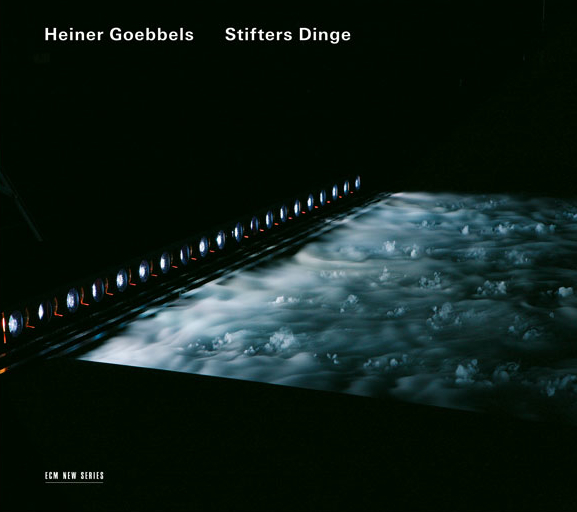
Heiner Goebbels Stifters Dinge Heiner Goebbels conception, direction
Recorded October 20/21, 2007 by Willi Bopp, Grand Théâtre de la Ville de Luxembourg
Edited and mixed July 2010 by Max Federhofer (SWR) and Heiner Goebbels
Executive producer: Manfred Eicher
“Language cannot represent thought, instantly, in its totality; it is bound to arrange it, part by part, in a linear order.”
–Michel Foucault
How can the pen be mightier than the sword when the page is the most hurtful weapon? It is not that the flesh receives the pen, but that the eyes swallow words into the soul, their blades wreaking havoc in a place where dying utterances thrash, unnoticed, for want of lips and tongue. There is something to be felt here, pondered like sun and moon in the same sky, only to slip from grasp, tether to a dream. In that state of half-sleep we are hyper-aware of sounds that make us. We turn them inside out and hold them to our ears, each a vacated conch shell. Were we able to peer into the shadows of those porcelain folds, we might encounter composer Heiner Goebbels tinkering in the deepest crevice, his fingernails clicking like camera shutters at the dawn of time.
Such is the veil that stands between us and Stifters Dinge (Stifter’s Things), the 2007 installation piece that would be enigma were it not for the clarity of its presence. It is many things. It is everything. It is the power of speech turned on its head and spun until it is a single color. The voice of Claude Lévi-Strauss excavates the work’s ethos, at once underscoring and disavowing our need for discovery, the rarity of adventure in a global network mapped and catalogued to every conceivable end. It is also a regression into a past where the truest blanks in our physiological scripts remain. These blanks play host to other notable figures. William S. Burroughs levels his critique of inner fire into social ice. Malcolm X speaks of division, fragmentation of power, splitting of the master’s tools. Goebbels weaves in field recordings from Papua New Guinea, Greece, and Colombia, archives of travel and lost communities, shades of Bach and monoliths. Bobbing along these waves is the constant ghost of one Adalbert Stifter, the eponymous 19th-century Austrian writer who, like Henry David Thoreau, heard nature as the musical amalgam of machine and biome that it is.
The piece is, above all, an experience—Goebbels calls it a “performative installation”—that abets the evolutionary processes it unravels and reties into permeable sculpture. The gentle logic of it all is indeed linguistic. We feel ourselves caught up in its locks and thorns. But the human is hidden, falling into ruin among the crust and residue of progress. It is an irrigation system that draws forth the atmospheres of solids. Drones of screen and sand, of distortion and touch: these are its faces.
The piano looms large, both literally onstage and figuratively as the consummation of the gallantry it burns to ash. As a mouthpiece of elitist spirit, its heft trembles under contact. As a technological pest, it is so impervious that only practice, mastery, and ultimately submission are its effects. It is an artificial ecosystem that somehow becomes parthenogenetic. As the soundtrack to smoke, it enfolds us, settles in with our bacteria. Stifters Dinge, then, is an astonishing concept that fully alerts us to the astonishment of concept.
“Language refuses but one thing,
to make as little noise as silence.”
–Francis Ponge
“Is there such a thing as three-dimensional music?” asks Wolfgang Sandner. In ECM’s audio version of Stifters we have one answer.
The fog (1) flaunts a wave of mystery, given traction by the distant bass beat of a techno house, pulsing like our zeitgeist through avenues of youthful expression, bodily movement, and philosophical naïveté. The salt (2) chips away at our ear canals and offsets the arterial spice trade with the attention of rot hidden in every city’s foundation. The water (3) speaks in drips, opening us to the metronome’s deception. In every deposit we startle a different facet of the same visage. The wind (4) carries sailors’ incantations: sinewy, mineral. A recurring clutch, an audio checkmark spinning us on our axes of interpretation. A prayer for the nameless, for the bodiless, for the motionless. The trees (5) whisper through punctured tires and forest tales. Piano chords rest on the fulcrums of frozen pasture. Anxieties fade, crystalline, into the aching heart of the beast. The thing (6) abrades its hide with strings, in each a keystone of intent that opens its mouth and sings nothing. The rain (7) does not pour but weeps, finding its way through crags, abandoned houses, and blackened farms. It soaks the earth, churning, sneezing diagrams into every root. It is the thunder (8) that falls, unleashing torrents of political rhetoric. The sound (9) emotes from a muffled source, its life written in a phonograph’s needle and spoken through a black-and-white broadcast. The piano kicks like a sleeping dog. And while the storm (10) hails morose arpeggios, it also closes itself to the possibility of air and cracks instead along fault lines that far outdate the means of their articulation. A foot drags through leaves and curls around the coast (11). A blink extends, every lash a piece of driftwood pillared between heaven and earth. A pressure gauge, valve and open throat, thump of a Tell-Tale Heart and tick of an Ingmar Bergman clock. In the exhibition of objects (12), we find that many such curios have fallen through the cracks and gathered at the bottom of this tub, washed down a drain of silence.
“So we have destiny to thank for permitting us to be what we will become to each other.”
–The Brothers Quay, The Piano Tuner of Earthquakes
In light of these evocative possibilities, of which I have sketched hardly the crescent of a thumbnail, I search for concrete language with which to describe that which is coated like so many dusty attics. For this, I go to the source. Mr. Goebbels answers the following questions I posed via e-mail:
1. There is a sense of “opening” in your music that, like a painting, offers a window into its own world. In your mind, where does this opening lead?
To the listener’s imagination.
2. Often in your work, and especially in Stifters Dinge, I feel a sense of unsettling, of things coming apart. And yet, there is still unity. The music, the theatre—it all holds together. How do you balance these two seemingly contradictory aspects? Or are they part of the same sound, image, and word?
I think it’s a sometimes-unconscious contrapuntal (counterpoint) strategy, in the best possible 18th-century sense.
3. How did you approach the CD version versus the museum version? What special characteristics of the CD as a visual and sonic package influence the physical experience of Stifters Dinge?
The CD recording offers a very direct and detailed “view” of the machines and instruments; you can hear things which you will not be able to perceive in the live performance because of visual distraction or spatial distance.
4. Was there anything about Stifters Dinge that surprised you when you experienced the final result?
Yes, everything. I didn’t start this project with a vision. Just with a question: Are the performative installation and music possible without any performer? The answer is the result.
5. On that note, is there a “final” result, or does it always shift and evolve? Does it still surprise you?
What still surprises me is the range of experiences from audiences. These are the actual “center” of the piece.
6. Which elements from your previous work are present in Stifters Dinge? Which elements are new?
There is a strong continuity in all my work regarding the use of acousmatic voices, the use of documentary recordings. What’s new is the heavy, overall machine-like construction.
7. I am so grateful not only to you for creating such visceral and reactive art, but also to Manfred Eicher for believing in it so strongly. Because of him, I have discovered it. Can you briefly discuss how you first met Mr. Eicher and how he has influenced your activities and way of thinking?
I met him for the first time in the late seventies/early eighties in concerts. Since The Man In The Elevator (1987) we’ve had a sort of exclusive partnership based on friendship, with inspiring talks on all art forms, literature, music, film, etc. And during these exchanges he was the one who drew my attention to Francis Ponge’s “The Pine Wood Notebook” (in Ou bien le débarquement désastreux) or to Samuel Beckett’s “Worstward Ho” (in I went to the house but did not enter).
For further answers, I turn to filmmaker Marc Perroud, whose documentary The experience of things, Heiner Goebbels charts the development and realization of Stifters from the turnstiles of the brain to the stages of reality. As Goebbels informs the camera, he sought to eschew the use of actors, to build a “free area” of intensity for the public. For him, composition and stagecraft go hand in hand. “I’m not a visionary or someone who has a clear idea of what he wants to do,” he goes on to say. “I always react strongly to what I see.” The lack of prepared material allowed for merging between technical and artistic processes. The situation created the music.
As one interested in the infinity of theatre, Goebbels sees the art form not as a means of “narrowing vision” but as an “open channel” for fresh experiences. Placing action behind details is his fascination. Communication thrives here in song, in text, in stasis, cracked to reveal the sound that is its blood: “We understand things better when they are placed at a distance and are more aware of their structure when we focus on abstraction.” Stifters ritualizes nature. Land and water become one. Things are not only objects, but are the unfamiliar, a space of curiosity to which Goebbels holds a magnifying glass. The machines speak, he listens.
For a more user-friendly synopsis of Stifters Dinge, visit ECM’s background page.
To watch a trailer of Marc Perroud’s documentary and find ordering information, click here.
Ketil Bjørnstad piano David Darling cello
Recorded June 1996 at Rainbow Studio, Oslo
Engineer: Jan Erik Kongshaug
Produced by Manfred Eicher
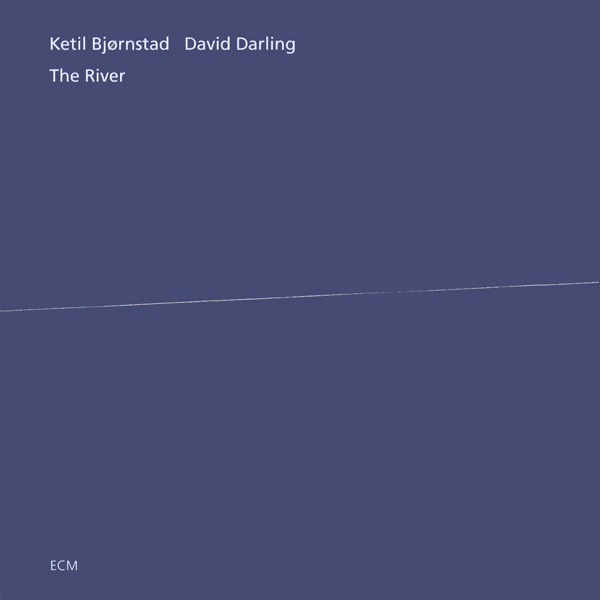
If ever there was a seed beating like a shaded heart in The Sea, it was the twined musical filaments of Ketil Bjørnstad and David Darling. The Norwegian pianist and American cellist spoke on that session like siblings, at points giving us a foretaste of the droning flavors we encounter at the edge of The River. The size and scope of the water have changed in name only, for here is the former’s other half, spreading its finger paint across twelve parallel sections. If we note anything different this time around, it’s that the horizon feels so close that we could just close our eyes and reach out and there would be the sun.
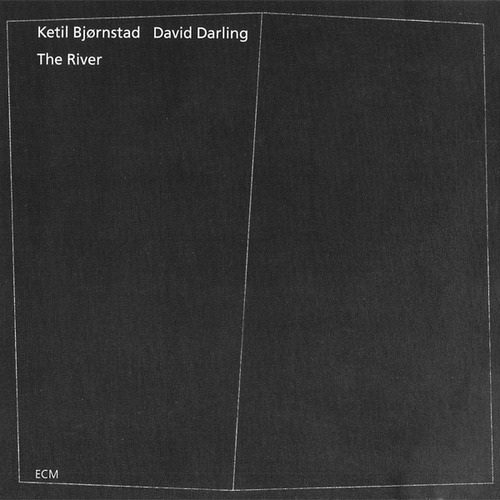
Bjørnstad’s love of aquatic themes stretches an ideal surface tension across which Darling may unfurl his sails. The delicate ostinato of one becomes the leviathan drone of the other, drawing threads through opaque expanse (just as Swiss-born artist Mayo Bucher has placed a white edge through this and select other ECM cover paintings). As cello keens and trembles through a pianistic hall of mirrors, it ladles shadow from the wells of solitude in which we all take shape before birth and to which we also return, lowered in buckets of light. So is The River as much about earth as it is about water, impossible to separate from the glitter of mineral deposits that marks its flow. Darling may paint the air as a salmon through the current, but he is also keenly aware of the sediment kicked up by his journey, of the molecular oneness that binds. Lost to the gazes of two figures crouched at the banks, lowering offering memories to an open fan of moonlight, he swims on.
These are pieces of subtle virtuosity, timbre, and emotional integrity, utterly devoid of self-interest. Their flowering symmetry is a living palindrome of surrender that shuns the pleasures of its philosophies in favor of feeling for its own sake. Though overwhelming at times, there is never a possibility of drowning when water is your air. In this reverie there can be no reveries, for the world is already a dream.
Alternate cover
<< Arvo Pärt: Litany (ECM 1592 NS)
>> Peter Erskine Trio: As It Is (ECM 1594)












 Between Sound and Space: ECM Records and Beyond