AM 4: …and she answered: (ECM 1394)


AM 4
…and she answered:

Wolfgang Puschnig alto saxophone, alto flute, hojak, shakuhachi
Linda Sharrock vocals
Uli Scherer piano, prepared piano, keyboards
Recorded April 1989 at Rainbow Studio, Oslo
Engineer: Jan Erik Kongshaug
Produced by Manfred Eicher

Four years before stepping into the studio to record the Korean crossover project Then Comes The White Tiger alongside the influential SamulNori, saxophonist and flutist Wolgang Puschnig and vocalist Linda Sharrock stepped into ECM’s Rainbow Studio with pianist Uli Scherer as AM 4 for an equally unusual project. Blending poetry and Nordic folk roots with jazz and subtle instrumentation, …and she answered: is as open-ended as the colon of its title. Sharrock captivates wherever she is featured in this project, though perhaps nowhere more so than in the opening “Streets And Rivers” (am I the only one who is reminded of Ani DiFranco’s “Buildings and Bridges”?), which parallels the pathos of life and the literatures through which we seek to divide it. Its synthesizer undercurrent and Jon Hassell-like blips unfurl a pathway for Pushcnig’s breathy alto, both matched by Sharrock’s languorous diction. The following track is as haunting as its title. “And She Answered: ‘When You Return To Me, I will Open Quick The Cage Door, I Will Let The Red Bird Flee’” paints a wide landscape populated with Puschnig’s animal cries. Through these horns a muted piano string drops its heavy footfalls and spins from its wool a yarn of darkness. All of this time in the field, as it were, leaves us open to a wrenching interpretation of Ornette Coleman’s “Lonely Woman.” Here Sharrock is like a catalyst for instrumental change, leaving Puschnig and Scherer to navigate the channels of her words with a cartographer’s exactitude (the two likewise shine in the duo cut “Bhagavad” and in “Far Horizon”). This is one of two standards to creep into the mix, the other being a pointillist rendition of “Over The Rainbow,” which enchants with wisps of the familiar in an otherwise distant wash of flute and echo. Puschnig turns inward with “The Sadness Of Yuki.” The lipped strains of the shakuhachi thread the piano like time itself. We catch only flashes of imagery: a girl’s face, a bleak and oppressive house, an existence destined for ghostly things, as might be spoken through the aphasia of “Oh!” The latter brings the most rhythmic elements to bear on this eclectic set, and speaks to us through the shawm of its gamelan-encrusted interior. All of which leaves us alone with the intoned question in “One T’une,” of which gongs and air are a way of life.

ECM has thankfully made this overlooked release available through digital download, and it bears seeking out for those wanting to step off the label’s beaten path.

<< First House: Cantilena (ECM 1393)
>> Bach: Goldberg Variations – Jarrett (ECM 1395 NS)

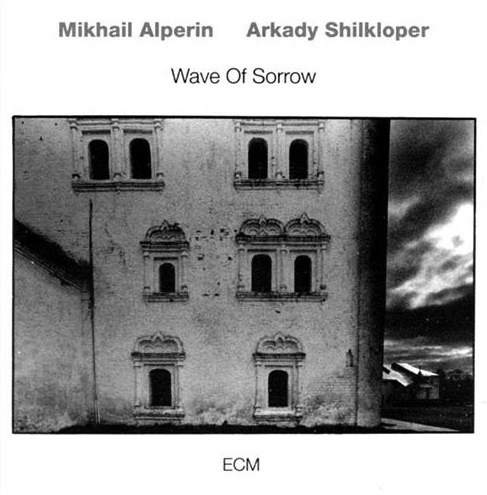
Misha Alperin/Arkady Shilkloper: Wave Of Sorrow (ECM 1396)

Misha Alperin
Arkady Shilkloper
Wave Of Sorrow

Misha Alperin piano, melodica, voice
Arkady Shilkloper French horn, jagdhorn, fluegelhorn, voice
Recorded July 1989 at Rainbow Studio, Oslo
Engineer: Jan Erik Kongshaug
Produced by Manfred Eicher

With Wave Of Sorrow, Misha (then Mikhail) Alperin began what has proven to be a fruitful relationship with ECM. Though the Ukraine-born pianist has but a modest discography on the label, each recording brims with the folklore of his sensitivity. Since this date he has spun a telepathic relationship with trumpeter Arkady Shilkloper, and the results on this duo album are as unique as their players. Alperin offers a set of ten original compositions, each, in spite of the intimate arrangement, a grand and sweeping thing. Not unlike label mate Richie Beirach, his architecture is ambitious in its scope and clarity yet rarely deviates from the warm embrace that births it. One hears this in the opening “Song,” to which Shilkloper adds the bay of a hunting horn. Like many of the pieces that follow, it smacks of tradition even as it shines with modern interpretation. Yet this is also a world of shadows, for in the title piece (one of the most affecting melodica solos you will ever hear) we can intuit a web of tortured histories and only hints of the happiness that may unravel it. Shilkloper arrives toward the end bathed in ECM’s plush reverb, seeming to hang from the tail of Alperin’s breathy comet like a child of the night. Still, this date is not without its fun. “Unisons,” for example, casts the two musicians in a decidedly vocal mold as they rap and tap their way through a cathartic romp. “Poem” similarly allows Shilkloper to come out of his lyrical shell into a full-blown dance. Alperin also offers up a few piano solos, of which “Prelude in Bb minor” is the most evocative—a shaft of moonlight through which the dust of a wanderer’s journey casts its sparkle. Other highlights include the simple yet ingenious motivic arcs of “Short Story” and Shilkloper’s distant mutes in “Miniature.”

The contradiction of the album’s title is that so much of the music springs to its feet, all the while harboring a matrix of oppression and exile. We hear this especially in the solo “Epilogue.” The atmosphere is dim yet also sparkling, as if it were a harsh present slumbering behind the illusory veil of a memory, fond and forever lost.

<< Bach: Goldberg Variations – Jarrett (ECM 1395 NS)
>> Shankar: nobody told me (ECM 1397)

First House: Cantilena (ECM 1393)

First House
Cantilena

Ken Stubbs alto saxophone
Django Bates piano, tenor horn
Mick Hutton bass
Martin France drums
Recorded March 1989 at Rainbow Studio, Oslo
Engineer: Jan Erik Kongshaug
Produced by Manfred Eicher

After a memorable ECM debut with Eréndira, the talented quartet of saxophonist Ken Stubbs, pianist Django Bates, bassist Mike Hutton, and drummer Martin France—a.k.a. First House—followed up with an even more effective chunk of progressive jazz in Cantilena. From the first soulful licks of the title opener, we know we are in for something special and from the heart. The composer’s alto draws us into the night with recumbent charm, thereby opening an ambitious set that delivers everything it promises and more. Like a model posing for a painting, its contours come into representational being only through an artist’s touch. This leads us into the connective tissue of the piano, which seems to blossom, lured by the alto’s return to a place where dreams can be made real. From this we are introduced to the writing of Bates, of whose “Underfelt” the theme is anything but as it sneaks its way through a burrow of circular motives. Stubbs shells out some incredible improvisation here, working his way far beyond the corners of the page. The Bates train continues on through the whimsies of “Dimple,” for which he clashes horns with alto against exemplary and jaunty support from Hutton and France. More of the same energy awaits us the sprightly abstractions of “Low-Down (Toytown),” to which the rubato slice of blues that is “Sweet Williams” (Bates) is indeed a sweet preamble, while the urban sprawl of “Jay-Tee” features the date’s most spirited soloing from our two lead melodicians. The Bates sector rounds out with the vastly energizing “Hollyhocks,” which features rolling harmonies in the pianism and a spate of resplendent energy that grabs us hook, line, and sinker into the contemplative yet all-too-brief tenderness of Eddie Parker’s “Madeleine After Prayer” (the only non-group tune on the record), which is spun through “Shining Brightly” into a horizon backlit by hope. Once again the alto hollows out our bones and fills them with the marrow of sentiment. Some tracings from Bates initiate “Pablo,” thus ending the album where it began: in a dream where music is the only language that remains.


Original cover

Of the many strengths First House possesses, it is the compositional prowess within that shines above the rest. The group’s robust musical ideas have immense staying power, and in combination with such a smooth blend of the forward-thinking and the classic, one would be as foolish as Oliver to ask for more in a jazz outfit.

<< Keith Jarrett Trio: Changeless (ECM 1392)
>> AM 4: …and she answered: (ECM 1394)

Abercrombie/Johnson/Erskine: s/t (ECM 1390)


John Abercrombie
Marc Johnson
Peter Erskine
s/t

John Abercrombie guitar, guitar synthesizer
Marc Johnson bass
Peter Erskine drums
Recorded April 21, 1988 live at the Nightstage, Boston
Engineer: Tony Romano
Produced by Manfred Eicher

After the resounding success of their two studio albums, Current Events and Getting There (with Michael Brecker), guitarist John Abercrombie teamed up with bassist Marc Johnson and drummer Peter Erskine for this wondrous live 1988 recording from the Nightstage in Boston. It’s crystal clear from the groove laid down by Johnson and Erskine in the opener, “Furs On Ice” (think Getting There), that each of these men travels the edges of a constantly shifting yet with-it triangle. Abercrombie spins some Frisell-like chording before emerging with a soaring synclavier line in this, one of two Johnson-penned tunes, the other being a trimmed-down version of his “Samurai Hee-Haw” (see Bass Desires). Replacing Bill Frisell and John Scofield is no small order, yet Abercrombie fills these shoes with plenty of funk to spare. That unmistakable bass line, in fact, courts some of the most electrifying improv heard in a while from Abercrombie, who brings a Hammond organist’s sensibility to the proceedings via his fiery macramé. Erskine is also fantastic here. Abercrombie turns up the heat even more on his own two contributions. “Light Beam” is a particularly well-suited vehicle for synth guitar, and indeed seems focused like a laser splashed through the prism of his rhythm section. This is followed by a drum solo from Erskine, who shows us a nifty thing or two from his skill set, particularly in his dialoguing between bass drum and toms, before Abercrombie’s classic “Four On One” (from his seminal 1984 joint, Night) plies its musings and rounded edges with the record’s crunchiest playing. The three continue to converse beautifully in their group improv piece, “Innerplay.” Notable for Johnson’s delightful string games, it is a lasting testament to the powers of spontaneity.

The rest of the set is filled to bursting with a hefty portion of standards. Between Erskine’s delicate rat-a-tat timekeeping in “Stella By Starlight” and the delicacies of “Alice In Wonderland” (into which the rhythm section eases so carefully one feels more than hears it), there is much to stimulate repeated listening. Yet it is in “Beautiful Love” that we find the pot of gold at the end of this rainbow. From the gentlest guitar solo Abercrombie spins a song even as he unravels it into a water-skating journey so gorgeous it almost weeps. The trio’s finest moment and easily one of Abercrombie’s most inspired (and inspiring) improvisatory passages on record. The final “Haunted Heart” almost reaches those same depths, smoothing out an extended guitar intro into a velvety soft ballad that stirs us into a pool of melting chocolate and lets us steep.

A sublime recording from musicians at the top of their game, for a game this most certainly is, played by those who know the rules as well as anyone.

<< Terje Rypdal: Undisonus (ECM 1389)
>> Thomas Demenga: Bach/Carter (ECM 1391 NS)

Egberto Gismonti: Dança dos Escravos (ECM 1387)

Egberto Gismonti
Dança dos Escravos

Egberto Gismonti guitars
Recorded November 1988 at Rainbow Studio, Oslo
Engineer: Jan Erik Kongshaug
Produced by Manfred Eicher

When I first heard Egberto Gismonti’s Dança dos Escravos (Dance of the Slaves) it had been months since I’d listened to the Brazilian master, and the feeling of being wrapped in his brilliant passion again was a joy to say the least, for in his comforting embrace I can always find more than a gesture to relate to. Although he is an adept multi-instrumentalist, I’ve always felt that Gismonti excels alone at the guitar, and you will not likely find a purer distillation of his art than this. The 15-minute title track constitutes the album’s lungs, through which Gismonti respires in concise autobiographical detail. Upon waking, it hits the ground running, flipping space as if through the pages of a well-weathered book into which a photographic record has been pasted. The glue becomes brittle and flakes the farther one goes back, and though images have loosened their grip on the past Gismonti rescues them with every unexpected turn in his playing. There are moments when he seems to time-travel, his fingers working independently yet with an orchestral unity so personal that even when he adds a 12-string it seems but an extension of the same instrument.

“Dança dos Escravos” bears the subtitle “black,” and Gismonti has accordingly designated every track its own color. Red is represented by the enthralling opener, “2 Violões.” From jubilant to regretful, he cycles through a youth’s worth of faded dreams and unrequited loves. It is one of his best and in it we find the intimacies of his craft overflowing in full disclosure. Moving on to blue in “Lundu,” he plows through a cycle so engaging that he cannot help but let out an mm of ecstatic communion with his instrument. That same voice comes out more intentionally in the green (“Trenzinho do Caipira”) and in the white (“Salvador”), uncovering in both the playful spirit that lurks in the interstices of his memories. It is as if he were standing on the center of a seesaw, at one end of which is the weight of the future and at the other sits the child-self thereof. Gismonti pares his abstractions to their hearts, working them into the traditional yellow ornaments of “Alegrinho.” Here he shares a fleeting portrait of the streets (and of the trees not so far away). We encounter open markets and the patter of boys’ feet between stalls as they snatch fruits and life experience from the tables.

There is something indescribably authentic (whatever currency that word may have nowadays) about Gismonti’s music. Listen, for instance, to the burnished brown of “Memoria e Fado” and hear within it a thousand voices, each having fed into this one musical utterance and of which said utterance will one day become a part of the growing chorus to inspire those in the future. It is through this music that one steps outside into the night, looks up at the stars, and thinks not confoundedly, but rather forgoes philosophy, content in knowing that its mysteries are life itself. These are shadows made bright again.

<< Paul Giger: Chartres (ECM 1386 NS)
>> Ralph Towner: City Of Eyes (ECM 1388)

Terje Rypdal: The Singles Collection (ECM 1383)

Terje Rypdal
The Singles Collection

Terje Rypdal guitar
Allan Dangerfield keyboards, synclavier
Bjørn Kjellemyr bass
Audun Kleive drums
Recorded August 1988 at Rainbow Studio, Oslo
Engineer: Jan Erik Kongshaug
Produced by Manfred Eicher

Long before ECM released its first remix album (for Nils Petter Molvær’s Khmer), it put out this, its first singles collection. Or so it’s nice to think: the title actually has nothing to do with the content. For their third album, Terje Rypdal & the Chasers instead spit out one of the most transcendent rock albums this side of the Milky Way. So much of that transcendence lies in the bandleader’s characteristic sere. When spurred on by the keyboard stylings of Allan Dangerfield and Audun Kleive’s clear-and-present drumming, he simply can’t go wrong. Yet what truly impresses me about this record is the playing of bassist Bjørn Kjellemyr. His sound, depth, and prowess are flat-out inspiring and constitute the red thread running through this set of 10 blistering cuts. His tight spirals in “Sprøtt” (Crazy), for example, rev up the action into the stratosphere, where Rypdal tills vast climates of thematic information over a nostalgic 80s beat and a Hammond organ so intense it’s almost vitriolic. “Coyote” is another Kjellemyr showcase. Along with the worldly percussion, his thrumming heart animates this track with Steve Tibbett-like expansiveness. The bassist isn’t all winces and head-nods, however, for in “Mystery Man” we find a fat slice of noir gilded in weeping tenderness. Still, he does wind a fuse that Rypdal follows into the passage of “The Last Hero,” lighting it into a hard-edged jam. Not to be outdone, of course, Rypdal cracks his whip with enough force to send us into the next county. The drum- and bass-heavy “U.’N.I.,” for one, is the perfect foil for his ring of fire, and in “Steady” he rides a rollercoaster whose tracks are marked by chromatic footfalls and skipping drums. He also excels in the slower numbers. From the twinkling synths of “Strange Behaviour” and on through the pentatonic infusions of “Somehow, Somewhere” to the final “Crooner Song,” he keens across the airwaves with the conviction of one who knows his emotions fairly and squarely. His provocatively titled opener, “There Is A Hot Lady In My Bedroom And I Need A Drink,” pretty much says it all, for here is a guitarist with a thousand stories to tell. With a powerful sense of development and musical architecture, his tunes are like landscapes razed and re-gentrified with every lick.

If you want to know Rypdal’s strengths as composer, you need look no further than Descendre, but for those who also want to experience the rawness of his talents on the axe, this one’s for you. Prepare to rock out.

<< Keith Jarrett: Personal Mountains (ECM 1382)
>> Stephan Micus: The Music Of Stones (ECM 1384)

Dave Holland Trio: Triplicate (ECM 1373)

Dave Holland Trio
Triplicate

Dave Holland bass
Steve Coleman alto saxophone
Jack DeJohnette drums
Recorded March 1988 at Power Station, New York
Engineer: James Farber
Produced by Lee Townsend

Triplicate is a fantastic (surprise, surprise) trio album that joins bassist Dave Holland with altoist Steve Coleman and rhythmatist Jack DeJohnette. This date’s quintessential opener, “Games,” comes from Coleman’s pen and showcases Holland’s love of play. The man with the upright plan is light on his feet here, DeJohnette even more so, while Coleman brings a chocolaty sound to his playing. Holland gives us his first of four compositions in “Quiet Fire,” which might as well fall under Coleman’s job description, such is the warming depth he elicits. In the wake of these tender considerations, Duke Ellington’s “Take The Coltrane” brings a different fire, this one whipped like cream into soft peaks. Coleman injects a classic energy into this tune, so vivid that we must readjust to Holland, who solos in a relatively quiet space. DeJohnette, on the other hand, kicks up the dust to match. With “Rivers Run” we’re back on the Holland track as he opens with a solo before that soulful alto breathes its magic into the air. Holland settles on a groovy line, picked up by DeJohnette’s cymbals and snared into an engaging roll. What seems a short and sweet ending then segues into a solo from the drummer, thereby inspiring the most spirited playing on the album from his bandmates. After a delicate rendition of “Four Winds,” we transition into Holland’s “Triple Dance.” Coleman winds fluently here, while Holland unseals a fantastic solo of his own. The trio take things down a few notches during DeJohnette’s “Blue,” regaling us with a smooth and tattered tale in which Holland’s understated brilliance shows us once again that he can lie low just as well as he can swing. Coleman likewise reveals the depths of his soul, and continues to do so amid the delicacies of the traditional “African Lullaby,” our final coddling before Charlie Parker’s “Segment” throws us back in the loop for an ecstatic close.

Triplicate is not an in-your-face album but one wrought with careful language. It avoids the danger of expletives in search of a clean melodic line. One imagines that if this album were alive, the audience would be whooping and clapping all the same, but in the studio a certain cleanliness of sound wins over. This has its pros and cons, depending on your preferences, but either way we can step outside of this record knowing we’ve just experienced something joyous.

<< Alex Cline: The Lamp And The Star (ECM 1372)
>> Eberhard Weber: Orchestra (ECM 1374)

Alex Cline: The Lamp And The Star (ECM 1372)

Alex Cline
The Lamp And The Star

Aina Kemanis voice
Jeff Gauthier violin, viola, voice
Hank Roberts cello, voice
Wayne Peet piano, organ
Eric von Essen bass
Alex Cline percussion, voice
Nels Cline voice
Susan Rawcliffe didgeridoo
Recorded September 1987 at Mad Hatter Studio, Los Angeles
Engineer: Geoff Sykes
Produced by Nels Cline and Alex Cline

The Lamp And The Star was the first recording for American drummer Alex Cline as bandleader. At the core of this session is his Quartet Music group, which included twin brother and guitarist Nels, violinist Jeff Gauthier, and bassist Eric von Essen. Joining this already verdant nexus is vocalist Aina Kemanis (whose precise colors had already enhanced past ECM sessions with Barre Phillips and Adelhard Roidinger), pianist Wayne Peet, and cellist Hank Roberts (who added so much to Bill Frisell’s Lookout For Hope). The resulting offering is something just outside the purview of jazz and sits more comfortably under the rubric of chamber suite. This is clear from the prayerful chime that unfolds silence into “A Blue Robe In The Distance.” Like the bell worn around Mona’s neck in Lars von Trier’s The Kingdom, it floats along shores where life and death comingle. This gives way to subterranean soundings from percussion gilded by stalactites. These drip with age and recognize only the language of gravity. We hear the creaking of some vast gate opening out onto a war-torn land where tolls the emptiness of action gone still. A procession of cellos. Darkened veils obscure any intimation of earthly care even as their feet squish into the soil with every step. Their voices intone the litany of an ancient era. Kemanis matches their pace. Is she aware of the blue robe, we wonder. Is she the holder of that bell? She rains drizzle on the thirsty land. Peet’s pianism, meanwhile, curls one key only like a finger at the edge of rhythm. String and voice become inseparable. Do not be mistaken: this is not an exercise in morbidity, for there is something duly thriving and present about the configuration and its intermingling of sound, as if each instrument were its own language vying to be heard and translated across the open plains all share. Thus does Kemanis eschew words, choosing instead to spread her garments and catch the wind while delicate keys buoy her cause. She drinks in every invisible radio wave that inhabits her airspace, breathing out a single bow drawn across gut and wire. The last high note from Gauthier leaves us still, closing its eyes around the dream of “Eminence.” More percussion bubbles from the magma of which the strings are but a melodic fantasy, seeming to spread their delicate hands across a throated vista. The vibration of vocal folds is like an earthquake slowed into discernible pathos. Drums return, flirting with the water’s surface, if not dropping rocks through it, as strings and cymbals bring their delicacy to an organ’s slow-motion undertow. After a vocal line threads the needle of our attention into “Emerald Light,” it recedes for a foregrounding of piano and bass, heard through pellucid veils of strings. They catch the last rays of sunset in a cupped hand of water, sparkling with the memories of a space where love was once born. Bowed gongs touch the mountainous horizon with aurora light in “Altar Stone.” This opens into a tundra where drums hit the ground running with a chain of social conflicts and accords alike in tow and ending in that same private space where the borealis smiles across the sky: a Cheshire cat who needs no longer appear to be known. With the offering thus laid, “Accepting The Chalice” turns inward with piano and cello before the latter gives way to Kemanis, whose strains jump the cliffs amid ocean waves crashing below into hydrated ribbons of reflection.

One of ECM’s most beautiful enigmas.

<< Markus Stockhausen: Cosi Lontano … Quasi Dentro (ECM 1371)
>> Dave Holland Trio: Triplicate (ECM 1373)

Keith Jarrett Trio: Still Live (ECM 1360/61)

Keith Jarrett Trio
Still Live

Keith Jarrett piano
Gary Peacock bass
Jack DeJohnette drums
Recorded live, July 13, 1986 at Philharmonic Hall, Munich
Engineer: Martin Wieland
Produced by Manfred Eicher

Mentioning the Keith Jarrett Trio and virtuosity in the same sentence is like breathing out after breathing in. That being said, none of said virtuosity would mean very much without the potent skeletons around which Jarrett, Gary Peacock, and Jack DeJohnette string their veins and flesh. This particular trio has always laid its performances at the altar of melody, the music’s A to Z, and the respect shows in every moment.

“My Funny Valentine” opens this 1986 date from Munich, where a crowd had the great fortune (let’s get this straight right away) of witnessing one of the finest trio sets in history. Jarrett’s unmistakable intro plows a field of harmonic possibility and hauls its crop through the dazzle of DeJohnette’s peripheral tracings. Jarrett sings with the ecstatic pain of his exposition, unfolding a chip carving of interlocking geometries. A change of angle from an unnamable light source imparts soloed secrets. Another brings us back into the fold of those solemn keys, each a window into another full instrument. In the sprightly rendition of “Autumn Leaves” that follows, Peacock regales like a bird loosed from its thematic cage, spurred ever onward by a crisp snare. DeJohnette and Jarrett share an interplay that most of us could hardly dream of, feeding off each other’s fire around the wick of that perpetual bass. In fact, the more I listen to this trio, the more I go starry-eyed over Peacock. I feel it especially in “When I Fall In Love.” Burnished to perfection by DeJohnette’s brushes, this ballad also finds Jarrett winding just the right amount of tension to make it sing. Which brings us to “The Song Is You.” Jarrett speaks more carefully here, pausing for reflection and putting intelligent expectorations into every new cluster, acting the lit match to DeJohnette’s fireworks. He cuts out amid a dissipation of applause, allowing the rhythm section to tip the scales in its favor, though Jarrett’s return does bring this pot to a raging boil. DeJohnette’s occasional snare hit here is one of the more magical touches of the show.

The second disc begins with a chromatically infused introduction into the smoothness of “Come Rain Or Come Shine.” Peacock takes an early lead, dancing on air into Jarrett’s highflying banks and turns. Things take another slow turn in the Gurdjieff-like “Late Lament.” After an elegiac intro, DeJohnette wipes away the dust of time with his brushes to expose a familiar tale in which Peacock’s soulful and maple-grained steps dance their way into our hearts. Jarrett outdoes himself in “You And The Night And The Music,” which kicks off a 19-minute medley that is an album in and of itself and proves that, for all their sensitivity, DeJohnette and Peacock can swing hard. Jarrett is content in playing string games in the ether for a while before sliding down to earth on a monochromatic rainbow into lush fields of twilight. DeJohnette pulls some microscopic trickery on cymbals as a monotone left hand keeps us in suspension before unfolding “Someday My Prince Will Come.” One of the most remarkable transitions on jazz record. Peacock wraps this sonic present with a florid bow, while Jarrett takes this tune to fresh heights of syncopation. Next, “Billie’s Bounce” achieves an eerie balance of airiness and forward drive and highlights the man with the sticks, popping as many kernels as he can over the open fire of his kit. Last but not least is “I Remember Clifford,” which like a master’s sketch conveys all that it needs to with the merest strokes, slow and sure.

Peacock and DeJohnette are instinctively attuned to every interstice of Jarrett’s architecture. Their unity has arguably never meshed so closely as it does here. It seems impossible that this trio could have ever hit a single wrong note, and one finds nothing but perfection at every turn throughout Still Live. It is, in fact, one of the most magical live recordings in ECM’s annals, both in terms of content and technicality. Jarrett and company know just how to let loose without ever breaking seams. It is this holding together that keeps us wanting more. The Keith Jarrett Trio exemplifies the pinnacle of the art by living the art of the pinnacle.

<< Rabih Abou-Khalil: Nafas (ECM 1359)
>> Bach: Das Wohltemperierte Klavier, Buch I – Jarrett (ECM 1362/63 NS)