Jan Garbarek: I Took Up The Runes (ECM 1419)

Jan Garbarek
I Took Up The Runes

Jan Garbarek soprano and tenor saxophones
Rainer Brüninghaus piano
Eberhard Weber bass
Nana Vasconcelos percussion
Manu Katché drums
Bugge Wesseltoft synthesizer
Ingor Ántte Áilu Gaup voice
Recorded August 1990 at Rainbow Studio, Oslo
Engineer: Jan Erik Kongshaug
Produced by Manfred Eicher

By 1990, Jan Garbarek had for decades been searching for that one key, navigating a landscape of peaks and valleys, only to find it slumbering within the runes which, with this album, he eponymously took up. A snaking version of Mari Boine Persen’s “Gula Gula” outlines the album’s perfectly proportioned ritual space for a sound that has come to define the Norwegian saxophonist’s output since. With Runes his tone had achieved a luminescence that fell like liquid onto the keyboard of Rainer Brüninghaus.

Balancing note and movement, Garbarek hones something truly special in the five-part “Molde Canticle,” which draws out the album’s deepest anatomies. Above all, the piece is about time. It speaks in a language that moves us. The gyroscopic quality of Part 2 hums around the centrifugal force of Garbarek’s lyricism as he scales ever higher. Part 3 features a singsong solo from bassist Eberhard Weber, who elicits bird-like harmonics from the soft glide of his bow. These enchantments are but a prelude to a round of wind and pianistic musings. Part 4 is a more rhythmic showcase (percussionist Nana Vasconcelos’s influence is also clear on tracks like “Buena Hora, Buenos Vientos”), and features some heavy blowing from Garbarek, at once whimsical and weighty, while Part 5 finds him weaving a simple wave over a harp-like ostinato.

These melodies all have the makings of folk songs (sometimes the other way around, as in “His Eyes Were Suns”), so vivid is each in its evocation of peoples and traditions. The title track is a more groove-oriented spectacle and finds Garbarek freeing himself even further. This leaves only “Rahkki Sruvvis,” another chanting piece with some overdubbed saxes for a final skyward glance.

Many have criticized Garbarek for going soft. I Took Up The Runes proves that he has simply channeled that dynamic energy through different rivulets of intensity. Like smoke, they need fire to soar, but fire in its natural state requires time and care to catch.

A masterpiece.

<< John Surman: Road To Saint Ives (ECM 1418)
>> Keith Jarrett Trio: Tribute (ECM 1420/21)
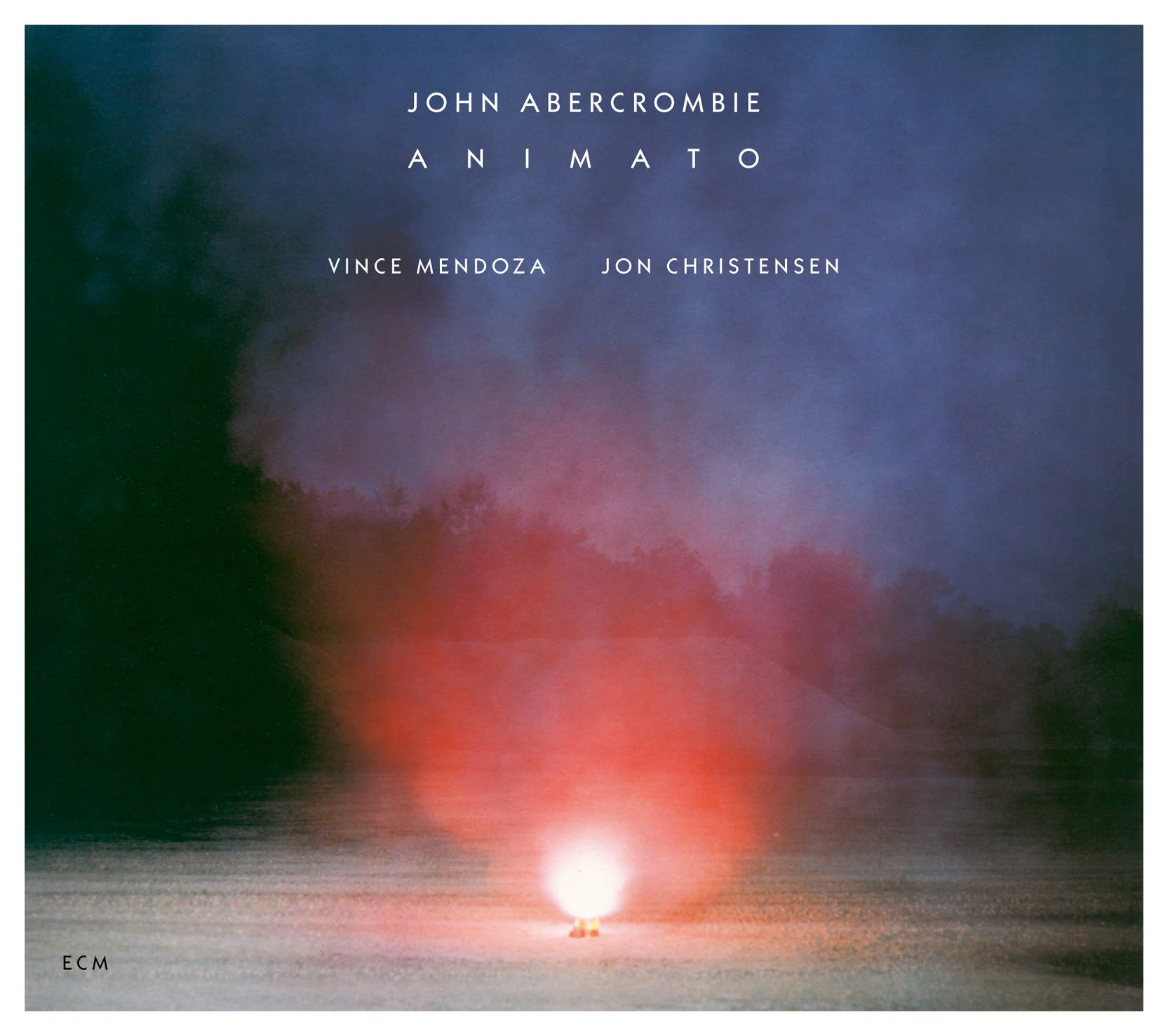
John Abercrombie: Animato (ECM 1411)

John Abercrombie
Animato

John Abercrombie guitar, guitar synthesizer
Jon Christensen drums, percussion
Vince Mendoza synthesizers
Recorded October 1989 at Rainbow Studio, Oslo
Engineer: Jan Erik Kongshaug
Produced by Manfred Eicher

Despite the fact of John Abercrombie headlining this curious little album called Animato, the finished product is a real showcase for drummer Jon Christensen and synthesizer virtuoso Vince Mendoza. The latter, who wrote the bulk of the album’s music (the only exceptions being the group improv that begins the set and the Jon Hassell-esque strains of Abercrombie’s “Bright Reign”), fleshes out some of the strokes Abercrombie was already beginning to paint with his synth augmentations in years past. Still, the guitarist is a major melodic force on this date. Where “Right Now” rises from the depths with the torch in his hands, swirling around a fiery center, self-contained yet extroverted, “Single Moon” floats his tenderness over a bass of electronic goodness. Like a skilled R&B singer, he plumbs the ballad to new depths, each new stratum accentuated by the warmth and timeless energy of Mendoza’s tasteful atmospheres. In this vein, the sequencer qualities of “Agitato” make for a bed of ashes from which the guitar rises like a phoenix and duets with drums in powerful conversation amid gorgeous synth lines and a classically inflected refrain. After the swelling interlude of “First Light” we come into the bubbling abstractions of “Last Light,” in which Abercrombie dances like fire on water. The darkly anthemic “For Hope Of Hope” is an audible mirage throughout which Christensen proves a fantastic painter of colors, even as Mendoza deepens them in a continuous pall of time and narrative experience. We end with a lullaby in “Ollie Mention.” This is perhaps Abercrombie at his most sensitive yet somehow spirited as he tumbles over comforting waves into the final recession of the tide.

The inclusion of Mendoza on this album was a stroke of genius. On the one hand he is an extension of what Abercrombie already implies, while on the other he emotes with such distinctness that one feels the session pushed to new territories with every touch. Together these musicians bring a storyteller’s art to wordless songs, hollowing a vein of shadow through which the blood of dreams runs bright.

<< Dave Holland Quartet: Extensions (ECM 1410)
>> Walter Fähndrich: Viola (ECM 1412 NS)

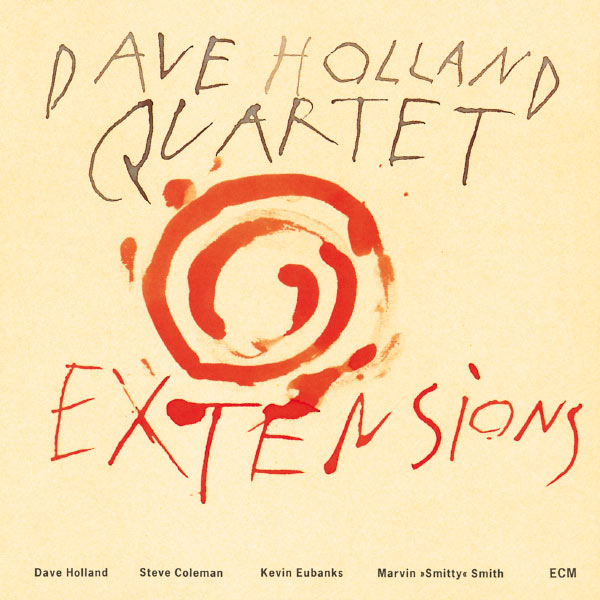
Dave Holland Quartet: Extensions (ECM 1410)


Dave Holland Quartet
Extensions

Dave Holland bass
Steve Coleman alto saxophone
Kevin Eubanks guitar
Marvin “Smitty” Smith drums
Recorded September 1989, Power Station, New York
Engineer: James Farber
Produced by Manfred Eicher

If you’re like me, then you’re most familiar with this album’s rhythm section from The Tonight Show with Jay Leno. From 1995 to 2006, guitarist Kevin Eubanks and drummer Marvin “Smitty” Smith were the anchors for said program’s house band. I always knew that Eubanks was a talented musician but felt that his insights were often lost in the muddled acoustics of the NBC studio in which they were situated. These conditions also boded ill, in most cases, for the show’s musical acts. In addition, for the most part Eubanks had his distortion turned high in order to achieve a certain brand of punctuation in his bantering with Leno, but I sometimes noticed that when returning from a commercial break he would be finishing a smooth jazz number, the brilliance of which I could only guess at. It wasn’t until I heard Extensions that I realized just how deep that brilliance goes.

Eubanks astounds at every turn of Extensions. Having penned the opening and closing tracks, he has the first and last word on things and brings to the in-between a certain majesty to the scope of his improvisatory paths. His “Nemesis” starts things off just right, giving way from barely plucked stirrings to the controlled vigor of altoist Steve Coleman’s left side drive. Not to be outdone, of course, are Smith and the album’s leader (though you wouldn’t know it from Holland’s many gracious nods to these younger trailblazers), whose interactions give Coleman just the lift he needs to soar with a blistering yet somehow nonabrasive sound. A toffee crisp solo from Eubanks paints here in leaps and somersaults, each a tight circle of deftly contained energy.

Holland himself gives us two tracks, of which “Processional” is the most sumptuous. This arid groove finds the bassist stepping lightly, making way for a starlit solo from Eubanks. Holland opens “The Oracle” with a line so delicate, it almost sounds like a classical guitar. The subtlety of Smith’s stylings at the kit and Eubanks’s bird-like calls work themselves through the curling plumes of windswept dunes, leaving a sonorous trail of footsteps that is redrawn as quickly as it is buried. This nearly 15-minute cut is the highlight of the album and should make a Eubanks believer out of anyone. Holland’s almost spiritually minded solo, detailed like a prayer, still conveys an unparalleled wanderlust before Coleman draws a trail of fire into the refrain. His two tunes, “Black Hole” and “101° Fahrenheit (Slow Meltdown),” are respectively funky and sultry, the latter unveiling fan-chopped smoke and alleys littered with wasted opportunities, singing of a time when one could forget them all in an amber bottle.

The closer, “Color Of Mind,” sports one of Holland’s catchiest bass lines and another astonishing dialogue from Eubanks. It also gives us some downtime with Holland along with Smith, who turns up the heat a notch or two into a sparkling close.

This album is a coming of age in an age of becoming. If ECM’s Touchstones series, of which this is a part, had its own Touchstones, this would be one of them.

<< Berlin Contemporary Jazz Orchestra: s/t (ECM 1409)
>> John Abercrombie: Animato (ECM 1411)

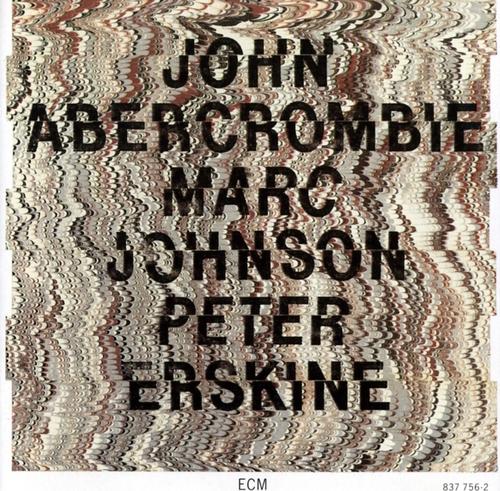
Abercrombie/Johnson/Erskine: s/t (ECM 1390)


John Abercrombie
Marc Johnson
Peter Erskine
s/t

John Abercrombie guitar, guitar synthesizer
Marc Johnson bass
Peter Erskine drums
Recorded April 21, 1988 live at the Nightstage, Boston
Engineer: Tony Romano
Produced by Manfred Eicher

After the resounding success of their two studio albums, Current Events and Getting There (with Michael Brecker), guitarist John Abercrombie teamed up with bassist Marc Johnson and drummer Peter Erskine for this wondrous live 1988 recording from the Nightstage in Boston. It’s crystal clear from the groove laid down by Johnson and Erskine in the opener, “Furs On Ice” (think Getting There), that each of these men travels the edges of a constantly shifting yet with-it triangle. Abercrombie spins some Frisell-like chording before emerging with a soaring synclavier line in this, one of two Johnson-penned tunes, the other being a trimmed-down version of his “Samurai Hee-Haw” (see Bass Desires). Replacing Bill Frisell and John Scofield is no small order, yet Abercrombie fills these shoes with plenty of funk to spare. That unmistakable bass line, in fact, courts some of the most electrifying improv heard in a while from Abercrombie, who brings a Hammond organist’s sensibility to the proceedings via his fiery macramé. Erskine is also fantastic here. Abercrombie turns up the heat even more on his own two contributions. “Light Beam” is a particularly well-suited vehicle for synth guitar, and indeed seems focused like a laser splashed through the prism of his rhythm section. This is followed by a drum solo from Erskine, who shows us a nifty thing or two from his skill set, particularly in his dialoguing between bass drum and toms, before Abercrombie’s classic “Four On One” (from his seminal 1984 joint, Night) plies its musings and rounded edges with the record’s crunchiest playing. The three continue to converse beautifully in their group improv piece, “Innerplay.” Notable for Johnson’s delightful string games, it is a lasting testament to the powers of spontaneity.

The rest of the set is filled to bursting with a hefty portion of standards. Between Erskine’s delicate rat-a-tat timekeeping in “Stella By Starlight” and the delicacies of “Alice In Wonderland” (into which the rhythm section eases so carefully one feels more than hears it), there is much to stimulate repeated listening. Yet it is in “Beautiful Love” that we find the pot of gold at the end of this rainbow. From the gentlest guitar solo Abercrombie spins a song even as he unravels it into a water-skating journey so gorgeous it almost weeps. The trio’s finest moment and easily one of Abercrombie’s most inspired (and inspiring) improvisatory passages on record. The final “Haunted Heart” almost reaches those same depths, smoothing out an extended guitar intro into a velvety soft ballad that stirs us into a pool of melting chocolate and lets us steep.

A sublime recording from musicians at the top of their game, for a game this most certainly is, played by those who know the rules as well as anyone.

<< Terje Rypdal: Undisonus (ECM 1389)
>> Thomas Demenga: Bach/Carter (ECM 1391 NS)

Dave Holland Trio: Triplicate (ECM 1373)

Dave Holland Trio
Triplicate

Dave Holland bass
Steve Coleman alto saxophone
Jack DeJohnette drums
Recorded March 1988 at Power Station, New York
Engineer: James Farber
Produced by Lee Townsend

Triplicate is a fantastic (surprise, surprise) trio album that joins bassist Dave Holland with altoist Steve Coleman and rhythmatist Jack DeJohnette. This date’s quintessential opener, “Games,” comes from Coleman’s pen and showcases Holland’s love of play. The man with the upright plan is light on his feet here, DeJohnette even more so, while Coleman brings a chocolaty sound to his playing. Holland gives us his first of four compositions in “Quiet Fire,” which might as well fall under Coleman’s job description, such is the warming depth he elicits. In the wake of these tender considerations, Duke Ellington’s “Take The Coltrane” brings a different fire, this one whipped like cream into soft peaks. Coleman injects a classic energy into this tune, so vivid that we must readjust to Holland, who solos in a relatively quiet space. DeJohnette, on the other hand, kicks up the dust to match. With “Rivers Run” we’re back on the Holland track as he opens with a solo before that soulful alto breathes its magic into the air. Holland settles on a groovy line, picked up by DeJohnette’s cymbals and snared into an engaging roll. What seems a short and sweet ending then segues into a solo from the drummer, thereby inspiring the most spirited playing on the album from his bandmates. After a delicate rendition of “Four Winds,” we transition into Holland’s “Triple Dance.” Coleman winds fluently here, while Holland unseals a fantastic solo of his own. The trio take things down a few notches during DeJohnette’s “Blue,” regaling us with a smooth and tattered tale in which Holland’s understated brilliance shows us once again that he can lie low just as well as he can swing. Coleman likewise reveals the depths of his soul, and continues to do so amid the delicacies of the traditional “African Lullaby,” our final coddling before Charlie Parker’s “Segment” throws us back in the loop for an ecstatic close.

Triplicate is not an in-your-face album but one wrought with careful language. It avoids the danger of expletives in search of a clean melodic line. One imagines that if this album were alive, the audience would be whooping and clapping all the same, but in the studio a certain cleanliness of sound wins over. This has its pros and cons, depending on your preferences, but either way we can step outside of this record knowing we’ve just experienced something joyous.

<< Alex Cline: The Lamp And The Star (ECM 1372)
>> Eberhard Weber: Orchestra (ECM 1374)

Marc Johnson’s Bass Desires: Second Sight (ECM 1351)


Marc Johnson
Second Sight

Marc Johnson bass
Bill Frisell guitar
John Scofield guitar
Peter Erskine drums
Recorded March 1987 at Rainbow Studio, Oslo
Engineer: Jan Erik Kongshaug
Produced by Manfred Eicher

This sophomore effort from Marc Johnson’s Bass Desires comes nowhere near the octane levels of the project’s wild self-titled debut. This doesn’t mean, however, that Second Sight is no less enthralling. Its strength lies in its personnel. Guitarists Bill Frisell and John Scofield seem so well made for each other that, were they not split between the left and right channels, respectively, they might as well be thought of as some bizarre 12-stringed chunk of genius. How can we, for instance, not be moved by the sentiment of “Small Hands” and the resonant eddies of “Sweet Soul”? The latter, with its touch of Pat Metheny brightness, is especially moving. And let us not bypass the unassuming opener, “Crossing The Corpus Callosum.” Here the guitars dance on edge over the rolling hills of Peter Erskine’s drums and Johnson’s bass. The wealth of extended textures opens vista upon vista of possibility. Frisell is downright glowing in “1951,” which might as well have been an outtake from Naked City’s Radio. A dreamy slice of nostalgia pie if there ever was one, it comes served piping hot with a dollop of electric ice cream to boot. The solos are three-dimensional.

Lest we think this is all too ponderous, Scofield livens the proceedings with an invigorating twofer. The Richard Thompon-esque rhythm guitar in “Twister” is the set’s most spirited. Frisell and Scofield add to each other’s fire as they unabashedly scale the diminished seventh ladder (think Beatles), splitting off into the groovier weave of “Thrill Seekers.” Scofield rules with his solo here, while Frisell winds some of his most insectile threads in the background before slingshotting stardust back through the atmosphere. The band recedes for a fragile solo from Johnson before playing out on the vamp. The jauntiness of this number is superbly contrasted by “Prayer Beads,” a monologue from Johnson, who closes the door with “Hymn For Her.” This last is a dream within a dream. It feels like watching life through a veil of trickling water and finding that hope is already beside you, that its forgiving melodies flow both into and from the heart.

A note on the cover: the helicopter is a foil. Without it, the beach is just a beach. With it, the beach begs to be appreciated.

<< The Bill Frisell Band: Lookout For Hope (ECM 1350)
>> Gary Peacock: Guamba (ECM 1352)

John Surman: Private City (ECM 1366)

John Surman
Private City

John Surman bass clarinet, recorders, soprano and baritone saxophones, synthesizer
Recorded December 1987 at Rainbow Studio, Oslo
Engineer: Jan Erik Kongshaug
Produced by Manfred Eicher and John Surman

If the title of Private City comes about as close as one can get to describing the sound-world of John Surman, then that of its first piece, “Portrait Of A Romantic,” does the same for the man behind it. Its quivering recorder blankets us in warmth, fully realized by an electric piano and bubbling as the waters in a forgotten loch. A bass clarinet swims, a creature of myth remembering a time when its kind were plentiful. Thus begins this widely regarded album of incidental ballet music that remains one of Surman’s most personal. The recorder returns, an elusive and mythic voice, “On Hubbard’s Hill,” calling forth steady electronics from the depths of its own dreaming, leaving us to look out on all we’ve done. The familiar sequencer shows its face in “Not Love Perhaps,” climbing itself like a self-generating ladder and carrying with it a sacred form of déjà vu, in which time is but a loop within the heart of learning. Surman’s soprano moves with the grace of a traditional melody that has only now come to the surface of our audible history. “Levitation” is exactly what he accomplishes with an unwieldy instrument like the bass clarinet. As it splinters into myriad offerings beneath a pregnant moon, an “Undernote” bobs on a current of its own regret. “The Wanderer” is another watery piece, that beautiful soprano melting over a wavering ground of synth lines and bass clarinet, and ending on a distant fanfare. The swaying “Roundelay” exemplifies Surman’s limitless talents, as well as the purity of his notecraft. Led by a fairy-like soprano, it feels like ice-skating along an infinity sign set to music. Last is “The Wizard’s Song,” the album’s crowning jewel, showing us again the inimitable delicacy with which its composer approaches the lower, neglected reeds. Like the ending credits to a movie that lives on even after it is done, the effects keep scrolling in our heads, wandering the darkness until they have reached the private cities inside all of us.

<< The Paul Bley Quartet: s/t (ECM 1365)
>> Masqualero: Aero (ECM 1367)

Dino Saluzzi: Andina (ECM 1375)

Dino Saluzzi
Andina

Dino Saluzzi bandoneón, flute
Recorded May 1988 at Rainbow Studio, Oslo
Engineer: Jan Erik Kongshaug
Produced by Manfred Eicher

Each title on Andina, Dino Saluzzi’s second solo album for ECM, describes a different facet of the bandoneón prodigy’s creative process. He is the forlorn sonic architect, using melody to construct a world of indelible impressions, and perhaps nowhere more so than in “Memories,” which in both concept and execution seems the culmination of his notecraft and the spirit on which it thrives. Saluzzi makes an organ of his instrument, suspending a new ornament from every echoed moment, each a forgiving step into a shaded past. And in that past we encounter a life in miniature. A lively “Dance” introduces us to the music’s silver screen, on which rich insights flicker like a trailer for all that follows. “Winter” leaves a chain of cautious footsteps imprinted on the blanketed landscape. The promise of a warm hearth quivers in a single lit window, a beacon in the snowdrift. We feel this domestic comfort in every key change, in every “Transmutation” that balances agitation with resignation. The overwhelming solitude then splits into the eerie “Tango Of Oblivion,” moving with light footwork across heavy sentiments into “Choral.” This slow hymn-like progression is the one of the album’s most endearing, sounding like an organ touched by the fingers of a lone Kapellmeister, whose only muse is the absence of light. In contrast, the chording of “Waltz For Verena” twirls joyfully like a gymnast’s ribbon. And if by the time the title piece unleashes its emotional reserves you aren’t fully immersed, then you may want to get an EKG.

Another quiet stunner from Saluzzi, Andina is lovingly recorded, allowing perfect separation between both sides of the bellows. His leading lines in the right hand move like ice skaters across the blackened surfaces of the left. And while an unaccompanied squeezebox recital may not sound like everyone’s idea of a good time, Saluzzi holds rapt attention through a constantly metamorphosing array of moods, melodies, and atmospheres. Nothing short of magical.

<< Eberhard Weber: Orchestra (ECM 1374)
>> Werner Bärtschi: Mozart/Scelsi/Pärt/Busoni/Bärtschi (ECM 1377 NS)

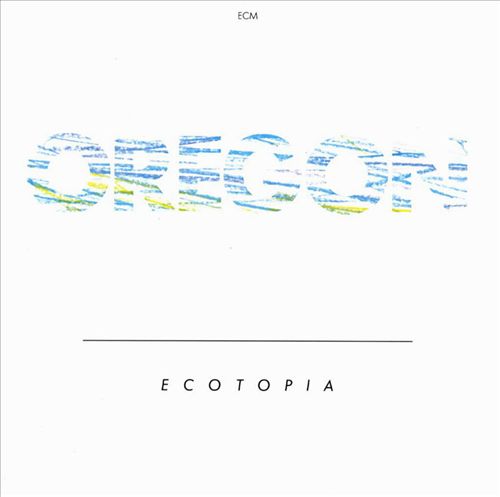
Oregon: Ecotopia (ECM 1354)

Oregon
Ecotopia

Trilok Gurtu tabla, percussion
Paul McCandless oboe, English horn, soprano saxophone, wind-driven synthesizers
Glen Moore bass
Ralph Towner classical and 12- string guitars, piano, synthesizers, drum machine
Recorded March 1987 at Tonstudio Bauer, Ludwigsburg
Engineer: Carlos Albrecht, Martin Wieland
Produced by Manfred Eicher

The stars of Ecotopia, Oregon’s third and final album for ECM and one wounded by the absence of Colin Walcott, are undoubtedly Ralph Towner and Paul McCandless. One could easily be content in listening to just the two of them for the album’s 50-minute duration, pairing so gorgeously as they do on tracks like “Zephyr.” As it is, we get a rich sound palette that, while a definite shift from what came before, speaks to a mode of experimentation that is therapeutic and adventurous. McCandless’s lines in “Twice Around The Sun” are somewhat lost in the cheapening synthesizer, but make for a light-footed introduction all the same. Thankfully, Glen Moore’s bass and Trilok Gurtu’s percussion steer this vessel into more organic waters. As the group swings in retrograde, Moore works his corona through a shower of bells and stardust. Piano and reeds fall behind silhouetted mountains, leaving Gurtu to ponder the landscape with nimble footsteps, writing the history of a savannah without wind. “Innocente” is the album’s zenith, a wondrous journey in which Towner rides a wave of table beneath McCandless’s lone seagull, who touches wing to water with every chromatic dip. His reeds sound absolutely resplendent, every note a thin ray of sunlight gathered in able grasp. After a brief throwaway improvisation (“WBAI”), the title track vindicates the use of electronics, while the swanky late-night stroll of “Leather Cats” does not. Thankfully, McCandless’s soprano wins out in this conversation. Towner lays down the groovy backbone of “ReDial,” which Gurtu and McCandless are more than willing to flesh out with all manner of delicate venation. Towner outdoes himself and brings his gentle cascade to bear on a smooth finish. “Song Of The Morrow” also makes beautiful use of synthesizers and ends this colorful and classic album which, despite its unnecessary forays into technology, is now assured of its status as one of ECM’s Touchstones.

<< Dave Holland Quintet: The Razor’s Edge (ECM 1353)
>> Steve Tibbetts: Yr (ECM 1355)