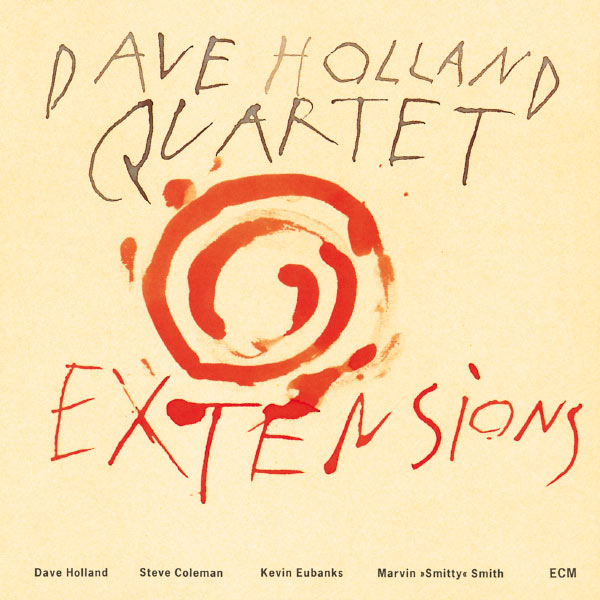
Dave Holland Quartet: Extensions (ECM 1410)


Dave Holland Quartet
Extensions

Dave Holland bass
Steve Coleman alto saxophone
Kevin Eubanks guitar
Marvin “Smitty” Smith drums
Recorded September 1989, Power Station, New York
Engineer: James Farber
Produced by Manfred Eicher

If you’re like me, then you’re most familiar with this album’s rhythm section from The Tonight Show with Jay Leno. From 1995 to 2006, guitarist Kevin Eubanks and drummer Marvin “Smitty” Smith were the anchors for said program’s house band. I always knew that Eubanks was a talented musician but felt that his insights were often lost in the muddled acoustics of the NBC studio in which they were situated. These conditions also boded ill, in most cases, for the show’s musical acts. In addition, for the most part Eubanks had his distortion turned high in order to achieve a certain brand of punctuation in his bantering with Leno, but I sometimes noticed that when returning from a commercial break he would be finishing a smooth jazz number, the brilliance of which I could only guess at. It wasn’t until I heard Extensions that I realized just how deep that brilliance goes.

Eubanks astounds at every turn of Extensions. Having penned the opening and closing tracks, he has the first and last word on things and brings to the in-between a certain majesty to the scope of his improvisatory paths. His “Nemesis” starts things off just right, giving way from barely plucked stirrings to the controlled vigor of altoist Steve Coleman’s left side drive. Not to be outdone, of course, are Smith and the album’s leader (though you wouldn’t know it from Holland’s many gracious nods to these younger trailblazers), whose interactions give Coleman just the lift he needs to soar with a blistering yet somehow nonabrasive sound. A toffee crisp solo from Eubanks paints here in leaps and somersaults, each a tight circle of deftly contained energy.

Holland himself gives us two tracks, of which “Processional” is the most sumptuous. This arid groove finds the bassist stepping lightly, making way for a starlit solo from Eubanks. Holland opens “The Oracle” with a line so delicate, it almost sounds like a classical guitar. The subtlety of Smith’s stylings at the kit and Eubanks’s bird-like calls work themselves through the curling plumes of windswept dunes, leaving a sonorous trail of footsteps that is redrawn as quickly as it is buried. This nearly 15-minute cut is the highlight of the album and should make a Eubanks believer out of anyone. Holland’s almost spiritually minded solo, detailed like a prayer, still conveys an unparalleled wanderlust before Coleman draws a trail of fire into the refrain. His two tunes, “Black Hole” and “101° Fahrenheit (Slow Meltdown),” are respectively funky and sultry, the latter unveiling fan-chopped smoke and alleys littered with wasted opportunities, singing of a time when one could forget them all in an amber bottle.

The closer, “Color Of Mind,” sports one of Holland’s catchiest bass lines and another astonishing dialogue from Eubanks. It also gives us some downtime with Holland along with Smith, who turns up the heat a notch or two into a sparkling close.

This album is a coming of age in an age of becoming. If ECM’s Touchstones series, of which this is a part, had its own Touchstones, this would be one of them.

<< Berlin Contemporary Jazz Orchestra: s/t (ECM 1409)
>> John Abercrombie: Animato (ECM 1411)

Berlin Contemporary Jazz Orchestra: s/t (ECM 1409)

ECM 1409Berlin Contemporary Jazz Orchestra

Benny Bailey trumpet
Thomas Heberer trumpet
Henry Lowther trumpet
Kenny Wheeler trumpet, fluegelhorn
Paul van Kemenade alto saxophone
Felix Wahnschaffe alto saxophone
Gerd Dudek soprano and tenor saxophones, clarinet, flute
Walter Gauchel tenor saxophone
E. L. Petrowsky baritone saxophone
Willem Breuker baritone saxophone, bass clarinet
Henning Berg trombone
Hermann Breuer trombone
Hubert Katzenbeier trombone
Utz Zimmermann bass trombone
Aki Takase piano
Günter Lenz bass
Ed Thigpen drums
Misha Mengelberg piano
Alexander von Schlippenbach conductor
Recorded May 1989 at Studio 10, RIAS Berlin
Engineer: Sören Pehrs
Produced by RIAS Berlin and ECM

The Berlin Contemporary Jazz Orchestra was begun in 1988 as the brainchild of Alexander von Schlippenbach. A decorated composer and student of B. A. Zimmermann, Schlippenbach is perhaps best known as the founder of the Globe Unity Orchestra, which spurred the 1960s jazz scene into the first of many influential phases. This self-titled album is the BCJO’s group’s debut, recorded when the outfit was all of a year old, and features a stunning array of musicians, including trumpeter Kenny Wheeler, reed man and flutist Gerd Dudek, baritone saxophonist E. L. Petrowsky, bass clarinetist Willem Breuker, and pianist Misha Mengelberg.

The set is a triptych of moods and configurations, of which the first, Ana, comes to us from the mind of Kenny Wheeler. From the somber piano intro, one might think a Keith Jarrett solo concert was in store. This illusion is quickly banished by the wealth of instrumental forces at hand. With horns taking the upper range and arco bass the lower, drums ride the outer circle while a hefty trombone strings along some rounded hits from the band. Between the deftly woven brass tapestry and beautiful solo turn from pianist (and wife of Schlippenbach) Aki Takase, Wheeler dominates the solo-sphere —that is, until Petrowsky’s tenor throws some much-needed fuel into the fire. This slides into an upbeat bridge before ending on a free-for-all and a sparkling piano flourish.

The album’s remainder was penned by Misha Mengelberg, whose keys can be found poking their thoughts here and there. The conventional horn intro of Salz wipes the blackboard clean for the frantic bass clarinet lessons of Willem Breuker—who, along with Petrowsky, is one of the group’s shining stars—and the composer’s own frolicking pianism. Another of the album’s best solos resides herein, this time from the tenor of Dudek, who also threads in a few lines of flute.

The lightly syncopated vertigo that welcomes us into Reef und Kneebus promises the album’s best engagements, but instead turns into an over-long meander between a few stellar points. Wheeler, though, is as engaging as always, and the swing comes back into the picture toward the end. This final piece plays more like a series of unrelated vignettes and feels a touch out of place.

This is a full recording, one that accentuates the breezy rhythm section and keeps the brass well separated. The band blows free and easy and tries its best to keep us out of the compositional rut with some freer gesticulations. A respectable outing that could have stood to be spun blindfolded a few times and loosed unaided, but which nevertheless balances its conscious progressions well.

<< Sidsel Endresen: So I Write (ECM 1408)
>> Dave Holland Quartet: Extensions (ECM 1410)

Alexander Knaifel: BLAZHENSTVA (ECM New Series 1957)


Alexander Knaifel
BLAZHENSTVA

Ivan Monighetti violoncello
Tatiana Melentieva soprano
Piotr Migunov bass
State Hermitage Orchestra
Saulius Sondeckis Principal conductor
Lege Artis Choir
Boris Abalian Artistic director
Recorded March 2006 at St. Catherine Lutheran Church and Capella Concert Hall, St. Petersburg
Engineer: Boris Isaev
Recording supervision: Alexander Knaifel
An ECM Production

Just when we ECM listeners had become lulled in the embraces of Arvo Pärt and Valentin Silvestrov, thinking no others might widen that door further, suddenly we encountered a new visionary: Alexander Knaifel. Although Knaifel shares the spotlight with other such stars of the Soviet avant-garde, his ability to paint with sound is arguably unrivaled among them. To experience his music is to experience the pathos of life itself: sometimes bumpy, even hurtful, but always rewarding with the tranquility of learning. In it one feels the weight of the world balanced like a feather on the breath.

Lamento (1967, rev. 1987) for cello solo is dedicated to the memory of choreographer Leonid Jakobson. And indeed, one can feel the shapely movements of the stage working their way into every facet of this sometimes-challenging work. From the opening series of attacks, chained by silence, to the heart-stopping double stop that carries us into prayer, we hear in it a promissory refrain. With youthful caution it spins from agitation a thread of such transcendent light that one feels blinded by its tonality. What follows skirts the line of harmony and dissonance, finding the divine without need of the Word. Knaifel’s attentive scoring allows us to hear the true interior of the cello. To accomplish this, he externalizes its full dynamic range. This is not a piece that answers its own question, but one that becomes the question itself.

Blazhenstva (1996) for soloists, orchestra, and choir also bears dedication, in this instance to mentor Mstislav Rostropovich in honor of his 70th birthday. It’s astonishing that such a meditative piece can harbor so much conflict, and yet here it is speaking to us in the sonic equivalent of Psalmnody. The voice of soprano Tatiana Melentieva proves to be one of the most heavenly on land, and one Knaifel does not exploit but rather bows to through his music, such that with the entrance of bass Piotr Migunov it reveals cardinal avenues of possibility. As a sustained piano intones, it flows like the text it engenders (Our Lord’s Sermon on the Mount, Mt 5:3-12). This overlaps in unexpected ways while maintaining an antiphonal feeling. Men’s voices make way for altos as a constant sheet of strings forms like ice beneath. Vocal lines stretch before fraying into a holy triad, unwound like Creation returning to its firmament. A cello solo lends finality and grace, as if passing along the wisdom of the Beatitudes through a more terrestrial channel before crossing their vertical transmission.

“Both compositions form a united way,” says Knaifel, and this we can hear without question. If one is death, the other is life, and together they complete a circle that touches us all. The sheer amount of space articulated therein (and on this note one must praise engineer Boris Isaev) envelops the darkness and the light, traveling a way of gray that walks as it breathes.

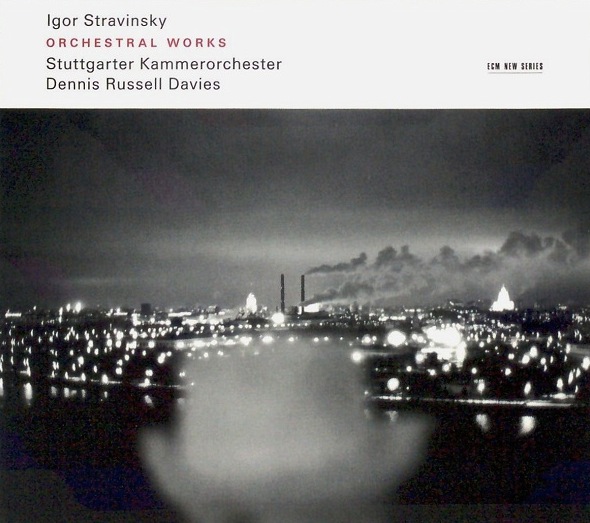
Igor Stravinsky: Orchestral Works (ECM New Series 1826)


Igor Stravinsky
Orchestral Works

Stuttgarter Kammerorchester
Dennis Russell Davies conductor
Recorded October 2002 at Liederhalle Stuttgart
Engineer: Peter Laenger
Produced by Manfred Eicher

This reference recording of conductor Dennis Russell Davies’s account of Igor Stravinsky is proof that a conductor can make all the difference. Davies sprinkles the Stuttgarter Kammerorchester with life at every turn and in the process reintroduces us to a composer whose music is all too often neglected in spite of his fame. He’s either the Russian provocateur whose ballet The Rite of Spring caused a riot during its 1913 premier or the poster child for a now passé neoclassicism. We can be thankful for having recordings such as this to educate.

In light of this, Davies has assembled a program that brings together the known and the not so known, opening in the latter persuasion with the 1960 Monumentum pro Gesualdo di Venosa ad CD annum. Stravinsky’s magisterial humility shines like light through the stained glass of his sources. As one might expect, brass figures heavily in these Baroque arrangements and recalls the matrix of Bach’s first Brandenberg Concerto. It is the thrill of the hunt and divine peace all rolled into one and paints Stravinsky as a skillful pastiche artist.

Davies and his musicians soften the neoclassical category by approaching the music as it presents itself to be. Consequently, a piece like the Danses Concertantes (1942) for chamber orchestra comes across as neither a reimagining nor a recycling of fashionable moods, but rather the exuberance of its own soundness. The halting rhythms and skillful wind writing—note, for instance, the bassoon in Variation IV—make for an enchanting experience all around.

Next is the Concerto in D (1946) for string orchestra, which here finds itself reborn in time. Its vivacious interior shows in the attention paid to dynamics and syncopation. The meat of its second movement sits comfortably between the two more strained slices above and below. The latter follows a line of agitation from which the rest is blended, leaving a cello to fade out of sight…

…only to resurface in the Apollon musagète of 1927/28. This ballet, written for Georges Ballanchine in two tableaux, finds the cello running through its half-waking dreams like remembrance. Its counterpart, the violin, makes similar orchestral encroachments, only to pull at the intertextual weave therein until a somber but spirited finish is all that remains.

Stravinsky’s is a macramé of inspiring proportions. Yet it is always surrounded by modesty, as if the very world might crumble were too many of its resources funneled into one place.

Anja Lechner and Vassilis Tsabropoulos: Chants, Hymns and Dances (ECM New Series 1888)


Chants, Hymns and Dances

Anja Lechner cello
Vassilis Tsabropoulos piano
Recorded December 2003, Festeburgkirche, Frankfurt am Main
Engineer: Markus Heiland
Produced by Manfred Eicher

The enigmatic sound-world of G. I. Gurdjieff (c.1877-1948) made its first appearance on ECM via the spirited renditions of pianist Keith Jarrett. Now another wizard at the keyboard, Vassilis Tsabropoulos, joins kindred spirit cellist Anja Lechner for a redrawing of old maps alongside the newly discovered continents of Tsabropoulos’s own stilling compositions around Byzantine hymns. The result is less a hybrid and more of a conversation across (and of) time. Harmonically a simple world, it elides the trappings of the social, forging its own divine concept in the grip of ideological binds. Some, like Chant from a Holy Book, build up in intensity as might a raga, spinning from humble beginnings a sustained lyricism that speaks with the language of afterlife. Others maintain that humility throughout, as in Prayer. Tsabrapolous’s approach to these free-floating motives is gently improvisational, and yet the star of every note seems to hold its place in the music’s nightfall. In Duduki, for one, we hear in the pianism a potency of such fragile proportions that Lechner’s cello seems to weep with the passion of a last dance.

The album’s heart also renders a portrait of Tsabrapolous’s, as he gives us his own bridging melodies in the wilting graces of Trois Morceaux après des hymnes byzantinshas. In these Lechner’s exquisite tone glows, threading an emotional line as one might find in an Eleni Karaindrou soundtrack. The playful undertones of Dance then give way to Chant, which is closest to its surroundings in mood. Although elegiac, it is bright with textless voices. More Gurdjieff rounds out program, of which the highlights are the evocative Assyrian Women Mourners and its sister piece, Woman’s Prayer.

Anyone who enjoyed Jarrett’s earlier take on the shape of things will find plenty to open the mind further on Chants. I can hardly imagine an album better suited for ECM’s pioneering programming. It is a quiet, unassuming space that takes nothing for granted, granting as it does all that it has ever received.

ECM New Series Anthology (ECM New Series 1405)

ECM New Series Anthology

Staatsorchester Stuttgart
Dennis Russell Davies
conductor
The Hilliard Ensemble
Gidon Kremer violin
Keith Jarrett piano
Meredith Monk voice, piano
Heinz Holliger oboe
Kim Kashkashian viola
Tamia voice
Pierre Favre percussion
Shankar double violin
Jan Garbarek soprano saxophone, flute
Paul Hillier voice
Stephen Stubbs lute
Erin Headley vielle
Thomas Demenga cello
Paul Giger violin

ECM made history in 1984 with the release of Tabula rasa, the first of the jazz label’s equally influential New Series. Not only did this beloved recording introduce many to the music of Arvo Pärt, but it also clarified producer Manfred Eicher’s classical roots and fed into the likeminded sensibilities Eicher was then bringing with increasing confidence to his groundbreaking approach to jazz. It is therefore appropriate that Pärt, the imprint’s shining star, should be represented here more than any other composer or performer. His Cantus In Memory Of Benjamin Britten, a haunting secular homage to a composer he would never meet, is the disc’s open door. Its quiet sweeps and intoning tubular bell resemble little in all recorded music. Pärt comes to us further through his spiraling Arbos for brass and percussion and through Fratres, a touchstone in his compositional career. Existing in many treatments, here it is given one of its most powerful through the greatness of violinist Gidon Kremer. Accompanied by Keith Jarrett at the piano, his simple yet burrowing progressions capture (and release) the essence of something so physiological that one cannot but help feel it in the veins.

If Pärt is the New Series’ mainstay composer, then the phenomenal singers of the Hilliard Ensemble are its star performers. Since making their label debut with a flavorful rendition of Thomas Tallis’s Lamentations Of Jeremiah, of which the Incipit is given here, they have redefined the art of the chamber vocal ensemble.

Meredith Monk shifts the light considerably in a selection from her Vessel: An Opera Epic. The New York-based composer and performer has established a loyal group of vocal artists, all of whom find in her voice a depth of inspiration all too rarely encountered. One would feel tempted to call her world mysterious, were it not for the fact that it sounds undeniably familiar. “Do You Be” is a representative work in this regard, an aria of sorts that blows her ululations through the branches of a faraway tree.

Swiss oboist Heinz Holliger is another major compositional force in the New Series catalogue, and his Studie Über Mehrklänge for solo oboe is as good a place as any to start for those adventurous enough to wander his musical paths. As the title (A Study in Multiphonics) already informs us, Holliger wrings a wealth of sounds and colors from the single woodwind. Whether unsettling or ethereal, they never fail to enchant and reinvent with every listen.

The peerless Kim Kashkashian gives us the final movement of Paul Hindemith’s fifth Viola Sonata. This 11-minute masterpiece is the first of a smattering of solo pieces on the album, the others being Thomas Demenga’s astonishing Sarabande from the fourth Cello Suite of J. S. Bach and an all-too-short excerpt (only three of its original twenty-two minutes) from “Crossing” by Swiss violinist Paul Giger. The album, Chartres, from which the latter was taken is one of the finest violin recordings ever released and is a must-have for those interested in exploring more of what the New Series has to offer.

Singer, scholar, and early music specialist Paul Hillier gives us “Can Vei La Lauzeta,” a haunting lilt of troubadour stylings by Bernart de Ventadorn (fl. 1145-1180). It is a fitting inclusion in a program that is but a thread in an ongoing tapestry—more than I can say about the album’s filler. Why, for example, do we find not one but two selections from saxophonist Jan Garbarek’s Legend Of The Seven Dreams? A fantastic album, to be sure, but not a New Series release. The same goes for “Ballade” by singer Tamia and percussionist Pierre Favre and “Adagio” by Carnatic violinist L. Shankar. Both are lovely sonic constructions yet neither appears under the New Series title. I realize that perhaps these were an attempt to show that the music of ECM proper can sometimes carry over into fuzzier areas of genre, but isn’t that what the far more numerous anthologies from the very same are for?

Another addition—that of actor Bruno Ganz’s recitation of “Vom Abgrund Nämlich” by Friedrich Hölderlein—may also seem curious, if only for its politics, but its opening lines at least ring to the tune of the ECM spirit, which has cast its sonic lessons into the widening sea of listening in which we are all embedded:

We began of course at the abyss
And have gone forth like lions

By and large, this is an adequate introduction to a side of ECM that some may feel hesitant to explore. Yet rather than pay for a well-chosen, if sometimes puzzling, collection, I would instead encourage the curious to get their hands on any one of the above recordings in full.

<< Aparis: s/t (ECM 1404)
>> Karlheinz Stockhausen: MICHAELs REISE (ECM 1406 NS)

John Holloway: Der Türken Anmarsch – Biber/Muffat (ECM New Series 1837)


Heinrich Ignaz Franz Biber
Georg Muffat
Der Türken Anmarsch

John Holloway violin
Aloysia Assenbaum organ
Lars Ulrik Mortensen harpsichord
Recorded July 2002 at Propstei St. Gerold, Austria
Engineer: Stephan Schellmann
Produced by Manfred Eicher

Many of the musicians we know and adore come to us only through recorded media. They step into a studio, bear their souls into a digital void, and send the results out into a world of ears. These blessed creators may seem immortal to us, for even when their bodies are gone they continue living through the art they have gifted to humanity. Such thoughts weighed on my mind when I first listened to Der Türken Anmarsch, for in addition to signing off a fourteen-year project by baroque violinist John Holloway to engage the fascinations of composer Heinrich Ignaz Franz von Biber (1644-1704), it was the last recording to feature Holloway’s wife, organist Aloysia Assenbaum, who along with harpsichordist Lars Ulrik Mortensen fashioned the most distinctive continuo in Baroque music.

My first Biber encounter came via Monica Hugget’s phenomenal Birds, Beasts and Battles recording on Channel Classics. I was immediately enlivened by its bold strokes and programmatic flair. Yet for this program, Holloway and company offer us five sonatas by the Bohemian-Austrian master in a more devotional vein, along with another by contemporary Georg Muffat (1653-1704). The former’s Sonata “Victori der Christen” in A minor sets the spiritual tone, through which shines the depth and complexity of his faith. Its ebb-and-flow energies enchant from the first. Here, as throughout, the rich continuo hovers like an energy waiting to be unleashed in the overflow of trills that spills from the violin’s gut strings. The remaining four Biber sonatas are culled from his 1681 Sonatae Violino solo. The opening birdcalls of the Sonata I in A major take full advantage of the scordatura so favored by the composer. Rocking a fulcrum of speed and lethargy, it explores modes at once Monteverdian and ahead of their time. The D-dorian Sonata II showcases Holloway’s dynamic range, as in an early passage for which his playing blends so well with the organ that a ghostly, clarinet-like overtone is created. The Sonata V in E minor has by far the most attention-grabbing introduction of the set. Like its cousins, it alternates between slow and fast, never staying in one mode for too long and thereby emphasizing merits of both. Biber’s melodic lines are always so flexible. They circle, splitting themselves into leaders and followers, ascending and descending as they do in the A-major Sonata VIII, which scales a hilly landscape into the roiling plains of Muffat’s Sonata Violino solo in D major. Its stunning melodies sound at first familiar, only to carry the secrets of places lost to us. It is both the end of its own cycle and of the album as a whole, a masterpiece truly on par with Biber’s unflagging virtuosity and inventive embodiments.

Holloway deftly mixes styles and tones, at times getting a rustic sound out of his D string while soaring effervescently on the E. Yet what ultimately makes him such a consummate performer is that, unlike some, who despite their great talents tend to embellish to the point of distraction, he brings something raw and unfettered to his studied approach, which is only intensified through the somehow gentle ferocity of his style. When we hear someone like Holloway we can truly appreciate the amount of embellishment already encoded into the music of this richly productive era. And when Assenbaum unfurls the final carpet as faders escort the music on its way from the chamber, we can take comfort in knowing that through such vital recordings as this the art of her and others like her will live in our hearts and minds so long as music is loved.

Sidsel Endresen: So I Write (ECM 1408)

Sidsel Endresen
So I Write

Sidsel Endresen vocal
Nils Petter Molvær trumpet, fluegelhorn, percussion
Django Bates piano
Jon Christensen percussion
Recorded June 1990 at Rainbow Studio, Oslo
Engineer: Jan Erik Kongshaug
Produced by Manfred Eicher

Sidsel Endresen’s So I Write was the first ECM jazz vocal album I ever bought. While that in and of itself would have been enough to make it special, the music housed within its windswept sleeve made it unquantifiably more so. Just holding it in my hand above the used CD bin from which I’d fished it, I could already feel its shaded vistas spreading through me.

The title track is also the album’s first, and one could hardly dream of a more affecting introduction to this Norwegian chanteuse’s inner life. It is a sound-world in which the word is its own creator, one that utters itself into being in the floating pall of its residual meanings. Accompanied by the staggering palette of drummer Jon Christensen and the punctilious spirals of pianist Django Bates, Endresen travels far and wide along extemporaneous landscapes. “This Is The Movie” bolds and underlines the cinematic qualities of her breathy poetry, flitting through stills like sadness through transient life and tenderly exploring the complementary nature of love. In “Dreamland” she exchanges light for dark, turning a lullaby into a personal mantra in the process. The ever-lyrical horns of Nils Petter Molvær, who comments on every stirring from a respectful distance, bleed into “Words,” which spins from his plaintive salutation a letter of unbridled subtlety. Here we find ourselves embraced by the dangers of dreams and the depths of their promises. This leads us to explore in “Mirror Images” the boundaries of the image as the boundaries between flesh and self.

The mood takes a noticeable turn in the more abstract “Spring,” which separates its eponymous season as if it were a theater curtain, throwing the spotlight of an empty house on to a character whose life moves an idea of retribution through chaos. “Truth” carries this idea further into a purely rhythmic language before the human voice lays its biases on the water’s surface and casts the thrills of illusion into the emotional deep end, where we are met by “Horses In Rain.” Endresen fashions from this image a babbling where metaphor speaks for all, and where Bates’s thematic reflections close the door on this enigmatic date as would a mother exit her child’s room once the bedtime story has worked its magic.

So I Write is a musical gem and the perfect companion to any Norma Winstone album on your shelf. If these are only half the stories told, then we can take great comfort in writing our own remainder.

<< Shankar: Pancha Nadai Pallavi (ECM 1407)
>> Berlin Contemporary Jazz Orchestra: s/t (ECM 1409)

Shankar: Pancha Nadai Pallavi (ECM 1407)

Shankar
Pancha Nadai Pallavi

Shankar double violin, vocals
Zakir Hussain tabla
Vikku Vinayakram ghatam
Caroline talam, sruthi
Recorded July 1989 at Rainbow Studio, Oslo
Engineer: Jan Erik Kongshaug
Produced by Manfred Eicher

Shankar’s last album for ECM may just be his finest. Pancha Nadai Pallavi shows the violinist at his creative peak and weaves an unforgettable atmosphere. From the solemn cover photograph to the flawless production, it is a perfect package and a fitting label swan song for an association stretching full circle back to the comparable masterpiece that is 1981’s Who’s To Know.

Shankar’s playing, however you look at it, is a language of the utmost depth and beauty. His voice is smoky, arising from those strings like an echo of the inner spirit that animates his craft. This traditional raga features three cycles, the first two of which—the Ragam and the Tanam—foreground the improvisational skills of the soloist, while the concluding Pallavi emphasizes the rhythmic contributions of the percussionists in dialogue. Although Carnatic purists may be put off by Shankar’s modern touches, the music soars in ways that far outsoar its criticism.

Shankar’s sound is a constant balance of skyward uplift and subterranean excavation. From the thrums and strums of his 10-string violin’s lowest utterances to his harmonic-peaked runs, he scales full ladders of octaves in but single exhalations of his creative breath. And although the violin parts are multi-tracked, they shine like facets of the same crystal. His lines hold on to a core tone. No matter how far they waver from it, they are like rivers that both flow out from and back to their sources. In the process they provide a rhythmic drive in the absence of the percussion waiting in the wings—such that once the voices of Zakir Hussain and Vikku Vinayakram do make themselves known, it feels as if they’ve always been there, moving but never audible until now. The dynamics of this expansion alone are enough to dazzle, but with Shankar’s burrowing melodies their effects become inescapable. Moving from passages of blinding speed to lyrical laments at a mere stroke, they glow in a spectrum of colors. On that note, we must not neglect Shankar ally Caroline Morgan, whose drones and timekeeping unfold their inner depths in those brief moments of rest. Her humility rings like the voice of the firmament, stilling us in anticipation of the flights to come and baying into the beautiful call and response that leaves us spellbound at the raga’s finish.

Pancha is, along with the aforementioned Who’s To Know, by far Shankar’s best work on record. It is also an album that most cleanly showcases the capabilities of his custom instrument. One feels its lows in the rib cage, its highs in the farthest reaches of our minds. Through it Shankar sustains a purity of tone, a moral and spiritual center around which he swings the caduceus of his melodies with eyes closed and arms open. He looks into the stars and sees the strings between them not as constellations but as musical notations. And in these he paints the picture of a god-given gift that has left an indelible mark of greatness.

<< Karlheinz Stockhausen: MICHAELs REISE (ECM 1406 NS)
>> Sidsel Endresen: So I Write (ECM 1408)