Signs Among Us: 30 Years of ECM New Series

ECM New Series

ECM’s New Series has been producing classical releases of highest caliber since 1984. As the German imprint quietly celebrates its 30th anniversary, these words attempt an affectionate survey of its output. Then again, how does one delineate a history of that which is so much a part of it? Jean-Luc Godard addresses this very question in his Histoire(s) du cinéma, of which the soundtrack saw a New Series release (ECM 1706-10) in 1999 and from which this essay borrows its title. The parenthetical “s” of Godard’s masterwork serves not merely to hinge the singular and the plural, but to unravel the multiple, simultaneous registers of the filmic medium—moving, as it were, from an “either-or” to a “neither-nor” approach. A film breaks down not only into individual frames, but also into molecular compounds within those frames, until signs of the original become nothing more than the breath expended to describe it. Similarly, the New Series vision, under the watchful ear of producer Manfred Eicher, has for three decades programmed music as if it were a field of signs that live among and within us, each an ephemeral capture that begets infinite others.

The New Series bears no discernibly overarching aesthetic. Just as ECM proper has diversified the pasture of jazz with flowers of stark variation, so has the New Series loosened the borders of the classical landscape through democratic enhancements of technique, instrumentation, and concept. Indeed, the success of the New Series vision has grown in direct proportion to its inclusivity, even as it has refined an idiosyncratic corpus of composers. If one can say that Eicher has brought a classical sense of detailing toward the jazz-oriented records that earned him first renown, one might also say that he brought to classical recording a feeling of jazz, insofar as whatever spirit animates the improviser with unquantifiable purpose also thrums like a shell around every classical recording worthy of the ECM moniker.

Inception of the New Series traces back to 1980, when Eicher first heard Arvo Pärt on the radio. Not knowing what it was, he searched for quite some time before connecting those angelic sounds to a name that would define the label to come. In its role as the first New Series release, Pärt’s Tabula rasa (ECM 1275) is said to have introduced an ancient world to a new sound. And yet, it would be just as accurate to say that the album introduced an ancient sound to a new world. In other words, it wasn’t the newness of Pärt’s music that turned the album into such a watershed moment. It was, rather, its resonant heart, to which listeners across genres and affiliations found immutable connections, points of relatability, and glimmers of familiarity in its starry sky. Such an interpretation existed already in the name: New Series. As for the “new,” one finds it in the recordings and performances. The word “series,” on the other hand, connotes linkages between past and future tenses in an unbroken chain of influence. Like the single line that underscores the label’s logo, it’s a horizon, either side of which brings innovative possibilities to the old, and old possibilities to the innovative.

Within the parameters of Eicher’s discerning archaeology, much credit must go to ECM’s committed engineers, of whom Peter Laenger and Stephan Schellmann stand out for their clear, adaptive methods. Schellmann’s tenure with the label has been remarkably varied, ranging from violinist John Holloway’s benchmark accounts of transitional Baroque repertoires to the chamber music of 20th-century Korean composer Isang Yun. Moreover, Schellmann has shadowed András Schiff’s 10-disc traversal of the complete Beethoven sonatas and, within the last year, an extraordinary account by Anna Gourari of Sergey Prokofiev’s Visions fugitives. Laenger’s most commercially successful intersections with ECM have generated collaborations with the Hilliard Ensemble, including the much-beloved Officium project with Norwegian saxophonist Jan Garbarek. He has also been involved in Pärt productions, Tabula rasa not least of all, and made audible the slightest whispers of Russian contemporary Alexander Knaifel. The contributions of these and others at the mixing board are integral by presence so tangible that their all-too-often-ignored efforts would be impossible not to notice.

Binding these artistic confluences is Eicher’s willingness to not so much think outside the proverbial box as redefine and expand what that box may contain to begin with. An especially fascinating orbit of the ECM solar system has been traced by a relatively small but no less life-sustaining planet of spoken word projects. These have taken various forms, as in the above-mentioned Godard soundtrack and in the unaccompanied recitations of actor Bruno Ganz, who has lent his voice to the poetry of Friedrich Hölderlin, T.S. Eliot, and Giorgos Seferis. There is, too, the gorgeous pairing of cellist Frances-Marie Uitti and author Paul Griffiths, there is still time (ECM 1882), which dovetails poetry by Griffiths, limited to the 482-word vocabulary as spoken by Ophelia in Shakespeare’s Hamlet, into the cellist’s fully immediate improvising.

I recently caught up with Griffiths, who kindly offered his insight into working with Manfred Eicher in the studio.

“Manfred said almost nothing, but what he did say was crucial. No less crucial was his just being there. We hadn’t prepared very much—hardly at all. We tried some things out that didn’t work. Others did, sometimes at a first take. It was hard work, and extremely easy. No pressure. Just let it happen. Room for spontaneity. We kind of relaxed into intensity. Frances’s playing was—you can hear this, and though I don’t like the word I have to use it—an inspiration.”

Griffiths’s summary of the recording process happens to be an effective description of the listening that attends it. One may come to each New Series recording afresh, suspending expectations toward even standard repertory in favor of the novel expositions sure to take place. Sometimes the listening clicks, achieving unity of absorption at first meeting. Other times, understanding grows as experiences bond with the music, little by little. There is room for spontaneity in how one may hear the sounds and, yes, an inspired communication behind it all.

I began, though, by asking Griffiths about his first experience as New Series listener. “That would have to have been the Arvo Pärt album Tabula rasa, when it came out, in pre-CD days, in a foot-square sleeve of unglossy white, which would be so difficult to keep clean, but one would try,” he said. The historicity of his reply would seem to treat the album in question as an artifact and reminds me that my first copy of the same was on the even more outmoded medium of cassette. And his initial impressions?

“I was bowled over, like everyone else, especially by the title piece. Before that ‘Arvo Pärt’ was just a name floating around—one of the younger Soviet composers who’d taken modernism on board—without that name being grounded in any experience of the music. We’re talking of a time, of course, when knowledge of music from the Soviet Union was very limited. To anticipate your third question, I can’t remember what came next—maybe the second Pärt album, Arbos, or a Lockenhaus compilation. But I’m not sure I was aware that the Lockenhaus disc came from the same stable; it took a little while, for me at least, before I began to have a notion of an ECM identity.”

And what did that identity signify once he became aware of it as such?

“There was the matter of design, which impressed in a very different way when sleeves were 12” by 12”—I vividly recall the beautiful starkness of, especially, the Arbos cover, with the title in blue-green against dark grey. Then the notes were always good. But of course it was the sound, the combination of intimacy and distance, and the awareness that a recorded performance is not simply a recording of a performance but something distinct—the Glenn Gould lesson, absorbed with total simplicity and straightforwardness. It may have taken me a little longer to notice that ECM was also creating its own repertory.”

On the topic of notes, any fan will have become acquainted with the contributions of Griffiths, who along with music critic Hans-Klaus Jungheinrich has brought his erudition to the lion’s share of New Series booklets. In addition to an encyclopedic knowledge of contemporary classical music and its lineages, Griffiths has given beautiful, narrative readings to handfuls of compositions in ways thitherto unexplored. I inquired about his first assignment, which to his recollection was Kim Kashkashian’s disc of three Hungarian viola concertos—by Bartók, Kurtág, Eötvös—with the Netherlands Radio Chamber Orchestra (ECM 1711).

“That would have been in the late nineties. I knew it had to be good. I would guess that everyone working for Manfred, in whatever capacity, strains to deliver only the best. That’s part of his skill and his success, that he doesn’t impose but somehow opens, lets you achieve as much as you’re able. The terms are perhaps too grand in which to talk about liner notes, but I felt—and still feel, maybe twenty or thirty albums later—an ECM assignment to be a special opportunity.”

Special, too, for those on the receiving end of their intellectual labor.

No such musical body would stand without the nourishment of its composers. In this respect, ECM has widened the listenership of previously insularly known figures. Pärt, to be sure, heads the list for his inaugural significance, but more lastingly for the unpretentious depth of his notecraft. Here is a human being of flesh and less tangible things who tends the latter with such integrity that even those who wouldn’t normally consider themselves classical listeners have made his motives a staple of their listening diet. I hesitate to describe Pärt as a “universal” composer, implying as the term does a reach fanning out from this blue orb and its galaxy into countless more beyond, when in reality his power has the opposite effect, burrowing so far inward that it caresses the spark which makes each of us unique.

Pärt’s ruminations comprise but one landmass in a changing map that has lowered its waters to reveal archipelagos, canyons, and glaciers—each possessed of its own topographical influence. In this respect, one value of the New Series is its vested interest in the marginalized, the exiled, and the misunderstood. Estonia has blessed us further with the folkloric choral interpretations of Veljo Tormis and the glowing architectures of Erkki-Sven Tüür, while the former Soviet state of Georgia has given the thematic persistence of Giya Kancheli, Ukraine the postludinal elegies of Valentin Silvestrov, and Armenia the open loom of Tigran Mansurian’s threadbare prayers. On the European continent, we find the meticulous microscopy of György Kurtág, while Gavin Bryars emotes from across the English Channel with his sonorous fusions. Through all of this, the works of Bach—and, more recently, Schubert and Schumann—have become touchstones. Hence, my final question for Griffiths on the nature of ECM’s classical interests, to which he replied:

“Yes, there certainly is an ECM repertory—a world where Schubert and Schumann are more prominent than Beethoven, and certainly than Mozart—but I’m not sure its rationale can easily be defined. Factors include Manfred’s taste, of course, but also his loyalty to artists and his curiosity, or perhaps his eagerness to go against his own grain. Perhaps there’s a sort of intimate yet intense expressiveness that links all these things. And an absence of show. Is it possible to think of a composer unimagineable on ECM? Wagner? But then I could imagine the Siegfried Idyll, with the right performers and the right context. Oh, perhaps the key is in some sense of the music—and the performance—creating an arc of an uncompleted circle, a sense of something beyond.”

Mention of performance speaks to the talented musicians that have lent their hands, bows, and voices to the above repertoires. Notable among them are violinist Thomas Zehetmair and his famously score-less quartet; cellist Thomas Demenga for his pairing of Bach’s cello suites with contemporary chamber works, to say nothing of his phenomenal homage to Paul Sacher (ECM 1520/21); Gidon Kremer and the Kremerata Baltica for their sense of adventure; Kashkashian for her impeccable tone and tireless championing of modern music; the now-disbanded Hilliard Ensemble and their thriving protégés Trio Mediaeval for likewise expanding vocal repertoires with utmost professionalism and respect; pianists Alexei Lubimov and Herbert Henck for their artful assemblies and contrasting touch at the keyboard; and tenor John Potter’s Dowland Project for unusually organic permutations of the troubadour’s heart. These are but a few.

There are those—namely Meredith Monk, Heinz Holliger, and Thomas Larcher—who fulfill both categories with comparable proficiency, and still others who are in categories all their own: violinist Paul Giger, composer Heiner Goebbels, and keyboardist extraordinaire Keith Jarrett. That Jarrett has been able to cross the line so fluidly between jazz and classical realms speaks to the blurriness of that line. Whether playing Bach’s French Suites on harpsichord (ECM 1513/14), the 24 Preludes and Fugues of Shostakovich on piano (ECM 1469/70), or fronting an orchestra in sweeping accounts of Mozart piano concertos, his contributions to the label circle back to where it all began: with him at the keyboard and Kremer at the violin ushering in an age of discovery as Pärt’s Fratres prepared to speak its mantra for all time.

In line with an arbitrary and subjective tradition, I conclude with the following “Top 10” list of New Series recommendations. More than anything, it reflects a hierarchy of personal engagement and as such may or may not overlap with your own experience of the label. Either way, I hope it will be cause for (re)discovery. The astute fan will note that a good portion of my picks was recorded in the first half of the 1990s. This is no coincidence. Many of my favorites immediately proceeded from my introduction to the Series by way of Pärt’s Te Deum (ECM 1505) and represent something of a golden age for the label, during which production, aesthetic, and selection were for me at their peak of harmony.

  1. Giya Kancheli: Exil (ECM 1535). Kancheli’s Exil will forever be the crowning achievement of all for which the New Series stands. Recorded in the defining acoustics of Austria’s Sankt Gerold monastery and featuring the incomparable soprano Maacha Deubner, its sounds are of an order beyond the craft of any wordsmith. Hear it, and you may just find that your heart has been holding a space for it since before you were born.
  2. Paul Giger: Chartres (ECM 1386). The Swiss violinist combines improvisation and through-composed scripture in a peerless—all the more so for being solo—exploration of the Chartres cathedral. Through extended techniques such as overtones, percussive tapping, and choral textures, Giger forges an effect so unearthly that it pulls ghosts from every stone.
  3. Heinz Holliger: Scardanelli-Zyklus (ECM 1472/73). Holliger’s seasonally inflected obsession is a masterpiece. From the album’s mysterious cover, in which the autograph of Hölderlin’s alter ego floats in a sea of stars, to the shuffling of a cappella settings into small orchestral longings, and all of it sheltering an epic flute solo by Aurèle Nicolet, there’s enough here to satisfy a lifetime of returns.
  4. Erkki-Sven Tüür: Crystallisatio (ECM 1590). With a background in progressive rock and abiding interest in jazz-like sonorities, Tüür pulls out all the stops in his ECM debut. Shorter works for various orchestral combinations build to the title composition for 3 flutes, glockenspiel, strings, and live electronics, and beyond it to the 1994 Requiem, which stands as one of the most compelling examples to ever bear the title.
  5. Gavin Bryars: Vita Nova (ECM 1533). Though Bryars seems to have faded from the label’s auspices, there was a time when he flourished, and never to such beauteous effect as on Vita Nova. The album documents some of countertenor David James’s most articulate singing on record, both among the Hilliards and with a haunting trio of strings, and amends the composer’s atmospheric precision with textual resonances, even in the absence of words.
  6. Arvo Pärt: Miserere (ECM 1430). Of the many recordings I might have selected from the Estonian composer’s archive, Miserere stands apart. Pärt’s handling of the title work balances the apocalyptic and the introspective with such care, it’s a wonder the musicians don’t weep as they play. The singers’ interactions with organ and winds prepare the skin until the ritual drumming of Sarah Was Ninety Years Old anoints with holy genealogy.
  7. Christopher Bowers-Broadbent/Sarah Leonard: Górecki/Satie/Milhaud/Bryars (ECM 1495). There’s nothing quite like this rarely mentioned record, which combines the smooth limb-work of organist Christopher Bowers-Broadbent and the atmospheric reach of soprano Sarah Leonard (both featured to astonishing effect on Miserere) across a bridge of music by Górecki, Satie, Milhaud, and Bryars. While the middle two are writing for organ alone, the album’s massive bookends feature the unusual duo, and the results shatter. Between the declamatory punctuations of Górecki’s O Domina Nostra and the stream-of-conscious narrative of The Black River, for which Bryars sets words of Jules Verne, listeners might very well find themselves transformed.
  8. Hans Otte: Das Buch der Klänge (ECM 1659). Even more rarely mentioned is this enchanting album of solo piano music by Hans Otte, which in Henck’s capable hands comes alive in a most assured interpretation. Otte’s infusion of fundament and fragment belongs to a world unto itself.
  9. J.S. Bach: Ich hatte viel Bekümmernis (ECM 2229). Despite the fact that Bach lurks in so many places, some more overtly than others, it wasn’t difficult to settle on this recording by master oboist Heinz Holliger, violinist-director Erich Höbarth, and the Camerata Bern, though Keith Jarrett and Kim Kashkashian’s rendering of the viola da gamba sonatas (ECM 1501) comes a close second. The sheer fullness of Holliger’s phrasing and feel for rhythm alone make this one worth owning. That, and one of the finest Bach programs ever assembled.
  10. Arianna Savall/Petter Udland Johansen: Hirundo Maris (ECM 2227). So many albums might have occupied this place in my list, but this one is a more recent discovery and therefore freshest in mind. Singer-harpist Arianna Savall, daughter of Jordi Savall and the late Monstserrat Figueras (in whose memory the album is dedicated), and Oslo-born singer and multi-instrumentalist Petter Udland Johansen form the core of the titular project, which explores folk roots in early music of Norway and Catalonia. Bound by an uncompromising instinct for melody and augmented by spirited arrangements, their artistry seems boundless in one of the more surprising bouquets to sprout from ECM soil.

Honorable mentions might just as well include every other release from the label, but I would highlight, in catalog order: Meredith Monk’s Dolmen Music (ECM 1197), Steve Reich’s Tehillim (ECM 1215), Paul Hindemith’s Viola Sonatas as played by Kashkashian (ECM 1330-32), Thomas Demenga’s pairing of Bach’s 4th Cello Suite with works of Heinz Holliger (ECM 1340), Gesualdo’s Tenebrae as sung by the Hilliard Ensemble (ECM 1422/23), the same ensemble’s landmark recording of selections from the Codex Speciálnik (ECM 1504), an impressionistic rendering of Federico Mompou’s Música Callada by Henck (ECM 1523), an all-Sándor Veress program which includes his Passacaglia Concertante under baton and oboe of Holliger (ECM 1555), Eleni Karaindrou’s soundtrack to the film Ulysses’ Gaze (ECM 1570), Arvo Pärt’s a cappella magnum opus Kanon pokajanen (ECM 1654/55), the Trio Sonatas of J. D. Zelenka (ECM 1671/72), Heiner Goebbels’s spectral Surrogate Cities (ECM 1688/89), Jan Garbarek and the Hilliard Ensemble’s sophomore album Mnemosyne (ECM 1700/01), H.I.F. Biber’s Unam Ceylum as played to perfection by Holloway and friends (ECM 1791), Ensemble Belcanto’s unorthodox (or is it?) account of the Ordo Virtutum by Hildegard von Bingen (ECM 2219), the Italian Duo Gazzana’s dynamic Five Pieces (ECM 2238), Dobrinka Tabakova’s label debut String Paths (ECM 2239), Helena Tulve’s mystical Arboles loran por lluvia (ECM 2243), and Victor Kissine’s profound Between Two Waves (ECM 2312).

Finally, no New Series conspectus would be complete without at least passing mention of Valentin Silvestrov’s Silent Songs (ECM 1898/99). Though not originally an ECM production, Eicher saw fit to reissue these invaluable recordings of poem settings for baritone and piano. Like the label that revived them, they speak for the forgotten so that we might remember.

(See this article as it originally appeared for Sequenza 21.)
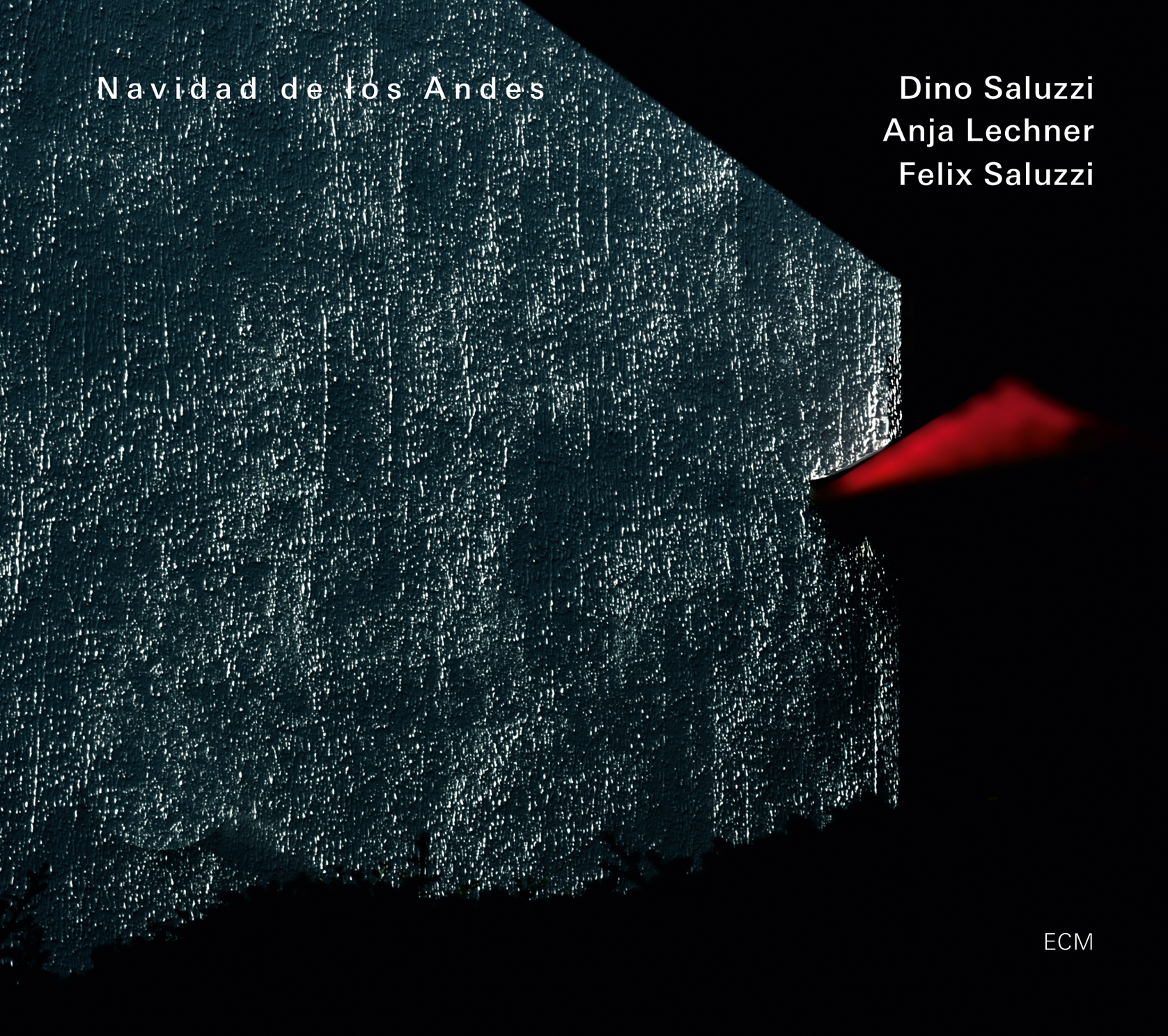
Saluzzi/Lechner/Saluzzi: Navidad de los Andes (ECM 2204)

Navidad de los Andes

Dino Saluzzi
Anja Lechner
Felix Saluzzi
Navidad de los Andes

Dino Saluzzi bandoneon
Anja Lechner violoncello
Felix Saluzzi tenor saxophone, clarinet
Recorded July 2010, Auditorio Radiotelevisione svizzera, Lugano
Engineer: Stefano Amerio
Produced by Manfred Eicher

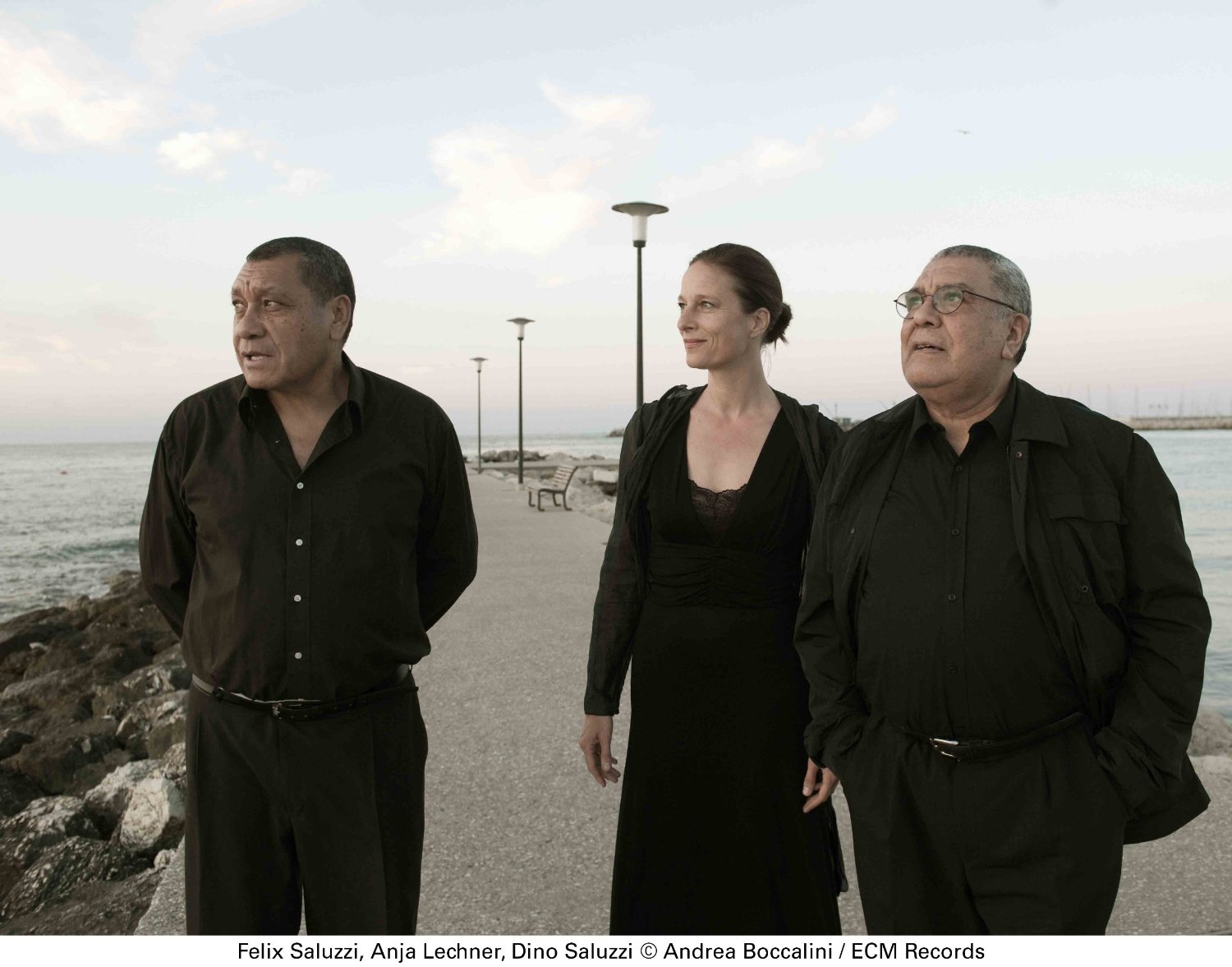
Building on the fruitfulness of their previous collaborations, Dino Saluzzi and Anja Lechner have never sounded so beautiful together as they do on Navidad de los Andes. Their unity reaches profoundest depths, more attentive than ever to the value of spaces between them. This achievement proves to be the album’s blessing and its curse.

In light of their groundbreaking Ojos Negros, the Argentine bandoneón master and German cellist welcome the former’s brother Felix, a reedman of exquisite talent who has graced such classic records as Mojotoro, Juan Condori, and more recently El Valle de la Infancia. Where in those larger contexts the Saluzzi “family band,” as it has come to be known, worked wonders in selective navigations of original and traditional sources, in this more compact setting Felix’s contributions on tenor saxophone feel somewhat excessive. Thankfully, they appear only on three tracks, working progressively better from the incongruous “Requerdos de Bohemia” to the jazzier “Candor/Soledad” and lastly to “Ronda de niños en la montaña,” where it fits best for being more like a voice singing a lullaby.

Lechner and the Saluzzis

Felix’s clarinet, on the other hand, is a revelation. Whether nominally fronted in fragments from the “Trio for clarinet and two bandoneóns” or exploring the tango in “Variaciones sobre una melodia popular de José L. Padula,” his heavenly tone deepens the atmosphere of everything he touches. On that point, the trio functions most effectively when duties are shared in equal measure, as in “Son qo’ñati,” a lively dance that finds each musician handing off motives to the next in a continuous chain of technique and ingenuity. Breathtaking.

But it is, again, the bandoneón-and-cello center that mines the purest ore. Each collaboration in this vein develops its own film of a faraway ecosystem. The whistles and birdcalls of “Flor de tuna” give way to the cloudless sky of “Sucesos” and finish the album with the egalitarian “Otoño.” Along the way, the duo gives “Gabriel Kondor,” last heard on Saluzzi’s ECM debut, Kultrum, a nostalgic makeover.

Despite the tenor’s minor setback, the album stays true to its title, which translates as “Andean Nativity.” A spiritual sense of family and community across eras has always been at the heart of Saluzzi’s music, through which those dynamics thrive. Indeed, life would be nothing without them.

(To hear samples of Navidad de los Andes, click here.)

Paolo Fresu: Mistico Mediterraneo (ECM 2203)

Mistico Mediterraneo

Paolo Fresu
A Filetta
Daniele di Bonaventura
Mistico Mediterraneo

Paolo Fresu trumpet, flugelhorn
Daniele di Bonaventura bandoneón
A Filetta
Jean-Claude Acquaviva seconda
Paul Giansily terza
Jean-Luc Geronimi seconda
José Filippi bassu
Jean Sicurani bassu
Maxime Vuillamier bassu
Ceccè Acquaviva bassu
Recorded January 2010, ArteSuono Studio, Udine
Engineer: Stefano Amerio
Mixed June 2010 by Manfred Eicher, Paolo Fresu, and Stefano Amerio
Produced by Manfred Eicher and Paolo Fresu

My first encounter with Corsican chant was the wondrous Chant Corse, released in 1994 on Harmonia Mundi. Its Rubik’s cube of harmonies, burlap-textured singing, and precise intonation left indelible impressions that lay dormant until Mistico Mediterraneo graced my ears with its irresistible fusion. This phenomenal new project from Paolo Fresu casts the trumpeter’s rounded improvisations into the wind of bandoneón player Daniele di Bonaventura and the all-male Corsican singing group A Filetta. The name means “bracken” in Corsican, referring to a hardy fern that grows along the island and standing in this context as a symbol for the traditions it preserves. A Filetta’s recording career began in 1981, long before Harmonia Mundi introduced Corsican chant to a wider audience, and hopefully awareness and listenership will expand by influence of this groundbreaking ECM production.

The song cycle documented here is the result of four years’ refinement following an initial meeting in 2006. In his liner text, Steve Lake astutely notes the similarity between it and the collaborations between Jan Garbarek and the Hilliard Ensemble. He makes this comparison not only because of the crossover, but also because it forges a living, as opposed to revived, music. As such, it represents much more than a balancing act of the old and the new. Rather, it upends the scale in favor of a highly enmeshed sound from which one can no longer tease apart one influence from another.

Mistico performance
(Photo credit: Andrea Boccalini)

The Corsican strains of Mistico are written in an indigenous style of polyphony and originate mostly in the pen of singer Jean-Claude Acquaviva, who joined A Filetta in 1978 at the age of 13. His “Rex tremendae” sets parameters with its seamless combination of voices, drone, and electronic sheen. In tandem with di Bonaventura’s dreamy filigree, Fresu’s lines push roots through the rolling earth, churned to consistency of prayer. Offerings from other composers sprinkled throughout put such sanctities into bright relief. Bruno Coulais’s “Le lac” is among the album’s more ethereal, while his rhythmic ingenuities evoke African religious song in his setting of the “Gloria” (noteworthy also for Fresu’s flanged inlaying) and give the instrumentalists a fronted stage in “La folie du Cardinal.” These last three were originally written for film, as was Acquaviva’s “Liberata,” and as autonomous pieces open the possibility for fresh imagery. Three pieces by Jean-Michele Gannelli include the oceanic “Da tè à mè,” which perhaps best highlights the singers’ kaleidoscopic profundity, which in the braided “Dies irae” are the illumination to Fresu’s cellular imaginings.

At points, elements diverge for sessions of focus. “Corale,” for instance, establishes a flowing atmosphere without voices. “Figliolu d’ella” begins with that same duet of bandoneón and trumpet and bleeds into voices alone before welcoming both forces into a resonant finish. “Gradualis” features bandoneón and singers only, the concluding high note of which is an unforgettable color shift and leaves the credit roll of di Bonvaventura’s “Sanctus” to sail us out toward misty horizons. On the one hand, it’s unfortunate that no English translations are provided to help navigate those waters. On the other, the words burrow so deeply into us that linguistic signs cease to matter altogether.

None of this would be so if not for Stefano Amerio’s brilliant engineering, which draws out a code so fundamental that it can only be written on the surface of direct experience.

(To hear samples of Mistico Mediterraneo, click here.)

Kremer/Dirvanauskaitė/Buniatishvili: Tchaikovsky/Kissine – Piano Trios (ECM New Series 2202)

Piano Trios

Gidon Kremer
Giedré Dirvanauskaité
Khatia Buniatishvili
Peter I. Tchaikovsky / Victor Kissine – Piano Trios

Gidon Kremer violin
Giedré Dirvanauskaité violoncello
Khatia Buniatishvili piano
Recorded August 2010, Himmelfahrtskirche, Munich
Engineer: Peter Laenger
Produced by Manfred Eicher

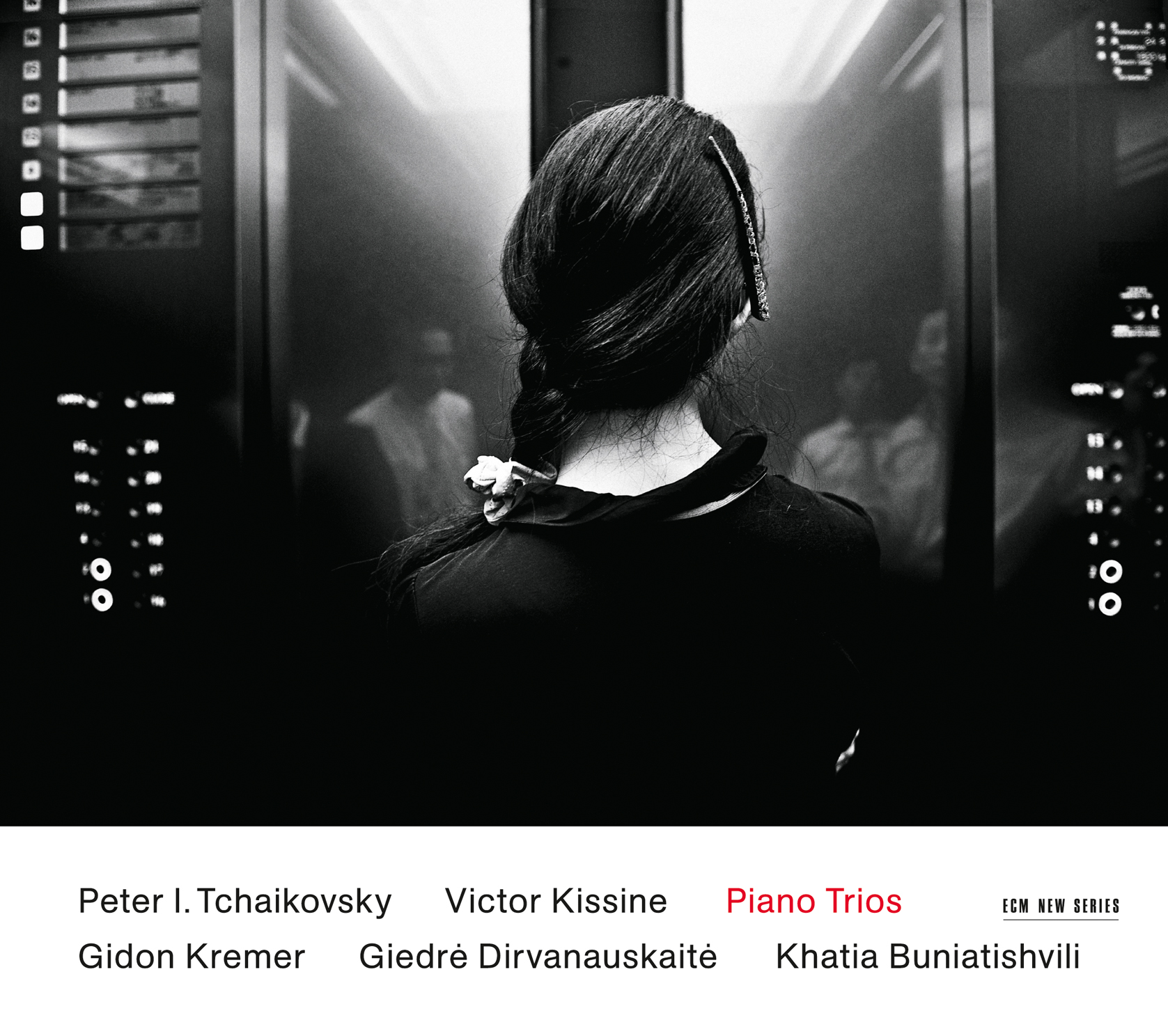
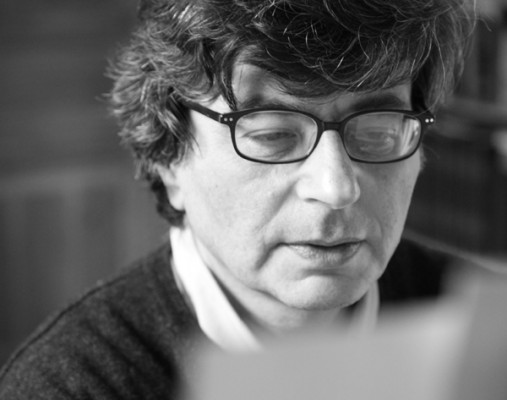
Russian-born composer Victor Kissine first eased into ECM when violinist Gidon Kremer and the Kremerata Baltica recorded Kissine’s orchestration of the Schubert G-major quartet for the label in 2003. The present disc of piano trios gives Kissine’s own music a welcome spotlight, placing his 2009 Zerkalo (The Mirror) in conversation with a masterwork of the medium: Tchaikovsky’s opus 50 a-minor Trio.

Kissine

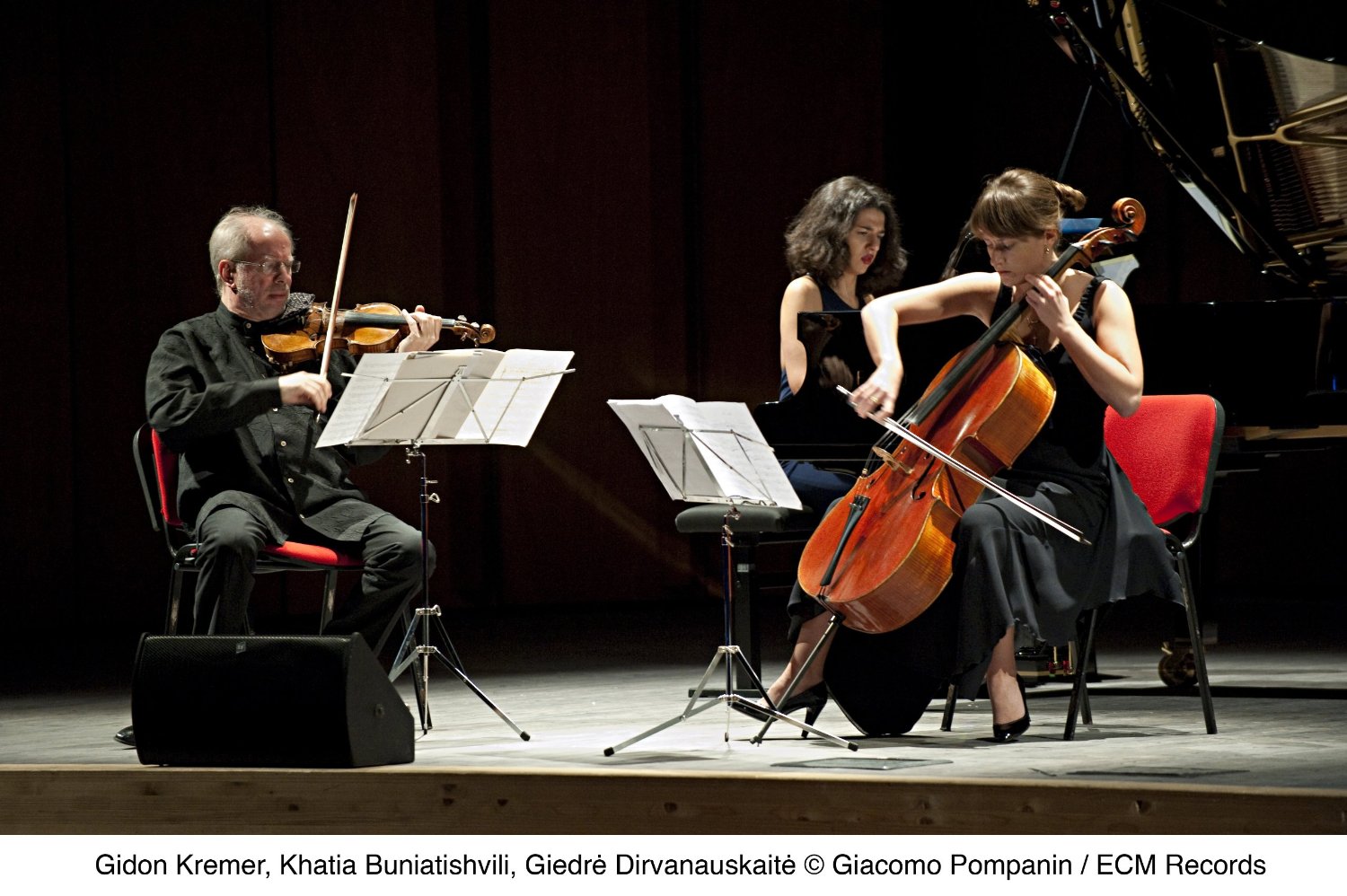
For this reference performance of Zerkalo, Kremer joins cellist Giedré Dirvanauskaité and pianist Khatia Buniatishvili, the very trio to whom the work is dedicated. From the beginning it’s clear that Kissine’s music doesn’t believe in beginnings. Rather, it raises one hand to the sky and another to the earth, leaving grooves of barest traction along the way and notating the resulting paths, yet always with the unwritten periphery in mind. Throughout the piece, Kissine riffs meticulously on the piano’s essence as a percussion instrument. Its echoing relationship to pizzicati provides as much rhythmic as melodic emphasis. It might seem a bold move to begin the album with this nominally modern piece were it not also so delicate in its infusions of place and time, creating of those philosophical staples an intimate and dialogic repose. Speaking to the latter is an astonishing variety of timbres, from the flute-like breath of Dirvanauskaité’s bow to Buniatishvili’s field of twigs and branches, and all of it kissed by Kremer’s wiring. Zerkalo speaks mostly at the level of a whisper and turns the magnification of its microscope higher with every pianistic reset. The music ends—again, not really an ending—in the manner of a palindrome, touched by an evening breeze that has licked brine and carried with it the dreams of freshwater afterlife.

Kremer Trio

Tchaikovsky’s Trio is headed with the words “To the memory of a great artist,” referring to pianist Nikolai Rubinstein, on whose first death anniversary the piece was premiered. In light of this, it’s no wonder that Tchaikovsky himself claimed it an elegiac piece. And yet, such a range of moods courses through its two gargantuan movements that choosing any single quality from among them would seem a sacrilege. We may read plenty of mourning into the cello writing especially, which like Peter Pan seems at times embroiled in a struggle to attach shadows to the pianism’s running feet. But then one notices Tchaikovsky’s feel for space, no better served then by engineer Peter Laenger, and which like the composer’s Souvenir de Florence turns harmonies and compulsions into imagistic storehouses.

The drama therein exists not only in the heft of its 20-minute first movement, but also in the sensitivity of its outpouring. Its most robust sections are also its tenderest, as in a beautiful passage just over halfway through in which violin and cello circle slowly around the piano’s lumbering chords. The Trio concludes with a theme and 11 variations. Enchanting passages abound, as in the fifth variation, for which the piano floats into higher registers against folkish backing from the strings. The churning reverie of the ninth variation and anchoring pizzicato cello of the eleventh are further highlights. All roads lead to the bracing Finale and a Coda that sends us off with a lullaby, that we might dream of the music’s continuance.

(To hear samples of Piano Trios, click here.)

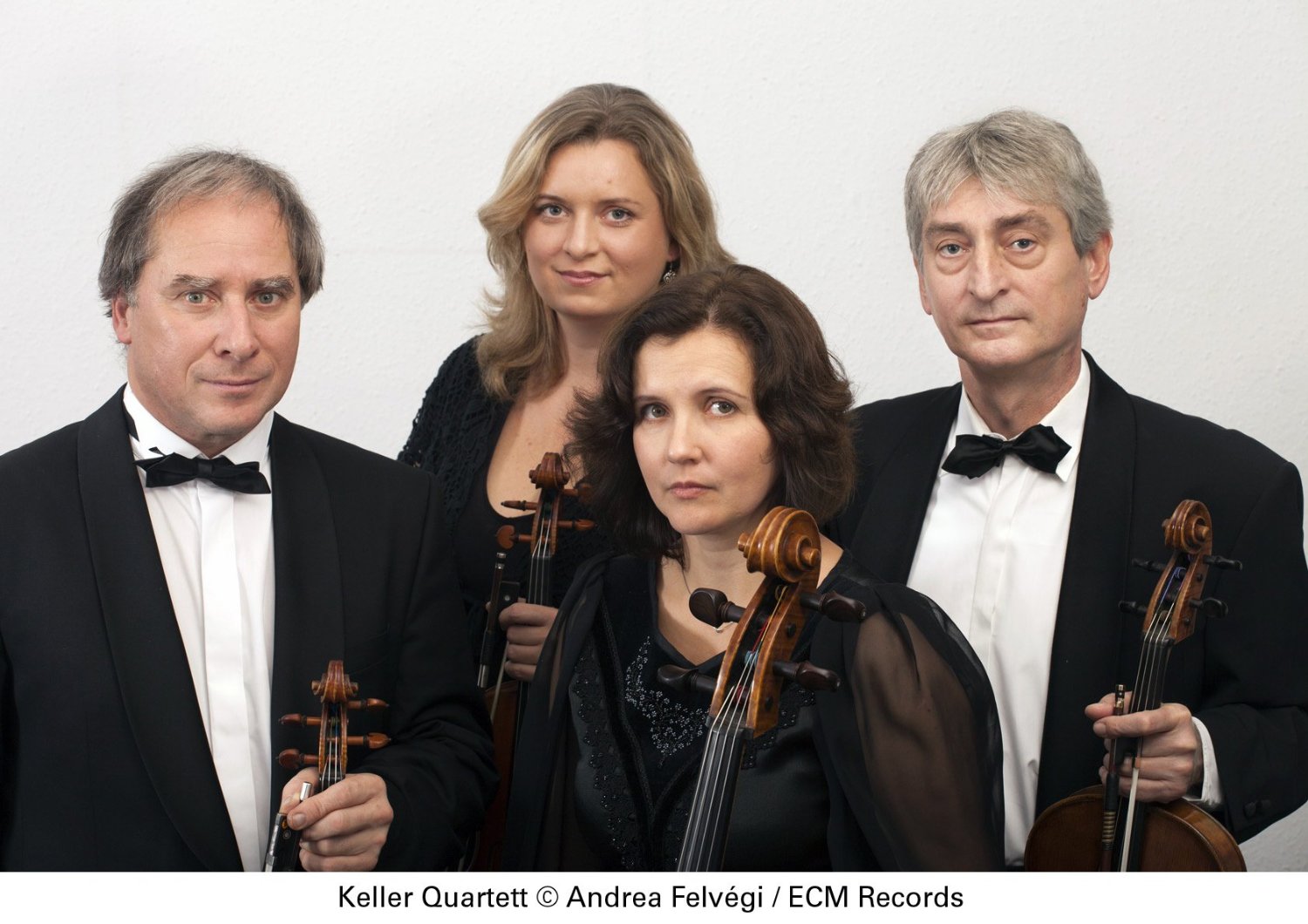
Keller Quartett: Ligeti String Quartets / Barber Adagio (ECM New Series 2197)

Ligeti Barber

Keller Quartett
Ligeti String Quartets / Barber Adagio

András Keller violin
János Pilz violin
Zsófia Környei violin (on String Quartet No. 2)
Zoltán Gál viola
Judit Szabó violoncello
Recorded June 2007 and October 2011 (String Quartet No. 2), Radio Studio DRS, Zürich
Engineer: Peter Laenger
Produced by Manfred Eicher

“How times have changed,” notes Paul Griffiths in his liner text to this album of string quartets by György Ligeti (1923-2006) and Samuel Barber (1910-1981). “How a recording can change them.” Indeed, at the bows of the Keller Quartett, the capabilities of two violins, one viola, and a cello are intensely magnified by performance and composition in equal measure.

Keller Quartett

Ligeti’s single-movement String Quartet No. 1 (1953/54) takes the title Métamorphoses nocturnes. It opens the program with a DNA helix, from which a single aberrant rung breaks free as a model for the others. The Kellers handle such structural changes with graceful science as warped dances and dizzying draws stoke the embers of continuity from beginning to end. Pizzicati become tactile pressure points, signs that the titular metamorphoses take place in those interims where dreams expand into days’ worth of experience yet take up only a sweep of the second hand. Darker textures at the center of this quartet prefigure Henryk Górecki’s own by decades, while the unforgettable slap pizzicato from cello marks the path with fortitude. The sheer variety of textures is beguiling enough. That Ligeti is able to combine them so organically takes a depth of attention of which few are possessed. A flock of harmonic glissandi toward the end elicit some of the most atmospheric writing for the medium, lasting only as long as the thought to include them before the cello snakes into affirmation and quiet recoil.

The undefeated Adagio from Barber’s opus 11 String Quartet (1935/36) is a chromatic dream come true. Needing no introduction, it nonetheless feels introduced here by the Keller touch. Tasteful, selective applications of vibrato allow for smooth textures to arise, especially in the second violin and viola. Furthermore, the musicians back off at the piece’s climax, thus rendering it less insistent, more of a blossoming than a cutting through, and setting up rawness in the cello-heavy afterglow. It’s somewhat regrettable that the rest of the quartet should be so often ignored, and the missed opportunity to correct this tendency here is only somewhat perplexing, for full inclusion might also have undermined the intimate compactness of the disc, which if pushed to a double could lose its hold on the listener (I would argue for the opposite). Either way, Barber’s contrapuntal beauties are vibrant and secure in this unique Ligeti sandwich.

Second violinist Zsófia Környei replaces János Pilz for Ligeti’s String Quartet No. 2, which over the course of five movements proves itself to be microscopically bonded beneath a seemingly fragmented surface. Where the mood is slow and sustained, the feeling is of viscous substance from which arise globules that never quite attain autonomy. The mostly pizzicato center forges dawn from dusk, welcoming ephemeral bow contacts in latent purchase. The final Allegro, by contrast, orients itself by a language most akin to cinema. As if in a credit roll, arpeggios and peripheral utterances sweep themselves into recession, leaving only a trail of shadows for us to follow.

Then again, the invitation to follow might itself be an illusion born of the listening process, which can never repeat itself exactly as before. And so, not only can a recording change the times; it can record change itself.

Zehetmair Quartett: Beethoven/Bruckner/Hartmann/Holliger (ECM New Series 2195/96)

ZQ

Zehetmair Quartett
Beethoven/Bruckner/Hartmann/Holliger

Thomas Zehetmair violin
Kuba Jakowicz violin
Matthias Metzger violin (Hartmann)
Ruth Killius viola
Ursula Smith violoncello
Françoise Groben violoncello (Hartmann)
Beethoven, Bruckner, and Holliger recorded April/May 2010 by Andreas Werner Hartmann recorded April 2002 by Markus Heiland at Radio Studio DRS, Zürich
Produced by Manfred Eicher

Violinist Thomas Zehetmair has become a household name at ECM, and nowhere more passionately than in his world-renowned quartet. While the group has always been adventurous, this album takes that spirit to new heights, and lengths, as it presents a monumental two-disc program of quartets by Ludwig van Beethoven, Anton Bruckner, Karl Amadeus Hartmann, and Heinz Holliger.

ZQ Portrait
(Photo credit: Keith Pattison)

In his brilliant liner notes, Wolfgang Sandner discusses the senescent Beethoven, whose final work, the formidable Opus 135, is the subject of the Zehetmairs’ bar- and hair-raising performance: “Beethoven’s late string quartets share the fate of many works created by great artists in their declining years, works which, as Adorno put it, point to the borderlines of art and almost acquire documentary stature. That is why, he continues, discussions of late Beethoven rarely lack references to his life and destiny.” In other words, the stature of an artist tends to be proportional to one’s biographical investment in that artist, as if the two were bonded matter. But if we were to see this quartet as a rope, we would find that, throughout each movement and between them, the unraveling yields thinner and thinner fibers, each more potent than the last. What distinguishes it as the final work of a master composer is therefore not so much the foreboding admixture of death and reflection that may or may not be intentioned in the music as an underlying spiritedness, held in check until choicest moments of reveal. All of this gives delicate passage into the second movement, which begins in that carefully controlled fragility by which Beethoven was so enamored but sows its field of tension with mounting density. The third movement, marked Assai lento, is cosmic and emotionally naked, a filamented chain into the final movement. Where rhythmic interplay was delightful before, here it surges.

From the end of one’s compositional life to the beginning of it, Bruckner’s String Quartet in c minor, WAB 111, was written in 1862 as a study piece while under the tutelage of German cellist-conductor Otto Kitzler. A smooth mélange of styles, it harbors echoes of Beethoven, and perhaps more explicitly of Dvorák, especially in the opening and closing movements. It is a sumptuous offering, its relief more extroverted in comparison to Beethoven’s inlaid approach, but in the flowing Andante we hear the latter’s game of hide and seek with exuberance before climbing ashore fully intact in the Scherzo, which serves as an amiable and spirited portal into the darker conclusion.

Hartmann’s String Quartet No. 2 is duly special for appearing on this record. First, it was recorded in 2002, eight years before the rest of the program, with a different second violinist (Matthias Metzger) and cellist Françoise Groben (1965-2011), a founding member of the quartet and in whose memory this recording, her last, bears dedication. Second, the music itself represents one of the pinnacles of the 20th-century string quartet. Begun at the tail end of World War II and finished in its immediate wake, it takes a three-movement structure, building on lachrymose foundations a tower of dance. Far from linear, however, it continues the theme of animated expositions out of quiet introductions. By these the music adopts an illusion of self-recognition. Despite its many shadows, the passion and joy with which the quartet plays this piece is fully evident. Groben’s playing is a wonder, bringing out as it does a turgid core. That said, the players do, and must, work together as one unit, for each move pulls the others in empathic response. A pervading heaviness in the central Andantino makes it an especially demanding play, as the performers must engage in deep listening and strictest attention to dynamics. The last movement, a Presto, enables reckoning of those darker predecessors with the light of geometric (if not also geographic) thinking and lends sanctity to the final major chord. Phenomenal.

Last is Holliger’s own String Quartet No. 2. Written by commission from the musicians, this stream-of-consciousness, single-movement work includes aleatory elements and is played scordatura. Like a scientist who pours water from one glass to another yet still finds wonder in the changes, Holliger engages the strings in flowing conversations of elements and transparencies, marking every drop spilled with precision. In this way, he cleverly reverses inner and outer. Like the Hartmann, this piece requires religious attention to dynamic contrast. This is not to say that Holliger is a cryptic composer, but that he composes with solutions rather than questions. One needs not overextend any theoretical impulse to understand the motives of writing that so comfortably favors absorption. This means that the piece’s quieter midsection may seem the very definition of mystery, when in fact it uses the mode of whisper to focus attention on its thread count. Consequently, the more forthright politics of its surroundings glisten with a personal sheen, which finds itself honed by erosion and the shape of human voices, as the musicians are bid to sing in the final scene. With the joining of their throats, these classical constructions of gut and wood become bodies in and of themselves, and render the preceding quartets a limb apiece.

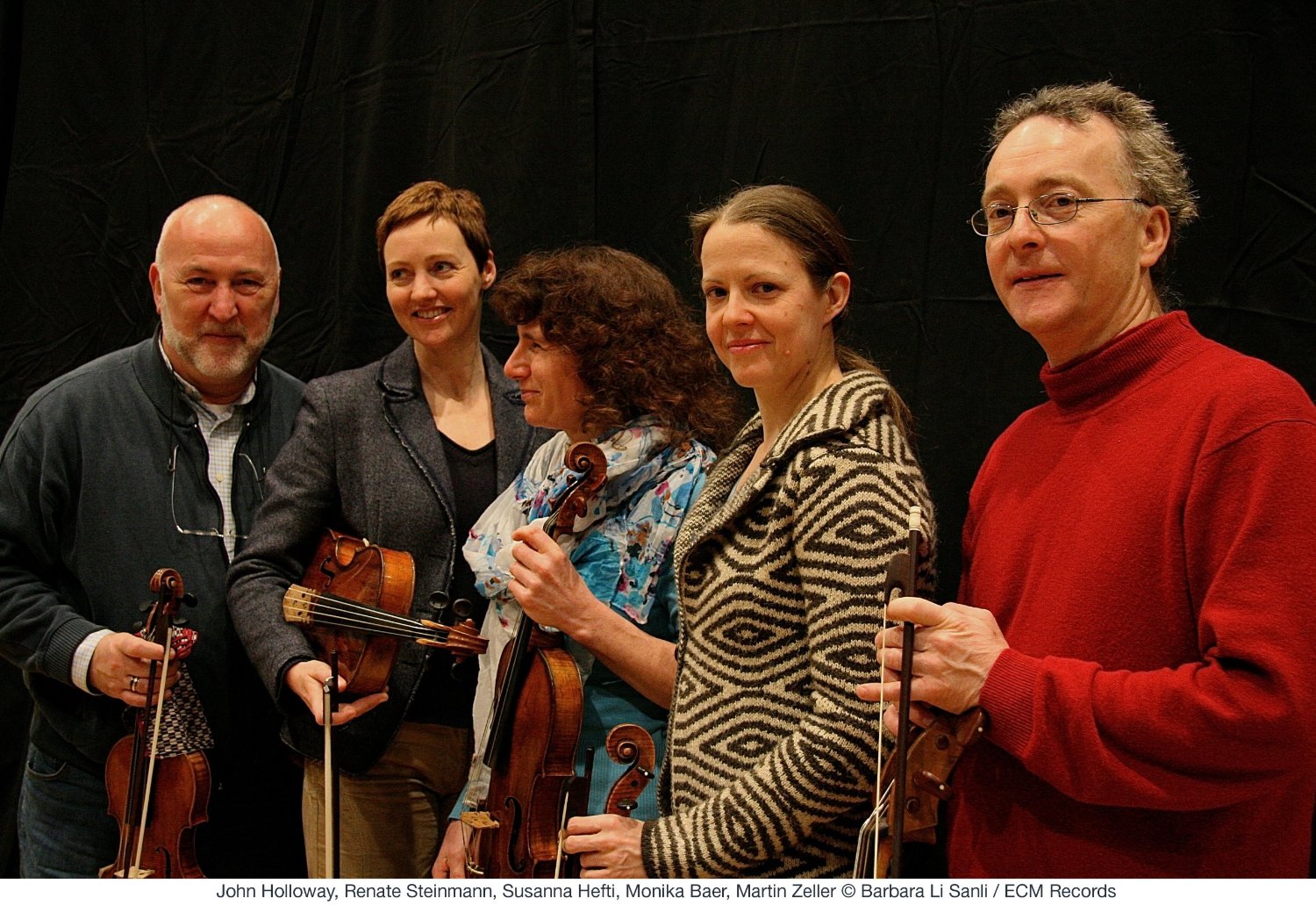
John Holloway: Pavans and Fantasies from the Age of Dowland (ECM New Series 2189)

Pavans and Fantasies

John Holloway
Pavans and Fantasies from the Age of Dowland

John Holloway violin, viola
Monika Baer violin, viola
Renate Steinmann violin
Susanna Hefti viola
Martin Zeller bass violin
Recorded March 2013, Radio Studio Zürich
Engineer: Andreas Werner
Produced by Manfred Eicher
An ECM / SRF2 Kultur co-production
Executive producer (SRF): Roland Wächter

Violinist John Holloway has carved the deepest Baroque relief into ECM’s surface. With sole exception of Bach’s Sonatas and Partitas for solo violin, he has since 1999 been accompanied by harpsichord and organ or cello continuo in thoughtful and superbly executed programs of music by such composers as Schmelzer, Biber, Veracini, Leclair. For the present disc he joins an all-string ensemble of period specialists in a book of music at once haunting and robustly fleshed. Not only is it renewing to hear Holloway free-floating in a choir of equal voices; his choice of material carries further significance for turning back the dial to one of the great masterworks of the late Renaissance.

Holloway and Friends

The Lachrimae Pavans of John Dowland (1563-1626) take thematic root in composer’s evergreen “Flow My Teares,” a song last recorded for ECM by John Potter on his Dowland Project’s debut. By time the Lachrimae were published in 1604, Dowland had been court hopping for a decade. He composed the collection under the auspices of his then-employer, Denmark’s King Christian IV, whose sister-queen Anne was the subject of its dedication. In addition to being musical landmarks, the Lachrimae represent a watershed historical moment in English music publishing. They came at a time of great frustration for Dowland, who never realized his dream of holding post at the English court. But while melancholy pervades, there are sunlit glades to be discovered among the thickets.

Lachrimae

Indeed, there’s plenty of sunshine to be had in the “Lachrimae Antiquae,” which prepares for its daily works with nightlong ablution. As from so much of what follows, its darkness seeps through like a contrapuntal substance of harmonic order. Dowland’s beauties turn supplication into strength and draw the clouds nearer to earth with every added layer. Both musicians and music move as one sinuous entity—must do so, in fact, to achieve the limpid consistency required of the “Lachrimae Tristes,” which as the program’s exact center is the most deeply hued jewel of this crown. The qualities of subsequent variations are as individual as their titles. “Lachrimae Coactae” is threadbare yet flourishing, “Lachrimae Amantis” more viscous, and the “Lachrimae Verae” a burnished hasp of a conclusion.

Shuffled into the Lachrimae are exemplary selections of English consort music from Dowland’s time. Of these, the Fantasy upon one note by Henry Purcell (1659-1695) is the most forthright, while the Fantasy for 2 Trebles and Bass of Matthew Locke (1621/3-1677) cradles fleeting exuberances in downtempo reflections. The brightest surfaces come from William Lawes (1602-1645), whose autumnal Fantasy in C for 5 is another highpoint of the literature assembled herein. John Jenkins (1592-1678) gets a nod in the form of his Fantasy No. 12 for 2 Trebles and Bass, a fugal ripple of a piece with ballroom denouement. Its contrast of floating highs and supportive brushwork from bass violin give it a most expansive reach. Last but not least is Thomas Morley (1557/58-1602), a key figure in realizing the Lachrimae in print, and whose Lamento for 2 (excerpted from his Canzonets for two voyces) is a slow dance between forest sprites, whose leaf-hidden conjugations harness moonlight in every step.

Although there’s so much to admire the form and content of this album, it’s just the tip of a mountain of contemporaneous sources. Listening to Holloway and friends making such sweet music is akin to skipping a perilous journey and diving straight into the treasure horde at the end of it. But its greatest value might just be the desire it inspires to backtrack and see what fruitful lodgings might have been missed along the way.

(To hear selections from Pavans and Fantasies from the Age of Dowland, click here.)

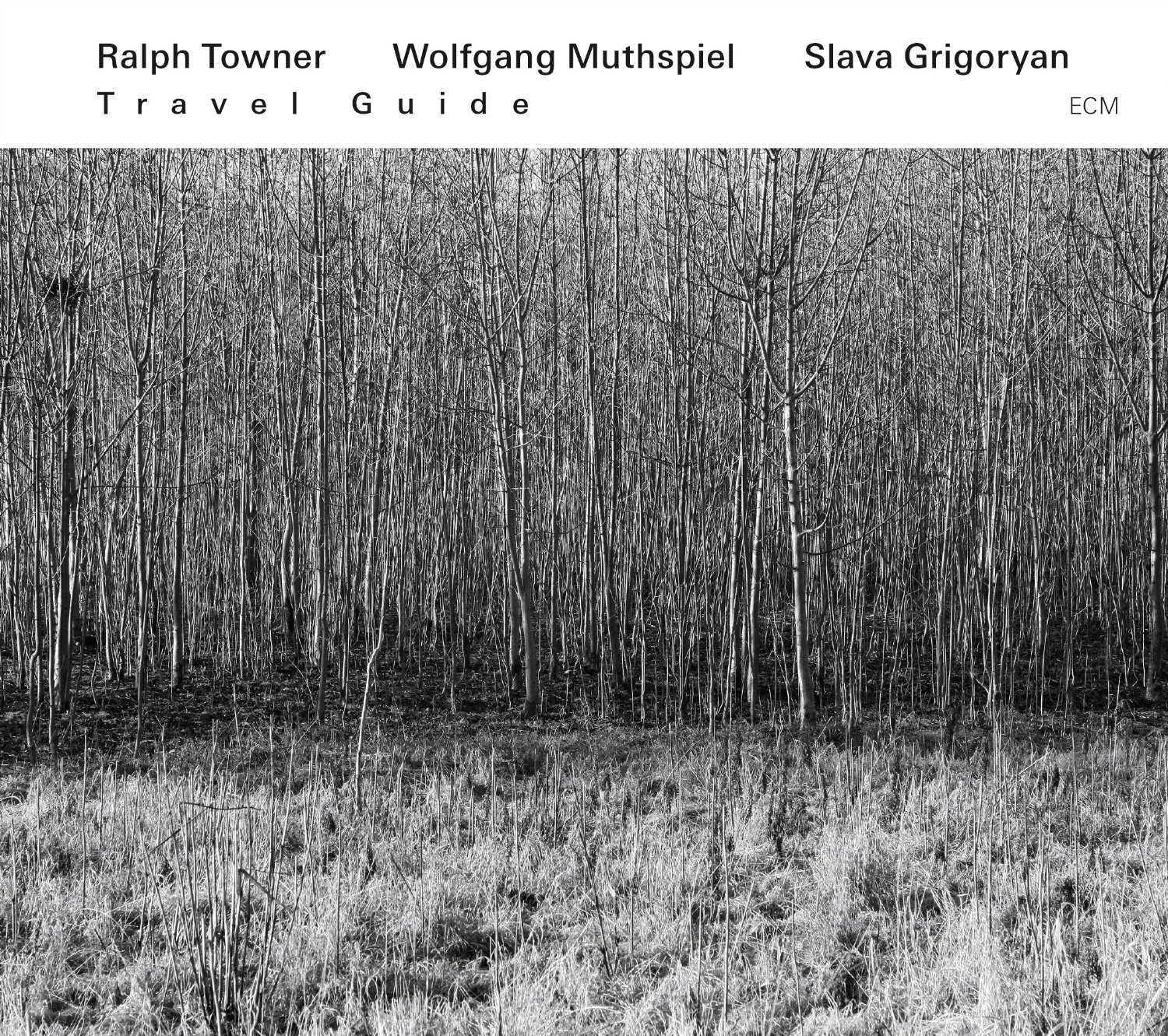
Towner/Muthspiel/Grigoryan: Travel Guide (ECM 2310)

Travel Guide

Travel Guide

Ralph Towner classical and 12-string guitars
Wolfgang Muthspiel electric guitar, voice
Slava Grigoryan classical and baritone guitars
Recorded August 2012, Auditorio Radiotelevisione svizzera, Lugano
Engineer: Stefano Amerio
Produced by Manfred Eicher

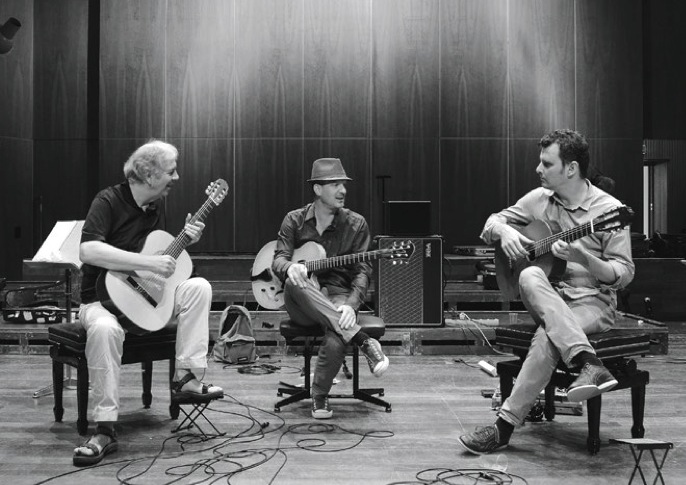
Travel Guide brings together Ralph Towner on classical and 12-string guitars, Wolfgang Muthspiel on electric guitar, and Slava Grigoryan on classical and baritone guitars. Representing the US, Austria, and Kazakhstan, respectively, the three came together in a 2005 tour that first brought their sound as a unit into undeniable perspective. The resulting trio builds on the integrity of every tune—in this case an even ten from Towner and Muthspiel. The two write with such kindred spirit that one needn’t even parse them, though characteristics familiar to Towner fans do give his music a distinctive arc. Ultimately, the lyrical improvising on all fronts turns every track into a matter of group belonging.

Travel Portrait
(Photo credit: Dániel Vass)

“The Henrysons” introduces a tone-setting spiral of ostinatos and leading lines in a mesh so organic that one might think these musicians had been playing together for as long as they have alone. The resonance of Muthspiel’s electric imbues the trio with a pianistic touch of magical realism throughout, especially in the title track, of which the uplifting prosody and luminescent harmonies make it a highlight. Muthspiel even lends his voice for a spell on “Amarone Trio,” evoking the instrumental singing of Nana Vasconcelos in the context of the Pat Metheny Group. But Muthspiel’s deepest achievement is his stellar writing, which spans the subdued wit of “Die Blaue Stunde” and the virtuosic “Nico und Mithra,” at moments sounding more like Towner than Towner. The latter’s unmistakable 12-string carves oars for “Windsong,” guiding a compact yet fully featured vessel down a moonlit river. Grigoryan has a standout solo here, his lyricism attuned to every negative space.

The brilliance of execution on each side of this equilateral triangle resides in timekeeping precision. Without it, so much of what is unwritten in Towner would be impossible to articulate. The fragile coloratura of “Father Time,” for instance, shows just how well the musicians understand the spirit of his texts. For indeed, Towner builds his lodgings on bedrock of language—a diary, if you will, of life’s unpredictable passage. His substantial “Duende” is the highest peak in this regard. Its impulses are every bit as linked as Towner’s solo “Tarry,” which turns toward the concluding “Museum of Light” with a cloudy but self-understanding heart.

Whether or not you’re a Towner aficionado, Travel Guide is a no-brainer for the ECM enthusiast. It requires no suitcase or ticket, only an open ear and an open road.

(To hear samples of Travel Guide, click here.)

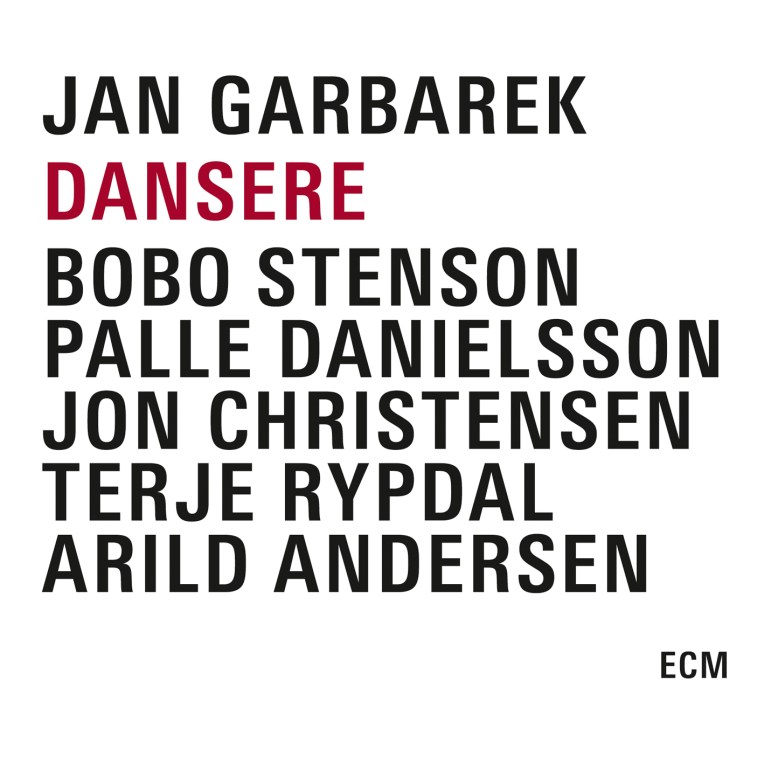
Jan Garbarek: Dansere (ECM 2146-48)

ECM 2146-48

Jan Garbarek
Dansere

The Dansere box continues ECM’s Old & New Masters series with four landmark achievements, the first three being the albums gathered within its matte packaging and the fourth being producer Manfred Eicher’s decision to reissue them as a set. None of the musicians need introduction here, least of all Norwegian saxophonist Jan Garbarek, who spearheads classic concoctions of extracts new and old. These early albums were key developments in the sounds of the musicians and a label with the wherewithal to pave their launching pad into the stratosphere of music history.

Garbarek is said to have forged Norwegian jazz from diverse elements of his homeland, but something elemental in the very earth must also have forged his endlessly creative mind as a receptor to those elements. His career has of course splintered in so many directions since then, but a genuine commitment to the music has remained constant in everything he plays and is only magnified by the company he has chosen to keep.

ECM 1015

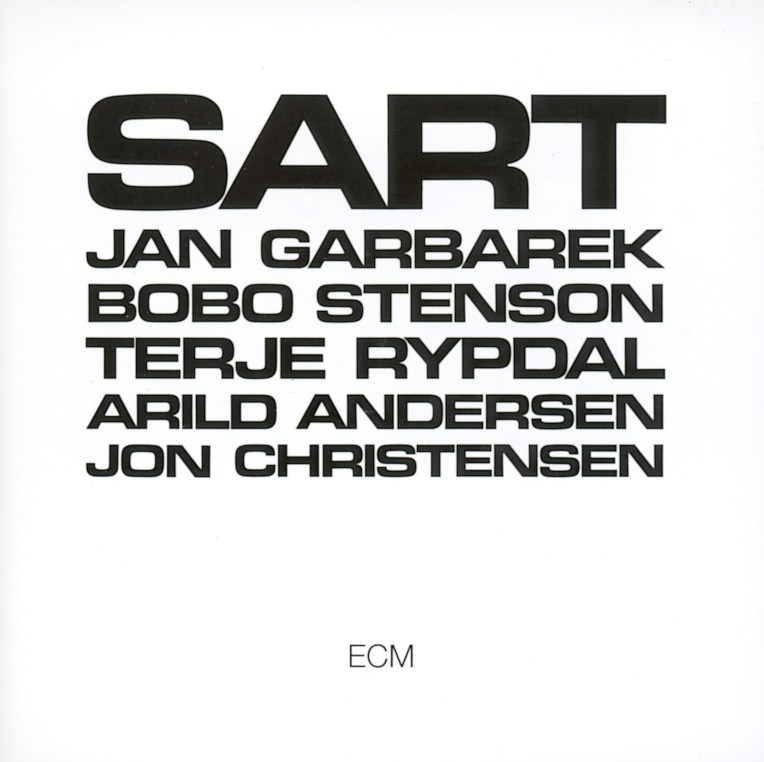
Sart (ECM 1015)

Jan Garbarek tenor and bass saxophones, flute
Bobo Stenson piano, electric piano
Terje Rypdal guitar
Arild Andersen bass
Jon Christensen percussion
Recorded on April 14/15, 1971, at the Arne Bendiksen Studio, Oslo
Engineer: Jan Erik Kongshaug
Produced by Manfred Eicher

One could hardly ask for a more dynamic super group than that assembled on Sart. Garbarek’s first album of this boxed set is also his second for ECM and throbs with these young musicians’ intense desire to lay down new paths. Four of the album’s six compositions are by Garbarek. The first of these is the title cut, which takes up more than one third of the album’s total length. After an eclectic swirl of wah-pedaled guitar riffs from Terje Rypdal, Bobo Stenson’s sweeping pianism, the fluttering drums of Jon Christensen, and erratic bass lines of Arild Andersen, Garbarek’s entrance alerts us with all the import of an emergency siren. It’s an arresting beginning to an arresting album, evoking at one moment a 70s action film soundtrack and the next a clandestinely recorded late-night jam session. “Fountain Of Tears ­ Parts I & II” forges a harsher sound before swapping reed for flute. With the support of Stenson’s electric piano, Garbarek slathers on the sonority for a striking change of atmosphere. In “Song Of Space,” sax and guitar double one another almost mockingly before Rypdal hops a more intense train of thought, in the process mapping the album’s most epic terrain. Garbarek is only too happy to lend his compass. “Irr” turns Andersen’s nimble opening statement into a full-fledged narrative, along with some enjoyable adlibbing from Garbarek and Stenson. Andersen and Rypdal round out the set with respective tunes of their own. “Close Enough For Jazz” is a brief interlude for bass and reed full of unrequited desire, while “Lontano” finishes with Rypdal’s meditative, twang-ridden charm.

More expressive than melodic, per se, this is engaging free jazz that’s constantly looking for debate. Such is the sense of play through which it thrives. At times the music is so spread out that one has difficulty knowing if and when a “solo” even occurs. Regardless, Garbarek’s playing is knotted, but also carefully thought out. As in so much of his output during this period, he tends toward a sobbing, wailing quality that adds gravity to relatively airy backdrops. This is music with patience that demands just as much from the listener. It lives on the edge of its own demise, always managing to muster one final declaration before it expires.

<< Chick Corea: Piano Improvisations Vol. 1 (ECM 1014)
>> Terje Rypdal: s/t (ECM 1016)

… . …

ECM 1041

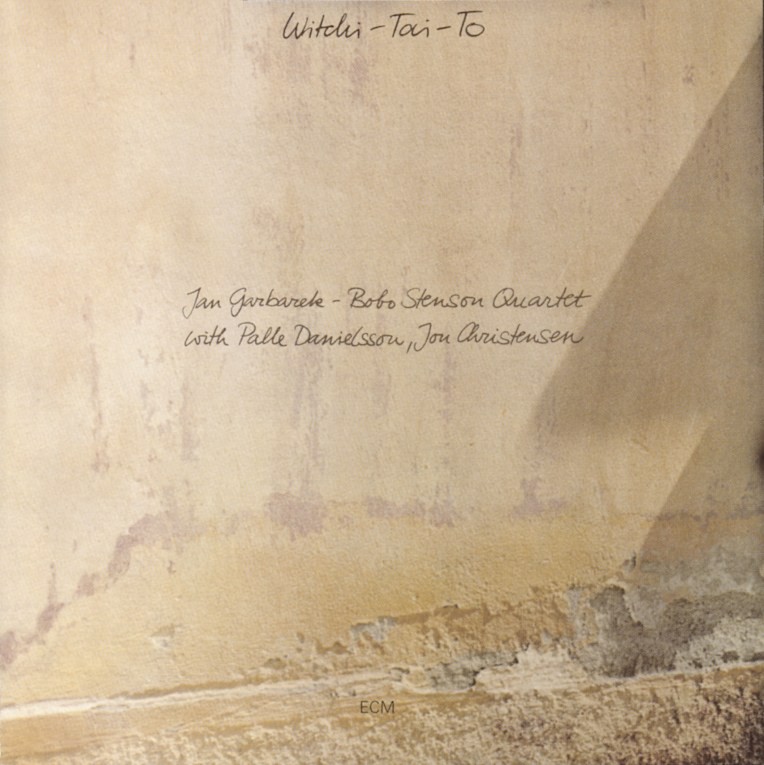
Witchi-Tai-To (ECM 1041)

Jan Garbarek soprano and tenor saxophones
Bobo Stenson piano
Palle Danielsson bass
Jon Christensen drums
Recorded November 27/28, 1973 at Arne Bendiksen Studio, Oslo
Engineer: Jan Erik Kongshaug
Produced by Manfred Eicher

Regarding jazz, Louis Armstrong once famously quipped: “Man, if you have to ask what it is, you’ll never know.” For those still feeling lost, let Witchi-Tai-To provide one possible answer. As Jan Garbarek’s oft-touted masterpiece, this is not an album to shake a stick at. If anything, it is one to be shaken by.

Carla Bley’s “A.I.R.” (All India Radio) summons this classic soundscape with a ceremonial thumping of bass, working toward saxophonic flights of fancy. Before long, Garbarek descends from his cloud with a pentatonic flavor before again riding the thermals of his generative spirit. This segues into a rousing piano exposition from Stenson, running with the adamancy of a child who thinks he can fly. The avian soprano sax returns as if to espouse the wonders of the air while also warning of its hidden hazards, catapulting itself into the vanishing point. “Kukka,” by bassist Palle Danielsson, is a relatively somber, though no less effective, conversation. It gives ample room for piano and bass alike to make their voices known and ends with another ascendant line of reed. Carlos Puebla’s politically charged “Hasta Siempre” seethes like radical folk music in search of an outlet. Drums and piano enable a boisterous towering of improvisatory bliss. Garbarek is a wonder, grinding out the most soulful sound he can muster, while Stenson’s frolicking runs practically stumble over their own momentum. In the title track by Jim Pepper, the rhythm section’s windup pitches more soulful solos from Garbarek, who can do no wrong here. His clarity of tone and conviction are sonically visionary and ideally suited to his cadre of fellow soundsmiths. Last but not least is “Desireless.” This Don Cherry tune is given a 20-minute treatment that surpasses all expectations. It’s a mournful closer, a song of parting, an unrequited wish. It tries to hold on to a rope that is slipping through its fingers, even as it struggles with all the strength at its disposal to keep the music alive. Garbarek refuses to go down without an incendiary swan song, however, and by the end it is all we have left.

Much has been said in praise of the Danielsson/Christensen support in this outfit, and one would be hard-pressed not to feel the intense drive the duo invokes at almost every moment. To be sure, this is a team of musicians whose independent visions work flawlessly together, and whose end result is an essential specimen in any jazz collection. Witchi-Tai-To is a struggle against time from which time emerges victorious. Thankfully, we can always start the record over again.

<< Gary Burton: Seven Songs For Quartet And Chamber Orchestra (ECM 1040)
>> Eberhard Weber: The Colours Of Chloë (ECM 1042)

… . …

ECM 1075

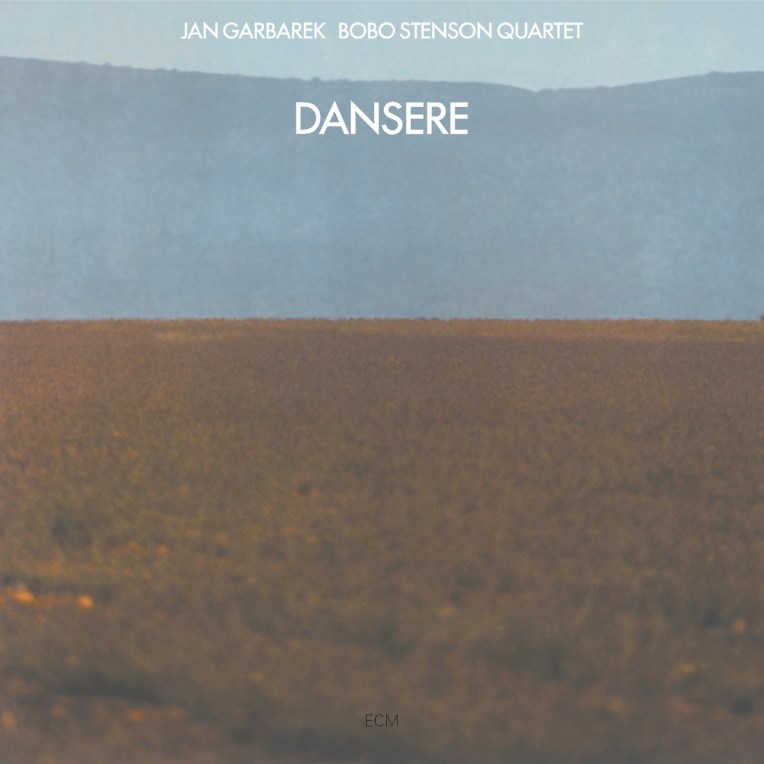
Dansere (ECM 1075)

Jan Garbarek saxophones
Bobo Stenson piano
Palle Danielsson bass
Jon Christensen drums
Recorded November 1975 at Talent Studio, Oslo
Engineer: Jan Erik Kongshaug
Produced by Manfred Eicher

There is a tendency in ECM’s formative jazz releases toward immersive beginnings. Dansere is no exception, with its introductory flutter of sax and glittering piano runs. Comparing this album to Belonging, which features Keith Jarrett in the same company as Bobo Stenson is here, it’s amazing to consider the differences with another pianist at the fulcrum. One musician’s worth of difference may not seem like much on the back of an album jacket, but here it translates into essentially ten new voices with their own sensibility of time and space. Stenson’s abstractions throughout bleed into the listener’s mind like a smearing of watercolor across absorbent paper.

This is music that has woken up after a long slumber—so long, in fact, that now it struggles to face the morning glare. The musicians seem to play with their eyes closed, grasping at fading tendrils of memory so close in dreamtime yet otherwise so distant. Whereas some of us might grab a note pad and try to capture as many of those fleeting moments before they escape us upon waking, each member of this quartet finds an instrument and sets his recollections to music. The album finds the time to stretch its vocal cords, to take in the air, to look outside and judge the weather from the clouds and the moisture it inhales.

The title track is the most demanding journey here, carrying us through a gallery of moods and locales, and fades out beautifully with Christensen’s rim shot clicking like a metronome into the heavy silence. In “Svevende” Stenson emotes a laid-back aesthetic, finding joy in quieter moments. Though we are by now fully awake, we still find ourselves regressing to the darkness of sleep and its promise of vision. Every moment leaves its own echo, so that each new note carries with it a remnant of all those it has left behind. “Bris” picks up the pace a little and showcases Garbarek in a heptatonic mode. Stenson also has some memorable soloing here, working wonderfully against Christensen’s drums and Danielsson’s steady thump. Somehow the motives remain melancholy, speaking as they do in languages they have yet to understand. “Skrik & Hyl” features a sax/bass duet of piercing incantations before Stenson brings us back down to terra firma in “Lokk.” The title here means “herding song” and feels like a call home. It unfolds like the dotted plain on the album’s cover, a desert under a hanging moon or an ocean swept by a lighthouse. “Til Vennene” is the end of a long and fruitful day. Yet in spite of the album’s pastoral flair, I find this final track to be rather urban. It shifts and settles like a drained glass of scotch, leaving only that diluted rim of sepia at the bottom: a mixture of melted ice and solitude. You feel just a little tipsy, straggling home through the rainy streets. Memory and sorrow swirl without blending, like every rainbow-filmed puddle you pass in gutters and potholes. You wander as if you are walking these streets for the first time, knowing that your legs will get you home regardless of your inebriation. Your only footholds are those brief moments of bliss shared among friends; the only times when trust was never absent. Your world becomes blurry…or is it you who blurs?

<< Jack DeJohnette’s Directions: Untitled (ECM 1074)
>> Barre Phillips: Mountainscapes (ECM 1076)