Gard Nilssen Acoustic Unity: Elastic Wave (ECM 2724)

Gard Nilssen Acoustic Unity
Elastic Wave

André Roligheten tenor, soprano and bass saxophones, clarinet
Petter Eldh double bass
Gard Nilssen drums
Recorded June 2021
Studios La Buissonne, Pernes-les-Fontaines
Engineer: Gérard de Haro
Mastering: Nicolas Baillard
Cover: Fotini Potamia
Produced by Steve Lake
Release date: July 15, 2022

André Roligheten is one of the most exciting young saxophonists in the Norwegian jazz scene. I had the pleasure of seeing him in various guises under the auspices of the 2018 Nutshell jazz festival (see my writeup and photos here), and I always hoped to see his name on an ECM roster one day. I am happy to say that day has come, and I can hardly imagine finer company than Swedish bassist Petter Eldh (who made his first label appearance as part of Django Bates’ Belovèd on The Study Of Touch) and Norwegian drummer Gard Nilssen, whose highly sought-after name emblazons Elastic Wave as bandleader. Nilssen has played with almost anyone of note in the European circuit you can think of, from veterans like Audun Kleive (under whom he studied) and Arild Andersen to fresher talents like Maciej Obara (see Unloved and Three Crowns) and Roligheten himself. His paths have also intersected with major figures from across the pond, including Bill Frisell and Pat Metheny.

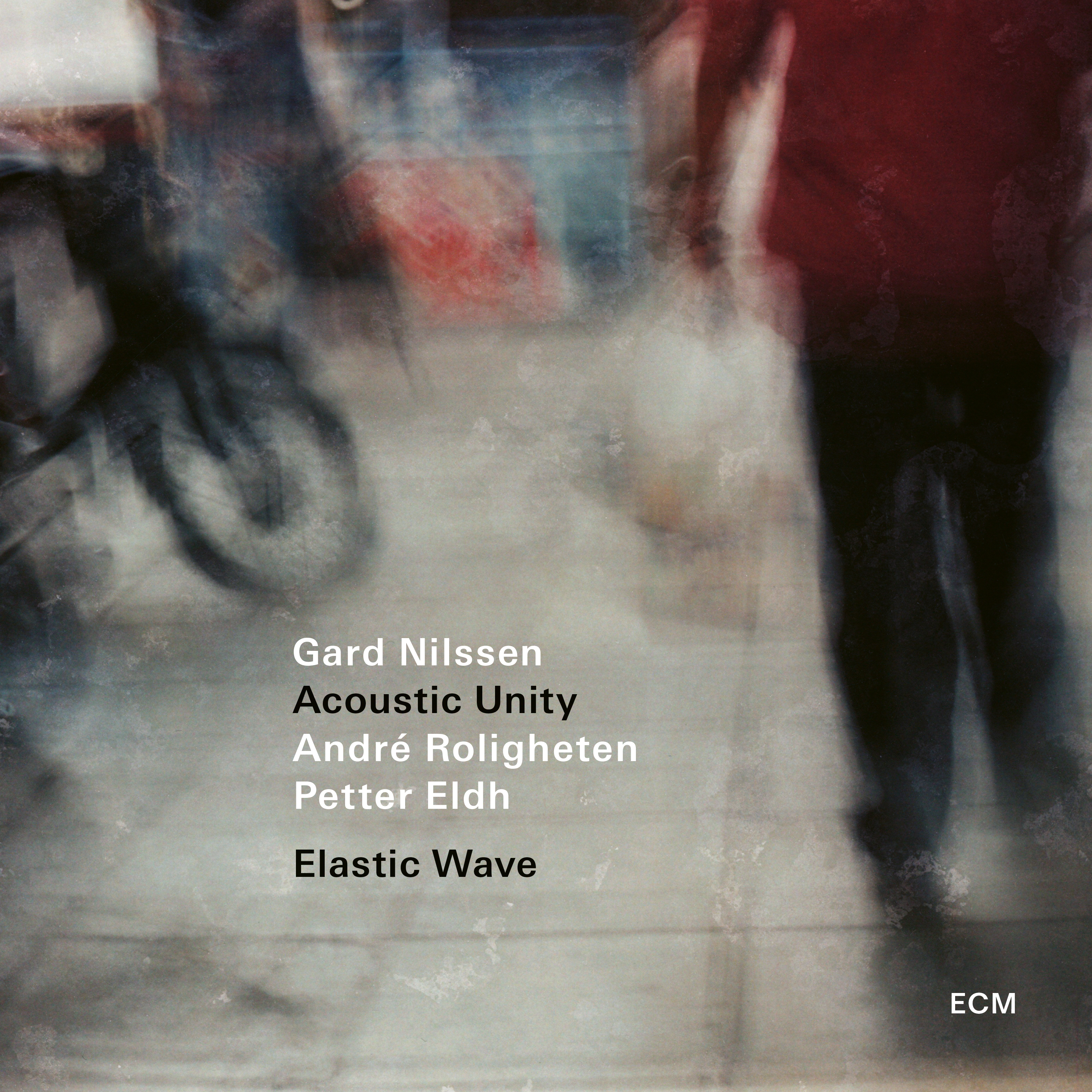
With such a title and album cover to go with it, we might expect a frenzy of activity. Instead, we are introduced to Acoustic Unity’s fluid identity via “Altaret,” one of two more relaxed tunes from Eldh’s pen. In silver-tinted monochrome, it lays an ante of trust on the proverbial card table. Later in the set, the bassist’s “Dreignau” allows the chips to fall where they may, tapping into an ethos that animates everything the band touches. “Influx Delight” breaks form with a tenor-led romp of post-bop energy that sparks the senses and, along with “Acoustic Dance Music” (both were co-written by Nilssen and Roligheten), puts its unique brand of introspective extroversion on full display. On the flip side, we find extroverted introspection in Roligheten’s “Cercle 85” and “Til Liv.” Whereas the first is a clarinet-led stroll through streets at night, the second is an ode to the composer’s daughter, the abstractions of which capture that delightful complexity daughters so uniquely hold. Nilssen’s “Spending Time With Ludvig” counters with a tribute to the drummer’s son, while “Boogie” flows with Eldh in intuitive confluence. Its free and easy style never forces its hand, puffing out old clouds into a new sky.

Nilssen cites many influences, from Jack DeJohnette to Jon Christensen (one of whose cymbals, in fact, takes pride of place in this session’s kit), among others. The tune “Lokket til Jon, og skjerfet til Paul,” notes this album’s press release, “also alludes to a scarf once left at the La Buissonne studio by Paul Motian, used here to take the edge off the bass drum’s ringing overtones.” Brushed drums and softly splashing cymbals show an artist at the kit, painting in everything from watercolor and acrylics to thickly applied oils. Roligheten’s sensitivities retake the helm, revealing the same depth of character I experienced in live settings. The saxophonist further contributes “The Other Village,” in which he plays tenor and soprano simultaneously, surprising us with bagpipe sonorities before riding Nilssen’s rolling thunder into oblivion. The latter’s “The Room Next To Her” closes the set with the guttural wonders of Roligheten on bass saxophone. Such feet-to-flame playing enacts a slow-motion punch to the gut that leaves us stronger for it. I can’t wait for Round 2.

Avishai Cohen: Naked Truth (ECM 2737)

Avishai Cohen
Naked Truth

Avishai Cohen trumpet
Yonathan Avishai piano
Barak Mori double bass
Ziv Ravitz drums
Recorded September 2021
Studios La Buissonne, Pernes-les-Fontaines
Engineer: Gérard de Haro
Mastering: Nicolas Baillard
Cover photo: Juan Hitters
Produced by Manfred Eicher
Release date: February 25, 2022

The first eight notes of Naked Truth planted themselves in the soil of trumpeter Avishai Cohen’s mind at the beginning of the pandemic. Thus sprouted the present suite in as many parts. Every question it poses can only be answered by listening.

Cohen and his faithful bandmates—pianist Yonathan Avishai, bassist Barak Mori, and drummer Ziv Ravitz—craft a story that has been told before, but rarely with such transparency. Part I opens with a duet between Cohen and Mori that looks through holes in the fence of life to glimpse what hopes might exist beyond. Part II introduces the sparks of Avishai at the keys, floating from the small fires of Ravitz at the kit. Cohen and Mori close with a prayer as much for the journey ahead as for the rubble left behind.

The pianism of Part III reaches vastly, setting up a bass-doubled motif that circles in search of song. From these threads, Cohen spins a fibrous sound, muted yet strong enough to suspend the very earth before revealing a heart of light. Past the softer carpet of Part IV, Parts V and VI offer respective interludes for piano and drums, before the introspective Part VII rises in intimate grandeur. Part VIII adopts a backward glance, grooving subtly into the receding horizon.

The set closes with Cohen’s reading of “Departure” (written in full below), a poem by Zelda Schneurson Mishkovsky (1914-1984), in a translation from the Hebrew by Sharon Mohar and Cohen himself. Cohen recited this poem during his ECM 50th anniversary appearance at Lincoln Center. Its opening lines, which make up this review’s epigraph, have lived with me ever since. Mishkovsky reminds us that even when our elders hand us the truths of their experience, we tend to ignore them until we know them firsthand. We must live separated yet ever in the world, holding certainty like the candle it is, knowing its flame will one day sputter out. The music beneath the verses frames Cohen as a traveler whose journey has graciously intersected with ours for the exact duration of this album. I thank him for the honor of sharing the road with us.

… . …

Departure
Zelda Schneurson MishkovskyTranslated from Hebrew by Sharon Mohar and Avishai Cohen

It is necessary to begin the
departure from the splendour
of the skies and the colours
of earth, to stand alone and
face the silence of death, to
part from curiosity, part from
words, all the words that I’ve
read and heard.

And from water, that I’ve
seen and haven’t seen. To die
without seeing the ocean.

Part from the air of the night
and part from the air of the
morning.

Part from weeds, part from a
fruit tree and from a barren
tree, from the lesser light and
from the stars.

Abandon the sight of a flying
bird, part from the sight of
a beast or an insect, part from
my friends and comrades, part
from the dampest of excitement
and from fear of the obscure
madness.

Part from the Shabbat, from the
sweetness of the seventh day.

Part from all work and art, from
rituals, from rain and from all
that is pleasing to the eye.

It is necessary to part from
Knowing-Good-And-Evil of
this world since other terms
of good and evil are there.

Part from what happened, from
the deep sleep and from the
dream.

Part from shame, from the fear
of death, from guilt, from curse,
from exhaustion.

Part from reflections about life,
from reflections about human
nature, from reflections about
the nature of the universe.

Part from reflections about
the difference between myself
and the other, from reflections
about identity, from reflections
about my inner nature, from
reflections about how little
I know about myself and about
all that is around me, part from
the sensation of the soul facing
the high mountains, part from
the need of food, from anxiety,
from the ridicule.

Part from the clouds, from
all that is changing, from the
undefined, from fire, from
stones and from wisdom.

From the physical movement
and from the inner movement.
From love and from hate.
From music. And before the
end, to live with the fear of
their death, and the certainty
of my own.

Kit Downes: Vermillion (ECM 2721)

Kit Downes
Vermillion

Kit Downes piano
Petter Eldh double bass
James Maddren drums
Recorded May/June 2021
Auditorio Stelio Molo RSI, Lugano
Engineer: Stefano Amerio
Cover photo: Fotini Potamia
Produced by Manfred Eicher
Release date: February 11, 2021

On Vermillion, pianist Kit Downes continues guiding his chisel along ECM’s burnished surface. With bassist Petter Eldh and drummer James Maddren, he presents a mixture of ripe and freshly planted tunes, giving himself over to unforeseen impulses.

Downes and Eldh contribute five tunes apiece. The bandleader tries on outfits of various abstractions, finding each to be sleek and unrestrictive. The sound forged on “Minus Monks,” the album’s opener, is arboreal in its shade-providing abilities. Movements between colors, times, and places feel effortless beneath Downes’s fingertips. Paying homage to pianist John Taylor, he continues down that path of reverence with a sound that pushes as much as pulls. “Sister, Sister” takes an opposite approach, opening with exact measurements before tessellating into off-kilter rhythms, wherein his expressive body can flex without tripping over itself. It takes up no more space than it needs to, whispering its mantras of care only to those who ask to hear them. Such empathy can be hard to come by in a pandemic-scarred world, and it is a welcome gift. Further grace abounds in “Seceda” and “Bobbl’s Song.” In these, the trio shifts from wide-angle shots to close-ups, rendering the ears projection screens for the lives of others. Its breezy sentience finds solace in “Rolling Thunder” (Downes), wispy as clouds stretched translucent by the wind.

Alongside these graded plateaus, Eldh juxtaposes geometric rock formations. “Plus Puls” embraces quietly propulsive pianism while the rhythm section experiments with phonemes like a child rolling possibilities of meaning around in the brain. The upbeat fibrillations of “Sandilands” carry over that verve as its composer runs through a field of leaves without stepping on a single one of them. “Waders” is a high point for the trio’s organic changes, which do nothing to betray the difficulty of this music, rendered smooth as glass. What begins as an almost hesitant blues in “Class Fails” turns into a forthright exclamation of learning the hard way, leaving “Math Amager” to solve the Rubik’s cube of its self-regard.

In listening to Vermillion for the first time, I am moved by how these musicians treat light. Bright as our nearest star is, they manage to put a stained-glass window between it and us. This is most evident in their concluding rendition of Jim Hendrix’s “Castles Made of Sand,” an ode to the crumbling idols we call politics. If these reflections seem somber, it is only because those who’ve seen enough of life never stop drawing lines of awareness to the sun behind the clouds. There is always more to hope for.

Michael Mantler: Coda (ECM 2697)

Michael Mantler
Coda

Recorded September 2019
at Porgy & Bess Studio, Vienna, Austria
Engineers: Martin Vetters and Juan José Carpio del Rio
Additional recording, mixing, and mastering
November 2019 and June 2020
at Studios La Buissonne, Pernes-les-Fontaines
Engineers: Gérard de Haro and Nicolas Baillard
Design: Sascha Kleis
Produced by Michael Mantler
An ECM Production
in collaboration with Porgy & Bess
Release date: July 16, 2021

Coda: a concluding statement, based on elaborations of thematic material from selected past works. So does the booklet for this album of Austrian trumpeter and composer Michael Mantler’s Orchestral Suites define its collective title. In that sense, we might point to its reworking of material from his substantial corpus, including elements of 13 3/4AlienFolly Seeing All ThisCerco Un Paese InnocenteHide and Seek, and For Two. Beyond that, it is an inclusive force that attaches its tendrils to outside influences, carved as much on the surface of the present as of the past. Using his favorite ensemble format of flute, oboe, clarinet, bass clarinet, trumpet, French horn, trombone, tuba, guitar, piano, marimba/vibraphone, and a string section (here under the direction of Christoph Cech), he walks self-referencing as a path to evolution.

While Mantler’s music has deeply cinematic skin (going back at least to 1978’s Movies), there’s no denying a dramaturgical heartbeat within. This isn’t just recycling; it’s a psychological reforming of the self. A frenetic yet never overbearing energy pulls a punch in the TwoThirteen Suite. The electric guitar of Bjarne Roupé rises from the strings as a phoenix, while pianist David Helbock stirs the ashes left behind. In the wake of this tempered triumph, the Folly Suite interrupts in mid-sentence, opening into a quieter realm where the trumpet emotes from the ledge of a skyscraper, tracking as many bodies as it can on the streets below until it loses count. Effortlessly gliding from one part of the city to another until only memories of gridlines are left, Mantler is the itinerant planner whose leaves his messages like tickets on the windows of every illegally parked car as a reminder of acoustic order in a digital world. The Alien Suite leaves such quotidian concerns far behind as Roupé and Mantler go extraterrestrial. The flute of Leo Eibensteiner adds a touch of unexamined landscapes over tense strings. The overarching sense is that of an oncoming storm that never arrives.

If the piano in the Cerco Suite is a pile of bones, then the orchestra is the archaeological team putting it back together. The excitement of this discovery veers into a cavern where the oboe of Peter Tavernaro speaks of civilizations drawn into ruin. Whatever voices we might have recovered there are subsumed into the HideSeek Suite. What were once lyrics now become impulses—the physical sensations of the breaths that produced them. As winds and piano hover beneath the heat of the electric guitar, a mature control of tension and release treats the explosive reveals of life as a matter of course.

Mantler has always had a gift for turning melodies into full bodies. More than signatures or calling cards, they hold themselves together in spite of staggered surroundings. Such is the theme of these compressed realities, each a doorway leading to another.

Tord Gustavsen Trio: Opening (ECM 2742)

Tord Gustavsen Trio
Opening

Tord Gustavsen piano, electronics
Steinar Raknes double bass, electronics
Jarle Vespestad drums
Recorded October 2021
Auditorio Stelio Molo RSI, Lugano
Engineer: Stefano Amerio
Cover photo: Thomas Wunsch
Produced by Manfred Eicher
Release date: April 4, 2022

A new Tord Gustavsen Trio album is cause for quiet celebration. In that regard, ECM’s characteristic five seconds of opening silence feel most appropriate, at once an obstacle to and a cushion for our expectations. With the introduction of new bassist Steinar Raknes, the feeling of revival is palpable.

Melodies are treated as structural suggestions rather than prescriptions, allowing them to travel as a cartographer would, knowing the general layout of the land but never the details until they fall under foot. Being invited along for the journey is an honor I do not take for granted. Neither do these introspective artisans take the creative act for granted, as “The Circle” proves with open arms. It is the embrace of a friend we haven’t seen since the world became socially distanced yet whose presence never left, our ears receiving the kiss of something wondrous. Despite the slight reshuffling of personnel, the communication between Gustavsen and his bandmates is as organic as ever, each signature floating in and out of focus with an overall coherence.

The pianist’s writing is once again the center of this solar system, its light shining brightest on “The Longing.” In only two and a half minutes, this anthemic interlude charts an album’s worth of space and is the epitome of what this trio can accomplish. Other peaks in the proverbial valley include “Shepherd Song” and “Stream,” where soloing is always connected by a wind of regard. Just when it seems Gustavsen might fly off on his own, he reunites with his earthly shadow, never losing sight of home. In the latter tune, I cannot help but feel mourning for the late Harald Johnsen, who once stood where Raknes stands now. Like the Forest Spirit in Princess Mononoke, Raknes leaves slow explosions of floral life, fading as quickly as they blossom. What’s astonishing is how he, Gustavsen, and Vesepstad do all of this in real time, patiently crafting (if not letting themselves be crafted by) a gentle tug of war between echoing and foreshadowing. Such is the progression of life. Raknes must also be commended for bringing electronic enhancements to “Helensburgh Tango” and “Ritual,” in which his bow evokes the guitar of Terje Rypdal à la The Sea (in that same vein, Vespestad’s rolling snare and cymbals nod deeply to Jon Christensen). What sounds more aggressive on the surface, however, bleeds internally with humility.

A few improvised pieces keep us centered while revealing older inspirations and traditions. From the initial examinations of “Findings,” for instance, emerges the Swedish folk song “Visa från Rättvik,” while the album’s title track cloaks itself in a Gurdjieff-esque meditation. Both tracks have their counterparts, offering plenty of carpet on which to step, and not a hardwood floor in sight.

The final two tracks are the only ones not written by Gustavsen. Geirr Tveitt’s “Fløytelåt” (The Flute) takes us into a folkish vastness, widening the path for the metaphysical denouement of “Vær sterk, min sjel,” a Norwegian hymn by Egil Hovland. A conservative yet wholly appropriate statement on which to end, it moves in unison of steps. Here, the widest door is opened, even if the musicians feel no obligation to tell us what’s on the other side. That’s for them to know and us to find out.

Andrew Cyrille Quartet: The News (ECM 2681)

Andrew Cyrille Quartet
The News

Andrew Cyrille drums
Bill Frisell guitar
David Virelles piano, synthesizer
Ben Street double bass
Recorded August 2019 at Sound on Sound, New Jersey
Engineer: Rick Kwan
Assistant engineer: Christopher Gold
Mastering: Christoph Stickel
Cover photo: Caterina Di Perri
Produced by Sun Chung
Release date: August 27, 2021

The News convenes drummer Andrew Cyrille, guitarist Bill Frisell, pianist David Virelles, and bassist Ben Street. One would never guess the ad hoc nature of the quartet (Virelles was a last-minute substitute for Richard Teitelbaum, who bowed out over illness) in light of the cohesions that abound from note one of “Mountain.” Its compassionate declarations describe a peak of sub-equatorial verdancy. Awaiting us at the top is not snow but a clear and sunlit promontory from which to gaze upon the path we are about to follow in subsequent tracks. This is also the first of three tunes by Frisell, whose “Go Happy Lucky” is rendered as an object of dark fascination in Virelles’s pianism, leaving “Baby” to shine for its continuity. As the epitome of this band’s approach to time and space, it glistens with the purity of a virgin spring.

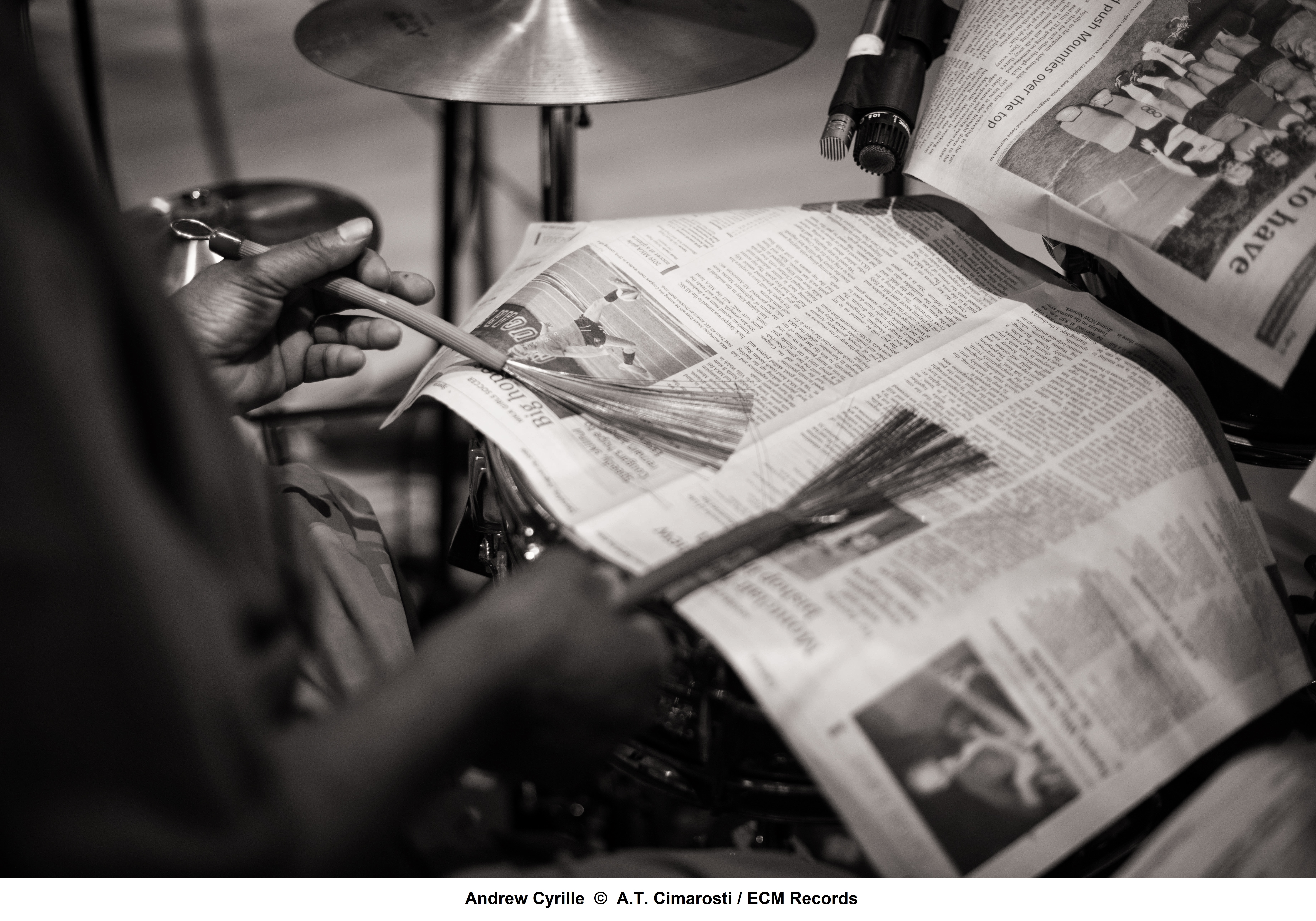
The title track by Cyrille dates back to the late 1970s and involves a newspaper-covered snare drum with rhizomatic touches from his bandmates. This brilliant turn hints at melody but sidesteps the commonality of expectation for the rewards of each unraveling moment. The bandleader further offers his balladic “With You in Mind,” which opens in spoken word. This sets up a late-night feeling from piano and bass, then shifts into Frisell’s meticulous speech-songs as warm organ undercurrents embody a respiration of the soul. Cyrille and Virelles detach in the improvised “Dance of the Nuances,” a delicate web of communication.

Where the pianist thinks outside the box in his playing, he shows restraint in the original “Incienso.” Along with “Leaving East of Java” (by AACM advocate Adegoke Steve Colson), it paints with flowers. In the latter, Cyrille’s cymbals work itinerant wonders as Street’s bass holds a steady watch in the background.

This production from Sun Chung (who has since left ECM to start Red Hook Records) is a masterclass in how jazz should sound when left to define a space. The recording is shaped by the languages we hear, translated out of—and back into—a universal tongue and the great equalizer of all things: nothing less than music itself.

Enrico Rava: Edizione Speciale (ECM 2672)

Enrico Rava
Edizione Speciale

Enrico Rava flugelhorn
Francesco Bearzatti tenor saxophone
Francesco Diodati guitar
Giovanni Guidi piano
Gabriele Evangelista double bass
Enrico Morello drums
Recorded live August 18, 2019
at Jazz Middelheim, Antwerp
by VRT-Vlaamse Radio en Televisie
Engineers: Peter Préal and Maarten Heynderickx
Mastering: Christoph Stickel
Cover design: Sascha Kleis
Executive producer: Manfred Eicher
Release date: October 29, 2021

Recorded live at Antwerp’s Jazz Middelheim festival in 2019, the aptly named Edizione Speciale brings flugelhorn maestro Enrico Rava to the stage with tenor saxophonist Francesco Bearzatti, guitarist Francesco Diodati, pianist Giovanni Guidi, bassist Gabriele Evangelista, and drummer Enrico Morello. That many of these musicians are Rava’s mentees is obvious given the level of communication achieved in this performance. As Rava notes in the album’s press release, trust is at the core of everything this band does.

Pure excitement ignites the night as “Infant” hits the air. Its maximalism leaps into the listener’s heart, especially through the stellar guitar work and the detail-oriented drumming. Guidi further energizes the congregation while Evangelista gilds the frame with strong patterns of recognition. Bearzatti, too, grabs a prime patch of spotlight to strut his stuff. After only a brief introductory statement, the bandleader recedes to let his entourage do the talking on this 13-minute juggernaut. 

Michel Legrand’s “Once Upon A Summertime” and Rava’s “Theme For Jessica Tatum” make for solid company. Rava opens with the lyricism of classic cinema before Bearzatti paves the way for Guidi’s solo delicacies over a spirited rhythm section that harks to Rava’s second home of South America, where Brazilian vibes seep freshly through the mesh of time. After a round of solos, Bearzatti and Rava trading diary entries along the way, Evangelista puts a finer point on things. 

The sprawling introduction of “Wild Dance” (from Rava’s 2015 record of the same name) leads to Diodati’s surreal monologue, which Rava turns into an intermittent conversation. Electronic abrasions add a new face to this repertoire. After a fearless morph into “The Fearless Five,” of which Evangelista’s bass is the wick to the candle, “Le Solite Cose” finds the horns charging into a sparkling take on “Diva” (also heard on Wild Dance). As Rava re-enters the picture, joy abounds and carries over into the Cuban tune “Quizás, Quizás, Quizás” (previously heard on Guidi’s This Is The Day). This one rolls off the proverbial tongue with ease. Its pianistic undercurrent gives rise to artful rhythming from Morello and an ecstatic round of input. With us as vessels, the music is assured of a home worthy of its robustness and love for life.

John Scofield: s/t (ECM 2727)

John Scofield

John Scofield electric guitar and looper
Recorded August 2021
Top Story Studio, Katonah, NY
Engineer: Tyler McDiarmid
Mastering: Christoph Stickel
Cover photo: Luciano Rossetti
Executive producer: Manfred Eicher
Release date: May 6, 2022

John Scofield’s latest for ECM features a set of solo guitar tunes backed by a looper, which he uses to establish progressions and contexts for his adroit picking. This long-awaited project, one that fans thought might never come, offers plenty of variety to meet that expectation. It all begins with a second-nature take on Keith Jarrett’s “Coral.” Launching into an improvisational spirit from the first breath and shifting into the melody only at the end, this interpretation features all of Scofield’s hallmarks: forthright expression, clear lines, and enough rough edges to guarantee authenticity. This is edible music.

Among all that follows, my ears are drawn immediately to Scofield’s originals. From the finely sculpted “Honest I Do” and the more whimsical “Since You Asked” to the emotionally charged “Mrs. Scofield’s Waltz,” he proves an uncanny ability to unravel moments of life into stories with beginnings, middles, and endings. The bluesy “Elder Dance” is a highlight. Scofield’s description says it all: “I picture older people (like me) doing a kind of lindy hop. I can picture it but I can’t do it.” This and the vibrant “Trance du Jour” make their recorded debut. Both are genuine pleasures to hear.

“It Could Happen to You” is the first among a handful of jazz standards. While recognizable from the start, it adds Scofield’s idiosyncratic touches, by turns fluid and angular. Even “Danny Boy” feels spontaneous in his brilliant hands, while the prison song “Junco Partner” bows its head in honor of the wrongfully incarcerated. Whereas “My Old Flame” and Buddy Holly’s “Not Fade Away” favor message over medium, others, like “There Will Never Be Another You,” add new levels of interest to the tried and true. We end with the Hank Williams classic, “You Win Again,” speaking in the language of experience.

Despite my appreciation for all that transpires here, this isn’t my favorite of ECM’s 2022 releases. Scofield is, of course, a master who could sound like no one but himself. And while I dig the easygoing, unrushed quality of the playing, I find relatively little to chew on in the standards. On the other hand, there’s plenty to enjoy in Scofield’s originals, which gift these ears with fresh, honest sounds. I just wish we’d been given nothing but, especially for a self-titled record from an artist whose contributions to the art of jazz are every bit as flavorful as the old chestnuts he has roasted here. Many will disagree with this assessment, so don’t let me discourage you from enjoying an album that might very well grow more than show.

Matthieu Bordenave: La Traversée (ECM 2683)

Matthieu Bordenave
La traversée

Matthieu Bordenave tenor saxophone
Patrice Moret double bass
Florian Weber piano
Recorded October 2019, Studios La Buissonne, Pernes-les-Fontaines
Engineer: Gérard de Haro
Mastering: Nicolas Baillard
Cover photo: Thomas Wunsch
Produced by Manfred Eicher
Release date: September 25, 2020

La traversée offers the ECM leader debut of French tenor saxophonist Matthieu Bordenave, who first appeared thereon as part of Shinya Fukumori’s 2018 masterpiece, For 2 Akis. This time, he is joined by German pianist Florian Weber and Swiss bassist Patrice Moret. Clearly born for the label, onetime host to his hero Jimmy Giuffre’s band with Paul Bley and Steve Swallow, he allows those early influences to take residence in current practice, each a shade letting in different amounts of light through the windows of his musical soul. The present trio holds its own in the presence of such expectations, ever open to the possibilities of space and unstructured play. Other influences include classical chamber music, especially of the modern French persuasion (think Messiaen and Dutilleux). Classical training indeed comes to the fore in his technical control while his love of jazz spreads across eight originals in the fashion of a spilled glass of water—inching ever closer to the edge of the table but prevented from falling by delicate surface tension.

When the darkening of “River,” a duet between the bandleader and Weber, makes its gradations known, we find the saxophonist sitting alone in a place of seeming childhood significance. His breathy register is a ghost—not of the past but of the future. At the same time, his sound is antique in that one can taste the patina of his horn. When the character of the bass is introduced in the second scene, “Archipel,” an underlying cinematic implication is consummated. Thus, Bordenave recalls Giuffre but also Charles Lloyd’s muggy charm, cherishing the potential of a dying note as might a sitar virtuoso. All the while, Weber’s forthright pointillism meshes lovingly with Moret’s rounded spacing.

“Le temps divisé” assembles notes as an archaeologist does a skeleton, for great care is required amid the excitement of discovery to fashion a coherent simulacrum of the body it once inhabited. In the wake of that exacting labor, “Dans mon pays” speaks of home as the piano and saxophone nourish each other in the bass’s soil. “The Path” follows with the album’s deepest passage, rewarding the patient listener (like the set as a whole) with moments of sheer lucidity.

Although Bordenave is powerful and direct in his gentility, he understands the preciousness of space. “Ventoux” and “Incendie blanc” are special cases in point. Both are hopeful fascinations, treating yearning as an instructive force. Moret’s bass monologue in the former tune is superb, giving way to galactic light from Weber, whose delicate flames dance across the latter’s terrain. From the ashes of those reactions arises “Chaleur grise,” of which the meticulous fray wavers in reflection. Hence our return to “River,” now in trio form and willingly shed of its skin. A stepwise unison leads to the final note, free yet bound by just enough grit to make the dream feel actual.

La traversée is a diurnal experience, tracking heavenly bodies in a climate all its own. To listen to it is to watch your shadow marking the hours from dawn until dusk.