Terje Rypdal: Chaser (ECM 1303)

Terje Rypdal
Chaser

Terje Rypdal guitar
Audun Kleive drums, percussion
Bjørn Kjellemyr basses
Recorded May 1985 at Rainbow Studio, Oslo
Engineer: Jan Erik Kongshaug
Produced by Manfred Eicher

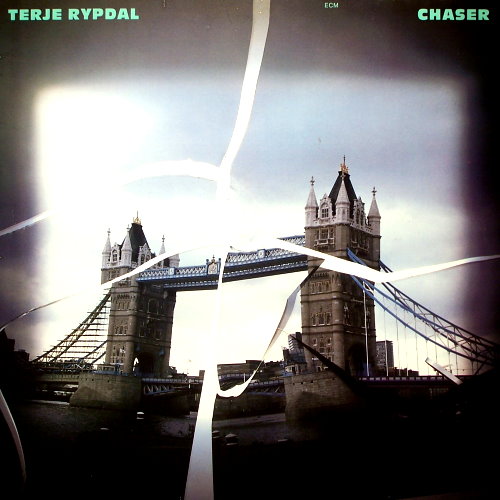
1985’s Chaser finds Norwegian guitarist Terje Rypdal in cahoots with drummer Audun Kleive and bassist Bjørn Kjellemyr. From what I can gather, even some die-hard Rypdal fans are turned off by this one. I can only scratch my head at such reactions, because for me the results are powerful and memorable. Rypdal’s strong-armed phrasing makes the nine-minute opener, “Ambiguity,” a bitter piece of chocolate indeed, but Kjellemyr’s caramel center gives us just the sweetness we need to balance it out. It takes a few minutes to accustom oneself to the sound, but once the rock grabs hold it is difficult to deny. The trio shifts gears with “Once Upon A Time,” which sounds like a film noir that never materializes, if only because there is no one around to populate it. It is the slow blaze of a metal barrel fire pit, a cityscape obscured by sewer steam. For “Geysir,” Rypdal hooks his fluid anchor through a snaking Eberhard Weber-like bass, finding light, cold and subterranean, in every echo. The nighttime feel of “A Closer Look” ports us into “Ørnen,” a deep spiral of hard-won energy—the badlands compressed into 6.5 minutes of emotive genius. Also masterful is the title track. This tender ode to art rock evokes youth and electricity, charging us for the keening embrace of “Transition” and on through “Imagi (Theme),” this last a flexing muscle through which the band separates strength into chains of non-strengths, looking past the façade of power to the surrender that begets it.

Rypdal has singlehandedly honed his axe into an exacting, if serrated, edge. Forged in fire and ice, his sound sings as it lives: nakedly and brightly. This is without a shadow one of Rypdal’s best and belongs alongside such classics as Descendre and his self-titled debut on the throne of his craft. Due to its wide range, to which one finds touchpoints in the work of guitarists as diverse and Buckethead and Bill Frisell, this is as broad a portrait as one can expect to find of a consummate artist who has, in ECM, found a loving home.

<< Marc Johnson: Bass Desires (ECM 1299)
>> Gidon Kremer: Edition Lockenhaus Vols. 1 & 2 (ECM 1304/05 NS)

Rypdal/Vitous/DeJohnette: To Be Continued (ECM 1192)

ECM 1192

To Be Continued

Terje Rypdal electronic guitars, flute
Miroslav Vitous acoustic and electric bass, piano
Jack DeJohnette drums, voice
Recorded January 1981 at Talent Studio, Oslo
Engineer: Jan Erik Kongshaug
Produced by Manfred Eicher

Nearly three years after their first collaboration, Terje Rypdal, Miroslav Vitous, and Jack DeJohnette unwrapped the ghostly sunset that is To Be Continued. The most spine-tingling moments therein thrive at half the speed of life. The intensities of “Maya” must be heard to be believed, for in them we see the night sky in negative image. Likeminded pulchritude prevails in “Topplue, Votter & Skjerf” (Hat, Gloves & Scarf), easily one of Rypdal’s most awesome committed to disc. His hands fade as soon as they are laid, leaving only the trace by which he elicits every note.

Don’t be mistaken, however, in thinking this is another lazy morning session. Rather, it dances to the tune of DeJohnette’s propulsion in “Mountain In The Clouds,” to say nothing of Vitous’s fanciful colors in the title track. For “This Morning” in particular, crosshatched by electric bass and flute, DeJohnette seems to want to draw the others into more finely grained conversations, only to get pixilated versions thereof. Yet these unformed images allow us to supply our own dreams, so that by the time we reach the haunting “Uncomposed Appendix,” in which he sings with and through his piano, we are already converted.

Though the album is brimming with sharp production and electronically enhanced instruments, there is something purely elemental about it. Its stew of metal, wood, and air wafts like the scent of plane trees in summer and leaves a taste of copper in the mouth.

<< John Abercrombie Quartet: M (ECM 1191)
>> Surman/DeJohnette: The Amazing Adventures Of Simon Simon (ECM 1193)

Terje Rypdal: Descendre (ECM 1144)

ECM 1144

Terje Rypdal
Descendre

Terje Rypdal guitar, keyboards, flute
Palle Mikkelborg trumpet, fluegelhorn, keyboards
Jon Christensen drums, percussion
Recorded March 1979 at Talent Studio, Oslo
Engineer: Jan Erik Kongshaug
Produced by Manfred Eicher

Before hearing the opener that lightens Descendre, I believed that the introduction was a thriving art form. Entitled “Avskjed” (Farewell), it works its distant organ, glockenspiel, and muted trumpet through the nocturnal folds of a weightless security. In a mere three minutes, I hear sunrise, worldly virtue, and restraint rolled into a single entity. Rypdal’s palimpsestial motifs grace the edges of dense brass and sudden exhalations. The album is full of such moments, unexpected and eternal. Nestled in the tessellation of Jon Christensen and Palle Mikkelborg, that unmistakable guitar cuts its swath through the swells and squawks of “Circles,” on through the trembling “Men Of Mystery,” and ending on the delicate considerations of “Speil,” where kaleidoscopic keyboards abound. Standouts include the title track, where Christensen’s melodic sensibilities shine forth and Rypdal’s solos brand themselves into our hearts like the icy stares of advertising icons in Blade Runner, and “Innseiling” (Approach), a masterful slice of transcendence that guides Mikkelborg to glorious heights. With every change of light, bright resolutions and shadowy recollections are revealed, betraying the raging fire behind its glacial surface.

An elegy in emotional unrest, Descendre is a must-have for any Rypdal veteran and greenhorn alike. Like its title, it descends with every sonic verb, reminding us that conjugations never end.

<< Leo Smith: Divine Love (ECM 1143)
>> Miroslav Vitous: First Meeting (ECM 1145)

Rypdal/Vitous/DeJohnette: s/t (ECM 1125)

ECM 1125

Terje Rypdal/Miroslav Vitous/Jack DeJohnette

Terje Rypdal guitar, guitar synthesizer, organ
Miroslav Vitous double-bass, electric piano
Jack DeJohnette drums
Recorded June 1978 at Talent Studio, Oslo
Engineer: Jan Erik Kongshaug
Produced by Manfred Eicher

Terje Rypdal/Miroslav Vitous/Jack DeJohnette joins its eponymous crew in a one-off trio date for the ages. Although billed as something of a Rypdal venture, the album is primarily a canvas for Vitous, who bubbles forth with all the viscous potency of oil from a crack in the earth. The bassist and Weather Report founder culls from that selfsame influential oeuvre his classic tune, “Will” (a lilting and sentimental ride which made its first appearance on Sweetnighter), and pairs it with “Believer,” another original that is more Rypdal-driven. These two form the heart of a tripartite experience that begins with a pair of Rypdals. The first of these, “Sunrise,” floats in on DeJohnette’s scurrying drums, spurred by the air currents of Rypdal’s Fender Rhodes. Suspended plucking from bass stands out like heat lightning against Rypdal’s grittier monologues. Overdubs balance out the spacious surroundings with their fallow echoes. The guitar dominates here, its trembling accents seeming to grab clouds by their collars and shake them until melodies come falling out in patchy storms. He scrapes his pick along the strings, as if tearing holes in the very fabric of space-time. With respectful stealth, his gorgeous chording in “Den Forste Sne” manages to undercut the bowed bass, the latter recalling the tender songs of David Darling. This one is a stunner in its grandiose intimacy, accentuated all the more by Rypdal’s low-flying passes. We end with a diptych of group improvisations, each the shadow of the other. Between the frenetic syncopations of “Flight” and the pointillism of “Seasons,” we are given plenty of poetry with which to narrate our inner lives.

While, arguably, a pronounced variety of modes would have made this a “stronger” record, it seems content in being the languid organism that it is, and constitutes another enchanting landscape deservedly hung in the hallowed ECM Touchstones gallery. It might not be the best place to start, but what a detour to be had along the way…

<< Steve Kuhn: Non-Fiction (ECM 1124)
>> Art Ensemble of Chicago: Nice Guys (ECM 1126)

Terje Rypdal: Waves (ECM 1110)

Terje Rypdal
Waves

Terje Rypdal electric guitar, keyboard, synthesizer
Palle Mikkelborg trumpet, fluegelhorn, RMI, tac piano, ring modulator
Sveinung Hovensjø basses
Jon Christensen drums, percussion
Recorded September 1977 at Talent Studio, Oslo
Engineer: Jan Erik Kongshaug
Produced by Manfred Eicher

One is often tempted to appreciate Terje Rypdal through the lens of some icy Nordic mystique that, while certainly supported by the sleeves that adorn his music, may ultimately be a myth. Either way, there is something to be said for the biting winds that blow through his sonic landscapes. I would like to present Waves, however, as a corrective to this assumption, for it emanates nothing but heat. Much of that heat comes courtesy of trumpeter Palle Mikkelborg, whose legendary reputation bears auditory bounty throughout.

Much of the album’s blurry spirit takes bodily form in “Per Ulv.” Combining a delightfully dated drum machine and quasi-Afrobeat percussion from Jon Christensen with the mellifluous bass of Sveinung Hovensjø, it opens itself to Rypdal’s searing flights. Mikkelborg’s quick fingers fuel the fire, which calms to a smolder in “Karusell,” where he marks his territory with breath rather than exaltation, trading off guttural statements with Rypdal’s softened twang. Mikkelborg even contributes a composition of his own in “Stenskoven,” a raunchy carnivalesque that might as well have switched titles with its predecessor. The title piece depends from lines of cymbals and snare and is supported by organ. Over this synthesized bliss, Rypdal and his cohorts weave a loose and lyrical song. “The Dain Curse” takes a tripartite structure. A clean bass line and flanged chording from guitar waft around the muted horn of a distant horizon, only to be cracked by Christensen like an egg of rock that oozes yolky guitar solos before being poached into stillness. “Charisma” reprises the organic river of “Waves,” into which Rypdal trails his fingers, leaving ephemeral shapes on the water’s surface. Cymbals drop like seeds, only to be washed away in the current, their potential life leaving like ghosts via the haunted trumpet.

If we imagine the cover photograph as having any bearing on what lies within, then the music is neither the trees nor the mist that envelops them. Rather, it is the sun that blinds us to both throughout the album’s gradual evaporation.

<< Dave Holland: Emerald Tears (ECM 1109)
>> Gary Burton: Times Square (ECM 1111)

Terje Rypdal: Undisonus (ECM 1389)

Terje Rypdal
Undisonus

Terje Tønnesen violin
Royal Philharmonic Orchestra, London
Christian Eggen conductor
Grex Vocalis
The Rainbow Orchestra

Carl Høgset
director

Recorded September 1986, St. Peter’s Church, Morden, London (Undisonus) and November 1987, Rainbow Studio, Oslo (Ineo)
Engineers: Arne Akselberg (Undisonus) and Jan Erik Konghaug (Ineo)
Produced by Arne-Peter Rognan

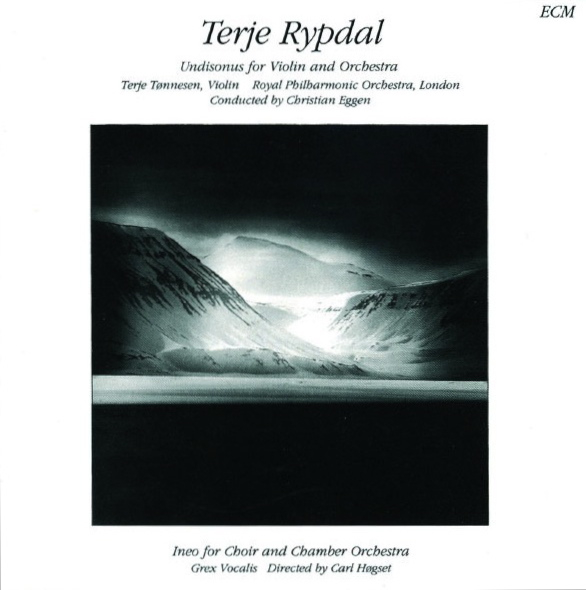
For as long as I’ve been listening to Terje Rypdal, I’ve known him to skirt idiomatic borders without presumption. I can only admire him for his dedication to jump headlong into such projects as this pairing of two classical pieces. As one who is so often present in the realization of his works, allowing the music to take on its own life isn’t always easy. Rypal, however, takes this step gracefully and with melodic integrity intact.

Undisonus, op. 23 is set for violin and orchestra, but it’s the brass section that first catches our attention with its subterranean rumblings. First seeded in 1979, the present version represents years of additions and fine-tuning, which one can hear throughout Terje Tønnesen’s fine playing. His tone is declamatory without being overbearing, lyrical yet more acrobatic than romantic, but always with the feel of a sketch running off the page. This puts the orchestra in a precarious position, taking on the role of caretaker at its haunts the aura of the soloist’s imagination. Silences are always heavy and felt like a remembered drone, ending on a shadowy slide in which double basses and violin circumscribe the entire musical space in a beautiful gesture of completion.

Where Undisonus skirts a dichotomy of call and response, Ineo, op. 29 (composed 1983) transcends that dichotomy into a more noticeably unified sound. Originally featuring Rypdal on guitar for its Danish Radio premier, here it has been reworked for choir and chamber orchestra. Lush writing for woodwinds and brass lends deeper poignancy to the choir’s memorial intonations. Constructed in gorgeous little cells drawn by near-silent threads, every utterance spreads into an overarching whole. A lyrical oboe solo recalls Rypdal’s formative meditations in his self-titled debut and in What Comes After, foreshadowing a glorious Alleluja that is as close to the spirit of Giya Kancheli’s Prayers cycle as I have ever experienced in another’s work.

Averaging 20 minutes each, these pieces make for a modest album in length that is anything but in scope. Rypdal clearly has nothing to prove, as the music drapes a blanket of sonic comfort over our prog rock expectations. It is best appreciated in half-slumber, where judgment is but a stepping-stone toward broader skies.

<< Ralph Towner: City Of Eyes (ECM 1388)
>> Abercrombie/Johnson/Erskine: s/t (ECM 1390)

Terje Rypdal: After The Rain (ECM 1083)

ECM 1083

Terje Rypdal
After The Rain

Terje Rypdal electric and acoustic guitars, string ensemble, piano, electric piano, soprano saxophone, flute, tubular bells, bells
Inger Lise Rypdal voice
Recorded August, 1976 at Talent Studio, Oslo
Engineer: Jan Erik Konghaug
Produced by Manfred Eicher

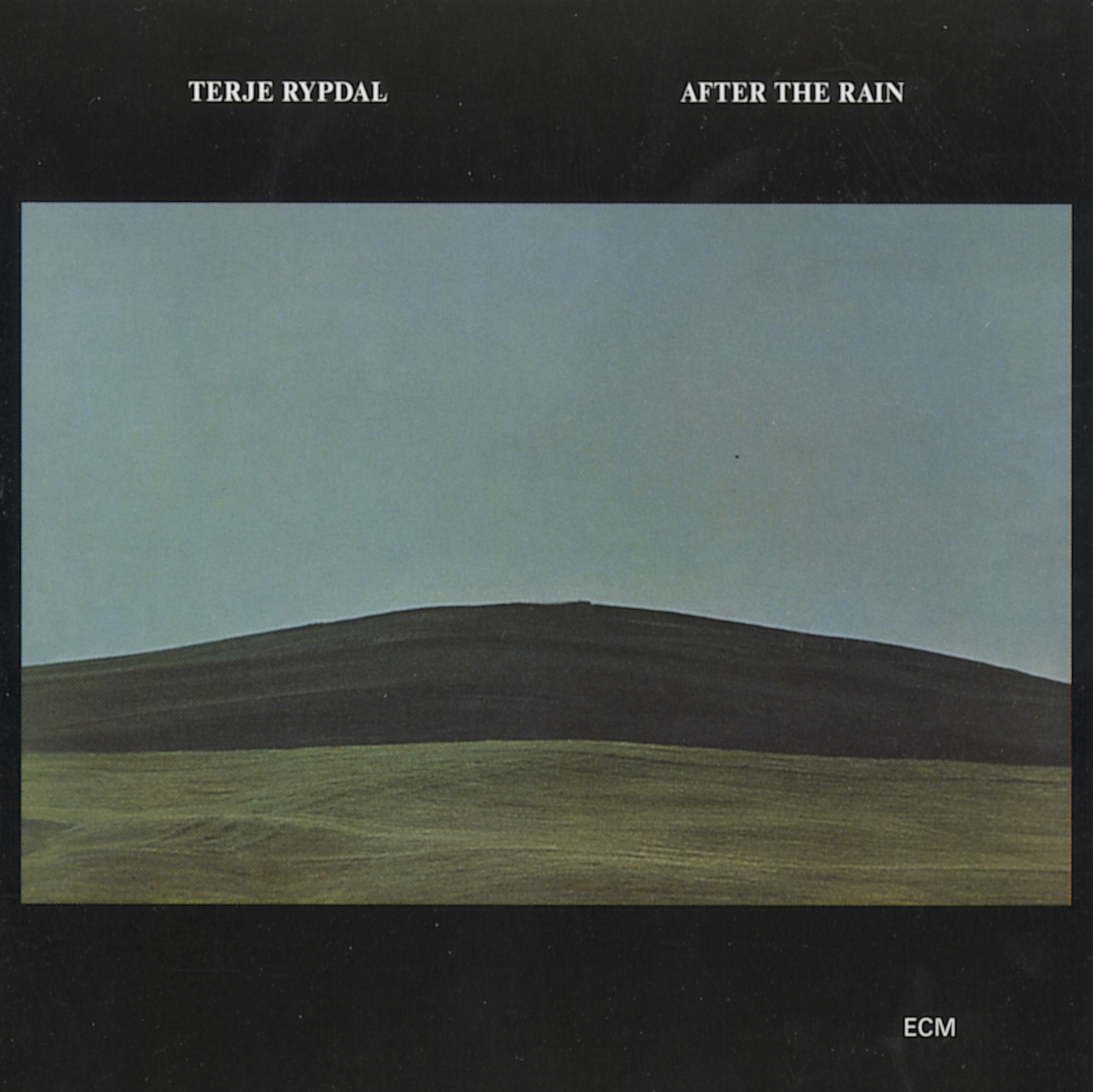
With an incendiary initiation on Jan Garbarek’s Afric Pepperbird, and after successfully leading far-reaching experiments like his first self-titled project and the plush Whenever I Seem To Be Far Away, Terje Rypdal opened a new door for ECM when he stepped into the studio to record perhaps his most intimate statement to date. In spite of their brevity, the ten tracks on After The Rain flow in a single 38-minute ode to the almost painful depths of life’s greatest joys. Rypdal overdubs every instrument himself, with his then-wife, vocalist Inger Lise, providing the occasional organic touch. Shielded by a holy trinity of intimacy, sincerity, and fearlessness, Rypdal plunges with open eyes into the darkest eddies of his emotional waters. An electric keyboard provides much of the album’s supportive breadth, as in the heavily flanged gem that is “Air.” Rypdal gives us a rare acoustic taste in “Now And Then,” and in “Wind” an even rarer flute solo. The title track breathes in a cloudless sky, Rypdal’s electric cello-like in its weighted grace. Wind chimes complete the illusion of the cover art’s open plain. A string of vignettes, among them the utterly poignant “Little Bell,” leads us to “Like A Child, Like A Song,” bringing its hands together in humble elegy.

Hanging words such as “atmospheric,” “evocative,” or “lyrical” on this Christmas tree would only topple it in a shower of withered needles. One might say the title refers not to the music itself, which if anything feels drenched, but rather to its lingering effects. I sometimes imagine the synthesizer here as a substitute for an unavailable orchestra, the presence of which would have created an entirely different, Eberhard Weber-like, experience. As it is, its sedation lends a potent archival ascendency and distills the soaring solos within. Rypdal’s keening guitar percolates through the album’s semi-porous cloth like sunlight through the veil over a face of one who has seen the world only through the wavering screen of tears, and never in the clarity of day. It is a style of playing that falls even as it rises. At his profoundest moments, Rypdal inspires a humbling lack of vocabulary with which to describe what one hears. In which case, After the Rain is filled with silence.

<< Arild Andersen: Shimri (ECM 1082)
>> Eberhard Weber: The Following Morning (ECM 1084)

Terje Rypdal: Whenever I Seem To Be Far Away (ECM 1045)

Terje Rypdal
Whenever I Seem To Be Far Away

Terje Rypdal electric guitar, guitar
Sveinung Hovensjø 6- & 4-string basses
Pete Knutsen mellotron, electric piano
Odd Ulleberg French horn
Jon Christensen percussion
Südfunk Symphony Orchestra
Mladen Gutesha conductor
Recorded 1974 in Oslo and Ludwigsburg
Engineers: Jan Erik Kongshaug and Martin Wieland
Produced by Manfred Eicher

This laconic yet lasting statement from Terje Rypdal marked the Norwegian guitarist’s third ECM appearance as composer and leader. Its crucible continues to yield an enticing tincture of prog-rock and classical stylings for the weary musical mind. The reverberant French horn that animates “Silver Bird Is Heading For The Sun” betrays nothing of its cooption by a punchy g/d/b constituent. Floating on a well-aged mellotron, it bows out gracefully as Rypdal rolls in like a fuzzed haze. Sveinung Hovensjø’s robustly amplified bass carries its surrounding weight beautifully, and continues to do so for the album’s duration. Languid relays between guitar and horn coalesce at the piece’s muscular conclusion. In “The Hunt,” we get a heftier dose of percussion, courtesy of the one and only Jon Christensen. Thus begins a brightly syncopated journey filled with plenty of dynamic movement. All of which makes the title piece that much more affecting. A lone cello becomes our only introduction into its slow 18-minute wave of orchestral bliss. Oboe and clarinet usher in the encroaching stillness with subdued attention. Only during a climactic peak does Rypdal make his presence known, as if born from the nexus of violins trailing off into the darkness (a section that perhaps foreshadows Gavin Bryars’s After the Requiem). This switch from external to internal register seems to caress some distant shore, much like the waters of the album’s cover. We wait for dusk, only to realize that the night has never left us.

Whenever I Seem To Be Far Away is an album in infrared, a silent face whose expressions make infinite use of a limited palette. Rypdal is one of the few hybridizers whose creations become something outside of themselves. His soloing wrenches from its present surroundings as many handfuls of melody as it can before fading into the solace implied at the album’s genesis. And I cannot stress enough how fantastic the bass sounds throughout, its steady tone stabilizing like an iron cable. In it, we hear our own gravidity made audible, touching its lips to a temple of sound with a following of one.

<< Julian Priester: Love, Love (ECM 1044)
>> Dave Liebman: Drum Ode (ECM 1046)

Terje Rypdal: What Comes After (ECM 1031)

ECM 1031

Terje Rypdal
What Comes After

Terje Rypdal guitars, flute
Barre Phillips basses
Jon Christensen percussion, organ
Erik Niord Larsen oboe, English horn
Sveinung Hovensjø electric bass
Recorded August 7/8, 1973 at Arne Bendiksen Studio, Oslo
Engineer: Jan Erik Kongshaug
Produced by Manfred Eicher

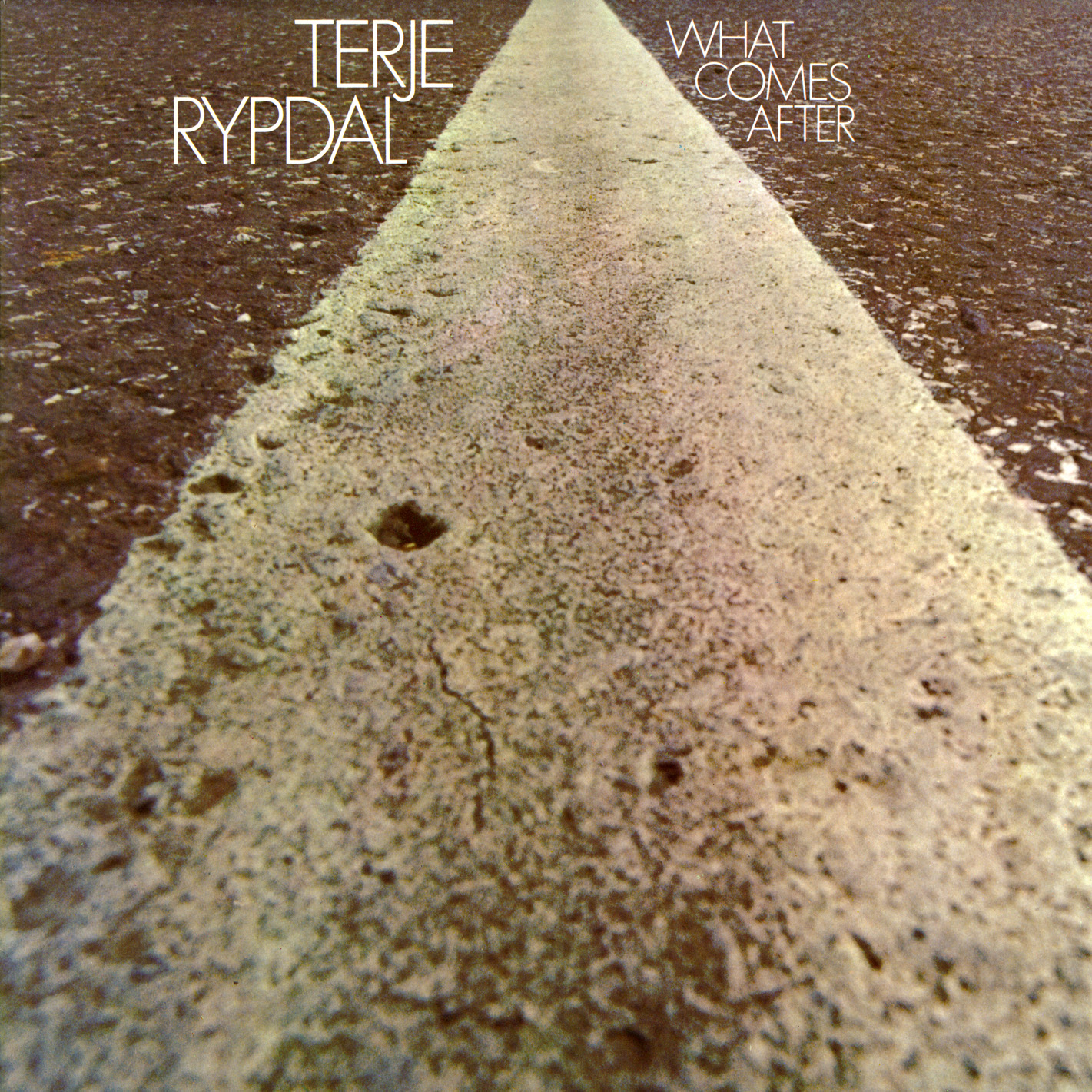
Terje Rypdal’s What Comes After, his second for ECM as frontman, is more about what came before. An exquisite diversion from the dustier billows of his later work, it charts much of the same territory as its self-titled predecessor, only this time with a tighter supporting roster. Sveinung Hovensjø lays down the dominant bass line that is “Bend It,” an atmospheric 10-minute opener that lulls us into its nocturnal crawl. The bowed bass of Barre Phillips and Jon Christensen’s subtle drum work adorn long-form improvisations from Rypdal as he wrenches out an ever-changing dialogue from the repetitive core. “Yearning” reprises the sinewy oboe (played here by Erik Niord Larsen) of Rypdal’s self-titled effort and features him in a rare acoustic turn. The jangly percussion makes for a mystical, if all too brief, experience. The see-sawing melodies and tender bass solo of “Icing” extend this feeling of isolation and memory before the delicate rimshot of the title track slinks metronomically through Rypdal’s mounting ruminations. “Séjours” marks the oboe’s standout return in one of the album’s most thoroughly realized tracks, while “Back Of J.” leaves us with a sparse final word, Rypdal unplugged and unhurried.

Albums like this allow us to appreciate the ways in which artists grow. ECM’s consummate electric guitarist has worn many hats, and perhaps none so many as in his formative years. Here, he feeds off his surroundings, even as he strays in equally fruitful directions, always harboring an innate awareness of where he is grounded. A wonderful place to start for initiates and strangers alike.

<< Gary Burton: The New Quartet (ECM 1030)
>> Ralph Towner: Diary (ECM 1032)