Then Comes The White Tiger (ECM 1499)

Red Sun
SamulNori
Then Comes The White Tiger

Red Sun
Wolfgang Puschnig alto saxophone, alto flute
Linda Sharrock voice
Rick Iannacone electric guitar
Jamaaladeen Tacuma bass guitar
SamulNori
Kim Duk Soo changgo, piri, hojok, ching
Lee Kwang Soo k’kwaenwari, vocals, ching
Kang Min Seok buk, ching
Kim Woon Tae buk, ching, bara
Kim Sung Woon komungo, kayagum
Recorded May 1993 at Garak Studio, Seoul
Engineer: Jan Erik Kongshaug
Produced by Wolfgang Puschnig

Look at the sky and pluck a star
Look at the earth and farm the land…
Moon, moon, bright moon, as bright as day
In the darkness this light is our illumination

Like many people I am sure, my first exposure to the world of samul nori was through the 1984 Nonesuch Explorer Series recording Samul-nori: Drums and Voices of Korea.
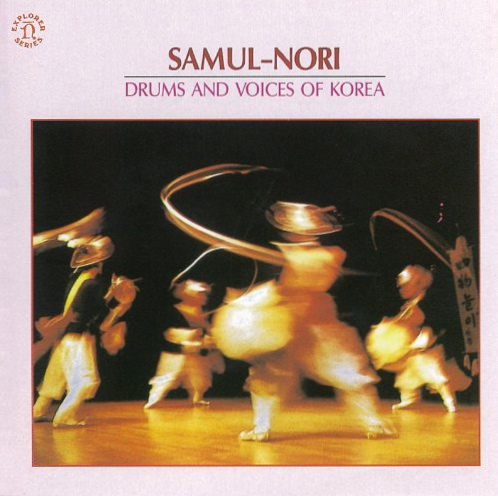
The group SamulNori, which takes its name from the selfsame style of Korean folk music and was founded in 1978 by Kim Duk Soo as a means of expanding the music’s compass of awareness, combines its namesake’s balance of ritual and humble beginnings with contemporary leanings. Samul nori is at heart a percussive genre. Its four instruments are the jing (large gong), the kkwaenghwari (small gong), the janggu (hour-glass drum), and the buk (barrel drum). Each is its own element—wind, thunder, rain, and clouds, respectively—and brings a fertile sound to bear upon a range of ecologically minded texts, both recited and sung. SamulNori members have worked with, among others, Bill Laswell (a true maverick whose seamless productions were the soundtrack to my late teens) and Kodo, but perhaps most notably with Red Sun, a jazz outfit that was the brainchild of saxophonist and flutist Wolfgang Puschnig and with whom SamulNori had its first meeting eight years prior to this influential record.

The ritual drums and horns of “NanJang (The Meeting Place)” are the ideal start, giving way as they do to Lee Kwang Soo’s recitation of the “Pinari,” a Korean origin myth in verse form. Splashing gongs seem to swirl at our feet, and from them arises the voice of Linda Sharrock (wife of another maverick, Sonny), who explores a panorama of nature and living bounty. Guitarist Rick Iannacone draws a cosmic thread through these rawer beads (not to say that one is purer than the other, for they are all made from the same breath that gives all life to matter, and all matter to life), and steers us into the beauties of “Peaceful Question.” Though it is but an amorphous congregation of gongs and bells nesting a voice born from nature who blurs the lines between human and animal (and in fact shows them to be one and the same), words fail to evoke its splendor. It sounds familiar to us all the same, so that “Kil-Kun-Ak” becomes the percussive sinew connecting that voice to the void from which it has taken shape. It leaps like a fire, finds its stillness of mind in the sharing.

Like a playground swing moving of its own accord, Jamaaladeen Tacuma’s crab-walking bass line in “Hear Them Say” traces a counter arc while Sharrock’s notes tremble amid Puschnig’s starlit branches, singing of self-empowerment in a spider’s web of radial guitar lines. “Piri” changes gears dramatically and takes its name from the double-reed bamboo pipe played here by Kim Duk Soo, who soars on a crane’s back through a flowering rendition of the folk song “Han O-Paek Nyn” (The Sorrows of Five Hundred Years). “Soo Yang Kol (The Valley Of Weeping Willows)” is an equally inspired construction that celebrates the place where the musicians had their first Korean pre-production meeting. It also boasts most arresting sax solo on album. Quieter pastures await us in the electric gyrations of “Flute Sanjo” and in “Komungo,” a wavering solo from guest artist Kum Sung Woon on the zither of the same name. This is followed by the two-part “Full House.” Composed by Tacuma, it brings some groove into the mix and represents the session’s deftest idiomatic blends. Its message of joy, peace, and thanksgiving leads us into “Ariang,” which comes to us as if from a distance, an ancestral song woven anew into the lighted corridor of all life.

I have to admit that, as one who had only heard samul nori outside of any fusion context, it took me a while to understand the sound-world of this project. Yet what at first seems an incongruous meeting of “East” and “West” ends up a genuinely wholehearted attempt to undermine those very arbitrary categories. And in the end, perhaps jazz and samul nori aren’t all that different in what they are trying to achieve, in the language they speak and in the ways they speak it. Its voices enact that same need for dialogue and communication that is at the heart of jazz, and expresses said need through evolution and improvisation. All of this is wrapped up in those voices, and in the saxophonic punctuation that reorders their grammar. This music speaks to us because it tells us a story we already know. It is a story from which we were born, one into which we will be written when we die. A space-time continuum to which profundity need not apply, for it is too lowly to express that from which it hangs.

<< Hal Russell/NRG Ensemble: The Hal Russell Story (ECM 1498)
>> Jan Garbarek Group: Twelve Moons (ECM 1500)

Keith Jarrett: Personal Mountains (ECM 1382)


Keith Jarrett
Personal Mountains

Keith Jarrett piano, percussion
Jan Garbarek tenor and soprano saxophones
Palle Danielsson bass
Jon Christensen drums
Recorded in concert, April 1979, Tokyo
Engineer: Jan Erik Kongshaug
Produced by Manfred Eicher

Despite being recorded in 1979, it would be a full decade before this jewel of a live recording from Keith Jarrett’s unparalleled European quartet (with Jan Garbarek on saxophone, Palle Danielsson on bass, and Jon Christensen on drums) would find itself sleeved and catalogued at last. From note one Personal Mountains paints melodic vistas of great majesty wrapped in a bow of rarified execution. As throughout, Garbarek’s blustery tone in the title opener proclaims themes with crystal-clear diction across the widening sky of Jarrett’s pianism. Jarrett himself takes an early leap in this outing, riding the rhythm section like a thoroughbred into open fields. He turns night into day with every chord, the fullness of his sound accentuated especially by Christensen’s rolling thunder as he unravels wonder after wonder. Yet even as Garbarek works his chromatic magic for the betterment of something profound, Christensen and Danielsson are given no small spotlight in which to shuffle their dialogue into a hollering tumble. Thus are we jettisoned skyward into an unexpected turn of phrase. Garbarek constructs hang gliders of melody in the thick night, every dip a chance to rise again. Meanwhile, Jarrett sews our hearts into the folds of a time unbound, thus moving us smoothly into “Prism.” Our usher this time is Danielsson, who pulls Jarrett’s ballad energy through a brushed corridor. Jarrett has all he needs from Garbarek to burn the midnight oil with a sparkling tapestry of soloing. His gentle cascades then release us into “Oasis” before Garbarek’s sharply inclined theme breaks the waves. Jarrett is again wondrous, spinning the finest spider’s thread into a wheel of adhesive memories. Offset by Christensen’s vibrancy, he and the others forge a vision for all senses. Jarrett invites us all by his lonesome into the aptly titled “Innocence.” Like a candle that barely trembles in the rhythm section’s sleeping breaths, his playing makes string games of moonbeams with the conviction of a dream. Of the latter we hear but a snippet in “Late Night Willie.” This gentle groove—bluesy enough to have Jarrett whooping all the same—gives us a soulful Garbarek and an overall elasticity which hurls us into an even deeper appreciation for the art at hand.

There is something magical about the pairing of Garbarek and Jarrett that brings out the best in both. And with such fine rhythmic support—and, to be sure, Danielsson and Christensen are as much melodicians as they are rhythmatists—one can hardly ask for anything grander. Although this is a live recording, one would hardly know it from the rapt silence that embraces this music until the audience’s applause breaks the spell.

<< Jan Garbarek: Legend of The Seven Dreams (ECM 1381)
>> Terje Rypdal: The Singles Collection (ECM 1383)

Koch/Schütz/Käppeli: Accélération (ECM 1357)

Hans Koch
Martin Schütz
Marco Käppeli
Accélération

Hans Koch clarinet, bass clarinet, tenor and soprano saxophones
Martin Schütz bass, cello
Marco Käppeli drums
Recorded June 1987 at Tonstudio Bauer, Ludwigsburg
Engineer: Martin Wieland
Produced by Manfred Eicher

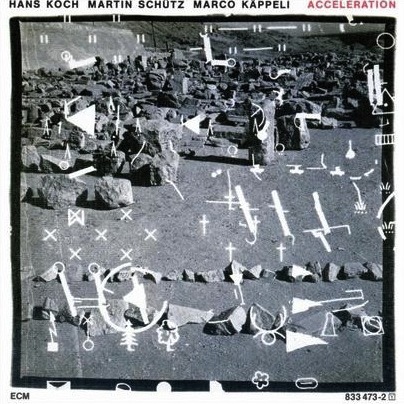
The debut recording of classically trained Swiss clarinetist Hans Koch’s jazz trio with bassist/cellist Martin Schütz and drummer Marco Käppeli, Accélération is not a shy blip in the fascinating potpourri of ECM’s 80s period, by which time Koch’s formidable outfit had left its footprints in standard territories before branching out here with a set of nine originals. Into this, the shivering cello and pointillist rims of “Shy Csárdás” provide a fitting point of entry. Like an opera overture these sounds recede as quickly as they rise, making way for the clarineted protagonist whose introductory aria secures a tether of human folly to the romantic sentiments that follow. Koch’s forte sings as it moves and moves as it sings, finding an ecstatic dance “Im Delirium,” which gives us also the album’s first and last tenor line over a waltzing bass. “Midori” is a synaesthetic exercise, rustling through leaves and time with the obsession of hunger and divulging some fine moments from Schütz against a spate of frenetic drumming. That clarinet waves like the last thread to something familiar as it snaps into an ecstatic death throe. “Loisaida” casts a dreamy spotlight thereon and unspools a whirligig of a denouement in “Glas(s)no(s)t.” Of this, the engaging stichomythia between cello and soprano is but an appetizer to the screeching “Tatzelwurm,” itself a preamble to the bouquet of trio action that begins with “Nitrams Rock” and ends in the playful piece of swank that is “GG-U-GG-U-RR-U-GG.”

A personal favorite among ECM’s lesser-knowns.

<< Pepl/Joos/Christensen: Cracked Mirrors (ECM 1356)
>> Stephan Micus: Twilight Fields (ECM 1358)

Dave Holland Quintet: The Razor’s Edge (ECM 1353)

Dave Holland Quintet
The Razor’s Edge

Dave Holland bass
Steve Coleman alto saxophone
Kenny Wheeler fluegelhorn, trumpet, cornet
Robin Eubanks trombone
Marvin “Smitty” Smith drums
Recorded February 1987 at Tonstudio Bauer, Ludwigsburg
Engineer: Martin Wieland
Produced by Manfred Eicher

Still reeling after seeing Dave Holland in a recent intimate performance with Jason Moran, I find myself going back to the fresh directions he explored on ECM with one of his finest outfits: the Quintet. As its third album for the label, The Razor’s Edge is all the more important for being reedman Steve Coleman’s last run with the group before his travels took him elsewhere on the path to musical geomancy. He joins Holland with the usual suspects: trumpeter Kenny Wheeler, trombonist Robin Eubanks, and drummer Marvin “Smitty” Smith (of, among countless other projects, Jay Leno Tonight Show Band fame).

The Quintet is as dynamic as ever in this seminal outing, which finds Eubanks and Coleman in particularly fine form. The trombonist gives us some early traction against Holland’s skittering delights in “Brother Ty,” while that unmistakable alto trades places with soulful insights in the more pensive “Vedana.” Next is, if the reader will indulge me, the title cut, which opens with Wheeler against a delicate rhythm section before releasing a tremulous solo from Eubanks. Coleman flies off a half-pike of big band sound, a raging flare of virtuosic wonder at the mouthpiece. Holland pauses for reflection in “Blues For C.M.,” only to drop the anchor with a gorgeous and unassuming theme. Coleman dominates again, bringing a slower heat this time around as he fills each available nook and cranny with his golden tone. An all-too-brief response from Eubanks brings us down into “Vortex.” Holland proves the early bird, opening to the full band with Coleman at the helm of yet another engaging vessel. And out of sparkling breath comes a muted Wheeler, hurling a pitch to Coleman at bat. Tracks like this are hard to beat, each a hefty dose of wonder and logic rolled into a ball of fun. After a couple of slow swings, Smith kicks us off into “Figit Time,” in which Coleman excels right out the gate. He is, like the album as a whole, a house aflame, threading every hot potato of a needle passed his way. The invigorating drum work in this masterpiece makes it alone worth the price of admission. This is life on jazz.

<< Gary Peacock: Guamba (ECM 1352)
>> Oregon: Ecotopia (ECM 1354)

Marc Johnson’s Bass Desires: Second Sight (ECM 1351)


Marc Johnson
Second Sight

Marc Johnson bass
Bill Frisell guitar
John Scofield guitar
Peter Erskine drums
Recorded March 1987 at Rainbow Studio, Oslo
Engineer: Jan Erik Kongshaug
Produced by Manfred Eicher

This sophomore effort from Marc Johnson’s Bass Desires comes nowhere near the octane levels of the project’s wild self-titled debut. This doesn’t mean, however, that Second Sight is no less enthralling. Its strength lies in its personnel. Guitarists Bill Frisell and John Scofield seem so well made for each other that, were they not split between the left and right channels, respectively, they might as well be thought of as some bizarre 12-stringed chunk of genius. How can we, for instance, not be moved by the sentiment of “Small Hands” and the resonant eddies of “Sweet Soul”? The latter, with its touch of Pat Metheny brightness, is especially moving. And let us not bypass the unassuming opener, “Crossing The Corpus Callosum.” Here the guitars dance on edge over the rolling hills of Peter Erskine’s drums and Johnson’s bass. The wealth of extended textures opens vista upon vista of possibility. Frisell is downright glowing in “1951,” which might as well have been an outtake from Naked City’s Radio. A dreamy slice of nostalgia pie if there ever was one, it comes served piping hot with a dollop of electric ice cream to boot. The solos are three-dimensional.

Lest we think this is all too ponderous, Scofield livens the proceedings with an invigorating twofer. The Richard Thompon-esque rhythm guitar in “Twister” is the set’s most spirited. Frisell and Scofield add to each other’s fire as they unabashedly scale the diminished seventh ladder (think Beatles), splitting off into the groovier weave of “Thrill Seekers.” Scofield rules with his solo here, while Frisell winds some of his most insectile threads in the background before slingshotting stardust back through the atmosphere. The band recedes for a fragile solo from Johnson before playing out on the vamp. The jauntiness of this number is superbly contrasted by “Prayer Beads,” a monologue from Johnson, who closes the door with “Hymn For Her.” This last is a dream within a dream. It feels like watching life through a veil of trickling water and finding that hope is already beside you, that its forgiving melodies flow both into and from the heart.

A note on the cover: the helicopter is a foil. Without it, the beach is just a beach. With it, the beach begs to be appreciated.

<< The Bill Frisell Band: Lookout For Hope (ECM 1350)
>> Gary Peacock: Guamba (ECM 1352)

Miroslav Vitous: Emergence (ECM 1312)


Miroslav Vitous
Emergence

Miroslav Vitous bass
Recorded September 1985 at Tonstudio Bauer, Ludwigsburg
Engineer: Martin Wieland
Produced by Manfred Eicher

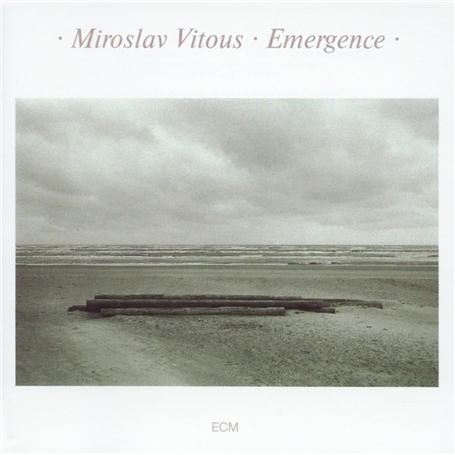
Although Miroslav Ladislav Vitouš has had varying levels of success in the post-Weather Report years as bandleader, we can hardly help but marvel at this gem of a solo recording. With nary an overdub in sight and more than enough heart to spare, the Czech bassist plots an orchestral sweep through his precisely (at)tuned skills. Like the caron that disappeared from the end of his name before going international, it is a valley of possibility, and he our shepherd through its gallery of songs and tales. All the more appropriate, then, that we begin with “Epilogue,” for it is a lasting look back at what is to follow. There is much to experience in this piece: a deep memory, intimations of a dance, the infused colors of a dream. Vitous carves from this chunk of maple the balsa-like delicacies of “Transformation.” There is indeed a metamorphosis in its lovely arco lines: from the internal to the external, from the thought to the spoken. Yet all of this is but a prelude to the four-part Atlantis Suite, of which the third movement (“The Choice”) is one of the most beautiful on the album. It flexes like a hand wafting smoke into our interpretive memories, and holds a flock of harmonics in its nets. From this, rays of light open into further transformations I can only liken to the shift from a voiceless to voiced consonant. Here, the mythical continent has not been torn asunder by inexplicable cataclysm. Rather, Vitous unravels its legacy in reverse, back to its golden age. “Wheel Of Fortune” similarly turns the passage of time into a visage of understanding, running through a field of prismatic colors into the abstract whirlwind-cum-groove that is “Regards To Gershwin’s Honeyman.” Vitous shows his sense of humor in the spirited “Alice In Wonderland,” which has something of the elusive rabbit’s mockery, then turns to subtler invigorations in “Morning Lake For Ever.” This is a fantasy in sound, a cleansing of the palate before a nod to Sketches of Spain ends the set in the rainbow of dramatic statements.

The skill of commanding attention with only a bass lies in the ability to treat the instrument as both a self-contained unit and as a seed for unheard things. Vitous accomplishes just such a dynamic. Never once does he sound like a backup instrument in want of a band. Whenever his fingers way to bow, there is nothing but openness in every action. As Vitous says in his dedication, this is “music with no boundaries.”

Emergence delights in the ways it blends registers, drawing upon a wealth of joys with just the right touches of melancholy and cerebral edginess. Such a well thought-out session cannot help but earn a rightful place alongside Dave Holland’s Emerald Tears as a classic in its field. The album is also superbly recorded, enhancing the instrument’s natural resonance by placing us in its very ribcage, as it were. It feels like walking through a dream, for in its confines perspectives change with such fluidity that one hardly notices them as the whims of a human touch. And perhaps they are the most natural of all, guiding us into a world of perception where evaluations such as this are but feathers on a dying bird.

<< John Abercrombie: Current Events (ECM 1311)
>> Werner Pirchner: EU (ECM 1314/15 NS)

Playing it like it is: Jason Moran and Dave Holland take to the Barnes stage at Cornell

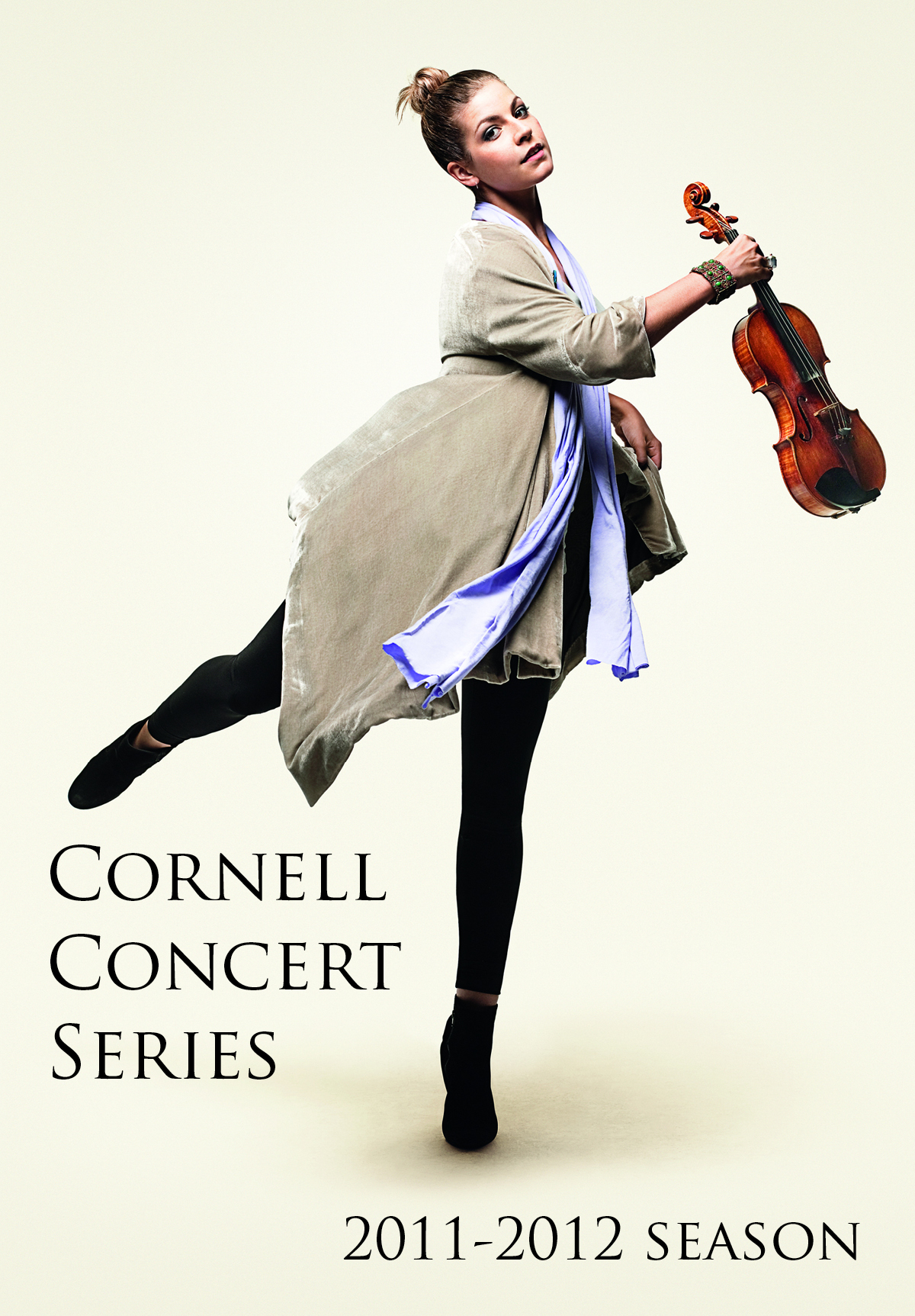
Comedian Hannibal Buress tells it straight: “People say, ‘I’m just taking it one day at a time.’ You know who else is? Everybody. That’s how time works.” And maybe that’s how jazz works, too. It’s a daily process, an ever-expanding diary of life experience that everybody’s being written into. Its pages ruffle and shuffle, rhyme in real time, bend and tear, yet through it all retain a cover as distinct and as battered as our Real Books. Every once in a while, a musician comes along who tapes up the binding, slaps on a new nameplate, and calls it fresh. Pianist Jason Moran is one such musician, one who knows there’s no past without a future. Bassist Dave Holland is another, one who knows there’s no future without a past. Though far from strangers, having been involved together in latter’s Overtone Quartet since 2009, as a duet they offer a rare chance to see two consummate artists in dialogue.

“My first opportunity to work with Dave,” says Moran in an e-mail interview, “was as a sub for Steve Nelson in his Quintet. This was the first time Dave’s quintet music was played with a piano, so it was quite a big space to fit in. Dave is an extremely supportive player. Meaning he is both a fantastic captain and a deck hand.” Yet the Houston native, who celebrates his 37th birthday this month, has spent much of his career rocking the boat. With influences ranging widely, from Thelonious Monk to Sol LeWitt, the avenue of his playing is lined with all manner of architectural styles. In addition to being one of the most important jazz pianists of his generation, he’s a thinker and, above all, a father. When I ask him about how he’d like to be remembered, he says, humbly, “That my children loved me, and that I taught them how to love.”

The title of his major debut, I think, says it all: Soundtrack to Human Emotion. It’s a philosophy to live by for someone who uses emotions as a writer might lay verbs on the page. From his jump outside the box with the immortal Sam Rivers on Black Stars (Holland also worked with Rivers on the seminal 1972 joint Conference Of The Birds) and on through to a trio session for the ages with Chris Potter and the late Paul Motian on Lost In A Dream, he has painted a veritable gallery of life-driven moods and impressions. Moran is also an educator. He teaches at the New England Conservatory of Music, where he places no small value in passing on ideas and conversations: “Young players should follow their heart. And if the music takes over their life, let the music lead the way, as there is so much to discover.” A harbinger of things to come, to be sure. Then again, why wait when you can experience it for yourself?

Most thumbnail sketches of Dave Holland, now 65, will include the requisite cameo by Miles Davis, in whose band the young bassist’s voice came to prominence. As a bandleader in his own right, the voice is so inimitable that those same sketches have since become a blur of dazzling color. To hear him in any group setting, one would never suspect—and rightly so—that he felt anything less than admiration for the talents he has enlisted over the years. His larger ensembles, beginning with the Quintet on 1984’s Jumpin’ In for ECM and expanding more recently to the Octet and beyond on his own Dare2 Records, have proven to be hotbeds for progressive thinking in the genre. Holland also redrew the upright landscape with 1978’s Emerald Tears, joining a growing roster of unaccompanied albums for an instrument all too often relegated to the rhythm section. There’s an enormous difference between playing solo and playing a solo. And while the lone piano is a relative mainstay in jazz recordings, Moran’s 2002 contribution, Modernistic, managed to make a comparably original statement: here is one who listens.

Indeed, listening is what these men do best. Whether it’s to themselves or to one another, their craft welcomes us to share in a compassion so hip that your head is already nodding before note one. Theirs are open, melodious hearts, and we are honored in their presence to step into an intimate circle where sound and peace walk hand in hand, taking it—you guessed it—one day at a time.

Jason Moran and Dave Holland will be performing at Cornell University’s Barnes Hall in Ithaca, New York this Saturday, January 28, at 8:00 pm. Tickets are sold out, but be sure to check back with me here at “between sound and space” for the post-concert report. The full Moran interview is below.

How do you define the power of a standard?

The power of a standard lies within how good it sounds when out of the hands of it’s original composer.

Can you tell us a little more about your classical background and how that fits into what you do at the keyboard?

My technique is where most of my classical background reveals itself. My first Suzuki method teacher was Yelena Kurinets. She had a very strict vision about what piano technique is, and that has helped keep my hands in good form, knock on wood.

When you’re on point, really feeling it, what is your state of awareness? Do you disconnect or plug in? Do you leave us behind or take us with you?

Well, I think it’s a combination of both disconnecting and connecting. I like to think of it as simultaneously talking and listening to someone. It’s the balance of those things. The audience is always on the ride. And as with all riders, some like to wear no seatbelt, some ride in the bed of a truck, some water-ski, and some simply look out of the window.

Tell us about working with Dave Holland for the first time. Will you be approaching the duo set any differently than your work with the Overtone Quartet?

My first opportunity to work with Dave was as a sub for Steve Nelson in his Quintet. This was the first time Dave’s quintet music was played with a piano, so it was quite a big space to fit in. Dave is an extremely supportive player. Meaning he is both a fantastic captain and a deck hand. So if I want to make a sharp left turn with the boat, he’s pulling the line quickly to help change the course. Given his extensive history, there won’t be much that will throw him off. So, we love having our musical dialogue shift languages.

You are clearly dedicated to passing along your passion and energy to the next generation. How has teaching informed your playing? What do you think is most important for younger players to understand as they grow into jazz, and vice versa?

Teaching allows me to hear the concerns of the next generation of musicians. Their concerns allow me to tailor my teaching methods to them. I continue to be a student myself, so I feel like we are all in the same boat, and we are all on the front line. As for my playing, I think having to discuss my methods so frequently, I realize I need to practice what I preach. Young players should follow their heart. And if the music takes over their life, let the music lead the way, as there is so much to discover. Most of all, young players need to study themselves, and secondly study the history.

Which artists, musical or otherwise, make you shake your head in wonder and think, “I’ll never get there”?

Bach.

What do you get from working with other musicians? What do you think they get from you?

This music is built around community. It works best when you work well with others. It’s more a life lesson than a musical one. Have respect for people and their ideas, and work with them. I’m not sure what they get from me, but “energy” is the term I keep telling myself.

How did you react to Paul Motian’s recent passing?

Paul was a fixture in NY, so it’s very different without him occupying the city. He let everyone in. Wonderful man.

Being an ECM nut, I adore your presence on the Athens Concert with Charles Lloyd and Maria Farantouri. How did you become involved in this fantastic project, and what was it like working with two such distinct legends at the same time?

I’ve been with Charles for almost 5 years, and it is an ongoing process. He shares so much knowledge with his band, and he shares his community as well. In one breath Maria gives us the history of vocal music. It’s all circular, as we like to say.  

When the day comes that you lay down your last note, how would you like your contributions to be remembered?

That my children loved me, and that I taught them how to love.

Who are you listening to these days?

Sam Rivers and Henry Threadgill. Sam also passed recently. For many years, he and Dave were very close. A wonderful catalog of music has been left behind. I’m working on a Henry Threadgill celebration. And lastly, I’ve been listening to a lot of comedy, and am loving Hannibal Buress.

Describe what jazz means to you in one word.

I can’t, so I won’t.

Eberhard Weber: Orchestra (ECM 1374)


Eberhard Weber
Orchestra

Eberhard Weber bass, percussion, keyboards
Herbert Joos fluegelhorn
Anton Jillich fluegelhorn
Rudolf Diebetsberger French horn
Thomas Hauschild French horn
Wolfgang Czelustra trombone
Andreas Richter trombone
Winfried Rapp bass trombone
Franz Stagl tuba
Recorded May/August 1988 at Tonstudio Bauer, Ludwigsburg
Engineer: Carlos Albrecht
Produced by Manfred Eicher

Despite an overt lack of the very instruments implied by the title of this mysterious effort from bassist Eberhard Weber, it is far from misleading, for the orchestra is in our minds, and in Weber’s heart as he emotes with the fullness of his instrument. The album divides itself between two distinct halves. The first of these hones emphasis on the solo. Weber is the foreground, flexing like the backbone of a creature whose anatomy is otherwise invisible. After the fluttering opening statement of “Seven Movements,” the palette warms into a lush ostinato, which only seems to accompany itself as it coils its golden threads into a brass-gilded frame. Some percussive death throes provide rare drama. “Broken Silence” features a delicate arco bass soaring low above its droning shadow toward the horizons of “Before Dawn.” This, a gorgeous spell working its lilting magic like a funhouse mirror, except that here we find not laughter or distortion, but an expansion of our sonic worldview. Weber jazzes things up for “Just A Moment,” riding a slingshot into “Air,” itself but a pliant reed in a pond, a cattail waiting to cast its children into the wind.

“Two Early To Leave” blends a congregation of brass into tremulous strings, thereby evoking the sweeps of Weber’s earlier work and inaugurating us into the breathtaking second half. We continue with “One Summer’s Evening,” floating sinuous lines along a current of synthesizer. The tender solo of “Daydream” winds its embrace against a sunny drone, while the darker emotional urgency of “Trio” drops itself into a deep sleep, where it dreams of the “Epilogue,” a forlorn path tread by pizzicato footsteps until it is flattened and no longer kicks up dust.

Orchestra is Weber at his purest. A lovely exposition of his talents, technical and melodic alike. Certainly not the one you’ll want to start with, but by no means a shabby place to spend the night before continuing on your journey.

<< Dave Holland Trio: Triplicate (ECM 1373)
>> Dino Saluzzi: Andina (ECM 1375)

John Surman: Private City (ECM 1366)

John Surman
Private City

John Surman bass clarinet, recorders, soprano and baritone saxophones, synthesizer
Recorded December 1987 at Rainbow Studio, Oslo
Engineer: Jan Erik Kongshaug
Produced by Manfred Eicher and John Surman

If the title of Private City comes about as close as one can get to describing the sound-world of John Surman, then that of its first piece, “Portrait Of A Romantic,” does the same for the man behind it. Its quivering recorder blankets us in warmth, fully realized by an electric piano and bubbling as the waters in a forgotten loch. A bass clarinet swims, a creature of myth remembering a time when its kind were plentiful. Thus begins this widely regarded album of incidental ballet music that remains one of Surman’s most personal. The recorder returns, an elusive and mythic voice, “On Hubbard’s Hill,” calling forth steady electronics from the depths of its own dreaming, leaving us to look out on all we’ve done. The familiar sequencer shows its face in “Not Love Perhaps,” climbing itself like a self-generating ladder and carrying with it a sacred form of déjà vu, in which time is but a loop within the heart of learning. Surman’s soprano moves with the grace of a traditional melody that has only now come to the surface of our audible history. “Levitation” is exactly what he accomplishes with an unwieldy instrument like the bass clarinet. As it splinters into myriad offerings beneath a pregnant moon, an “Undernote” bobs on a current of its own regret. “The Wanderer” is another watery piece, that beautiful soprano melting over a wavering ground of synth lines and bass clarinet, and ending on a distant fanfare. The swaying “Roundelay” exemplifies Surman’s limitless talents, as well as the purity of his notecraft. Led by a fairy-like soprano, it feels like ice-skating along an infinity sign set to music. Last is “The Wizard’s Song,” the album’s crowning jewel, showing us again the inimitable delicacy with which its composer approaches the lower, neglected reeds. Like the ending credits to a movie that lives on even after it is done, the effects keep scrolling in our heads, wandering the darkness until they have reached the private cities inside all of us.

<< The Paul Bley Quartet: s/t (ECM 1365)
>> Masqualero: Aero (ECM 1367)