Keith Jarrett Trio: Setting Standards – New York Sessions (ECM 2030-32)

2030_32

Keith Jarrett Trio
Setting Standards – New York Sessions

Keith Jarrett piano
Gary Peacock double-bass
Jack DeJohnette drums
Recorded January 1983 at Power Station, New York City
Engineer: Jan Erik Kongshaug
Produced by Manfred Eicher
“I feel we are an underground band that has, just by accident, a large public.”
–Keith Jarrett, on his trio with Gary Peacock and Jack DeJohnette

The piano is considered by some to be a “complete” instrument. On it, one can compose anything from a simple etude to the grandest of symphonies, and its most adored practitioners may be said to be whole at the keyboard. The beauty of a player like Keith Jarrett is that he makes the piano sound so gorgeously incomplete, emphasizing as he does the unfathomable volume of sentiments he would convey through it if given the time. As it is, we get the barest taste of immortality. Jarrett carries the entire weight of any composition in even the most linear of melodic lines. In doing so, he opens doors that few could step through unharmed.

And yet, step through them the rare soul has, and perhaps none so ingenious as bassist Gary Peacock and drummer Jack DeJohnette. When listening to the bliss that rolls off Jazz’s proverbial tongue throughout Setting Standards, however, we must constantly remind ourselves that the three albums collected therein represent the first time Jarrett, Peacock, and DeJohnette had ever stepped into the studio as a bona fide trio. The three men were, of course, far from strangers, but produced such unreal synergy in these unrehearsed sessions that they might as well have been cut from the same cloth. The trio would also prove in a way cathartic for Jarrett, who was already beginning to buckle under the pressures of an increasingly demanding listenership. For this, he turned to the tried and true, if not to the plied and blue, for solace.

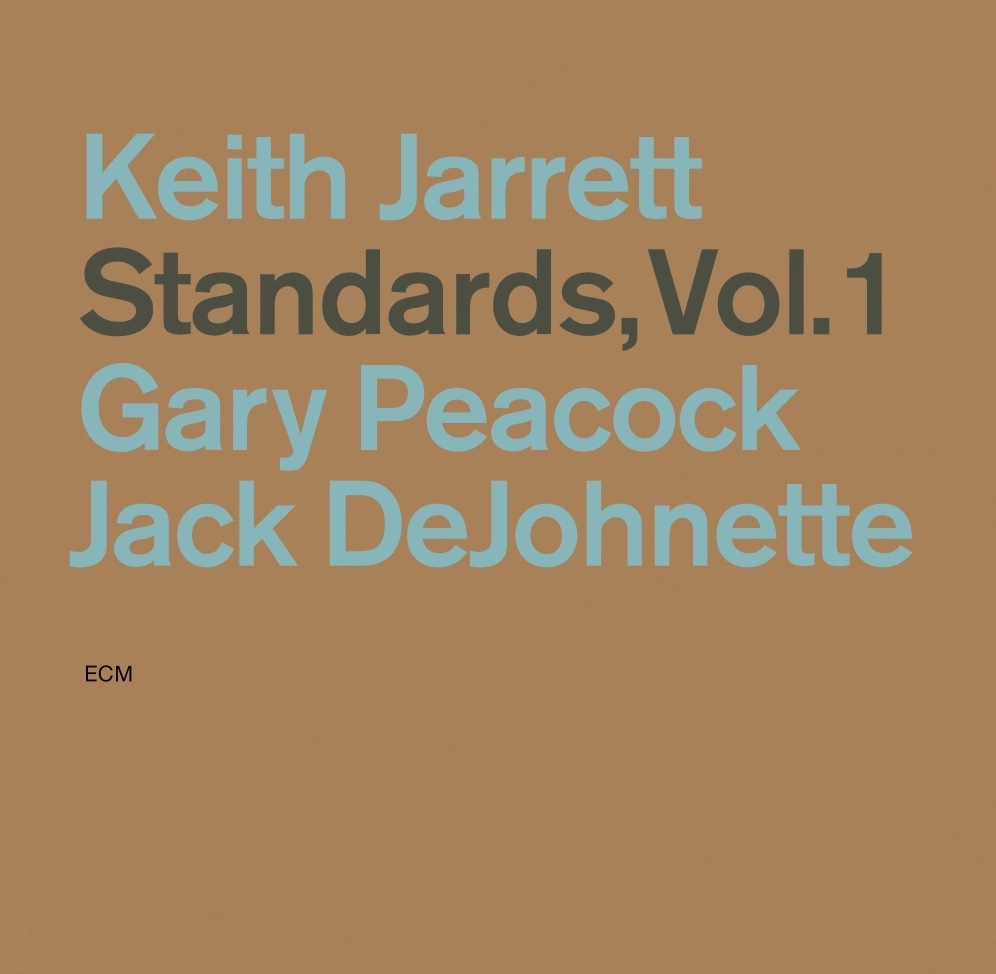
With Standards, Vol. 1 (ECM 1255) Jarrett and company set things straight from the get-go by showing us the “Meaning Of The Blues.” This swath of melodious rain is the trio form at its best and never lets up until the very end. DeJohnette’s charcoal sketches in background add a quiet boldness. “All The Things You Are” is a more lighthearted, though no less intense, construction, and haunts Peacock’s nimble fingerwork with a visceral chord progression. Smoothness abounds in “It Never Entered My Mind,” a gentle tune that puts a new twist on the pessimism of balladry by resolving itself at moments into a hopeful groove. A hefty splash of freedom awaits us in “The Masquerade Is Over.” Peacock is on fire here, giving just the sort of fuel that Jarrett sets to such glorious conflagration. The latter’s soloing proves that not only is the masquerade over, but also that these musicians never hid behind masks in the first place. If any single facet of this jewel can be singled out, it is the stunning fifteen-and-a-half-minute rendition of “God Bless The Child” that concludes it. Peacock excels, taking the swing around the bar and back again.

<< John Surman: Such Winters of Memory (ECM 1254)
>> Charlie Mariano: Jyothi (ECM 1256)

… . …

ECM 1289

Standards, Vol. 2 (ECM 1289) is a shaded glen in Volume One’s verdant forest. Its mood is summed up perfectly in the title of the opening “So Tender,” which after a slow intro falls into the unity that so distinguishes this trio. Jarrett dances not on air but on fire in his pointillist lines, while Peacock and DeJohnette both captivate with their subtle, popping sound. “Moon And Sand” is an equally smooth ride through less traveled territories and finds Jarrett in a gentler mood. DeJohnette is also at his most delicate here, drawing circles in the sand with his brush. For “In Love In Vain” Jarrett spins from thematic threads a twin self, who for all his similarities breathes a different sort of politics in one of the set’s finest tunes. With every grunt, Jarrett voices only the tip of his creative iceberg. Peacock delights with a very elastic solo, which no matter how far it stretches stays locked to its theme as if by finger trap. Jarrett is at his lyrical best in “Never Let Me Go,” and skips to his Lou in “If I Should Lose You” before laying down the poetry of “I Fall In Love Too Easily” with a thick, tangible power.

<< Eberhard Weber: Chorus (ECM 1288)
>> Everyman Band: Without Warning (ECM 1290)

… . …

ECM 1276

Prior to the release of Setting Standards, I hadn’t yet encountered the free play session that is Changes (ECM 1276) and what a joyful surprise it turned out to be, for never has the trio emoted in such a blissful mode. “Flying” is a heavenly diptych honed in delicacy and abandon. Here the band describes a decidedly aquatic territory, each tattered thread of melody flowing like the tendrils of a throbbing deep-sea creature whose eyes are its hearts. Jarrett spreads and shoots straight like an octopus, every pad suctioning to a new and exciting motif. Peacock, meanwhile, threads his fingers through a vast oceanic harp, stretching his emotive capacity to its limits. DeJohnette surfaces with a deeply digging solo before we end with Jarrett alone in a quiet, dissipating reflection. Peacock trails his starfish of a bass line through the pianistic coral reef of Part 2, he and DeJohnette inking their solos before hollering their way into an inescapable passion. The set ends in the refractions of “Prism.” And indeed the trio as a unit is not unlike a prism, separating every ray of light into its composite colors, likewise every ray of darkness into its whispered secrets. Jarrett’s expulsions heighten every inarticulable word that he writes, the breath of an energy that cannot be contained. The farther these reveries drift, the more life experience they carry back into the fold when they return.

<< Arvo Pärt: Tabula rasa (ECM 1275 NS)
>> John Adams: Harmonium (ECM 1277 NS)

… . …

In a society gone astray from musical immediacy, it’s safe to point out Jarrett’s nexus as one of the more reliable vestiges where melody still blooms. With an average track length of nine minutes, these are quiet and endlessly interesting epics. Say what you will about Jarrett’s singing, which has sadly turned not a few off from these recordings, but I believe Peter Rüedi puts it best in his insightful liner notes when he says, “His groans and vocal outbursts, considered by many to be a quirk, are in fact nothing but a form of suffering at the thought that the abyss between the piano and sung melody can ultimately never be bridged, not even by Jarrett himself.” To these ears, Jarrett’s voice welcomes us into the intimacy of his creative spirit, so unfathomably expanded in the company of two fine musicians (and even finer spirits) whose talents can’t help but sing in their own complementary registers. And on that note, we mustn’t forget the contributions of Jarrett’s band mates, who constitute far more than anything the mere rubric of “rhythm section” might ever imply. How can we, for example, not shake our heads in wonder at DeJohnette’s consistent inventiveness, which singlehandedly reshaped the idioms at hand. And then there is Peacock, who for me is the bread and butter of the first two sessions. So carefully negotiating his path through various leaps and bounds, he seems to anticipate everything Jarrett throws his way. Just listen to his soloing on “It Never Entered My Mind” and “God Bless The Child,” and these words will mean nothing.

Through the two standards albums, Jarrett put the “Song” back into the Great American Songbook, and in Changes enlarged it with “Prism.” Now given the proper archival treatment in this 3-disc Old & New Masters edition commemorating 25 years of music-making, this unassuming surge of sonic bliss is now ours to cherish at will.

The camaraderie expressed in the booklet’s final session photo speaks for itself:

Marc Johnson: Bass Desires (ECM 1299)

Marc Johnson
Bass Desires

Marc Johnson bass
Bill Frisell guitar, guitar synthesizer
John Scofield guitar
Peter Erskine drums
Recorded May 1985 at Power Station, New York
Engineer: Jan Erik Kongshaug
Produced by Manfred Eicher

“Samurai Hee-Haw,” the opening track of Marc Johnson’s Bass Desires, is one of the most memorable cuts in the ECM catalogue and a signature one for this transient project. Yet beyond its leader’s deeply rooted bass and Peter Erskine’s key-to-lock drumming, the pairing of Bill Frisell and John Scofield is what truly sets this firecracker a-sparkle. Their combined forces are enough to make one dizzy, and more than once they slip past our expectations by the skin of their teeth. Perhaps nothing could bear the weight of this resounding call to electric arms more confidently than a movement lifted from John Coltrane’s A Love Supreme. Hence “Resolution,” a groovy flower in which Erskine proves his own mettle with a tripped out solo against the metal string game being woven before him. The band turns the tables once more with the keening “Black Is The Color Of My True Love’s Hair.” This Appalachian folk song of Scottish origin finds not new but old life in the stretch of sonic hallway down which it is led. Lest we fall too deeply into elegy, the title track counters with rip-roaring fun. Erskine and Johnson lay down plenty of traction to spare as the two pickers fry the ether with their song. Elmer Bernstein’s “A Wishing Doll” sports a dancing synth guitar that can’t help but put one in mind of Pat Metheny. Flip a switch, though, and suddenly we’re riding Johnson’s “Mojo Highway,” of which the reggae-ish beat and lumpy bass complement smoldering mood swings from guitars.

This is a must for any ECM lover’s collection and ranks among the best of the Touchstones series. Like the title of Scofield’s “Thanks Again” that ends it, it holds up as a sprawling love letter to those on either end of the musical stick.

<< Azimuth: Azimuth ’85 (ECM 1298)
>> Terje Rypdal: Chaser (ECM 1303)

Dave Holland Quintet: Seeds of Time (ECM 1292)

Dave Holland Quintet
Seeds of Time

Dave Holland bass
Steve Coleman alto and soprano saxophones, flute
Julian Priester trombone
Marvin “Smitty” Smith drums, percussion
Kenny Wheeler trumpet, cornet, pocket trumpet, fluegelhorn
Recorded November 1984 at Tonstudio Bauer, Ludwigsburg
Engineer: Martin Wieland
Produced by Manfred Eicher

Seeds of Time presents the Dave Holland Quintet in arguably its finest incarnation. With Kenny Wheeler blowing brass, Marvin “Smitty” Smith on drums, Julian Priester on trombone, and Steve Coleman on reeds to enlighten the senses at every turn, one simply can’t go wrong with this date. For me its brightest stars are Wheeler and Coleman, both of whom paint the album’s most vivid scenes. Coleman’s transportive alto lights up the night against Holland’s metronomic click in “Uhren” before Wheeler pushes us into the deep end, where swims a school of extracurricular percussion. This fantastic start keeps expectations high, though these are ultimately surpassed by what follows. “Homecoming” is another jubilant enterprise, which turns on every dime dropped from Holland’s strings along its precisely winding road. The tightly wound horns unleash one engaging phrase after another, Wheeler in particular kicking up the solo-verse up a notch or two. Holland also punches his time clock with a tight diversion. “Perspicuity” introduces Coleman’s flute into a lacier matrix as Holland walks on air. The opening of the “Celebration” that follows speaks from beyond our time with the voice of an era wrapped in gold. Some of the grooviest bass work around can be found on this track as Holland runs up and down the stairs of an architecture that is purely his own. The title couldn’t be more apt, for celebration is exactly what this formidable band brings to the table every time. “World Protection Blues” seems also to come from a distant time, only now from the future. The quintet builds to fever pitch as lines and spaces fill out one another into a solid color of wonder. A noteworthy solo from Priester to boot, positively swinging with rounded edges. “Gridlock (Opus 8)” is a working argument of modern anxiety. Its confrontations of flesh and technology, of mobility and imprisonment, are cracked open like a forgotten blue egg from the robin’s nest of the Art Ensemble of Chicago. Coleman dances on air as the band takes flight from a hard bop defenestration. Smith’s back-and-forth action here is a high point in the Holland archive. The funkier lines and cowbell-infused gait of “Walk-A-Way” leaves us blissfully prepared for “The Good Doctor.” Here Holland slinks in like a panther into a caravan of flute and horns. “Double Vision” ends on a high note, lassoing our attention (as if the album hasn’t already) to an electrifying hitching post. After the opening blast Wheeler launches forth as Holland and Smith hold down Fort Groove. A flick of register gives us a wormy soprano sax solo, positively soaring over Holland’s firm grounding.

The energy of this music is such that we find ourselves lost in every contortion of its features. Holland is no holds barred without being aggressive, direct without being confrontational, straightforward without ever being staid. Each successive album only seems to further energize his band mates, and with Seeds of Time we know firsthand how he can do the same for his listeners.

A must-hear for those who take their coffee with excitement.

<< Oregon: Crossing (ECM 1291)
>> Gary Burton Quartet: Real Life Hits (ECM 1293)

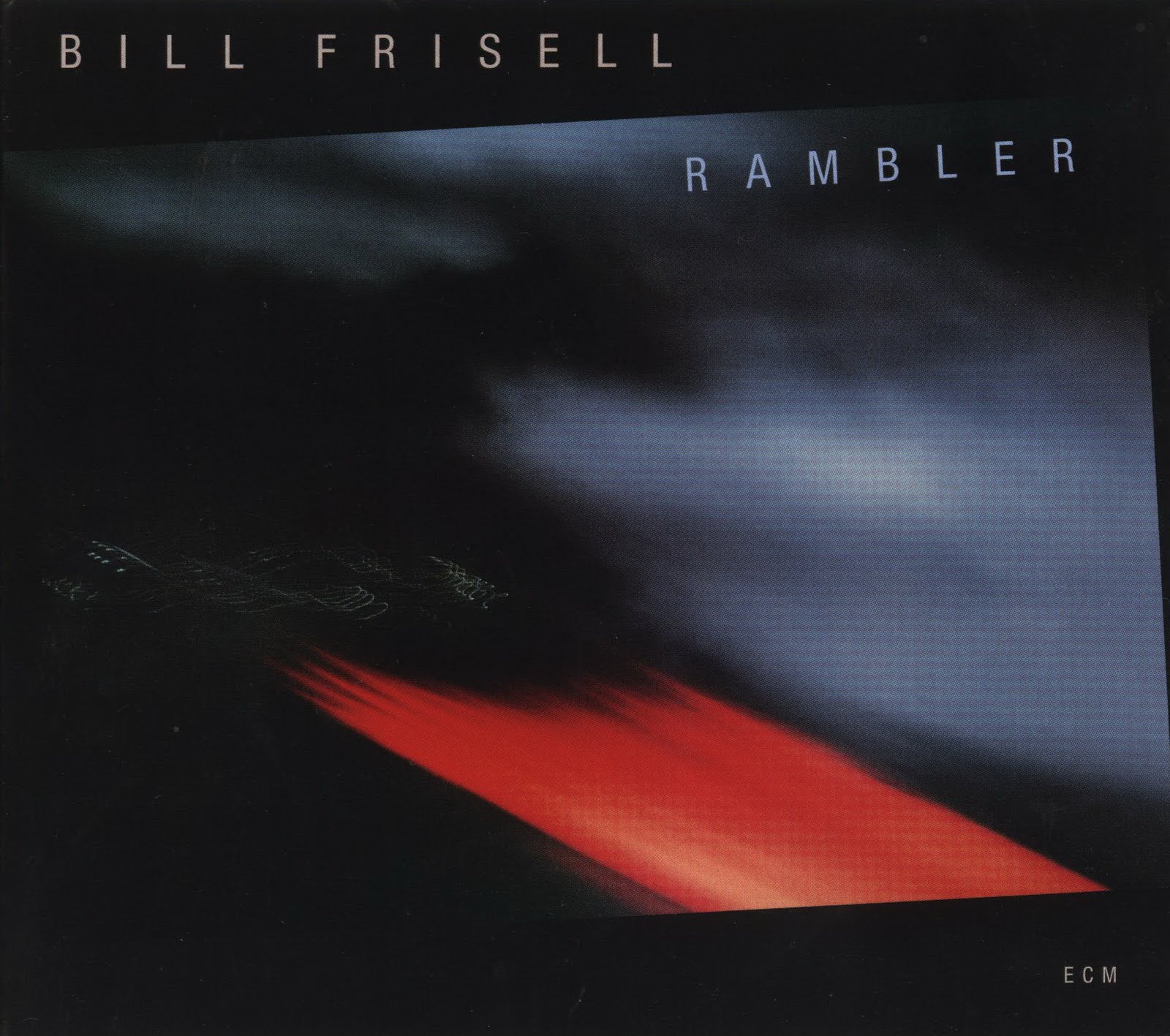
Bill Frisell: Rambler (ECM 1287)

Bill Frisell
Rambler

Bill Frisell guitar, guitar synthesizer
Kenny Wheeler trumpet, cornet, fluegelhorn
Bob Stewart tuba
Jerome Harris electric bass
Paul Motian drums
Recorded August 1984 at Power Station, New York
Engineer: James Farber
Produced by Manfred Eicher

If you’re like me, then you were introduced to the prodigy of guitarist Bill Frisell through the work of John Zorn’s groundbreaking Naked City outfit. In that context, Frisell was able to stretch his skin in ways that he never has before or since. Or so I believed until I only recently began to explore his back catalogue on ECM. The summit of these early explorations is shared by 1983’s In Line and Rambler. Where the former seemed to burrow into the deepest recesses of his craft, the latter travels far and wide, not least through the presence of some fine sidemen: Kenny Wheeler on three kinds of brass, Paul Motian on drums, Jerome Harris on electric bass, and, perhaps most notably, Carla Bley band regular Bob Stewart on tuba. Stewart’s pomp is especially enlivening, teasing out as it does Frisell’s penchant for not taking himself too seriously. The tuba threads an unwavering smile through the morbid march that is “Music I Heard” and adds earth tones to the silvery palette of the title track. The latter is quintessential among Frisell’s output. The lovely webbed slink of his guitar and gorgeous Wheelerian dialogues carries us in strums and strides to an ethereal conclusion. The band also abides by humor in the hokey and lumbering “Tone.” This, the album’s opener, gives us a taste of the mesh that is Frisell’s style, one strung with long threads of algae, picked up and spun by his band mates in kind. Through the tree swing sway of “When We Go” and the tongue-in-cheekily titled “Wizard Of Odds” we encounter Frisell’s flowery side, ever enhanced by Wheeler’s squeals and stops. The campiness of “Resistor” is tempered by the welding torch of Frisell’s electric and the laser of Wheeler’s trumpet, while “Strange Meeting,” fettered by a pleasant bass line, draws itself into an incisive Synclavier sound. As vital as Frisell is to this date, one feels him most in the compositions. Wheeler and Harris are the real stars, and let us not shut our eyes to Paul Motian’s sparkling threads.

Rambler is a significant album for showing the world a remarkable guitarist on his own terms, and through a set of compositions as distinct to his sound-world as the clouds are to the sky.

<< Shankar: Song For Everyone (ECM 1286)
>> Eberhard Weber: Chorus (ECM 1288)

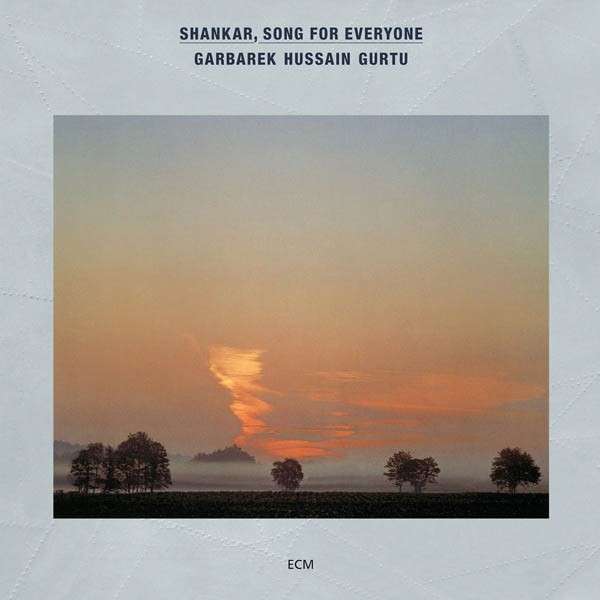
Shankar: Song For Everyone (ECM 1286)

Shankar
Song For Everyone

Shankar 10-string double violin, drum machine
Jan Garbarek soprano and tenor saxophones
Zakir Hussain tabla, congas
Trilok Gurtu percussion
Recorded September 1984 at Rainbow Studio, Oslo
Engineer: Jan Erik Kongshaug
Produced by Manfred Eicher

Shankar and Jan Garbarek’s previous collaboration, Vision, opened many people’s ears to the more fruitful possibilities of idiomatic blends. And while that initial project yielded a fascinating album in its own right, I always felt it lacked something I couldn’t quite articulate. With Song For Everyone, that lack becomes clear once Trilok Gurtu and Zakir Hussain level the playing field with their earthy rhythms. In their presence, electric violin and saxophone can soar even higher, knowing there will always be a ground to return to. As if to underscore this point, Shankar also employs a drum machine, as in the delightful “Paper Nut” that inaugurates us into the album’s universe. Shankar’s Philip Glassean harmonies and flexible dips form a sling that shoots us in slow motion toward the Visionary galaxy of “I Know,” where his sparkling pizzicato lines are reinvigorated by the presence of tabla. Garbarek has hardly ever sounded as clean as he does here. He digs deep into his emotional and technical reserves and proves his chameleonic abilities, such that whenever he returns with the theme in tow, it is always as if from a long journey. This enchanting track also exemplifies the coalescence of which these two musicians are so worthily capable. “Watching You” reinstates the drum machine, which is immediately valorized by Shankar’s likeminded precision (even when multi-tracking, he sounds like one instrument). Ascendant chording provides ample uplift for Garbarek’s rainbow arcs. The violin solo here proves that Shankar’s mastery comes not from the top down, but from the inside out. He makes the most demanding passages seem effortless and the simplest seem complex, as in “Conversation.” Here his virtuosity enhances Garbarek at his adaptive best. After the anthemic jubilation of the title track, “Let’s Go Home” comes across as introverted, though no less energetic. “Rest In Peace” ends the album with bowed heads. It is a slow dissipation of cloud, a gentle breeze of the heart, the empty chambers of a body in which music is the only tangible spirit.

<< Bruno Ganz: Hölderlin – Gedichte gelesen von Bruno Ganz (ECM 1285 NS)
>> Bill Frisell: Rambler (ECM 1287)

Egberto Gismonti/Nana Vasconcelos: Duas Vozes (ECM 1279)

Duas Vozes

Egberto Gismonti guitars, piano, flutes, dilruba, voice
Nana Vasconcelos percussion, berimbau, voice
Recorded June 1984 at Rainbow Studio, Oslo
Engineer: Jan Erik Kongshaug
Produced by Manfred Eicher

Sometimes I wonder. I wonder what forces were at work to have brought two brilliant music makers like Egberto Gismonti and Nana Vasconcelos together on this earth. I wonder what energies nourish their spirits any time the two of them step into the studio, alone or otherwise. I also wonder how a surefire recipe for continued enchantment could come out of the oven as this misshapen improvisation session from 1984. Neither musician has ever needed a definitive structure around which to coil his respective song in order to be captivating (just listen to, for example, the breadth of freedom in Gismonti’s Solo or Vasconcelos’s Saudades), but during the first few steps of Duas Vozes I find myself craving it. It’s not that the images painted therein aren’t unique, only that the colors with which they are painted simply don’t blend. Thus is the album’s first half the backside of a one-way mirror: we can see through its devices, even if the microphones can’t. Thankfully, in the latter half we come face to face with a reflection that shows us only the depth of our awe.

Our first confusions arise in “Aquarela Do Brasil,” which begins playfully enough, but quickly degrades into six long minutes of Vasconcelos’s whooping (compare his sparing use thereof on “Carneval Of The Four”). “Rio De Janeiro” also breaks its promise when, after the lively pulse that opens it, Gismonti’s guitar wanders in circles without ever enlarging any of them. And while much of this sounds like outtakes between jam sessions, there are some flashes of brilliance in which these longtime friends explore insanely microscopic avenues of their craft, particularly during a passage for which Gismonti plays the little strings at top of his instrument. The cavernous flute of “Tomarapeba” opens the portal just a little more, as do Vasconcelos’s calls from the treetops in “Dancado.”

It isn’t until “Fogueira” that we get something undeniably special, something far beyond what I would already have expected. Its balance of restraint and full-out effusiveness blossoms with a Ralph Towner-like sensibility, Vasconcelos adding masterful color all the while. With this, the portal is thrown open, letting in the floodlights that are “Bianca” and “Don Quixote.” In the latter, Vasconcelos’s insectile tongue-fluttering adds the perfect environmental touch, even as Gismonti unveils his piano for a final stretch of droning brilliance.

For an album that is only half the masterpiece it could have been, how it ever came to be included in ECM’s Touchstones series would seem unwarranted were it not for its destination. But even if we aren’t quite sure about how it gets there, Duas Vozes is worth your attention for that destination alone.

<< Pat Metheny Group: First Circle (ECM 1278)
>> Jack DeJohnette’s Special Edition: Album Album (ECM 1280)

Pat Metheny Group: First Circle (ECM 1278)

Pat Metheny Group
First Circle

Pat Metheny guitars, synclavier guitar, guitar synthesizer
Lyle Mays trumpet, synthesizers, piano, organ, bells
Steve Rodby acoustic bass, bass guitar, drum
Pedro Aznar voice, guitar, percussion
Paul Wertico drums, percussion
Recorded February 15-19, 1984 at Power Station, New York
Engineer: Jan Erik Kongshaug
Produced by Pat Metheny

By the release of First Circle, expectations for the Pat Metheny Group surely ran high, but with the appearance of new drummer Paul Wertico (replacing Danny Gottlieb) and Argentine percussionist Pedro Aznar (who took the place of Nana Vasconcelos, and whose vocals elevated the group to new levels) the results coalesced into something timeless. Don’t let the hokey “Forward March” fool you, however. Everything that follows is as solid as it gets. Were you to map out a flow chart of listeners’ favorites here, the largest field would likely be taken up by the effervescent title cut. And while indeed this vocalese-laden train of stunning pianism from Lyle Mays and Metheny’s equally locomotive acoustic is a glorious masterstroke if there ever was one, one can hardly refuse the wide vistas of “Yolanda, You Learn” or the heartrending brushwork of “If I Could,” one of the most utterly beautiful statements Metheny has ever recorded. “Tell It All” and “End Of The Game” hark back to Offramp, the latter especially in its soaring synth guitar lead. Both are spurred along by a gentle guiding hand, born of a palpable synergy and given traction in Wertico’s fantastic timekeeping. Although Metheny’s presence is vivid throughout, for me it is Mays who gilds this project with its distinguishing colors. And hats off to Aznar, whose singing in “Más Allá” (this album’s “What Game Shall We Play Today?”) adds another highlight. It’s fantastic to hear lyrics being added sparingly to the Metheny universe, if only because his melodic lines already describe so much without them. Aznar shines again in “Praise,” thereby ending things with a revelry more than worthy of its title. Listen to this already.

<< John Adams: Harmonium (ECM 1277 NS)
>> Egberto Gismonti/Nana Vasconcelos: Duas Vozes (ECM 1279)

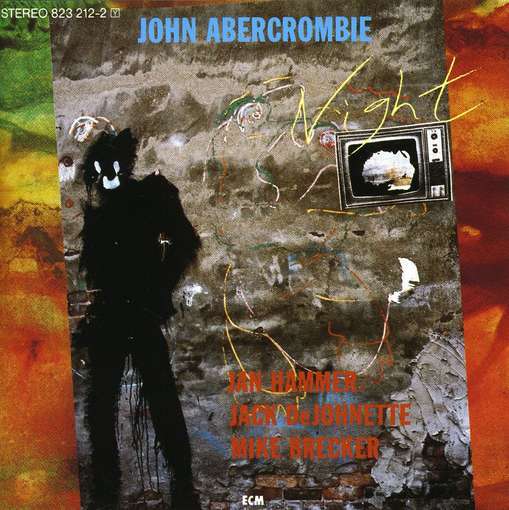
John Abercrombie: Night (ECM 1272)

John Abercrombie
Night

John Abercrombie guitar
Jan Hammer keyboards
Jack DeJohnette drums
Michael Brecker tenor saxophone
Recorded April 1984 at Power Station, New York
Engineer: Jan Erik Kongshaug
Produced by Manfred Eicher

As its cover indicates, Night gives us a colorful, collage-like portrait of John Abercrombie, who jumps here into the urban deep end with smoky club atmospheres and tight jams. It’s a joy to see the guitarist working with Jan Hammer again, and the inclusion of Mike Brecker on tenor and Jack DeJohnette on drums make for a winning formula. Hammer adds a particular spike to this sonic punch, competently filling the session’s lack of bass while also fleshing out the production with an evocative sweep. Between the idiomatic blend of “Ethereggae” and the Timeless heat distortion of “3 East,” his billowing keys give Brecker more than enough room to show off his chops (he has hardly sounded better). This date isn’t all fun and games, however, for the rain-slicked streets of “Look Around” give us pause for reflection. Hammer reignites things in “Believe You Me,” which despite being the most straightforward track compositionally sports Brecker’s most uninhibited solo yet. The band saves the best for last with “Four On One,” which draws another ring of fire in an enthralling closer. DeJohnette gets his moment in the sun here as well.

Though something of an blip in the Abercrombie back catalogue, Night is far from benign. Aside from the effusive music, what really distinguishes this album is its sound. Another slam-dunk for engineer Jan Erik Kongshaug.

<< Pat Metheny: Rejoicing (ECM 1271)
>> Art Ensemble of Chicago: The Third Decade (ECM 1273)

Kenny Wheeler: Double, Double You (ECM 1262)

Kenny Wheeler
Double, Double You

Kenny Wheeler trumpet, fluegelhorn
Michael Brecker tenor saxophone
John Taylor piano
Dave Holland bass
Jack DeJohnette drums
Recorded May 1983 at Power Station, New York
Engineer: Jan Erik Kongshaug
Produced by Manfred Eicher

One can always count on trumpeter Kenney Wheeler for three things: (1) rounded writing contrasted with pointed soloing, (2) an always-engaging sound, whether alone or surrounded by a large band, and (3) a perfect marriage with ECM production values. For this modest set, we get two epic cuts bookending two shorter ones, and the results do not disappoint. As if having the talents of Jack DeJohnette, Dave Holland, and Mike Brecker along for the ride weren’t enough, Wheeler is also joined by John Taylor, whose sweeping pianism tempers the trumpeter’s fire just enough to keep it from scalding us, and whose resplendence could alone carry the album. The potent lyricism of the entire congregation is on full display in “Foxy Trot.” Holland and DeJohnette bring on their own heat, as well as a live, exuberant energy to the proceedings that provides an ideal carpet of hot coals for Brecker’s carefully measured walk. After an unremarkable duet between Wheeler and Taylor (“Ma Bel”), he and Brecker spin a duet in “W. W.” that bowls us over once the rhythm section kicks in. The two horns are superbly attuned here, and Brecker in particular in his soaring solo, which burns up all of its available oxygen and leaves Holland to dance among the ashes. Last is a triptych of compositions that begins in bliss with Brecker and Taylor, wrought through by Wheeler’s sunshine and the glistening accents of DeJohnette and Holland. We also get an effervescent solo from Taylor, who draws the curtains around us like a silo of intimate memories. Wheeler’s resolutions seem to trace a life of contented solitude and bring closure to an album of high energy.

Wheeler hits his stride at every turn with his unabashed brand of exposition, which defines new sonic territory with every project. One could easy gush at length about his lyricism, but on this album we also get an even clearer sense his rhythmic sensibilities. Ignore the filler of “Ma Bel,” and you have an almost perfect album.

<< Shankar: Vision (ECM 1261)
>> Terje Rypdal/David Darling: Eos (ECM 1263)