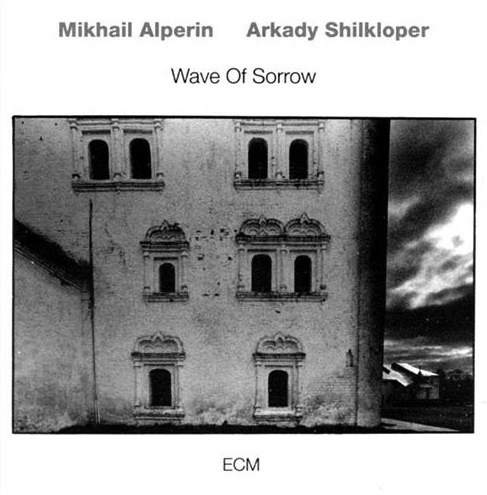
Misha Alperin/Arkady Shilkloper: Wave Of Sorrow (ECM 1396)

Misha Alperin
Arkady Shilkloper
Wave Of Sorrow

Misha Alperin piano, melodica, voice
Arkady Shilkloper French horn, jagdhorn, fluegelhorn, voice
Recorded July 1989 at Rainbow Studio, Oslo
Engineer: Jan Erik Kongshaug
Produced by Manfred Eicher

With Wave Of Sorrow, Misha (then Mikhail) Alperin began what has proven to be a fruitful relationship with ECM. Though the Ukraine-born pianist has but a modest discography on the label, each recording brims with the folklore of his sensitivity. Since this date he has spun a telepathic relationship with trumpeter Arkady Shilkloper, and the results on this duo album are as unique as their players. Alperin offers a set of ten original compositions, each, in spite of the intimate arrangement, a grand and sweeping thing. Not unlike label mate Richie Beirach, his architecture is ambitious in its scope and clarity yet rarely deviates from the warm embrace that births it. One hears this in the opening “Song,” to which Shilkloper adds the bay of a hunting horn. Like many of the pieces that follow, it smacks of tradition even as it shines with modern interpretation. Yet this is also a world of shadows, for in the title piece (one of the most affecting melodica solos you will ever hear) we can intuit a web of tortured histories and only hints of the happiness that may unravel it. Shilkloper arrives toward the end bathed in ECM’s plush reverb, seeming to hang from the tail of Alperin’s breathy comet like a child of the night. Still, this date is not without its fun. “Unisons,” for example, casts the two musicians in a decidedly vocal mold as they rap and tap their way through a cathartic romp. “Poem” similarly allows Shilkloper to come out of his lyrical shell into a full-blown dance. Alperin also offers up a few piano solos, of which “Prelude in Bb minor” is the most evocative—a shaft of moonlight through which the dust of a wanderer’s journey casts its sparkle. Other highlights include the simple yet ingenious motivic arcs of “Short Story” and Shilkloper’s distant mutes in “Miniature.”

The contradiction of the album’s title is that so much of the music springs to its feet, all the while harboring a matrix of oppression and exile. We hear this especially in the solo “Epilogue.” The atmosphere is dim yet also sparkling, as if it were a harsh present slumbering behind the illusory veil of a memory, fond and forever lost.

<< Bach: Goldberg Variations – Jarrett (ECM 1395 NS)
>> Shankar: nobody told me (ECM 1397)

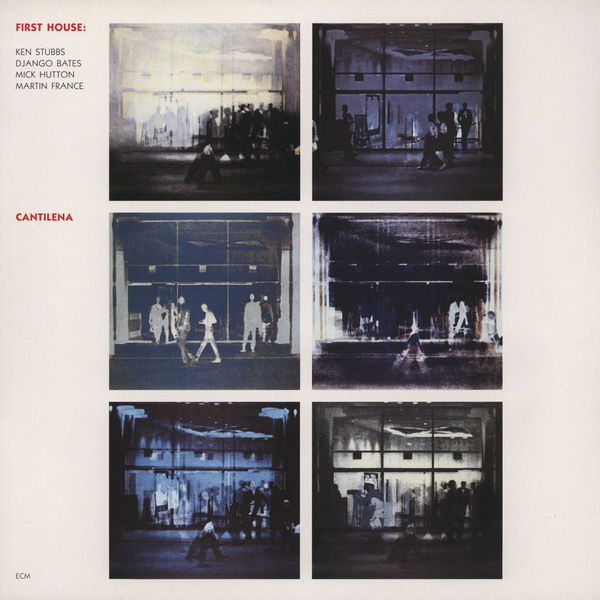
First House: Cantilena (ECM 1393)

First House
Cantilena

Ken Stubbs alto saxophone
Django Bates piano, tenor horn
Mick Hutton bass
Martin France drums
Recorded March 1989 at Rainbow Studio, Oslo
Engineer: Jan Erik Kongshaug
Produced by Manfred Eicher

After a memorable ECM debut with Eréndira, the talented quartet of saxophonist Ken Stubbs, pianist Django Bates, bassist Mike Hutton, and drummer Martin France—a.k.a. First House—followed up with an even more effective chunk of progressive jazz in Cantilena. From the first soulful licks of the title opener, we know we are in for something special and from the heart. The composer’s alto draws us into the night with recumbent charm, thereby opening an ambitious set that delivers everything it promises and more. Like a model posing for a painting, its contours come into representational being only through an artist’s touch. This leads us into the connective tissue of the piano, which seems to blossom, lured by the alto’s return to a place where dreams can be made real. From this we are introduced to the writing of Bates, of whose “Underfelt” the theme is anything but as it sneaks its way through a burrow of circular motives. Stubbs shells out some incredible improvisation here, working his way far beyond the corners of the page. The Bates train continues on through the whimsies of “Dimple,” for which he clashes horns with alto against exemplary and jaunty support from Hutton and France. More of the same energy awaits us the sprightly abstractions of “Low-Down (Toytown),” to which the rubato slice of blues that is “Sweet Williams” (Bates) is indeed a sweet preamble, while the urban sprawl of “Jay-Tee” features the date’s most spirited soloing from our two lead melodicians. The Bates sector rounds out with the vastly energizing “Hollyhocks,” which features rolling harmonies in the pianism and a spate of resplendent energy that grabs us hook, line, and sinker into the contemplative yet all-too-brief tenderness of Eddie Parker’s “Madeleine After Prayer” (the only non-group tune on the record), which is spun through “Shining Brightly” into a horizon backlit by hope. Once again the alto hollows out our bones and fills them with the marrow of sentiment. Some tracings from Bates initiate “Pablo,” thus ending the album where it began: in a dream where music is the only language that remains.


Original cover

Of the many strengths First House possesses, it is the compositional prowess within that shines above the rest. The group’s robust musical ideas have immense staying power, and in combination with such a smooth blend of the forward-thinking and the classic, one would be as foolish as Oliver to ask for more in a jazz outfit.

<< Keith Jarrett Trio: Changeless (ECM 1392)
>> AM 4: …and she answered: (ECM 1394)

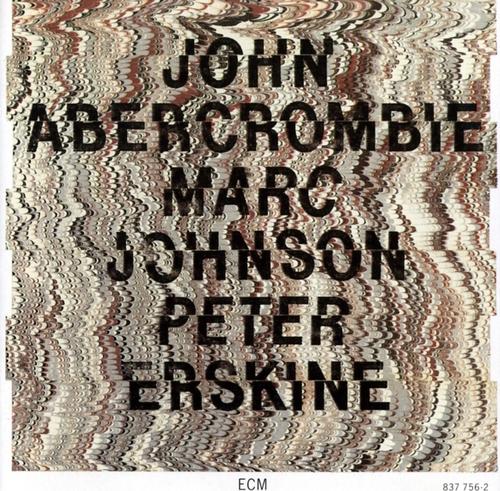
Abercrombie/Johnson/Erskine: s/t (ECM 1390)


John Abercrombie
Marc Johnson
Peter Erskine
s/t

John Abercrombie guitar, guitar synthesizer
Marc Johnson bass
Peter Erskine drums
Recorded April 21, 1988 live at the Nightstage, Boston
Engineer: Tony Romano
Produced by Manfred Eicher

After the resounding success of their two studio albums, Current Events and Getting There (with Michael Brecker), guitarist John Abercrombie teamed up with bassist Marc Johnson and drummer Peter Erskine for this wondrous live 1988 recording from the Nightstage in Boston. It’s crystal clear from the groove laid down by Johnson and Erskine in the opener, “Furs On Ice” (think Getting There), that each of these men travels the edges of a constantly shifting yet with-it triangle. Abercrombie spins some Frisell-like chording before emerging with a soaring synclavier line in this, one of two Johnson-penned tunes, the other being a trimmed-down version of his “Samurai Hee-Haw” (see Bass Desires). Replacing Bill Frisell and John Scofield is no small order, yet Abercrombie fills these shoes with plenty of funk to spare. That unmistakable bass line, in fact, courts some of the most electrifying improv heard in a while from Abercrombie, who brings a Hammond organist’s sensibility to the proceedings via his fiery macramé. Erskine is also fantastic here. Abercrombie turns up the heat even more on his own two contributions. “Light Beam” is a particularly well-suited vehicle for synth guitar, and indeed seems focused like a laser splashed through the prism of his rhythm section. This is followed by a drum solo from Erskine, who shows us a nifty thing or two from his skill set, particularly in his dialoguing between bass drum and toms, before Abercrombie’s classic “Four On One” (from his seminal 1984 joint, Night) plies its musings and rounded edges with the record’s crunchiest playing. The three continue to converse beautifully in their group improv piece, “Innerplay.” Notable for Johnson’s delightful string games, it is a lasting testament to the powers of spontaneity.

The rest of the set is filled to bursting with a hefty portion of standards. Between Erskine’s delicate rat-a-tat timekeeping in “Stella By Starlight” and the delicacies of “Alice In Wonderland” (into which the rhythm section eases so carefully one feels more than hears it), there is much to stimulate repeated listening. Yet it is in “Beautiful Love” that we find the pot of gold at the end of this rainbow. From the gentlest guitar solo Abercrombie spins a song even as he unravels it into a water-skating journey so gorgeous it almost weeps. The trio’s finest moment and easily one of Abercrombie’s most inspired (and inspiring) improvisatory passages on record. The final “Haunted Heart” almost reaches those same depths, smoothing out an extended guitar intro into a velvety soft ballad that stirs us into a pool of melting chocolate and lets us steep.

A sublime recording from musicians at the top of their game, for a game this most certainly is, played by those who know the rules as well as anyone.

<< Terje Rypdal: Undisonus (ECM 1389)
>> Thomas Demenga: Bach/Carter (ECM 1391 NS)

Stephan Micus: The Music Of Stones (ECM 1384)


Stephan Micus
The Music Of Stones

Stephan Micus shakuhachi, tin whistle, stone chimes, resonating stones, voice
Elmar Daucher resonating stones
Günther Federer resonating stones
Nobuko Micus resonating stones
Recorded 1986 at Ulm Cathedral
Engineer: Martin Wieland

Elmar Daucher’s resonating stones have haunted me since I first heard them on Klangsteine-Steinklänge (released 1990 on ProViva). While not conceptually unique (stone instruments, notes Micus, have at least a 2500-year history), Daucher’s playable sculptures nevertheless speak with voices all their own. They are, as anyone familiar will tell you, enchanting enough on their own terms, but to hear them in the context of Stephen Micus’s visceral melodies is to hear them as the source of some nameless creation. For the most part Micus has had free reign in recording for and submitting his work to ECM producer Manfred Eicher, who commits the material to disc as an acolyte might transcribe a master’s words. But for this project he took a rare dip into the pool of collaboration along with his wife Nobuko, Günther Federer, and Daucher himself all playing resonating stones. Add to these Micus’s unique instrumental prowess in the reverberant embrace of Germany’s Ulm Cathedral, and the results are as profound as they are extraordinary.


Micus and Daucher at Ulm Cathedral

The stones come alive in Part 1. Their voices hum through the listener’s bones. A shakuhachi begins its bird-like dip from the heavens, touching its wings to freedom. In its song one finds a cave, never knowing what will be heard, for under the cover of that night there is but a single voice calling (or is it weeping?) for someone. Two hands hold a song of water, turning it like a teacup held high in the absence of ceremony for the gods to drink. The shakuhachi then becomes a woodland creature who knows the trees well enough to skip through the branches blindfolded. The striking of the stones in Part 2 therefore startles with a blast of light. With the delicate force of a prepared piano or gamelan it is at once metal and flesh. One feels within it a sense of coming together through falling apart, a slow dissolve into unity at a molecular level. Part 3 introduces a penetrating tin whistle, and with it a feeling of windswept plains and distant shorelines, the continued gonging of the stones like cow bells in the pastures. Underlying rhythms carry over into Part 4, embracing an elemental sound in their tectonic heart, in which every seismic shift carves a new glyph of experience. Part 5 is a shakuhachi solo, tremulous and breaking. Spun of cloud and snow, it is a crane’s inner life unfolding before the dawn. Micus lets his throat unspool at last in Part 6, making music out of the very air around him. Which brings our attention to the one uncredited stone sculpture in all of this: the very cathedral itself, which has collected and preserved the footprint of every note played and which imparts its histories to us in an everlasting whisper.

<< Terje Rypdal: The Singles Collection (ECM 1383)
>> The Hilliard Ensemble: Perotin (ECM 1385 NS)

Shankar: nobody told me (ECM 1397)

Shankar
nobody told me

Shankar double violin, vocals
V. Lakshminarayana violin, double violin, vocals
Ganam Rao vocals
Zakir Hussain tabla
Vikku Vinayakram ghatam
Caroline vocals, tamboura
Recorded 1989 at The Complex, Los Angeles
Engineer: Billy Yodelman
Produced by The Epidemics (Shankar & Caroline)

After the uncharacteristic misstep that was The Epidemics, Shankar returned to his roots with nobody told me and showed us that his flair for Carnatic vocals is almost as deeply fleshed as his improvisational gifts on the double violin. And while he has never quite recaptured the magic of Who’s To Know, that same generative spirit is present here in every gesture of his bow. The recording is far more intimate than anything else he has put out. For that reason alone it bears repeated listening and the nuances that repetition brings to each new experience. He is also accompanied by some staggering talents, among them V. Lakshminarayana (father of the venerable L. Subramaniam and pioneer of the Indian violin, he died the year following this session), Zakir Hussain on tabla (who, if you’re reading this, probably needs no introduction), and ghatam master Vikku Vinayakram. The session is rounded out by vocalists Ganam Rao and Caroline, the latter of whom also provides the foundational tamboura drone throughout.

The most heartening moments are to be found between Lakshminarayana and Shankar, whose exchanges in the opening Chittham Irangaayo constitute a spiritual conversation to which the listener can only nod. From tender beginnings, their stichomythia of the rustic and the laser-like opens into a broader language as the rest join in the fray. Shankar emerges from this milieu with beautifully articulated chording and pizzicato accentuations in turn before bowing his way into a rousing finish. Vocals predominate the Chodhanai Thanthu that follows. The unrestrained cadences therein bring us to the root of this music, which at its best floats straight from the body and into the heart of the divine. Only with the introduction of percussion and violin do words step out onto the histrionic stage, taking us by the hand into the brief yet inescapable Nadru Dri Dhom ­Tillana, a fitting end to a raw and impassioned document of collective music-making.

<< Misha Alperin/Arkady Shilkloper: Wave Of Sorrow (ECM 1396)
>> Charles Lloyd: Fish Out Of Water (ECM 1398)

Egberto Gismonti: Dança dos Escravos (ECM 1387)

Egberto Gismonti
Dança dos Escravos

Egberto Gismonti guitars
Recorded November 1988 at Rainbow Studio, Oslo
Engineer: Jan Erik Kongshaug
Produced by Manfred Eicher

When I first heard Egberto Gismonti’s Dança dos Escravos (Dance of the Slaves) it had been months since I’d listened to the Brazilian master, and the feeling of being wrapped in his brilliant passion again was a joy to say the least, for in his comforting embrace I can always find more than a gesture to relate to. Although he is an adept multi-instrumentalist, I’ve always felt that Gismonti excels alone at the guitar, and you will not likely find a purer distillation of his art than this. The 15-minute title track constitutes the album’s lungs, through which Gismonti respires in concise autobiographical detail. Upon waking, it hits the ground running, flipping space as if through the pages of a well-weathered book into which a photographic record has been pasted. The glue becomes brittle and flakes the farther one goes back, and though images have loosened their grip on the past Gismonti rescues them with every unexpected turn in his playing. There are moments when he seems to time-travel, his fingers working independently yet with an orchestral unity so personal that even when he adds a 12-string it seems but an extension of the same instrument.

“Dança dos Escravos” bears the subtitle “black,” and Gismonti has accordingly designated every track its own color. Red is represented by the enthralling opener, “2 Violões.” From jubilant to regretful, he cycles through a youth’s worth of faded dreams and unrequited loves. It is one of his best and in it we find the intimacies of his craft overflowing in full disclosure. Moving on to blue in “Lundu,” he plows through a cycle so engaging that he cannot help but let out an mm of ecstatic communion with his instrument. That same voice comes out more intentionally in the green (“Trenzinho do Caipira”) and in the white (“Salvador”), uncovering in both the playful spirit that lurks in the interstices of his memories. It is as if he were standing on the center of a seesaw, at one end of which is the weight of the future and at the other sits the child-self thereof. Gismonti pares his abstractions to their hearts, working them into the traditional yellow ornaments of “Alegrinho.” Here he shares a fleeting portrait of the streets (and of the trees not so far away). We encounter open markets and the patter of boys’ feet between stalls as they snatch fruits and life experience from the tables.

There is something indescribably authentic (whatever currency that word may have nowadays) about Gismonti’s music. Listen, for instance, to the burnished brown of “Memoria e Fado” and hear within it a thousand voices, each having fed into this one musical utterance and of which said utterance will one day become a part of the growing chorus to inspire those in the future. It is through this music that one steps outside into the night, looks up at the stars, and thinks not confoundedly, but rather forgoes philosophy, content in knowing that its mysteries are life itself. These are shadows made bright again.

<< Paul Giger: Chartres (ECM 1386 NS)
>> Ralph Towner: City Of Eyes (ECM 1388)

Trio Mediaeval: Soir, dit-elle (ECM New Series 1869)


Trio Mediaeval
Soir, dit-elle

Anna Maria Friman soprano
Linn Andrea Fuglseth soprano
Torunn Østrem Ossum soprano
Recorded April 2003, Propstei St. Gerold
Engineer: Peter Laenger
Produced by John Potter
Executive Producer: Manfred Eicher

The music on this, the second album from the Trio Mediaeval, represents 500 years of creation. And yet, as John Potter notes, “in a sense it is older than that, tapping into the continuing present—a timeless present, perhaps—that is what medieval music means to us.” These three Scandinavian singers have done so much for the music they touch, and in turn British composers Gavin Bryars, Ivan Moody, Andrew Smith, along with Ukrainian Oleh Harkavvy, have nourished that sound with newly fashioned music of their own. At the heart of these dedicatory contributions lies the Missa “Alma redemptoris mater” of Leonel Power (fl. 15th century). The mass is a fine example of early Renaissance polyphony and through the Gloria alone expresses a cathedral’s worth of light and shadow. The tonal qualities of the singers and the sung are luminescent, all coming to a flowering head in the visceral Agnus Dei. Power’s music comes to us in spite of Henry VIII’s Dissolution of the Monasteries, thereby speaking to us all the more lucidly through a history that might have silenced it. Its clarity is as pervasive as its texts and forms a warm framework through and around which the women of Trio Mediaeval weave their artfully conceived program.

Plainchant is the inhalation and exhalation of Harkavvy’s Kyrie (2002), as of the program as a whole, which unfurls bursts of polyphony in its pores. From ashes to flesh and back to ashes, it paints a tableau of life in barest terms, exceeded in simplicity only by the solo laude of Bryars, who also aligns all three voices in his stilling Ave regina gloriosa (2003). The Ave Maria (2000) and Regina caeli (2002) of Smith expand upon the gorgeousness of these horizons, again inscribing broad mosaics of faith with minimal vocal borders. Only when we get to Moody’s The Troparion of Kassiani (1999) do we find ourselves wrapped in a more detailed cartography. Its shifting microtonal harmonies, evocative textual phrasings, and resplendent highs cut to the core of the singers’ art. Moody also offers the pinnacle of this disc in his 2002 composition A Lion’s Sleep, if only because it seems to draw upon the Trio’s talents most intimately.

In light of the above impressions, however, I am wary of treating the album as anything but a unified whole. Like all Trio programs, it is structured like a stained glass window, each section having been soldered into place with great individual detail, but which comes to vibrant life when vocal light shines through it. Only then does the image tell its story, share its moral lesson, and open its wings to an understanding of vibration and sound that is as constant as the sun in its veins.

Charles Ives: Sonatas for Violin and Piano (ECM New Series 1605)


Charles Ives
Sonatas for Violin and Piano

Hansheinz Schneeberger violin
Daniel Cholette piano
Recorded December 1995 at Tonstudio van Geest, Sandhausen
Engineer: Teije van Geest
Produced by Manfred Eicher

The violin sonatas of Charles Ives were famously considered unplayable at the time of their composition (1903-1916). This is about as far my knowledge about their background reaches, for Ives represents a sore gap in my listening that was only recently salved by violinist Hansheinz Schneeberger and pianist Daniel Cholette, who bring 20 years of experience with the sonatas into the studio for what I imagine will be a reference recording for years to come. In this instance I feel fortunate in my ignorance, for it allows me to approach this music with fresh ears and an open mind. Having listened only a few times thus far, I clearly have much to learn and discover.

Perhaps akin to its French counterparts, the First Violin Sonata to my ears feels connected to the intersection of body and landscape, of song and action. It youthfully skirts the line between outright offense and justifiable play (and is that Bartók I hear creeping in through the exuberant double stops?). The second movement, an Allegro, is a pastiche of soaring melodies and grinding moments of impasse, while the final movement is like some anthemic dream turned in on itself. Such twisted charm seems part and parcel of the Ivesian experience, and backgrounds the “Autumn” movement of the Second Violin Sonata with tortured intimations in a magisterial wash of melody. These underlying struggles haunt with such regularity that whenever energies do pick up they seem like desperate attempts to break free from something dark and adhesive. In much the same way, “In The Barn” is at once exuberant and tempered by internal conflict, while “The Revival”—which opens with what I can only describe as a morose version of “Jingle Bells”—fascinatingly overlaps traditions and distortions with a jeweler’s eye. The Third Violin Sonata is the most consistent of the four. Its chain of verses moves through a mosaic of narratives, but always with a sense of forward motion and thematic drive. From the aggressive to the pastoral, it handles its moods with conviction. Subtitled “Children’s Day At The Camp Meeting,” the Fourth Violin Sonata opens with a terse Allegro and a cascading second movement, the latter being for me the masterpiece of the collection. Lullabies give way here to lilting rhythms and jolting cutoffs, inviting us to fill in the gaps with our own experiences and understandings.

Although these sonatas don’t make for the most “pleasant” listening, one can hardly fault them for their honesty. Ives’s was an uncompromising approach to style, which is to say he eschewed it. Instead, he seemed equally bound to a highly idiosyncratic aesthetic and to the whim of the moment. Schneeberger and Cholette bring out that very tension and walk the edge of predetermination and spontaneity with practiced intimacy. Not unlike the early compositions of John Cage, Ives’s music commits to its own unfolding even as it thrives on the mystery of impossible form(ation).

<< Bobo Stenson Trio: War Orphans (ECM 1604)
>> Ingrid Karlen: Variations (ECM 1606 NS
)

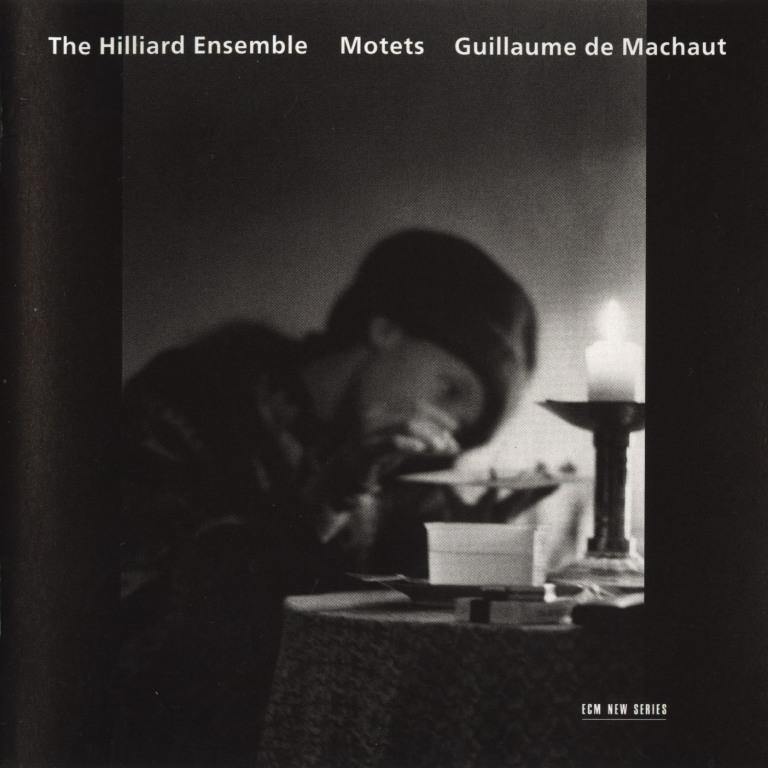
The Hilliard Ensemble: Guillaume de Machaut – Motets (ECM New Series 1823)

Guillaume de Machaut
Motets

The Hilliard Ensemble
David James counter-tenor
David Gould counter-ternor
Rogers Covey-Crump tenor
Steven Harrold tenor
Gordon Jones baritone
Recorded November 2001 at Propstei St. Gerold
Engineer: Peter Laenger
Produced by Manfred Eicher

As one who spent a good part of his formative Renaissance listening digesting the music of Guillaume de Machaut (c. 1300-1377) via non-Hilliard Ensemble recordings (most notably Ensemble P.A.N.’s exemplary Remède de fortune on New Albion), I have to admit to not taking much of a shine to these renditions at first. Yet after sitting with, and returning to, this recording a number of times over the years, I’ve been able to move beyond my preconceived notions and to appreciate the stunning light they shed. I venture to say that others may have the same reaction, but the rewards for immersing oneself in this ECM treatment are revelatory. The Hilliards have never been ones to take any project lightly, nor the choices within it, and the emotive care with which they sand and shape Machaut’s virtuosic settings is something to behold with wholehearted attention.

Like Gesualdo some two centuries later, Machaut was not without his preoccupations with mortality, love (both sacred and secular), and human beings’ penchant for suffering. It is perhaps for this reason that the Hilliards present their program in chronological order, as if to show us how Machaut grew behind and through its trajectory. And indeed we can almost hear that single comet’s tail drawn quietly from a tangle of cosmic lines. To be sure, these performances maintain the composer’s bold dissonances and challenging harmonies as they cascade over one another in waves of overwhelming polyphony (this, also, I think contributes to their hold on a listener), but in the Hilliards’ mouths their edges become rounded and fair, an effect only heightened by the resonance of Propstei St. Gerold, where the session was recorded.

The music is often anchored by dominant lines (e.g., Puis que la douce rousée) even as it spirals through a galaxy of atmospheres. Like a four-dimensional object it is impossible to fathom through the eyes, yet when we hear it through the shadows of the recorded medium it unscrambles our inner vocabulary like a Rubik’s cube until every side is uniform. Thus the movable nature of Machaut is so well suited to the Hilliards, for a likeminded meticulousness of vocal color and rhythmic staggering (O livoris feritas) truly distinguishes these singers from the rest. They also manage to enhance the sometimes-whimsical edge of the music’s piteous core, as in Helas! où sera pris confors. David James glows in the intimacies of Eins que ma dame d’onnour, Faus Samblant m’a deceü, as do the falsetto tenor lines in Fins cuers dous. Ultimately, however, one feels arbitrary in singling out certain moments over others, for Machaut’s knots are too well balanced to begin picking at individual threads.

I feel at pains to articulate what this music feels like, and equally so in trying extract some interpretive statement to which others, whether they’ve heard it or not, may relate. Like so much of what we encounter in our listening lives, these sounds come and go, lost even as they are experienced. That being said, I cannot help but believe that they leave discernible traces in the body, in the very synapses of the brain. If this recording has taught me anything about this art of reviewing in which I so humbly engage, it’s that immediate effect is not the criterion by which music should necessarily be judged. (In a world so bound by linear time, what currency does immediacy carry anymore?) Rather, I have increasingly tried to look at the specks of permanent change that Machaut, here and elsewhere, has lodged in me. Looking back on the experiences that led me to him in the first place, I know that fortune has indeed whispered into my ears with his texts and melodies from so many centuries ago.

If I may interrupt this stream of thought with a technical one, this was the first recording I ever heard with tenor Steven Harrold, who signed on with the Hilliard Ensemble in 1998. And while the colors of John Potter are certainly missed, Harrold delivers a fresh and slightly brighter tone (at the risk of undoing my earlier assertion, may I point your attention to his gorgeousness in the Veni creator spiritus). His presence is duly welcome in the context of Machaut’s motets, and along with countertenor David Gould enhances every motif he touches. If each motet is a series of numbers, then the Hilliards have provided us with legible solutions. Like a proof, each is filled with potential diversions and dead ends, but through this singular recording we are given a full map that we do well to follow with our eyes closed and our ears walking, open-armed.