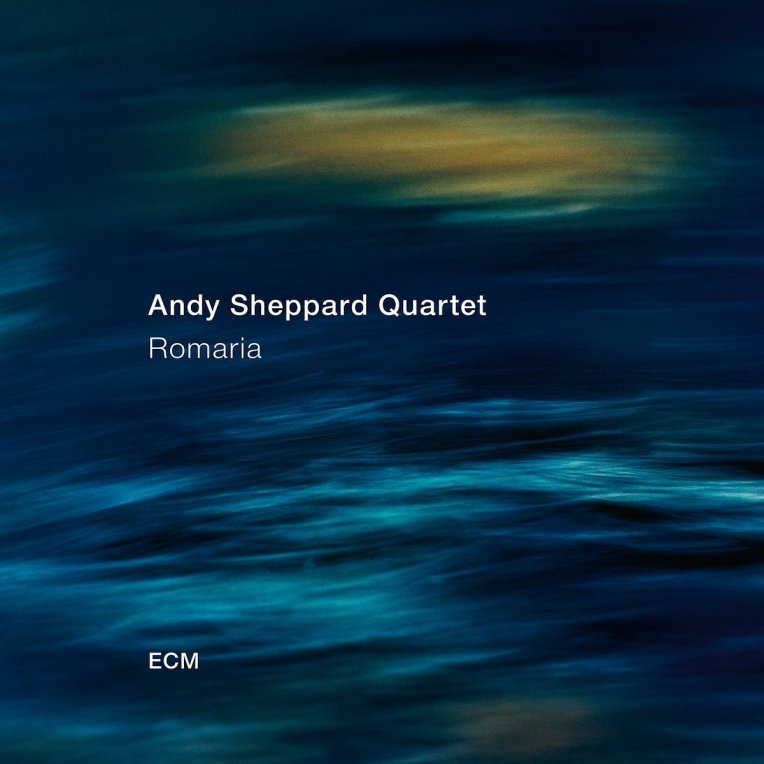
Andy Sheppard Quartet: Romaria (ECM 2577)

Romaria

Andy Sheppard Quartet
Romaria

Andy Sheppard tenor and soprano saxophones
Eivind Aarset guitar
Michel Bonita double bass
Sebastian Rochford drums
Recorded April 2017, Auditorio Stelio Molo RSI, Lugano
Engineer: Stefano Amerio
Produced by Manfred Eicher
Release date: February 16, 2018

Saxophonist Andy Sheppard’s quartet with guitarist Eivind Aarset, bassist Michel Benita and drummer Sebastian Rochford pulls out threads from this album’s predecessor and from them weaves an even more seamless tapestry.

Once again, Aarset proves an integral presence, adding (in Sheppard’s words) an “orchestral voice,” which percolates as life-giving water through soil. On “Thirteen,” one of seven tunes penned by the bandleader, swells of guitar move with a grace rarely encountered since, appropriately enough, Terje Rypdal’s contributions to Ketil Bjørnstad’s The Sea. The title track, by Brazilian songwriter Renato Teixeira, is a vessel drifting on the waves that surround it. Its contours, graceful as they are melodic, accommodate Benita and Rochford’s infusions like sail to wind.

“Pop” returns to native lyricism, once again highlighting Aarset’s textural relief with aching regard. “They Came From The North” delineates yet another altar for this intuitive rhythm section, whose attention to detail swings from guitar strings into Sheppard’s sunlight. The tenderness of “With Every Flower That Falls,” written as part of a live soundtrack to Fritz Lang’s Metropolis, sashays with all the monochromatic charm it can muster, turning silence into song and leaving “All Becomes Again” to dance as if alone in the dawn, holding onto last night’s dream with the conviction of someone newly in love.

All of this is cloaked in “Forever And A Day,” two takes of which frame the album in an aquatic ellipsis. With an atmospheric integrity made possible only by such a combination of musicians, engineer (hat tip to the great Stefano Amerio in Lugano) and producer Manfred Eicher at the helm, the port of your listening may just feel emptier than you ever imagined without its docking.

(This review originally appeared in the March 2019 issue of The New York City Jazz Record, a full PDF of which is available here.)

Open Land: Meeting John Abercrombie (ECM 5053)

Open Land

Open Land: Meeting John Abercrombie

A film by Arno Oehri & Oliver Primus
A Music Heritage Production
Release date: June 15, 2018

Open Land: Meeting John Abercrombie is a curious film. On the one hand, it’s the only documentary on the late guitarist, and for that reason alone has value. On the other, it’s such a cursory treatment of an immense talent that I would hesitate to recommend it except to the most die-hard fans.

As the delicate strains of “Sad Song” waft through a nocturnal New York City montage, we’re promised an intimate look at an intimate artist—one whose discography on ECM and beyond reads like a film unto itself. And in this regard the directors tick the usual boxes when it comes to a standard biographical portrait. We learn of Abercrombie’s earliest inspirations, listening as a boy to the likes of Chuck Berry, Fats Domino, and Little Richard and feeling a fuse ignited within by the electric guitar. After convincing his parents to buy him one, he finds himself smitten by its possibilities. “This was my salvation,” he says of the instrument as a divining rod for discovering his path.

03

He tells us of his parents, who, despite their hesitations, let him study at Berklee College of Music—a rather unusual gesture for the times, as jazz was still an “underground” music. He lived in Boston for eight years, studying for half of them, started gigging, and began attending jazz concerts on a regular basis. His growing reputation earned him walk-in rights to The Jazz Workshop, a prestigious club where all the greats played just feet in front of him. “I thought the mothership had just landed from space,” he says of hearing John Coltrane live for the first time. He still had a lot to learn.

02

No such documentary would be complete without contributions from those who knew him best. We meet his wife Lisa, who speaks of her husband’s unerring love, as expressed in a willingness to put his music on hold while she finished her schooling in California, and in his acceptance of people as they were. “The deepest part of him is music,” she says, yet in the same breath acknowledges his ability to make everyone feel just as vital to living.

04

Drummer Adam Nussbaum and keyboardist Gary Versace share their own fond memories of going on the road with Abercrombie. They remember his humor, his practical nature, and the trust he placed in his fellow musicians. Thus, we come to something of a double meaning in the film’s title: his openness was not only musical but also interpersonal. As if to prove that statement, we encounter some wondrous footage of Abercrombie, Nussbaum, and Versace playing “Another Ralph’s” at Jazztage 2014 in Eschen, Liechtenstein. Through 12 minutes of delicate fire, the trio works its magic with ease.

05

All of which points to the film’s greatest weakness, which should have been its strength: namely, the music itself. Throughout we hear selections from Wait Till You See Her (2009), Within A Song (2012), The Third Quartet (2007), 39 Steps (2013), Class Trip (2004), Current Events (1986), and Timeless (1975). The first thing to notice is that, among this latter-day selection, we don’t hear any music from a 20th-century recording until an hour into the film. Anyone being introduced to Abercrombie’s music through this documentary alone might therefore mistake him for a laid-back picker, as there’s no attempt whatsoever to flesh out his variety, as expressed in such albums as Night (1984), Getting There (1988), and Animato (1989), to say little of the dynamism of Timeless itself. Neither is there discussion of his non-ECM recordings, including his groundbreaking work with Stark Reality and Billy Cobham, in the early 1970s.

06

Many of these musical selections share a feeling of melancholy, a characterization that fittingly describes his most personal writing and a quality that brought him and ECM producer Manfred Eicher together in the first place. But this is half of his personality at best, by no means the only lens through which to scrutinize his art. A related misstep, for example, concerns his first studio appearance on Barry Miles’s Scatbird (1972), which Abercrombie talks about at some length twice in the documentary. And yet, we don’t hear a lick of it.

07

We are, however, treated to Abercrombie’s recollections of making Timeless, a record that came about through Eicher’s persistence alone. Under the influence of Indian fusion (by way of John McLaughlin) in vogue at the time, he created a melody over an E-major drone, showed it to keyboardist Jan Hammer and drummer Jack DeJohnette, and the rest was history. We learn, too, that Manfred Eicher turned off all the lights in the control room while listening back to “Timeless,” which until then had no title. Abercrombie cites this as the moment his identity as a leader, composer, and performer gelled. Fascinating, to say the least.

Timeless

While the film has other issues—notably its hesitant editing and filler visuals that take up valuable real estate in time—these are tolerable in light of the fact that so little music is offered. Witnessing Abercrombie at home on the piano, for example, is unabashedly beautiful, but gone too soon.

01

Open Land is ultimately one of those situations where our love for the subject outweighs our criticism of presentation. But as someone who simply plays what he likes, working with two parts intuition for every part intention, Abercrombie isn’t all that dynamic when it comes to describing his music or process. All of which makes for a lovely piece of apocrypha, to be sure, but far from the best introduction to the man’s life, art, and musical significance. For that, look no further than The First Quartet and its in-depth liner notes by John Kelman, whose laser-focused passion for and knowledge of this music speak to the worth of experience not only for artists but also those who admire their creations.

John Abercrombie: The First Quartet (ECM 2478-80)

The First Quartet

John Abercrombie
The First Quartet

Release date: November 6, 2015

The three albums reissued for this Old & New Masters set were the missing pieces in John Abercrombie’s discographic puzzle for ECM. Released less than two years before his death in 2017, the present collection comprises a vital document not with regard to its bandleader but also the label he would call his primary home after the release of Timeless in 1975. As Abercrombie recalls in John Kelman’s superb liner notes, “[T]hat was my first real break; it helped me find my own way, because I was basically a John McLaughlin rip-off at the time.” Whether we agree with the latter self-assessment, the album was a watershed moment of jazz history in which Abercrombie and producer Manfred Eicher collaborated on a lasting statement.

Abercrombie, Kelman goes on, fell in with bassist George Mraz and drummer Peter Donald while studying at the Berklee College of Music in Boston (where he was roommates with Mraz and keyboardist Jan Hammer). After moving to New York, he squared the circle upon meeting pianist Richie Beirach. While building his profile as both musician and composer, Eicher gifted him with a Revox reel-to-reel tape recorder, which along with the piano would become his primary compositional tool for years to come. It was around that time that the quartet featured here came together in the studio under Eicher’s watch. As Kelman notes of their first session, “Arcade doesn’t sound like a nascent group still finding its way.” Indeed, what we have here is music that comes to us as if midstream, matured and ready to be experienced without any other filter than the decades it took to reach us in digital form.

Arcade

Arcade (ECM 1133)

John Abercrombie guitar, electric mandolin
Richard Beirach piano
George Mraz bass
Peter Donald drums
Recorded December 1978 at Talent Studio, Oslo
Engineer: Jan Erik Kongshaug
Produced by Manfred Eicher
Original release date: March 1, 1979

Toward the end of Akira Kurosawa’s Kagemusha, a rainbow spreads its band across the ocean to warn General Katsuyori not to proceed into the Battle of Nagashino that lies ahead, lest he meet with certain doom. Tragically, he ignores it and rushes himself and his men into an all-out massacre. Such omens are rare outside of the cinematic imagination. And yet, here we find a similar image gracing the cover of Arcade, signaling to us a music that doesheed that omen and luxuriates in the sonic benefits of its deference to a higher power.

Kagemusha
Film still from Kagemusha (1980)

The title track, with its buoyant bass line courtesy of George Mraz (onetime member of the Oscar Peterson Quartet) and an effervescent Richard Beirach (rightful heir to the Tatum/Evans legacy) on piano, frames John Abercrombie’s adventurous fingers like gloves, making shadow puppets against the taut screen of Peter Donald’s drumming. This formula works from the get-go and provides plenty of magic from which the quartet spins one glorious melody after another. A splash of rain brings us to the “Nightlake” with downcast eyes as Abercrombie lays his rubato soloing over a liquid rhythm section. The results showcase the quartet at its best. “Paramour” is another stunner, working over the listener in waves. Mraz digs deep into his emotional reserves for this one. Meanwhile, things are a bit more cosmic on “Neptune,” where arco bass cuts a swath of moonlight in nebular darkness. Abercrombie launches tiny rockets into the stars with his electric mandolin, tracing new constellations on the way to becoming one himself. In closing, the group shows us what “Alchemy” is all about. From its lead filings arises a golden phoenix. Every appendage is an instrument animating the harmonious whole, tickled by Beirach’s ivory and gilded in a layer of cymbals. As its heart contracts, the guitar lets out a plaintive cry, running ever so delicately into the shadows of resolution.

Abercrombie’s pinpoint precision abounds, his mid-heavy picking amplified to buttery sweetness, and shares notable interplay with Beirach. Over a yielding backing, these sustained reverberations occasionally coalesce in bright tutti passages. The resulting sound is enchantment.

<< Walcott/Cherry/Vasconcelos: CODONA (ECM 1132)
>> Tom van der Geld: Path (ECM 1134)

… . …

Abercrombie Quartet

Abercrombie Quartet (ECM 1164)

John Abercrombie guitar, mandolin guitar
Richard Beirach piano
George Mraz bass
Peter Donald drums
Recorded November 1979 at Talent Studio
Engineer: Jan Erik Kongshaug
Produced by Manfred Eicher
Original release date: 1980

One year after debuting with Arcade, the John Abercrombie Quartet cut out the auditory paper doll that is this curiously overlooked successor. What set the quartet apart from its contemporaries was not only the fluid playing of its frontman and the ways in which it intertwines with that of musicians who are beyond intuitive, but also the sense of development in the structuring and ordering of tunes. Beginning with the pianistic groove of “Blue Wolf” and ending on the acoustically minded “Foolish Dog,” this self-titled peregrination winds itself into a tour de force of solemn virtuosity. From Beirach’s overwhelming cascades to Mraz’s contortions, we encounter a virtual entity of unity whose heartbeat counts off to Donald’s drumming and whose eyes glow with Abercrombie’s characteristic pale fire. This body unfolds into a misty landscape, where the gusts of “Dear Rain” spread melodies into harmonic pastures. Looser gestures like “Stray” (here, both verb and noun) share appendages with the resignation of “Madagascar,” which falls like a sheet from a clothesline in an oncoming storm. As the quartet grows in, Abercrombie’s gentle remonstrations graze the bellies of clouds with the barest touch of curled fingers, allowing “Riddles” to build their conversational nests in the branches of an undisclosed longing.

No matter how “into it” these musicians get, they always display an admirable sense of control, so committed are they to the thematic altar around which they cast their spells. There is a sound that lingers on the palate, one that finds in its cessation the birth of something new.

<< Azimuth: Départ (ECM 1163)
>> Gary Peacock: Shift In The Wind (ECM 1165)

… . …

M

(ECM 1191)

John Abercrombie electric and acoustic guitars
Richard Beirach piano
George Mraz bass
Peter Donald drums
Recorded November 1980 at Tonstudio Bauer, Ludwigsburg
Engineer: Martin Wieland
Produced by Manfred Eicher
Original release date: 1981

For its third ECM outing, the John Abercrombie Quartet produced this viscous and mysterious entity known simply as M. This seven-part exercise in burnished reflection plows its foggiest waters in “Boat Song.” Abercrombie’s guitar weeps like bells over a harbor, skimmed for flotsam by Beirach’s somber piano. At nearly ten minutes, this is the longest track of the album, and its darkness haunts all that proceeds from it. We encounter this also in “To Be” (a rubato wave notable for Mraz’s effortless bassing), and the harmonic inversions of “Veils.” Here, Abercrombie’s sinewy melodic lines stretch farthest, slowly immersing hands into the “Pebbles” in which we find closure. Donald’s drumming is particularly fine here and shines like sunrays from cloud-break.

JAQ
(Photo credit: Rick Laird)

Despite Abercrombie’s often-piercing swan dives and a pirouetting rhythm section, even the liveliest moments in “What Are The Rules” (a rhetorical move proving there need be none) or “Flashback” never lift their feet too high off the ground. The latter’s circular conversations draw around us a perimeter that we are free to overstep. Yet after being bathed in such sonic finery, we feel reluctant to do so. The result is one of Abercrombie’s lushest albums, with a somewhat obscure and tinny production style that writes a different story every time.

Taken as a trilogy, these albums are a time capsule of creative evolution into which the listener may step in, reading each tune like a cross-section of its own becoming in service of a whole that will only continue to grow as it ages now—remastered, revitalized, and released for all to share.

<< Pat Metheny & Lyle Mays: As Falls Wichita, So Falls Wichita Falls (ECM 1190)
>> Rypdal/Vitous/DeJohnette: To Be Continued (ECM 1192)

Live Report: Klaeng Festival 2018

Now approaching its 10th year, Köln’s Klaeng Festival (Nov. 23rd-26th) has developed into a synaptic hub of local and international jazz talents. Fueled by seven musicians with a passion for seeking out the finest in improvised music, 2018’s incarnation brought out the collective’s most eclectic mission statement yet upon the Stadtgarten stage.

Throughout the three-day festival, a number of perennial themes clarified themselves. First and foremost was listening, as quintessentially expressed in the music of Clang Sayne. Led by vocalist/guitarist and principal composer Laura Hyland, the Irish band hung meticulously woven tapestries of song in celebration of life and death. Together with Judith Ring (voice/cello), Matthew Jacobson (drums) and Carolyn Goodwin (bass clarinet), Hyland crafted a tender yet restless atmosphere. Songs like “Thoughts from a Church Pew at a Mountain Cabin” and “The Round Soul of the World” revealed a lifetime’s worth of impressions with dirge-like pathos. Through it all, an awareness of silence as a physical substance of memory prevailed.

DSC02487-Edit-Edit

David Virelles and Marcus Gilmore showed us the art of listening within to bring meaning without. The pianist and drummer were more than that, as each had a modest arsenal at his disposal—Virelles on his Alesis MIDI keyboard fed with custom samples and Gilmore employing Sunhouse sensory percussion technology—to fill in the finer details.

DSC02498-Edit-Edit

Either musician could fill a room without these enhancements, which made their tasteful application thereof all the more joyful. Over the course of one long-form improvisation followed by something of a summary encore, the performance cycled through ambient grooves, massive block chords and solo relays in service of pathfinding music blurring the line between compression and decompression.

DSC02496-Edit

No mode of listening was as intense, however, as that brought to bear by bassist/vocalist Ruth Goller, whose Skylla (a new group playing its first live gig) gave pause to the relatively denser sound clouds preceding it. Flanked by the precise intonations and occasional aphasic turns of vocalists Lauren Kinsella and Alice Grant, Goller proceeded from humble intervals to unravel an intimacy so deep it felt almost blasphemous to be privy to its wonders. Bass kept things grounded in every sense, serving as an interpreter of dreams in a larger feedback loop.

DSC02654-Edit

Likeminded inwardness abounded in Of Cabbage and Kings, a local “neo a cappella” quartet who opened for drummer Leif Berger’s sextet and whose spiritual arrangement of Laura Mvula’s “Overcome” gave a taste of what could easily have been an entire concert.

DSC02508-Edit

Berger and friends spotlighted a second major theme of the festival: communication. Here the focus was on gestures, motifs and improvisational strategies. Berger’s band was catalyzed by alto saxophonist Fabian Dudek, trombonist Moritz Wesp, pianist Felix Hauptmann, synth wizard Yannis Anft and bassist David Helm. Half of the tunes were so new as to have only numbers for titles. Of these, “Zwei” and “Sechs” evoked an arid, desert-like atmosphere. The moodier “Basilica” was a highlight for its vivid evocation of sun, stone and glass while “Pflanzem,” despite its nonsensical title, proved Dudek to be a sensible improviser.

This slideshow requires JavaScript.

Further outstanding communication came from violinist Harald Kimmig, bassist Daniel Studer, cellist Alfred zimmerlin and pianist Philip zoubek, who over two long takes fleshed out a fascinating hour of free improvisation. Shifting between contemporary classical music (at times veering into darker, George Crumb-like territories) and jazz (as when Studer rubbed a drum brush across his instrument), every extended technique felt natural and inevitable and proved the humility of a quartet willing to be nothing more than the sum of its parts.

This slideshow requires JavaScript.

The festival’s communication ambassador, however, was Soweto Kinch. The British alto saxophonist lifted his trio with bassist Nick Jurd and drummer Will Glaser to postmodern heights across a set of six original tunes, followed by a freestyle rap built around words suggested by the audience. Kinch’s forays into hip-hop firmly placed the cornerstones of his politics, worldview and harmony-seeking personality. His original blend addressed salient issues of division without proselytizing, yielding the most audience-aware act of the weekend.

DSC02578-Edit-Edit

A final binding theme was synergy. Philm set the tone in this regard as the festival’s opener. Comprised of Philipp Gropper (tenor sax), Elias Stemeseder (piano/synths), Robert Landfermann (bass) and Oliver Steidle (drums), the band spoke in poetry rather than prose and brought unforced flow to fruition in chains of subtle explosions. The band carefully framed one scene after another, if only to allow dialogue to flow unscripted. Thus, piano and drums conversed from either end of the stage. Like a spirograph in sound, they embodied a dichotomy of chaos and order, revealing a depth of design in every turn of the cog.

DSC02484-Edit-Edit

The Buoyancy Band, a new outfit from pianist and bandleader Pablo Held, took synergy to an even higher level. Boosted by the flair of Percy Pursglove (flugelhorn), Kit Downes (organ) and Sean Carpio (drums), Held sparked one beautiful fire after another. Pursglove was a special treat, as his stratospheric improvisations recalled the late Kenny Wheeler in the most heartfelt way imaginable. Downes was another key presence, bringing depth to tunes like “Floater” and a remarkable translucence overall.

This slideshow requires JavaScript.

Synergy incarnate came in the form of Gilad Hekselman’s Zuper Octave. Joined by keyboard player Aaron Parks and drummer Kendrick Scott, the guitarist closed the festival with mostly original music that was on-point and welcoming. Between the fast-fingered “VBlues” and downtempo encore “Stumble,” the trio made magic seem like second nature. Parks held the most unenviable post, providing basslines on a Korg microKEY while playing Rhodes underneath. Hekselman’s writing represented one of the band’s many strengths. Whether in the beautifully arranged rhythms of “Tokyo Cookie” or relief-oriented “It Will Get Better,” his love of life was as obvious as the smiles he exchanged with his bandmates were plentiful. Theirs was a wisdom of experience most bands would take a lifetime to achieve.

This slideshow requires JavaScript.

If nothing else, however, 2018’s Klaeng Festival was about sound as substance. This was nowhere so obvious as in the venue’s slogan, printed on the door opening into the concert space: “We eat music.” If so, then everyone was surely nourished to capacity, leaving room only for the dessert of reflection.

(This article in its original form appeared in the January 2019 issue of The New York City Jazz Record, a full PDF of which is available here.)

Tord Gustavsen Trio: The Other Side (ECM 2608)

2608 X

Tord Gustavsen Trio
The Other Side

Tord Gustavsen piano, electronics
Sigurd Hole double bass
Jarle Vespestad drums
Recorded January 2018 at Rainbow Studio, Oslo
Engineer: Peer Espen Ursfjord
Produced by Manfred Eicher
Release date: August 31, 2018

Following the success of three earlier ECM recordings and reeling from the death of bassist Harald Johnsen, Norwegian pianist Tord Gustavsen decided to pursue other sources of light. Here his trio is relit, carrying over the torch of drummer Jarle Vespestad and adding the new flame of bassist Sigurd Hole for a veritable candelabrum of poetic originals, folk songs and church music. Although 11 years separates this from the last trio session, Gustavsen’s self-styled approach of “radical listening” is more vibrant than ever—a mood only confirmed by the crispness of this album’s engineering and the humbling interactions it documents.

TGT
(Photo credit: Hans Fredrik Asbjørnsen)

Like a prism, colors change throughout The Other Side as a matter of perspective. Upon first listen, I find myself drawn to an anthemic subtlety such as only Gustavsen can articulate. It’s all there in the inaugural “The Tunnel,” which feels like a slow-motion flashback into the deepest corners of my happiest memories.

A slight change of angle highlights the band’s newest member. Hole is an intrepidly lyrical bassist whose approach to folk tunes and hymns alike reveals a buoyant physicality of execution. His spirited contributions to folklorist Ludvig Mathias Lindeman’s “Kirken, den er et gammelt hus,” for instance, reveal a heart rooted deeply in tradition. His arco whispers in “Duality” and “Taste and See,” both of which float on softest beds of electronics, are haunting and precise and the continuity of his playing in “Re-Melt” is nothing short of romantic.

Another shift brings out the deeper hues of three Bach chorales, lovingly arranged in dramatic braids. Of these, “Schlafes Bruder” teases out great joy from solemn hymnody and frames butterfly-winged drumming. The piano solo “Left Over Lullaby No. 4” is yet another band of a spectrum that speaks for itself and, like the title track and the concluding “Curves,” has a classic feel that beckons us into Gustavsen’s back catalogue. All of which yields a life-affirming record and a profound leap of faith for one of ECM’s most indelible trios. Welcome home.

(This review originally appeared in the September 2018 issue of The New York City Jazz Record, a full PDF of which is available here.)

Mark Turner/Ethan Iverson: Temporary Kings (ECM 2583)

2583 X

Temporary Kings

Mark Turner tenor saxophone
Ethan Iverson piano
Recorded June 2017, Auditorio Stelio Molo RSI, Lugano
Engineer: Stefano Amerio
Produced by Manfred Eicher
Release date: September 7, 2018

Following two appearances on ECM as part of the Billy Hart Quartet, saxophonist Mark Turner and pianist Ethan Iverson return to the fold as a duo. Their speculative blend of chamber jazz is a nod to the Lennie Tristano/Warne Marsh school, yet every listen reveals layers of spontaneous design.

Marsh’s own “Dixie’s Dilemma” is a thematic centerpiece, which in its present form feels like a jazz message shot into space, scrambled by the universe and dropped back through the Earth’s atmosphere with exacting lyricism. The lion’s share of credit, though, goes to Iverson, who penned six of the album’s nine selections. Set opener “Lugano” is an ode to the place of its recording as well as the state of mind it conveys. It’s a feeling that could exist nowhere and nowhen else and finds Turner’s tone, fleshier than ever, sprouting wings from the spine of an aching altissimo. The title tune and darker “Third Familiar” are soundtracks of the soul while the tighter knots of “Turner’s Chamber of Unlikely Delights” unravel with playful extroversion. Against the cloudy backdrop of “Yesterday’s Bouquet,” a piano solo oozing with remembrance, the bluesier “Unclaimed Freight” puts a spirited ice cube in the cocktail. Turner’s contributions, for their part, constitute a binary star of personal expression. Where “Myron’s World” is a masterfully realized tangle of associations given credence by the profundity of their grammar, “Seven Points” is the album’s creative apex. Its balance between focus and surrender is indicative of open communication. Turner navigates every change of direction and terrain with eyes closed and heart open, yielding massive returns from investments of experience.

Although the musicians were recorded in the same room, they seem to inhabit their own planetary orbits. Bound by the gravitation of a serious whimsy, they finish each other’s sentences even as they begin to cast new lines into the galactic pond on which they’ve anchored their boat for an hour’s duration. And while their kingship may be temporary, whatever they’re tapping into is anything but.

(This review originally appeared in the September 2018 issue of The New York City Jazz Record, a full PDF of which is available here.)

Charles Lloyd: Arrows Into Infinity (ECM 5052)

Arrows Into Infinity

Charles Lloyd
Arrows Into Infinity

A film produced and directed by Dorothy Darr and Jeffery Morse
Appearances by Lewie Steinberg, original bassist for Booker T and the MGs; Buddy Collette, musician and mentor; John Densmore, drummer for the Doors; writer Stanley Crouch; Michael Cuscuna, producer at Mosaic Records; drummer Jim Keltner; Robbie Robertson, guitarist, the Band; pianist Herbie Hancock; Arthur Monroe, artist and chief curator of the Oakland Museum of Art; Manfred Eicher; Jack DeJohnette; Don Was, musician, president of Blue Note Records; pianist Jason Moran; educator Herman Bossett; Jessica Felix, founder of Healdsburg Jazz Festival; educator and historian Phil Schaap; Dizzy Gillespie; Ayuko Babu, founder of the Pan African Film Festival; wife Dorothy Darr; Ornette Coleman; John Gilbreath, artistic director of Earshot Jazz; Ustad Zakir Hussain; drummer Eric Harland; pianist Geri Allen; bassist Larry Grenadier; vocalist Alicia Hall Moran; bassist Reuben Rogers
Release date: July 18, 2014

Oh, Forest Flower tell me, do.
How can I become like you?
Indifferent to the sham
That always changes and rearranges who I am.

From the Mississippi to the Hudson, rivers have run their courses through the life of Charles Lloyd. Like the 1938 flood in Memphis, Tennessee during which he was born, those waters have broken the levees of his soul, loosening sediments of buried pasts. With archival care, filmmakers Dorothy Darr and Jeffery Morse dust off and piece together as many of these as they can into a narrative of interconnected branches. Grafting these to the same flowering tree, they offer us an unparalleled glimpse into one of jazz’s most shade-giving griots.

The trunk of this story roots itself in biographically rich soil. From under the wing of Phineas Newborn, Jr., Lloyd emerged holding the feathers of others who walked before him. Like rhythm in Charlie Parker’s purview, he was liberated to articulate the minutiae of jazz traditions with a voice that was more than personal: it was organic. From moving to New York City, where Booker Little peeled away the Big Apple’s skin for an easier bite, and where he jumped into the pond of Chico Hamilton’s band, to the path of illumination he now walks, there’s more than a lifetime’s worth of creative impulses to map along the canvas of our wonder. Here’s an artist who offered his future at the altar of what came before, treating character not as a calling card but as manifestation of inner life.

01

Although typically associated with the tenor saxophone, Lloyd began as an altoist. He only switched to the deeper cousin at the urging of John Coltrane and Sonny Rollins, who understood its range and possibilities. The suggestion was well taken, and Lloyd found himself once again broadening his wingspan. On stage with guitarist Gábor Szabó, in whose band Lloyd’s own compositions took flight, he developed more than a sound but a presence. After a brief stint with Herbie Hancock at Slug’s, then recording the album Of Course Of Course for Columbia (a reunion with Gabor that included Carter and Tony Williams), he joined forces with Keith Jarrett, Cecil McBee, and Jack DeJohnette. Hence, a creative explosion—if not also an implosion, as the sound was so introspective.

02

Lloyd soon found himself on bills with Grateful Dead (who were big fans) and Steve Miller, among others, and consequently drew appeal from younger audiences, kicking off a period of international touring and recognition. Along the way, he marked his trail with the classic Forest Flower (recorded live at the Monterey Jazz Festival in 1966), stopping also in Tallinn, Leningrad, and Moscow to great fanfare (people applauded so long, DeJohnette recalls, they had to be stopped by authorities). In the face of a quick rise to notoriety, Lloyd was resolutely concerned with freedom, breaking racial, cultural, and artistic barriers at a time when Vietnam, social unrest, and the civil rights movement were swirling in the public imagination. He was on his way to becoming an artist without geographic or spiritual boundaries who played the note that should be played.

07

And yet, after such adventuresome projects as his Moon Man opera and a recording with the Beach Boys (Warm Waters), he feared becoming a product in and of an industry that demanded of him a “boring retelling of the truth.” All the while, he was searching for a “holy grail” in the music that was to be his salvation and his light. Disenchanted by the false gospel of stimulants, and with the music business in which they proliferated, he felt he owed a “debt to the tradition” and exiled himself in Big Sur to recalibrate his spiritual compass. For someone who, as Hancock put it, was “brimming with love,” it came as a difficult but necessary decision.

10

During this period of reflection, he often played music outside, in response to (and in conversation with) nature. He sometimes shared performance spaces with actors and poets in California, all the while “uninvited” to the jazz circuit. While the world was waiting for a comeback, artist Dorothy Darr was finding inspiration in his music for her painting. Having first met him in 1968, she saw in him an unrivaled depth of expression, a beauty without and within. In light of this, we may read this film also as a love story, of which music is but one leaf.

14

Then came the historic ECM debut with Bobo Stenson, Palle Danielsson, and Jon Christenson. Producer Manfred Eicher describes their encounter in the studio as an “innocent first meeting.”

15

Thus began a period of rejuvenation, including travels to India and the formation of Sangam with Zakir Hussain and Eric Harland, with whom he expanded his feel for the living flesh of improvisation. In the 1990s, Lloyd and Billy Higgins reconnected for the first time in four decades, first in their Acoustic Mastersrecording on Atlantic, later in their masterful Which Way is East. Higgins was adamant about putting his dear friend back into the public forum, never hesitating to remind Lloyd that he was a conduit in service of higher power.

18

The band with Jason Moran, Reuben Rogers, and Eric Harland (documented on Mirror) is another vital ECM touchpoint by which is articulated the importance of trust. To that end, Moran tells us that Lloyd represents something that is almost extinct. Whatever that something is may differ from one listener to the next, but to my ears it’s an underlying humility that burns like a pilot light in the depths of his horn.

04

If life is a cycle, then it is made of endless others. As if to confirm that philosophy, Eicher calls Lloyd an “artist in progress,” Geri Allen a “free perfectionist,” and Ayuko Babu one who transmits energy and joy to understand pain. However we choose to characterize him, he is one who plays that which he alone cannot articulate. Hence the importance of us the on receiving end to absorb his melodies like the food they are.

06

Of all the images in this film, an enthralling clip of Lloyd improvising with DeJohnette in a forest stands out for its unbridled expression. It emphasizes the destructive tendencies of nature, swallowing their music down a throat of wind and light. And yet, their expulsions linger in the heart long after the inevitable fade, for we carry them as echoes of unrepeatable moments. It’s a sobering reminder that our hearts are the most indelible archives of all, gateways into understandings without end. Perhaps, as Lloyd says, you can’t shoot an arrow into infinity if you’re always in motion, but his music shoots arrows into us until we are still.

08

Jean-Luc Godard / Anne-Marie Miéville: Four Short Films (ECM Cinema)

Four Short Films

Jean-Luc Godard
Anne-Marie Miéville
Four Short Films

Produced and edited by Manfred Eicher
Editorial assistance: Sophie Schricker
Release date: April 24, 2006

“Culture is the rule, art is the exception.”

Jean-Luc Godard’s relationship with ECM Records and its producer, Manfred Eicher, seems as inevitable as the output of both artists is prolific. Eicher understands that the relationship between sound and image is at its most beautiful when contrapuntal, as proven by his own foray into filmmaking when he co-directed and -wrote the film Holozän with Heinz Bütler in 1992, to say little of his meticulous attention to album art and presentation. Godard, for his part, practically invented the cinematic language with which he is so often associated. Said language has always been as much about the ears as the eyes, and has intensified as his awareness of ECM has grown. Godard, on Eicher: “Every time he sends us music we have the impression this is somebody who is giving us something to listen to, sound from a place which comes from the same family as the place to which one should go. He is in a world which is not the same as ours but is on friendly terms with ours. And he says with his music: Carry on living, carry on working!”

Or 1

And carry on he does in this lovingly packaged DVD, for which Eicher has assembled a selection of Godard’s collaborations with Anne-Marie Miéville. The latter’s genius was already confirmed by her second film, 1985’s Le Livre de Marie (The Book of Mary), which served as prelude for Godard’s excoriating Je vous salue, Marie (Hail Mary) of the same year. In that pairing, Miéville’s laser focus on intersections of gender, space, and history found a kindred spirit in Godard. It was only a matter of time before the two would mesh their talents.

Or 3

De l’origine du XXIe siècle (On the Origin of the Twenty-First Century) was a commission for the opening of the 2000 Cannes Festival. It’s a veritable gymnasium for Godard’s wordplay. His language spits out the ruptures of an intrusive capitalism. We encounter a man playing violin on a country path as Sarah Leonard sings Górecki’s O Domina Nostra, interrupted by a gun shot and a scream. “You don’t wage war against outlaws,” says Miéville. “You exterminate them.” The people are always playing by an instruction manual written on the bodies of those who came before. Images of hanging, death, and torture ensue—not as an extension of shock value but as a critique of the master’s tools.

Or 2

“The spirit borrows from matter the perceptions it draws its nourishment from,” our narrator soliloquizes, “and gives them back as movement stamped with freedom.” Indeed, this is the process of speech at work, as words and impulses are scrambled and reshuffled to the tune of editorial improvisation. On that note, there is a haunting sequence in which The Shining’s Danny Torrance rides his tricycle through hallway as Hans Otte’s Das Buch der Klänge plays. The minimal leanings of this music ensure that the threat of death is a coercive tactic to bring about negations on a grander scale. It reminds us that the human is empty without the possibility of destruction. As if to underscore this point, shades of Vietnam, of whispered lives given credence by historical memory, are given a blood transfusion of sound and movement.

Or 5

The victory of war is necessarily predicated on defeat, and in these fan-leaves one understands that life is reducible to the spines connecting them. As a boy looks at the tanks outside his train window, on his face is written the enterprise of colonial interpretation, by which lands are divided on a first-come-first-served basis. “The state’s rationale,” we are told, “directly opposes the sovereign value of love,” and in that statement burns a world of understanding. In the boy’s countenance is a capacity for love clipped by passing trees until its edges are as frayed as mortality. The negative spaces between those tendrils is where the musk of reality develops its pungency. In tying the iconic images of cinema with those of history, as funneled through the atrocities of Nazi killings and other warmongerings, Godard and Miéville elucidate the cinematic tendencies of history and the historical tendencies of cinema. These connections are powerful enough to enliven mere numbers flashed on a screen, as intertitles flash years of significance: a dance chart between the frivolity of the West and the death of the East. By the end, Godard has proven that one cannot represent the 20th century without evil.

Or 4

“Society makes the body something more than it is, and the soul something less.”

Old 2

Like its predecessor, The Old Place examines the role of art in history, only this time in still rather than moving images. Says Michael Althen of this piece, commissioned by the New York Museum of Modern Art in 1999, “[T]he aim is not to give an overview of art history but to cut a path through the forest by asking how art relates to reality and its horrors.” Throughout its mid-length duration, reflections on art and its traces cross swords with future-oriented impulses. The questions it poses are not meant to be answered, but taken as wholesale embodiments of cultural memory, which tends to account for reality via myths and legends. As in the opening image of a monkey dangling from a tree, it is dependent on the presence of gravity to give hierarchical sensibilities a grounding from which to suspend our inhibitions.

Old 1

Against a musical collage drawn from pigments mixed by Tomasz Stanko, David Darling/Ketil Bjørnstad, Keith Jarrett, Federico Mompou, Dimitri Shostakovich, and more, the role of text functions more greatly in this film than in its predecessor. Recognizing these snippets from the ECM catalogue provides a fleshly satisfaction, and lends new interpretations to their already-deep entrenchment in the bodies of those who create and consume them. In their usage is a coded message, which tells us that choosing materials is choosing mortalities. As if to say that agreement with the self is far more important than with the world, for only the self receives recognition in return for inviting interpretation, and touches upon the web of human activity by its remnants alone.

Old 5

Crimes against humanity cannot be art because they shed light on darkness. It is the same with cinema: both are speaking the same language of death. The will to flight is humanity’s default setting, yet impossible to achieve, because creation has its hold on us so much so that we can only mock its divinity with illusions of our own. Image-based mediums render escape impossible because they are the undeniable incarnation of our fixation with darkness. As Godard puts it, “Maybe we’re the ghosts of people taken away when everybody vanished.” In that thought experiment is expressed the vagueness of expression, despite the explicitness of its products. In this respect, art and cinema equally tread the border zones of silence.

Old 4

“Art is normally not something to be touched, but regarded at a respectable distance, protected by law.”

Old 6

Moments can only be objects in art: paintings, sculptures, film stills. And as Godard and Miéville peek through the cinematic portal, we are reminded that construction is sovereign in both realms. The problem of progress, then, is not a lack of paths but of homes to return to. A paucity of materials, if you will, resulting from a ban on exploration. To be consciously alive is to articulate one’s vibrations in some form of impulsive communication, and shifts of color may be defined only in a realm of light and movement. Movement is essential in the artist’s brush, in transporting the work and giving it illusory stasis on a museum wall. The religiosity of painting is a means of asserting that humanity has a right to continue.

Lib 5

“In a plane, you never see the whole sky.”

Lib 1

Liberté et Patrie (Freedom and Fatherland), a commission for the 2002 Swiss Expo, was rarely seen until its release here on DVD. Something of a companion piece to the previous, it’s yet another dance between content and form, where liberty isn’t so much an illusion as it is hope for illusion. In this instance, the string quartets of Beethoven figure heavily, and with good reason: for the stereotypically tortured composer’s soul was swimming in contradictions. In this combination, we find that the boldest art can live without the rest of us to validate it. As war and technology flicker across the eyes like fire slashing through celluloid, we find ourselves as spectators making pathological errors of liberty in order to parse shadow from freedom. Whereas liberty is stationary, the film seems to claim, freedom is itinerant. This casts a fishing line back to the idea of movement as expressed in the previous film, and puts a finger on the pulse that animates these filmmakers in their walk with life.

Lib 4

“Representations depend on will.”

Sara 1

Je vous salue, Sarajevo (Hail Sarajevo) is a morsel of history in and of itself. Made in 1993, when the Bosnian War was at its apex, it compresses untold hours of action into two minutes. Arvo Pärt’s Silhouans Song lends it urgency, a feeling of searching and never finding a clue toward uncovering the heart of atrocity. “In a sense, fear is the daughter of God,” says Godard, “redeemed on Good Friday night.” With that theme, he personifies fear as an intercessor between reality and fantasy. By looking at a single photograph of the war, building it organ by organ, he shows that the purpose of art is to express the death of exception, the organizing principle behind torture and rule. Flesh can never be a canvas when its display is only for the wickedness of ephemeral violence.

Sara 3

“I’ve seen so many people live so badly, and so many die so well.”

Lib 3

In addition to musical allusions, these films include quotations from Godard’s own films, including À bout de souffle (Breathless), Passion, and others. And Miéville’s own Le Livre de Marie gets a nod as a reflection of a brush poised before an already-bloodied canvas. Another layer is added by the fact that certain ECM covers have also been drawn from these films. The result is a multisensory conversation. And while these are non-narrative pieces, they are heavy with stories. Cinema is the knife that cuts through reality with fantasy, and fantasy with reality.

Lib 2

These films comprise a haunting yawn into the great goodnight, each the crater of a meteor falling in slow motion before the dawn of an era comes to a close as extinction squeezes the land dry of its most formidable juices. A cup brimming with blood in our own image.

Old 7