Suite for Sampler – Selected Signs, II (ECM 1750)

Selected Signs II

Suite for Sampler – Selected Signs, II

This second ECM anthology was released in the spring of 2000, three years after the first, and shows the broadening of the label’s ocean in that short yet productive span. This album’s predecessor sustained itself on breath, featuring as it did a generous helping of Tomasz Stanko, and here too we encounter the clarinet of Gianluigi Trovesi and accordion of Gianni Coscia in the title track from from In cerca di cibo, which opens new contexts still. The tune was originally composed by Fiorenzo Carpi for a 1971 TV mini-series about Pinocchio, and perhaps one can read the stirrings of life in dormant wood passing over Trovesi’s reed. A leafy introduction from pianist Bobo Stenson then draws us into the forested “Polska of Despair (I),” off his trio album Serenity. As bassist Anders Jormin and drummer Jon Christensen fall into frame, the evolution of ECM’s sound practice discloses a yearning for space in jazz structures. The distance applied to Christensen’s drums is especially evident against the foregrounded cymbals and makes for effective contrast within a single instrument.

“Vilderness 2” significantly changes up the palette with Nils Petter Molvær’s electronics-heavy assembly, flowing into a blinding sun with every mechanism shining. The enhancements of guitarist Eivind Aarset add crosswind to the flight, while drum ‘n’ bass thermals puff their sporadic dragons into being. This one is off Molvær’s second ECM leader date, Solid Ether, the title of which produces as much as it describes.

Greek pianist Vassilis Tsabropoulos, a classically trained musician turned jazz architect, made an intensely melodic splash with Achirana, on which he debuted a trio with bassist Arild Andersen and drummer John Marshall. The smoothness of his improvising on the selected sign “Mystic,” which demonstrates the ECM ethos of melody having a life of its own, turns the program in yet another direction. And just when we are about to slip along an atmospheric slope into misty uncertainty, Trovesi and Coscia bring us back to where we started, extolling the virtues of “Django,” by jazz pianist John Lewis. It’s a subdued romp, but one of assertive whimsy.

Epigraphs was the second duo album from pianist Ketil Bjørnstad and cellist David Darling, and from it we encounter a fresh pairing of tracks. The aching “Upland” carries the flow of this compilation even deeper into the rock, while “Song for TKJD” drifts along the currents of Darling’s electric cello and Bjørnstad’s poetic commentary. Lest we get too attached to reverie, the first two movements of Heiner Goebbels’s Suite for Sampler and Orchestra (from the album Surrogate Cities) fragments all expectation with an electro-acoustic blend of cantorial sampling and string swells that recalls John Zorn’s Kristallnacht, ending this album with a reminder that beauty sometimes comes at the price of senseless destruction, and vice versa.

<< Claudio Puntin/Gerður Gunnarsdóttir: Ýlir (ECM 1749)
>> John Taylor Trio: Rosslyn (
ECM 1751)

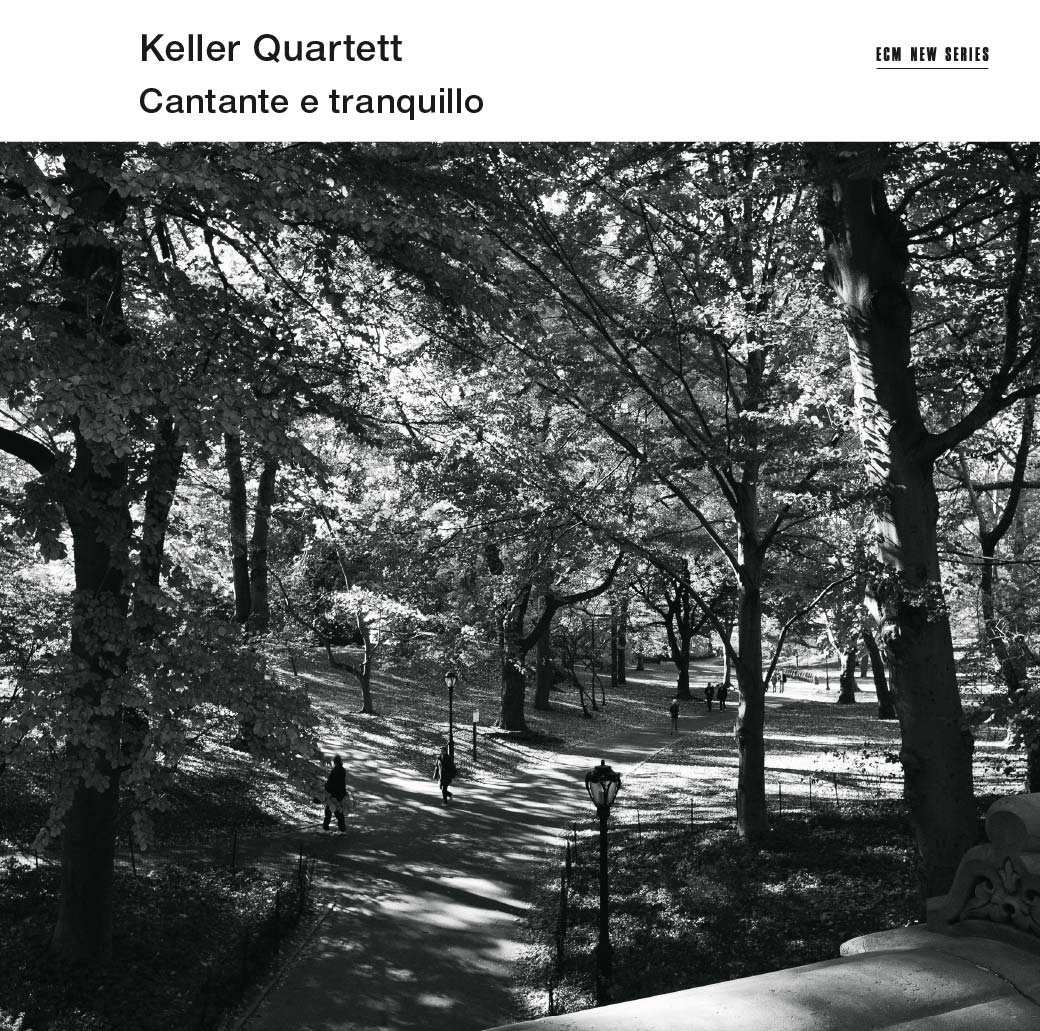
Keller Quartett: Cantante e tranquillo (ECM New Series 2324)

Cantante e tranquillo

Keller Quartett
Cantante e tranquillo

Keller Quartett
András Keller violin
János Pilz/Zsófia Környei violin
Zoltán Gál viola
Ottó Kertész/Judit Szabó violoncello
Alexei Lubimov piano
Recorded 1995-2012
Casino Zögernitz, Vienna
Stadttheater Eichstätt
Radiostudio DRS, Zürich
Engineer: Peter Laenger
Mastered by Christoph Stickel at MSM Studios, München
Produced by Manfred Eicher
U.S. release date: 2 June 2015

Cantante e tranquillo grew out of a conversation between producer Manfred Eicher and violinist András Keller, who envisioned an album of slower sections divorced from longer works. In true ECM fashion, this idea developed into a project all its own, framing previous recordings of Knaifel, Schnittke, Ligeti, and Bach by the renowned Keller Quartett with newly recorded selections from Beethoven’s opuses 130 and 135, and between them shorter pieces by Kurtág. The result is not a compilation but a sculpted entity with shape and sentience.

The concept alone is haunting enough; more so in execution, as ghostly appearances begin to sing once the third movement of Ludwig van Beethoven’s F-major quartet (from which the album gets its name) whispers into life. This rustling of the heart, slowed to feverish pathos and drawn as a brush across absorbent paper, embodies a yearning that, over the course of its awakening, resolves into a style of slumber in which the depth of life is surpassed only by that of death. Unlike the Adagio from the quartet in B-flat major, in inhales rather than exhales, holding all it can before expiring.

György Kurtág is known for his ability to pack surprising amounts of information into minute forms, but the Kellers give us examples of pieces that, despite their characteristic brevity, are spacious and expansive. At times parabolic (cf. the Officium breve in memoriam Andreæ Szervánszky), at others misty (Flowers We Are – for Miyako), and at still others pulsing like a geographic lay line (Aus der Ferne V), his music has no need to seek anything because it is starting point and destination all in one. The final movement of György Ligeti’s String Quartet No. 2, by contrast, sprouts in leaf-like structures that tremble to the rhythms of nervous winds. Unlike Narcissus, its reflection is being constantly disturbed, so that the illusion of a second self never clarifies. By yet further contrast, the stillness implied by “An Autumn Evening” (from Alexander Knaifel’s In Air Clear and Unseen), along with the Moderato pastorale of Alfred Schnittke’s Piano Quintet, breathes with lucidity. The latter’s pianism filters an unrequited dance which, like something out of a Tolstoy novel, twists until it bleeds music.

Anchoring all of this are two selections from one of the Keller Quartett’s finest recordings: Die Kunst der Fuge. Johann Sebastian Bach’s final masterwork is alluded to twice in the program, cycling between gradients of lost and found before ultimately falling in love with exile. A variation of Beethoven’s “Cantante” closes the circle with urgent, pregnant emotion, outlining a keyhole that only shadow can unlock to access the light beyond it.

Listening to this album is like watching the moon rise: if you focus on it long enough, you begin to detect its movement through the sky as if it had a mind of its own. Haunting, yes, but then again this music has no ghost to give up. It has one only to acquire.

(To hear samples of Cantante e tranquillo, click here.)

Arvo Pärt: Musica Selecta (ECM New Series 2454/55)

2454|55 X

Arvo Pärt
Musica Selecta
A Sequence by Manfred Eicher

Recorded 1983-2011
Mastered May 2015 from the original recordings by Peter Laenger and Manfred Eicher
Produced by Manfred Eicher
U.S. release date: 11 September 2015

Here is a commemoration not only of the professional and personal collaboration of Estonian composer Arvo Pärt and German record producer Manfred Eicher, but also of the creative spirits that guide them both toward shared spatial goals. Beyond that, it is a looking glass of sonic history in which is reflected two souls who’ve welcomed countless listeners on a journey of light. Issued in time for Pärt’s 80th birthday, Musica Selecta divides that light into its spectral gradations, sounding every band in a sequence of hand-selected pieces from his ECM New Series tenure thus far.

In his liner note for the two-disc album, Eicher refers to Pärt’s compositions as “solitary sound-sculptures.” An apt description if ever there was one. Solitary, because they come from the relationship of one man to the divine, but also sculpted because they take in countless aspects of creation into their corporea. What emerges from Eicher’s idiosyncratic sequencing of events here is therefore less the portrait of an artist than a horoscope, as planetary alignments contradict, refract, and inspire one another into a harmony of greater spheres.

Pärt and Eicher

Remarkable about the program is not only the way in which it compresses a 30-year history into two hours, but also the gentle reminders and forgotten facets—if not new discoveries—of the composer’s oeuvre it contains. Of the latter, the Hilliard Ensemble’s previously unreleased performance of Most Holy Mother of God is an astonishing example and proof that, more than meaning, it is the very architecture of words which determines their sacredness. Like a modest, timeworn church, these melodic structures stand before us marked by the passage of time. Astonishing, too, are those textures more familiar to us, such as the chant-like Ode VI from the Kanon pokajanen, one of Pärt’s profoundest medi(t)ations of flesh and sacrament. Architectural awareness is again central to understanding the integrity of this music, miring itself as it does in the rafters and other neglected places where godly light is most needed. It also introduces into the album’s narrative flow the Estonian Philharmonic Chamber Choir, whose voices, under the direction of Tõnu Kaljuste, have occupied the central axis of Pärt’s ECM zodiac from almost the beginning. Their harmonies uncover, like a skilled woodcarver’s tools, moments of transcendence as wounding as they are luminescent. Pärt recognizes the scar in every beauty.

This is what we really mean by the phrase “reading between the lines.” Not the extraction of the visible from the invisible, but the knowledge that everything is inherently invisible, except by the illumination of regard. And so, if either of these pieces feels like dreaming, it is only because singing can sometimes be more surreal than anything taking place behind closed eyes. Solitary voices fluctuate like reflections on water, because neither can exist without the other. We might do well to understand Pärt’s compositions in likeminded fashion—that is, to recognize that no simple motif would have grown without the ancestors before it. All the more appropriate, then, that this conspectus should begin with Es sang vor langen Jahren (“From long ago thus singing”) from Arbos. An album that seems to have fallen off the critical radar, but one that is nevertheless a Musica Selecta of its own. It showcases his ability to negotiate a range of atmospheres—from the intimacy of chamber settings (such as this one for alto, violin, and viola) to the inward-looking sweep of his Stabat Mater, which at 24 minutes is the vastest work included here. Its dramas are theatrical in the same way the heart is theatrical.

This collection’s remaining choral pieces are more entangled with non-living, yet somehow sentient, instruments. The Alleluia-Tropus and Beatus Petronius from Adam’s Lament represent organic conversations—one playful, the other somber—between voices and strings. The latter’s addition of winds renders stems for every leaf. Between them is Trisagion (from Litany), performed here by the Lithuanian Chamber Orchestra as if it were so fragile that even playing it might break it. In this universe, the value of silence, such as it is, feels especially alive. Wallfahrtslied / Pilgrims’ Song (Orient & Occident) is scored for men’s choir and string orchestra and moves more celestially in a combinatory realm of mysticism and gravity. It is an expression of the itinerancy of faith and the challenges it faces when crossing borders. Sometimes, however, the borders cross us, as in the two selections from In Principio. Mein Weg, scored for 14 strings and percussion, builds a descending framework to move upward, while antiphonal Da Pacem Domine is a righteous summation, a tipping point into the as-yet-unknown future of his flourishing.

Silouans Song brings us to one of Pärt’s most pivotal and defining releases: Te Deum, which in addition to the stirring title work (not featured here) yields the mighty Magnificat. These works—Silhouans Song for strings and the Magnificat for choir—feel their way along their respective paths, finding that the truest epiphany comes not from moments of grace (however one chooses to frame them) but in their aftermath, during which one trembles from the shock of revelation while putting together the pieces of a shattered soul. As strings cry out, so do voices draw their bows, each the inner to the other’s outer.

In the company of such vocal apparatuses, the mechanism of the piano, in all its earthy resonance, comes to us as if out of time. In his rendering of Für Alina (Alina), Alexander Malter removes enough of his touch that the windows of access he finds in the score glow with a light born of need to see itself seen.

In highlighting the spaces in which Eicher and Pärt have forged their friendship, one necessarily emphasizes the care with which they have chosen musicians to transport listeners outside themselves. And who better than pianist Keith Jarrett and violinist Gidon Kremer to play a duo version of Fratres. It is the most significant work of this collection, being the world’s introduction to Pärt via the seminal Tabula rasa. The album was the first of ECM’s New Series imprint, which since 1984 has sailed a discriminating vessel at the fore of contemporary music. Jarrett and Kremer bring a level of sensitivity rarely heard in subsequent versions of this often-recorded piece, a spirit of newness and adventure that can only have come from their unprecedented reckoning with what was then a relatively obscure voice leaping like the violin from behind the iron curtain of Soviet oppression. The Cantus in Memory of Benjamin Britten is another quintessential selection from Tabula rasa, a vibrant threnody that throbs with passion and memory.

From what is arguably Pärt’s finest release, Miserere, comes Festina Lente. Scored for orchestra and harp, it pairs beautifully with the Cantus, if only for its gradual development and lilting form. It also bears dedication, this time to Eicher himself. The tripartite Lamentate, from the album of the same name, is also included. Pianist Alexei Lubimov and the Stuttgart Radio Symphony Orchestra, at the baton of Andrey Boreyko, strike a most appropriate balance of lucidity and distortion in this fragile tone poem.

Musica Selecta does more than tell a story. It pulls the beginning and ending of that story together to form a circle, which stands before us like a portal, replacing the suffocation of expectations with an eminently breathable oxygen. Pärt, as only he can, spins our comprehension of it all from elements unseen yet—praise creation—audible. So audible, in fact, that this music might just hear more of us than we ever will of it.


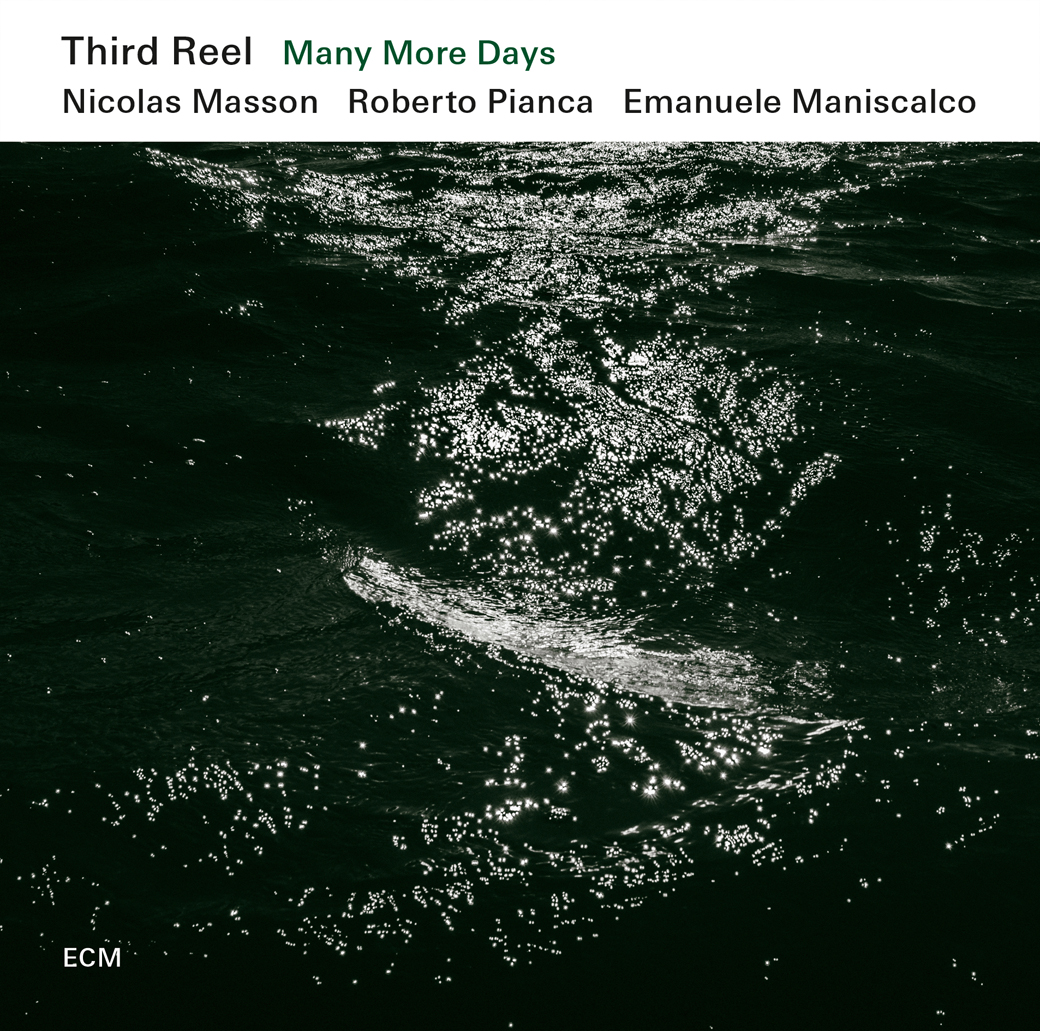
Third Reel: Many More Days (ECM 2431)

2431 X

Third Reel
Many More Days

Nicolas Masson tenor and soprano saxophones, clarinet
Roberto Pianca guitar
Emanuele Maniscalco drums, piano
Recorded August 2014, Auditorio Stelio Molo RSI, Lugano
Engineer: Lara Persia
Executive producer RSI: Paolo Keller
Produced by Manfred Eicher
U.S. release date: 2 June 2015

One might characterize multi-reedist Nicolas Masson, guitarist Roberto Pianca, and drummer Emanuele Maniscalco—a.k.a. Third Reel—as having carved a niche for themselves. Truer to say they’ve painted a context around that niche, which has taken shape from sheer formlessness into a tributary, emptying into a sea of shadows. Shadows, because the trio’s gestures seem to grow only darker with time, denying the convenience of light in favor of what can be felt in its absence.

If Third Reel’s self-titled ECM debut was the sun, then Many More Days is its corona, a dream to the former’s waking and a push toward those regions of the psyche wherein eddy fresh rhythmic motives. Days thus feels distinctly microscopic compared to its predecessor, even as it seems to travel farther. “For the first album we deliberately chose to almost never play a strict tempo,” Masson tells between sound and space, “we wanted to explore different ways to play in a very organic, non-linear way. For the second album, we wanted to keep the idea of short pieces, the same basic approach to interacting together, the same flow but with a more defined contour.” Along with the album’s temporal coming of age is the internal addition of Maniscalco’s pianism, which, Masson notes, hints at a chamber music aesthetic that sheds a few layers of jazz toward an art form less interested in genre than in generation.

Maniscalco yields a sizable share of the album’s compositions, ranging from the strangely comforting aneurysms of “Afterwards” to the burnished sounds of “Two-Part Chorale.” Such titles indicate a reflexive naming process. And yet, wherever they might fall into their respective slots, one knows the sacredness of their urgency, which apportions equal value to density and dissolution. Relationships between clarinet and piano or tenor saxophone and drums treat the album’s nervous system as a map to be rewritten. Pianca’s spider-veined chords in “Fourth Reel” and surface tensions in “Gilberto Stimmung” enhance the anatomical aspect, receding but never gone, even in the quiet foray of “Strand.” Each note is an eye in search of a face.

Although the two albums are different, I tell Masson they share a common approach to performance, which feels “bacterial,” as if every composed theme were a culture in a petri dish allowed to germinate and grow until it becomes its own unexpected entity. Though he agrees with this analogy, he cautions against painting Third Reel with a single brush:

“Most of the written material has no preconceived scenario, can be used for different musical purposes, and can take various forms according to the needs of a set or simply the inspiration of the moment. We’re trying to maintain an instinctive approach to the interpretation of our compositions, which are conceived with this idea in mind from the beginning. We’re all writing music for the trio, so I’m only speaking for myself, but in fact many times the idea I had in mind when composing was quite different from the results. We’re trying to leave enough space in our compositions to allow for multiple interpretations and developments. It is true that some pieces have a life of their own—we bring a few dots on a piece music paper and we just let them grow as we play. However, we don’t restrict ourselves to a single concept. If a tune feels complete by just reading it from top to bottom, without improvisations or variations, it’s also fine.”

While such openness might lead to chaos and wildness in the hands of others, in theirs it blossoms in thoughtful radiation. Masson’s own compositions, in particular the emblematic “Simple,” are self-deciphering codes—in other words, pieces that ask nothing of us in return for their admissions except our willingness to hear them as they are. Masson’s writing frames an organic triptych lodged in the album’s center. His “White” was inspired by Masabumi Kikuchi’s Sunrise, to which one may liken a kindred contemplation, while the title track follows clearer peaks and valleys. The same combination of drums, guitar, and saxophone graces Pianca’s “Happy People,” which nestles itself between them in a mosaic of endearing immediacy. Masson observes in retrospect how these three pieces “mark a turning point in the album’s dramaturgy, from the more intimate, chamber music-like pieces to the more expressive, lyrical pieces,” and the attentive listener is sure to feel this shift in visceral spades.

Between the parabolic “Hill” and the galactic compressions of “Fast Forward,” Masson’s pieces underscore Third Reel’s commitment to let the music go on only as long as it wants to. Each track, no matter how short, precludes the need for elaboration or reduction. I asked Masson whether any given performance of a particular piece influences its duration in real time, or where the band has a sense about how long a piece should go beforehand, to which he responded:

“The performance and the moment has a direct influence on a given piece’s duration, whether it is 2 or 20 minutes long. When we play live, we often connect compositions with open improvisations and therefore what is written becomes part of a bigger piece, like musical crossings to change direction and explore new territories. In the studio, however, we approached the material more with the idea of playing miniatures, each one of them being like a microcosm belonging to a bigger system or characters in a story. The studio in which we recorded both albums also played a good part in the outcome. We recorded at Swiss Radio’s Auditorio Stelio Molo in Lugano, Switzerland. The studio is actually a large wooden concert room designed primarily for classical music. It has beautiful acoustic qualities, with lots of reverb. This room is very inspiring, and the sound so detailed there, that it made us extremely cautious of the slightest changes in dynamics and sound textures. It definitely helped us being focused on the balance of each song. We tried to play only what we felt was necessary.”

Video from the CD release concert at Scnaffhauser Jazz Festival:

In the context of the Lugano studio, we can thank and acknowledge engineer Lara Persia, who may or may not be the subject of “Lara’s Song.” Either way, this piece, written by Pianca, does have something of the technician’s presence about it, the lone silhouette at the mixing board, her hands moving about the knobs and buttons to bring out the moment of the moment. It is therefore, and above all, a song of trust, an opening of newborn eyes, a quiet resignation into being in the world and its many purposes of living.

Behind it all, of course, is producer Manfred Eicher, whose tireless commitment to new music is expressly realized in this project. Indeed, Masson credits Eicher and ECM for playing no small role in the band’s evolution. “Working with Manfred Eicher as a producer is a unique experience,” he says, echoing many others in the sentiment, “and I think he helped us reveal a part of our musical personality and take it to the next level. However, playing live is still another story than making a studio recording, we stretch out more in concert, we’re taking more risks. We’re still experimenting but our musical identity got stronger and I personally feel more confident in what I have to offer.” That said, there is plenty of confidence in the dramaturgy of Days, proceeding as it does with such unhurried graciousness. With it, Masson and his bandmates have assured their place in the label’s history, from which key records by Paul Motian, Dewey Redman, Don Cherry, Keith Jarrett, Bill Frisell, Joe Lovano, and many others have fed into Third Reel’s dedication to liberty and abiding integrity of sound.

(To hear samples of Many More Days in its studio form, click here.)

Andy Sheppard Quartet: Surrounded by Sea (ECM 2432)

Surrounded by Sea

Andy Sheppard Quartet
Surrounded by Sea

Andy Sheppard tenor and soprano saxophones
Eivind Aarset guitar
Michel Benita double bass
Sebastian Rochford drums
Recorded August 2014, Auditorio Stelio Molo RSI, Lugano
Engineer: Stefano Amerio
Produced by Manfred Eicher
U.S. release date: 2 June 2015

Surrounded by Sea marks the fifth ECM appearance by English saxophonist Andy Sheppard. To the configuration of bassist Michel Benita and drummer Sebastian Rochford (with whom he previously recorded as Trio Libero) he now welcomes the ambient touch of guitarist Eivind Aarset. The latter, perhaps more than any other, evokes the encompassing waters of the album’s title, and draws on the relationship formed on Sheppard’s ECM debut, Movements in Colour.

ASQ

Emphasis sides with Sheppard’s compositions, which have the first and final word on Surrounded by Sea. “Tipping Point,” co-written with Benita, opens the set on a distant shore. Given its delicate bass ostinato and cavernous sustains (courtesy of Aarset), one could be forgiven in mistaking it for Arild Andersen’s Hyperborean. But tenor and drums paint a clearly different picture, Sheppard working his blemish-less magic into the fade-in. Intensely melodic yet never overwhelming, he balances mild and sharp like a chef aiming to please as many diners as possible without losing his originality. Already we can tell this will be a fruitful leap inward for the saxophonist, as well as a memorable masterstroke of overall production, writing, and performance that never wavers on its way toward the closing “Looking For Ornette,” which shines all the more poignantly in the wake of its namesake’s recent death. Sheppard cites Coleman as a towering influence, but one may also detect a little of Lee Konitz (cf. Angel Song) in the playing.

Between these two signposts, Sheppard’s new quartet charts the melodic valleys between his mountainous originals. Both “Origin Of Species” and “Medication” spotlight Benita’s versatile stylistics, ranging from starkly original contemplations to Eberhard Weber-like infrastructures. Each theme is stretched like taffy into an intensely flavored ocean for Sheppard’s vessels, which find their grooves in the motions of the waves. Two further tunes—“The Impossibility Of Silence” and “I See Your Eyes Before Me”—are by comparison more bodily than environmental, steeping in the viscosity of Aarset’s magic and drawing nourishment from Rochford’s carefully knotted roots.

Bassist and drummer each contribute their own tunes, which between the David Lynchean swagger of Benita’s “A Letter” and the psychedelic charge of Rochford’s “They Aren’t Perfect And Neither Am I” forge a wide spectrum of emotional courage. It’s as if every mood were a skin the band as a whole could put on and take off at will, just as the sky dons and discards shades from dusk to dawn. In that same spirit of variation, the quartet pays homage to the unexpected in an atmospheric rendition of Elvis Costello’s “I Want To Vanish,” in which Sheppard’s soprano, as windswept as the grasslands, settles into the comforts of brushed drums and more selective bassing. As in the traditional Gaelic “Aoidh, Na Dean Cadal Idir” (Aoidh, Don’t Sleep At All), scattered in three parts throughout the album, Sheppard and his companions make every note count. But like Pi, we need only know the first few numbers after the decimal to recognize their infinite potential.

(To hear samples of Surrounded by Sea, click here.)

Cyminology: Phoenix (ECM 2397)

Phoenix

Cyminology
Phoenix

Cymin Samawatie vocals
Benedikt Jahnel piano
Ralf Schwarz double bass
Ketan Bhatti drums, percussion
Martin Stegner viola
Recorded March 2014 at Rainbow Studio, Oslo
Engineer: Jan Erik Kongshaug
Produced by Manfred Eicher
Release date: 20 February 2015 (Europe only)

My melodies are reaching your heart, how come?
My words are easing your pain, how come?
Everything that I do, I don’t do it myself, how come?
I live for the ones, who love me
Why not for myself?

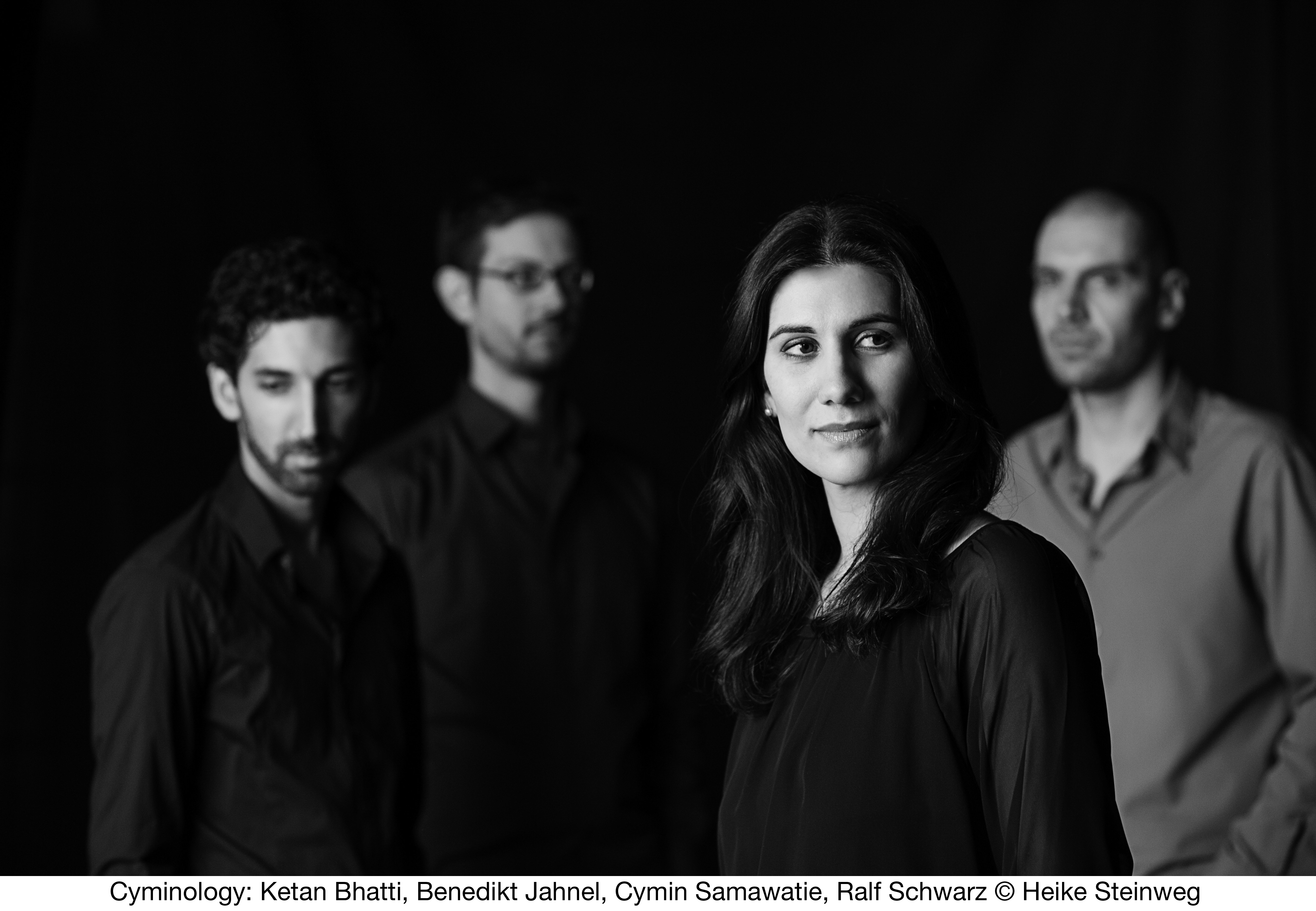
Cymin Samawatie, whose band Cyminology has swum twice in ECM waters (cf. 2009’s As Ney and 2011’s Saburi), is a crosser of barriers at once ethnic, linguistic, and musical. Such a characterization risks painting the German-Iranian singer as an enigma, when in fact she gives voice to her gifts through love of sentiment, empathy for politics, and humility of creation in a way so grounded, it feels as if she is singing as much for you alone as for the world. Samawatie’s backing trio of pianist Benedikt Jahnel, bassist Ralf Schwarz, and drummer Ketan Bhatti now welcomes violist Martin Stegner, whose presence is as defining as it is dressed in shadow. The voices of his bow constitute nominal additions, but their presence removes a few more layers of perception to reveal the naked truth of every note they touch.

Cyminology

The appropriately titled Phoenix revisits Iranian poet Forough Farrokhzaad (1935-1967), from whose own premature ashes emerged the winged verses explored therein. Farrokhzaad paints a veritable world around her body, which in “Aaftaab” and “Gozaraan” binds the narrator hand and food with ribbons of love’s many unspoken hues. The latter song’s improvisatory colors slip into a black hole as quickly as they emerge from one, feeling through the dark as if by every word, a fingertip. This is much in contrast with the former song, which unfolds, fractal-like, inlaying repeated patterns and meshing viola and voice interchangeably. Likewise, Farrokhzaad’s shapes tend toward a yin and yang relationship, whereby every pool of light contains one fish of dark, and vice versa. Like the stars she collects in “Harire Buse,” which accompanies Samawatie by bass alone, they shine only because of the unknowable pitch in which they swim.

Yet nowhere does Farrokhzaad—and Samawatie, by extension—speak so inwardly as in the closing “Baraaye To.” Here drums and bass shed their rigid constructions to better comprehend Cymin’s realisms as she sings:

I am writing this poem for you
In the sunset, in the thirsty summer
On a half gone, fatal way
In the old grave of my endless pain

Let my eyes overflow again
with dewdrops

The day will come when your yearning sight
Will fall on this painful tune
Searching within my words
You will say: “This was my mother”

Throughout this incremental, emotional implosion, the band’s melodic blush yields more than the sum of its parts and proves that life can be written only on the palimpsest of memory.

The distinction of Cyminology as a vocally-centered group is that its instrumentalists also emit a poetry of their own, every bit as verbal as their bandleader’s. This is nowhere truer than throughout Samawatie’s own songs, wherein members of the rhythm section, into which the piano grows to be an interlocking part, punctuate each other’s sentences until they are spherical—global, if you will. Her texts may be far more concise, but their impact is anything but. In the pulsing infrastructure of “Che Gune Ast,” she activates a fierce individuality. From the pulsing pianism, which gives a sun for drums to compass their solar system, to the viola’s innocence, which feels almost blood-related to the breath-drawn bass, Samawatie’s singing tracks every change of mood as if it were a diary in real time. “Talaash Makon” is another duet, this time pairing her with Jahnel, whose defining pianism sets up one patch of earth per footstep. The band saves its deepest poetry for “Baraaye Ranj,” which, although effectively wordless, nevertheless alters its own DNA as if by language alone.

From Nimā Yushij (1896-1960), so-called father of Persian poetry, comes the album’s title poem. Over the course of its two parts, Samawatie embodies the fabled bird’s tragic cycle, which in this context becomes an exercise in self-reflection. The viola reveals itself as a descriptive force, soaring with arpeggios before landing on the mountain from which Yushij unspools its sorrowful cry. In Part II, the instrumentalists are Erdnase-shuffled into Samawatie’s muscular legato, by which new details emerge from every listen.

A canonical Sufi poem by Hāfez (c. 1325-1390) completes the mosaic. The mournful “Dishab” is the album in miniature, blending clearly defined voices into an even more clearly defined whole, while holding on to one elemental mantra: there can be no water without land. And indeed, as a whole these melodies reach out their talons and pull until sky and earth become one horizon, opening an internal eye that interlocks with the external knowing of being gazed upon. By this dynamic, the listener turns into participant and allows the music to be reborn through the act of knowing it.

(To hear samples of Phoenix, you may watch the EPK above or click here.)

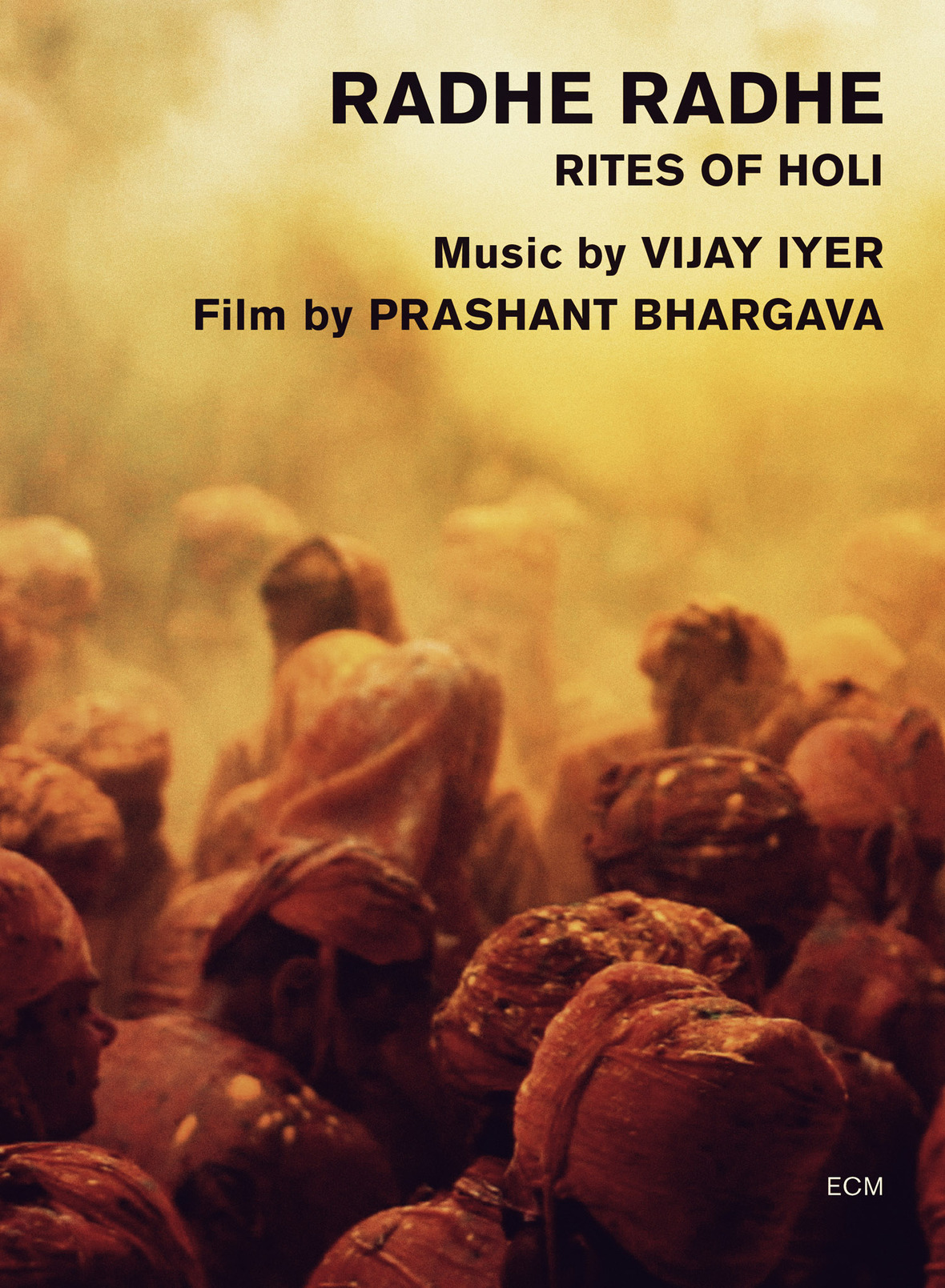
Prashant Bhargava & Vijay Iyer: Radhe Radhe – Rites of Holi (ECM 5507)

Radhe Radhe

Radhe Radhe: Rites of Holi

Vijay Iyer composer
Prashant Bhargava film director, editor
Anna George actor
Craig Marsden director of photography
International Contemporary Ensemble
Eric LambLaura Jordan Cocks: flute, alto flute, piccolo
Joshua Rubin: clarinet, bass clarinet
Rebekah Heller: basoon, contrabasoon
Gareth FlowersAmir Elsaffar: trumpet
Jennifer Curtis: violin
Kyle Armbrust: viola
Kivie Cahn-Lipman: cello
Cory Smythe: piano
Ross Karre: percussion
Tyshawn Sorey: percussion, drum set
Adam Sliwinski: conductor
Vijay Iyer: piano, electronics
Soundtrack produced by Vijay Iyer and Manfred Eicher.
Recorded live at Memorial Hall, UNC Chapel Hill, March 26, 2013
Engineer: Frank Martin/Media Production Associates
Live concert sound engineer: Levy Lorenzo
Additional recording at The Bunker Studio, April 20, 2014
Engineer: John Davis
Mixed at Avatar Studios, NYC by James Farber, Vijay Iyer, and Manfred Eicher
Assistant: Aki Nishimura
Additional engineering, editing, and consultation: Liberty Ellman

Bird

Ron Fricke’s 1992 classic Baraka endures as one of the most consummate examples of non-narrative cinema. Its montage of images from around the world was even more eclectic than the soundtrack that went along with it. But despite the many ceremonies, creative arts, and labors that Fricke documented—including death pyres and ritual baths in the river Ganges—he never captured the Hindu religious festival known as Holi. Had he done so, it might have looked something like Radhe Radhe.

Opening Shot

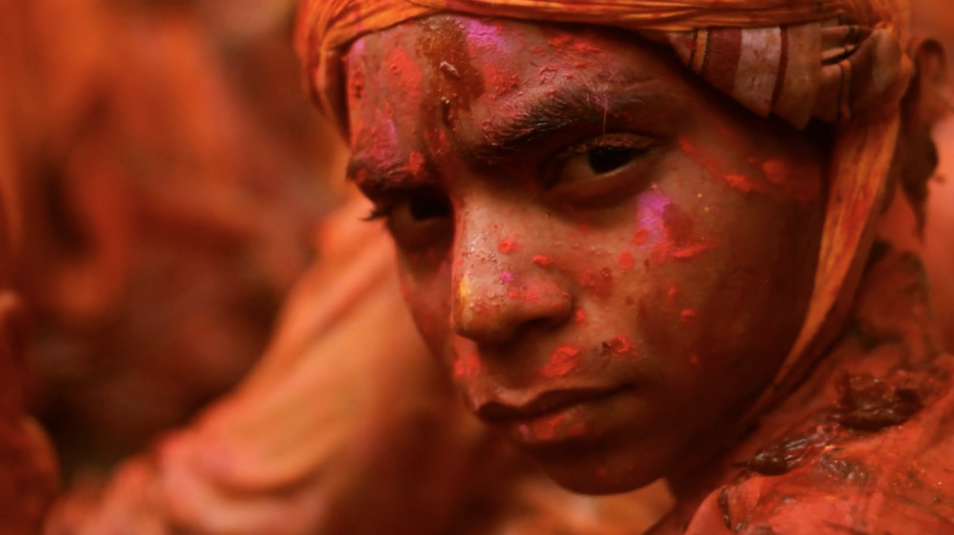
Filmmaker Prashant Bhargava’s ode to this so-called “festival of colors” traces the eight-day celebration back to Mathura, mythic birthplace of the supreme deity Krishna and his lover (in the strongest sense) Radha. Hence the film’s title, a term of praise and greeting often exchanged in the streets of Mathura, where she is believed to be a gateway to true understanding of Krishna. Her power is a central theme, an explosion of devotion far more vivid than the human-made pigment sold on the streets in the weeks leading up to this cathartic event.

Given the film’s subtitle, “Rites of Holi,” and the fact that Holi is practiced in the spring may put one in mind of Igor Stravinsky. This is no coincidence. Although not a direct homage to Stravinsky, Radhe Radhe was the result of a commission for the 100th anniversary of the Russian composer’s Rite of Spring, and one of a dozen projects freshly created in its honor. It is still a ballet of sorts, not least of all for the dialogic contributions of Indian-American pianist Vijay Iyer. In a manner of speaking, he and Bhargava met halfway—the director boiling down over 30 hours of footage into a 35-minute film and the composer expanding molecular impressions into a fully integrated score—so that the finished product was a narrative duly rendered. Iyer’s task was to match Bhargava’s rhythms, taking the listener through what he calls a “series of energies.”

Crowd 3

Bhargava first gained international attention with his debut feature Patang (The Kite) in 2011. That his roots grabbed their soil in hip-hop and graffiti art should come as no surprise, for his gifts of rhythm, poetry, and color were likeminded in their urban respect. But with Radhe Radhe he went further underground, mining deeper traditions of those same creative registers. The film is, then, as much a musical as it is a visual tour de force, building like a raga to near-ecstatic heights. Indeed, before a single image graces our retinas, Iyer’s pianism sets the stage over a dark title screen. Slight dissonances therein betray something of the chaos about to unfold, but obscure enough of it so that we might experience it anew, even in multiple viewings. Along with the young musicians of the International Contemporary Ensemble, Iyer creates a mood that is beautifully unsettling, and all the more organic for it.

Face 1

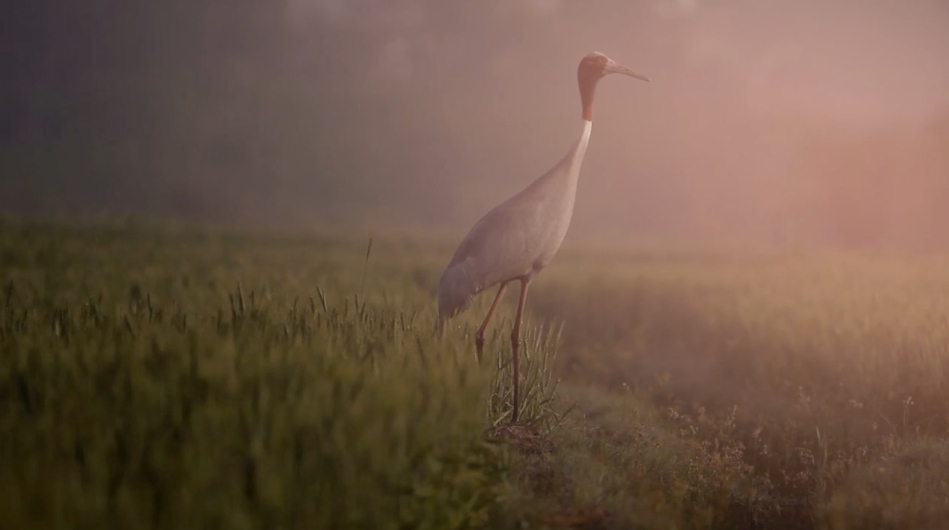
The film’s first part, “Adoration,” builds its intimacies one stratum at a time. The stage is set in a misty landscape. We see only details: boatmen preparing for the days’ revelry, a bare back, a glimpse of braided hair. The streets then come to life as food vendors ready their meals and women wash their garments in the river. The soundtrack is restless, anticipatory. A cargo train passes by, as if to underscore the film’s narrative drive. More fragments: a face half-reflected in a mirror, candles burning on an altar, a gossamer veil. As crowds thicken and the dance begins, Iyer’s pianism brightens. Even the birds in the field seem to join in. Flute and brass contrast one another with purpose. Their notes flower and wither, changing focus like the lens that guides them. Strings and percussion add color streamers of their own as the iconic powder hits the air.

Crowd 2

Part 2, “Transcendence,” puts further emphasis on Bhargava’s footage of an imaginary Radha played by actress Anna George. He spins from these scenes, shot in the US and woven throughout the film, a primal and sexual interplay that signals the true emergence of spring. It’s a bold move, as the director himself is first to admit in the DVD’s “Making Of” segment, but he wanted to bring that “everyday magic, that intimacy that we share as people to the narratives of the gods.” He believes that the push and pull of Radha and Krishna exists in all of us, as it does also in the increasingly inseparable relationship between sounds and scenarios. A trumpet, for example, works its melodic overlay during a long shot of Radha’s face, implying an environment far vaster than the immediate contrivance of the studio.

Radha 2

As the cinematography becomes more contemplative, the music subdues itself in solidarity. In the same way that Bhargava seems to have eyes in many places at once and flits between them by changing cognitive channels, so too does Iyer’s complementary switching take every movement into account. A sensual flowering of street noise enters the mix, as if bleeding of its own volition, leaving us wanting to shed our inhibitions and dive into that sea of color.

Dancing 2

In May of 2015, Bhargava died at the age of 42 from cardiac arrest after a history of heart disease. But the tragedy of this death is so graciously balanced by the exuberance of his small yet vivid oeuvre that one can focus on the latter in a state of pure invigoration. In this respect, we do well to read Radhe Radhe in the spirit for which it was made. In a world where the rites of Holi have spread to unlikely corners (I witness its rainbowed aftereffects on my American university campus every year), it’s nice to know that one artist’s vision can bring us anytime to the source with just the press of a PLAY button.

Field

(See this article as it originally appeared in RootsWorld online magazine here.)

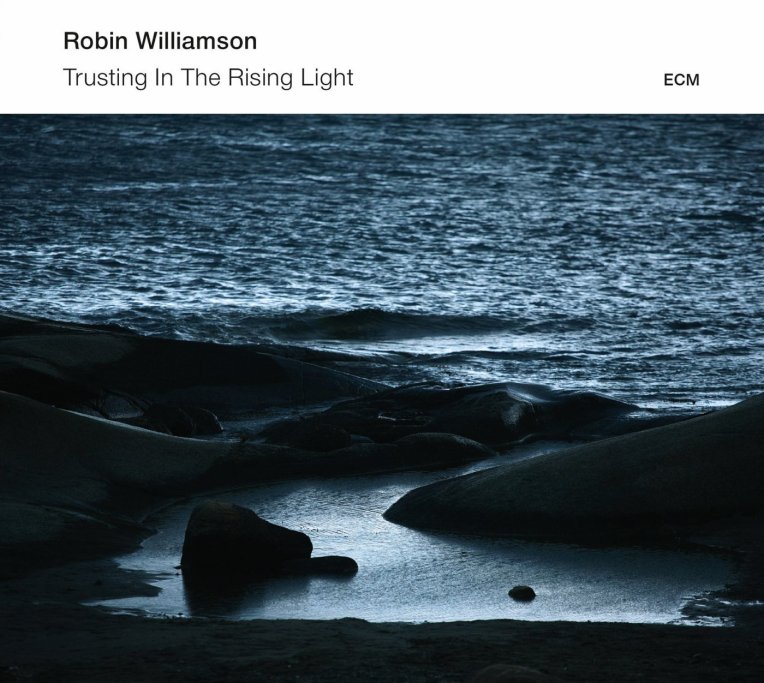
Robin Williamson: Trusting In The Rising Light (ECM 2393)

Trusting In The Rising Light

Robin Williamson
Trusting In The Rising Light

Robin Williamson vocals, Celtic harp, guitar, hardanger fiddle, whistles
Mat Maneri viola
Ches Smith vibraphone, drums, gongs, percussion
Recorded January 2014, Rockfield Studios, Monmouth
Engineer: Steve Lowe
Assistant engineer: Tim Lewis
Mastering: Christoph Stickel and Steve Lake
Produced by Steve Lake

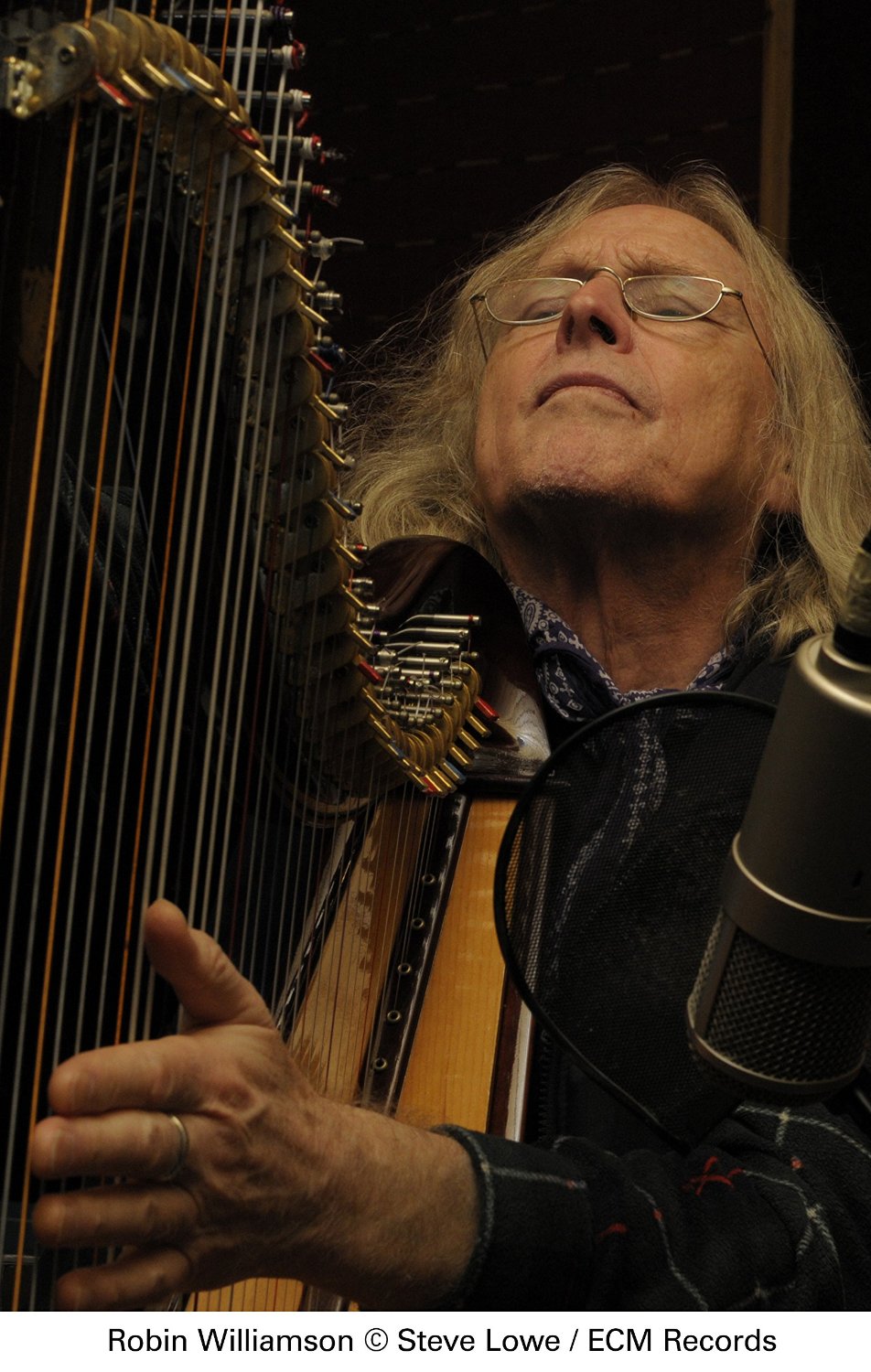
Robin Williamson, perhaps the last true bard on earth, returns with Trusting In The Rising Light. Following a string of intimate programs setting the words of famous poets to music (among them Dylan Thomas, Walt Whitman, and William Blake), he now dips a quill into his own inkwell and scrawls a masterful new ream of originals. Ten years separate this recording from its predecessor on ECM, The Iron Stone, but the wait has been well worth it, not least of all for the contributions of his fellow session musicians. From that last album he retains violist Mat Maneri and to this nexus adds drummer-percussionist Ches Smith. The result is an attuned, free jazz-folk session that feels at once long overdue and just right for its time.
RW

I caught up via e-mail with the album’s producer, Steve Lake, who described how the project came together:

“I’d been in touch with Robin over the years, and hadn’t realized that so much time had elapsed since The Iron Stone—the clichés about time moving faster as we age are true. In autumn 2013 he said he was in a period of writing lots of songs and read me the lyrics to ‘Trusting In The Rising Light’ and ‘Swan’ over the phone. It seemed like the moment for a new album. Robin said he wanted to work with Mat Maneri again, which of course was fine with me. I talked with [ECM head] Manfred Eicher about a possible vibraphone player for the session and Ches Smith’s name came up. It struck me as a good idea since I knew that Ches had formed a new trio with Mat and Craig Taborn. So inside the Williamson line-up there were two proven associations, Robin/Mat and Ches/Mat. With this as a basis we could confidently get to work.”

Where some voices crack and smolder with age, Williamson’s is like a fine sword: it only gets stronger the more it’s folded in its malleable state. And while he has always engaged larger questions of conviction, politics, love, and sense of place, on Trusting he seems far more content to dwell on the little things: spending time with a loved one, the fundamental pleasures of observation, and, as the album’s title implies, faith in life’s givens and regularities. As a romantic, he is lyrical yet realistic. He seems well aware that the limits of his control extend not much farther beyond his own body and the words and music it produces.

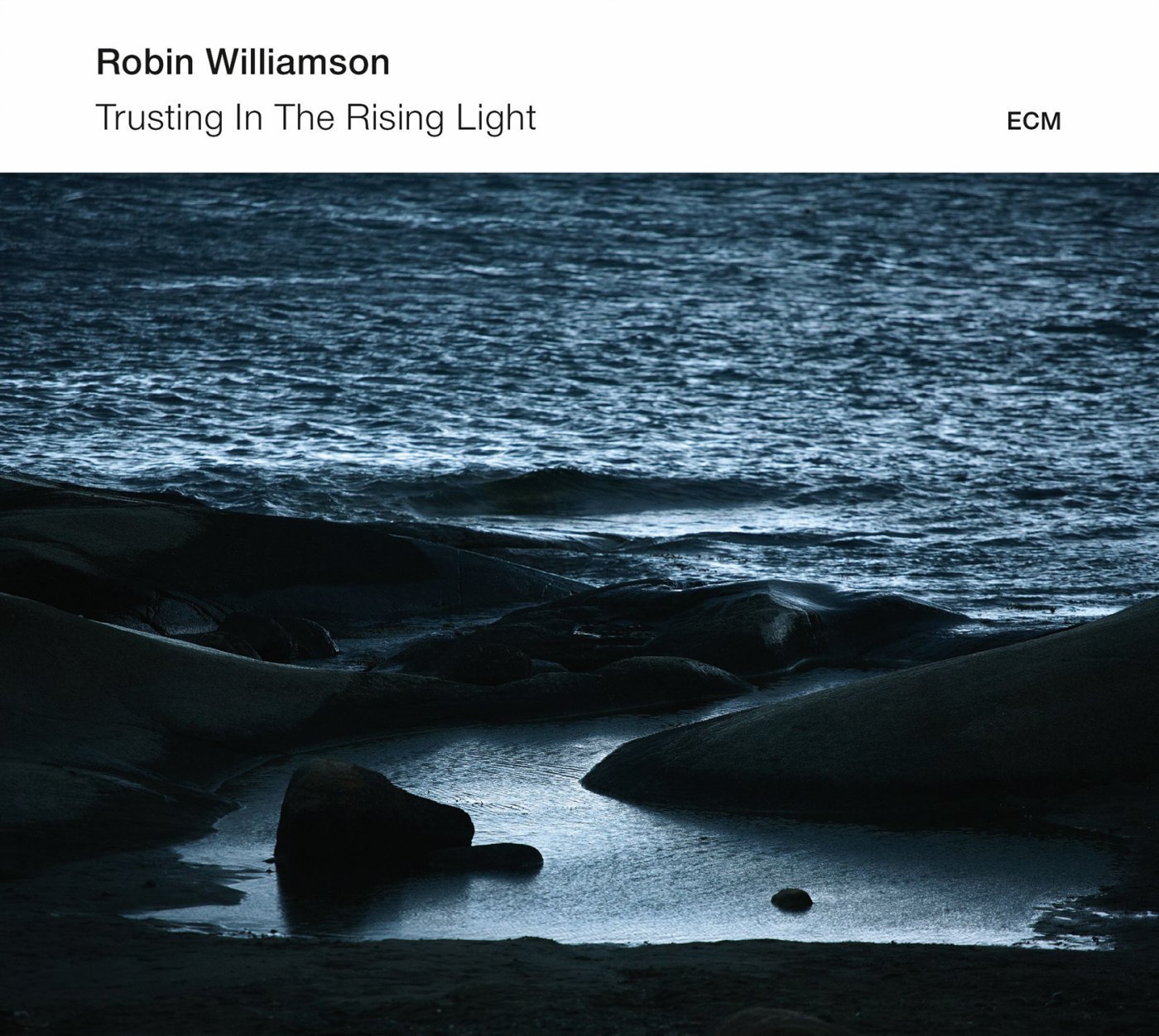
Nowhere is this clearer than in the title song, which turns on a movie with no opening credits. Here is one who stands at harbor, watching the rise and fall of the waves and knowing that some things are better left to their own rhythm:

In every man-hewn stone
The anchored voices murmur
Long long
What they have always to say
As to what of our life
When whence and whither
We born of woman
Born of the Great Mystery

Being a relatively new yet enthusiastic fan, I asked Lake to place the album in the larger context of Williamson’s decades-long career. “It’s a high point,” he answered, “but if I look at Robin’s discography there are a lot of high points, including albums on his own Pig’s Whisker label which too few people have heard (if you can find them I recommend Ring Dance, At The Pure Fountain, and Dream Journals). Robin’s been a working musician for almost sixty years but has never been exactly career-minded. His musical and literary interests carry him forward and as a result he has had, I would guess, a richer and more interesting life than many who have made the career a priority. Trusting in the way of the waves, as he says in the title track…”

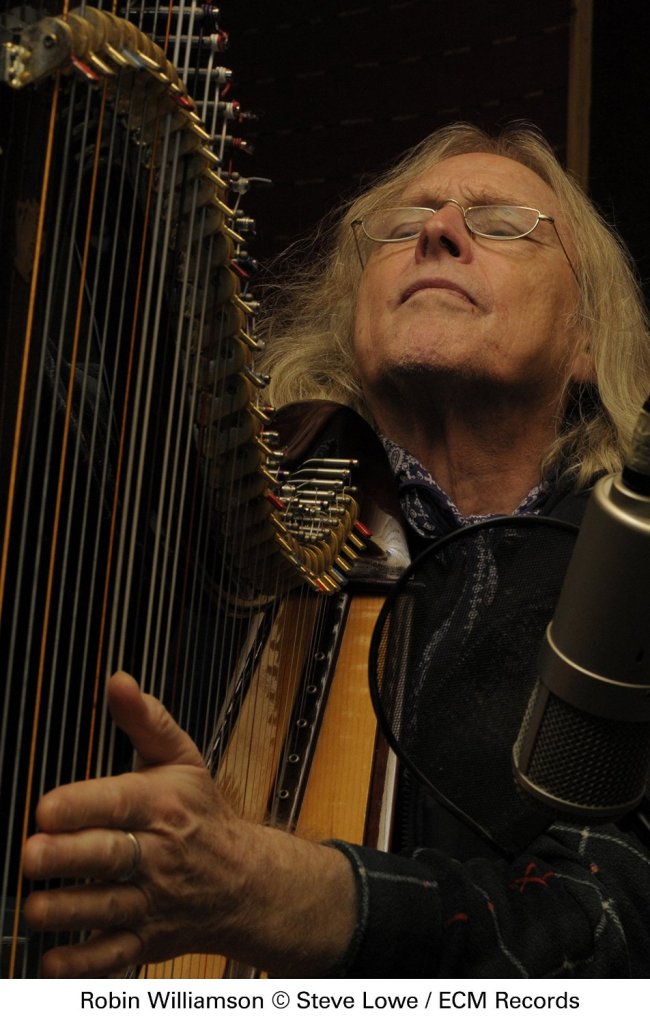
Accompanying these sentiments—in truth, embodying them—is Williamson’s trusty harp. Despite being prone to putting on magical airs, at his fingertips it is not an instrument of spells and incantations. Over the years it has become burnished like a well-worn table at which countless meals have taken place. And there, among the dishes and scratched spoons are those same rhythms of life, having left their hieroglyphics behind for deciphering. As he blossoms in a wave of strings, crashing on the shores of a dawn not so far away, he provides confirmation that in the good work one can be grateful for the opportunity to engage with land and sea, to know that it will all be waiting on the other side of slumber.

Whether through the droning raga of “Our Evening Walk,” in which love begets love, or the heartfelt wonder of “Alive Today,” in which Williamson takes comfort in something as insignificant as the flap of a bird’s wings, such assurances thread every song that follows with the knowledge that all those things we rely on will be there for us, in light or darkness. Sometimes, as in “Falling Snow,” his romance is with the universe at large, pulling together time and space like a massive proof of emotional and spiritual relativity. At others, it is undeniably close to home, calling his wife Bina by name as he does in the sensuously realized “Your Kisses.” For the most part, however, Williamson looks either down at “These Hands Of Mine” or back along the “Roads” that led him to where he stands. The former tune features a jaunty guitar while the latter’s commentating viola weaves in and out of the loom. In both, the feeling of departure is constant, arrival questionable. And in “The Cards,” a song loosely based on a traditional Irish air “The Coolin” but otherwise ad-libbed in the studio, he offers a cautionary tale against prediction, trusting in reality instead of relying on dreams or elusive signs. Accompanied only by guitar, elastic and supportive of any and all possibilities, he contemplates this dance in what he calls the “soul of souls.” It’s as if he were at a bar alone, the last dart thrown along with last call, but it’s the kind of draft of which every sip tastes as good as the first.

Sitting with this album is like traveling somewhere for a while, much as the musicians did just to bring it all together. Lake sets up the scene:

“Rockfield is a residential studio deep in the Welsh countryside with a long history of recording especially rock music. When we arrived, Mott The Hoople were just finishing a mixing session. We spoke briefly with them. It was slightly odd, almost time-warp inducing, to be in the same room with Mott and Mat Maneri, but strange juxtapositions belong to the journey. I liked living at the studio and had some interesting talks with its owner Kingsley Ward about his early life as a session musician working for Joe Meek in London. There’s a lot of idiosyncratic recording knowledge concentrated at Rockfield. For the session with Robin the mood was positive, friendly and committed. Robin had some songs mapped out on which Mat and Ches were given directives and specific things to play, mostly with some improvisational freedom. And there were some pieces that were wide open to improvising, particularly ‘Just West Of Monmouth,’ ‘Night Comes Quick In LA,’ ‘Swan’ and ‘Islands Of The Inner Firth.’”

The latter songs rest somewhere between speech and singing and flower in freely improvised settings. “Youth burns brighter than neon,” he sings in “Night Comes Quick In LA,” a cynical, bird’s-eye view of superficiality gone rotten in the valley. The beat poetry aesthetic only adds to the acuteness of his poet’s eye. In “Just West Of Monmouth,” Williamson nestles himself in a gravelly accompaniment of percussion, whistles, and bows, unspooling his tale of creation in the rustle of underbrush and thirsty plains. Next is a sojourn into “The Islands Of The Inner Firth,” where awaits the mirror into which we must all someday look:

Now in the October of my life
I trace
Beloved and well remembered shore
Your stony verge
You cold and turbulent Scots water
In memory I trace
My kindly haunted past

So begins a summation of a creation and a new beginning of memory strung like a bead on a necklace that is forever growing to fit the thickening neck of experience. And before him is the pond where swims the eternal “Swan,” who joins her “world self / Where air and water meet.” Let us hope that Williamson’s swan has a long time yet before it sings.

(See this article as it originally appeared in RootsWorld online magazine, where you can also hear sample clips. To hear more of Trusting In The Rising Light, click here.)