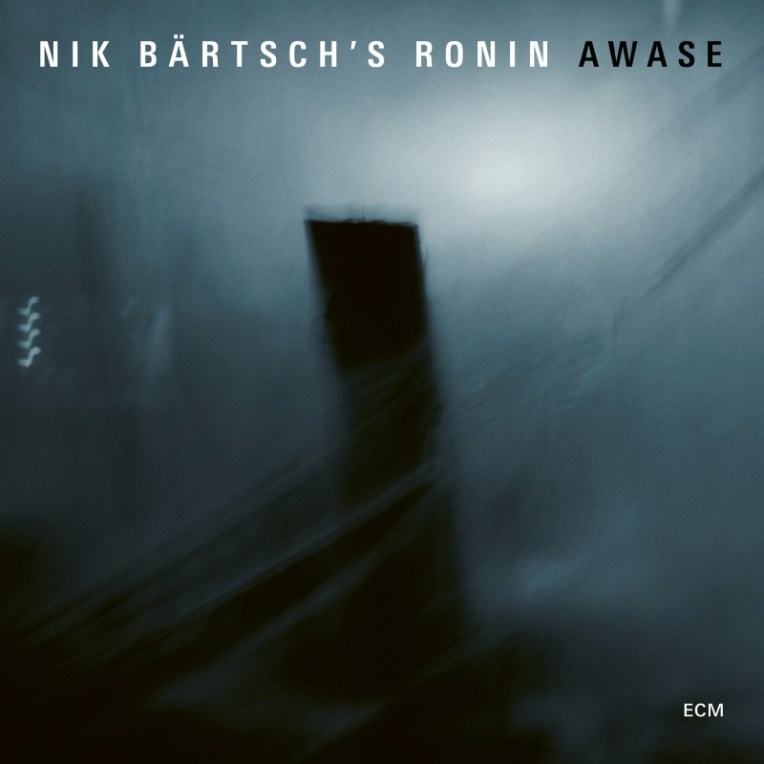
Nik Bärtsch’s Ronin: Awase (ECM 2603)

Awase

Nik Bärtsch’s Ronin
Awase

Nik Bärtsch piano
Sha bass clarinet, alto saxophone
Thomy Jordi bass
Kaspar Rast drums
Recorded October 2017, Studios La Buissonne, Pernes-les-Fontaines
Engineers: Gérard de Haro and Nicolas Baillard
Produced by Manfred Eicher
U.S. release date: May 4, 2018

The booklet for Awase, Swiss pianist Nik Bärtsch’s latest release with his band of Ronin, quotes French theorist Roland Barthes: “The sign is a fracture which only ever opens onto the face of another sign.” Perhaps no other statement better expresses the fractal nature of this music, for the more one zooms in on its precisions, the more one senses its freedoms expand. Joined by Sha (bass clarinet and alto saxophone), Kaspar Rast (drums) and newest recruit Thomy Jordi (bass), Bärtsch finds himself rooted in a familiar ethos while sprouting new verdure.

The album continues his “modular” approach, by which larger bodies coalesce from elemental forces. The newest of these, “Modul 60” and “Modul 59,” open and close the album with hints of a concentrated future. Where the latter emotes in liminal territory, the former is a direct link to Continuum, Bärtsch’s previous record for ECM with his Mobile project. Any nods to the past, however, are refracted through a brighter coming of age: a sound that once ran now leaps. The ritual groove of “Modul 58,” for instance, is at once what we might expect and a fresher take on group integration, a taste of perpetual motion shown in the band’s willingness to let details express themselves to the level of ecstasy. “Modul 36” reveals the deepest change; known to any longtime listener of Bärtsch, here it takes on the uniformly colored properties that would seem to extend the band’s evolutionary path. It’s a classic yet forward-thinking groove, one that feels like a childhood home renovated from the inside out. “Modul 34” is another early tune, only now making its studio debut. There’s an almost digital quality to it, nuanced by human touch.

Awase is also a departure for including a non-Bärtsch original by Sha: the enigmatically titled “A.” Gradually building an ocean out of a water droplet, its waves flow to the magnetic suggestions of an itinerant philosophical compass. Like the album as a whole, it toes the line between light and shadow with every intention of shedding its ego to both along (and by) the way.

(This article originally appeared in the May 2018 issue of The New York City Jazz Record, a full PDF of which is available here.)

ECM by the Decades: The 1990s

On April 9, 2018, WKCR DJ Andrew Castillo and I presented the third in our five-part series, “ECM by the Decades,” focusing this time on the 1990s. The episode is now available to listen by clicking the PLAY button below. You may also download the full episode by clicking here. Scroll down for a full playlist, including links to my reviews of each album:

LEAD-IN
Jan Garbarek
RITES (ECM 1685/86)
“Rites”

[INTRO @ 00:08:25]

00:15:02
Kenny Wheeler Quintet
The Widow In The Window (ECM 1417)
“Ma Belle Hélène”

00:23:42
Dino Saluzzi Group
Mojotoro (ECM 1447)
“Lustrin”

00:30:00
Don Cherry
Dona Nostra (ECM 1448)
“What Reason Could I Give”

00:33:45
Trevor Watts/Moiré Music Drum Orchestra
Wider Embrace (ECM 1449)
“Southern Memories”

[BREAK @ 00:41:39]

00:45:27
John Surman
Adventure Playground (ECM 1463)
“As If We Knew”

00:52:54
Charles Lloyd
Notes From Big Sur (ECM 1465)
“Requiem”

01:00:54
Arild Andersen/Ralph Towner
If You Look Far Enough (ECM 1493)
“For All We Know”

[BREAK @ 01:04:56]

01:10:30
Peter Erskine/Palle Danielsson/John Taylor
You Never Know (ECM 1497)
“Evans Above”

01:16:48
Bobo Stenson Trio
Reflections (ECM 1516)
“Reflections in D”

01:22:12
Ketil Bjørnstad/David Darling/Terje Rypdal/Jon Christensen
The Sea (ECM 1545)
“The Sea II”

[BREAK @ 01:29:40]

01:33:27
Terje Rypdal
If Mountains Could Sing (ECM 1554)
“The Return Of Per Ulv”

01:38:24
Jack DeJohnette
Dancing With Nature Spirits (ECM 1558)
“Anatolia”

01:50:33
Nils Petter Molvær
Khmer (ECM 1560)
“Access / Song of Sand I”

[BREAK @ 01:56:26]

01:59:33
Jan Garbarek
Visible World (ECM 1585)
“Red Wind”

02:03:21
Misha Alperin
North Story (ECM 1596)
“North Story”

02:08:45
Tomasz Stanko
Leosia (ECM 1603)
“Morning Heavy Song”

[BREAK @ 02:15:23]

02:17:50
Kenny Wheeler
Angel Song (ECM 1607)
“Nicolette”

02:26:19
Ralph Towner
ANA (ECM 1611)
“The Reluctant Bride”

02:30:43
Dino Saluzzi
Cité de la Musique (ECM 1616)
“Gorrión”

[BREAK @ 02:34:02]

02:35:52
Christian Wallumrød Trio
No Birch (ECM 1628)
“The Birch 2”

02:39:00
Charles Lloyd
Voice In The Night (ECM 1674)
“Homage”

02:48:22
Vassilis Tsabropoulos/Arild Andersen/John Marshall
Achirana (ECM 1728)
“Fable”

[CLOSING REMARKS @ 02:56:40]

LEAD-OUT
Arild Andersen
Hyperborean (ECM 1631)
“Patch Of Light I”

ECM by the Decades: The 1980s

On March 12, 2018, WKCR DJ Andrew Castillo and I presented the second in our five-part series, “ECM by the Decades,” focusing this time on the 1980s. The episode is now available to listen by clicking the PLAY button below. You may also download the full episode by clicking hereThere were some microphone issues during my introductory remarks, so the volume is rather low in that portion alone. Scroll down for a full playlist, including links to my reviews of each album:

LEAD-IN
Hajo Weber/Ulrich Ingenbold
Winterreise (ECM 1235)
“Karussell”

[INTRO @ 00:07:24]
(Please excuse the microphone issues here…)

00:11:54
Art Ensemble of Chicago
Full Force (ECM 1167)
“Old Time Southside Street Dance”

00:17:03
Eberhard Weber
Little Movements (ECM 1186)
“‘No Trees?’ He Said”

00:22:03
Rainer Brüninghaus
Freigeweht (ECM 1187)
“Stufen”

00:30:21
Steve Eliovson
Dawn Dance (ECM 1198)
“Venice”

[BREAK @ 00:36:51]

00:43:16
David Darling
Cycles (ECM 1219)
“Cycle Song”

00:50:18
Mike Nock
Ondas (ECM 1220)
“Doors”

00:56:40
Paul Motian Band
Psalm (ECM 1222)
“Psalm”

[BREAK @ 01:03:27]

01:12:15
Dewey Redman Quartet
The Struggle Continues (ECM 1225)
“Joie De Vivre”

01:20:42
Chick Corea
Trio Music (ECM 1232/33)
“Eronel”

01:25:17
Bill Frisell
In Line (ECM 1241)
“Throughout”

[BREAK @ 01:32:04]

01:36:54
Steve Tibbetts
Safe Journey (ECM 1270)
“Test”

01:43:07
Everyman Band
Without Warning (ECM 1290)
“Patterns Which Connect”

01:48:30
Marc Johnson
Bass Desires (ECM 1299)
“Samurai Hee-Haw”

[BREAK @ 01:56:09]

01:59:09
Gary Burton Quintet
Whiz Kids (ECM 1329)
“Yellow Fever”

02:05:52
Enrico Rava/Dino Saluzzi Quintet
Volver (ECM 1343)
“Minguito”

02:17:05
Oregon
Ecotopia (ECM 1354)
“ReDial”

[BREAK @ 02:22:59]

02:27:04
The Paul Bley Quartet
s/t (ECM 1365)
“One In Four”

02:36:31
First House
Cantilena (ECM 1393)
“Cantilena”

02:39:57
Dave Holland Quartet
Extensions (ECM 1410)
“The Oracle”

ECM by the Decades: Second Installment Tonight

Please join me and host Andrew Castillo tonight on WKCR’s Jazz Alternatives program, from 6-9pm EST. We’re continuing where we left off, exploring some hidden (and some not-so-hidden) gems of the ECM catalog from the 1980s. Click the logo below to be directed to the WKCR website, where you will find more information about tonight’s program, and where you may stream us live by clicking the “LISTEN” icon on the top-right corner of the screen. Note: there will be no fundraising interruptions this time around, so listen with confidence! And even if you’re unable to tune in, we will be archiving the program here for future streaming and downloads.

WKCR

ECM by the Decades: Upcoming Shows

Thank you all who tuned in for my first of four “ECM by the Decades” radio shows on WKCR. Host Andrew Castillo and I will continue our saga through the label on March 12, April 9, and April 23. For those of you who joined us live during the first show, you will be pleased to know that the station’s fundraising efforts for this cycle are complete and that our show will no longer be interrupted. I am grateful for your patience the first time around. We’ll be on the air next Monday from 6-9pm EST, streamling live on the station website here. A podcast version will also appear on this website soon thereafter.

ECM by the Decades: The 1970s

On February 26, 2018, WKCR DJ Andrew Castillo and I presented the first in our five-part series, “ECM by the Decades.” The inaugural episode is now available to listen by clicking the PLAY button below. You may also download the full episode by clicking here. Scroll down for a full playlist, including links to my reviews of each album:

LEAD-IN
Barre Phillips
Mountainscapes (ECM 1076)
“Mountainscape VII”

[INTRO @ 00:03:18]

00:11:02
The Music Improvisation Company
s/t (ECM 1005)
“Dragon Path”

00:21:22
Stenson/Andersen/Christensen
Underwear (ECM 1012)
“Underwear”

00:28:57
Gary Burton
The New Quartet (ECM 1030)
“Mallet Man”

00:36:06
Ralph Towner
Diary (ECM 1032)
“Icarus”

00:42:18
Bennie Maupin
The Jewel In The Lotus (ECM 1043)
“Past Is Past”

00:46:09
John Abercrombie
Timeless (ECM 1047)
“Red And Orange”

00:51:31
Steve Kuhn
Trance (ECM 1052)
“Trance”

[BREAK @ 00:57:24]

01:01:58
Arild Andersen
Clouds In My Head (ECM 1059)
“305 W 18 St”

01:05:46
Collin Walcott
Cloud Dance (ECM 1062)
“Prancing”

01:09:08
Enrico Rava
The Pilgrim And The Stars (ECM 1063)
“Parks”

01:10:53
Tomasz Stanko
Balladyna (ECM 1071)
“First Song”

01:18:32
Edward Vesala
Nan Madol
(ECM 1077)
“Areous Vlor Ta”

01:31:14
Jack DeJohnette
Pictures (ECM 1079)
“Picture 6”

[BREAK @ 01:39:06]

01:44:02
Jack DeJohnette
New Rags (ECM 1103)
“Steppin’ Thru”

01:54:25
Art Lande and Rubisa Patrol
Desert Marauders (ECM 1106)
“Livre (Near The Sky)”

01:58:14
Bill Connors
Of Mist And Melting (ECM 1120)
“Café Vue”

02:04:15
Miroslav Vitous
First Meeting (ECM 1145)
“Silver Lake”

02:14:39
Sam Rivers
Contrasts (ECM 1162)
“Zip”

[CLOSING REMARKS @ 02:19:17]

“ECM by the Decades” on WKCR

Please join me and host Andrew Castillo tonight on WKCR’s Jazz Alternatives program, where I’ll be your guest for five shows to present “ECM by the Decades.” Each program has been specially curated by myself to reflect the more obscure and hidden gems of the ECM catalog, decade by decade. Tonight, from 6-9pm EST, we’ll be exploring the label’s formative forays of the 1970s. Click the logo below to be directed to the WKCR website, where you will find more information about tonight’s program, and where you may stream us live by clicking the “LISTEN” icon on the top-right corner of the screen. Even if you’re unable to tune in, we will be archiving the program here for future streaming and downloads.

WKCR

Norma Winstone: Descansado (ECM 2567)

Descansado

Norma Winstone
Descansado

Norma Winstone voice
Glauco Veneier piano
Klaus Gesing soprano saxophone, bass clarinet
Helge Andreas Norbakken percussion
Mario Brunello violoncello
Recorded March 2017, ArteSuono Studio, Udine
Engineer: Stefano Amerio
Produced by Manfred Eicher

Vocalist Norma Winstone returns to ECM with pianist Glauco Venier and reedplayer Klaus Gesing to explore the relationship between song and cinema. Interpreting the scores of Legrand, Rota and Morricone, among others, and referencing such filmmakers as Godard, Fellini and Scorsese, the result is a collection of moving images in and of itself.

Winstone’s penchant for moody arrangements and organic insights into the human condition shares the silver screen’s existential concerns. Said concerns are made explicit as her trio, joined by percussionist Helge Andreas Norbakken and cellist Mario Brunello, flip through the pages of the human heart. The power of memory to shape how we live and love is a central theme. Whether toeing the line between past and future in “Il Postino” or weaving through the corridors of yearning in “Amarcord (I Remember),” Winstone’s voice knows where it stands at any given moment. Thus, “What Is A Youth?” and the opening “His Eyes, Her Eyes” set the tone for a plaintive emotional experience, like a dark filter placed over the lens of the mind through which she captures parries of affection.

Winstone’s musicians soliloquize the finer implications of her sentiment. Norbakken and Brunello add points and lines, respectively, setting the scene for every story, while Venier populates those backdrops with extras. Gesing, alternating between soprano saxophone and bass clarinet, is a protagonist on par with Winstone, responding to her every move in dialogic fashion. Four tracks in which Winstone sings wordlessly further highlight these infrastructural relationships. Of these, the jig-like comportment of “Meryton Town Hall” comes as a welcome splash of Technicolor in an otherwise noir-ish program.

Lyrically, too, this record stands out within an already-distinguished discography. Beginning with the title song, one of six for which Winstone penned her own words, and continuing on through to “So Close To Me Blues” (her take on the theme from Taxi Driver), she demonstrates a keen understanding of the magnitude of intimacy, thereby providing shelter for any soul craving refuge from its weary transit.

(This review originally appeared in the March 2018 issue of The New York City Jazz Record, a full PDF of which is available here.)

Ben Monder: Amorphe (ECM 2421)

Amorphae

Ben Monder
Amorphae

Ben Monder electric guitar, electric baritone guitar, Fender Bass VI
Pete Rende synthesizer
Andrew Cyrille drums
Paul Motian drums
“Oh, What a Beautiful Morning,” “Triffids,” and “Dinosaur Skies” recorded October 2010 at Sear Sound
Engineer: James A. Farber
“Tendrils,” “Tumid Cenobite,” “Gamma Crucis,” “Zythum,” and “Hematophagy” recorded December 2013 at Brooklyn Recording
Engineer: Rick Kwan
Mixing Engineer: Rick Kwan
Produced by Sun Chung
U.S. release date: October 30, 2015

For his ECM leader debut, New York guitarist Ben Monder brings his improvisational destinations to fruition with respect for every musical step in reaching them. The album’s circle is opened and closed by two solo arcs: “Tendrils” and “Dinosaur Skies.” Where the former comes out of the woodwork as if after a long and melodic hibernation, the latter is a dragon’s breath turned into music.

Constellations fill the spectrum between as Monder sings through a variety of guitars and tunings. “Gamma Crucis” and “Zythum” triangulate with Pete Rende on synthesizer and Andrew Cyrille on drums. Both pieces are geological surveys of highest order. Monder and Rende release so much likeminded stardust, it’s all they can do to clarify that they’re two nebulae working independently of time. Cyrille’s tracery is the dark matter between them, a dimension in which concrete rhythms have no gravity.

Guitarist and drummer make art as duo on “Hematophagy” and “Tumid Cenobite.” In the absence of electronics, their language feels closer to home, each his own weather front blending into collaboration. Although the landscape below them is desolate, it wavers with memories of rivers and greenery. Monder’s stirrings are like those of a creature in the leaves of Cyrille’s reforesting. With each sunrise, they dissolve dust into breathable air.

Monder Trio

Poignantly, late drummer Paul Motian joins Monder for two further duets. First is a starlit take on the Rodgers and Hammerstein classic “Oh, What a Beautiful Morning.” It’s beautiful indeed to hear Motian’s brushes, pulled as if from beyond some mortal curtain, springing to vibrant life of their own impulse. There’s something fully alive about this music—not only because of the tune, but also because of the way it rolls off the musicians’ proverbial tongues like a psalm. Recognition is not a precondition for enjoyment, however, as Monder’s ambience forges new relationships using familiar actors. His searing explosions make steam of ocean water, leaving lost cities exposed to sunlight for the first time in eons. Then there is “Triffids,” a spontaneous blush of tenderness that eludes capture by microphone and digitization. It is, rather, a force that knows us before we may consciously seek it out in the listening. Motian’s feel for internal rhythm is profound.

Motian

Monder navigates the paths before him with confidence because he defines them as he goes along. Leaving behind uncertainty, he uses gentility as fuel for a strong spirit. It’s perhaps no coincidence that the track titles recall the histrionic wordplay of the Cocteau Twins, for with likeminded boldness he does away with consensus articulations in favor of the emotional resonances beneath.