

Please note that there will be no “ECM by the Decades” show as originally scheduled on March 26. The last two shows have been rescheduled for April 9 (covering the 1990s) and May 7 (covering the 2000s). The reason for this change is actually ECM-related, as that night I’ll be covering the John Abercrombie tribute concert in New York City for All About Jazz. Stay tuned, on all fronts!
ECM Records
ECM by the Decades: The 1980s
On March 12, 2018, WKCR DJ Andrew Castillo and I presented the second in our five-part series, “ECM by the Decades,” focusing this time on the 1980s. The episode is now available to listen by clicking the PLAY button below. You may also download the full episode by clicking here. There were some microphone issues during my introductory remarks, so the volume is rather low in that portion alone. Scroll down for a full playlist, including links to my reviews of each album:
LEAD-IN
Hajo Weber/Ulrich Ingenbold
Winterreise (ECM 1235)
“Karussell”
[INTRO @ 00:07:24]
(Please excuse the microphone issues here…)
00:11:54
Art Ensemble of Chicago
Full Force (ECM 1167)
“Old Time Southside Street Dance”
00:17:03
Eberhard Weber
Little Movements (ECM 1186)
“‘No Trees?’ He Said”
00:22:03
Rainer Brüninghaus
Freigeweht (ECM 1187)
“Stufen”
00:30:21
Steve Eliovson
Dawn Dance (ECM 1198)
“Venice”
[BREAK @ 00:36:51]
00:43:16
David Darling
Cycles (ECM 1219)
“Cycle Song”
00:50:18
Mike Nock
Ondas (ECM 1220)
“Doors”
00:56:40
Paul Motian Band
Psalm (ECM 1222)
“Psalm”
[BREAK @ 01:03:27]
01:12:15
Dewey Redman Quartet
The Struggle Continues (ECM 1225)
“Joie De Vivre”
01:20:42
Chick Corea
Trio Music (ECM 1232/33)
“Eronel”
01:25:17
Bill Frisell
In Line (ECM 1241)
“Throughout”
[BREAK @ 01:32:04]
01:36:54
Steve Tibbetts
Safe Journey (ECM 1270)
“Test”
01:43:07
Everyman Band
Without Warning (ECM 1290)
“Patterns Which Connect”
01:48:30
Marc Johnson
Bass Desires (ECM 1299)
“Samurai Hee-Haw”
[BREAK @ 01:56:09]
01:59:09
Gary Burton Quintet
Whiz Kids (ECM 1329)
“Yellow Fever”
02:05:52
Enrico Rava/Dino Saluzzi Quintet
Volver (ECM 1343)
“Minguito”
02:17:05
Oregon
Ecotopia (ECM 1354)
“ReDial”
[BREAK @ 02:22:59]
02:27:04
The Paul Bley Quartet
s/t (ECM 1365)
“One In Four”
02:36:31
First House
Cantilena (ECM 1393)
“Cantilena”
02:39:57
Dave Holland Quartet
Extensions (ECM 1410)
“The Oracle”
ECM by the Decades: Second Installment Tonight
Please join me and host Andrew Castillo tonight on WKCR’s Jazz Alternatives program, from 6-9pm EST. We’re continuing where we left off, exploring some hidden (and some not-so-hidden) gems of the ECM catalog from the 1980s. Click the logo below to be directed to the WKCR website, where you will find more information about tonight’s program, and where you may stream us live by clicking the “LISTEN” icon on the top-right corner of the screen. Note: there will be no fundraising interruptions this time around, so listen with confidence! And even if you’re unable to tune in, we will be archiving the program here for future streaming and downloads.

ECM by the Decades: Upcoming Shows
Thank you all who tuned in for my first of four “ECM by the Decades” radio shows on WKCR. Host Andrew Castillo and I will continue our saga through the label on March 12, April 9, and April 23. For those of you who joined us live during the first show, you will be pleased to know that the station’s fundraising efforts for this cycle are complete and that our show will no longer be interrupted. I am grateful for your patience the first time around. We’ll be on the air next Monday from 6-9pm EST, streamling live on the station website here. A podcast version will also appear on this website soon thereafter.
ECM by the Decades: The 1970s
On February 26, 2018, WKCR DJ Andrew Castillo and I presented the first in our five-part series, “ECM by the Decades.” The inaugural episode is now available to listen by clicking the PLAY button below. You may also download the full episode by clicking here. Scroll down for a full playlist, including links to my reviews of each album:
LEAD-IN
Barre Phillips
Mountainscapes (ECM 1076)
“Mountainscape VII”
[INTRO @ 00:03:18]
00:11:02
The Music Improvisation Company
s/t (ECM 1005)
“Dragon Path”
00:21:22
Stenson/Andersen/Christensen
Underwear (ECM 1012)
“Underwear”
00:28:57
Gary Burton
The New Quartet (ECM 1030)
“Mallet Man”
00:36:06
Ralph Towner
Diary (ECM 1032)
“Icarus”
00:42:18
Bennie Maupin
The Jewel In The Lotus (ECM 1043)
“Past Is Past”
00:46:09
John Abercrombie
Timeless (ECM 1047)
“Red And Orange”
00:51:31
Steve Kuhn
Trance (ECM 1052)
“Trance”
[BREAK @ 00:57:24]
01:01:58
Arild Andersen
Clouds In My Head (ECM 1059)
“305 W 18 St”
01:05:46
Collin Walcott
Cloud Dance (ECM 1062)
“Prancing”
01:09:08
Enrico Rava
The Pilgrim And The Stars (ECM 1063)
“Parks”
01:10:53
Tomasz Stanko
Balladyna (ECM 1071)
“First Song”
01:18:32
Edward Vesala
Nan Madol (ECM 1077)
“Areous Vlor Ta”
01:31:14
Jack DeJohnette
Pictures (ECM 1079)
“Picture 6”
[BREAK @ 01:39:06]
01:44:02
Jack DeJohnette
New Rags (ECM 1103)
“Steppin’ Thru”
01:54:25
Art Lande and Rubisa Patrol
Desert Marauders (ECM 1106)
“Livre (Near The Sky)”
01:58:14
Bill Connors
Of Mist And Melting (ECM 1120)
“Café Vue”
02:04:15
Miroslav Vitous
First Meeting (ECM 1145)
“Silver Lake”
02:14:39
Sam Rivers
Contrasts (ECM 1162)
“Zip”
[CLOSING REMARKS @ 02:19:17]
“ECM by the Decades” on WKCR
Please join me and host Andrew Castillo tonight on WKCR’s Jazz Alternatives program, where I’ll be your guest for five shows to present “ECM by the Decades.” Each program has been specially curated by myself to reflect the more obscure and hidden gems of the ECM catalog, decade by decade. Tonight, from 6-9pm EST, we’ll be exploring the label’s formative forays of the 1970s. Click the logo below to be directed to the WKCR website, where you will find more information about tonight’s program, and where you may stream us live by clicking the “LISTEN” icon on the top-right corner of the screen. Even if you’re unable to tune in, we will be archiving the program here for future streaming and downloads.
Ben Monder: Amorphe (ECM 2421)

Ben Monder
Amorphae
Ben Monder electric guitar, electric baritone guitar, Fender Bass VI
Pete Rende synthesizer
Andrew Cyrille drums
Paul Motian drums
“Oh, What a Beautiful Morning,” “Triffids,” and “Dinosaur Skies” recorded October 2010 at Sear Sound
Engineer: James A. Farber
“Tendrils,” “Tumid Cenobite,” “Gamma Crucis,” “Zythum,” and “Hematophagy” recorded December 2013 at Brooklyn Recording
Engineer: Rick Kwan
Mixing Engineer: Rick Kwan
Produced by Sun Chung
U.S. release date: October 30, 2015
For his ECM leader debut, New York guitarist Ben Monder brings his improvisational destinations to fruition with respect for every musical step in reaching them. The album’s circle is opened and closed by two solo arcs: “Tendrils” and “Dinosaur Skies.” Where the former comes out of the woodwork as if after a long and melodic hibernation, the latter is a dragon’s breath turned into music.
Constellations fill the spectrum between as Monder sings through a variety of guitars and tunings. “Gamma Crucis” and “Zythum” triangulate with Pete Rende on synthesizer and Andrew Cyrille on drums. Both pieces are geological surveys of highest order. Monder and Rende release so much likeminded stardust, it’s all they can do to clarify that they’re two nebulae working independently of time. Cyrille’s tracery is the dark matter between them, a dimension in which concrete rhythms have no gravity.
Guitarist and drummer make art as duo on “Hematophagy” and “Tumid Cenobite.” In the absence of electronics, their language feels closer to home, each his own weather front blending into collaboration. Although the landscape below them is desolate, it wavers with memories of rivers and greenery. Monder’s stirrings are like those of a creature in the leaves of Cyrille’s reforesting. With each sunrise, they dissolve dust into breathable air.

Poignantly, late drummer Paul Motian joins Monder for two further duets. First is a starlit take on the Rodgers and Hammerstein classic “Oh, What a Beautiful Morning.” It’s beautiful indeed to hear Motian’s brushes, pulled as if from beyond some mortal curtain, springing to vibrant life of their own impulse. There’s something fully alive about this music—not only because of the tune, but also because of the way it rolls off the musicians’ proverbial tongues like a psalm. Recognition is not a precondition for enjoyment, however, as Monder’s ambience forges new relationships using familiar actors. His searing explosions make steam of ocean water, leaving lost cities exposed to sunlight for the first time in eons. Then there is “Triffids,” a spontaneous blush of tenderness that eludes capture by microphone and digitization. It is, rather, a force that knows us before we may consciously seek it out in the listening. Motian’s feel for internal rhythm is profound.

Monder navigates the paths before him with confidence because he defines them as he goes along. Leaving behind uncertainty, he uses gentility as fuel for a strong spirit. It’s perhaps no coincidence that the track titles recall the histrionic wordplay of the Cocteau Twins, for with likeminded boldness he does away with consensus articulations in favor of the emotional resonances beneath.
Sokratis Sinopoulos Quartet: Eight Winds (ECM 2407)

Sokratis Sinopoulos Quartet
Eight Winds
Sokratis Sinopoulos lyra
Yann Keerim piano
Dimitris Tsekouras bass
Dimitris Emmanouil drums
Recorded April 2014 at Sierra Studios, Athens
Engineer: Giorgos Karyotis
Produced by Manfred Eicher
U.S. release date: January 15, 2016
Sokratis Sinopoulos is a master of the lyra, a bowed instrument whose lilt has polished a handful of ECM gems, including soundtracks of Greek composer Eleni Karaindrou (notably, The Weeping Meadow) and the Athens Concert of Charles Lloyd and Maria Farantouri. Despite its small size, the lyra is capable of painting holistic landscapes, and none so sweeping as those at Sinopoulos’s touch. After years of being a vital yet overshadowed sideman, Eight Winds finds the virtuoso making his debut as leader. Although the lyra comes preloaded with centuries of tradition, the music produced by the quartet assembled here— rounded out by pianist Yann Keerim, bassist Dimitris Tsekouras, and drummer Dimitris Emmanuel—is resolutely forward-looking. For this recording, as special in the listening as it was in the making, I sense a unity of purpose beating in the hearts of everyone involved. This is demonstrated by the album’s title alone, which charts not only the cardinal directions, but also the twin cross bisecting them. In each of the album’s 12 original tunes, the navigational freedom of those winds is palpable.
The title track opens with the bandleader’s distinctive sound. His lyra, as obvious to anyone tasked with analogizing it, has a distinctly vocal quality. Even before the jazz trio configuration in which Sinopoulos has situated himself becomes apparent, like a singer he has tasted the theme at hand and savored it to the brink of dissolution. All I can find myself thinking while absorbing the results of this collaboration in kind is that this is a first in jazz, an album that only Manfred Eicher and ECM could produce with such integrity of vision.

Much of this album moves at a pace of lives no longer lived. One strain of “Yerma” or “Lyric” is enough to reveal the folk roots feeding each improvisational leaf. Whether interacting with Keerim’s piano or Tsekouras’s bass, Sinopoulos puts his trust at the center. The melodies are so developed that they sound like ancient motifs rescued from obscurity, conjuring up images of a past you never knew was in you. In this respect, “Aegean Sea” is the most inviting tune of the set, if also for depicting an important location for its composer. Emmanuel’s hand-drumming brings it to an even earthier level.
Because the lyra is associated with dancing, tunes like “Street Dance” and “In Circles” inspire and energize. These are balanced buy “21st March” and “Forever,” which take stock of brokenness and find harmonies beneath its dissonant rubble. In both, Sinopoulos shows us just how many feathers his instrument has, while touching on the Byzantine musical interests of his formative years.
His delicacy is artfully supported by his bandmates. At no point do they drown out his whispers (a feat for which both musicians and engineer are praiseworthy). As the title track variation that ends the album, everything that precedes it is a gradient of oneness: an asymptote conquered by faith.
David Virelles: Gnosis (ECM 2526)
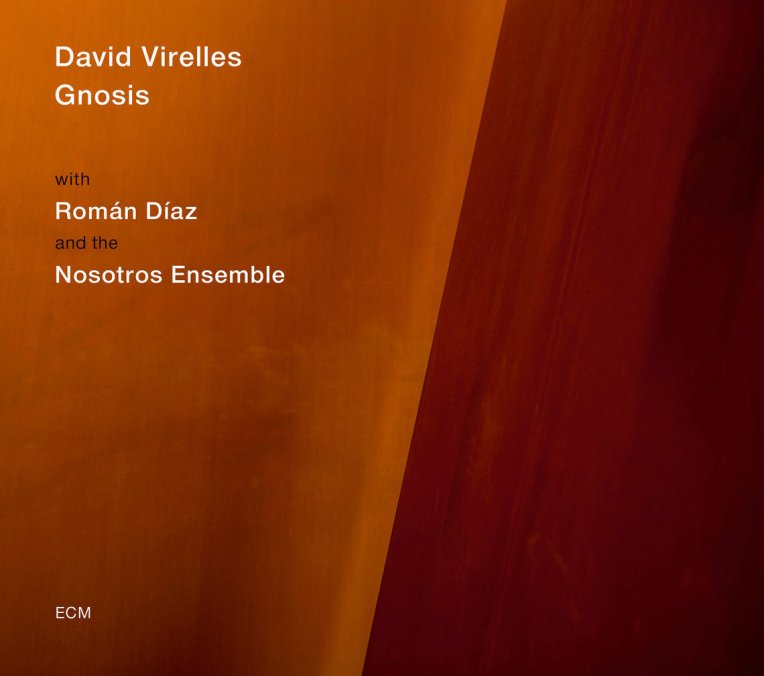
David Virelles
Gnosis
David Virelles understands that to make music of the future, one must delve into the past. Somewhere in the middle we find Gnosis. On his third album as leader for ECM, Virelles polishes the mirror of his Cuban roots, also as a prism of the chamber music sensibilities that informed his training under such composition teachers as Henry Threadgill. One couldn’t dream of a better assembly of musicians than the brotherhood of rhythm makers and guiding voice of poet/percussionist Román Díaz to bring these wonders to fruition. Bassist Thomas Morgan, flutist Allison Loggins-Hull and a modest string section complete the puzzle.
Each of the album’s 18 originals could be the start of another album. In this context, they work as one body. Whether in Virelles’ six solo piano pieces—including lyrical “De Ida y Vuelta I” and delicate “Dos” (arranged by Threadgill)—or in ensemble forays such as “Del Tabaco y el Azúcar” and “Tierra,” Virelles renders every dissonance an initiation into life. His pianism, especially in “Fitití Ñongo,” is ecstatic yet ponderous and speaks of an artist who understands the preciousness of time.
Morgan and Loggins-Hull are key players, balancing the pull and push of anchor and sail. Like a ship, Gnosis indeed needs water to give it purpose, even as those same oceans pose the constant threat of drowning. Virelles’ awareness of this tension sets his music apart by way of an organic postcolonial philosophy. Through it all, Díaz is the voice of land when sky is all we’ve ever known. His call and response in the ambient “Erume Kondó” is one of the profoundest things to grace these ears in a long time and speaks to what Díaz himself calls the “reciprocal language” of secrecy. According to Virelles, the album’s title “in this context refers to an ancient collective reservoir of knowledge.” Here, then, is the light of a star that died long ago but whose patterns are still perceptible, rewoven under a new name as an offering to the unborn.
(This review originally appeared in the January 2018 issue of The New York City Jazz Record, a full PDF of which is available here.)
 Between Sound and Space: ECM Records and Beyond