Jean-Louis Matinier/Kevin Seddiki: Rivages (ECM 2617)

2617 X

Jean-Louis Matinier
Kevin Sedikki
Rivages

Jean-Louis Matinier accordion
Kevin Seddiki guitar
Recorded April 2018, Auditorio Stelio Molo RSI, Lugano
Engineer: Stefano Amerio
Mixed by Lara Persia (engineer) and Manfred Eicher
Produced by Manfred Eicher
Release date: May 29, 2020

Following one of my favorite productions of this century alongside nyckelharpa virtuoso Marco Ambrosini, accordionist Jean-Louis Matinier returns with another duo, this time sharing Lugano’s Auditorio Stelio Molo RSI studio with guitarist Kevin Seddiki. In the past, Matinier has contributed vitally to ECM sessions with Anouar Brahem and Louis Sclavis, but in the here and now of Rivages cultivates some of his most heart-to-heart playing yet. Because this marks Seddiki’s debut for the label, however, many ears will be on him. As a student of guitarist Pablo Márquez, he brings classical precision and emotional fluidity to the program, which draws on ten years of friendship and collaboration. After refining their rapport and repertoire alike, they put together a mix of in-house compositions, improvisations, and arrangements of material they love.

Indeed, love is on tap when the flotation of “Schumannsko” opens its eyes. Its marriage of a Bulgarian folk tune to a theme by Robert Schumann establishes a tone of mutual regard and open-ended communication that sustains itself to the album’s very end. The accordion’s purchase lends itself to the guitar, which itself allows melody to flourish unimpeded by the creeping vines of expectation. Clearly, flow is the default mode for this duo. Other original material upholds such virtues with consistency, illustrating each image, thought, and word with the care of a calligrapher. “Après la pluie,” for one, begins with Matinier drawing air through the bellows without a single note, evoking a breeze after a quiet storm, while Seddiki regards every earthward droplet from its leafy perch. “Rêverie,” for another, builds a conduit between dreaming and waking or, as in “Sous l’horizon,” between childhood and adulthood. The more virtuosic “In C” treats ecstasis not as hedonic pleasure but as a form of communication between realms.

Arrangements of enduring gems, by contrast, show Matinier and Seddiki at their gentlest. Where the traditional “Greensleeves” reveals darker shades and a fresh, jazzy quality, their take on Gabriel Fauré’s “Les berceaux” is an astonishing example of how a relatively straightforward presentation can reveal something new. The same holds true of “La chanson d’Hélène.” This classic song by French film composer Philippe Sarde is transformed. Such is the power of letting things grow until they are mature enough to shine on their own. Even in the duo’s colorful improvisations, of which the retrospective “Miroirs” is a highlight, they recognize the simple yet profound fact that neither an origin nor a destination mean anything without drawing a line of travel between them.
Terje Rypdal: Selected Recordings (:rarum 7)

Rypdal

Terje Rypdal
Selected Recordings
Release date: April 29, 2002

Among the cadre of guitarists gathered beneath ECM’s umbrella, Terje Rypdal stands as a pioneer of Nordic hybridism. His cross-pollination of rock, jazz, and classical influences continues to inspire listeners all these decades later, and a collection like this offers blinks of an eye’s worth of insight into the full scope of his craftsmanship. Having said that, I can lead you through this sequence in confidence that Rypdal himself has chosen for us a worthy discographic pilgrimage.

Of the trifecta referenced above, the most thoroughly represented persona is that of art rocker. Wielding his guitar like an ax in both the proverbial and literal sense, he rightly divides sonic truth from fluff across a spectrum of classic albums. From the representative 14-minute “Silver Bird Is Heading For The Sun” (Whenever I Seem To Be Far Away, 1974), in lockstep with drummer Jon Christensen over Mellotron strings, to the aphoristic “The Curse” (Blue, 1987), with bassist Bjørn Kjellemyr and drummer Audun Kleive, Rypdal takes fearless melodic risks, compressing shadows into a prism through which to shine the distorted light of his guitar. Said guitar sings in “Transition” (Chaser, 1985) and distorts in “Tough Enough” (from his 1971 self-titled debut), but always in a way that listens before it speaks.

On the jazzier side of things, we find him guiding a band of melodic travelers in “Waves” (from the 1978 album of the same name) and forensically examining the horn-laced groove of “Over Birkerot” (Odyssey, 1975) as if his life depended on it. His sweet spot, however, lies somewhere between those two coasts, and reaches its apex in “The Return Of Per Ulv” (If Mountains Could Sing, 1995). More than my all-time favorite Rypdal track, it’s also a giant leap of intuition for ECM’s shaping of his sound. Rypdal is unabashedly lyrical and Kjellemyr’s bass pliant yet unbreakably supportive in a tightrope walk between grunge and beauty. Other liminal spaces to be noted are the cowboy’s funereal dream that is “Mystery Man” (The Singles Collection, 1989) and “Ørnen” (another from Chaser), which stokes Bill Frisell-esque flame with a distinctly Rypdalian kindling.

We encounter Rypdal the bona fide composer via the second movement of his Double Concerto, which was paired with his 5th Symphony on a wonderful 2000 release. Strings and harpsichord add a finely woven carpet beneath Rypdal’s guitar, building to urgency before flowing back into a comfortable baseline.

Like a saddle that must be ridden many times before it is broken in and which molds itself to rider and horse alike, Rypdal’s guitar has been well-traveled and handled to the point of serving as an extension of his body and soul. Only time can know where each ride will take us and how long we will need to get there.

Bill Frisell: Selected Recordings (:rarum 5)

Frisell

Bill Frisell
Selected Recordings
Release date: April 29, 2002

Bill Frisell is one of a few musicians who came into prominence under Manfred Eicher’s purview yet has since gone on to spread his wings over landscapes of other labels. On ECM, however, he produced a body of work that was entirely uncommon, and embodies the :rarum title as much as any artist featured in its roster of compilations. His self-selection of music is as insightful as it is dreamily alive. Such a description could apply across the board, but perhaps nowhere so organically as in his work with drummer Paul Motian. On “Mandeville,” for instance, a cornerstone of 1982’s Psalm, his backwoods charm—cultivated as if in the marshlands of a distant childhood—carries that same fluid charge of Motian’s free associations, as also in the dark river currents of “Introduction” and “India” from 1985’s it should’ve happened a long time ago. The latter’s inclusion of tenor saxophonist Joe Lovano shows just how wide a vista a trio can paint. Other key collaborations include “Singsong” (Wayfarer, 1983) with the Jan Garbarek Group, in which he and the saxophonist intertwine as birds who no longer need to hunt because they are fed by each other’s song, “Kind Of Gentle” with trumpeter Kenny Wheeler in 1997’s Angel Song (one of my all-time favorite ECMs), and “Closer” (Fragments, 1986) with pianist Paul Bley. In these, his guitar sings of the past in the language of the present.

Frisell’s albums as leader find him at his most distilled and hard-won. In this respect, he offers digests of three watershed sessions: 1988’s Lookout For Hope, 1985’s Rambler, and 1983’s solo In Line. The first contains such tender flavor profiles as “Alien Prints” and “Lonesome” and boasts the umami of cellist Hank Roberts. The second shows a grungier side of Frisell in such tracks as “Resistor” and “Tone.” In the third, we envision the surreal beauties of the title track. And while In Line also contains one of his gems, “Throughout,” we find it here not in its original form but as arranged by composer Gavin Bryars, who transformed it into the transcendent chamber piece Sub Rosa on 1994’s Vita Nova. In stretching Frisell’s sense of time to fill an era, offsetting regularity with slightly askew phrases, unexpected turns, and breath-stilling highs, Bryars-via-Frisell proves ECM to be its own ecosystem, filled with carefully planted hybrids thriving in crowning harmony.

Jan Garbarek: Selected Recordings (:rarum 2)

Garbarek

Jan Garbarek
Selected Recordings
Release date: April 29, 2002

After the broad yet intimate selected recordings of Keith Jarrett, it’s only natural that the :rarum series should follow up with another two-disc album from another of its biggest talents: Jan Garbarek. The Norwegian saxophonist and composer has left his fingerprints on many an object in the ECM curio cabinet, and in so doing has gifted listeners with countless hours of creative engagement, ideas, and memories. Indeed, perhaps more than those of most artists on the label, his albums are easily connected to times, places, and experiences for nearly everyone who has followed his career.

One thing that distinguishes this compilation from those that follow it is the abundance of title tracks, as if each were sigil of the past. From the anthemic enmeshments with Keith Jarrett on 1974’s Belonging and 1978’s My Song to his interdisciplinary collaborations with Shankar (Song For Everyone, 1985), Ustad Fateh Ali Khan (Ragas and Sagas, 1992), and Anouar Brahem (Madar, 1994), his saxophone is a cleansing harmonizer. Dominant but never dominating, its echoes carry every message as if it were the last. Like a strip of cloth washed in a river and wrung out to dry in the sun, it changes color in the evaporation process. Other noteworthy titles abound. Personal favorites include 1985’s It’s OK to listen to the gray voice, a timeless theme rendered by David Torn on guitar synthesizer, Eberhard Weber on bass, and Michael DiPasqua on drums that keeps us earthbound by the gentlest of gravities; 1992’s Twelve Moons, in which drummer Manu Katché and percussionist Marilyn Mazur add fire and attunement to one of his most mature melodies; and 1989’s Rosensfole, which elevates his arrangements of folk songs sung by Agnes Buen Garnås. It’s an album so brilliant and relatively neglected in the Garbarek catalog that I almost wish there was more of it here to entice newcomers to its wonders. Seek it out if you haven’t already.

Then again, any Garbarek admirer will know he has always been adept at creating traditions from scratch. Whether weaving himself into the rainforest with guitarist Egberto Gismonti and bassist Charlie Haden in “Cego Aderaldo” (Folk Songs, 1981) or rendering aching parabolas of honest reflection with organist Kjell Johnsen in “Iskirken” (Aftenland, 1980), or even riding the wave of windharp with Ralph Towner on 12-string guitar in “Viddene” (Dis, 1977), his music comes to us fully formed and preloaded with histories of their own. That thread of ancient purpose is woven through “Lillekort” (Eventyr, 1981), a track combining the signatures of percussionist Nana Vaconcelos and guitarist John Abercrombie on mandoguitar, and a turning point in the engineering of Garbarek’s sound. It continues on in “The Path” (Paths, Prints, 1982), a balancing act of sun and shade shared with guitarist Bill Frisell, bassist Eberhard Weber, and drummer Jon Christensen, as well as “Its Name Is Secret Road” and “Aichuri, The Song Man,” both solo excursions documented on 1988’s Legend Of The Seven Dreams. Said thread reaches something of a terminus in Part 1 of the floating “Molde Canticle,” from 1990’s I Took Up The Runes.

This collection offers even more joys for veterans and newcomers alike, such the classical piece “Windsong” (Luminessence, 1975), written by Keith Jarrett and performed with the Stuttgart Südfunk Symphony Orchestra, and the iconic cries of “Skrik & Hyl” (Dansere, 1976), with pianist Bobo Stenson, bassist Palle Danielsson, and drummer Jon Christensen. There’s even a haunting nod to 1991’s StAR with bassist Miroslav Vitous and drummer Peter Erskine.

But the two most important touchstones of my own Garbarek discovery are also to be found in these borders. First is “Parce Mihi Domine” (Officium, 1994). This profound collaboration with the Hilliard Ensemble was my introduction to Garbarek at a time when I was only immersed in ECM’s New Series classical releases, and which compelled me to purchase one of Garbarek’s own albums, Visible World, thus opening the doors to ECM proper. The beginning of that 1996 masterpiece, “Red Wind,” has always been a special one for that reason alone. With barest means—Garbarek on synths and soprano and Mazur on percussion—it meshes beautiful details and unfettered expression and stands as a testament to a relationship between musician and producer that will never be equaled in the hall of mirrors that is our audible universe.

Terje Rypdal: Works

Rypdal

Terje Rypdal
Works
Release date: April 1, 1985

Norwegian guitarist Terje Rypdal almost singlehandedly defined an era with his signature electric sound. While that sound had much to do with his balancing of lyricism and grunge, and of his classical and rock leanings, it was forged in no small way in his compositional foundry. Such eclectic roots were already well-watered by the time of his 1971 self-titled ECM debut, from which “Rainbow” is included in this deserving collection. Joined by Jan Garbarek on flute, Eckehard Fintl on oboe, Arild Andersen on bass, and Jon Christensen on percussion, Rypdal delineates a resonant dream space where symphonies and concertos go to be reborn.

Though the works featured here are not presented in chronological order, it makes sense to do so here. Next in the chain is “The Hunt” (Whenever I Seem To Be Far Away, 1974). This relatively surreal tune marries the Mellotron of Pete Knutsen with the deep digs of bassist Sveinung Hovensjø, while the French horn of Odd Ulleberg exchanges letters of the soul with Rypdal through forested landscapes. Said letters might as well be signed “Better Off Without You” (Odyssey, 1975), in which Rypdal’s delicate arpeggio draws a trajectory through the heat distortion of Brynjulf Blix’s organ. The title track of 1978’s Waves carries over the same Hovensjø/Christensen rhythm section over the uninhabited spaces mapped by Palle Mikkelborg on trumpet and keyboards. Rypdal takes an immaterial rather than physical role, brushing on the atmosphere one shadowy strand at a time.

“Den Forste Sne” references Rypdal’s marvelous 1979 trio album with bassist Miroslav Vitous and drummer Jack DeJohnette. The latter’s call is so bright that it would blind Vitous and Rypdal were it not for their solar responses. “Topplue, Votter & Skjerf,” from the 1981 follow-up To Be Continued, casts Rypdal in a leading role. Like a warrior without armor, he wields only melody and protective instincts. Between those two signposts stretches the hybrid banner of Descendre. With Mikkelborg and Christensen at his side, he digs through clouds like an archaeologist of the ether in “Innseiling” and sings like liquid mercury personified in that 1980 album’s title track. These are, however, but a few of his many facets, all of which are worth exploring in a career that continues to evolve with listeners firmly in mind.

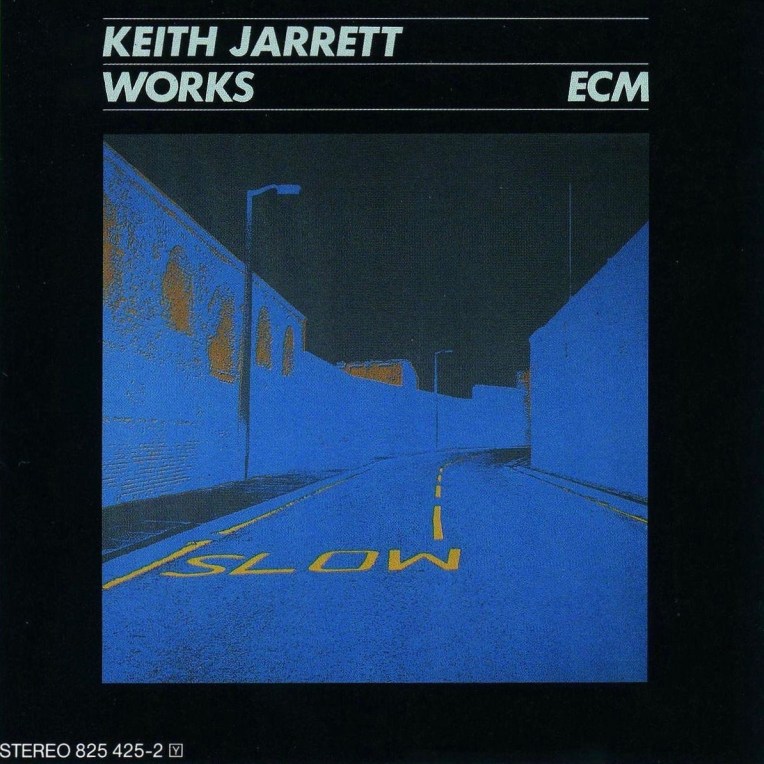
Keith Jarrett: Works

Jarrett

Keith Jarrett
Works
Release date: April 1, 1985

If the artists represented by ECM’s “Works” series so far have been princes, then Keith Jarrett would be candidate for their king. The pianist (and multi-instrumentalist besides), composer, and interpreter continues to chart the most prolific path through the label’s history in solo, trio, and quartet settings, as well as through the lenses of multiple genres. For this compilation, we encounter all of those strands, save for his trio outings, which would warrant a collection in and of itself.

Two tunes from his second European Quartet album, 1978’s My Song, touch our collective soul with a highly individualistic tone. “Country” reinscribes the unrepeatable nature of the band. From the ways in which piano and Jan Garbarek’s tenor saxophone lay down the theme while the rhythm section of bassist Palle Danielsson and drummer Jon Christensen emotes with equal assurance in horizontal (not vertical) relation to the exuberant restraint of Jarrett’s grounding throughout, it’s a tune that feels as much like a farewell as a hello. We then find ourselves walking “The Journey Home.” As Garbarek leads with melodic fortitude, he sets up a welcoming groove of light. Christensen is especially three-dimensional, while Jarrett defers to Garbarek’s charms and really only dominates in the final slowdown.

From that rich soundscape to the wonders of unaccompanied hideaways, we turn to “Ritooria,” from Jarrett’s 1972 ECM debut, Facing You. Like a candle burning in the dark for all who have ears to sense its dancing flame, it holds on to its wick in the left hand while the right flickers erratically yet connectedly. Another lone effort, Staircase, yields Part II of that 1977’s album’s title triptych. If you haven’t already revisited it, let this track remind you of it as one of Jarrett’s finest studio achievements alone at the piano. Like two transparencies of the same image overlapped yet slightly askew, it develops through not-quite-parallel voices, ending in almost ritualistic space. The only live solo selection is “Nagoya Part IIb (Encore)” from 1989’s Sun Bear Concerts. Treading the keyboard as if it were water, Jarrett holds every note in place before finding rest in gentle chords.

Between these relatively direct expressions of personal energy, Jarrett the composer is represented by the 2nd movement of his String Quartet, as performed by the Fritz Sonnleitner Quartet on 1974’s In The Light. Despite being a lovely work in its own right, it feels straightjacketed in its present company. (I might have chosen the beautiful Metamorphosis for flute and strings from that same program instead.) Somewhere in between those two poles of classicalist and improviser is Jarrett’s often-overlooked 1981 masterpiece Invocations/The Moth and the Flame, from which “Invocations (Recognition)” is excerpted. A semi-waltzing rhythm via pipe organ sets up an echoing soprano saxophone, warped and yet flowing in the right direction at any given moment. All of which serves to remind us that we are indeed nothing but moths in the presence of Jarrett’s alluring combustion, struggling to recreate our shape in the air long enough to be regarded as (to reference a much later title) a multitude of angels struggling to record what can never be notated, except on the ephemeral paper of the flesh.

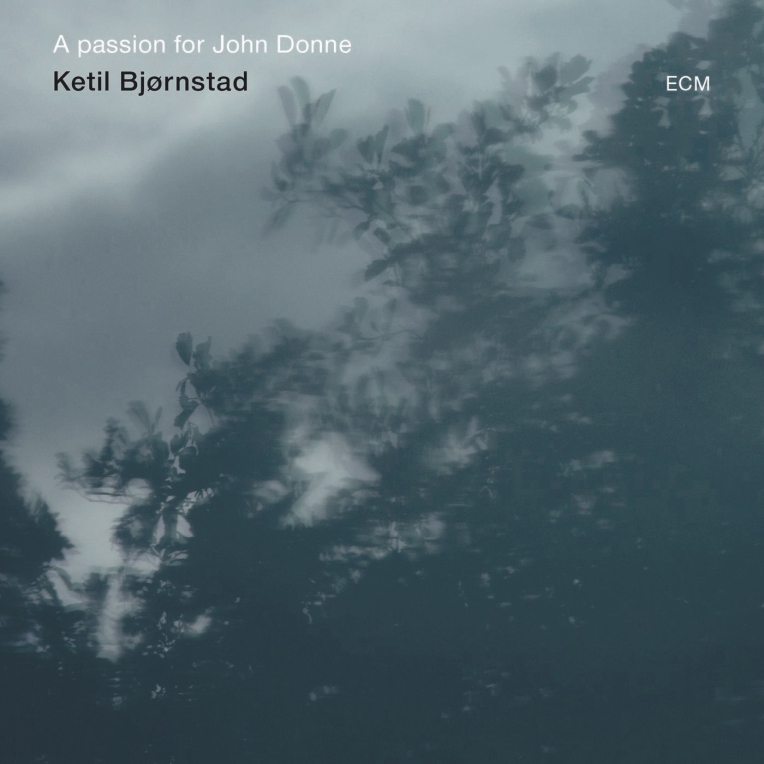
Ketil Bjørnstad: A passion for John Donne (ECM 2394)

2394-front

Ketil Bjørnstad
A passion for John Donne

Håkon Kornstad tenor saxophone, flute, voice
Ketil Bjørnstad piano
Birger Mistereggen percussion
Oslo Chamber Choir
Håkon Daniel Nystedt
conductor
Recorded live March 2012, Sofienberg Kirke, Oslo
at the Oslo International Church Music Festival
Engineer: Jan Erik Kongshaug
An ECM Production
Release date: October 24, 2014

Batter my heart, three-personed God; for, you
As yet but knock, breathe, shine, and seek to men;
That I may rise, and stand, o’erthrow me, and bend
Your force to break, blow, burn, and make me new.

Pianist and composer Ketil Bjørnstad has sailed some of ECM’s purest waters. Yet while many of those journeys have been instrumental, he has with increasing frequency turned to the human voice as a candle from which to exude a melodic glow. True to metaphor, much of 2008’s The Light represented a major engagement with English poet John Donne (1572-1631), whose verses are the backbone of the present recording. Written for the Oslo International Church Festival and given its premiere in March of 2012 (the very performance heard here), Bjørnstad’s A passion for John Donne features Håkon Kornstad (tenor saxophone, flute, voice) in his ECM debut alongside percussionist Birger Mistereggen, the Oslo Chamber Choir under the direction of Håkon Daniel Nystedt, and the composer himself at the keyboard.

An Introitus gradates this hymnal piece into existence with a gong before piano and choir pull back the curtain of night to reveal a dawn-lit choral arrangement of “Thou hast made me.” As Kornstad’s tenor weaves through the undergrowth of these self-reflective intonations, unfolding one wordless implications after another, a silent heart of reverence is illuminated. Kornstad also sings, lending sanctity to “A fever” and “Farewell to love” as Bjørnstad shelters him like a church would a believer.

The writing for choir is sweeping yet intimate, most notably in “Death, be not proud” and “A nocturnal upon St. Lucy’s Day, being the shortest day,” the latter an atmospherically rich tapestry of waning moons and withdrawn souls. “A valediction, forbidden mourning” is another memorable passage, its use of marimba laying a supple path for Kornstad’s reed and voice to wander.

Each poem enacts a laser-focused concentration of mortality, distilling years of life into single words and phrases. This scriptural quality lends itself well to the piece’s concept as a “passion,” which by virtue of its promises of everlasting life through the doorways of death and love gives rise to a grander meaning in the texts. Like the benediction for incorruptible blood with which it ends, its prayerful mold feels more ripe than ever to be filled with our submissive will.

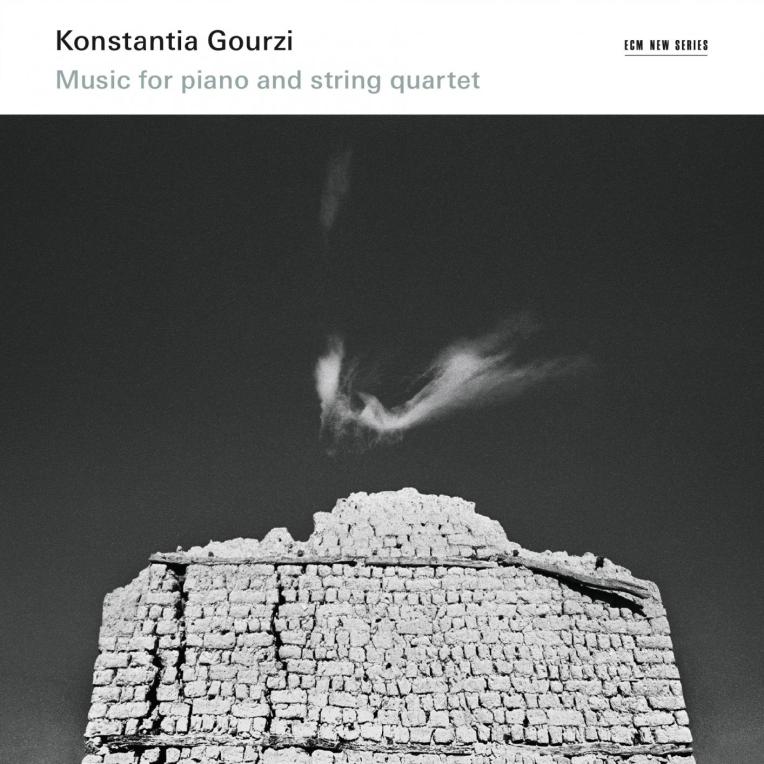
Konstantia Gourzi: Music for piano and string quartet (ECM New Series 2309)

Gourzi

Konstantia Gourzi
Music for piano and string quartet

Lorenda Ramou piano
Ensemble Coriolis
Heather Cottrell
violin
Susanne Pietsch violin
Klaus-Peter Werani viola
Hanno Simons violoncello
Recorded July 2012, Himmelfahrtskirche, Munich
Engineer: Stephan Schellmann
Produced by Manfred Eicher
Release date: October 10, 2014

Greek composer Konstantia Gourzi’s approach to time plus ECM’s approach to space equals the most whole of sonic numbers. Said whole consists of intimate minutiae, each the corner of a photograph otherwise hidden by the downturned palm of history. The transubstantiation of Eine kleine Geschichte, op. 25 (2005) for solo piano epitomizes this feeling of obscurity. Notes fall neither like rain nor like teardrops, but more like a maple copter in slow motion, yearning for the touch of soil. After such a liminal experience, the opening proclamation of the String Quartet No. 2, op. 33/2 (2007) indeed feels like a bear hug of gravity. Titled P-ILION, neun fragmente einer ewigkeit (the latter meaning “nine fragments of eternity”), it is a fitting description of the molecules that inform Gourzi’s atmospheres. A powerful river in which to drop one’s ears like stones, its currents teem with reminiscences and fantasies alike. Whether groveling in a heavenly day or dancing in a pagan night, the sheer breadth of evocation herein is staggering. As the cloth of familiarity frays at the shards of stories yet to be told, this piece elicits a lyricism so deep that it can only end where it began. Moods are darker in the String Quartet No. 1, op. 19 (2004). Bearing the title Israel, it begins with the mortal urgency of Henryk Górecki and the playfulness of Claude Debussy before morphing into a lone voice, orphaned but for its spiritual genealogies traceable back to Abraham’s near-sacrifice.

The program gives us a cross-section of Gourzi’s writing for piano. From the seven miniatures that make up „noch fürcht’ ich”, op. 8 (1993), an early opus that is her first for the instrument alone, to the similarly aphoristic Klavierstücke I-V, op.24 (2004) and the eclectic Aiolos Wind, op. 41 (2010), we encounter jazz, folklore, and hypermodern cartographies. The moment we find something to hold on to, it slips away and offers a substitute made of an entirely different material. When piano and string quartet combine in Vibrato 1, op. 38 (2009/10) and Vibrato 2, op. 38 (2010), Gourzi creates the soundtrack to a tracking shot, one footstep at a time.

I cannot fathom how this album slipped past my radar for so long. Though of only recent discovery, it has already earned a top spot among my favorite New Series discs. And while these compositions may sit comfortably beside those of György Kurtág and Helmut Lachenmann, there’s something distinct about Gourzi that is to be found not in her last name but in her first. Konstantia, which means “steadfastness,” is precisely the quality of which her music is possessed, moving ever forward as a way of polishing us like mirrors held up to the past.

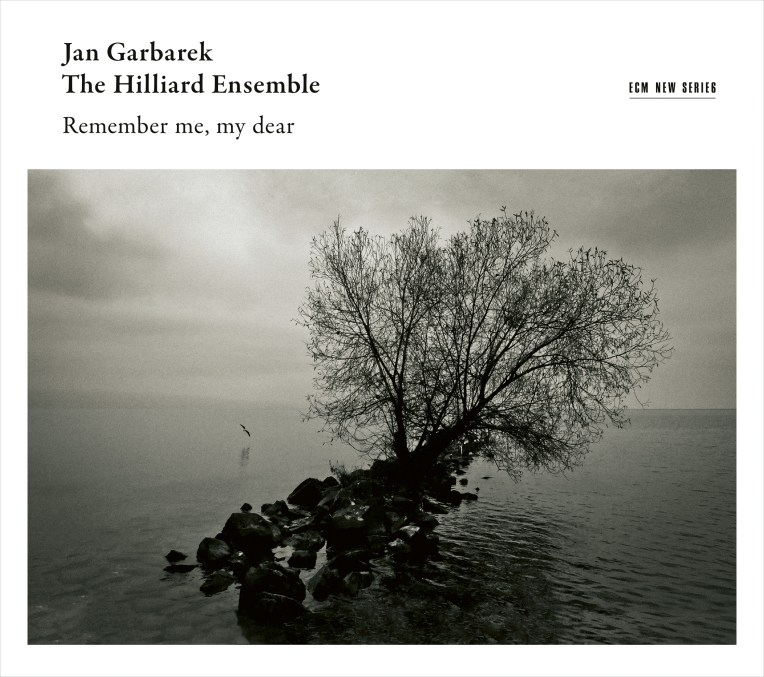
Jan Garbarek/The Hilliard Ensemble: Remember me, my dear (ECM New Series 2625)

2625 X

Jan Garbarek
The Hilliard Ensemble
Remember me, my dear

The Hilliard Ensemble
David James
countertenor
Rogers Covey-Crump tenor
Steven Harrold tenor
Gordon Jones baritone
Jan Garbarek soprano saxophone
Concert recording, October 2014
Chiesa della Collegiata dei SS. Pietro e Stefano,
Bellinzona (Switzerland)
In the series “Tra jazz e nuove musiche”
by Paolo Keller for RSI Rete Due
Tonmeister: Michael Rast
Engineer: Lara Persia
Mixed at Auditorio Stelio Molo RSI, Lugano
by Manfred Eicher and Michael Rast
Produced by Manfred Eicher
Release date: October 18, 2019

When the Hilliard Ensemble and saxophonist Jan Garbarek first recorded for ECM in 1993, they opened as many—if not more—forces than they joined. It was a collaboration not only between each other, but also between them and engineer Peter Laenger, the Austrian monastery of St. Gerold, and producer Manfred Eicher, whose vision was so attuned to the possibility of it all that he would seem to have heard it in his head before those five breaths intertwined in reality. Twenty-five years after the release of their self-titled debut, the Officium project resurfaces with this document of their final performance in 2014.

The roots of this program’s oldest branches may be traced to the soil of past albums. In the opening “Ov zarmanali,” a hymn of Christ’s baptism by Komitas that was likewise our doorway into Officium Novum, Garbarek’s keening soprano is unmistakable in shape and color. In this setting he plays with the decay of notes, sharing more with sitar virtuosos than other reed players and taking into account every incidental effect as physical material for expression. It is the Hilliards, then, who enter into his delineation—not the other way around—and who plow a field just as ancient in preparation of a hybrid crop unlike any other. This progression is reversed in “Procurans odium,” one among a handful of anonymous medieval pieces that finds its seeds, split with time, restored in the nourishment of resuscitation. Garbarek’s role is nevertheless fully dimensional, drawing out from within rather than applying from without. Other unattributable turns, such as the wondrously ambient “Procedentum sponsum” and more lilting “Dostoino est,” speak to the power of memory. And in the “Sanctus,” not heard since their debut, we find a folding inward rather than expansion of concept.

Beyond the category of performer, Garbarek’s contributions fall under composer and arranger, finding solace all the same in this sanctuary. In the latter vein is “Allting finns,” wherein his exploratory nature is particularly evident, as one can feel Garbarek roaming the church in search of stone and warmth, while his setting of the Passamaquoddy poem “We are the stars” draws an unbreakable thread from one corner of the earth to another, likewise itinerant in spirit.

From the liturgical, as in the light-through-stained-glass effect of Nikolai N. Kedrov’s “Litany,” to the repentant shading of Guillaume le Rouge’s “Se je fayz deuil” (gazing back to Mnemosyne), the vocal nature of Garbarek’s saxophone and the reed-like qualities of the Hilliards have perhaps never been so dimensionally interchangeable. For even when the saxophone is absent, as in a most intimate rendition of Arvo Pärt’s “Most Holy Mother of God,” its soul lingers—a dream upon waking. The effect is such that, even when turning the brittle pages of more familiar material, like the “Alleluia nativitas” of Pérotin or the “O ignis spiritus” of Hildegard von Bingen, we are welcomed in the spirit of newness. And so, in the 16th-century Scottish folk song we find more than a title, but a poignant reminder that our minds are at once the tenderest and most robust vessels for honoring the past. For how can we not remember the impact this quintet has made on modern music, and the love with which listeners will continue to fill its crater for ages to come?